
Life, 1907-12-05 · page 37 of 68
Life — December 5, 1907 — page 37: what you’re looking at
What you’re looking at
**"King Pierpont"** is a satirical poem about J.P. Morgan (nicknamed "Pierpont"), the powerful financier. "Wall Street" (personified as a mischievous child) causes chaos by "pricking" the Trusts—Morgan's business monopolies—with a pin. When the Trusts scatter and panic spreads through the kingdom, only Morgan's gold can restore order, saving his favorite subject (Wall Street itself). The satire criticizes how Morgan's wealth and financial manipulation control the nation's economy and stability. A small disruption causes massive chaos, yet throwing money at the problem fixes everything—mocking both Morgan's power and the era's financial instability. **"The Joys of Censorship"** discusses English theater censorship under official censor Mr. Redford. Playwright Edward Garnett's play "The Breaking Point" was banned despite being accepted by a theater manager. Garnett published it publicly and questioned whether it was actually immoral. The article criticizes Redford's secretive, paternalistic censorship while mocking his offense at being publicly challenged.
📄 Transcribed text from this page (OCR, searchable)
Machine-transcribed from the original scan — historical spelling and the odd misread are preserved.
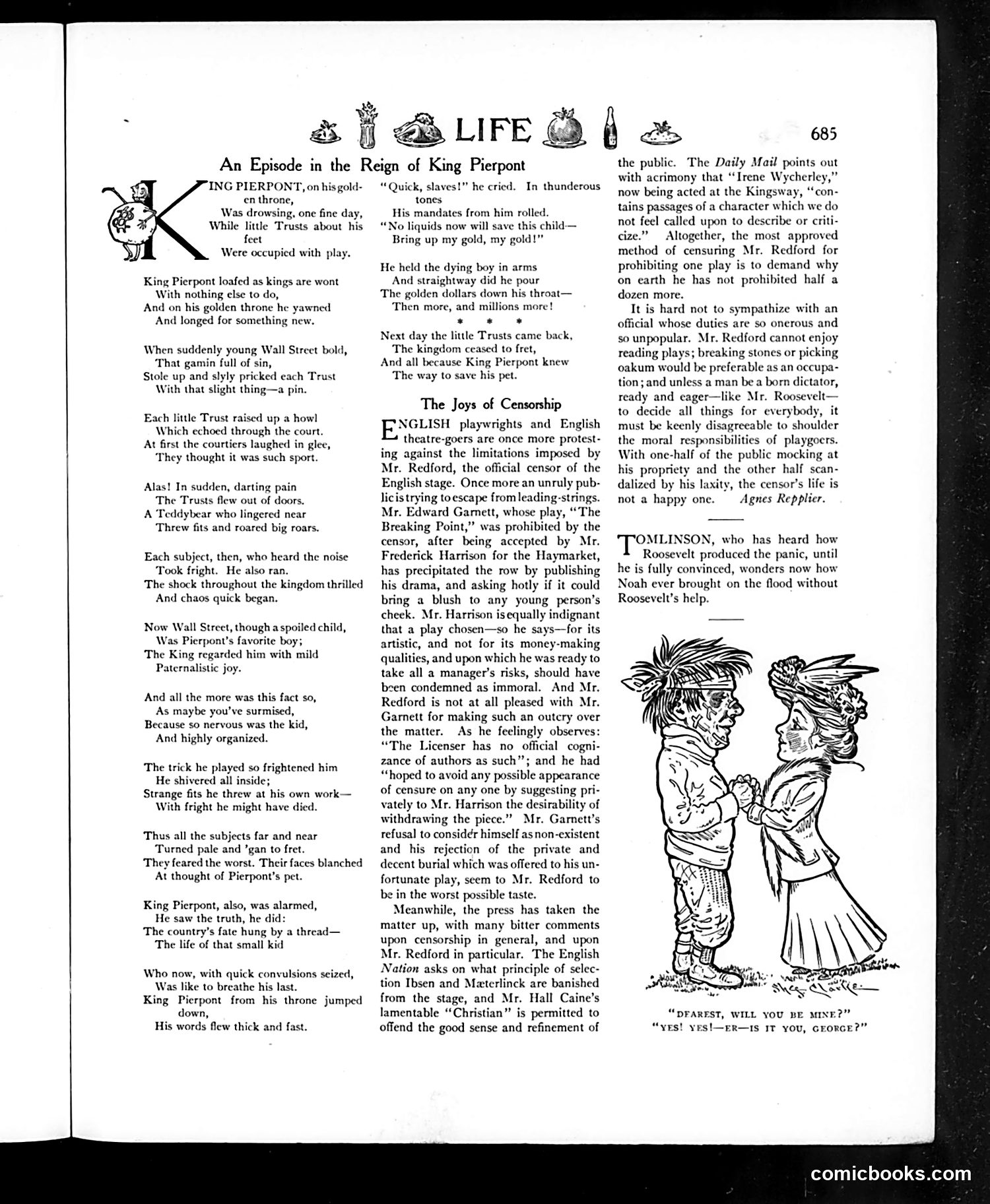
és i Bure@ | An Episode in the Reign of King Pierpont ING PIERPONT, on hisgold- en throne, Was drowsing, one fine day, While little Trusts about his feet Were occupied with play. King Pierpont loafed as kings are wont With nothing else to do, And on his golden throne he yawned And longed for something new. When suddenly young Wall Street bold, ‘That gamin full of sin, Stole up and slyly pricked each Trust With that slight thing—a pin. Each little Trust raised up a howl Which echoed through the court. At first the courtiers laughed in glee, ‘They thought it was such sport. Alas! In sudden, darting pain The Trusts flew out of doors. A Teddybear who lingered near Threw fits and roared big roars. Each subject, then, who heard the noise ‘Took fright. He also ran. The shock throughout the kingdom thrilled And chaos quick began. Now Wall Strect, though a spoiled child, Was Pierpont’s favorite boy; The King regarded him with mild Paternalistic joy. And all the more was this fact so, As maybe you've surmised, Because so nervous was the kid, And highly organized. The trick he played so frightened him He shivered all inside; Strange fits he threw at his own work— With fright he might have died. Thus all the subjects far and near Turned pale and ’gan to fret. They feared the worst. Their faces blanched At thought of Pierpont’s pet. King Picrpont, also, was alarmed, He saw the truth, he did: The country’s fate hung by a thread— The life of that small kid Who now, with quick convulsions seized, Was like to breathe his last. King Picrpont from his throne jumped down, His words flew thick and fast. “ Quick, slaves!" he cried. In thunderous tones His mandates from him rol “No liquids now will save this child— Bring up my gold, my gold!” He held the dying boy in arms And straightway did he pour The golden dollars down his throat— Then more, and millions more! + * + Next day the little Trusts came back, ‘The kingdom ceased to fret, And all because King Pierpont knew The way to save his pet. The Joys of Censorship NGLISH playwrights and English theatre-goers are once more protest- ing against the limitations imposed by Mr. Redford, the official censor of the English stage. Once more an unruly pub- licis trying toescape from leading-strings. Mr. Edward Gamett, whose play, “The Breaking Point,” was prohibited by the censor, after being accepted by Mr. Frederick Harrison for the Haymarket, has precipitated the row by publishing his drama, and asking hotly if it could bring a blush to any young person’s cheek. Mr. Harrison isequally indignant that a play chosen—so he say artistic, and not for its money-making qualities, and upon which he was ready to take all a manager’s risks, should have been condemned as immoral. And Mr. Redford is not at all pleased with Mr. Garnett for making such an outcry over the matter. As he feelingly observes: “The Licenser has no official cogni- zance of authors as such”; and he had “hoped to avoid any possible appearance of censure on any one by suggesting pri- vately to Mr. Harrison the desirability of withdrawing the piece.” Mr. Garnett’s refusal to consider himself as non-existent and his rejection of the private and decent burial which was offered to his un- fortunate play, seem to Mr. Redford to be in the worst possible taste. Meanwhile, the press has taken the matter up, with many bitter comments upon censorship in general, and upon Mr. Redford in particular. The English Nation asks on what principle of selec- tion Ibsen and Materlinck are banished from the stage, and Mr. Hall Caine’s lamentable “Christian” is permitted to offend the good sense and refinement of 685 the public. The Daily Mail points out with acrimony that ‘Irene Wycherley,” now being acted at the Kingsway, “‘con- tains passages of a character which we do not feel called upon to describe or criti- cize.” Altogether, the most approved method of censuring Mr. Redford for prohibiting one play is to demand why on earth he has not prohibited half a dozen more. It is hard not to sympathize with an official whose duties are so onerous and so unpopular. Mr. Redford cannot enjoy reading plays; breaking stones or picking oakum would be preferable as an occupa- tion; and unless a man be a born dictator, ready and cager—like Mr. Roosevelt— to decide all things for everybody, it must be keenly disagreeable to shoulder the moral responsibilities of playgocrs. With one-half of the public mocking at his propriety and the other half scan- dalized by his laxity, the censor’s life is not a happy one. Agnes Repplier. 'OMLINSON, who has heard how Roosevelt produced the panic, until he is fully convinced, wonders now how Noah ever brought on the flood without Roosevelt’s help. “DFAREST, WILL YOU BE MINE?” comicbooks.com YES! YES!—ER—IS IT YOU, GEORGE?”