
A complete issue · 48 pages · 1907
Life — May 2, 1907
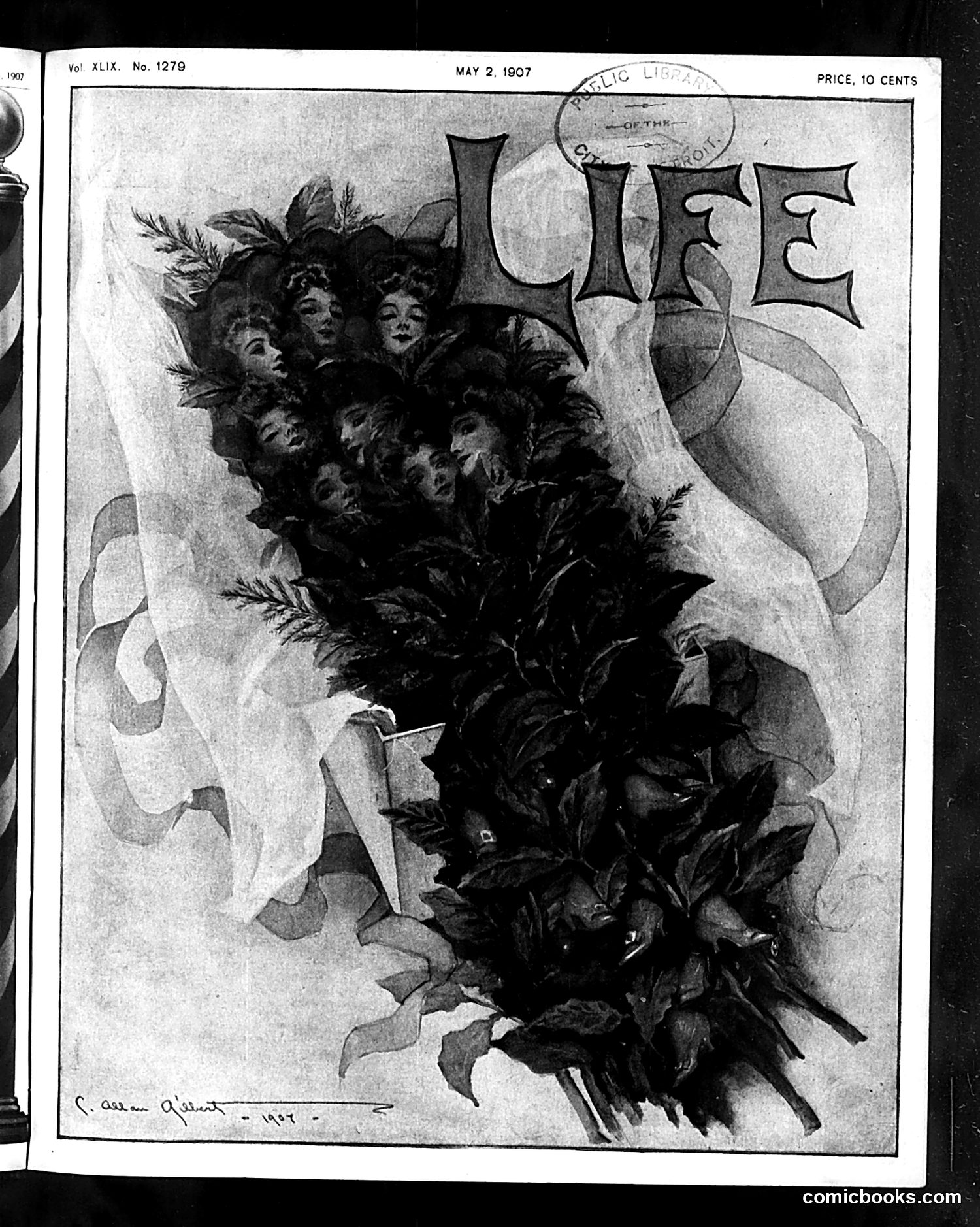
This appears to be a cover illustration for Life magazine rather than a political cartoon. The image shows a stylized arrangement of multiple female faces emerging from or composed of dark feathers or plumage, with the large decorative letters "LIFE" prominently displayed. The artwork, signed by what appears to be "Coles Phillips" (a prominent illustrator of the era), exemplifies the magazine's focus on satirical social commentary and aesthetic illustration. Without additional text visible on this page, the specific satirical point remains unclear, though the elaborate feathered composition likely references fashion, theater, or social pretension—common Life magazine targets during the Edwardian era.
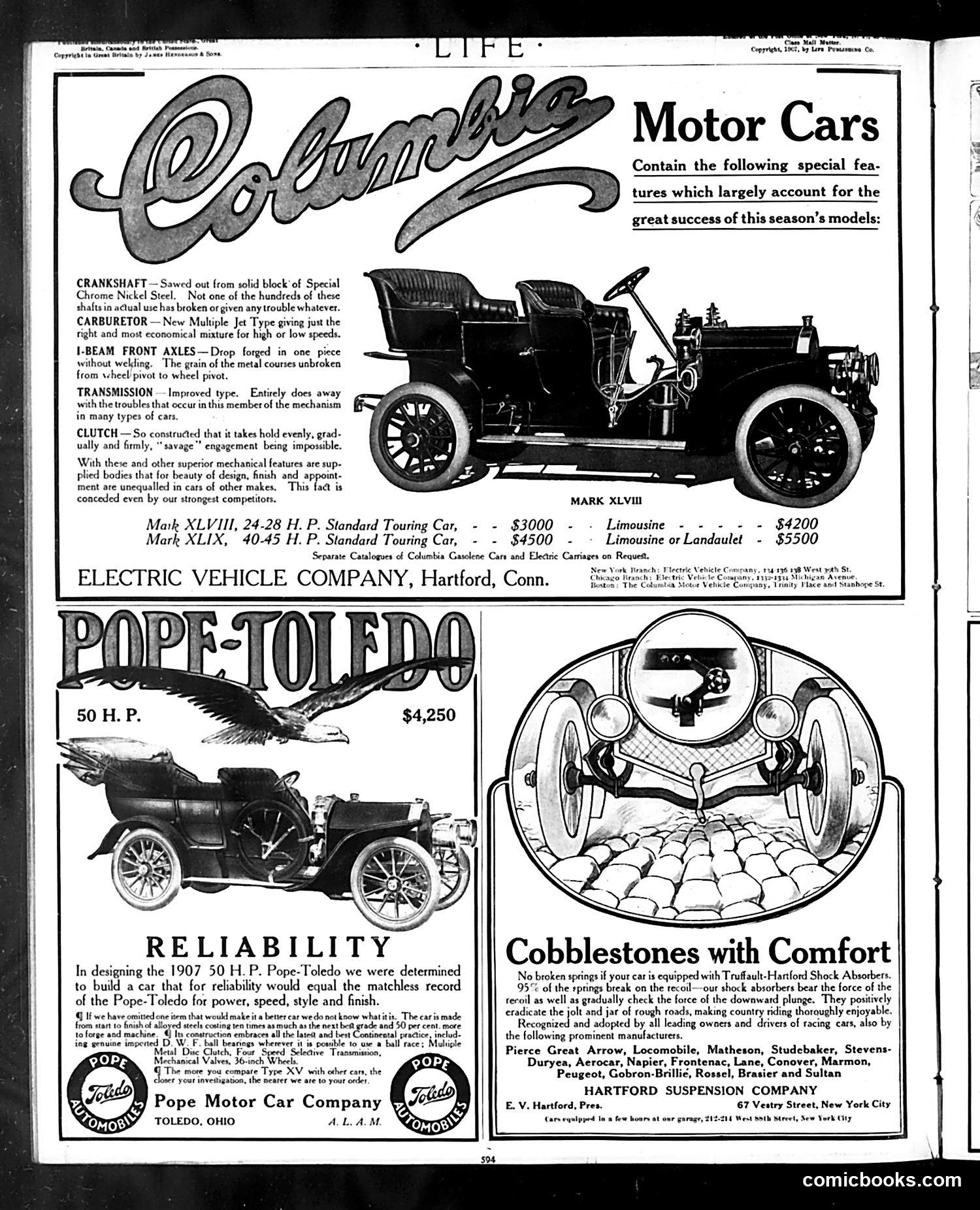
This page contains **no political cartoons or satire**—it is entirely **automobile advertising** from what appears to be an early 1900s issue of Life magazine. The ads feature three car manufacturers: 1. **Palomino Motor Cars** (Electric Vehicle Company, Hartford, Connecticut)—promoting features like improved transmissions and clutches 2. **Pope-Toledo** (Pope Motor Car Company, Toledo, Ohio)—emphasizing reliability, with a 50 H.P. model priced at $4,250 3. **Hartford Suspension Company**—advertising "Cobblestones with Comfort," suspension systems that absorbed road shock These are straightforward product advertisements showcasing early automotive technology and pricing. The page reflects the novelty and competition in the nascent American automobile industry, with manufacturers highlighting mechanical innovations as selling points.
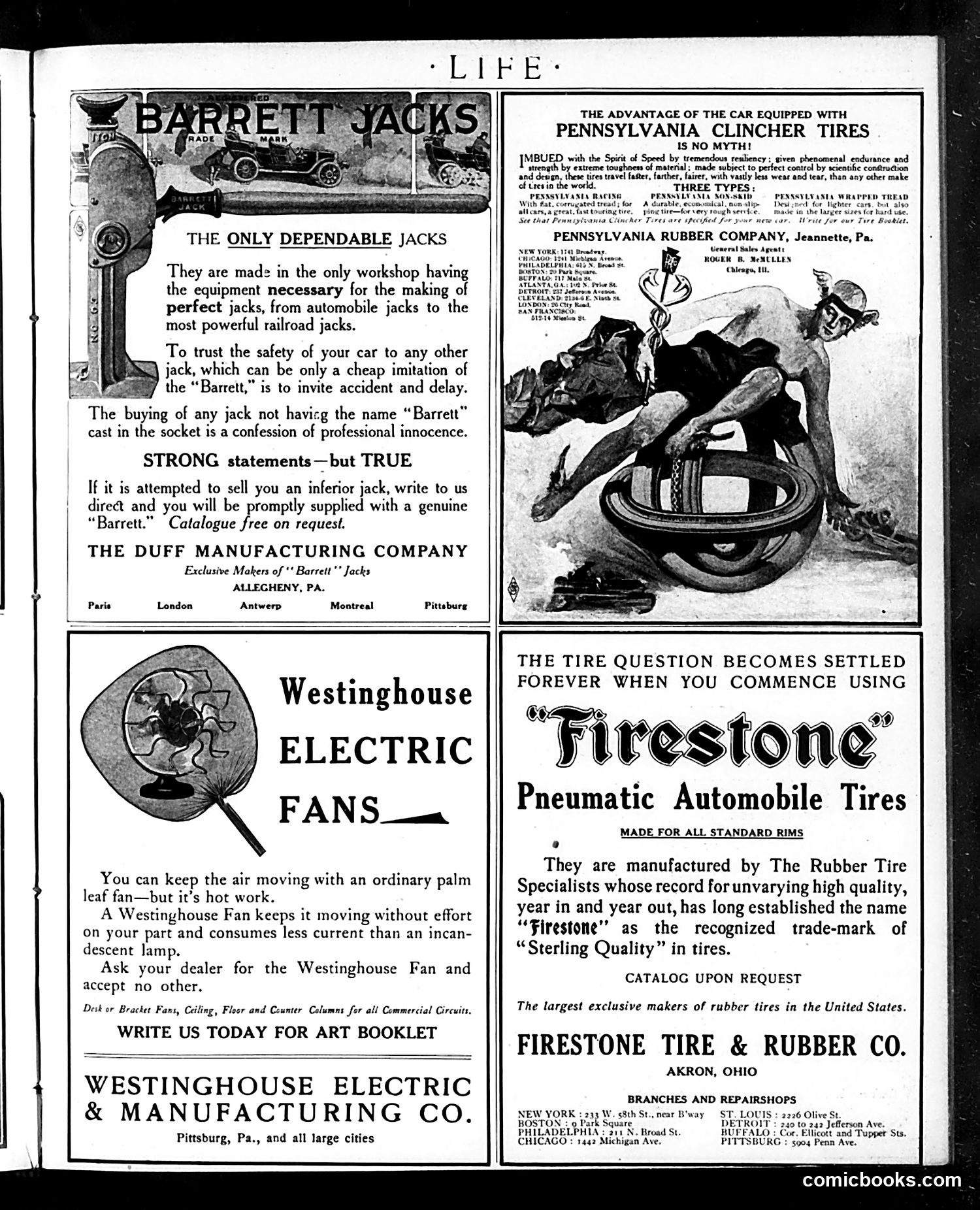
This page is **primarily advertising**, not editorial satire. It contains four ads from the early automotive era: 1. **Barrett Jacks** (top left): Promotes automobile jacks, claiming superiority through manufacturing quality and warning against cheap imitations. 2. **Pennsylvania Clincher Tires** (top right): Features a man struggling with a tire, humorously illustrating the difficulty of tire changes. The ad claims Pennsylvania tires require less frequent changing than competitors. 3. **Westinghouse Electric Fans** (bottom left): Promotes electric fans as labor-saving devices superior to manual fans. 4. **Firestone Pneumatic Tires** (bottom right): Emphasizes brand reliability and establishes "Firestone" as a quality trademark. No political satire or caricature is present. The page reflects early 1900s automobile culture and consumer anxieties about emerging technologies.
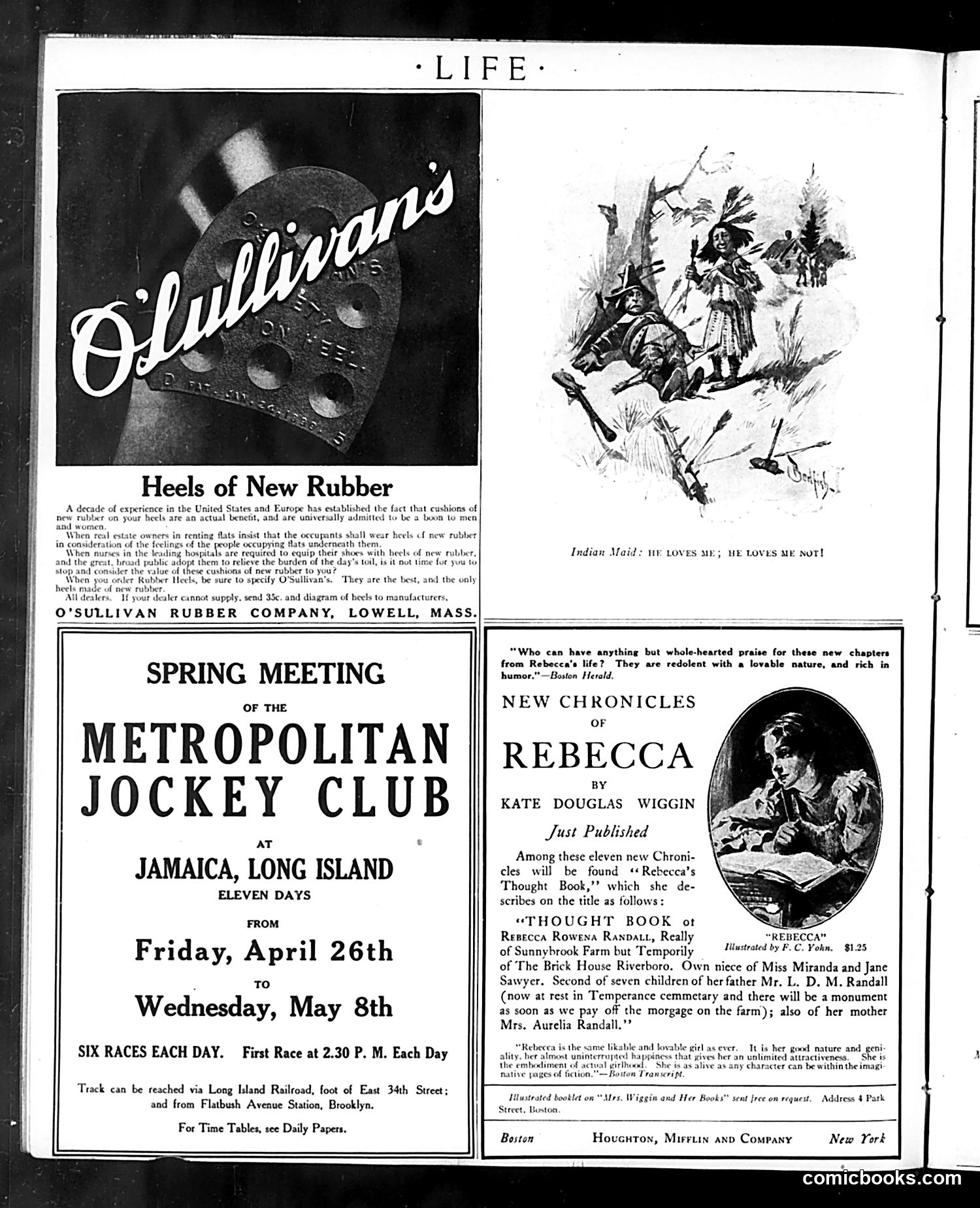
This page contains primarily **advertisements and announcements** rather than political satire. The top left features an **O'Sullivan Rubber Company ad** for heels made of new rubber—positioning this product as a practical innovation that relieves foot fatigue. The center-left announces a **Spring Meeting of the Metropolitan Jockey Club** at Jamaica, Long Island, offering horse racing with six races daily from April 26 to May 8. The right side advertises **"New Chronicles of Rebecca"** by Kate Douglas Wiggin, presenting new chapters from the popular novel *Rebecca of Sunnybrook Farm*. The accompanying illustration shows a figure reading. The small sketch at top-right titled "Indian Maid: He Loves Me; He Loves Me Not!" appears to be a light romantic cartoon, though details are unclear. Overall, this is a commercial page rather than political commentary.
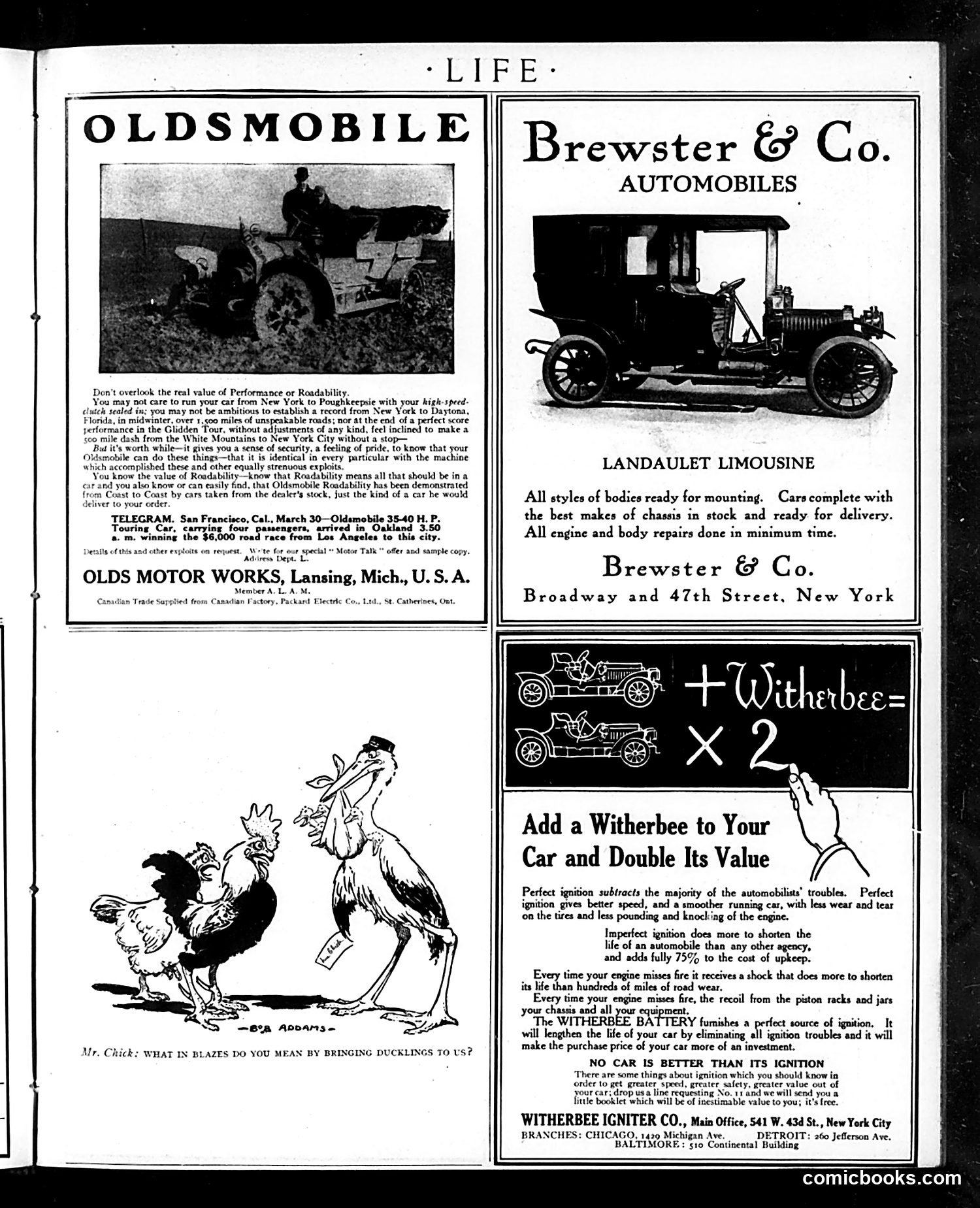
This page is primarily **automobile advertisements** from the early 1900s, not political satire. The only cartoon element is a small humorous illustration showing a rooster and stork, captioned "Mr. Chick: WHAT IN BLAZES DO YOU MEAN BY BRINGING DUCKLINGS TO US?" This appears to be a simple visual joke about mismatched offspring—unrelated to the advertisements surrounding it. The ads promote three vehicles: Oldsmobile (emphasizing reliability and durability), Brewster & Co.'s Landaulet Limousine (luxury automobile bodies), and Witherbee ignition systems (claiming to double a car's value). The humor is modest and domestic rather than political—typical of early 20th-century magazine content mixing advertising with light entertainment.
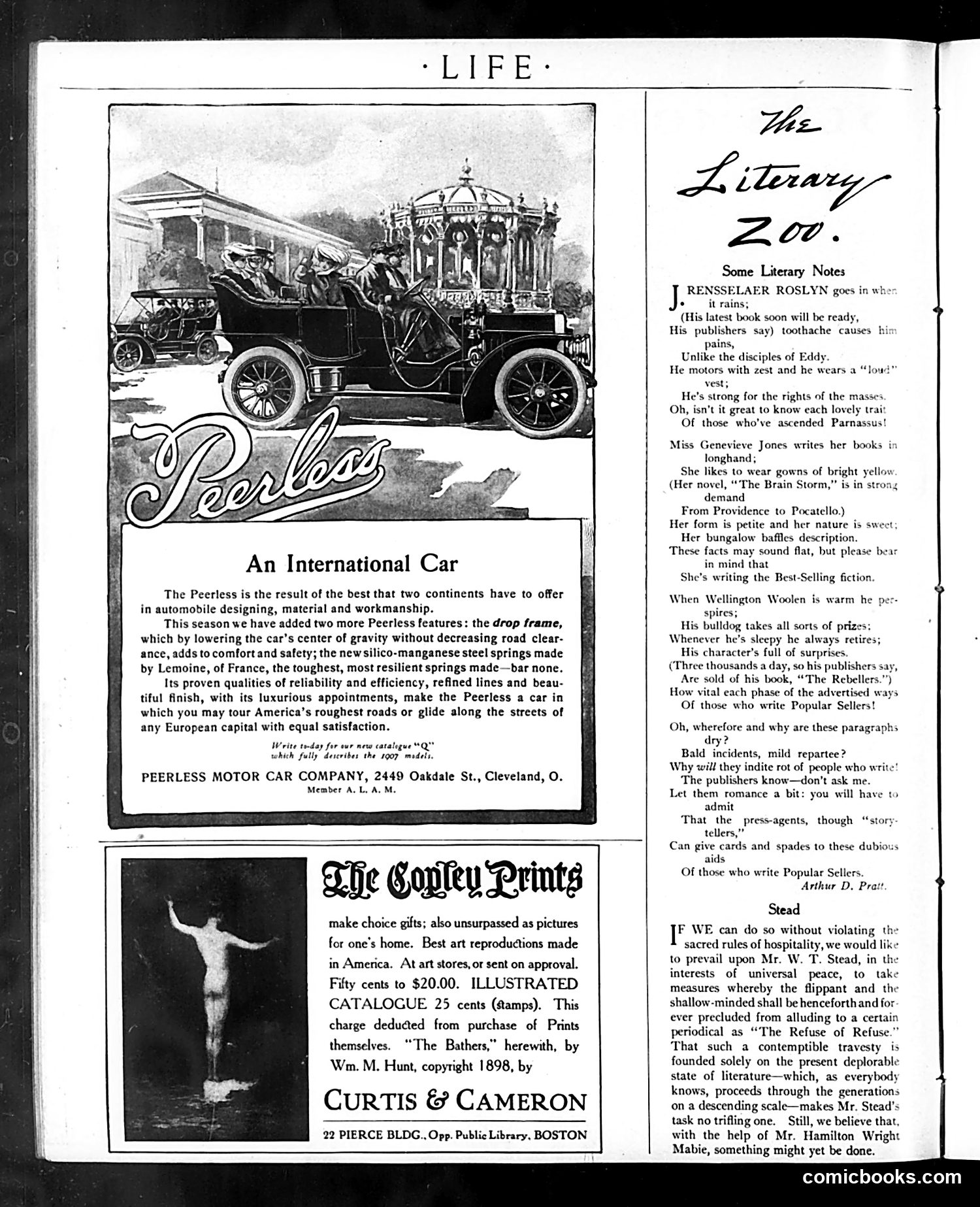
This page is primarily **advertising and literary commentary**, not political satire. The main content includes: 1. **Peerless Motor Car advertisement** - promoting an "International Car" with features like drop frames and steel springs, positioned as luxury transportation comparable to European vehicles. 2. **Curtis & Cameron art prints advertisement** - selling reproductions of classical artwork, including "The Bathers" by William M. Hunt (1898). 3. **"The Literary Zoo"** - a satirical column by Arthur D. Prat mocking popular authors and journalists of the era. It humorously critiques contemporary writers' pretensions and commercial success, questioning why certain "Popular Sellers" achieve prominence despite questionable literary merit. The page reflects early 1900s consumer culture and literary trends rather than political commentary.
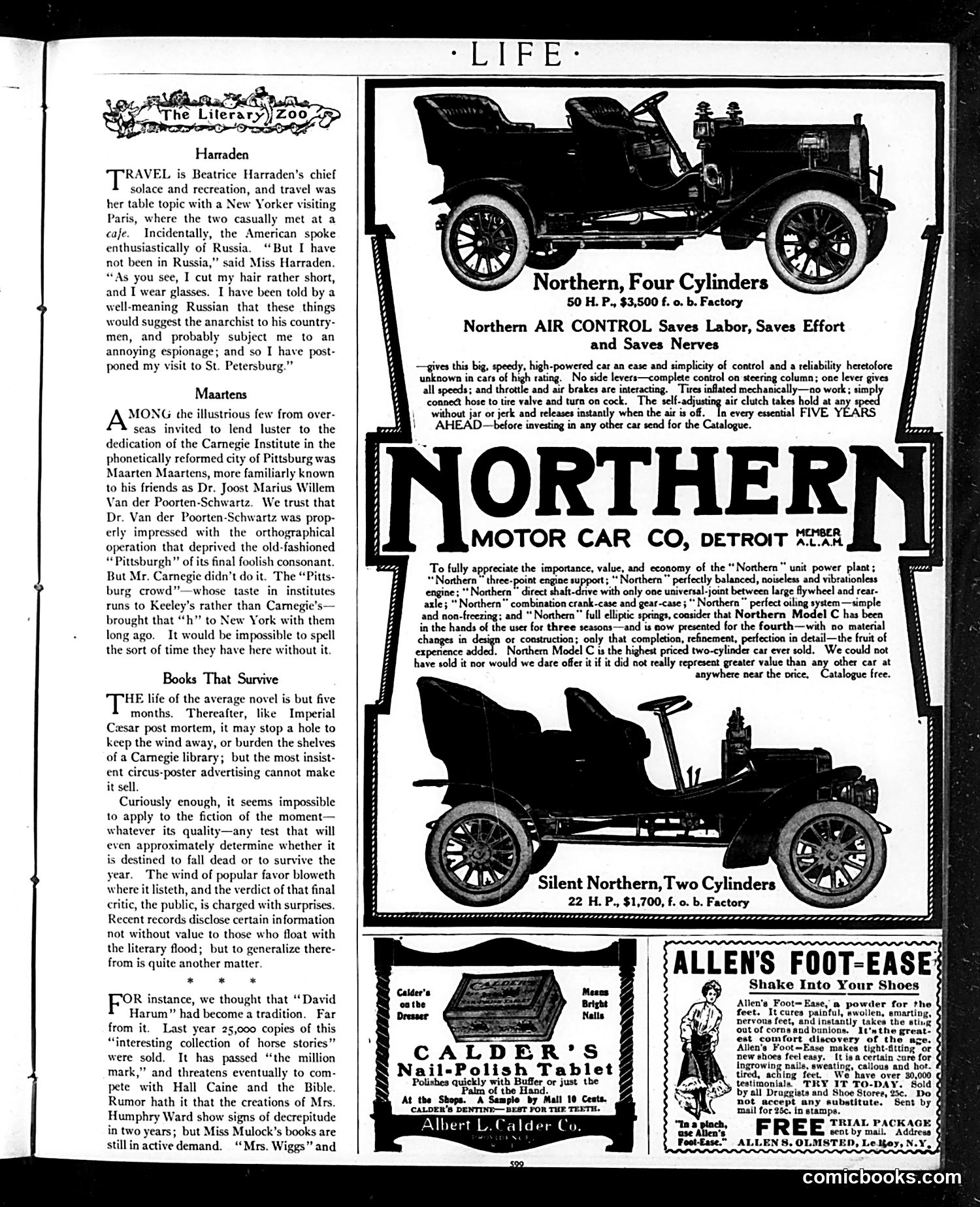
This page is primarily **advertising and literary commentary**, not political satire. The main content includes: 1. **"The Literary Zoo"** - A column by Beatrice Harraden discussing travel anecdotes (Russia, hair, glasses) and orthographical reform by a Dutch phonetician named Maartens. 2. **"Books That Survive"** - Commentary on novel longevity, noting most fiction lasts only five months. It discusses specific works like "David Harum" and books by Mrs. Humphry Ward and Miss Mulock that remained in demand. 3. **Advertisements** - The dominant visual element features Northern Motor Car Company vehicles (four and two-cylinder models) and Calder's Nail-Polish Tablet and Allen's Foot-Ease products. There is **no political cartoon** on this page. It reflects early 1900s consumer culture and publishing industry concerns.
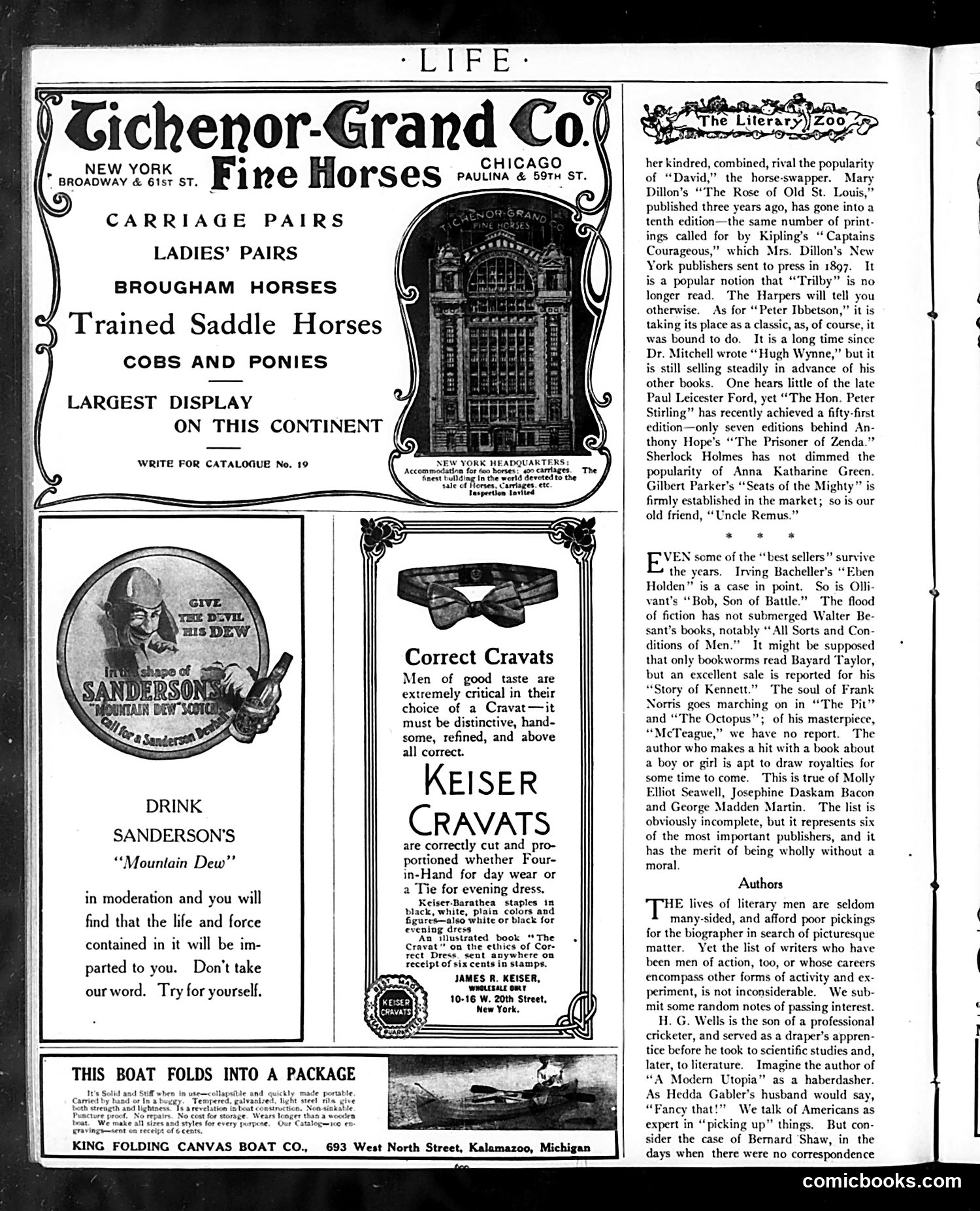
This page is primarily **advertising and literary content** rather than political satire. The ads feature: - **Eichenor-Grand Co.** (horses for sale in New York and Chicago) - **Sanderson's "Mountain Dew"** whiskey, with an illustration of a bearded man and text promoting moderate drinking - **Kaiser Cravats** (neckwear) - **King Folding Canvas Boat Co.** (collapsible boats) The right column contains **"The Literary Zoo,"** a book review section discussing popular authors and their sales figures—not satire, but consumer publishing news. The only potentially satirical element is the **Sanderson's whiskey ad**, which uses a rustic "mountain man" character to market alcohol, but this appears to be straightforward period advertising rather than political commentary. Overall, this is a **mixed advertising and entertainment page**, not primarily satirical content.
This page is primarily **advertising and literary content**, not political satire. The left side contains ads for Pabst Extract (a tonic), Globe Optical Company goggles, and a Mexican Palm Leaf Hat. The center features "The Literary Zoo," a column discussing various literary and historical figures including George Bernard Shaw, H. Rider Haggard, and others who achieved success despite limited formal education. The right side advertises Whiting Papers and French Chambray writing materials. At the bottom is a brief editorial note titled "The Silent War," referencing Uncle Tom's Cabin and slavery abolition. This is a typical early 20th-century **Life magazine page mixing advertisements with cultural commentary**—not primarily satirical cartooning.
This page is primarily **advertising and literary content** rather than political satire or editorial cartooning. The main feature is "The Literary Spotlight," a biographical column about various figures who've had diverse careers—Jack London (described as "oyster pirate, fish patrolman, longshoreman, goldminer and tramp"), James Whitcomb Riley, Charles F. Lummis, and Frank Cushing. The text celebrates their varied life experiences and accomplishments. The advertisements include **Mobiloil motor oil**, the **Jones Speedometer**, **Park & Tilford** food products, **Hinckkel & Winckler wines**, **John Jameson whiskey**, and flower services. These reflect early 20th-century consumer products and luxury goods targeting affluent readers. There is **no political cartoon or satire visible**—this is a standard magazine page mixing editorial content with period advertising.
This page is primarily **advertising and product promotions** from what appears to be an early 20th-century *Life* magazine issue. **Notable content:** The left side features Winchester ammunition and shotgun shell advertisements targeting hunters. The Hartshorn Shade Rollers ad uses comedic illustrations of figures. **"The Literary Zoo"** - a short satirical piece - describes a Western newspaper editor who suffered physical and mental strain from political corruption, eventually finding refuge among Mexican friends. This appears to be social commentary on journalism's toll. **"Time Tells the Tale"** promotes Wayne Automobiles, emphasizing durability through testimonials from long-term car owners. Additional ads include college seals, the Lackawanna Railroad's travel guide, and various automotive dealers nationwide. The page reflects early 1900s consumer culture and light satirical commentary on American life, rather than hard political cartooning.
This page is **primarily advertising** with minimal editorial content. The advertisements include: - **Great Western Champagne** - promoting a domestic American wine competing with French imports - **Spencerian Steel Pens** - office supplies - **The Autocar** - automobiles at various price points ($1,200-$3,000) The only substantial editorial content is **"The Literary Zoo"** column on the right, which discusses literary trends. It mentions "Five Acres Too Much" and references to authors like Kipling, appearing to critique contemporary literature and social pretensions about rural living. There are no political cartoons on this page. The layout reflects typical early 20th-century magazine design mixing advertisements with editorial commentary.
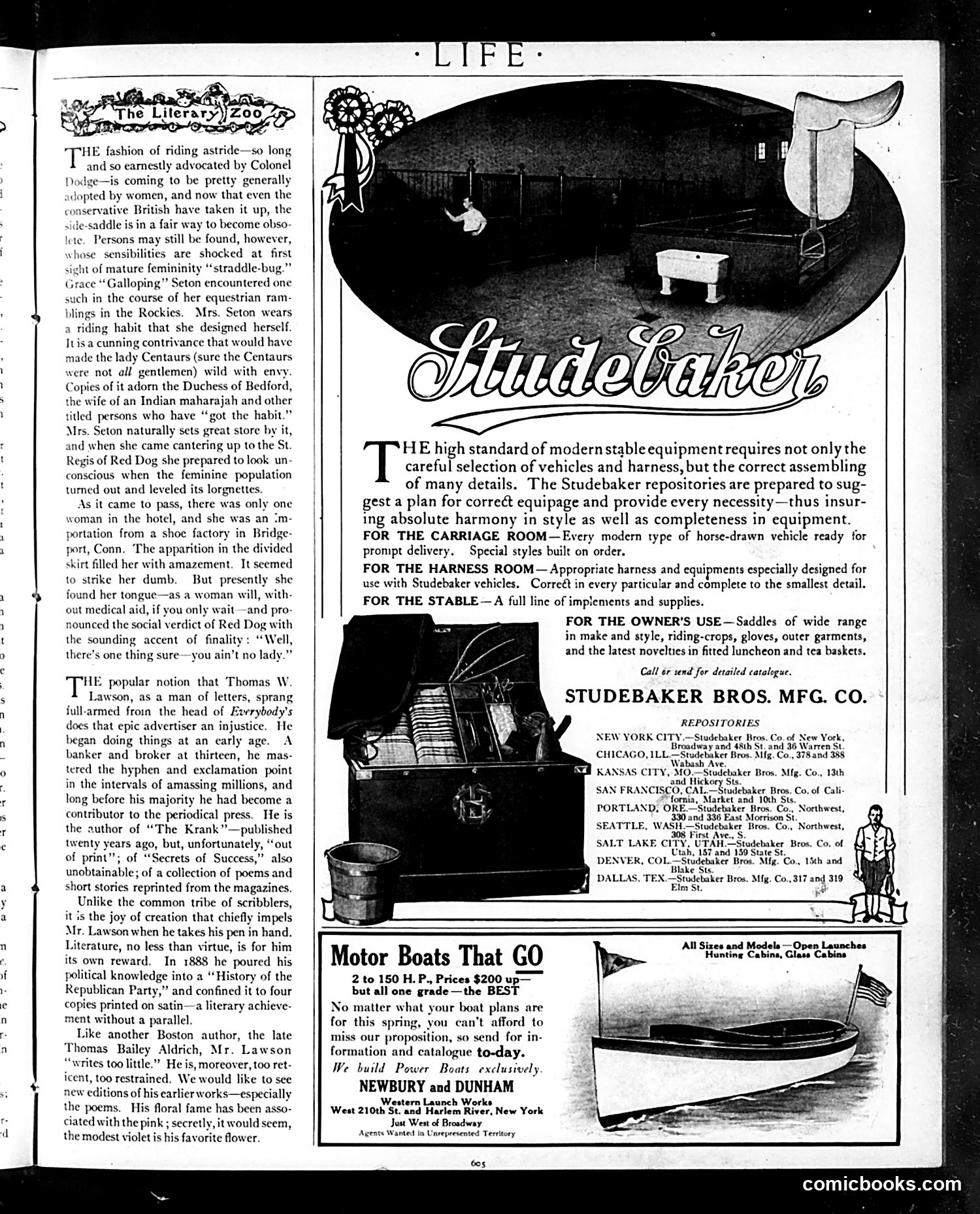
This page is primarily **advertising, not political satire**. The main visual content features two ads: 1. **Studebaker Bros. advertisement** (center): Showcases horse-drawn carriage equipment and stable supplies, emphasizing "high standard of modern stable equipment" with detailed illustrations of saddles, harnesses, and carriage room setups. 2. **Motor Boats That GO advertisement** (bottom): Promotes motorboats ranging 2-150 H.P., priced from $200 up, by Newbury and Dunham manufacturers in New York. The left column contains "The Literary Zoo," a lighthearted essay about riding habits and author Thomas W. Lawson's career as a writer and businessman—purely editorial content, not satirical commentary. The page reflects early 20th-century consumer advertising mixed with general interest editorial material.
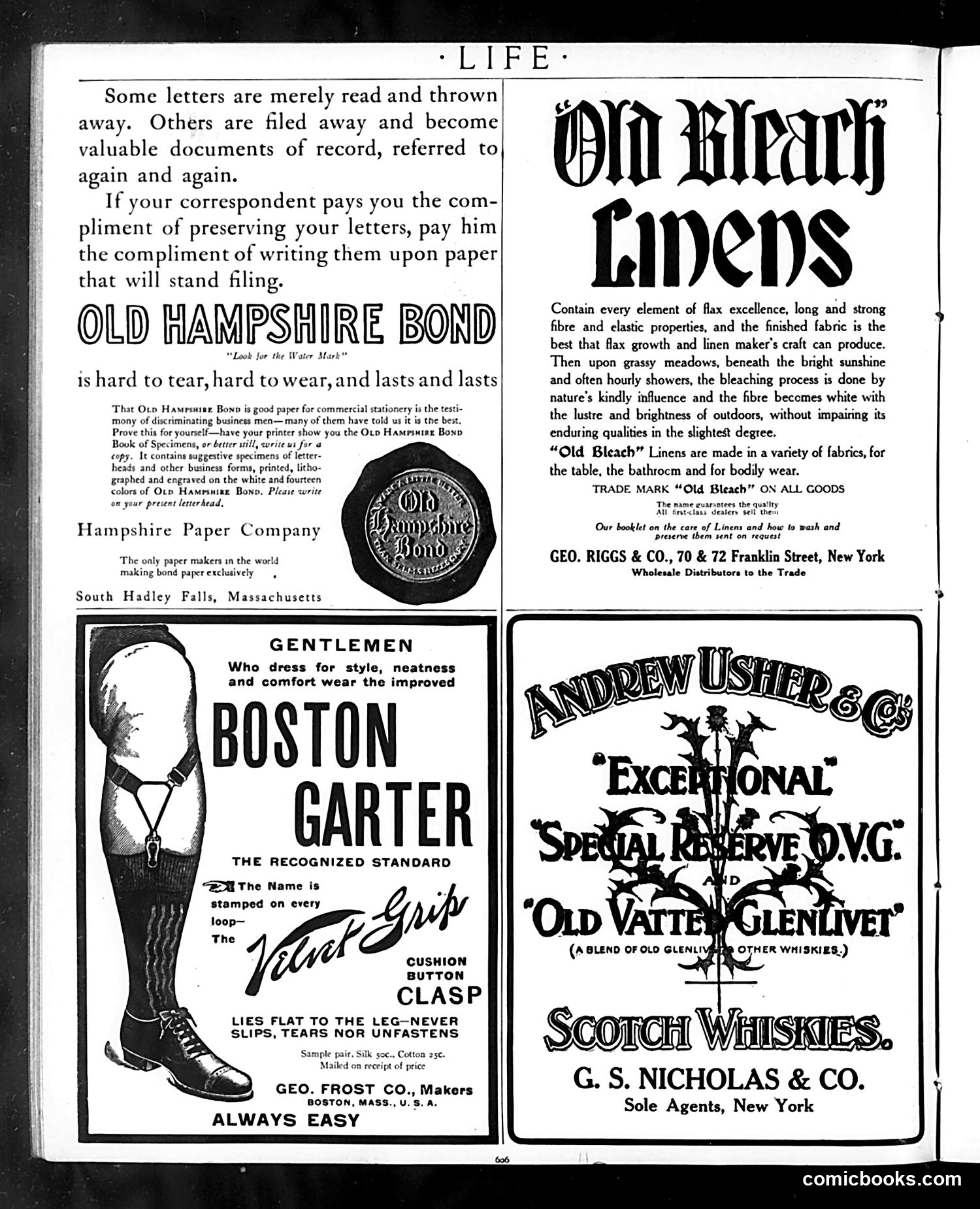
This is primarily an **advertising page**, not a satirical cartoon. It contains four product advertisements with no political commentary or satire. The ads promote: 1. **Hampshire Bond paper** — emphasizing durability for business correspondence 2. **Old Bleach linens** — highlighting quality flax and natural bleaching processes 3. **Boston Garter** — men's hosiery featuring a "cushion button clasp" that won't slip or tear 4. **Andrew Usher & Co. Scotch Whiskies** — various blends for upscale consumers Each ad appeals to gentlemen of means and emphasizes quality, reliability, and respectability—standard early-20th-century luxury marketing. The visual elements (the garter illustration, product seals, decorative typography) are typical period advertising design rather than satirical commentary. There is no identifiable political reference, caricature, or joke intended for a modern audience to decode.
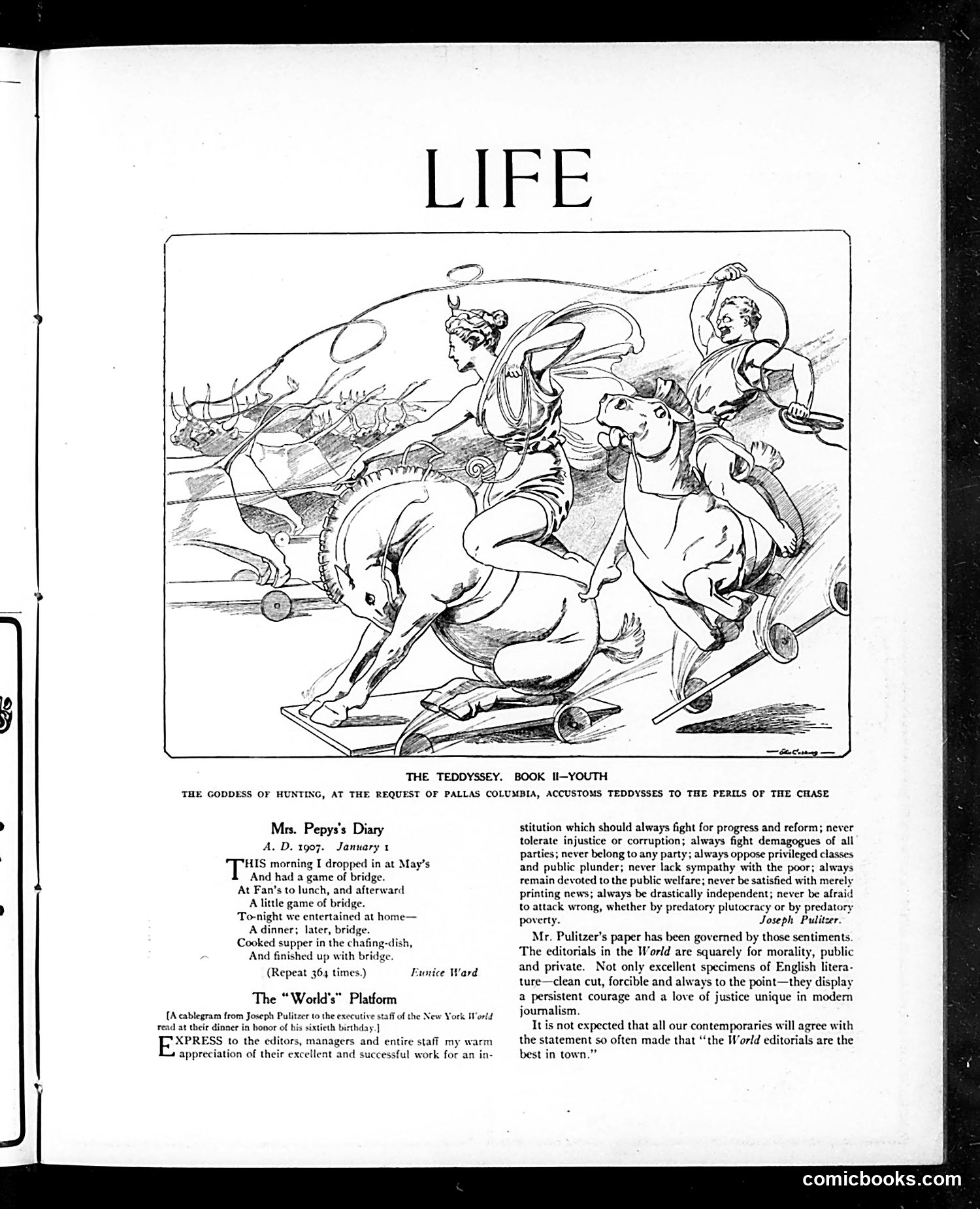
This page contains two distinct satirical pieces: **"The Teddyssey" cartoon** (top) parodies Homer's *Odyssey*, reimagining President Theodore Roosevelt as the hero. The goddess of hunting (Diana/Artemis) trains "Teddysses" in the chase—a reference to Roosevelt's famous enthusiasm for hunting and outdoor pursuits. The classical allusion elevates Roosevelt's adventurousness to epic status, likely both praising and gently mocking his rugged persona. **"Mrs. Pepys's Diary"** (bottom left) satirizes upper-class leisure through repetitive monotony—a wealthy woman's entire day consists of bridge games. The joke is that privileged society life lacks substance and variety, reduced to endless card-playing. **"The World's Platform"** (bottom right) celebrates Joseph Pulitzer's newspaper's editorial standards—fighting corruption, defending the poor, maintaining independence. This appears promotional rather than satirical, celebrating the *World*'s progressive journalism ideals. The page dates to 1907, during Roosevelt's presidency.
This page features an editorial essay discussing recent peace conferences in New York and The Hague, written in the satirical voice characteristic of *Life* magazine. The author argues that while neither conference will eliminate war, they serve a useful purpose in reducing conflict. The piece's central argument—that war is fundamentally a bad financial investment—reflects Progressive Era pragmatism. The author cites Ambassador James Bryce's observation that nations avoid war primarily for economic reasons, referencing Russia's 1904 Russo-Japanese War and British colonial conflicts as costly mistakes. The editorial proposes specific diplomatic remedies: establishing a permanent Hague conference, international arbitration treaties, mediation requirements before warfare, and protecting private property in war. The tone is characteristically wry; the author compares war unfavorably to football and notes sardonically that while statesmen ignore war's immorality, they cannot ignore its expense. The small decorative illustrations (soldiers, fortifications) are period-typical ornamental elements rather than pointed political cartoons.
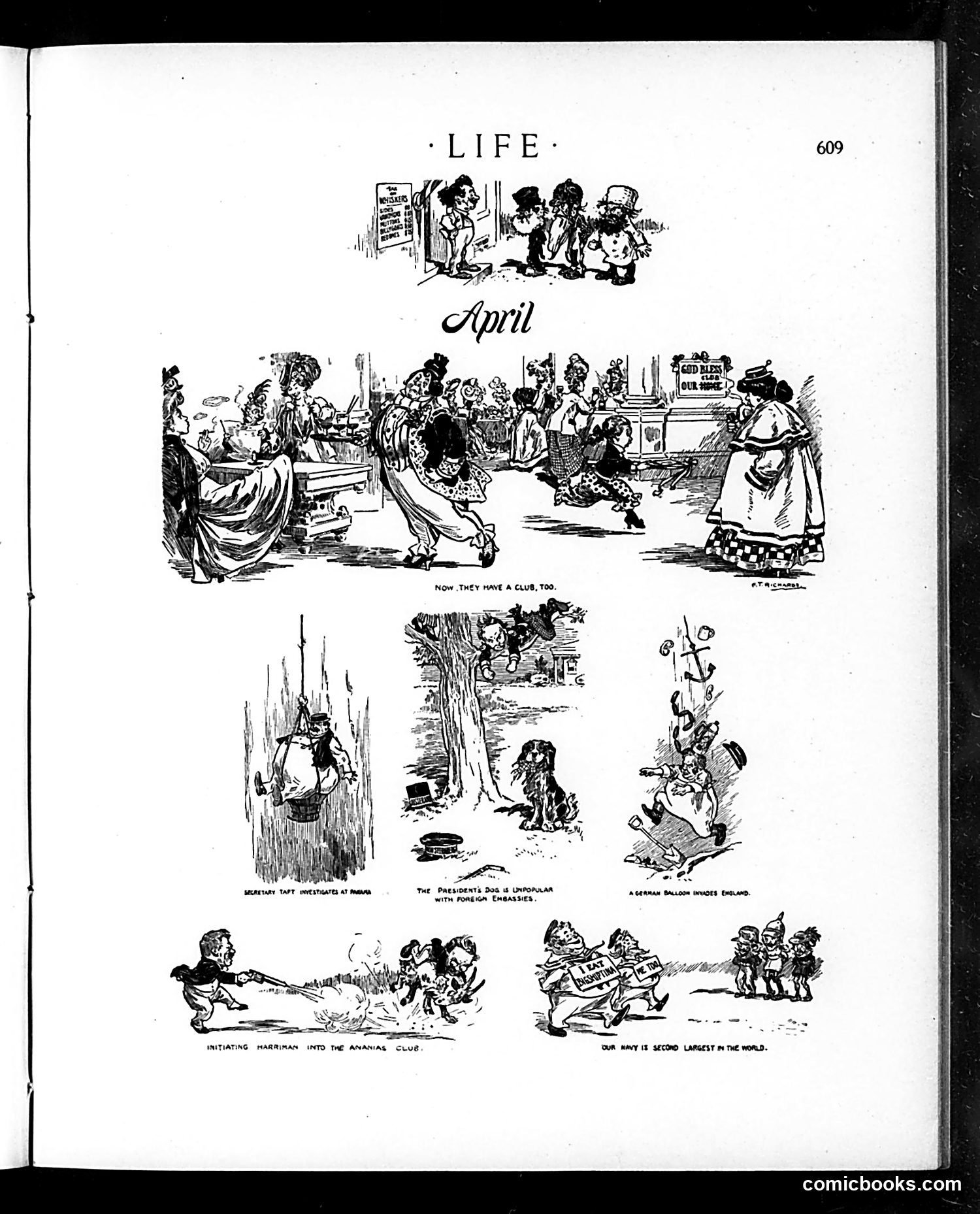
This page from *Life* magazine contains several April-themed political cartoons. The main large cartoon depicts a crowded street scene with the caption "Now they have a club, too"—likely satirizing a new organization or social trend. Below are smaller cartoons addressing various contemporary issues: one references a President's diplomatic dealings with foreign embassies; another shows military initiation; and the bottom panel declares "Our army is second largest in the world," which appears to be satirical commentary on American military strength or spending relative to other nations. The page uses caricature and exaggeration typical of early 20th-century political cartooning to mock current events and social developments, though specific figures and dates remain unclear without additional historical context.
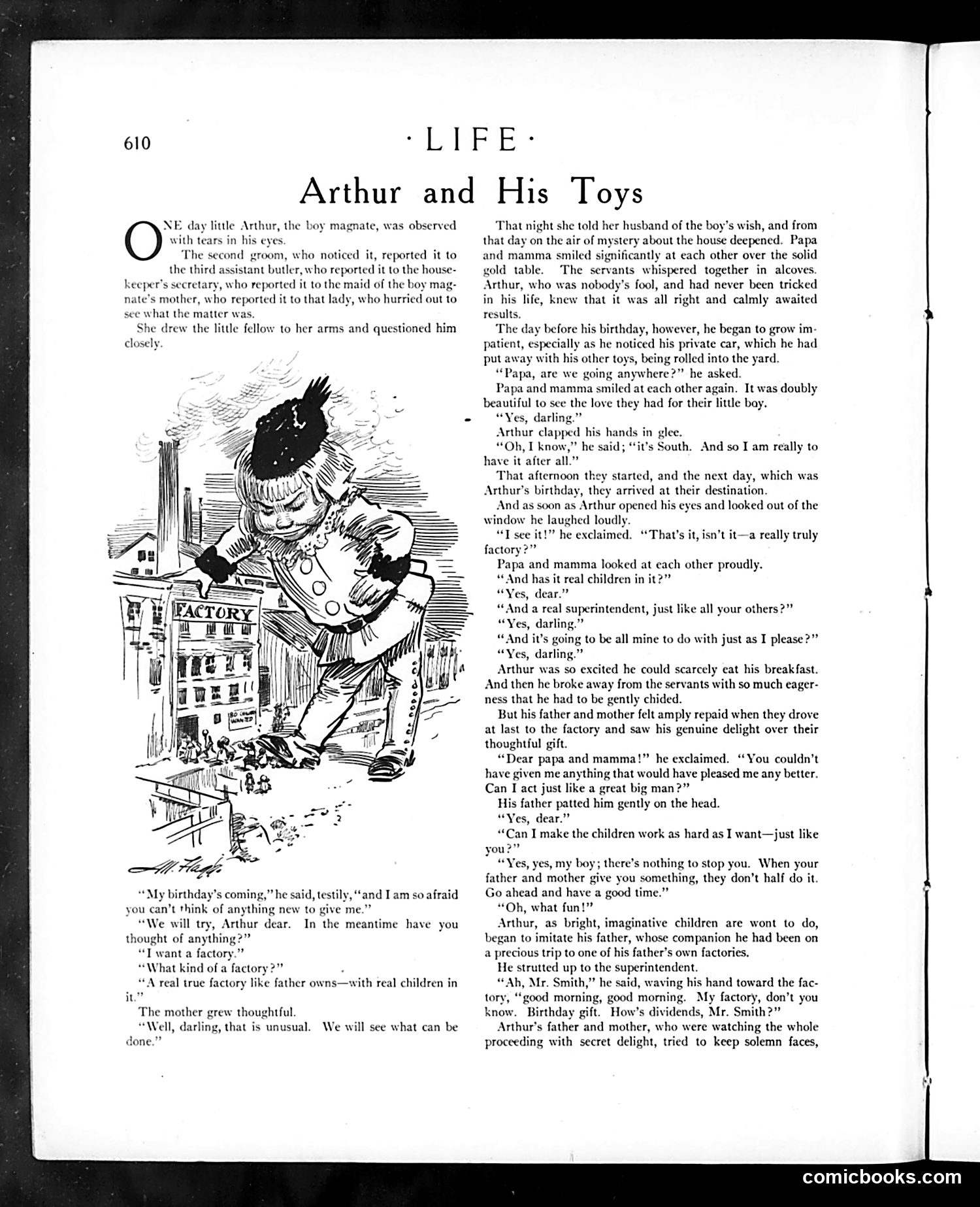
This is a biting satire of American industrial capitalism and child labor practices. Young Arthur, a wealthy "boy magnate," receives a real factory staffed with actual working children as his birthday gift. The joke targets the moral blindness of the industrial elite: Arthur's parents find it delightful that their son mimics his father's ruthless business practices, complete with demanding child labor and obsessing over dividends. The satire's sharp point is that the parents see nothing wrong with either their own exploitation of workers or teaching their son to do the same. The illustration shows Arthur towering over a factory building, emphasizing the grotesque power dynamic. The story's casual tone—treating child labor as amusing rather than abhorrent—intensifies the satirical critique of Gilded Age industrialists who normalized such exploitation. Life magazine is exposing the callousness of wealthy factory owners toward their workers, particularly children.
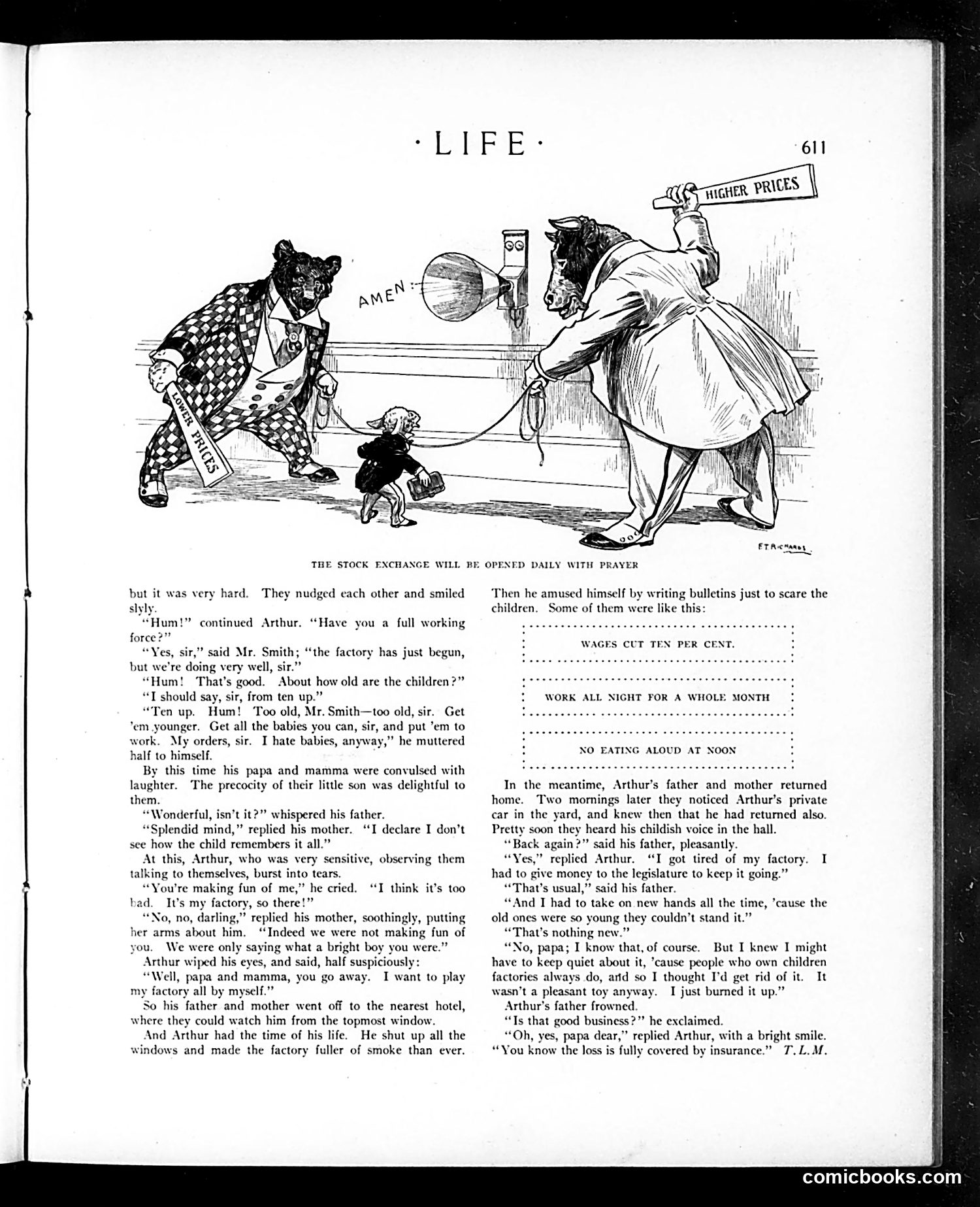
This is a satirical story-cartoon critiquing early 20th-century child labor practices and corporate corruption. A precocious boy named Arthur plays at running a factory, where he demands workers as young as possible, exploits them until they collapse, bribes legislators to keep operating, and finally burns down the factory to collect insurance—all while his parents find his behavior delightful. The satire works by having the child articulate real industrial practices openly: child labor, legislative corruption, worker expendability, and insurance fraud. The cartoon at top shows the "Stock Exchange" opening with prayer, mocking how business and morality are absurdly separated. Arthur's innocent recitation of corrupt adult behavior exposes how normalized these practices were. His final line—that the insurance covers losses—targets how corporations profited from destruction while workers suffered. The story ridicules both industrialists and parents who celebrate such ruthlessness in their offspring.
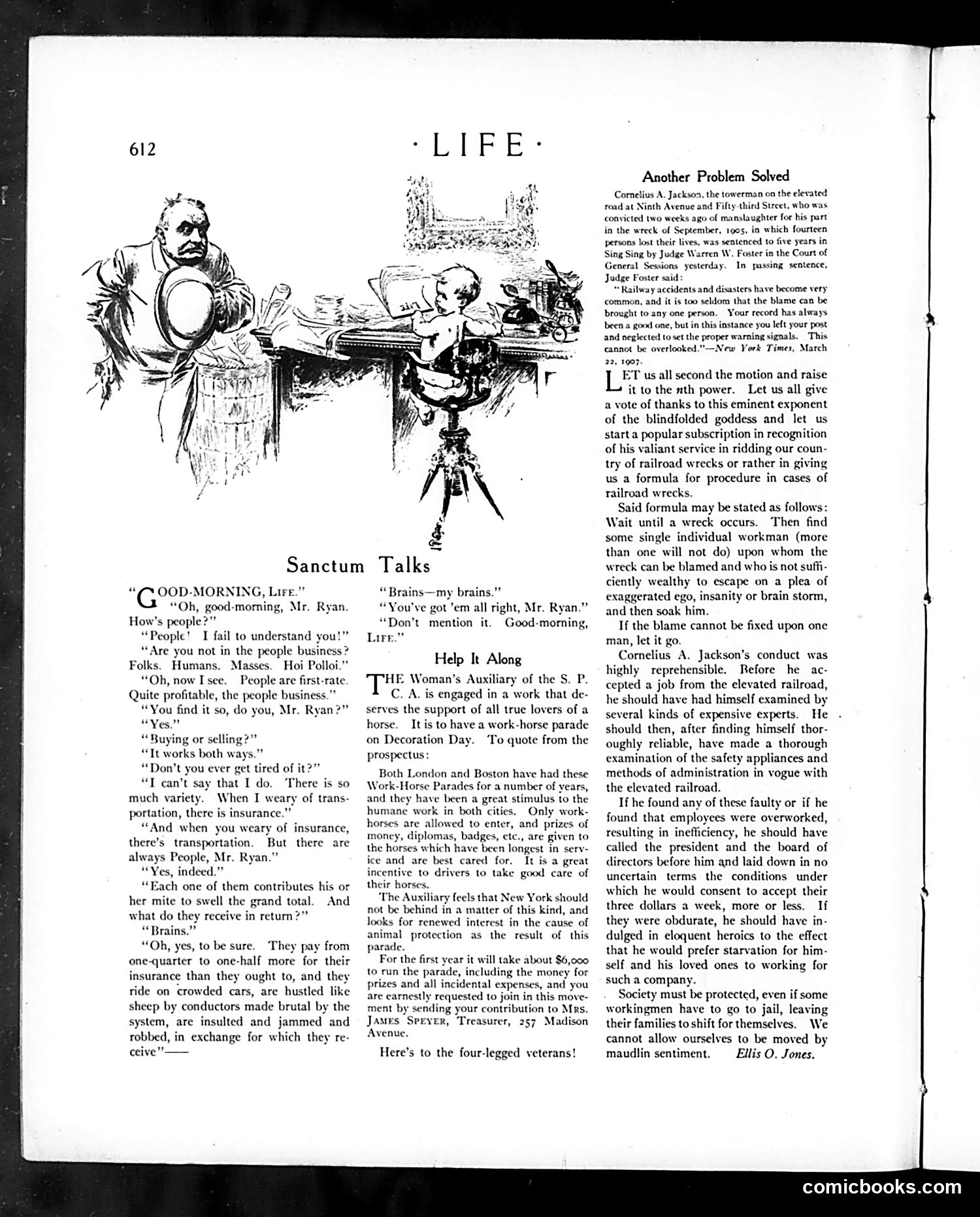
This page contains three satirical pieces critiquing American business and justice systems circa 1907. **"Sanctum Talks"** mocks a businessman (Mr. Ryan) who profits from people through insurance and transportation by exploiting them—overcharging for insurance, crowding them into transit, having them "hustled like sheep" by brutal conductors. The joke: Ryan generously gives them his "brains" in return for their money and suffering. **"Help It Along"** promotes a Work-Horse Parade charity, advocating better treatment of working horses—a genuine animal welfare cause presented earnestly. **"Another Problem Solved"** sarcastically celebrates the conviction of Cornelius Jackson, an elevated railroad tower operator sentenced for a 1905 wreck killing fourteen people. The satire savagely critiques the justice system: it finds one scapegoat worker rather than addressing systemic railroad negligence, and punishes only those too poor to escape accountability through claims of mental illness or wealth. The bitter formula: "Wait until a wreck occurs. Then find some single individual workman...and then soak him."
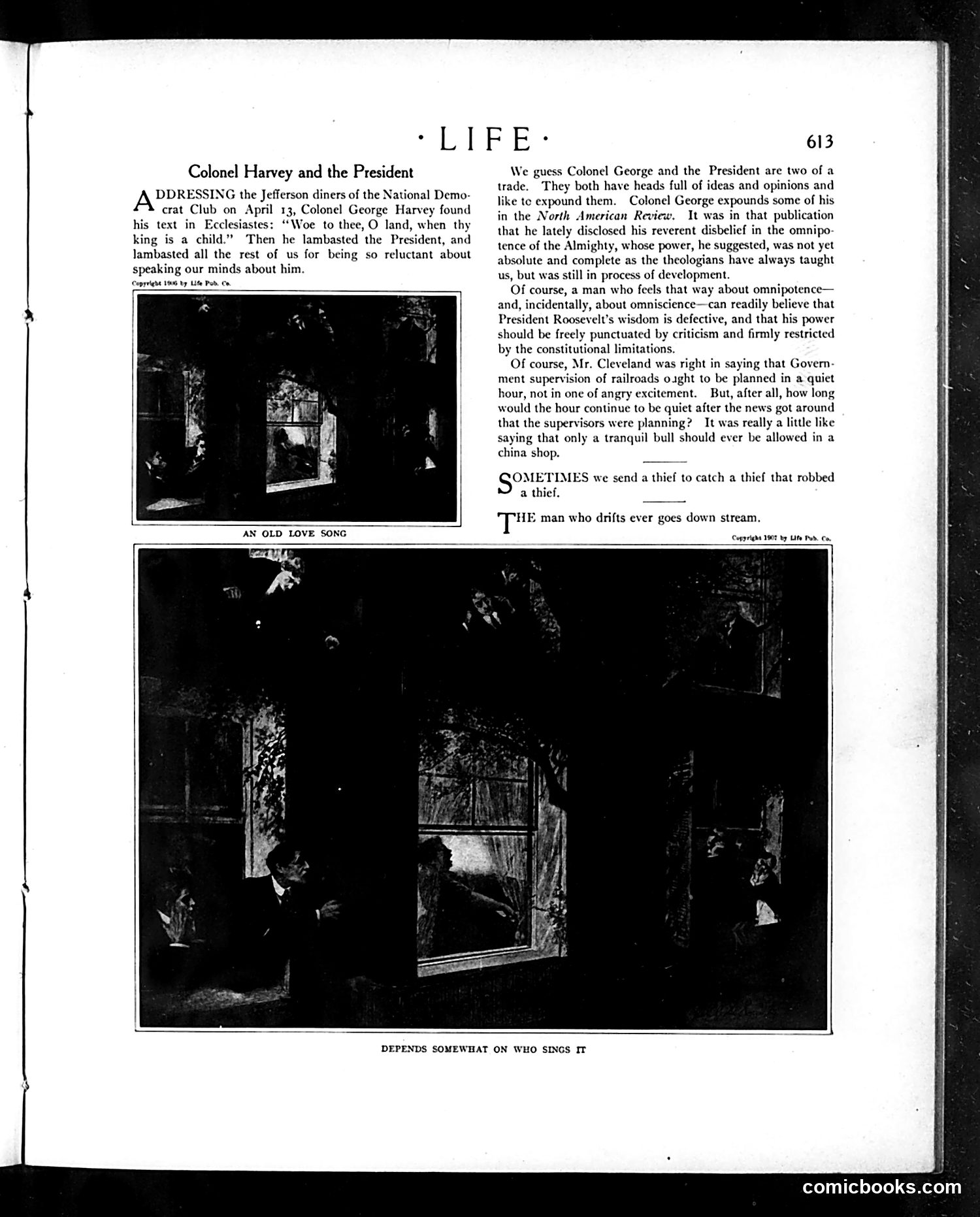
This page satirizes Colonel George Harvey's public criticism of President Theodore Roosevelt. Harvey, speaking at a Democratic Club dinner in April, quoted Ecclesiastes to attack Roosevelt as an immature leader ("when thy king is a child"). Life's response mocks Harvey's hypocrisy: Harvey himself has published irreverent views in the *North American Review*, including questioning God's omnipotence. The magazine suggests that if Harvey doubts divine wisdom, he shouldn't claim Roosevelt lacks judgment. The satire extends to government regulation: Harvey (echoing Cleveland) argues railroad supervision requires calm deliberation, not "angry excitement." Life ridicules this as naive—once supervisors announce plans, news spreads and controversy erupts anyway, "like saying that only a tranquil bull should ever be allowed in a china shop." The two images illustrate the title "An Old Love Song" and "Depends Somewhat on Who Sings It"—suggesting the same criticisms sound different depending on who voices them. The broader point: Harvey's objections to Roosevelt ring hollow given his own controversial statements.
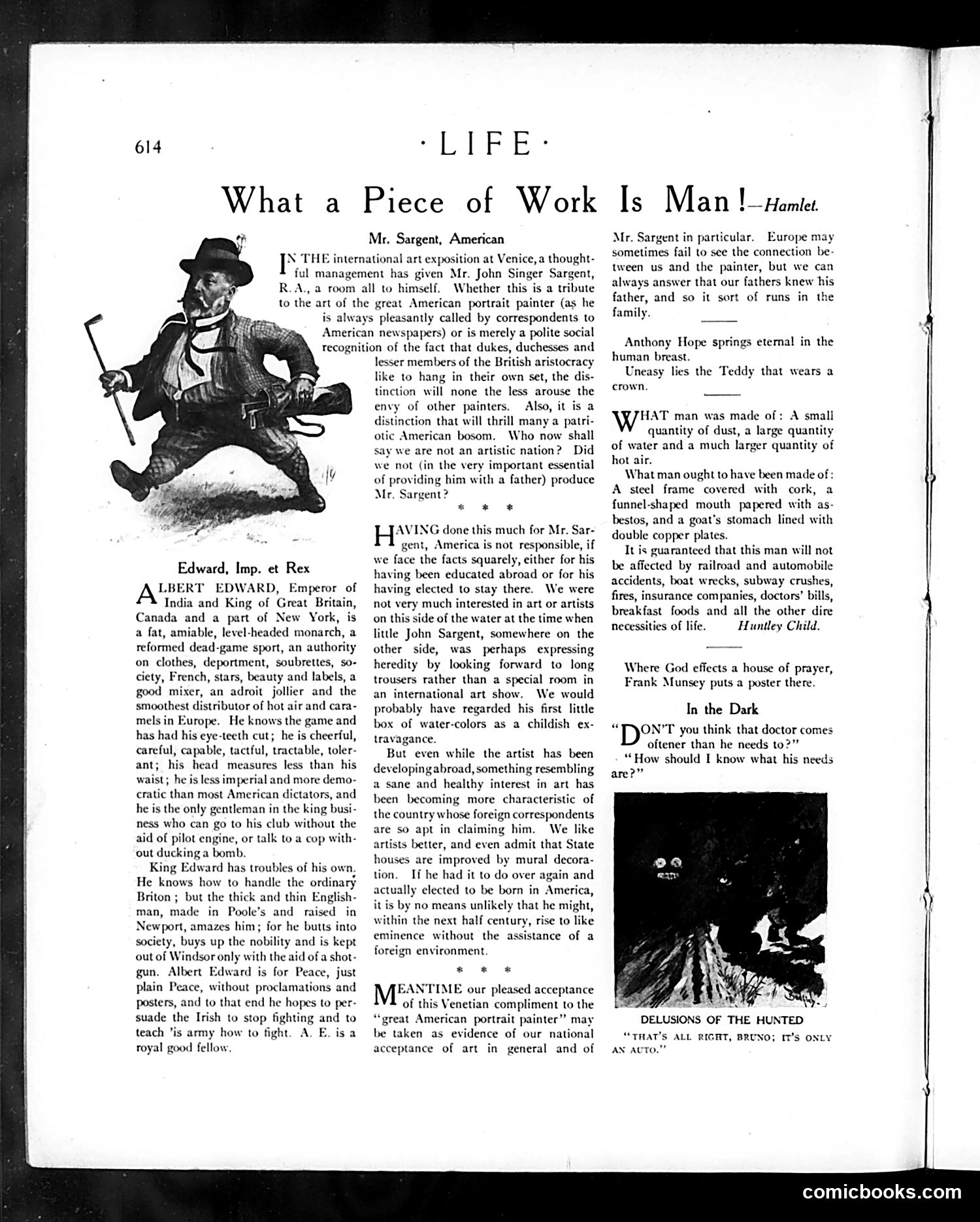
This page satirizes American cultural pretensions and the painter John Singer Sargent's international prominence. The main text celebrates Sargent receiving his own room at the Venice art exposition, presenting this as evidence of American artistic legitimacy. Life's satire is biting: Americans claim Sargent as "their" artist despite his European training and residence, boasting he proves "we are not an artistic nation"—the contradiction itself is the joke. The article mocks American pride in merely *producing* Sargent's father, as if paternity alone counts as cultural contribution. Life suggests Americans previously dismissed art as frivolous ("childish extravagance") but now retroactively claim Sargent as a national asset once Europe validated him. The secondary section profiles King Edward VII, using similar satirical tone toward British society and American social-climbers. The cartoons illustrate these themes of pretension and social climbing, though specific figures are unclear from the image alone.
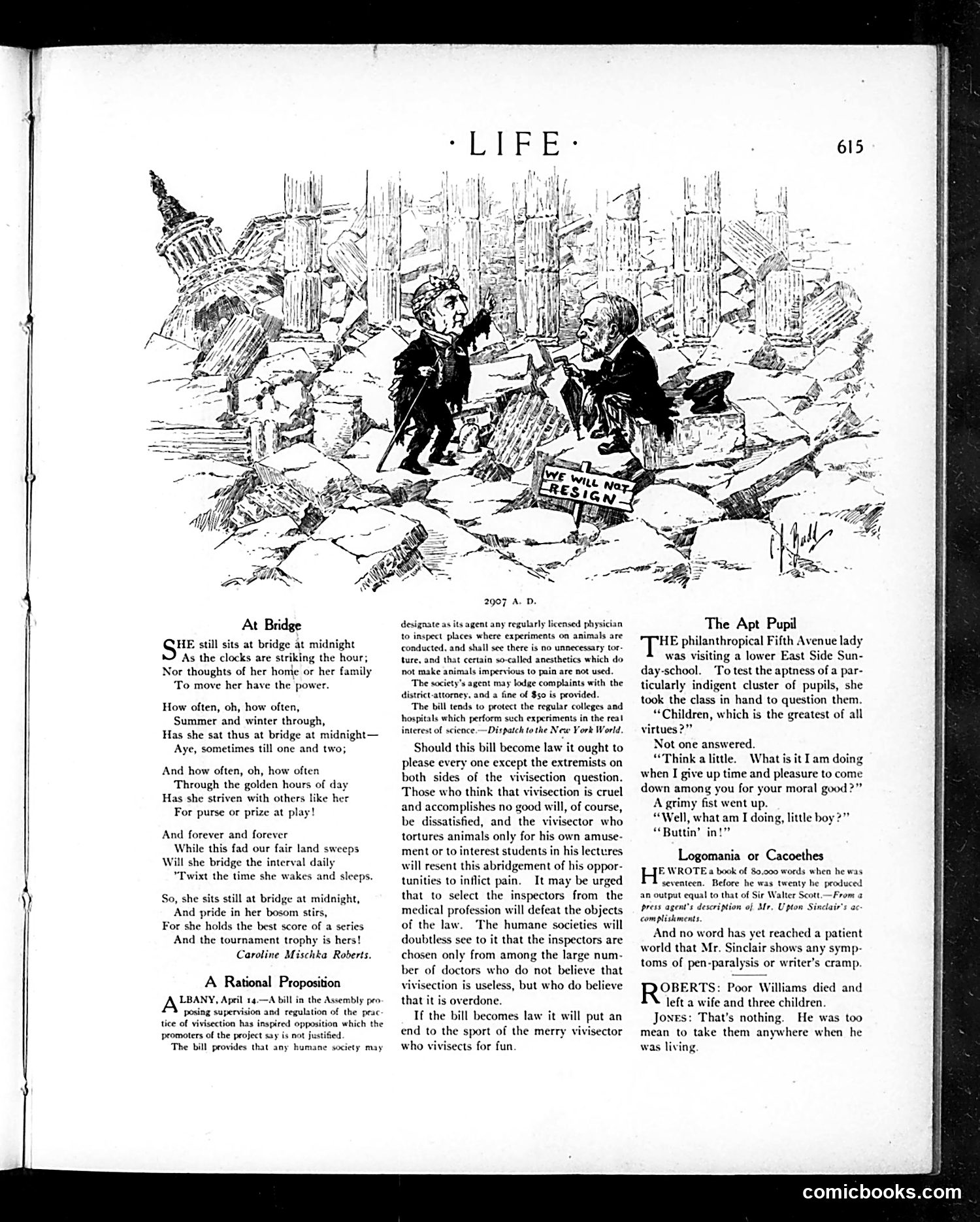
This page contains three distinct pieces satirizing early 1900s American society: **"At Bridge"** critiques upper-class women's obsession with card games, depicting a woman so consumed by bridge that she plays nightly while neglecting family responsibilities. The satire suggests this leisure pursuit has become a social epidemic among wealthy women. **"A Rational Proposition"** addresses a New York Assembly bill regulating vivisection (animal experimentation). The piece ironically supports oversight while acknowledging opposition from "extremists" on both sides—those opposing all animal testing and those performing experiments purely for entertainment or shock value in lectures. **"The Apt Pupil"** mocks philanthropic pretension: a Fifth Avenue society lady visits a lower East Side Sunday school to teach morality, but a street-smart child cuts through her self-righteousness by calling out her performative charity as mere "buttin' in." The cartoon at top depicts the ruined Capitol, illustrating apocalyptic decay—likely commentary on political corruption or societal decline.
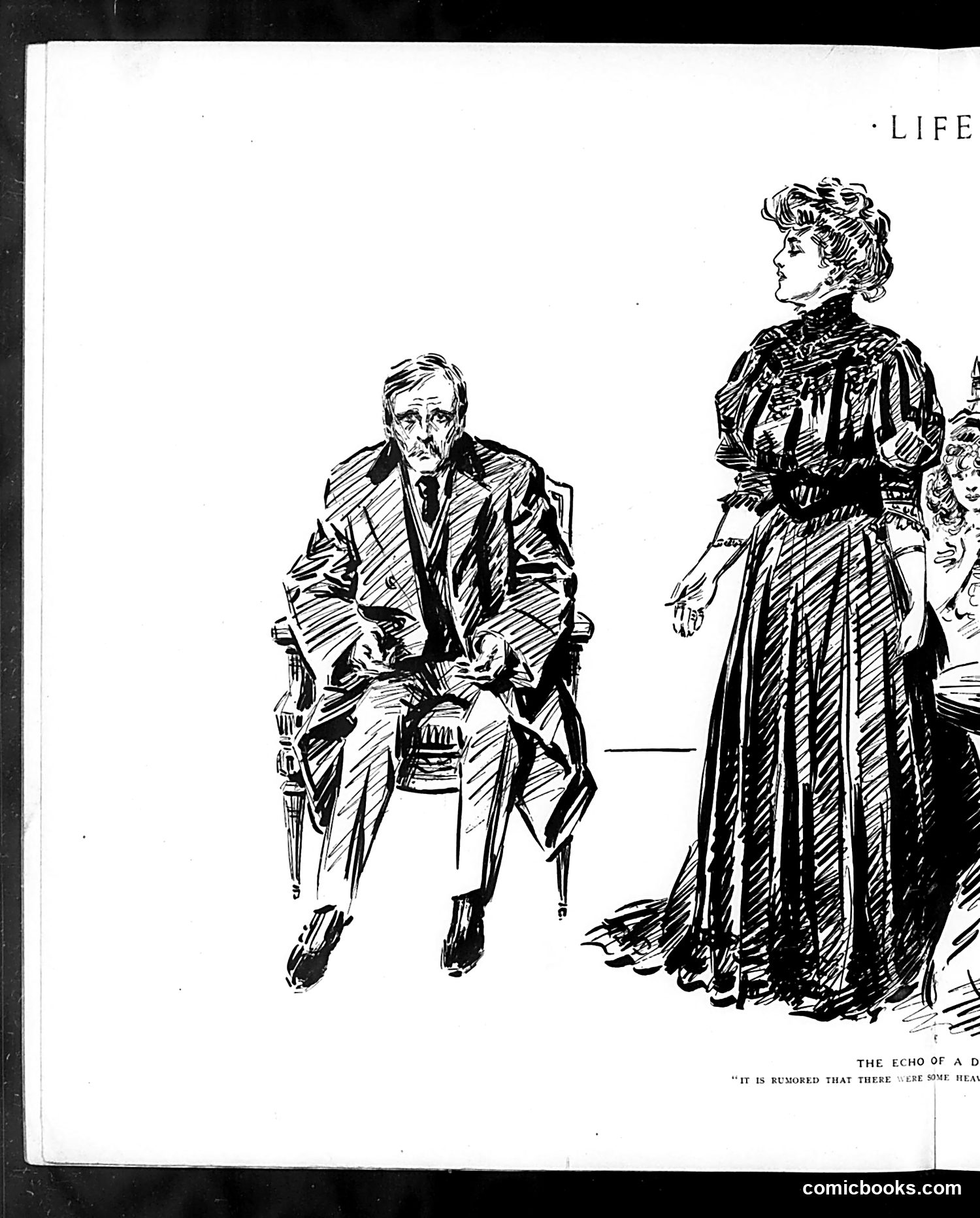
This page from *Life* magazine features a black-and-white sketch showing two figures in early 1900s dress: a seated man in a business suit looking troubled or concerned, and a standing woman in an elaborate high-collared gown with puffy sleeves. The caption reads "THE ECHO OF A D[...]" with incomplete text "IT IS RUMORED THAT THERE...ERE SOME HEA[...]" The OCR is too corrupted to determine the specific satirical point or identify the individuals depicted. The artistic style and clothing suggest Gilded Age or Progressive Era commentary, but without legible caption text, I cannot confidently explain what social or political situation this cartoon satirizes or which public figures it references.
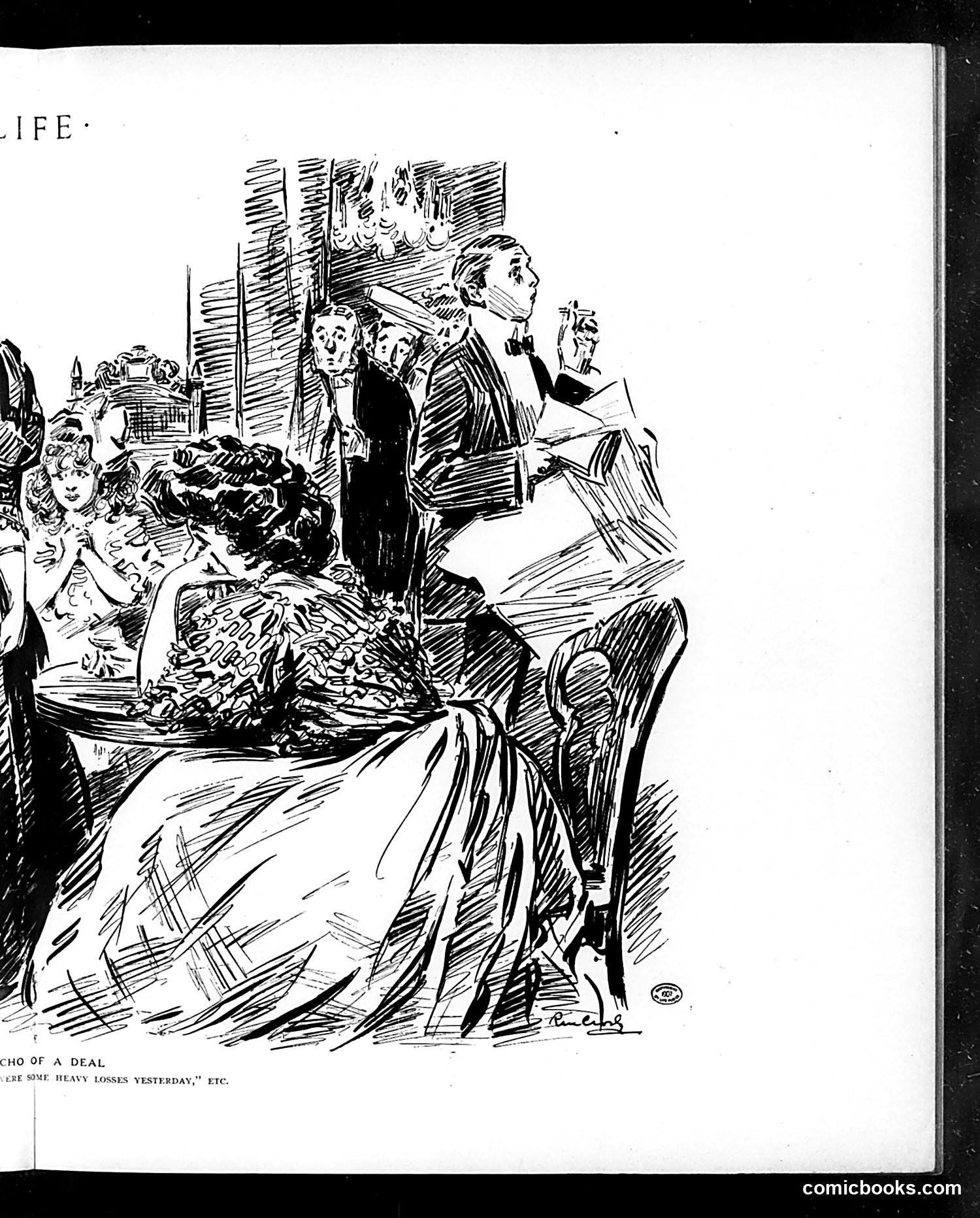
This is a satirical cartoon from *Life* magazine depicting what appears to be a high-society or political negotiation scene. The OCR text fragment "ECHO OF A DEAL" and partial text "ERE SOME HEAVY LOSSES 'YESTERDAY,' ETC." suggest commentary on financial or political losses. The scene shows well-dressed men in formal attire conducting business while an elegantly dressed woman in an elaborate gown sits prominently in the foreground. The cartoon's style and composition suggest satire about wealth, power dynamics, or potentially shady dealings conducted within polite society. Without the complete caption or publication date visible, I cannot definitively identify the specific political figures or financial event being referenced. The satire appears to critique either a business transaction or political agreement viewed as questionable by the cartoonist.
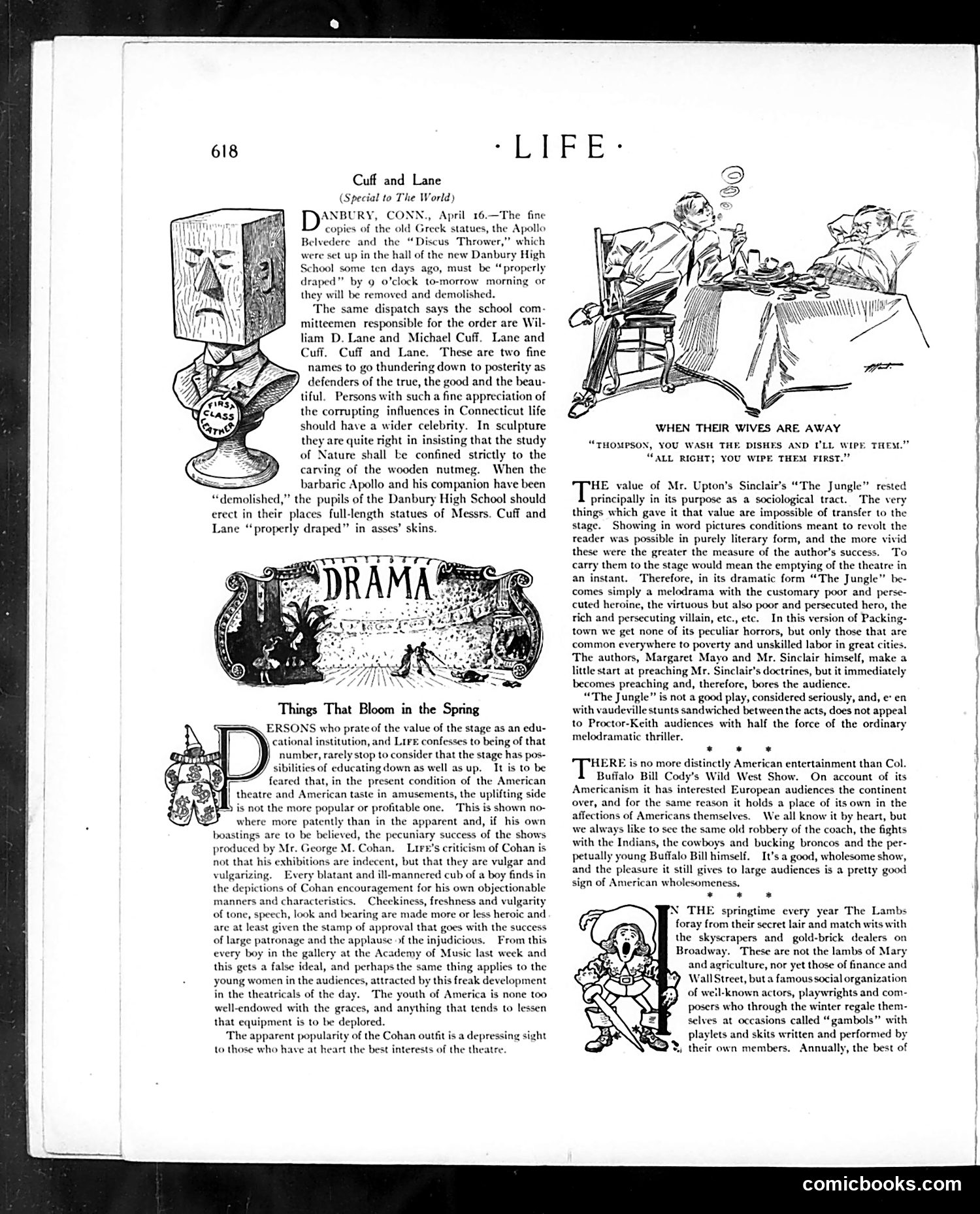
This page contains two separate satirical pieces: **"Cuff and Lane"** mocks Connecticut school officials who ordered Greek statues (the Apollo Belvedere and Discus Thrower) in Danbury High School's new hall to be "properly draped" by morning or removed. Life sarcastically praises Lane and Cuff as defenders of morality, then suggests they deserve full-length statues erected in their place—"properly draped in asses' skins." The joke: equating prudish censorship of classical art with donkey stupidity. This reflects early 20th-century tensions between Victorian modesty and artistic freedom. **"Things That Bloom in the Spring"** criticizes Broadway impresario George M. Cohan's theatrical productions as vulgar and morally corrupting to American youth, particularly young men in gallery audiences. Life argues Cohan's shows encourage "checkiness, freshness and vulgarity" rather than education or refinement. The piece laments that profitable entertainment appeals to base instincts rather than elevating public taste—a common Progressive-era complaint about mass culture. Both pieces reflect upper-class anxieties about American manners and morality.
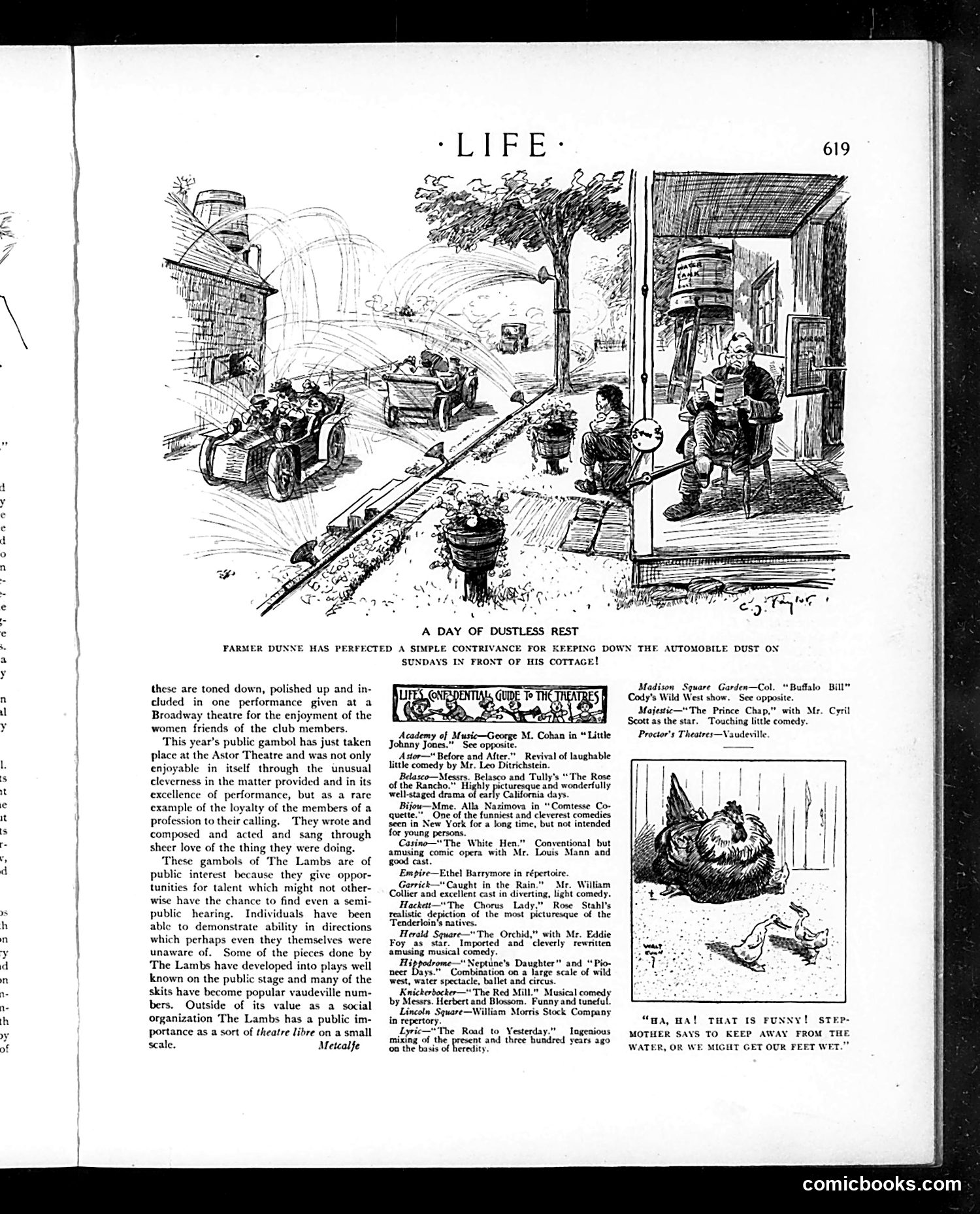
The main cartoon, titled "A Day of Dustless Rest," satirizes an early automotive-age problem: dust from automobiles on rural roads. A farmer has rigged a simple water-spraying contraption along his property line to keep down dust on Sundays when cars pass his cottage. The sketch shows various people and vehicles enjoying a dust-free day as a result. The smaller cartoon below depicts a stepmother warning children to avoid water because "we might get our feet wet"—a humorous non-sequitur playing on exaggerated parental caution. The page also lists Broadway theater offerings from the era, showcasing popular plays and performers like Ethel Barrymore. The text discusses The Lambs, a theatrical club whose annual amateur performances provided talent discovery opportunities, functioning as an experimental theater.
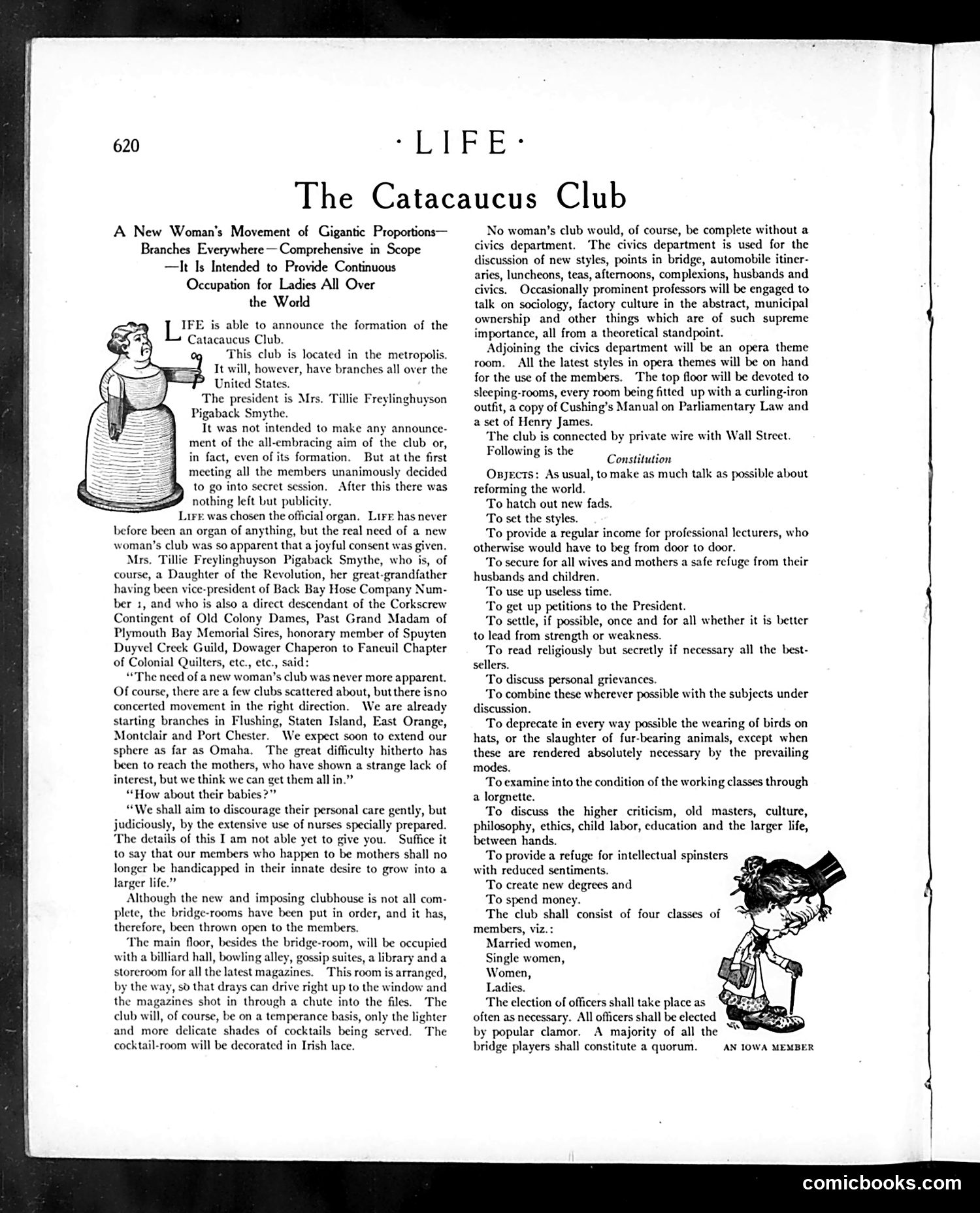
This *Life* magazine article satirizes the emerging women's club movement of the early 1900s through mock-serious description of a fictional organization. The satire targets wealthy, leisured women claiming progressive intentions while remaining frivolous. The club's president, Mrs. Tillie Freylinghuyson Pigaback Smythe, is a caricature: her absurdly long pedigree (Daughters of the Revolution, etc.) signals old-money pretension. The club's stated objectives—"reform the world," discuss civics—contrast absurdly with actual activities: bridge tournaments, gossip, discussing "husbands and complexions." The "civics department" devoted to fashion and bridge, and the "opera theme room," reveal the satire's core joke: women's clubs presented themselves as serious intellectual and civic institutions while remaining occupied with entertainment and vanity. The dismissal of childcare ("discourage personal care...by nurses") mocks women's claimed desire for independence. The overall tone suggests skepticism about female activism's genuine social impact.
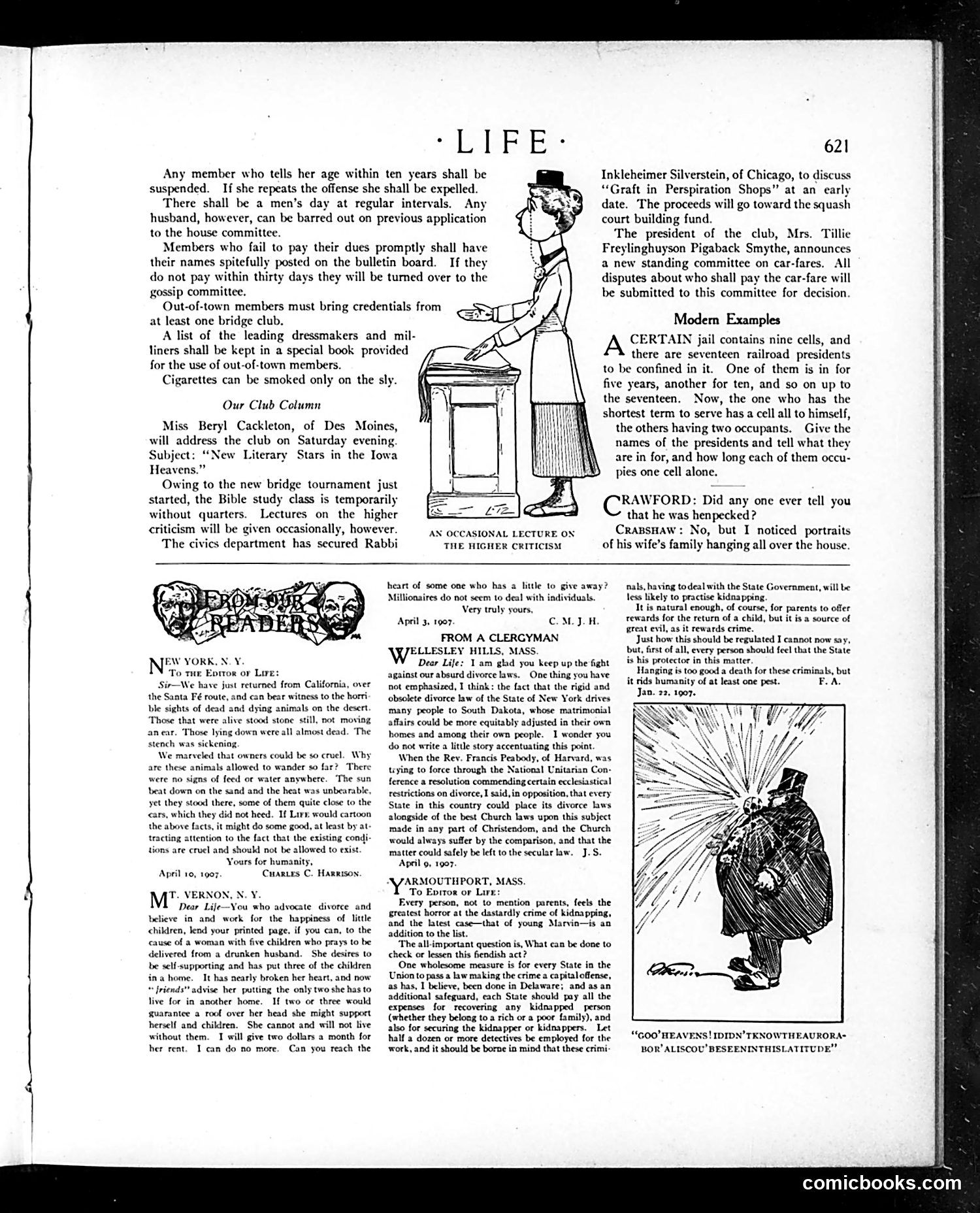
This page satirizes women's club culture and social pretensions of the Gilded Age. The main cartoon depicts a woman depositing something in a ballot box labeled "AN OCCASIONAL LECTURE ON THE HIGHER CRITICISM," mocking how women's clubs mixed frivolous activities (bridge tournaments, fashion gossip) with claims of intellectual substance (Bible study, lectures on theology). The club rules at top ridicule female club members: suspending women for revealing their age, enforcing dues payment via public shaming on a "gossip committee," and requiring members to smoke cigarettes "on the sly"—all poking fun at women's social pretensions and hypocrisy. The "Modern Examples" section presents a logic puzzle about jailed railroad presidents, likely referencing contemporary corporate scandals and the public perception that wealthy industrialists faced minimal legal consequences. The readers' letters address serious social issues—animal cruelty and divorce—contrasting sharply with the frivolous club culture mocked above, suggesting the magazine's critique of misplaced priorities among privileged women.
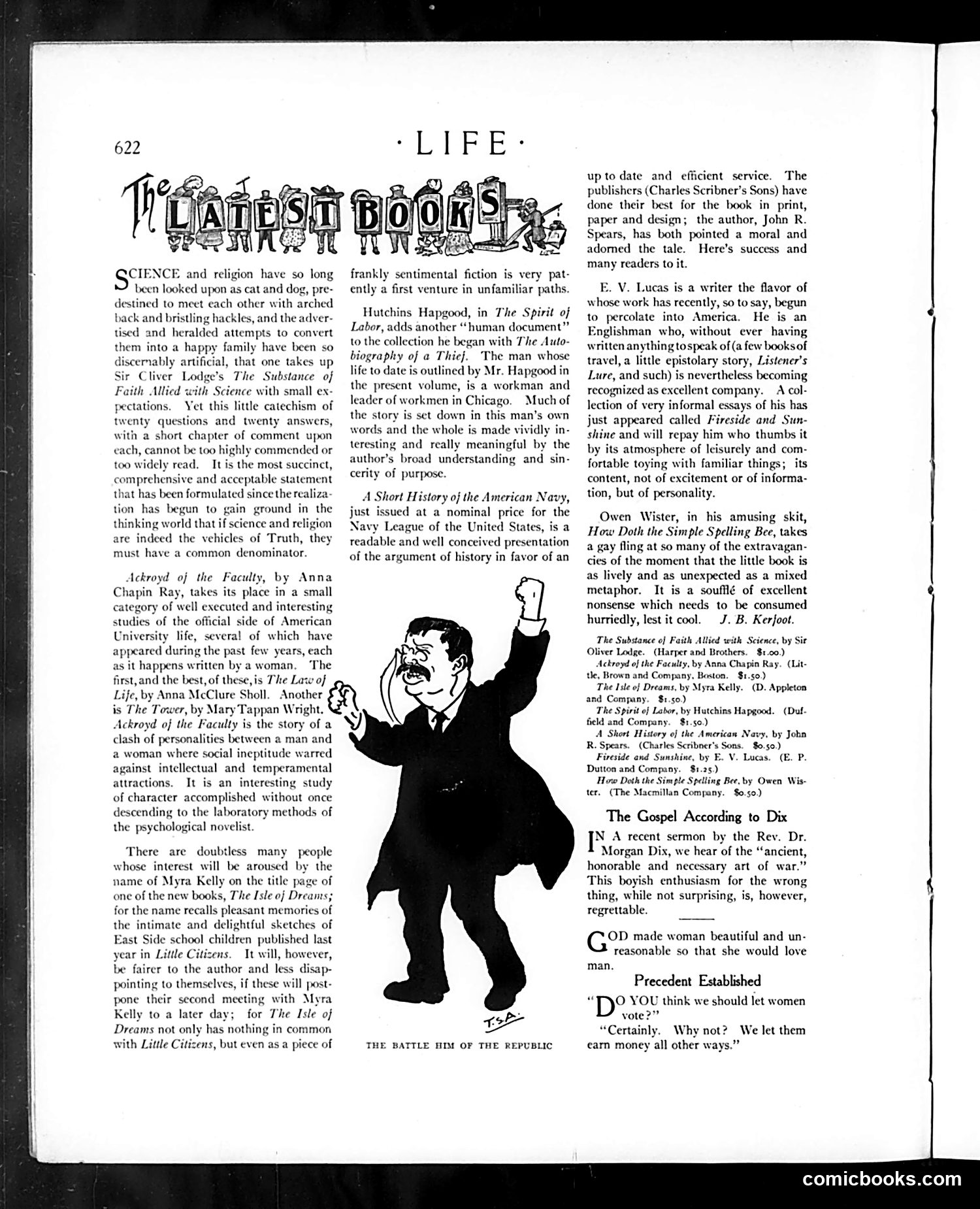
This political cartoon depicts a caricatured figure—likely representing a political opponent or ideological adversary—in an exaggerated fighting stance with a raised fist. The caption "THE BATTLE HIM OF THE REPUBLIC" (possibly a play on words, though the text is unclear) suggests this represents a symbolic struggle over the nation's future. The cartoon appears in Life magazine's book review section, accompanying discussions of contemporary works on science, religion, labor, and American naval power. Given the page's intellectual content and the figure's aggressive posture, this likely satirizes debates over modernism, labor organizing, or progressive politics that characterized early 20th-century American discourse. The specific identity of the caricatured figure remains unclear from the image alone.
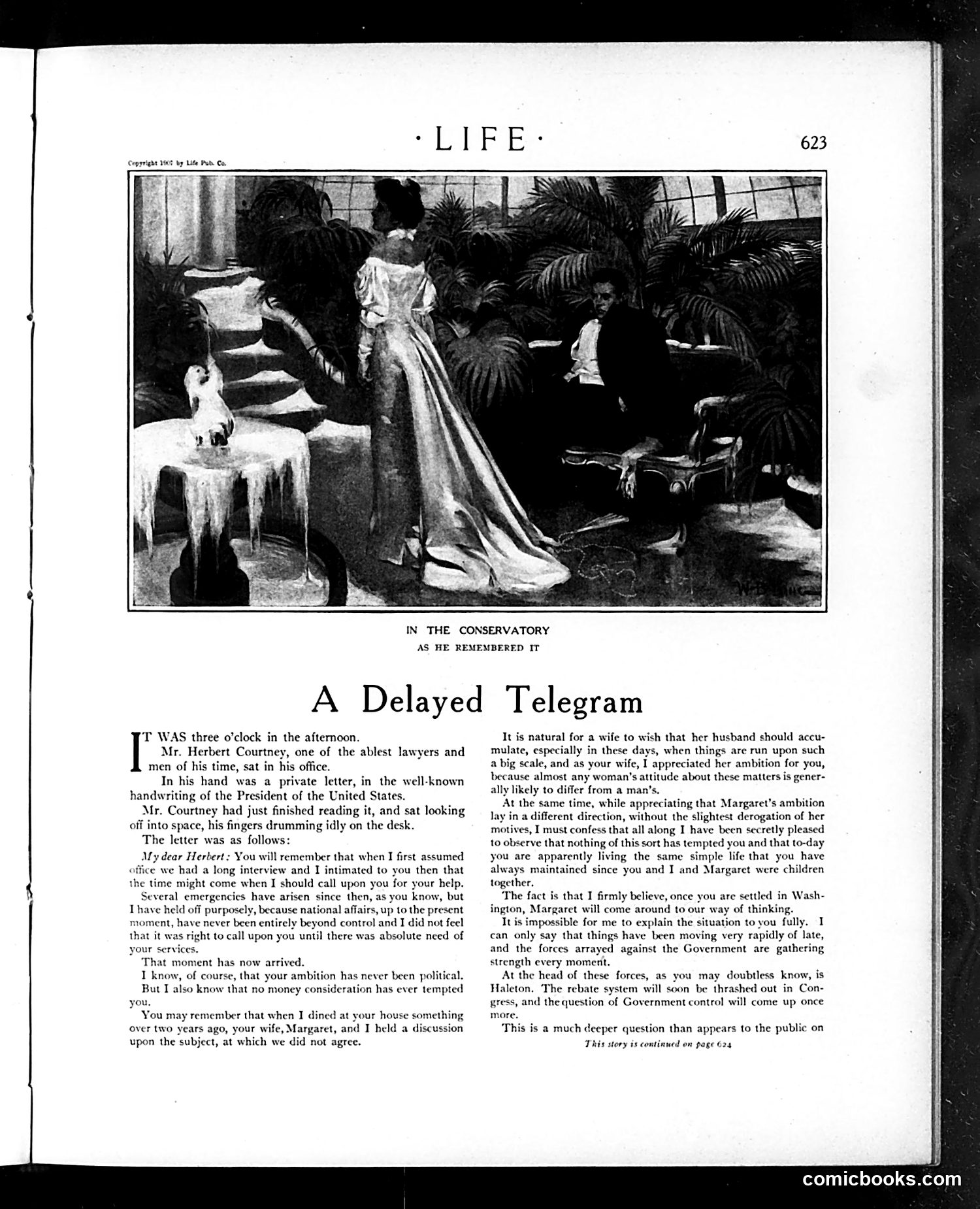
This appears to be the opening of a serialized political fiction story rather than a cartoon. The narrative depicts a lawyer, Herbert Courtney, receiving a private letter from the President of the United States requesting his service in Washington. The story engages with early 20th-century Progressive Era politics: it references railroad **rebate systems** and **Government control**—major reform issues of that period—and mentions an antagonist named Haleton who heads "forces arrayed against the Government." The illustration shows a conservatory scene, apparently depicting Courtney's memory of a dinner where the President, Courtney's wife Margaret, and Courtney discussed ambition and public service. The narrative emphasizes themes of duty, sacrifice, and marital disagreement over political involvement. Without seeing the continuation, the satire's specific target remains unclear, though it appears to critique wealthy lawyers' reluctance toward civic responsibility and wives' material ambitions versus patriotic duty.
This page presents a serialized political fiction story rather than a cartoon. The narrative depicts a conflict between **Courtney** (apparently a prominent businessman being recruited) and **Haleton** (a wealthy financier), both trying to influence the other regarding a Cabinet position the President has offered Courtney. The satire targets **financial elites versus democratic governance**. Haleton argues the President's policies will cause economic ruin and claims only financiers understand how to "handle" the common people ("with kid gloves"). He's attempting to block Courtney's acceptance by appealing to business interests over patriotic duty. The piece appears critical of wealthy financiers who position themselves as essential to national stability while actually seeking to control government policy for their own interests. Courtney's willingness to serve despite "no money consideration" frames patriotism against financial self-interest—a common Progressive Era satirical theme questioning whether unelected business leaders should influence executive decisions. The story's continuation is promised ("Continued on page 650").
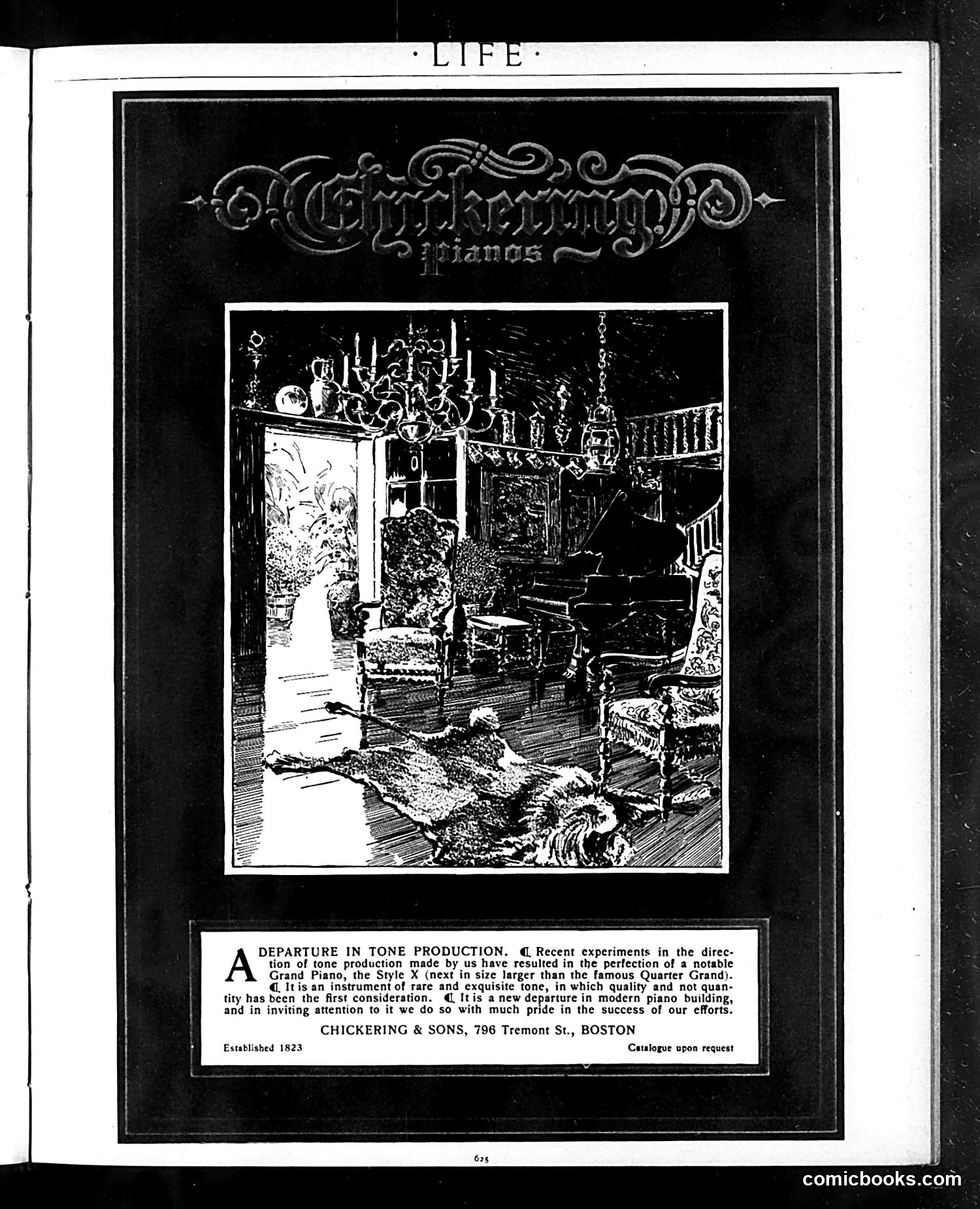
This is not a cartoon or satirical content—it's an **advertisement** for Chickering & Sons pianos, a Boston manufacturer established 1823. The full-page ad features: - **Ornamental header** reading "Chickering Pianos" in elaborate Victorian lettering - **Interior illustration** showing an elegant parlor with a grand piano, potted plants, chandelier, and furniture, depicting the aspirational domestic setting where such pianos belonged - **Marketing text** emphasizing their new "Style X" piano, stressing "rare and exquisite tone" and "quality" over quantity—positioning it as a luxury product for refined households The image reflects early 20th-century upper-class consumer culture: pianos as status symbols and centerpieces of genteel home life. This type of full-page advertising was common in *Life* magazine, which supported itself through such placements while running satirical content elsewhere.
This page satirizes political ambition and spousal influence in early-20th-century American politics. The narrative depicts Herbert's wife pressuring him to accept a government position (worth $8,000 annually) after she's engineered an introduction to wealthy financier Phineas Haleton, who supposedly wants to help Herbert's career. The satire targets: (1) the wife's mercenary ambitions disguised as family concern; (2) the corruption of political appointments through wealthy businessmen's patronage; (3) Herbert's apparent passivity and susceptibility to manipulation. The joke hinges on how easily political positions are bartered through personal connections rather than merit—the wife admits to "pumping" Haleton for information and orchestrating the entire arrangement. This reflects Progressive Era anxieties about cronyism and the influence of industrial wealth on government, presenting it as darkly comedic rather than shocking.
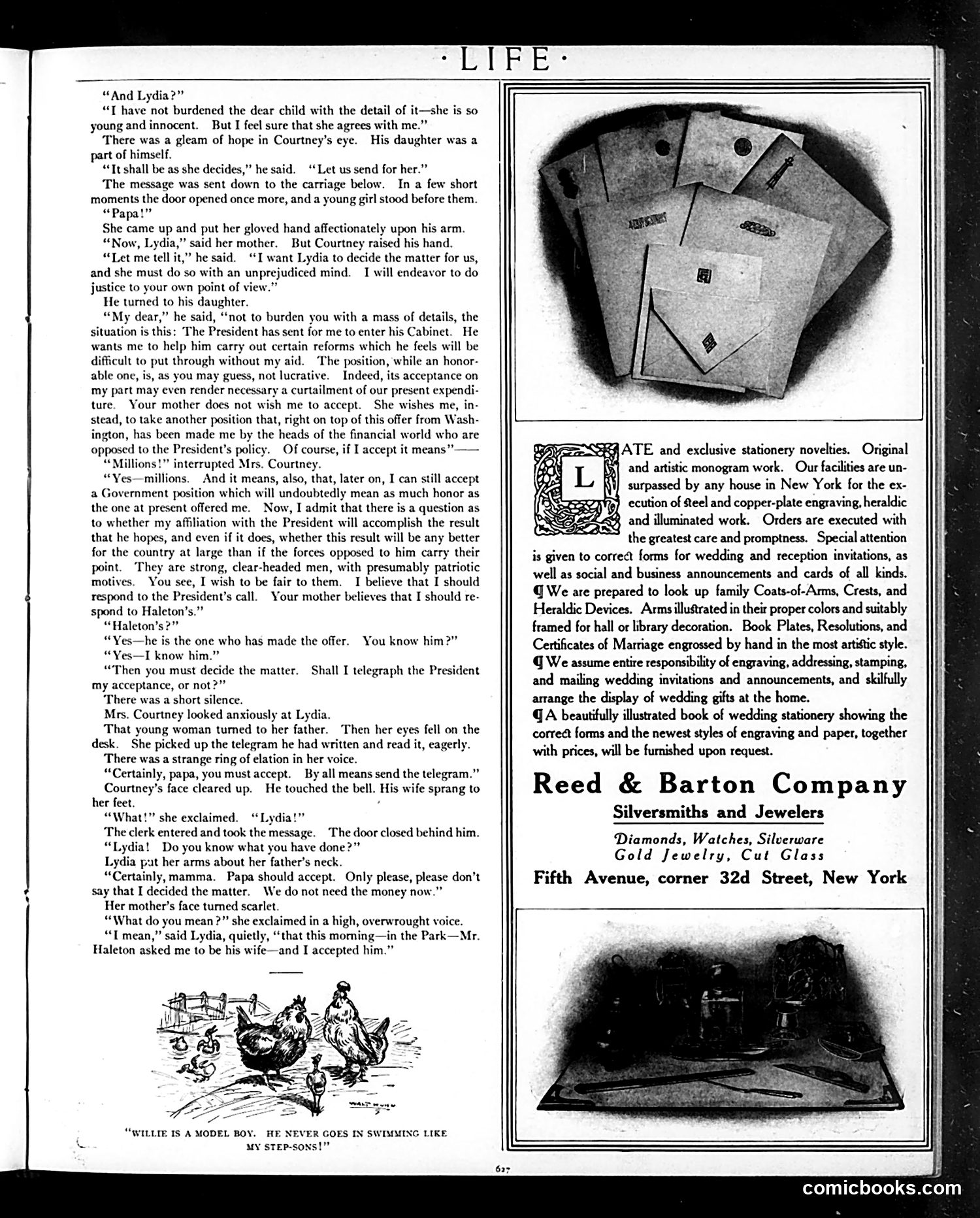
This page presents a serialized domestic drama rather than a political cartoon. The story depicts a moral dilemma: Mr. Courtney must choose between accepting a Cabinet position under the President (requiring financial sacrifice) or taking a lucrative private sector job from wealthy industrialists opposed to the President's reforms. The satire targets the conflict between civic duty and personal gain during the Progressive Era. Courtney frames the decision as principle-driven, letting his daughter Lydia decide. Her choice to accept the Cabinet position appears noble—until the final reveal: she has accepted a marriage proposal from Haleton, the wealthy financier, that morning. The joke undercuts Courtney's moral posturing: his daughter's "principled" decision is actually motivated by her impending wealth through marriage, not patriotism. The satire suggests that even seemingly idealistic choices are compromised by material self-interest.
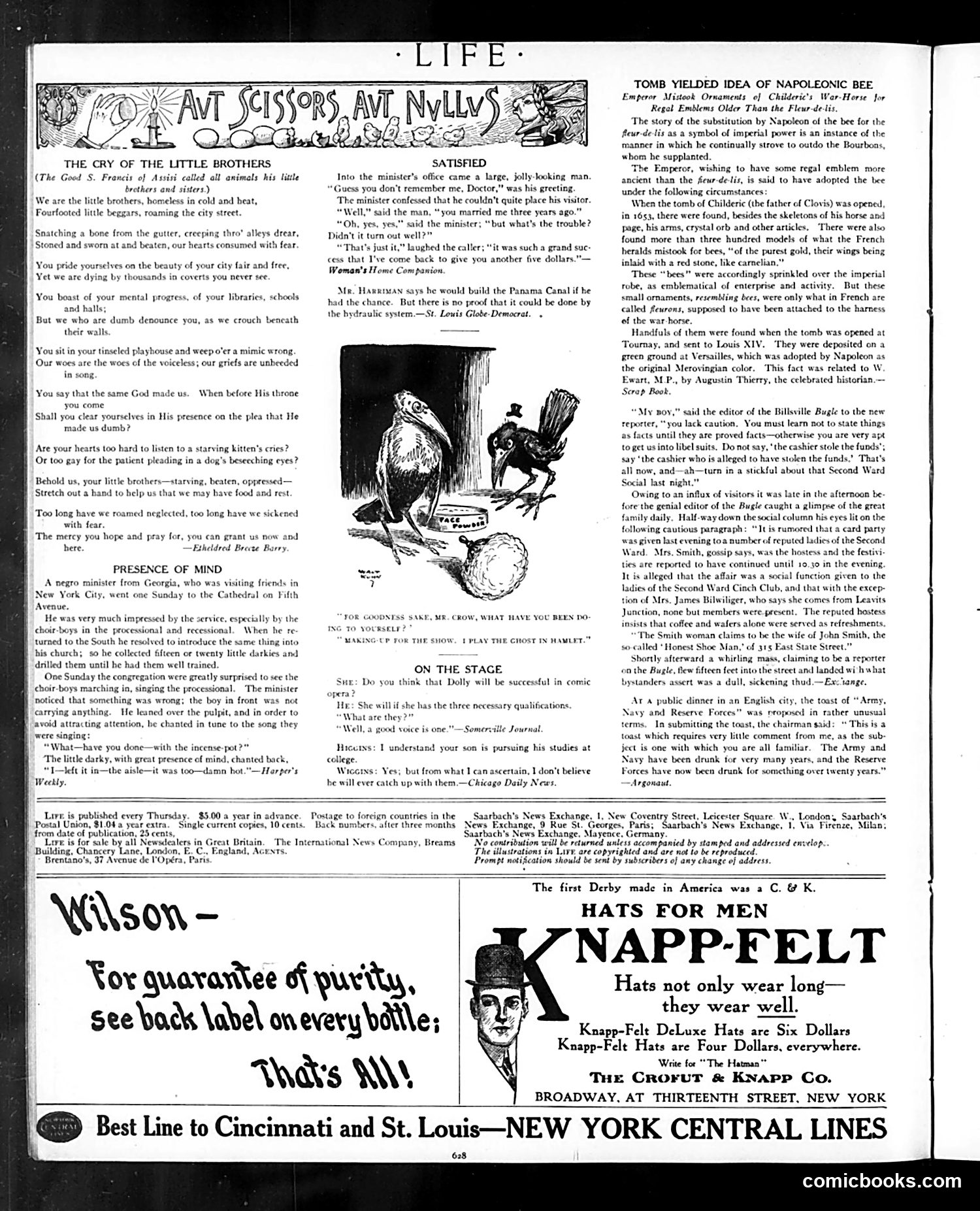
This page from *Life* magazine contains several distinct satirical pieces: **"The Cry of the Little Brothers"** is a sentimental poem about mistreated stray animals in cities, written from the animals' perspective. It appeals to readers' conscience about urban animal suffering. **"Presence of Mind"** is a joke about a Black minister from Georgia who attempts to replicate a cathedral choir processional in his church. The humor relies on racial stereotypes—the "punchline" is a young Black choir boy's profane response ("damn hot"), presented as amusing "dialect humor" typical of that era's casual racism. **"Satisfied"** is a brief anecdote about a man thanking a minister for a successful marriage, offering him money as gratitude—straightforward humor about marital contentment. Other short jokes follow standard formats of the period. The page also includes advertisements for Wilson whiskey, Knapp-Felt hats, and New York Central Lines. The content reflects early 20th-century magazine humor standards, including casual racism in dialect jokes that modern audiences would recognize as offensive.
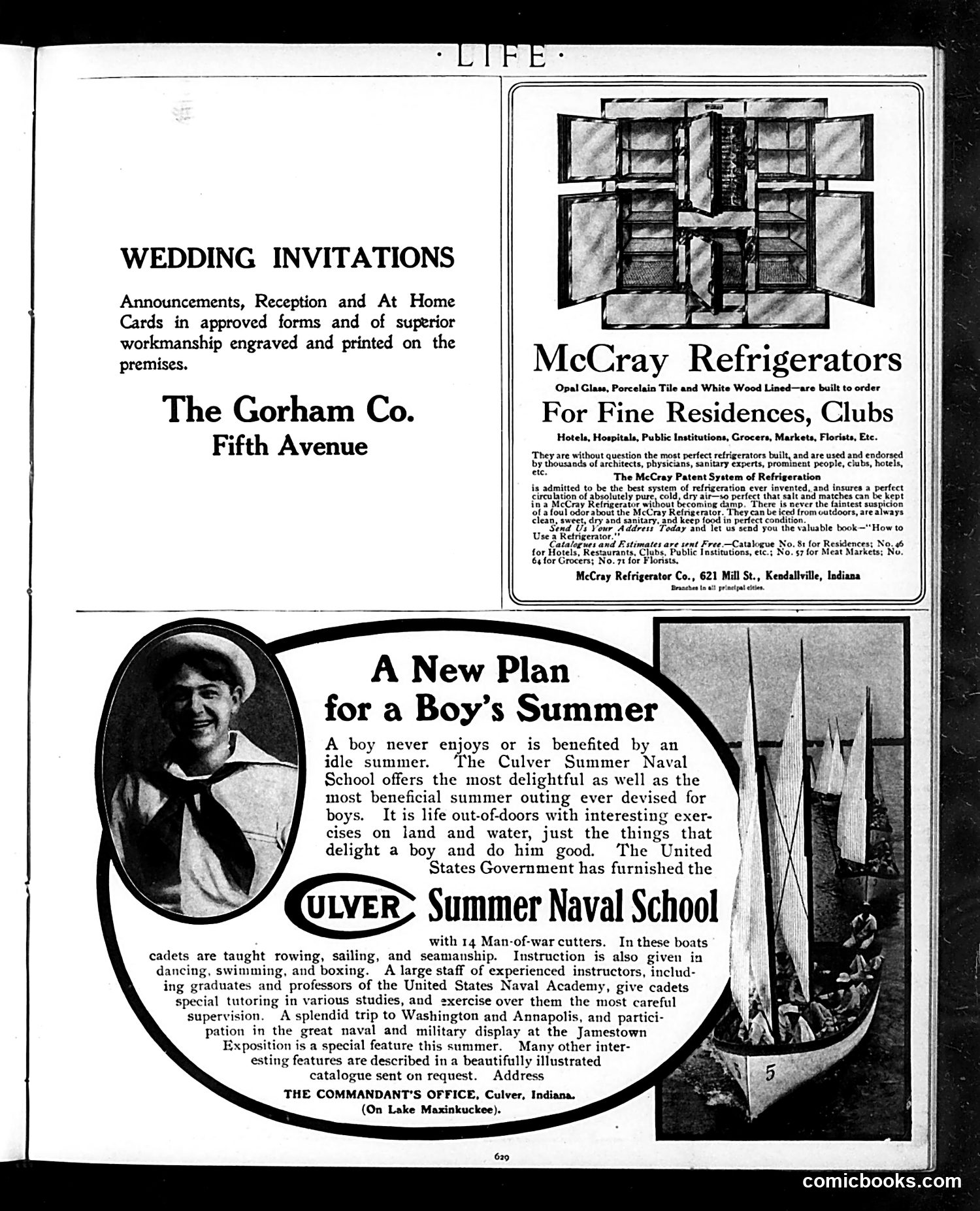
This is primarily an **advertising page** rather than satirical content. It contains three distinct ads: 1. **The Gorham Co.** (top left): Advertises wedding invitations and stationery services on Fifth Avenue—targeting wealthy clients. 2. **McCray Refrigerators** (top right): Promotes high-end iceboxes for "Fine Residences, Clubs" and commercial establishments, emphasizing their superior cooling system and sanitary design—a luxury appliance for the wealthy and institutions. 3. **Culver Summer Naval School** (bottom): The main feature ad promoting a boys' summer program offering naval training, academics, and a trip to the Jamestown Exposition. It positions the school as character-building through military discipline and outdoor activities. The page reflects early 20th-century advertising aimed at affluent readers—wedding services, luxury appliances, and expensive boarding school programs. There is no apparent satire; these are straightforward commercial appeals typical of Life magazine's revenue model.
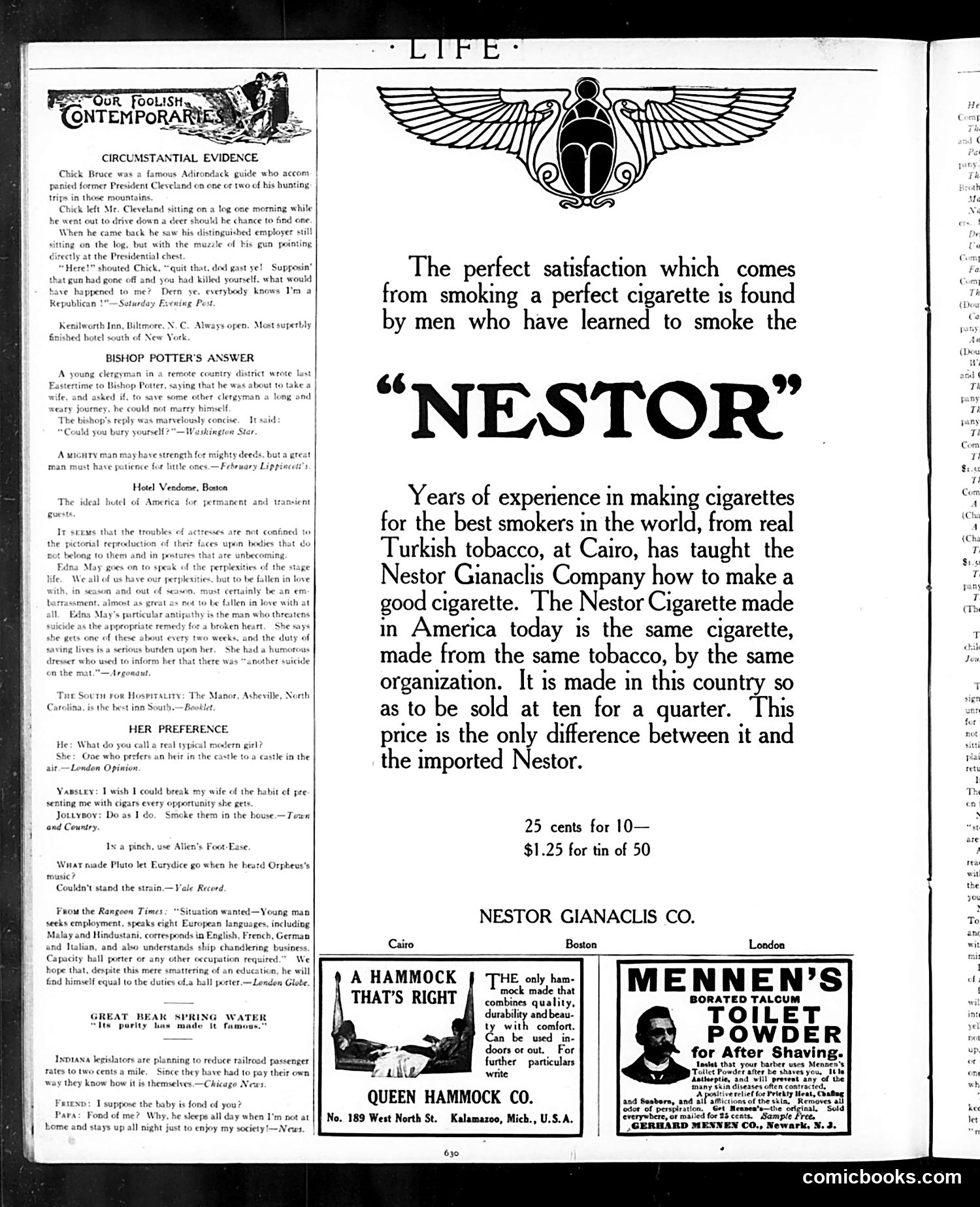
This page is primarily **advertising**, not satire or political commentary. It features the main Nestor cigarette advertisement alongside smaller ads for Queen Hammock Company and Mennen's Toilet Powder. The Nestor ad emphasizes that American-made cigarettes now match imported quality. It references the Nestor Gianaclis Company's Egyptian origins and Turkish tobacco expertise, claiming their American production achieves identical quality at lower cost (ten for a quarter versus imported versions). This reflects early 20th-century consumer anxiety about domestic versus foreign goods—reassuring Americans that domestic products weren't inferior knockoffs. The left column contains unrelated humor pieces ("Our Foolish Contemporaries"), including anecdotes about Cleveland hunting, Bishop Potter, and marital advice. These are joke submissions, not connected to the advertisements. The hammock and shaving powder ads use typical period marketing: emphasizing comfort/quality and endorsing barber-shop products for home use.
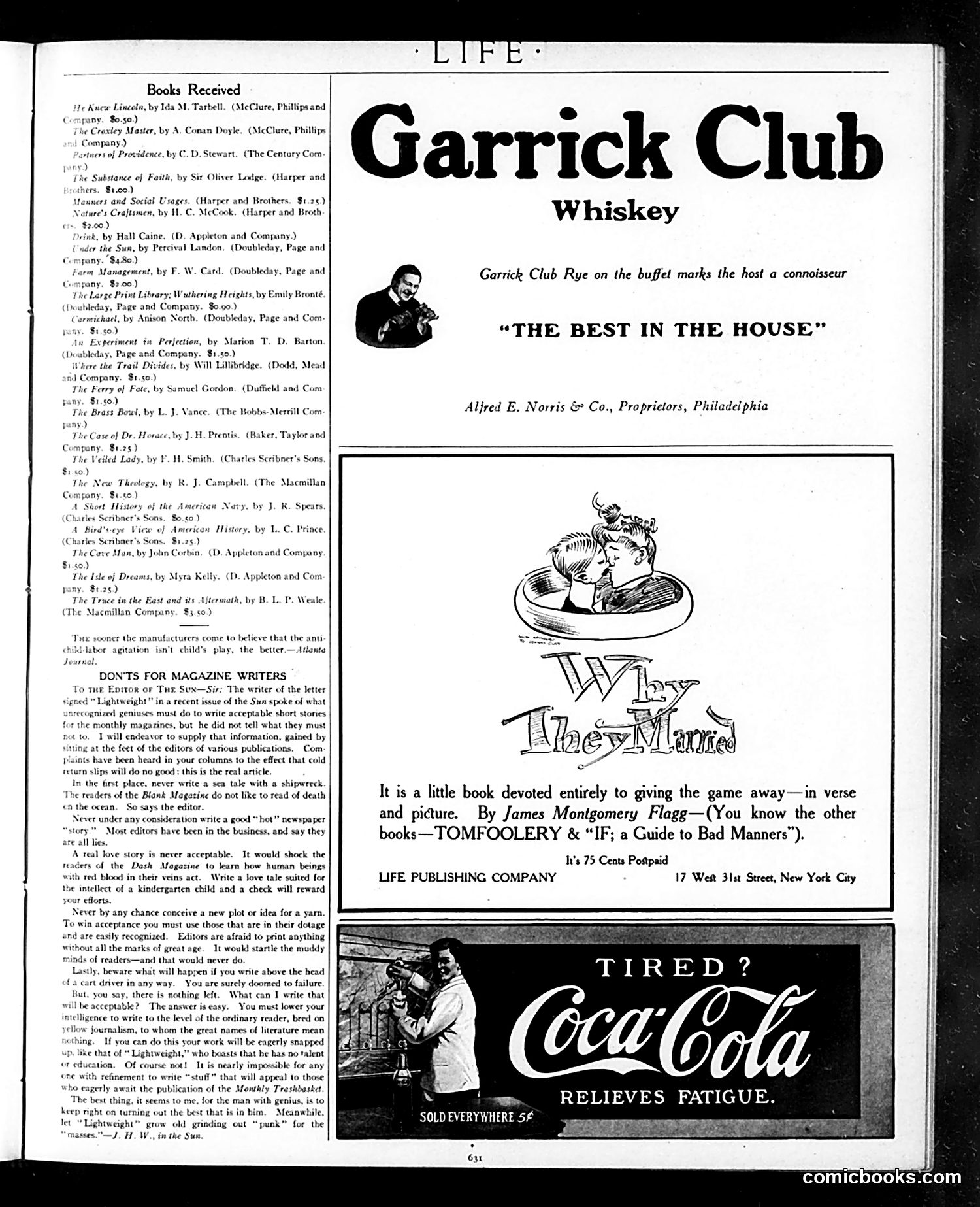
This page contains book reviews and advice to magazine writers, with advertisements rather than political cartoons. The "Don'ts for Magazine Writers" section is satirical guidance mocking editorial conservatism. It advises writers to avoid shipwrecks, realistic love stories, original plots, and intellectual content—instead catering to lowest-common-denominator readers. The satire critiques how commercial magazines demand mediocrity, with the closing jab that successful writers like "Lightweight" succeed precisely *because* they lack talent and education. The advertisements include **Garrick Club Whiskey** (marketed as "the best in the house") and **Coca-Cola** (claiming to "relieve fatigue"). The page primarily concerns literary publishing standards and commercial magazine culture of the early 1900s, not political satire.
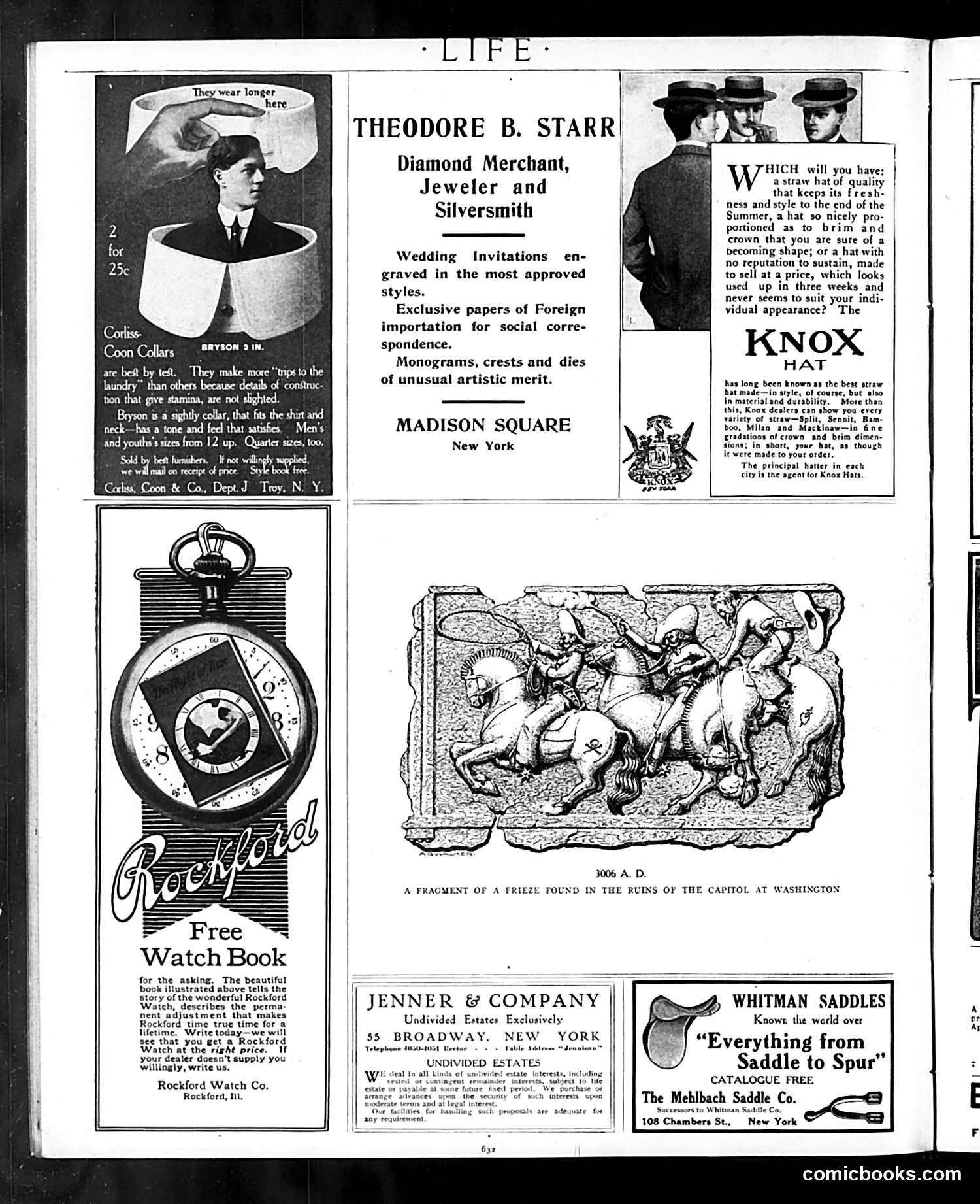
This page is primarily **advertising**, not political satire. It contains commercial advertisements for luxury goods and services typical of early 20th-century Life magazine: - **Coon Collars** (detachable shirt collars) - **Theodore B. Starr** (jeweler and silversmith in Madison Square, New York) - **Knox Hats** (premium straw hats for summer wear) - **Rockford Watches** (pocket watches) - **Jenner & Company** (estate services on Broadway) - **Whitman Saddles** (equestrian equipment) The single non-advertisement image is a classical frieze labeled "A Fragment of a Frieze Found in the Ruins of the Capitol at Washington"—depicting mythological or allegorical figures. Its purpose or satirical intent is unclear from the visible context. The page functions as a commercial product showcase for affluent readers rather than political commentary or satire.
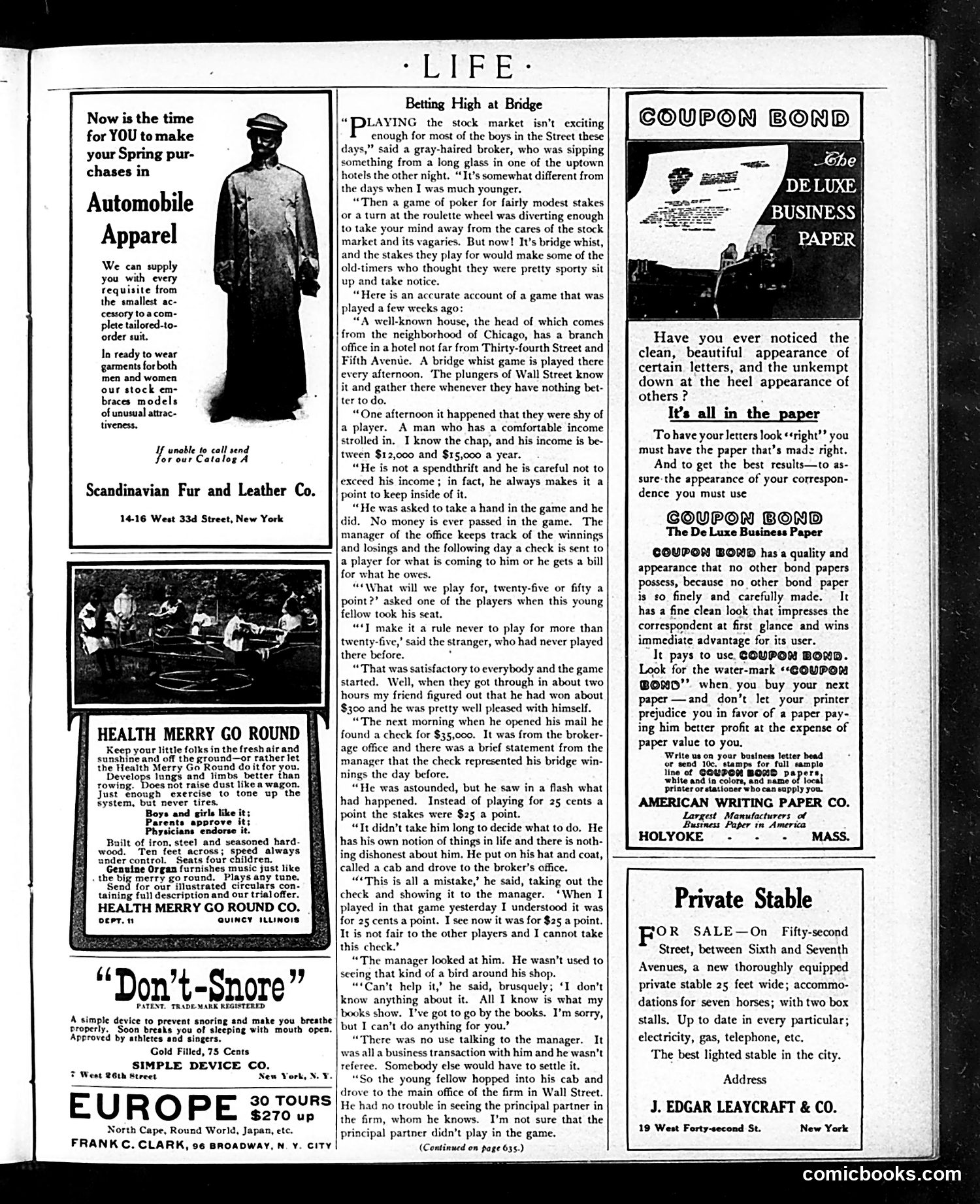
This page combines **advertisements** (automobile apparel, children's merry-go-round, anti-snoring device, European tours) with a satirical article titled **"Betting High at Bridge."** The article mocks wealthy Wall Street brokers and financiers who, finding stock market speculation insufficiently exciting, have escalated to high-stakes bridge whist games. The narrative describes a moderately wealthy man ($12,000-$15,000 annual income) joining an afternoon card game at a hotel office, where players bet substantial sums per point—then discovering he's won far more than expected and faces consequences. The satire targets the **reckless gambling culture** among financial elites during the pre-1920s era, portraying bridge as their newest addiction. The "young fellow's" modest restraint ("never play for more than twenty-five a point") contrasts sharply with the aggressive betting culture surrounding him, highlighting how normalized high-stakes wagering had become among the wealthy.
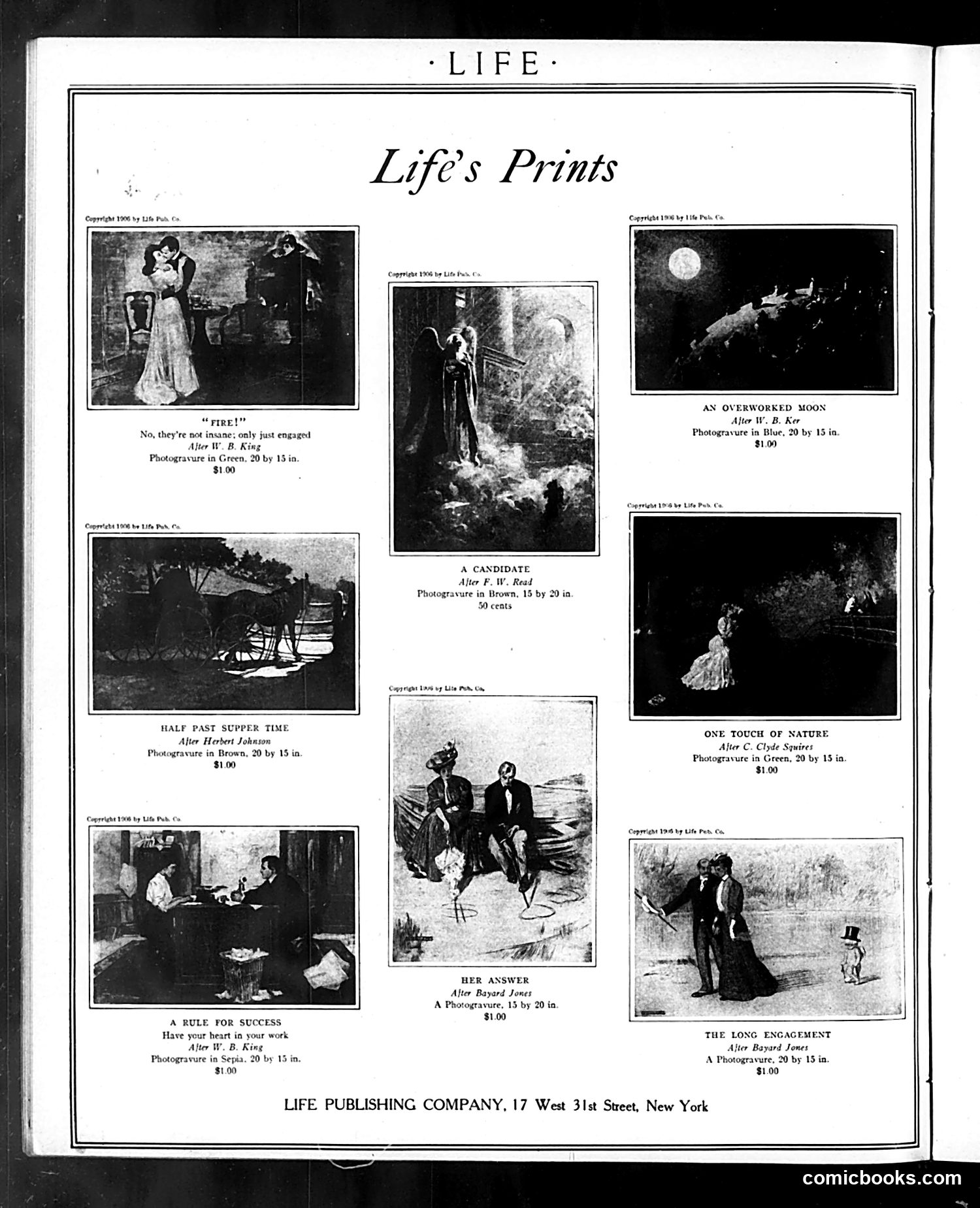
This is a catalog page advertising Life magazine's art prints (circa 1908), not political cartoons. It showcases satirical illustrations about courtship, romance, and early 20th-century social life—the actual substance of Life's humor during this era. The titles reveal the jokes: "Fire!" depicts an engaged couple (the caption notes their "insanity" is just engagement); "Half Past Supper Time" appears to mock domestic routines; "A Rule for Success" offers workplace advice; "Her Answer" and "A Candidate" suggest romantic rejection or proposal themes; "An Overworked Moon" likely jokes about the moon as a romantic backdrop; "One Touch of Nature" and "The Long Engagement" play on relationship anxieties. These are photogravures (fine art reproductions) by contemporary illustrators, priced affordably ($0.50–$1.00) for middle-class homes. The content reflects Life's focus on gentle social satire about gender relations and courtship rather than political content.
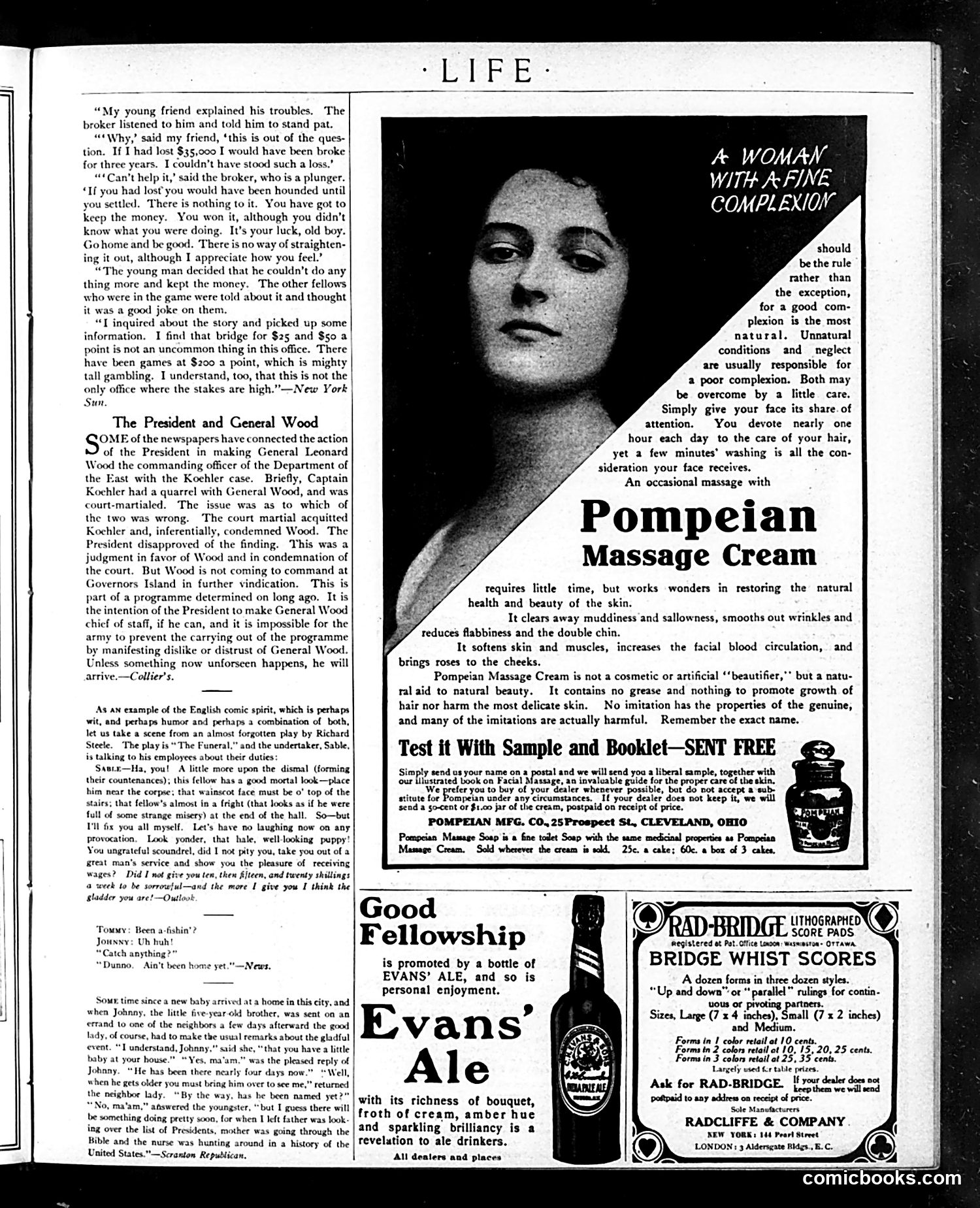
This Life magazine page contains two main editorial pieces: **"The President and General Wood"** discusses President Theodore Roosevelt's appointment of General Leonard Wood to command the Department of the East. The article references the Koehler court-martial case—a quarrel between Koehler and Wood where a military court acquitted Koehler but Roosevelt overruled the decision, favoring Wood. The satirical point: Roosevelt is using this appointment to vindicate Wood despite the court's judgment, and the author suggests Roosevelt intends to make Wood chief of staff regardless of military or public opposition—an example of executive power overriding institutional checks. The page is otherwise dominated by **advertisements** (Pompeian Massage Cream, Evans' Ale, Rad-Bridge bridge score pads), which was typical of Life's revenue model. A brief theatrical anecdote appears mocking English comedy conventions but lacks sufficient context to explain its specific reference.
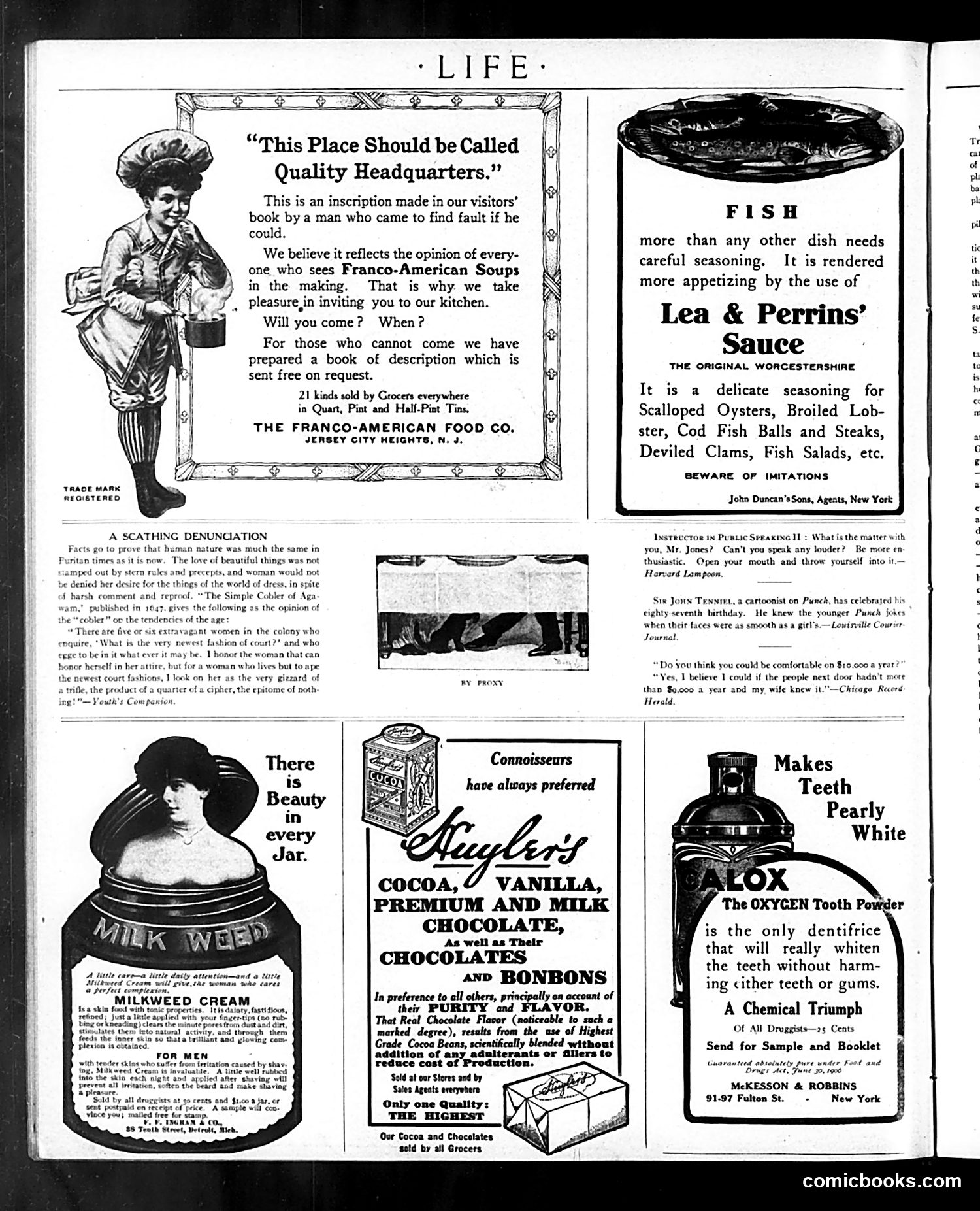
This page is primarily **advertising**, not political satire. It contains multiple product advertisements from the early 1900s interspersed with brief humorous items. The main content includes: **Advertisements:** - Franco-American Soups (top left, with illustrated chef) - Lea & Perrins' Sauce - Stuyler's Cocoa and Chocolate - Alox Tooth Powder - Milk Weed Cream **Humorous filler items:** - "A Scathing Denunciation": a reprint from *Youth's Companion* quoting a 1600s Puritan condemning women who chase fashion trends - Brief jokes about public speaking, a cartoonist's birthday, and marital finances The page reflects early 20th-century consumer culture and *Life*'s mix of advertising revenue with light satirical content. The Puritan quote provides mild social commentary on vanity, but the page is fundamentally a commercial product rather than political commentary.
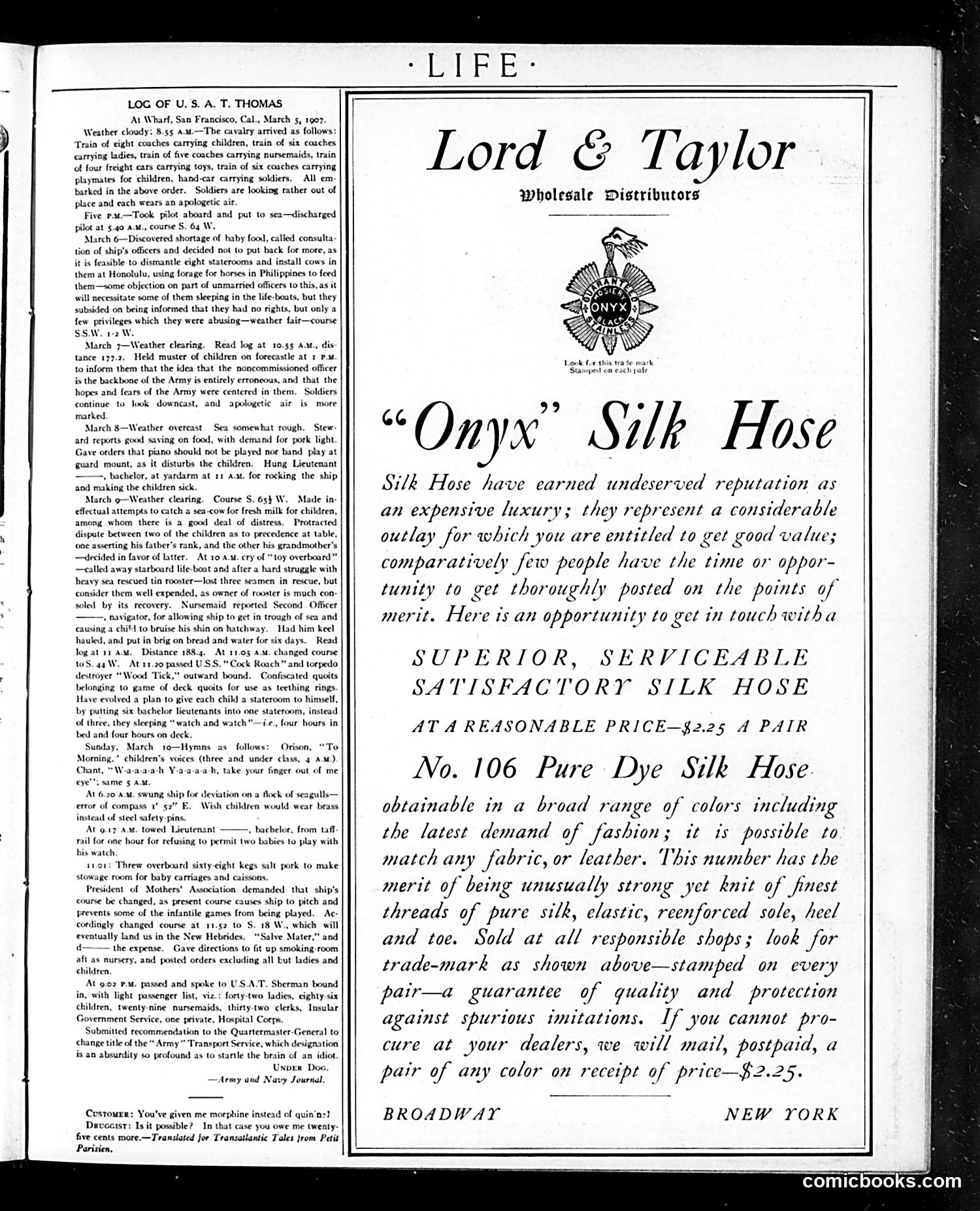
This page satirizes President Theodore Roosevelt's 1907 Great White Fleet—a massive naval voyage demonstrating American military might. The "log" mockingly documents a warship's departure from San Francisco, but its cargo is children, nursemaids, toys, and playmates instead of military equipment. The satire's point: Roosevelt has prioritized displaying American naval power so aggressively that the military itself has been subordinated to childish concerns. Soldiers appear "apologetic"; officers are punished for minor infractions; resources are diverted to accommodate infants rather than combat readiness. The humor cuts two ways—mocking both Roosevelt's militarism as absurdly excessive and suggesting the Navy has become feminized/trivialized by his policies. This reflects contemporary Progressive-era debates about American imperialism and military expansion during the Roosevelt presidency.
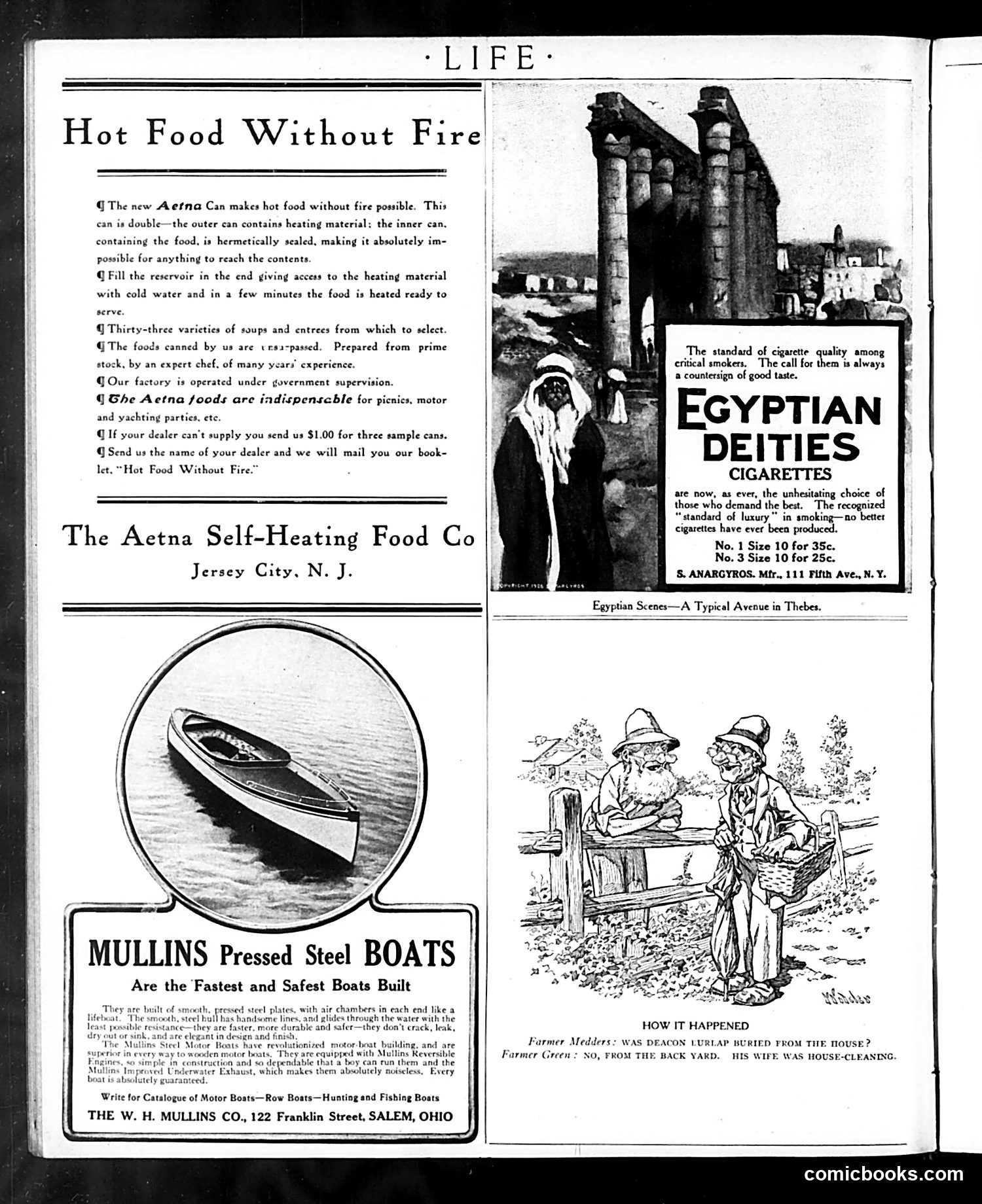
This page is primarily **advertisements** interspersed with a small cartoon joke. The ads promote: self-heating food cans (Aetna), Egyptian Deities cigarettes, and pressed-steel boats (Mullins). The only comic content is the bottom cartoon titled "How It Happened," which shows two farmers discussing a burial. The joke plays on a misunderstanding: Farmer Medders asks if Deacon Lurlap was "buried from the house," and Farmer Green clarifies he was buried "from the back yard" because "his wife was house-cleaning." The humor derives from the practical domestic concern (the wife needing the house clean) taking priority over funeral arrangements—a rustic, irreverent gag about rural priorities and domestic practicality overriding solemn occasions. The cartoon contains no political content or satire—merely a gentle joke about country life.
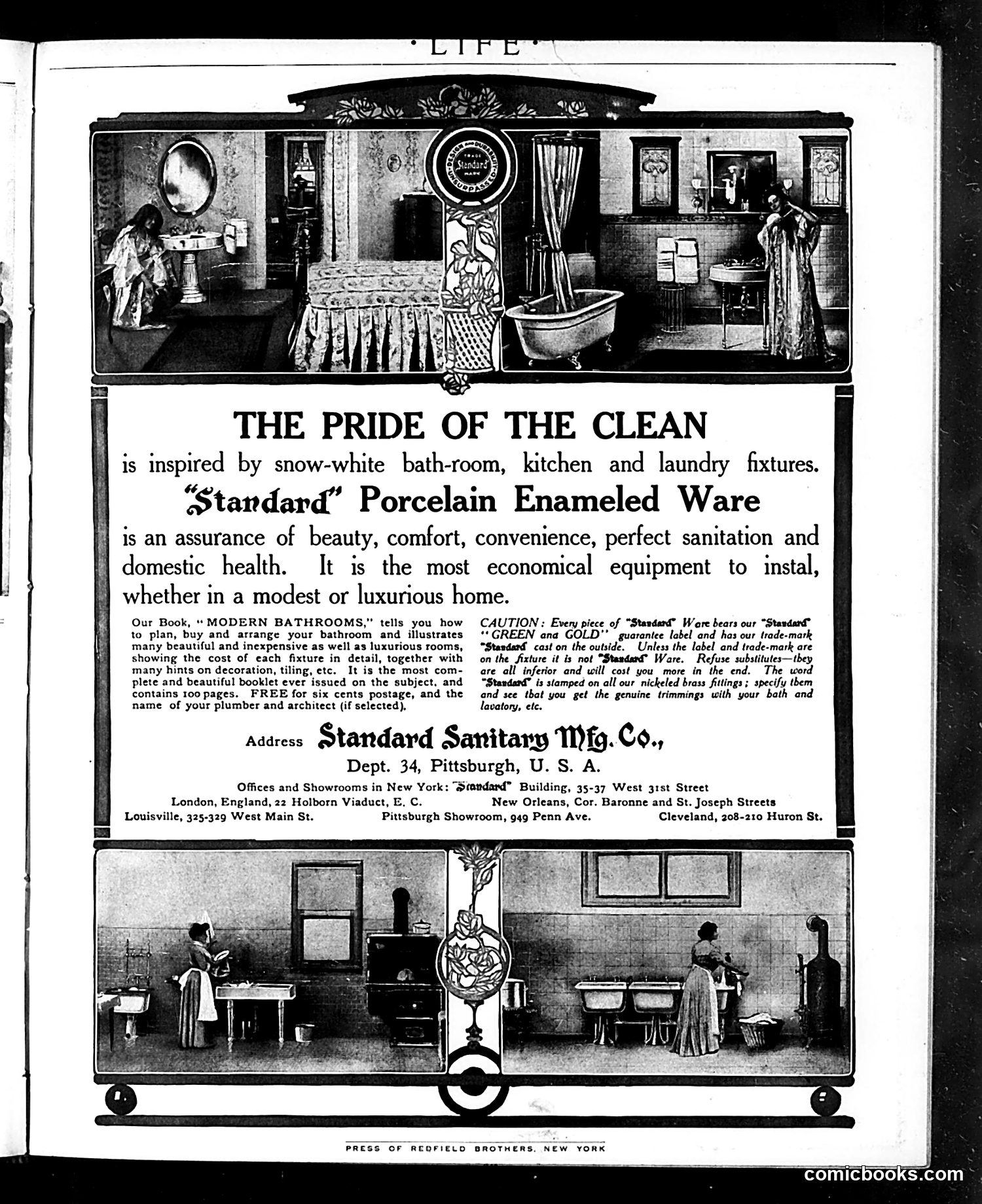
This page is primarily a **full-page advertisement** for Standard Sanitary Manufacturing Company's porcelain bathroom and kitchen fixtures, not political satire or editorial cartoon content. The imagery shows idealized domestic scenes—women using modern bathrooms, kitchens, and laundry facilities—to convey cleanliness and domestic modernity. The phrase "Pride of the Clean" appeals to early-20th-century values linking sanitation with moral virtue and social respectability. The advertisement emphasizes that Standard's products are affordable for "modest or luxurious" homes, positioning modern plumbing fixtures as accessible luxuries. The caution about counterfeit products and trade-marks reflects contemporary concerns about knock-offs. This represents **consumer advertising**, not satire—Life magazine sold advertising space to manufacturers. The content reflects period attitudes linking domestic cleanliness to family health and social status.
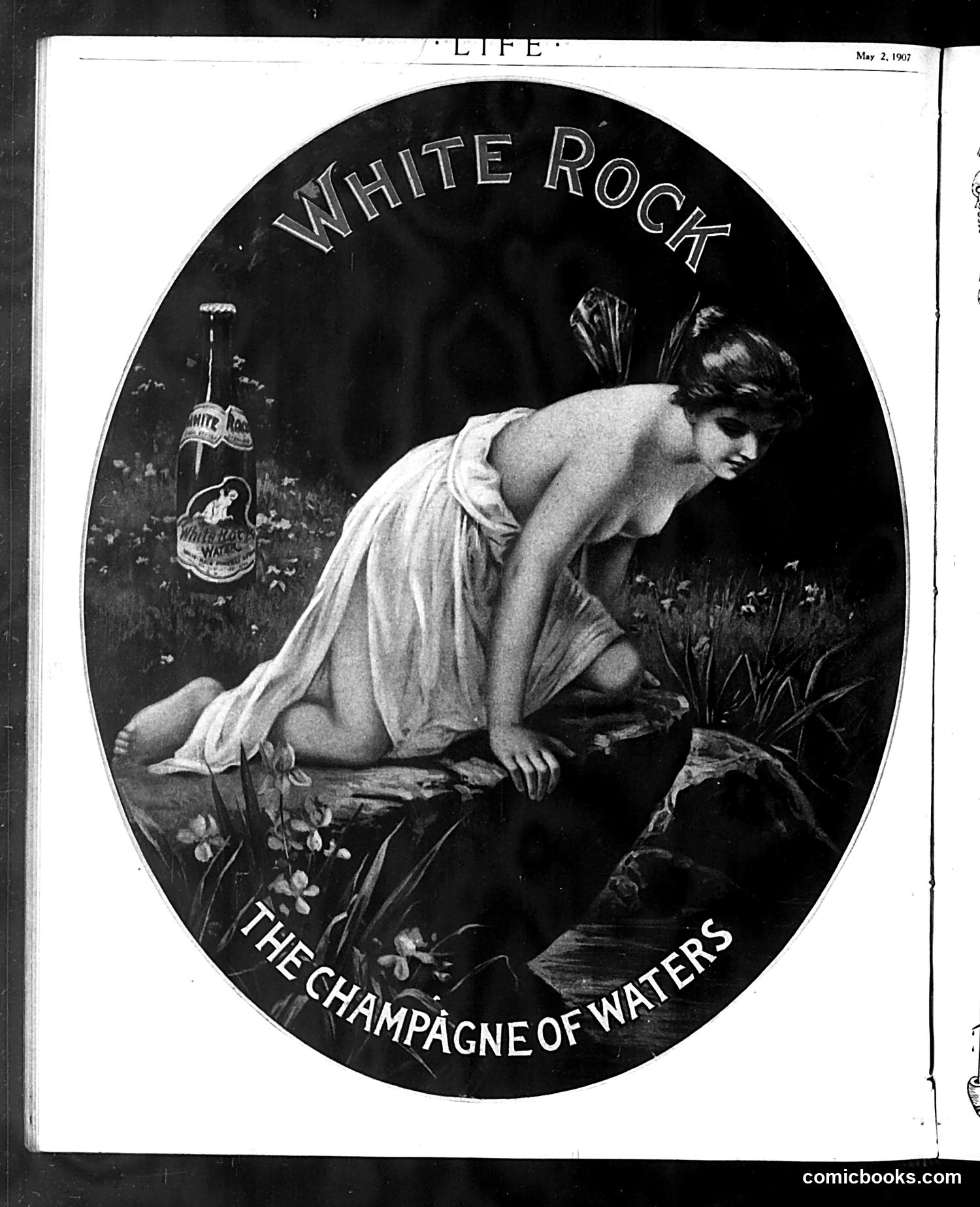
This is an advertisement for White Rock champagne from *Life* magazine (May 2, 1907). The image depicts a classical-style nude or semi-nude female figure reclining by water with flowers and vegetation, gazing at a bottle of White Rock champagne positioned in the background. The ad uses the common early 20th-century marketing strategy of associating luxury products with idealized feminine beauty and classical aesthetics. The tagline "The Champagne of Waters" suggests White Rock's purity and quality. The oval composition and artistic styling present the product as sophisticated and refined rather than merely commercial. For modern viewers, this represents vintage advertising that freely employed nudity and objectified women in ways now considered inappropriate, reflecting different social standards of the Edwardian era.