
Life, 1907-05-02 · page 35 of 48
Life — May 2, 1907 — page 35: what you’re looking at
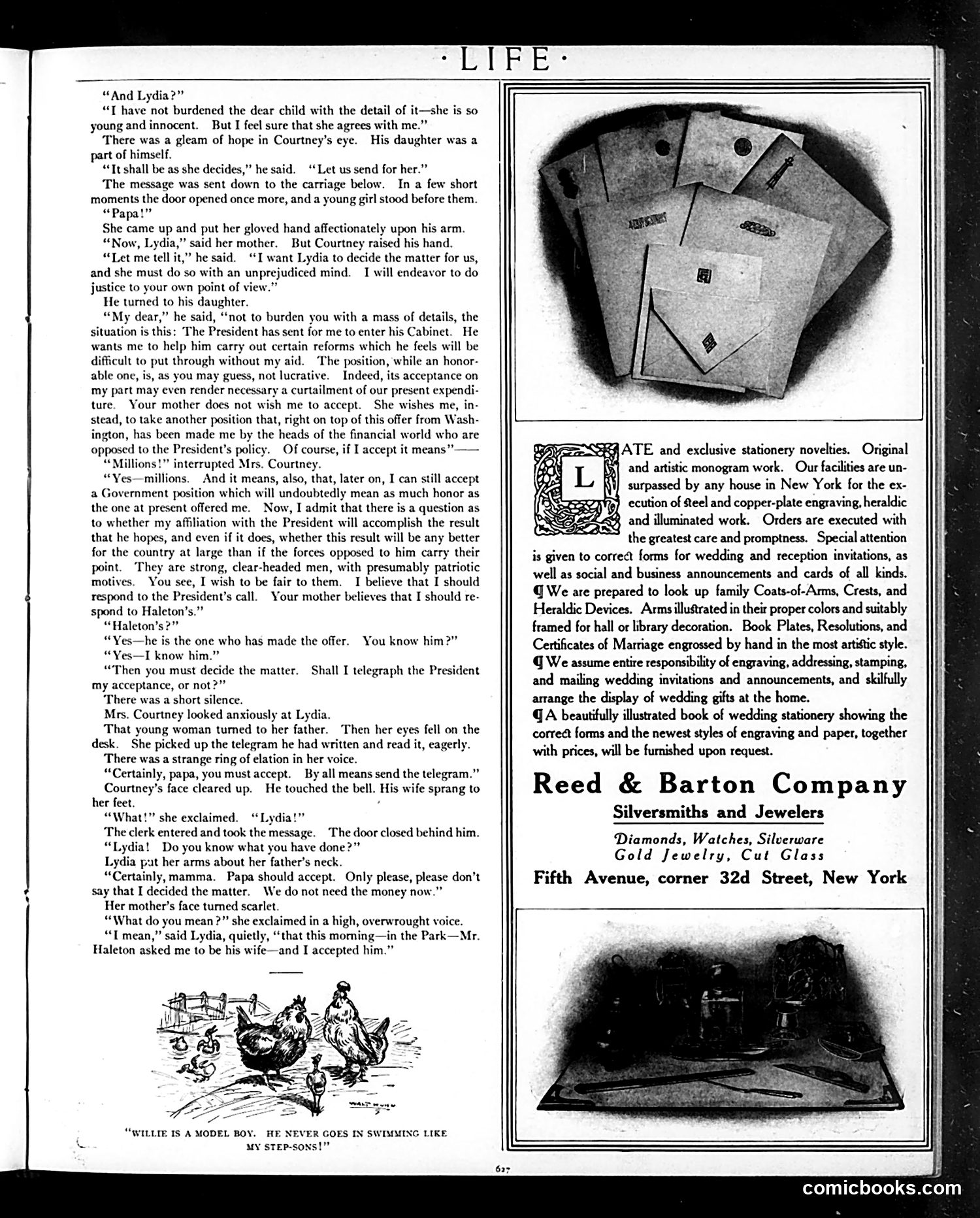
What you’re looking at
This page presents a serialized domestic drama rather than a political cartoon. The story depicts a moral dilemma: Mr. Courtney must choose between accepting a Cabinet position under the President (requiring financial sacrifice) or taking a lucrative private sector job from wealthy industrialists opposed to the President's reforms. The satire targets the conflict between civic duty and personal gain during the Progressive Era. Courtney frames the decision as principle-driven, letting his daughter Lydia decide. Her choice to accept the Cabinet position appears noble—until the final reveal: she has accepted a marriage proposal from Haleton, the wealthy financier, that morning. The joke undercuts Courtney's moral posturing: his daughter's "principled" decision is actually motivated by her impending wealth through marriage, not patriotism. The satire suggests that even seemingly idealistic choices are compromised by material self-interest.
📄 Transcribed text from this page (OCR, searchable)
Machine-transcribed from the original scan — historical spelling and the odd misread are preserved.
“And Lydia?” “T have not burdened the dear child with the detail of it—she is so young and innocent. But I feel sure that she agrees with me.” ‘There was a gleam of hope in Courtney's eye. His daughter was a part of himself. “Tt shall be as she decides,” he said. ‘‘Let us send for her.” The message was sent down to the carriage below. In a few short moments the door opened once more, and a young girl stood before them. “Papal” She came up and put her gloved hand affectionately upon his arm. “Now, Lydia,” said her mother. But Courtney raised his hand. “Let me tell it,” he said. ‘I want Lydia to decide the matter for us, and she must do so with an unprejudiced mind. I will endeavor to do justice to your own point of view.” He turned to his daughter. “My dear,” he said, “not to burden you with a mass of details, the situation is this: The President has sent for me to enter his Cabinet. He wants me to help him carry out certain reforms which he feels will be difficult to put through without my aid. ‘The position, while an honor- able one, is, as you may guess, not lucrative. Indeed, its acceptance on my part may even render necessary a curtailment of our present expendi- ture. Your mother does not wish me to accept. She wishes me, in- stead, to take another position that, right on top of this offer from Wash- ington, has been made me by the heads of the financial world who are opposed to the President’s policy. Of course, if I accept it means” —— “Millions!” interrupted Mrs. Courtney. “ ions. And it means, also, that, later on, I can still accept “Yes—mi a Government position which will undoubtedly mean as much honor as. the one at present offered me. Now, I admit that there is a question as to whether my affiliation with the President will accomplish the result that he hopes, and even if it does, whether this result will be any better for the country at large than if the forces opposed to him carry their point. They are strong, clear-headed men, with presumably patriotic motives. You see, I wish to be fair to them. I believe that I should respond to the President's call. Your mother believes that I should re- spond to Haleton’s.” “Haleton’s? “Yes—he is the one who has made the offer. You know him?” “Yes—I know him.” “Then you must decide the matter. Shall I telegraph the President my acceptance, or not?” ‘There was a short silence. Mrs. Courtney looked anxiously at Lydia. That young woman tumed to her father. Then her eyes fell on the desk. She picked up the telegram he had written and read it, eagerly. There was a strange ring of elation in her voice. “Certainly, papa, you must accept. By all means send the telegram.” Courtney’s face cleared up. He touched the bell. His wife sprang to her feet. “What!” she exclaimed. “Lydia!” The clerk entered and took the message. The door closed behind him. “Lydia! Do you know what you have done?” Lydia put her arms about her father’s neck. “Certainly, mamma. Papa should accept. Only please, please don’t say that I decided the matter. We do not need the money now.” Her mother’s face tumed scarlet. “What do you mean ?” she exclaimed in a high, overwrought voice. “T mean,” said Lydia, quietly, “that this morning—in the Park—Mr. Haleton asked me to be his wife—and I accepted him.” “WILLIE IS A MODEL BOY. HE WN’ MY STEP. and artistic monogram work. Our facilities are un- surpassed by any house in New York for the ex- 5) ecution of Steel and copper-plate engraving, heraldic 8 and illuminated work. Orders are executed with the greatest care and promptness. Special attention is given to corred forms for wedding and reception invitations, as well as social and business announcements and cards of all kinds. @ We are prepared to look up family Coats-of-Arms, Crests, and Heraldic Devices. Arms illustrated in their proper colors and suitably framed for hall or library decoration. Book Plates, Resolutions, and Certificates of Marriage engrossed by hand in the most artistic style. @ We assume entire responsibility of engraving, addressing, stamping, and mailing wedding invitations and announcements, and skilfully arrange the display of wedding gifts at the home. GA beautifully illustrated book of wedding stationery showing the correct forms and the newest styles of engraving and paper, together with prices, will be furnished upon request. Reed & Barton Company Silversmiths and Jewelers Diamonds, Watches, Silverware Gold Jewelry, Cut Glass Fifth Avenue, corner 32d Street, New York comicbooks.com