
Life, 1907-05-02 · page 30 of 48
Life — May 2, 1907 — page 30: what you’re looking at
What you’re looking at
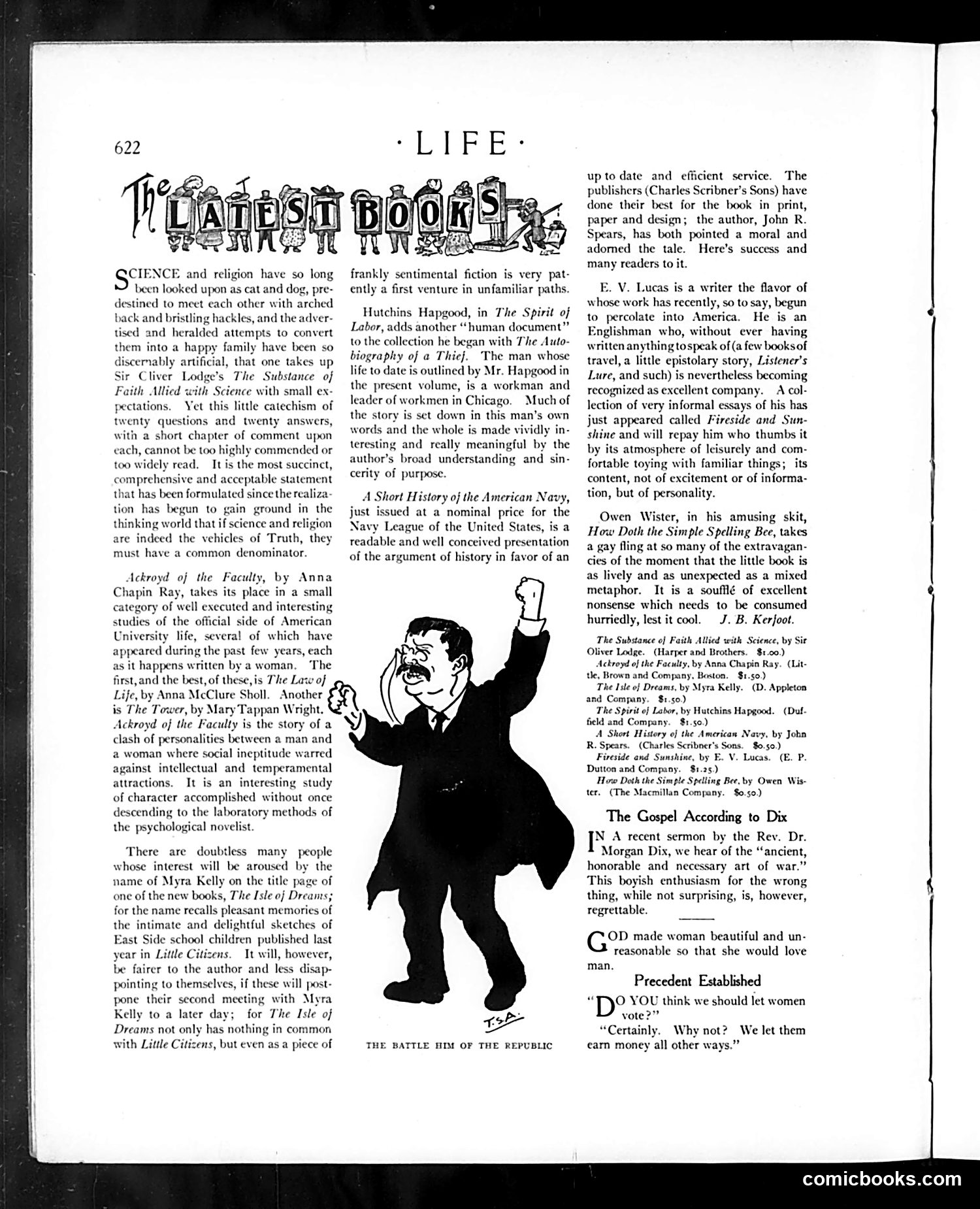
This political cartoon depicts a caricatured figure—likely representing a political opponent or ideological adversary—in an exaggerated fighting stance with a raised fist. The caption "THE BATTLE HIM OF THE REPUBLIC" (possibly a play on words, though the text is unclear) suggests this represents a symbolic struggle over the nation's future. The cartoon appears in Life magazine's book review section, accompanying discussions of contemporary works on science, religion, labor, and American naval power. Given the page's intellectual content and the figure's aggressive posture, this likely satirizes debates over modernism, labor organizing, or progressive politics that characterized early 20th-century American discourse. The specific identity of the caricatured figure remains unclear from the image alone.
📄 Transcribed text from this page (OCR, searchable)
Machine-transcribed from the original scan — historical spelling and the odd misread are preserved.
‘CIENCE and religion have so long been looked upon as cat and dog, pre- destined to meet each other with arched back and bristling hackles, and the adver- tised and heralded attempts to convert them into a happy family have been so discernably artificial, that one takes up Sir Cliver Lodge’s The Substance of Faith Allied with Science with small ex- pectations. Yet this little catechism of twenty questions and twenty answers, with a short chapter of comment upon each, cannot be too highly commended or too widely read. It is the most succinct, comprehensive and acceptable statement that has been formulated since the realiza tion has begun to gain ground in the thinking world that if science and religion are indeed the vehicles of Truth, they must have a common denominator. Ackroyd oj the Faculty, by Anna Chapin Ray, takes its place in a small category of well executed and interesting studies of the official side of American University life, several! of which have appeared during the past few years, each as it happens written by a woman, The first,and the best, of these,is The Law of Life, by Anna McClure Sholl. Another is The Tower, by MaryTappan Wright Ackroyd of the Faculty is the story of a clash of personalities between a man and a woman where social ineptitude warred against intellectual and temperamental attractions. It is an interesting study of character accomplished without once descending to the laboratory methods of the psychological novelist. There are doubtless many people whose interest will be aroused by the name of Myra Kelly on the title page of one of the new books, The Isle oj Dreams; for the name recalls pleasant memories of the intimate and delightful sketches of East Side school children published last arin Little Citizens. It will, however, rer to the author and less disap- pointing to themselves, if these will post- pone their second meeting with Myra Kelly to a later day; for The Isle of Dreams not only has nothing in common with Little Citizens, but even as a piece of frankly sentimental fiction is very pat- ently a first venture in unfamiliar paths. Hutchins Hapgood, in The Spirit of Labor, adds another “human document” to the collection he began with The Auto- biography of a Thiej. The man whose life to date is outlined by Mr. Hapgood in the present volume, is a workman and leader of workmen in Chicago. Much of the story is set down in this man’s own words and the whole is made vividly in- teresting and really meaningful by the author’s broad understanding and sin- cerity of purpose. A Short History oj the American Navy, just issued at a nominal price for the Navy League of the United States, is a readable and well conceived presentation of the argument of history in favor of an THE BATTLE HIM OF THE REPUBLIC uptodate and efficient service. The publishers (Charles Scribner’s Sons) have done their best for the book in print, paper and design; the author, John R. Spears, has both pointed a moral and adomed the tale. Here's success and many readers to it. E. V. Lucas is a writer the flavor of whose work has recently, so to say, begun to percolate into America. He is an Englishman who, without ever having written anything tospeak of (a few booksof travel, a little epistolary story, Listener's Lure, and such) is nevertheless becoming recognized as excellent company. A col- lection of very informal essays of his has just appeared called Fireside and Sun- shine and will repay him who thumbs it by its atmosphere of leisurely and com- fortable toying with familiar things; its content, not of excitement or of informa- tion, but of personality. Owen Wister, in his amusing skit, How Doth the Simple Spelling Bee, takes a gay fling at so many of the extravagan- cies of the moment that the little book is as lively and as unexpected as a mixed metaphor. It is a soufflé of excellent nonsense which needs to be consumed hurriedly, lest it cool. J. B. Kerjoot. The Substance o] Faith Allied with Science, by Sit Oliver Lodge. (Harper and Brothers. $1.00.) Ackroyd o} the Faculty, by Anna Chapin Ray. te, Brown and Company, Beston. $1.50.) The Isle o} Dreams, by Myra Kelly. (D. Appleton and Company. $1.50.) The Spirit o} Labor, by Hutchins Hapgood. (Duf- field and Company. $1.50.) Short History of the American Navy, by John R. Spears. (Charles Scribner's Sons. $0.50.) Fireside and Sunshine, by E. V. Lucas. (E. P. Dutton and Company. $1.25.) Horw Doth the Simple Spelling Bee, by Owen Wis- ter, (The Macmillan Company. $0.50) The Gospel According to Dix N A recent sermon by the Rev. Dr. Morgan Dix, we hear of the “ancient, honorable and necessary art of war.” This boyish enthusiasm for the wrong thing, while not surprising, is, however, regrettable. (Lit- OD made woman beautiful and un- reasonable so that she would love man. Precedent Established “T)O YOU think we should let women vote?” “Certainly. Why not? earn money all other ways.” We let them comicbooks.com