
Life, 1907-05-02 · page 23 of 48
Life — May 2, 1907 — page 23: what you’re looking at
What you’re looking at
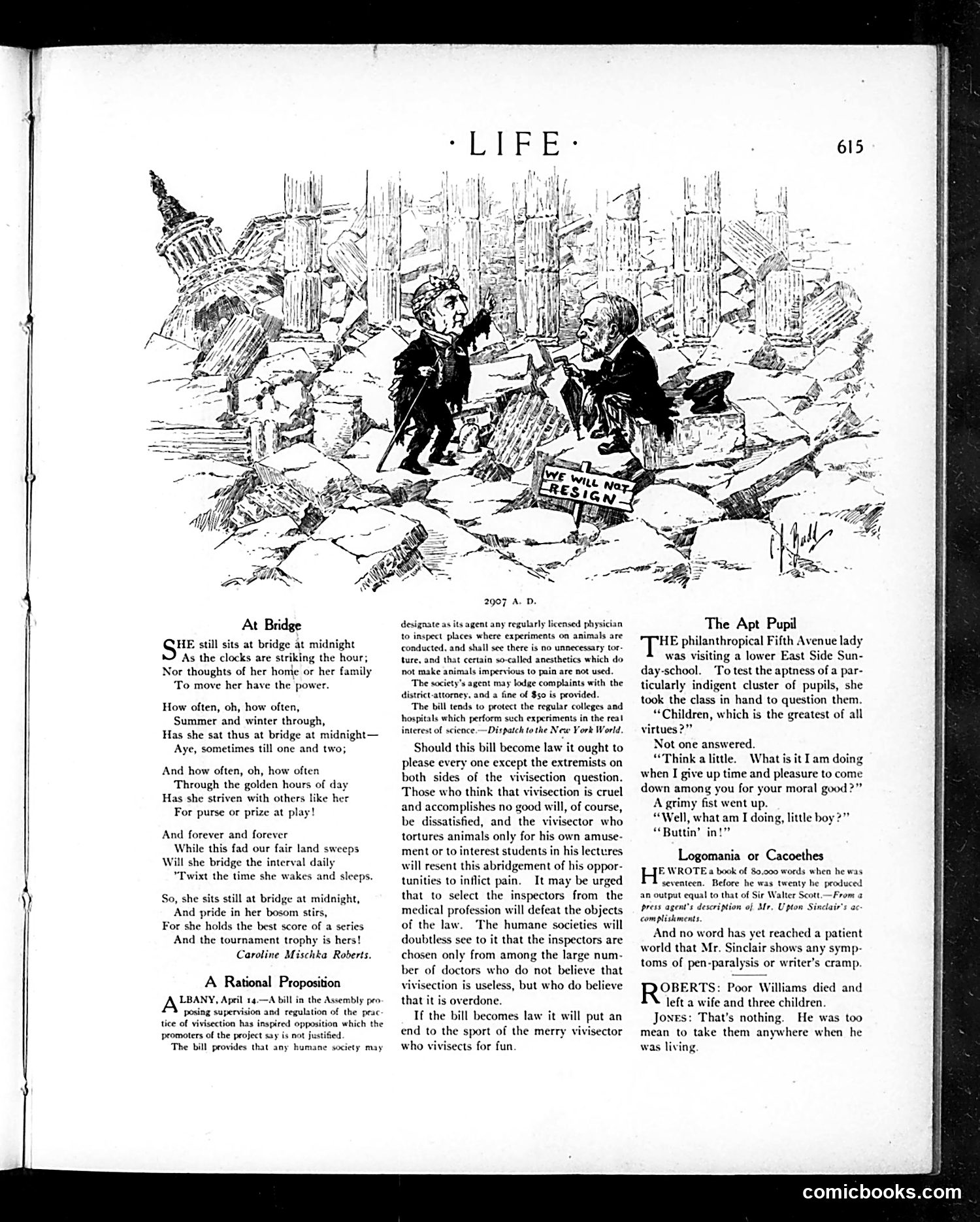
This page contains three distinct pieces satirizing early 1900s American society: **"At Bridge"** critiques upper-class women's obsession with card games, depicting a woman so consumed by bridge that she plays nightly while neglecting family responsibilities. The satire suggests this leisure pursuit has become a social epidemic among wealthy women. **"A Rational Proposition"** addresses a New York Assembly bill regulating vivisection (animal experimentation). The piece ironically supports oversight while acknowledging opposition from "extremists" on both sides—those opposing all animal testing and those performing experiments purely for entertainment or shock value in lectures. **"The Apt Pupil"** mocks philanthropic pretension: a Fifth Avenue society lady visits a lower East Side Sunday school to teach morality, but a street-smart child cuts through her self-righteousness by calling out her performative charity as mere "buttin' in." The cartoon at top depicts the ruined Capitol, illustrating apocalyptic decay—likely commentary on political corruption or societal decline.
📄 Transcribed text from this page (OCR, searchable)
Machine-transcribed from the original scan — historical spelling and the odd misread are preserved.
At Bridge HE still sits at bridge at midnight As the clocks are striking the hour; Nor thoughts of her home or her family To move her have the power. How often, oh, how often, Summer and winter through, Has she sat thus at bridge at midnight— Aye, sometimes till one and tw And how often, oh, how often ‘Through the golden hours of day Has she striven with others like her For purse or prize at play! And forever and forever While this fad our fair land sweeps Will she bridge the interval daily “Twixt the time she wakes and sleeps. So, she sits still at bridge at midnight, And pride in her bosom stirs, For she holds the best score of a series And the tournament trophy is hers! Caroline Mischka Roberts. A Rational Proposition LBANY, April 14.—A bill in the Assembly peo: posing supervision and regulation of the prac tice of vivisection has inspired opposition which the promoters of the project say is not justified The bill provides that any humane society may 2907 A. D. designate as its agent any regularly licensed physician to inspect places where experiments on animals are conducted, and shall sce there is no unnecessary tor- ture, and that certain so-called anesthetics which do not make animals impervious to pain are not used. The society's agent may lodge complaints with the district-attorney, and a fine of $50 is provided. The bill tends to protect the regular colleges and hospitals which perform such experiments in the real interest of science.—Dispatch to the New York World. Should this bill become law it ought to please every one except the extremists on both sides of the section question. Those who think that vivisection is cruel and accomplishes no good will, of course, be dissatisfied, and the vivisector who tortures animals only for his own amuse- ment or to interest students in his lectures will resent this abridgement of his oppor- tunities to inflict pain. It may be urged that to select the inspectors from the medical profession will defeat the objects of the law. The humane societies will doubtless see to it that the inspectors are chosen only from among the large num- ber of doctors who do not believe that vivisection is useless, but who do believe that it is overdone. Tf the bill becomes law it will put an end to the sport of the merry vivisector who vivisects for fun. 615 The Apt Pupil 4 Pe philanthropical Fifth Avenue lady was visiting a lower East Side Sun- day-school. To test the aptness of a par- ticularly indigent cluster of pupils, she took the class in hand to question them. “Children, which is the greatest of all virtues?” Not one answered. “Think alittle. What is it I am doing when I give up time and pleasure to come down among you for your moral good ?”” A grimy fist went up. “Well, what am I doing, little boy ?”” “Buttin’ in!” Logomania or Cacoethes E WROTE a book of 80,000 words when he was seventeen. Before he was twenty he produced an output equal to that of Sir Walter Scott.—From press agent's description of Mr. Upton Sinclair's ac- compliskments. And no word has yet reached a patient world that Mr. Sinclair shows any symp- toms of pen-paralysis or writer’s cramp. OBERTS: Poor Williams died and left a wife and three children. Jones: That’s nothing. He was too mean to take them anywhere when he was living. comicbooks.com