
Life, 1907-05-02 · page 16 of 48
Life — May 2, 1907 — page 16: what you’re looking at
What you’re looking at
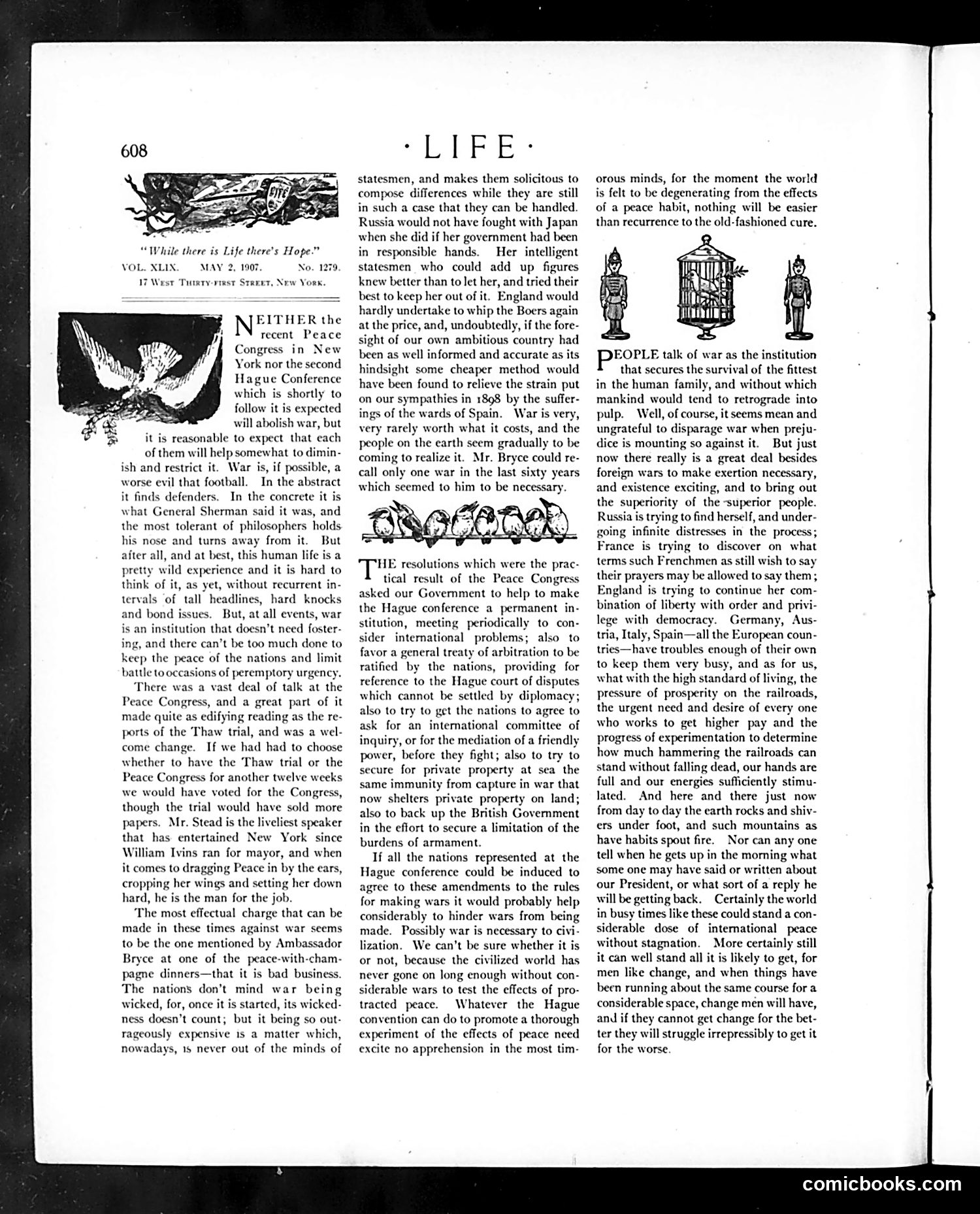
This page features an editorial essay discussing recent peace conferences in New York and The Hague, written in the satirical voice characteristic of *Life* magazine. The author argues that while neither conference will eliminate war, they serve a useful purpose in reducing conflict. The piece's central argument—that war is fundamentally a bad financial investment—reflects Progressive Era pragmatism. The author cites Ambassador James Bryce's observation that nations avoid war primarily for economic reasons, referencing Russia's 1904 Russo-Japanese War and British colonial conflicts as costly mistakes. The editorial proposes specific diplomatic remedies: establishing a permanent Hague conference, international arbitration treaties, mediation requirements before warfare, and protecting private property in war. The tone is characteristically wry; the author compares war unfavorably to football and notes sardonically that while statesmen ignore war's immorality, they cannot ignore its expense. The small decorative illustrations (soldiers, fortifications) are period-typical ornamental elements rather than pointed political cartoons.
📄 Transcribed text from this page (OCR, searchable)
Machine-transcribed from the original scan — historical spelling and the odd misread are preserved.
“While there is Life there's Hope.” VOL. XLIX. MAY 2, 19 17 West Truraty-rrast Staret, New Yorx. EITHER the recent Peace Congress in New York nor the second Hague Conference which is shortly to follow it is expected will abolish war, but it is reasonable to expect that each of them will help somewhat to dimin- ish and restrict it. War is, if possible, a worse evil that football. In the abstract it finds defenders. In the concrete it is what General Sherman said it was, and the most tolerant of philosophers holds his nose and turns away from it. But after all, and at best, this human life is a pretty wild experience and it is hard to think of it, as yet, without recurrent in- tervals of tall headlines, hard knocks and bond issues. But, at all events, war is an institution that doesn’t need foster- ing, and there can’t be too much done to keep the peace of the nations and limit battle to occasions of peremptory urgency, There was a vast deal of talk at the Peace Congress, and a great part of it made quite as edifying reading as the re- ports of the Thaw trial, and was a wel- come change. If we had had to choose whether to have the Thaw trial or the Peace Congress for another twelve weeks we would have voted for the Congress, though the trial would have sold more papers. Mr. Stead is the liveliest speaker that has entertained New York since iam Ivins ran for mayor, and when it comes to dragging Peace in by the ears, cropping her wings and setting her down hard, he is the man for the job. ‘The most effectual charge that can be made in these times against war seems to be the one mentioned by Ambassador Bryce at one of the peace-with-cham- pagne dinners—that it is bad business. The nations don’t mind war being wicked, for, once it is started, its wicked- ness doesn’t count; but it being so out- rageously expensive 1s a matter which, nowadays, 1s never out of the minds of “LLP E : statesmen, and makes them solicitous to compose differences while they are still in such a case that they can be handled. Russia would not have fought with Japan when she did if her government had been in responsible hands. Her intelligent statesmen who could add up figures knew better than to let her, and tried their best to keep her out of it. England would hardly undertake to whip the Boers again at the price, and, undoubtedly, if the fore- sight of our own ambitious country had been as well informed and accurate as its hindsight some cheaper method would have been found to relieve the strain put on our sympathies in 1898 by the suffer- ings of the wards of Spain. War is very, very rarely worth what it costs, and the people on the earth seem gradually to be coming to realize it. Mr. Bryce could re- call only one war in the last sixty years which seemed to him to be necessary. 'HE resolutions which were the prac- tical result of the Peace Congress ked our Government to help to make the Hague conference a permanent in- stitution, meeting periodically to con- sider international problems; also to favor a general treaty of arbitration to be ratified by the nations, providing for reference to the Hague court of disputes which cannot be settled by diplomacy; also to try to get the nations to agree to ask for an international committee of inquiry, or for the mediation of a friendly power, before they fight; also to try to secure for private property at the same immunity from capture in war that now shelters private property on land; also to back up the British Government in the effort to secure a limitation of the burdens of armament. If all the nations represented at the Hague conference could be induced to agree to these amendments to the rules for making wars it would probably help considerably to hinder wars from being made. Possibly war is necessary to civi- lization. We can’t be sure whether it is or not, because the civilized world has never gone on long enough without con- siderable wars to test the effects of pro- tracted peace. Whatever the Hague convention can do to promote a thorough experiment of the effects of peace need excite no apprehension in the most tim- orous minds, for the moment the world is felt to be degenerating from the effects of a peace habit, nothing will be easier than recurrence to the old-fashioned cure. Fae cae I alle u tin EOPLE talk of war as the institution that secures the survival of the fittest in the human family, and without which mankind would tend to retrograde into pulp. Well, of course, it seems mean and ungrateful to disparage war when preju- dice is mounting so against it. But just now there really is a great deal besides foreign wars to make exertion necessary, and existence exciting, and to bring out the superiority of the superior people. Russia is trying to find herself, and under- going infinite distresses in the process; France is trying to discover on what terms such Frenchmen as still wish to say their prayers may be allowed to say them; England is trying to continue her com- bination of liberty with order and privi- lege with democracy. Germany, Aus- tria, Italy, Spain—all the European coun- tries—have troubles enough of their own to keep them very busy, and as for us, what with the high standard of living, the pressure of prosperity on the railroads, the urgent need and desire of every one who works to get higher pay and the progress of experimentation to determine how much hammering the railroads can stand without falling dead, our hands are full and our energies sufficiently stimu- lated. And here and there just now from day to day the earth rocks and shiv- ers under foot, and such mountains as have habits spout fire. Nor can any one tell when he gets up in the morning what some one may have said or written about our President, or what sort of a reply he will be getting back. Certainly the world in busy times like these could stand a con- siderable dose of international peace without stagnation. More certainly still it can well stand all it is likely to get, for ¢ change, and when things have been running about the same course for a considerable space, change men will have, and if they cannot get change for the bet- ter they will struggle irrepressibly to get it for the worse. comicbooks.com