
Life, 1907-05-02 · page 21 of 48
Life — May 2, 1907 — page 21: what you’re looking at
What you’re looking at
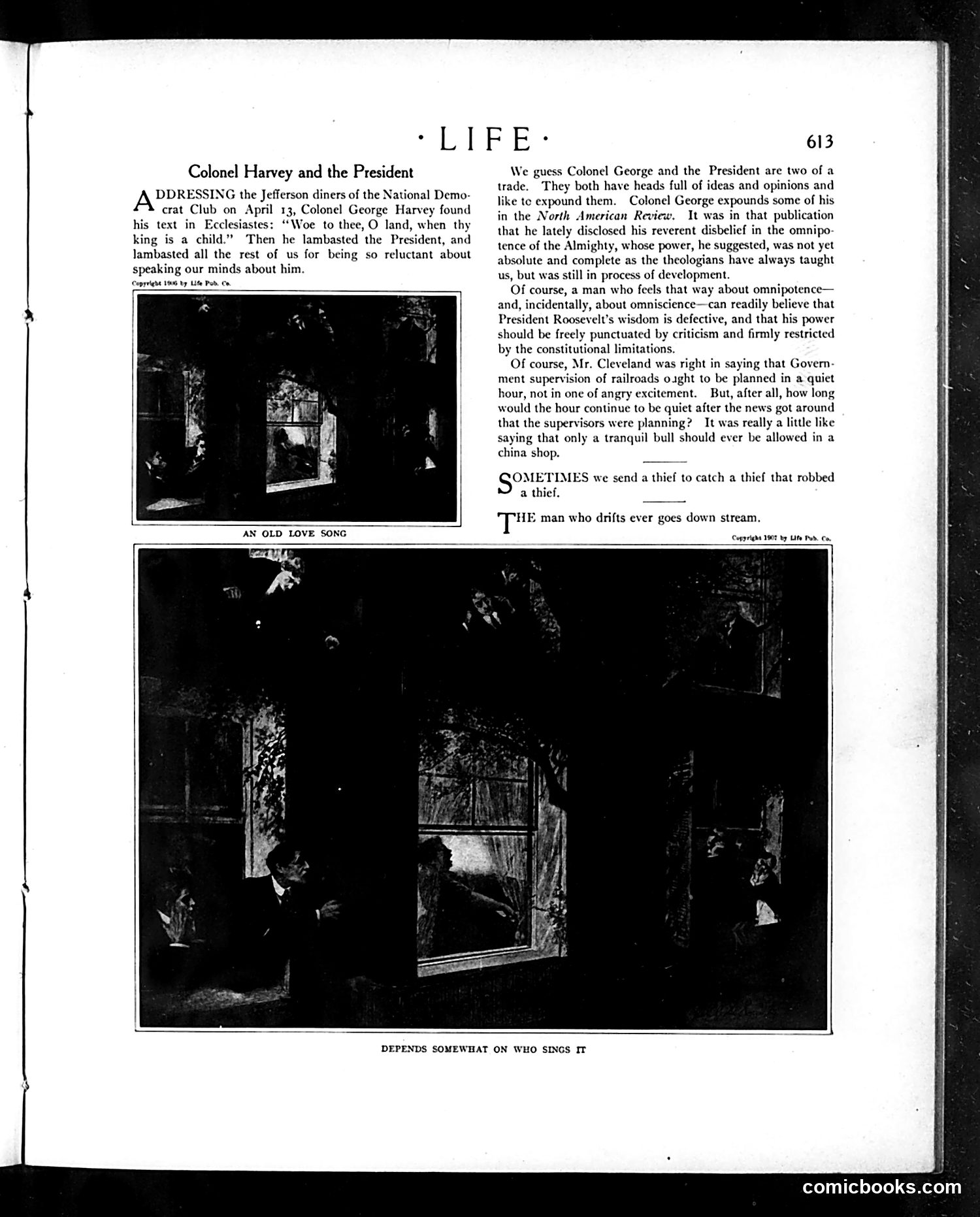
This page satirizes Colonel George Harvey's public criticism of President Theodore Roosevelt. Harvey, speaking at a Democratic Club dinner in April, quoted Ecclesiastes to attack Roosevelt as an immature leader ("when thy king is a child"). Life's response mocks Harvey's hypocrisy: Harvey himself has published irreverent views in the *North American Review*, including questioning God's omnipotence. The magazine suggests that if Harvey doubts divine wisdom, he shouldn't claim Roosevelt lacks judgment. The satire extends to government regulation: Harvey (echoing Cleveland) argues railroad supervision requires calm deliberation, not "angry excitement." Life ridicules this as naive—once supervisors announce plans, news spreads and controversy erupts anyway, "like saying that only a tranquil bull should ever be allowed in a china shop." The two images illustrate the title "An Old Love Song" and "Depends Somewhat on Who Sings It"—suggesting the same criticisms sound different depending on who voices them. The broader point: Harvey's objections to Roosevelt ring hollow given his own controversial statements.
📄 Transcribed text from this page (OCR, searchable)
Machine-transcribed from the original scan — historical spelling and the odd misread are preserved.
Colonel Harvey and the President DDRESSING the Jefferson diners of the National Demo- crat Club on April 13, Colonel George Harvey found his text in Ecclesiastes: “Woe to thee,O land, when thy king is a child.” Then he lambasted the President, and lambasted all the rest of us for being so reluctant about speaking our minds about him. Copylght 1806 by Lite Pod. Co *~LIFE- 613 We guess Colonel George and the President are two of a trade. They both have heads full of ideas and opinions and like te expound them. Colonel George expounds some of his in the North American Review. It was in that publication that he lately disclosed his reverent disbelief in the omnipo- tence of the Almighty, whose power, he suggested, was not yet absolute and complete as the theologians have always taught us, but was still in process of development. Of course, a man who feels that way about omnipotence— and, incidentally, about omniscience—can readily believe that President Roosevelt's wisdom is defective, and that his power should be freely punctuated by criticism and firmly restricted by the constitutional limitations. Of course, Mr. Cleveland was right in saying that Govern- ment supervision of railroads oaght to be planned in a quiet hour, not in one of angry excitement. But, after all, how long would the hour continue to be quiet after the news got around that the supervisors were planning? It was really a little like saying that only a tranquil bull should ever be allowed in a china shop. OMETIMES we send a thief to catch a thief that robbed a thief. TH! man who drifts ever goes down stream. Copyright 1901 by Life Tod. Co, DEPENDS SOMEWHAT ON WHO SINGS IT comicbooks.com