
Life, 1907-05-02 · page 36 of 48
Life — May 2, 1907 — page 36: what you’re looking at
What you’re looking at
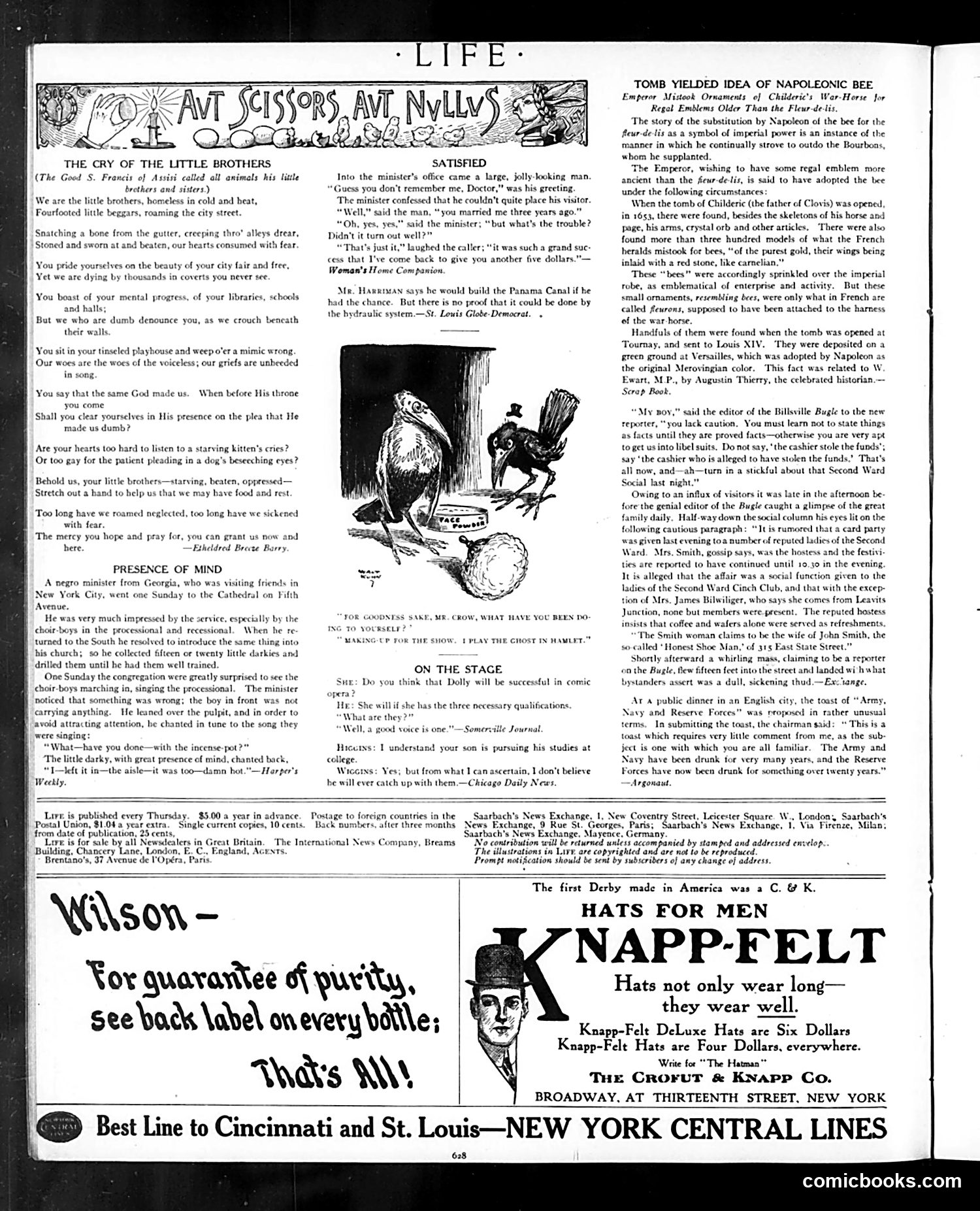
This page from *Life* magazine contains several distinct satirical pieces: **"The Cry of the Little Brothers"** is a sentimental poem about mistreated stray animals in cities, written from the animals' perspective. It appeals to readers' conscience about urban animal suffering. **"Presence of Mind"** is a joke about a Black minister from Georgia who attempts to replicate a cathedral choir processional in his church. The humor relies on racial stereotypes—the "punchline" is a young Black choir boy's profane response ("damn hot"), presented as amusing "dialect humor" typical of that era's casual racism. **"Satisfied"** is a brief anecdote about a man thanking a minister for a successful marriage, offering him money as gratitude—straightforward humor about marital contentment. Other short jokes follow standard formats of the period. The page also includes advertisements for Wilson whiskey, Knapp-Felt hats, and New York Central Lines. The content reflects early 20th-century magazine humor standards, including casual racism in dialect jokes that modern audiences would recognize as offensive.
📄 Transcribed text from this page (OCR, searchable)
Machine-transcribed from the original scan — historical spelling and the odd misread are preserved.
THE CRY OF THE LITTLE BROTHERS (The Good S. Francis of Assisi called all animals his little brothers and sisters.) We are the little brothers, homeless in cold and heat, Fourfooted little beggars, roaming the city street. Snatching a bone from the gutter, creeping thro’ alleys drear, Stoned and sworn at and beaten, our hearts consumed with fear You pride yourselves on the beauty of your city fair and free, Yet we are dying by thousands in coverts you never see. You boast of your mental progress, of your libraries, schools and halls; But we who are dumb denounce you, as we crouch bencath their walls ‘You sit in your tinseled playhouse and weep o'er a mimic wrong. Our woes are the woes of the voiceless; our griefs are unbeeded in so1 You say that the same God made us. When before His throne you come Shall you clear yourselves in His presence oa the plea that He made us dumb? Are your hearts too hard to listen to a starving kitten’s cries? Or too gay for the patient pleading in a dog's beseeching eyes? Behold us, your little brothers—starving, Stretch out a hand to help us that we may have food and rest beaten, oppressed — Too long have we roamed neglected, too long have we sickened with fear. ‘The mercy you hope and pray for, you can grant us now and here. Etheldred Brecte Barry PRESENCE OF MIND A negro minister from Georgia, who was visiting friends in New York City, went one Sunday to the Cathedral on Fifth Avenue. He was very much impressed by the service, especially by the When he re turned to the South he resolved to introduce the same thing into his church; so he collected fifteen or twenty little darkies and drilled them until he had them well trained One Sunday the congregation were greatly surprised to see the choir-boys marching in, singing the processional. The minister noticed that something was wrong; the boy in front was not carrying anything. He leaned over the pulpit, and in order to avoid attracting attention, be chanted in tune to the song they were singing: “What—have you done—with the incense-pot?" ‘The little darky, with great presence of mind, chanted back, *T—left it in—the aisle—it was too—damn hot."—Herper's Weekly. choir-boys in the processional and recessional SATISFIED Into the minister's office came a large, jolly-looking man. “Guess you don't remember me, Doctor,” was his greeting. The minister confessed that he couldn't quite place his visitor. “Well,” said the man, “you married me three years ago.” “Oh, yes. yes." said the minister; “but what's the trouble? Didn't it turn out well?” “That's just laughed the caller; “it was such a grand suc- cess that I've come back to give you another five dollars."— Weman’s Home Companion. Mr. Harmitaw says he would build the Panama Canal if he had the chance. But there is no proof that it could be done by the hydraulic system.—St. Lowis Glote-Democrat. TOR COODNISS SAKE, MR. CROW, WHAT HAVE YOU BEEN DO. ING TO YOURSELT?” MAKING. UP TOR THE SHOW. E PLAY THE GHOST IN HAMLET, ON THE STAGE Sue: Do you think that Dolly will be successful in comic opera? He: She will if she has the three necessary q) “What are they?” “Well, a fications, sod voice is one.” —Somerville Journal. Hicetys: I understand your son is pursuing his studies at college, Wicerxs: Yes; but from what I can ascertain, I don't believe be will ever catch up with them.—Chicago Daily News TOMB YIELDED IDEA OF NAPOLEONIC BEE Emperor Mistook Ornaments of Childeric's War-Horse Jor Regal Emblems Older Than the Fleur-de-lis, The story of the substitution by Napoleon of the bee for the fleur-de-lis as a symbol of imperial power is an instance of the manner in which he continually strove to outdo the Bourbons, whom he supplanted. The Emperor, wishing to have some regal emblem more ancient than the feur-delis, is said to have adopted the bee under the following circumstances: When the tomb of Childeric (the father of Clovis) was opened, in 1653, there were found, besides the skeletons of his horse and page, his arms, crystal orb and other articles, ‘There were also found more than three hundred models of what the French heralds mistook for bees, “of the purest gold, their wings being inlaid with a red stone, like carnelian.” These “bees” were accordingly sprinkled over the imperial robe, as emblematical of enterprise and activity. But these small ornaments, resembling bes, were only what in French are called feurons, supposed to have been attached to the harness of the war-horse. Handfuls of them were found when the tomb was opened at Tournay, and sent to Louis XIV. ‘They were deposited on a green ground at Versailles, which was adopted by Napoleon as the original Merovingian color, ‘This fact was related to W Ewart, M-P., by Augustin Thierry, the celebrated historian.— Scrap Book. “My noy,” said the editor of the Billsville Bugle to the new reporter, “you lack caution, You must learn not to state things as facts until they are proved facts—otherwise you are very apt to get usinto libel suits, Do not say, ‘the cashier stole the funds"; say ‘the cashier who is alleged to have stolen the funds.’ That's all now, and—ah—turn in a stickful about that Second Ward Social last night.” Owing to an influx of visitors it was late in the afternoon be fore the genial editor of the Bugle caught a glimpse of the great y daily, Half-way down the social column his eyes lit on the lowing cautious paragraph: “It is rumored that a card party ‘was given last evening toa number of reputed ladies of the Second Ward. Mrs. Smith, gossip says, was the hostess and the festivi- ties ate reported to have continued until 10.30 in the evening. It is alleged that the affair was a social function given to the ladies of the Second Ward Cinch Club, and that with the excep- tion of Mrs. James Bilwiliger, who says she comes from Leavits Junction, none but members were-present, The reputed hostess insists that coffee and wafers alone were served as refreshments, The Smith woman claims to be the wife of John Smith, the so called ‘Honest Shoe Man,’ of 315 East State Street.” Shortly afterward a whirling mass, claiming to be a reporter on the Bugle, few fifteen feet into the street and landed wih what bystanders assert was a dull, sickening thud.—Exz ‘ange. At A public dinner in an English city, the toast of “Army, Navy and Reserve Forces! was proposed in rather unusual terms. In submitting the toast, the chairman said: "This is a toast which requires very little comment from me, as the sub- ject is one with which you are all fa ‘The Army and Navy have been drunk for very many years, and the Reserve Forces have now been drunk for something over twenty years.” ~Argonaut. Lire. is published every Thursday. $5.00 a year in advance Postal Union, $1.04 year extra. Single current copies, 10 cents from date of publication, 25 cents, Lure is for sale by all Newsdealers in Great Britain. ‘The International News Company, Breams Building, Chancery Lane, London, E. C., England, AceNts. Brentano's, 37 Avenue de V'Opéra, Paris Postage to foreign countries in the Back pumbers, after three months Saarbach’s News Exchange, 1, New Coveney Se Leicester Square. W., News Exchange, 9 Rue St. Georges, Paris; Saarbach's News Exchange, Saarbach's News Exchange, Mayeace. Germany. No contribution will be returned unless accompanied by stamped and addressed envelop. The illustrations in Live. are copyrighted and are not to be reproduced. Prompt notiscation should be sent by subscribers o} any change o} address, ondon Saarbach’s Via Firenze, Milan; Wilson - Yor guarantee ff purity, see back \abel onevery baile; Wat's WS The first Derby made in America was a C. & K. HATS FOR MEN NAPP-FELT Hats not only ‘wear long— they wear well Knapp-Felt DeLuxe Hats are Six Dollars Knapp-Felt Hats are Four Dollars, everywhere. ‘Write for “The Hatman”* Tue CroruT & KNAPP Co. BROADWAY, AT THIRTEENTH STREET. NEW YORK @® Best Line to Cincinnati and St. Louis—NEW YORK CENTRAL LINES 628 comicbooks.com