
Life, 1907-05-02 · page 29 of 48
Life — May 2, 1907 — page 29: what you’re looking at
What you’re looking at
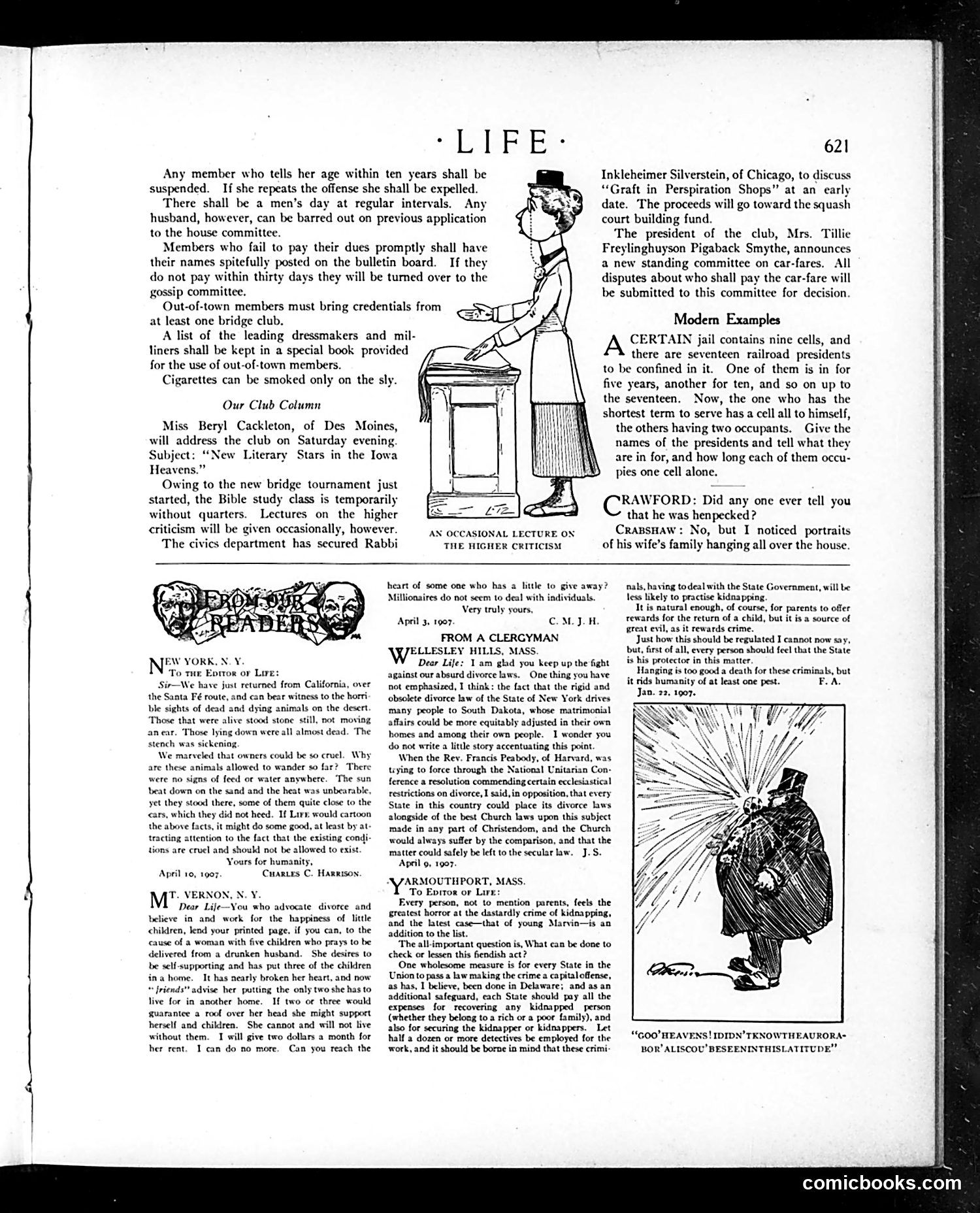
This page satirizes women's club culture and social pretensions of the Gilded Age. The main cartoon depicts a woman depositing something in a ballot box labeled "AN OCCASIONAL LECTURE ON THE HIGHER CRITICISM," mocking how women's clubs mixed frivolous activities (bridge tournaments, fashion gossip) with claims of intellectual substance (Bible study, lectures on theology). The club rules at top ridicule female club members: suspending women for revealing their age, enforcing dues payment via public shaming on a "gossip committee," and requiring members to smoke cigarettes "on the sly"—all poking fun at women's social pretensions and hypocrisy. The "Modern Examples" section presents a logic puzzle about jailed railroad presidents, likely referencing contemporary corporate scandals and the public perception that wealthy industrialists faced minimal legal consequences. The readers' letters address serious social issues—animal cruelty and divorce—contrasting sharply with the frivolous club culture mocked above, suggesting the magazine's critique of misplaced priorities among privileged women.
📄 Transcribed text from this page (OCR, searchable)
Machine-transcribed from the original scan — historical spelling and the odd misread are preserved.
* LB Any member who tells her age within ten years shall be suspended. If she repeats the offense she shall be expelled. There shall be a men’s day at regular intervals. Any husband, however, can be barred out on previous application to the house committee. Members who fail to pay their dues promptly shall have their names spitefully posted on the bulletin board. If they do not pay within thirty days they will be tumed over to the gossip committee. Out-of-town members must bring credentials from at least one bridge club. A list of the leading dressmakers and mil- liners shall be kept in a special book provided for the use of out-of-town members. Cigarettes can be smoked only on the sly. Our Club Column Miss Beryl Cackleton, of Des Moines, | address the club on Saturday evening Subject: “New Literary Stars in the Iowa Heavens.” Owing to the new bridge tournament just started, the Bible study class is temporarily without quarters. Lectures on the higher criticism will be given occasionally, however. The civics department has secured Rabbi THE HIGHER CRITICISM AN OCCASIONAL LECTURE ON 621 Inkleheimer Silverstein, of Chicago, to discuss “Graft in Perspiration Shops” at an early date. The proceeds will go toward the squash court building fund. The president of the club, Mrs. Tillie Freylinghuyson Pigaback Smythe, announces a new standing committee on car-fares. All disputes about who shall pay the car-fare will be submitted to this committee for decision. Modern Examples A CERTAIN jail contains nine cells, and there are seventeen railroad presidents to be confined in it. One of them is in for five years, another for ten, and so on up to the seventeen. Now, the one who has the shortest term to serve has a cell all to himself, the others having two occupants. Give the names of the presidents and tell what they are in for, and how long cach of them occu- pies one cell alone. RAWFORD: Did any one ever tell you that he was henpecked? CrassHaw: No, but I noticed portraits of his wife’s family hanging all over the house jir—We have just returned from California, over the Santa Fé route, and can bear witness to the horri ble sights of dead and dying animals on the desert Those that were alive stood stone still, not moving anear. Those lying down were all almost dead. ‘The stench was sickening. We marveled that owners could be so cruel. Why are these animals allowed to wander so far? There were no signs of feed or water anywhere. The sun beat down on the sand and the heat was unbearable, yet they stood there, some of them quite close (o the cars, which they did not heed. If Lirr, would cartoon the above facts, it might do some good, at least by at- tracting attention to the fact that the existing condi- tions are cruel and shoukd not be allowed to exist Yours for humanity, April 10, 1907 Cartes C. Harrison, T. VERNON, N.Y. Dear Lije—You who advocate divorce and believe in and work for the happiness of little chikren, lend your printed page. if you can, to the cause of a woman with five children who prays to be delivered from a drunken husband. She desires to be self-supporting and has put three of the children It has nearly broken her heart, and now * friends” advise her putting the only two she has to live for in another home. If two of three would guarantee a roof over her head she might support herself and children. She cannot and will not live without them. I will give two dollars a month for her rent. I can do no more. Can you reach the ina home. heart of some one who has a little to give away? Millionaires do not seem to deal with individuals. Very truly yours, April 3, 1907. CMJ. H. FROM A CLERGYMAN ELLESLEY HILLS, MASS. Dear Life: 1 am glad you keep up the fight against our absurd divorce laws. One thing you have ot emphasized, I think: the fact that the rigid and obsolete divorce law of the State of New York drives many people to South Dakota, whose matrimonial affairs could be more equitably adjusted in their own homes and among their own people. I wonder you do not write a little story accentuating this point. When the Rev. Francis Peabody, of Harvard, was tying to force through the National Unitarian Con- ference a resolution commending certain ecclesiastical restrictions on divorce, I said, in opposition, that every State in this country could place its divorce hws alongside of the best Church laws upon this subject made in any part of Christendom, and the Church would always suffer by the comparison, and that the matter could safely be left to the secular aw. J. S. April 9, 1907. ARMOUTHPORT, MASS. To Eprtor or Lirz Every person, not to mention parents, feels the greatest horror at the dastardly crime of kidnapping, and the latest case—that of young Marvin—is an addition to the list. ‘The all-important question is, What can be done to check or lessen this fiendish act ? ‘One wholesome measure is for every State in the Union to pass a law making the crime a capitaloffense, as has, I believe, been done in Delaware; and as an additional safeguard, cach State should pay all the expenses for recovering any kidnapped person (whether they belong to a rich or a poor family), and also for securing the kidnapper or kidnappers. Let half a dozen or more detectives be employed for the work, and it should be borne in mind that these crimi nals, having todeal with the State Government, will be less likely to practise kidnapping. It is natural enough, of course, for parents to offer rewards for the return of a child, but it is a source of great evil, as it rewards crime. Just how this should be regulated I cannot now say, but, first of all, every person should feel that the State is his protector in this matter. Hanging is too good a death for these criminals, but it rids humanity of at least one pest. FA. Jan. 22, 1907. “e00' BOR’ ALISCOU’ BESEENINTHISLATITUDE” comicbooks.com