
Life, 1907-05-02 · page 26 of 48
Life — May 2, 1907 — page 26: what you’re looking at
What you’re looking at
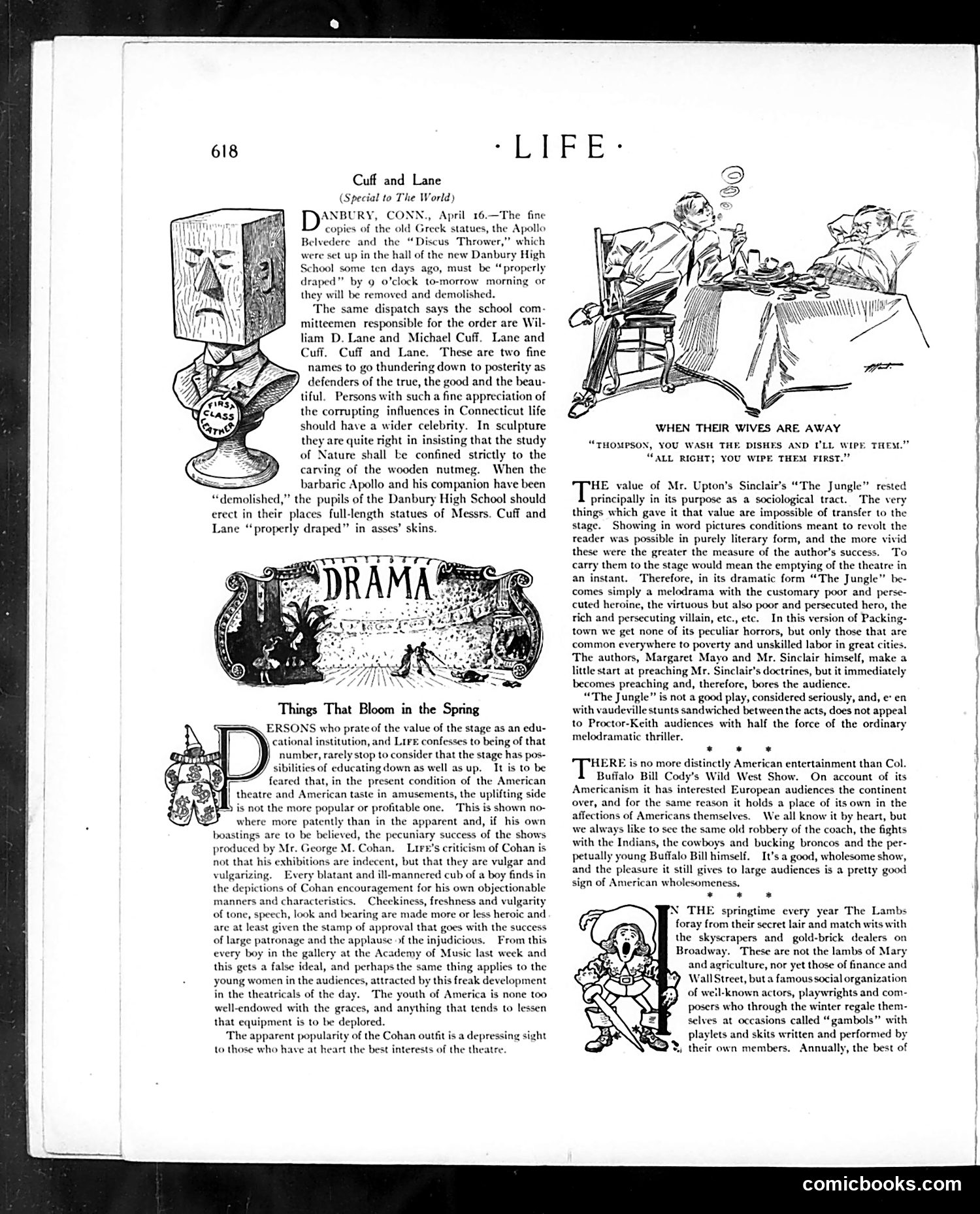
This page contains two separate satirical pieces: **"Cuff and Lane"** mocks Connecticut school officials who ordered Greek statues (the Apollo Belvedere and Discus Thrower) in Danbury High School's new hall to be "properly draped" by morning or removed. Life sarcastically praises Lane and Cuff as defenders of morality, then suggests they deserve full-length statues erected in their place—"properly draped in asses' skins." The joke: equating prudish censorship of classical art with donkey stupidity. This reflects early 20th-century tensions between Victorian modesty and artistic freedom. **"Things That Bloom in the Spring"** criticizes Broadway impresario George M. Cohan's theatrical productions as vulgar and morally corrupting to American youth, particularly young men in gallery audiences. Life argues Cohan's shows encourage "checkiness, freshness and vulgarity" rather than education or refinement. The piece laments that profitable entertainment appeals to base instincts rather than elevating public taste—a common Progressive-era complaint about mass culture. Both pieces reflect upper-class anxieties about American manners and morality.
📄 Transcribed text from this page (OCR, searchable)
Machine-transcribed from the original scan — historical spelling and the odd misread are preserved.
Cuff and Lane (Special to The World) NBURY, CONN., April 16.—The fine copies of the old Greck statues, the Apollo Belvedere and the “Discus Thrower,” which were set up in the hall of the new Danbury High School some ten ago, must be “properly draped” by 9 0’clock to-morrow morning or they will be removed and demolished. The same dispatch says the school com- mitteemen responsible for the order are Wil- liam D. Lane and Michael Cuff. Lane and Cuff. Cuff and Lane. These are two fine names to go thundering down to posterity as defenders of the true, the good and the beau- tiful. Persons with such a fine appreciation of the corrupting influences in Connecticut life should have a wider celebrity. In sculpture they are quite right in insisting that the study of Nature shall ke confined strictly to the carving of the wooden nutmeg. When the barbaric Apollo and his companion have been “demolished,” the pupils of the Danbury High School should erect in their places full-length statues of Messrs. Cuff and properly draped” in asses’ skins. Lane “ EAH I\WRES Things That Bloom in the Spring ERSONS who prate of the value of the stage as an edu- cational institution, and Lire confesses to being of that stop to consider that the stage has pos- of educating down as well as up, It is to be feared that, in the present condition of the American heatre and American taste in amusements, the uplifting side not the more popular or profitable one, ‘This is shown no- where more patently than in the apparent and, if his own boastings are to be believed, the pecuniary success of the shows produced by Mr. George M. Cohan. Lire’s criticism of Cohan is not that his exhibitions are indecent, but that they are vulgar and vulgarizing. Every blatant and ill-mannered cub of a boy finds in the depictions of Cohan encouragement for his own objectionable manners and characteristics. Checkiness, freshness and vulgarity of tone, speech, look and bearing are made more or less heroic and are at least given the stamp of approval that goes with the succes of large patrona; applause of the injudicious. From this every boy in the gallery at the Academy of Music last week and d perhaps the same thing applies to the young women in the audiences, attracted by this freak development in the theatricals of the day. The youth of America is none too well-endowed with the graces, and anything that tends to lessen that equipment is to be deplored. ‘The apparent popularity of the Cohan outfit is a depressing sight to those who have at heart the t interests of the theatre. «LEE : WHEN THEIR WIVES ARE AWAY “THOMPSON, YOU WASH THE DISHES AND I'LL WIPE THEM. “ALL RIGHT; YOU WIPE THEM FIRST.” 'HE value of Mr. Upton’s Sinclair’s “The Jungle” rested principally in its purpose as a sociological tract. The very things which gave it that value are impossible of transfer to the stage. Showing in word pictures conditions meant to revolt the reader was possible in purely literary form, and the more vivid these were the greater the measure of the author's success. To carry them to the stage would mean the emptying of the theatre in an instant. Therefore, in its dramatic form “The Jungle” be comes simply a melodrama with the customary poor and pe! cuted heroine, the virtuous but also poor and persecuted hero, the rich and persecuting villain, etc., etc. In this version of Packing- town we get none of its peculiar horrors, but only those that are common everywhere to poverty and unskilled labor in great cities. The authors, Margaret Mayo and Mr. Sinclair himself, make a little start at preaching Mr. Sinclair's doctrines, but it immediately becomes preaching and, therefore, bores the audience. “The Jungle” is not a good play, considered seriously, and, e* en with vaudeville stunts sandwiched between the acts, does not appeal to Proctor-Keith audiences with half the force of the ordinary melodramatic thriller. * * « HERE is no more distinctly American entertainment than Col. Bufialo Bill Cody’s Wild West Show. On account of its Americanism it has interested European audiences the continent over, and for the same reason it holds a place of its own in the affections of Americans themselves. We all know it by heart, but we always like to see the same old robbery of the coach, the fights with the Indians, the cowboys and bucking broncos and the per- petually young Buffalo Bill himself. It’s a good, wholesome show, and the pleasure it still gives to large audiences is a pretty good sign of American wholesomeness. * * * 'N THE springtime every year The Lambs foray from their secret lair and match wits with the skyscrapers and gold-brick dealers on Broadway. ‘These are not the lambs of Mary and agriculture, nor yet those of finance and Wall Street, but a famous social organization of weil-known actors, playwrights and com- posers who through the winter regale them- selves at occasions called “gambols” with playlets and skits written and performed by their own members. Annually, the best of comicbooks.com