
Life, 1907-05-02 · page 18 of 48
Life — May 2, 1907 — page 18: what you’re looking at
What you’re looking at
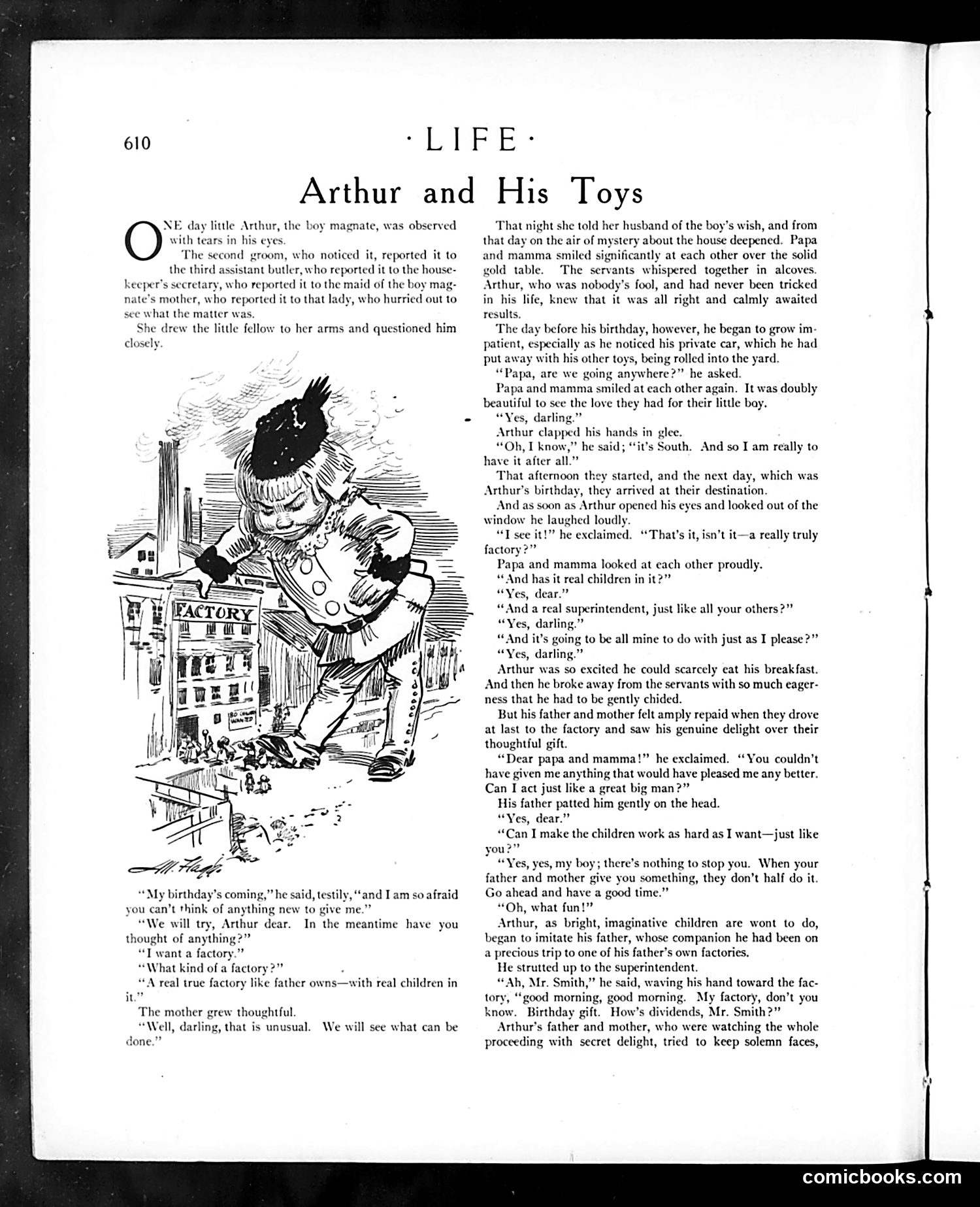
This is a biting satire of American industrial capitalism and child labor practices. Young Arthur, a wealthy "boy magnate," receives a real factory staffed with actual working children as his birthday gift. The joke targets the moral blindness of the industrial elite: Arthur's parents find it delightful that their son mimics his father's ruthless business practices, complete with demanding child labor and obsessing over dividends. The satire's sharp point is that the parents see nothing wrong with either their own exploitation of workers or teaching their son to do the same. The illustration shows Arthur towering over a factory building, emphasizing the grotesque power dynamic. The story's casual tone—treating child labor as amusing rather than abhorrent—intensifies the satirical critique of Gilded Age industrialists who normalized such exploitation. Life magazine is exposing the callousness of wealthy factory owners toward their workers, particularly children.
📄 Transcribed text from this page (OCR, searchable)
Machine-transcribed from the original scan — historical spelling and the odd misread are preserved.
“LIVE - Arthur and His Toys NE day little Arthur, the boy magnate, was observed with tears in his eyes The second groom, who noticed it, reported it to the third assistant butler, who reported it to the house- keeper's secretary, who reported it to the maid of the boy mag- nate’s mother, who reported it to that lady, who hurried out to see what the matter was. She drew the little fellow to her arms and questioned him closely. “My birthday’s coming,”’he said, testily, “and Tam so afraid you can't think of anything new to give me.” “We will try, Arthur dear. In the meantime have you thought of anything?” “T want a factor “What kind of ? . “A real true factory like father owns—with real children in it.” The mother grew thoughtful. “Well, darling, that is unusual. We will see what can be done.” That night she told her husband of the boy’s wish, and from that day on the air of mystery about the house deepened. Papa and mamma smiled significantly at each other over the solid gold table. The servants whispered together in alcoves Arthur, who was nobody’s fool, and had never been tricked in his life, knew that it was all right and calmly awaited results, The day before his birthday, however, he began to grow im- patient, especially as he noticed his private car, which he had put away with his other toys, being rolled into the yard. “Papa, are we going anywhere?” he asked. Papa and mamma smiled at each other again. It was doubly beautiful to see the love they had for their litle bay, “Yes, darling.” Arthur clapped his hands in glee. “Oh, I know,” he said; “it’s South. And so I am really to have it after all.” fternoon they birthday, th tarted, and the next day, which was arrived at their destination. And as soon as Arthur opened his eyes and looked out of the window he laughed loudly. it!” he exclaimed. “That's it, isn’t it—a really truly “And has it real children in it?” “Yes, dear.” nd a real superintendent, just like all your others?” “Yes, darling.” “And it’s going to be all mine to do with just as I please?” “Yes, darling.” Arthur was so excited he could scarcely eat his breakfast. And then he broke away from the servants with so much eager- ness that he had to be gently chided. But his father and mother felt amply repaid when they drove at last to the factory and saw his genuine delight over their thoughtful gift. “Dear papa and mamma!” he exclaimed. “You couldn't have given me anything that would have pleased me any better. Can I act just like a great big man?” His father patted him gently on the head. “Yes, dear.” “Can I make the children work as hard as I want—just like you?” “Yes, yes, my boy; there’s nothing to stop you. When your father and mother give you something, they don’t half do it. Go ahead and have a good time.” “Oh, what fun!” Arthur, as bright, imaginative children are wont to do, began to imitate his father, whose companion he had been on a precious trip to one of his father’s own factories. He strutted up to the superintendent. “Ah, Mr. Smith,” he said, waving his hand toward the fac- tory, “good morning, good morning. My factory, don’t you know. Birthday gift. How’s dividends, Mr. Smith?” Arthur's father and mother, who were watching the whole proceeding with secret delight, tried to keep solemn faces, comicbooks.com