
Life, 1907-05-02 · page 19 of 48
Life — May 2, 1907 — page 19: what you’re looking at
What you’re looking at
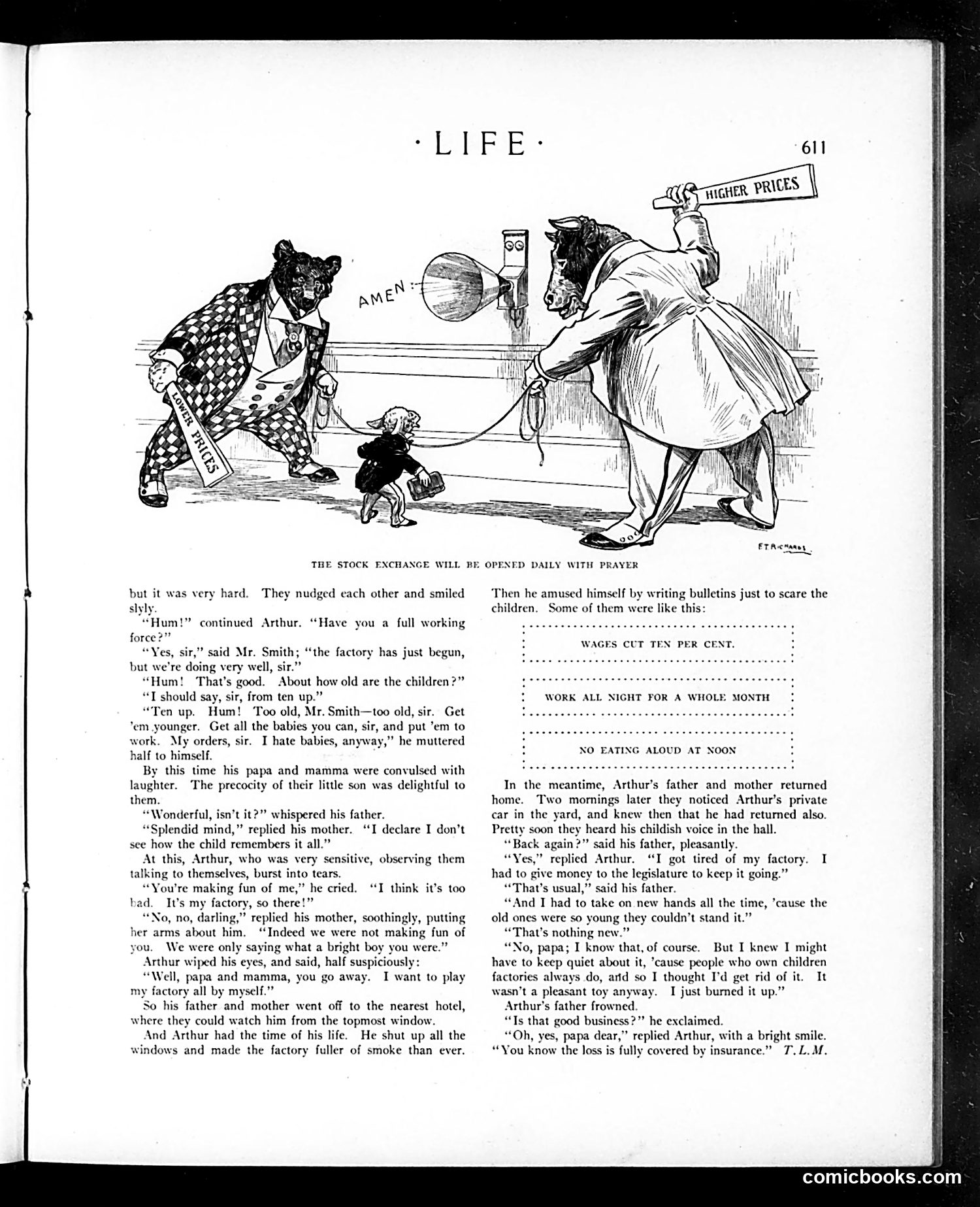
This is a satirical story-cartoon critiquing early 20th-century child labor practices and corporate corruption. A precocious boy named Arthur plays at running a factory, where he demands workers as young as possible, exploits them until they collapse, bribes legislators to keep operating, and finally burns down the factory to collect insurance—all while his parents find his behavior delightful. The satire works by having the child articulate real industrial practices openly: child labor, legislative corruption, worker expendability, and insurance fraud. The cartoon at top shows the "Stock Exchange" opening with prayer, mocking how business and morality are absurdly separated. Arthur's innocent recitation of corrupt adult behavior exposes how normalized these practices were. His final line—that the insurance covers losses—targets how corporations profited from destruction while workers suffered. The story ridicules both industrialists and parents who celebrate such ruthlessness in their offspring.
📄 Transcribed text from this page (OCR, searchable)
Machine-transcribed from the original scan — historical spelling and the odd misread are preserved.
but it was very hard. slyly. “Hum!” continued Arthur. “Have you a full working force?” “Yes, sir,” said Mr. Smith; “the factory has just begun, but we're doing very well, si “Hum! That’s good. About how old are the children?” “T should say, sir, from ten up.” “Ten up. Hum! Too old, Mr. Smith—too old, sir. Get ‘em younger. Get all the babies you can, sir, and put ’em to work. My orders, sir. I hate babies, anyway,” he muttered half to himself. By this time his papa and mamma were convulsed with laughter. The precocity of their little son was delightful to them. “Wonderful, isn’t it?” whispered his father. “Splendid mind,” replied his mother. ‘I declare I don’t see how the child remembers it all.” At this, Arthur, who was very sensitive, observing them talking to themselves, burst into tears. “You're making fun of me,” he cried. bad. It’s my factory, so there!” “No, no, darling,” replied his mother, soothingly, putting her arms about him. ‘Indeed we were not making fun of you. We were only saying what a bright boy you were.” Arthur wiped his eyes, and said, half suspiciously: “Well, papa and mamma, you go away. I want to play my factory all by myself.” So his father and mother went off to the nearest hotel, where they could watch him from the topmost window. And Arthur had the time of his life. He shut up all the windows and made the factory fuller of smoke than ever. They nudged each other and smiled “TI think it’s too THE STOCK EXCHANGE WILL BE OPENED DAILY WITH PRAYER Then he amused himself by writing bulletins just to scare the children. Some of them w In the meantime, Arthur’s father and mother returned home. Two mornings later they noticed Arthur’s private car in the yard, and knew then that he had retumed also. Pretty soon they heard his childish voice in the hall. “Back again?” said his father, pleasantly. “Yes,” replied Arthur. “I got tired of my factory, I had to give money to the legislature to keep it going.” “That’s usual,” said his father. “And I had to take on new hands all the time, ’cause the old ones were so young they couldn’t stand it.” “That’s nothing new.” “No, papa; I know that, of course. But I knew I might have to keep quiet about it, ‘cause people who own children factories always do, arid so I thought I'd get rid of it. It wasn’t a pleasant toy anyway. I just bumed it up.” Arthur's father frowned. “Ts that good business?” he exclaimed. “Oh, yes, papa dear,” replied Arthur, with a bright smile. “You know the loss is fully covered by insurance.” 7. L.M. comicbooks.com