
Life, 1907-05-02 · page 20 of 48
Life — May 2, 1907 — page 20: what you’re looking at
What you’re looking at
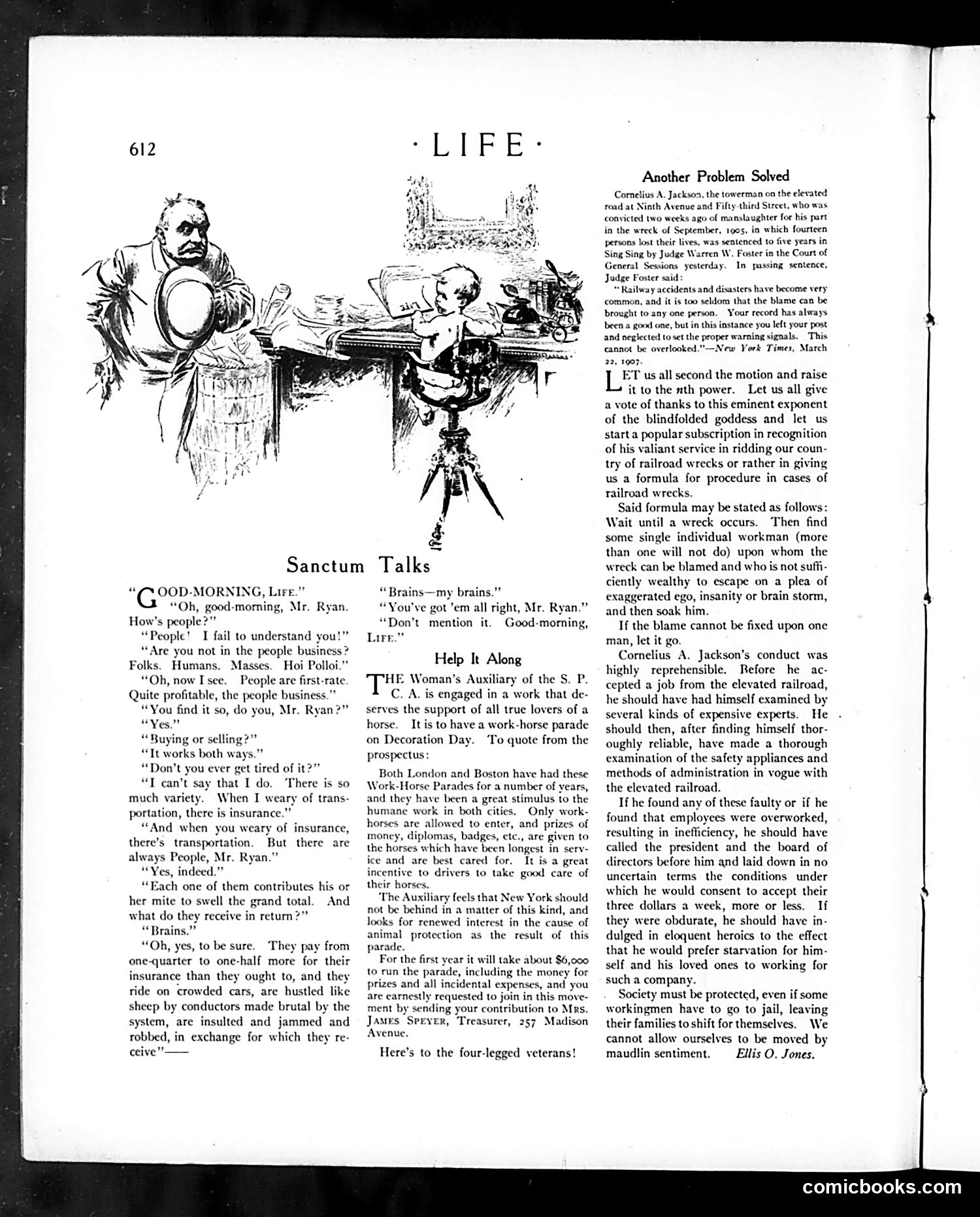
This page contains three satirical pieces critiquing American business and justice systems circa 1907. **"Sanctum Talks"** mocks a businessman (Mr. Ryan) who profits from people through insurance and transportation by exploiting them—overcharging for insurance, crowding them into transit, having them "hustled like sheep" by brutal conductors. The joke: Ryan generously gives them his "brains" in return for their money and suffering. **"Help It Along"** promotes a Work-Horse Parade charity, advocating better treatment of working horses—a genuine animal welfare cause presented earnestly. **"Another Problem Solved"** sarcastically celebrates the conviction of Cornelius Jackson, an elevated railroad tower operator sentenced for a 1905 wreck killing fourteen people. The satire savagely critiques the justice system: it finds one scapegoat worker rather than addressing systemic railroad negligence, and punishes only those too poor to escape accountability through claims of mental illness or wealth. The bitter formula: "Wait until a wreck occurs. Then find some single individual workman...and then soak him."
📄 Transcribed text from this page (OCR, searchable)
Machine-transcribed from the original scan — historical spelling and the odd misread are preserved.
Sanctum “( OOD-MORNING, Lt “Oh, good-morning, Mr. Ryan. How’s people?” “People! I fail to understand you!” re you not in the people business ? Folks. Humans. Masses. Hoi Polloi.”” “Oh, now Isee. People are first-rate. Quite profitable, the people business “You find it so, do you, Mr. Rya “Tt works both way “Don’t you ever get tired of it?” “T can’t say that I do. There is so much variety. When I weary of trans- portation, there is insurance. nd when you weary of insurance, transportation. But there are s People, Mr. Ryan.” “Yes, indeed.” ch one of them contributes his or her mite to swell the grand total. And what do they receive in return?” “Brains.” “Oh, yes, to be sure. They pay from one-quarter to one-half more for their insurance than they ought to, and they ride on crowded cars, are hustled like sheep by conductors made brutal by the system, are insulted and jammed and robbed, in exchange for which they re- ceive”? —— Talks “Brains—my brains.” “You've got ’em all right, Mr. Ryan.” “Don’t mention it. Good-morning, Lire.” Help It Along 'HE Woman's Auxiliary of the S. P. C. A. is engaged in a work that de- serves the support of all true lovers of a horse. It is to have a work-horse parade on Decoration Day. ‘To quote from the prospectus: Both London and Boston have had these Work-Horse Parades for a number of years, and they have been a great stimulus to the humane work in both cities. Only work- horses are allowed to enter, and prizes of moncy, diplomas, badges, etc., are given to the horses which have been longest in serv- ice and are best cared for. It is a great incentive to drivers to take good care of their horse: ‘The Auxiliary feels that New York should not be behind in a matter of this kind, and looks for renewed interest in the cause of animal protection as the result of this parade. For the first year it will take about $6,000 to run the parade, including the money for prizes and all incidental expenses, and you are earnestly requested to join in this move- ment by sending your contribution to Mrs. James Speyer, Treasurer, 257 Madison Avenue. Here's to the four-legged veterans! Another Problem Solved Cornelius A. Jackson, the towerman on the elevated toad at Ninth Avenue and Fifty-third Street, who was convicted two weeks ago of manslaughter for his part in the wreck of September, 1905, in which fourteen persons lost their lives, was sentenced to five years in Sing Sing by Judge Warren W. Foster in the Court of General Sessions yesterday. In passing sentence, Judge Foster said “ Railway accidents and disasters have become very common, and it is too seldom that the blame can be brought to any one person. Your record has always been a good one, but in this instance you left your post and neglected (o set the proper warning signals. This cannot be overlooked." —New York Times, March 22, 1907. us all second the motion and raise it to the nth power. Let us all give a vote of thanks to this eminent exponent of the blindfolded goddess and let us start a popular subscription in recognition of his valiant service in ridding our coun- try of railroad wrecks or rather in giving us a formula for procedure in cases of railroad wrecks. Said formula may be stated as follows: Wait until a wreck occurs. Then find some single individual workman (more than one will not do) upon whom the wreck can be blamed and who is not suffi- ciently wealthy to escape on a plea of exaggerated ego, insanity or brain storm, and then soak him. If the blame cannot be fixed upon one man, let it go. Cornelius A. Jackson’s conduct was highly reprehensible. Refore he ac- cepted a job from the elevated railroad, he should have had himself examined by several kinds of expensive experts. He should then, after finding himself thor- oughly reliable, have made a thorough examination of the safety appliances and methods of administration in vogue with the elevated railroad. If he found any of these faulty or if he found that employees were overworked, resulting in inefficiency, he should have called the president and the board of directors before him and laid down in no uncertain terms the conditions under which he would consent to accept their three dollars a week, more or less. If they were obdurate, he should have in- dulged in eloquent heroics to the effect that he would prefer starvation for him- self and his loved ones to working for such a company. Society must be protected, even if some workingmen have to go to jail, leaving their families to shift for themselves. We cannot allow ourselves to be moved by maudlin sentiment. Ellis O. Jones. comicbooks.com