
Life, 1907-05-02 · page 22 of 48
Life — May 2, 1907 — page 22: what you’re looking at
What you’re looking at
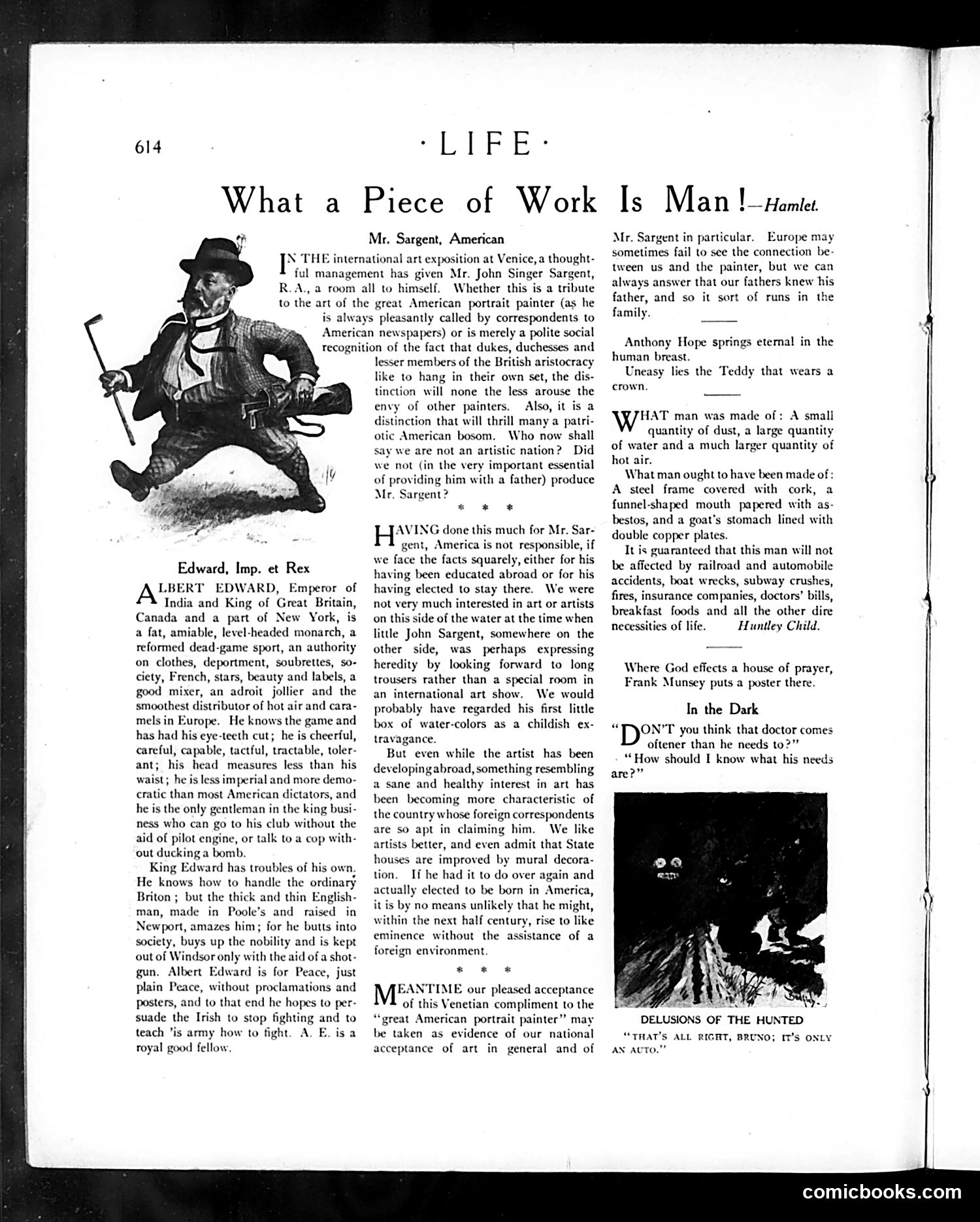
This page satirizes American cultural pretensions and the painter John Singer Sargent's international prominence. The main text celebrates Sargent receiving his own room at the Venice art exposition, presenting this as evidence of American artistic legitimacy. Life's satire is biting: Americans claim Sargent as "their" artist despite his European training and residence, boasting he proves "we are not an artistic nation"—the contradiction itself is the joke. The article mocks American pride in merely *producing* Sargent's father, as if paternity alone counts as cultural contribution. Life suggests Americans previously dismissed art as frivolous ("childish extravagance") but now retroactively claim Sargent as a national asset once Europe validated him. The secondary section profiles King Edward VII, using similar satirical tone toward British society and American social-climbers. The cartoons illustrate these themes of pretension and social climbing, though specific figures are unclear from the image alone.
📄 Transcribed text from this page (OCR, searchable)
Machine-transcribed from the original scan — historical spelling and the odd misread are preserved.
‘LIFE: What a Piece of Work Is Man !—demie. N THE ful management has given Mr. John Si R.A, a room all to himself. Mr. Sargent, American nternational art exposition at Venice, a thought- ger Sargent, Whether this is a tribute to the art of the great American portrait painter (as he is always pleasantly called by correspondents to American newspapers) or is merely a polite social recognition of the fact that dukes, duchesses and Edward, Imp. et Rex LBERT EDWARD, Emperor of India and King of Great Britain, Canada and a part of New York, is a fat, amiable, level-headed monarch, a reformed dead-game sport, an authority on clothes, deportment, soubrettes, so- ciety, French, stars, beauty and labels, a good mixer, an adroit jollier and the smoothest distributor of hot air and cara- mels in Europe. He knows the game and has had his eye-teeth cut; he is cheerful, careful, capable, tactful, tractable, toler- ant; his head measures less than his waist; he is less imperial and more demo- cratic than most American dictators, and he is the only gentleman in the king busi- ness who can go to his club without the aid of pilot engine, or talk to a cop with- out ducking a bomb. King Edward has troubles of his own. He knows how to handle the ordinary Briton ; but the thick and thin English- man, made in Poole’s and raised in Newport, amazes him; for he butts into society, buys up the nobility and is kept out of Windsor only with the aid of a shot- gun. Albert Edward is for Peace, just plain Peace, without proclamations and posters, and to that end he hopes to per- suade the Irish to stop fighting and to teach ‘is army how to fight. A. E royal good fell isa lesser members of the British aristocracy like to hang in their own set, the dis- tinction will none the less arouse the envy of other painters. Also, it is a distinction that will thrill many a patri- otic American bosom. Who now shall say we are not an artistic nation? Did we not (in the very important essential of providing him with a father) produce Mr. Sargent? * * * VING done this much for Mr. Sar- gent, America is not responsible, if we face the facts squarely, either for his having been educated abroad or for his having elected to stay there. We were not very much interested in art or artists on this side of the water at the time when little John Sargent, somewhere on the other side, was perhaps expressing heredity by looking forward to long trousers rather than a special room in an international art show. We would probably have regarded his first little box of water-colors as a childish ex- travagance. But even while the artist has been developing abroad, something resembling a sane and healthy interest in art has been becoming more characteristic of the country whose foreign correspondents are so apt in claiming him. We like artists better, and even admit that State houses are improved by mural decora- tion. If he had it to do over again and actually elected to be born in America, it is by no means unlikely that he might, within the next half century, rise to like eminence without the assistance of a foreign environment ek & ANTIME our pleased acceptance of this Venetian compliment to the great American portrait painter” may be taken as evidence of our national acceptance of art in general and of Mr. Sargent in particular. Europe may sometimes fail to see the connection be- tween us and the painter, but we can always answer that our fathers knew his father, and so it sort of runs in the family. Anthony Hope springs eternal in the human breast. Uneasy lies the Teddy that wears a crown. HAT man was made of: A small quantity of dust, a large quantity of water and a much larger quantity of hot air. What man ought to have been made of : A steel frame covered with cork, a funnel-shaped mouth papered with as- bestos, and a goat's stomach lined with double copper plates. It is guaranteed that this man will not be affected by railroad and automobile accidents, boat wrecks, subway crushes, fires, insurance companies, doctors’ bills, breakfast foods and all the other dire necessities of life. Huntley Child. Where God effects a house of prayer, Frank Munsey puts a poster there. In the Dark “DON’T you think that doctor comes oftener than he needs to?” “How should I know what his needs are?” “THAT AN AUTO. ALL RIGHT, BRUNO; IT’S ONLY comicbooks.com