
A complete issue · 52 pages · 1907
Life — March 7, 1907
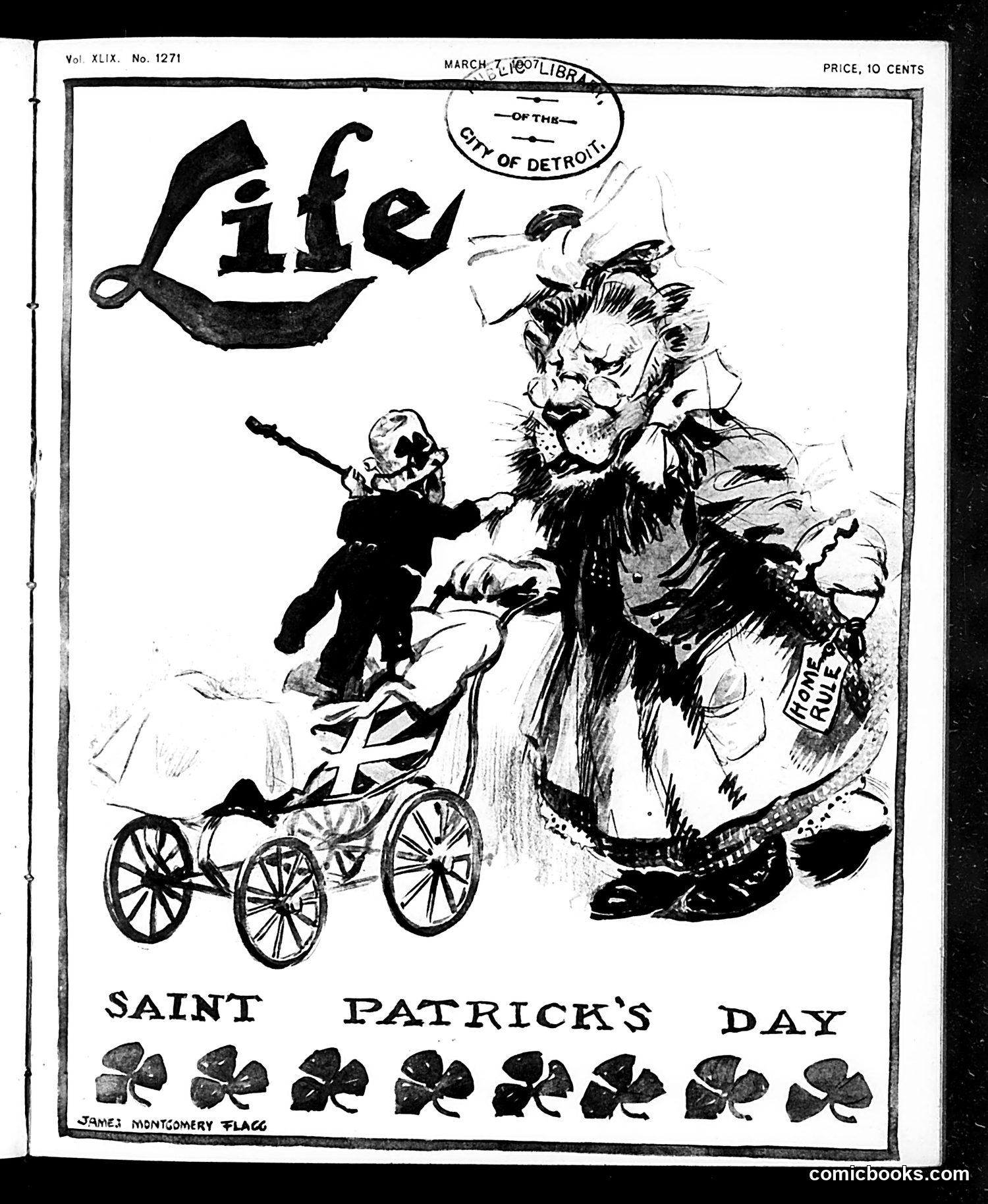
This 1907 *Life* magazine cover depicts a caricatured leprechaun or Irish figure with exaggerated features holding a baby in a carriage, illustrated by James Montgomery Flagg. The smaller figure brandishing a stick appears to be threatening or chasing the creature. The cartoon plays on Saint Patrick's Day imagery using shamrocks as decoration. The "Life" boat motif in the upper left suggests themes of survival or Irish immigration. The satire likely targets Irish-American stereotypes or anxieties common in early 20th-century America, when Irish immigrants faced considerable prejudice. The threatening gesture and caricatured depiction reflect the period's casual ethnic mockery typical of mainstream publications, though the specific social commentary remains unclear without additional context.
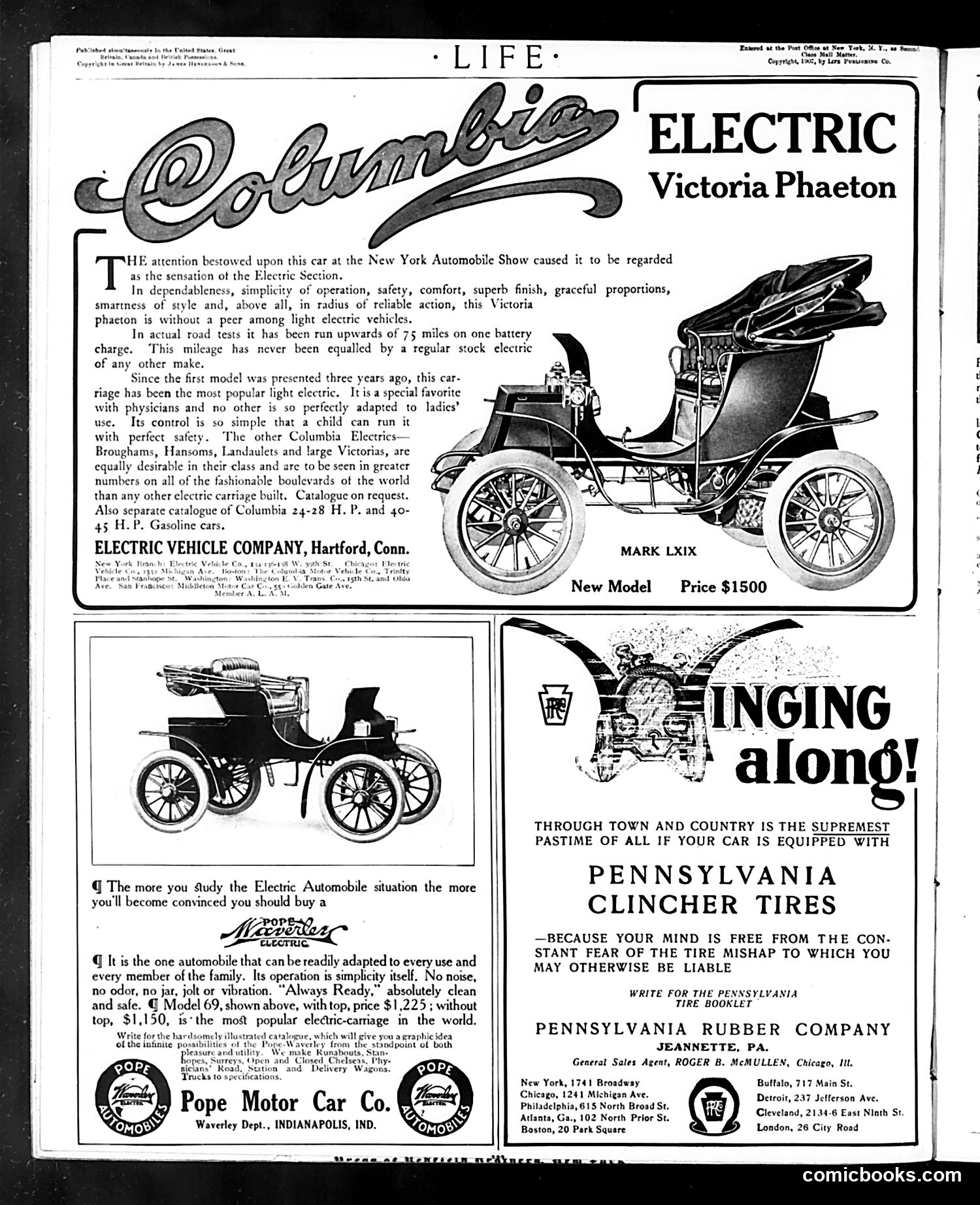
This page is **primarily advertising**, not political satire. It contains three car advertisements from the early 1900s: 1. **Columbia Electric Victoria Phaeton** ($1500) - emphasizes reliability, simplicity, and safety of electric vehicles. Notes it achieved 75 miles on one battery charge. 2. **Pope Motor Car** (Model 69, $1,225) - advertises an adaptable automobile with "no noise, no odor, no jar, jolt or vibration," positioning it as practical and clean. 3. **Pennsylvania Clincher Tires** - promotes tire reliability to reduce "constant fear" of tire failure while driving. The ads reflect early automotive marketing's focus on **reliability and safety** as selling points—concerns that dominated early motorcar adoption. The electric vehicle advertisement is particularly notable as it represents a now-obsolete technology that competed with gasoline engines in this era.
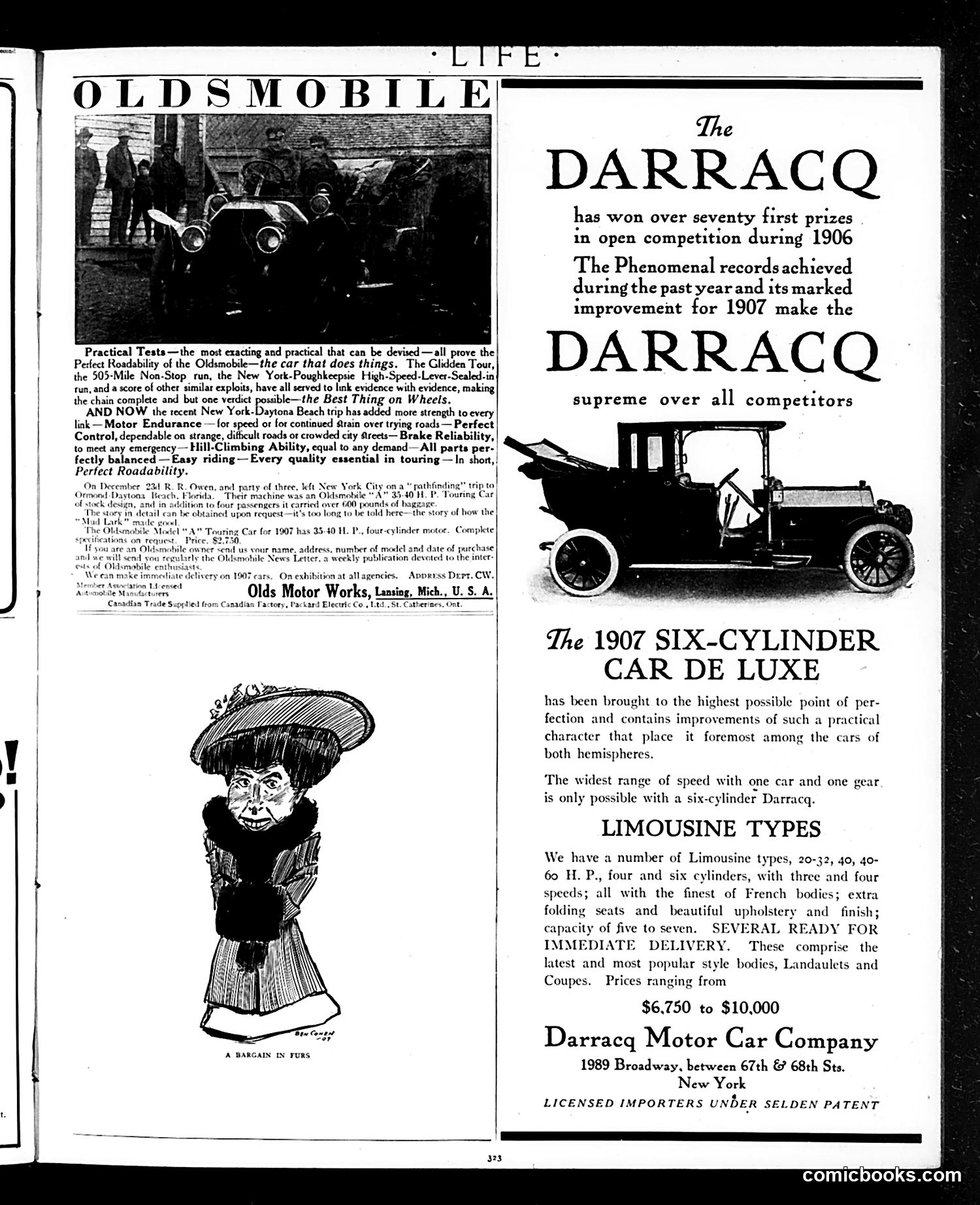
This page is primarily **advertising**, not satire or political commentary. The left side advertises Oldsmobile automobiles, emphasizing their reliability and practical testing. The right side promotes Darracq motor cars, highlighting their 1906 competition victories and the superiority of their 1907 six-cylinder model. The only cartoon element is a small illustration labeled "A BARGAIN IN FURS"—a caricatured woman's head wearing an elaborate hat and fur collar. This appears to be **unrelated social satire** about women's fashion, mocking either the extravagance of women's winter wear or possibly satirizing a specific socialite or trend of the era. The joke likely plays on the contrast between the "bargain" label and the obvious luxury of the furs depicted.
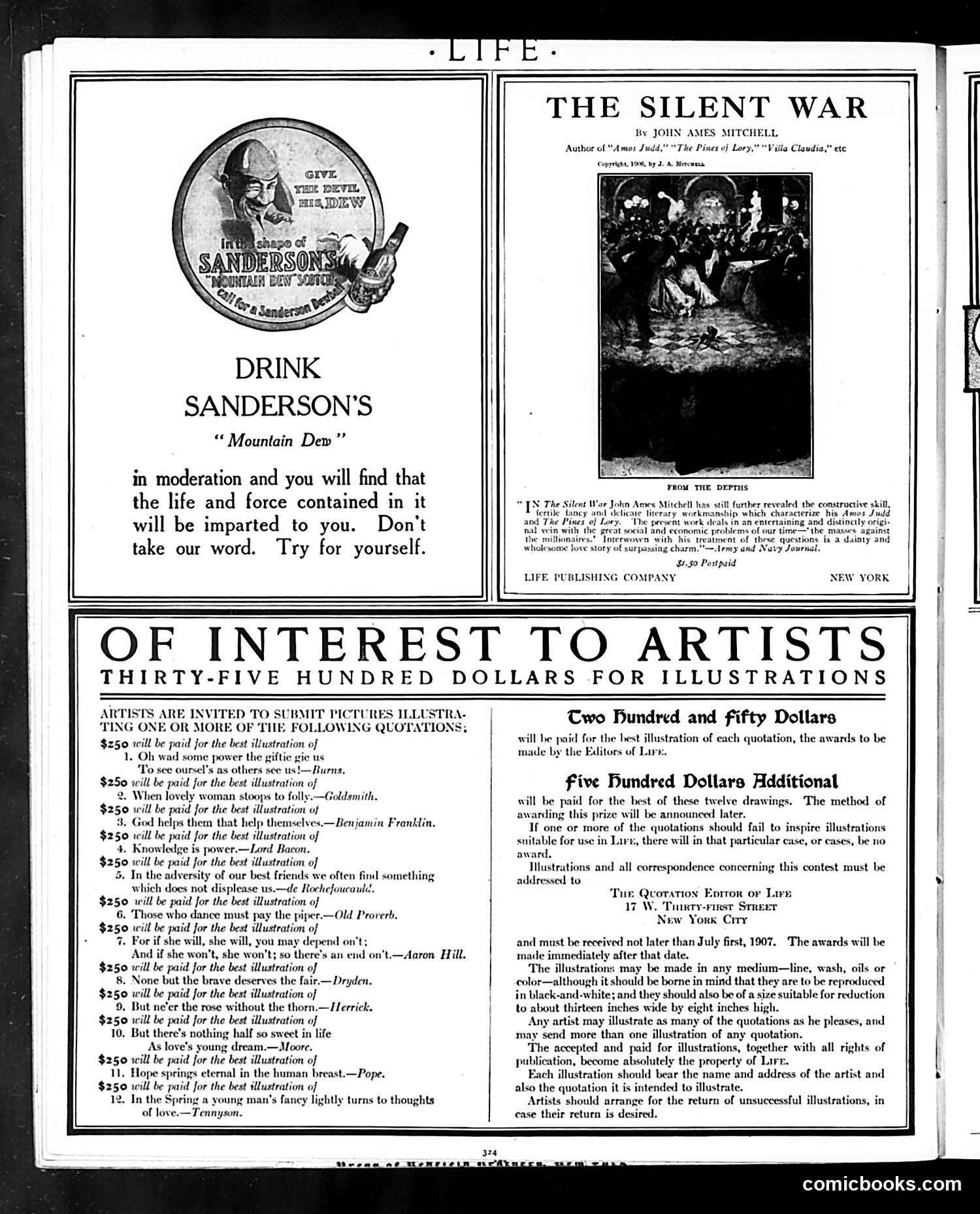
This page is primarily **advertising and a contest announcement**, not political satire. The left side advertises Sanderson's "Mountain Dew" beverage, featuring a caricatured figure (possibly a Scottish Highlander based on the "dew" reference) promoting the drink's vitality. The right side announces "The Silent War," a serialized story by John Mitchell appearing in Life Publishing Company, with an illustration showing figures in dramatic confrontation. Below is a major contest: **Life is offering $3,500 total** for artists to submit illustrations of famous quotations. Prizes range from $250-$500 per illustration, with specific quotes listed (from writers like Benjamin Franklin, Lord Bacon, Aaron Hill, Dryden, Herrick, Moore, Pope, and Tennyson). The deadline is July 1, 1907. This reflects Life's dual function as both satirical publication and literary magazine seeking visual art contributions.
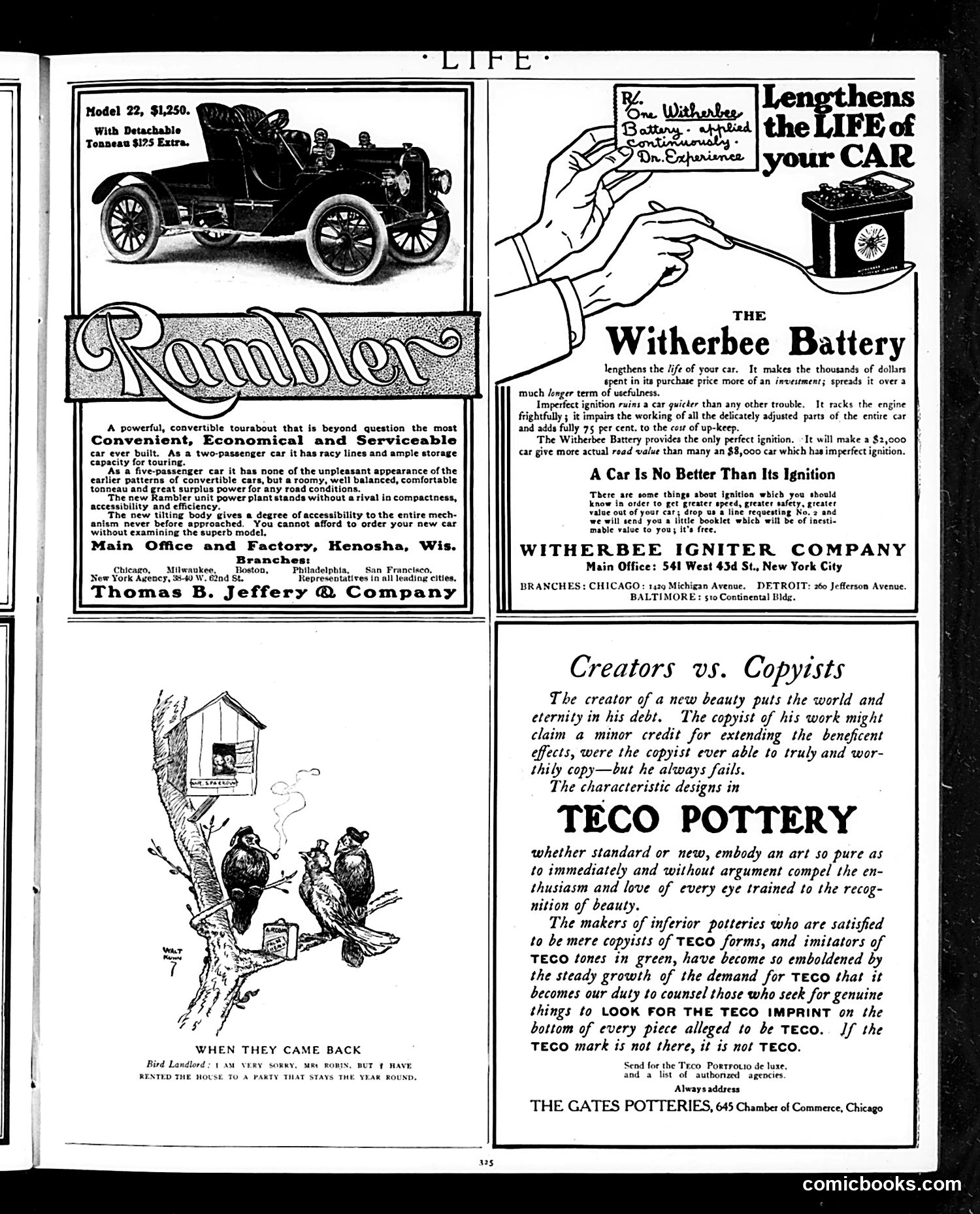
This page is primarily **advertising content** rather than political satire or editorial cartoons. The top-left features a Rambler automobile advertisement from Thomas B. Jefferson & Company, promoting a Model 22 touring car priced at $1,250. The right side advertises the Witherbee Battery, claiming to extend a car's engine life by improving ignition performance. The bottom-left contains a small illustration titled "When They Came Back" depicting birds returning to a birdhouse, with a humorous domestic caption about rented lodging. The bottom-right advertises Teco Pottery, distinguishing genuine Teco products from inferior copies and warning consumers to check for the manufacturer's imprint. This appears to be a standard magazine page mixing commercial advertisements with minimal editorial content—typical of early 20th-century American periodicals.
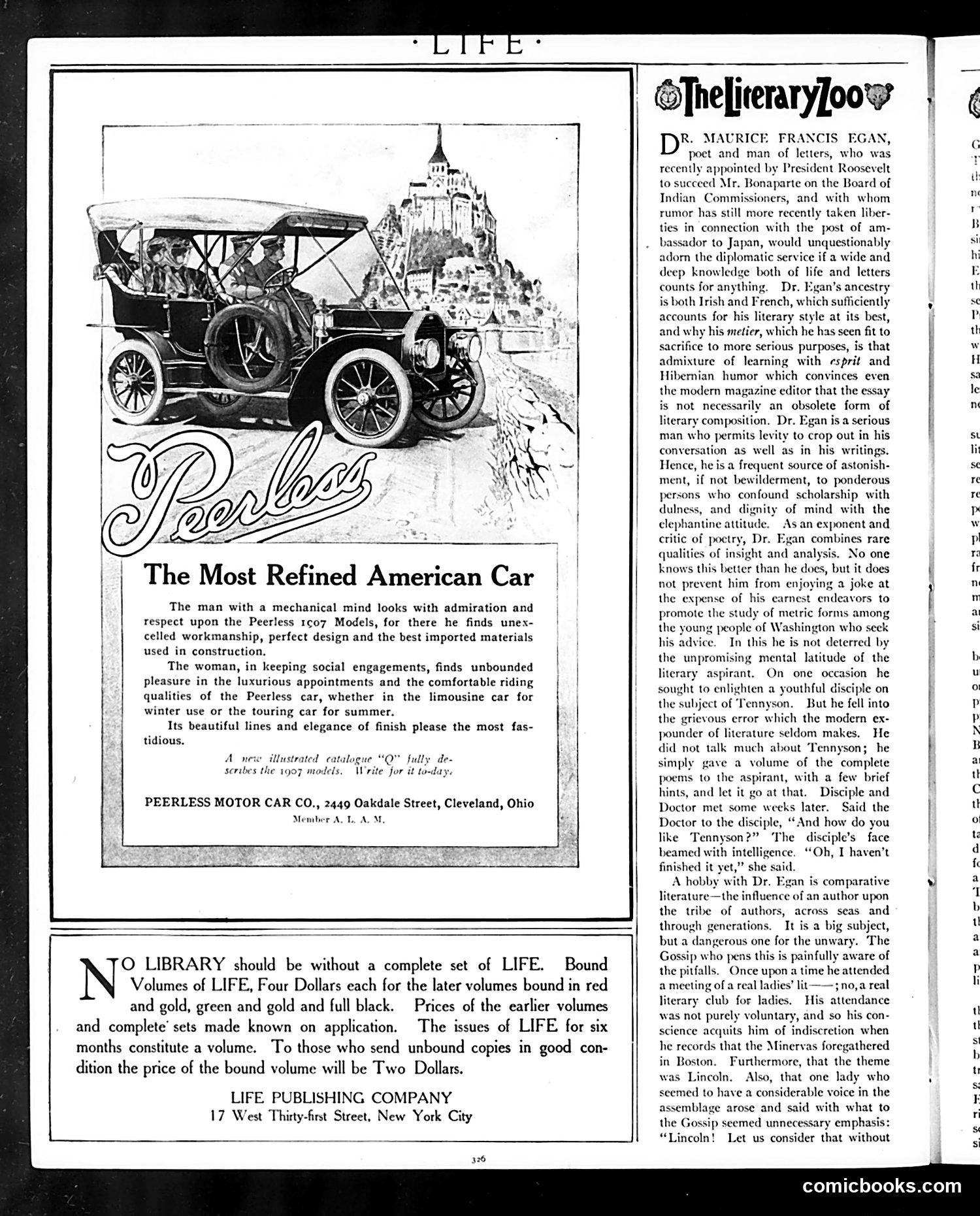
This page contains **advertisements and literary commentary**, not political satire. The left side features a **Peerless automobile ad** showing an early 1900s car near a castle, emphasizing luxury and refined engineering for both mechanical enthusiasts and society women. The right side, "The Literary Zoo," profiles **Dr. Maurice Francis Egan**, a poet and diplomat recently appointed to the Board of Indian Commissioners by President Roosevelt. The piece humorously describes his character—blending serious scholarship with "esprit and Hibernian humor"—and recounts an anecdote about him critiquing a student's Tennyson study. Below is a **Life magazine subscription advertisement** promoting bound volumes at four dollars each. The page reflects early 1900s American consumer culture and literary intellectualism.
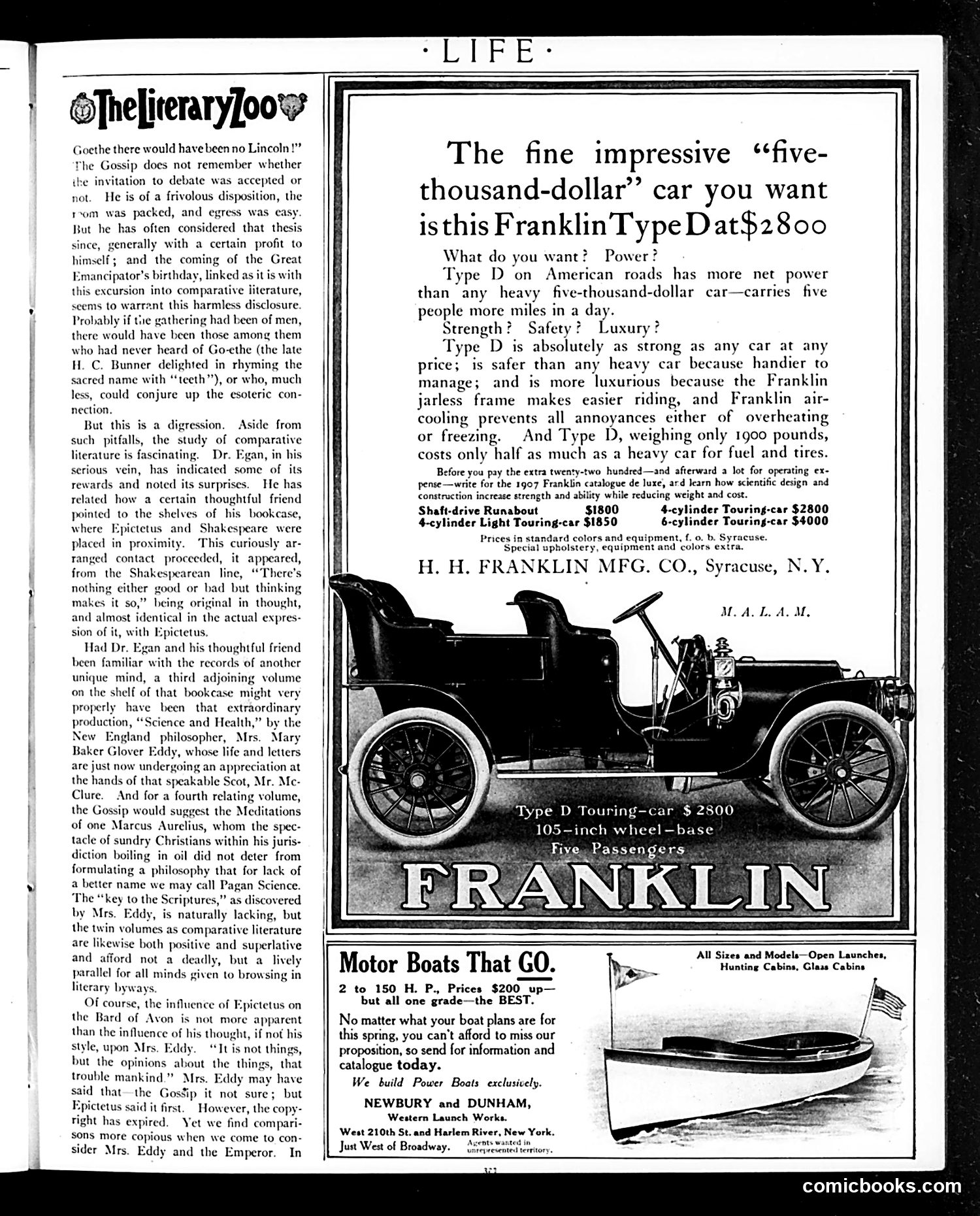
This page is primarily **advertising** rather than satire or political commentary. It contains two main advertisements: 1. **Franklin Type D automobile** (center): A luxury car marketed as offering power, strength, safety, and luxury comparable to expensive five-thousand-dollar vehicles, but at $2,800. The ad emphasizes practical features like fuel efficiency and air-cooling. 2. **Newbury and Dunham motor boats** (bottom): Advertising various boat models and sizes, emphasizing their quality and inviting catalog requests. The left column contains "The Literary Zoo," a gossipy column discussing literary figures and comparative literature—unrelated to the advertisements. The page functions primarily as a commercial vehicle for automobiles and recreational boats, typical of early 20th-century Life magazine's mixed content format.
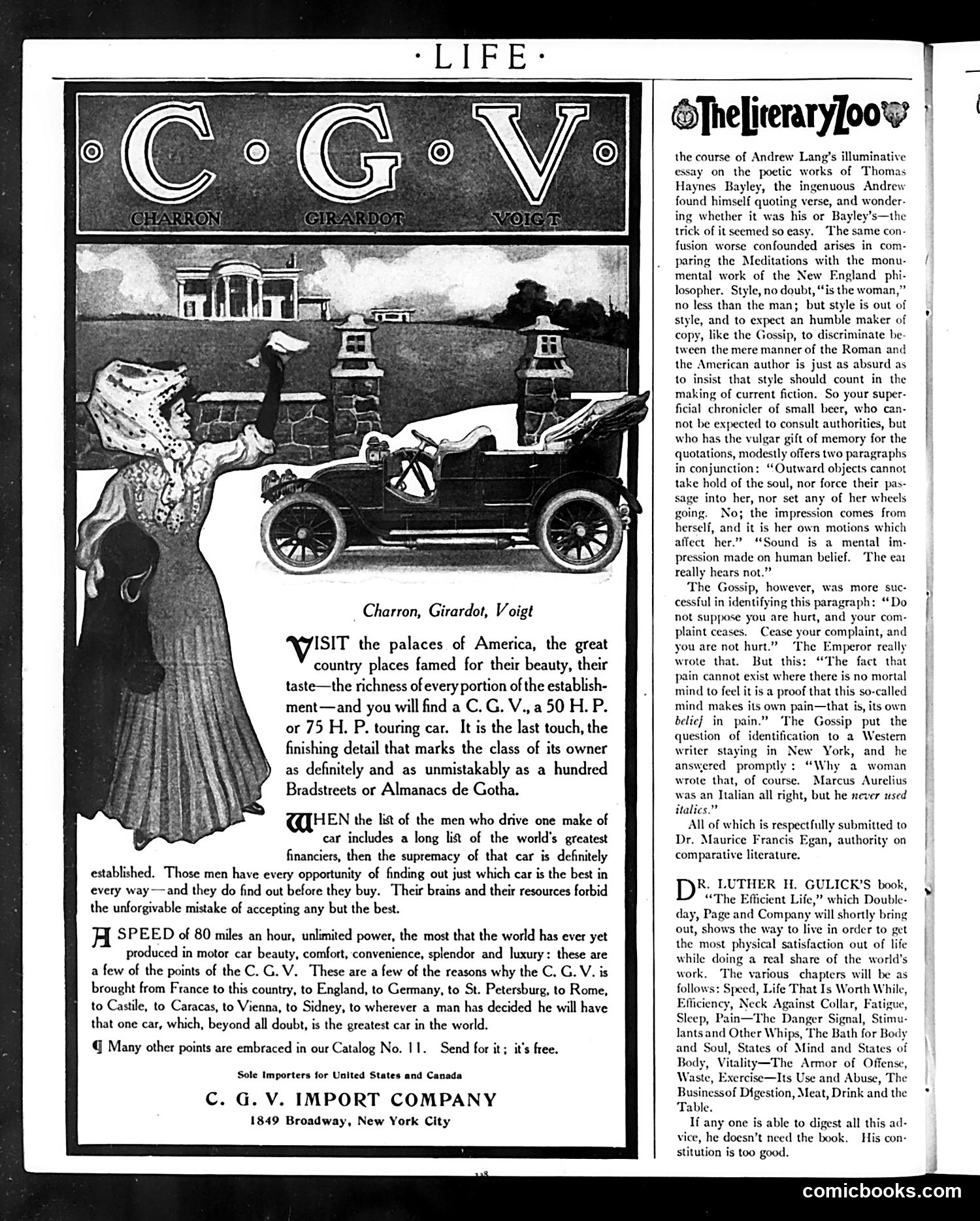
This page is primarily a **car advertisement**, not political satire. The upper portion advertises the C.G.V. (Charron, Girardot, Voigt)—a French luxury automobile. The decorative illustration shows an elegantly dressed woman in period clothing beside a touring car, emphasizing the vehicle's association with wealth and refined taste. The advertisement emphasizes the car's prestige, claiming it rivals famous European makes like Bradstreets and Almanacs de Gotha. It highlights specifications: 50-75 H.P., 80 mph top speed, and availability worldwide. The right column discusses literary matters unrelated to the car, including Thomas Haynes Bayley and style in writing—content typical of *Life* magazine's mixed editorial/advertising format of the early 20th century.
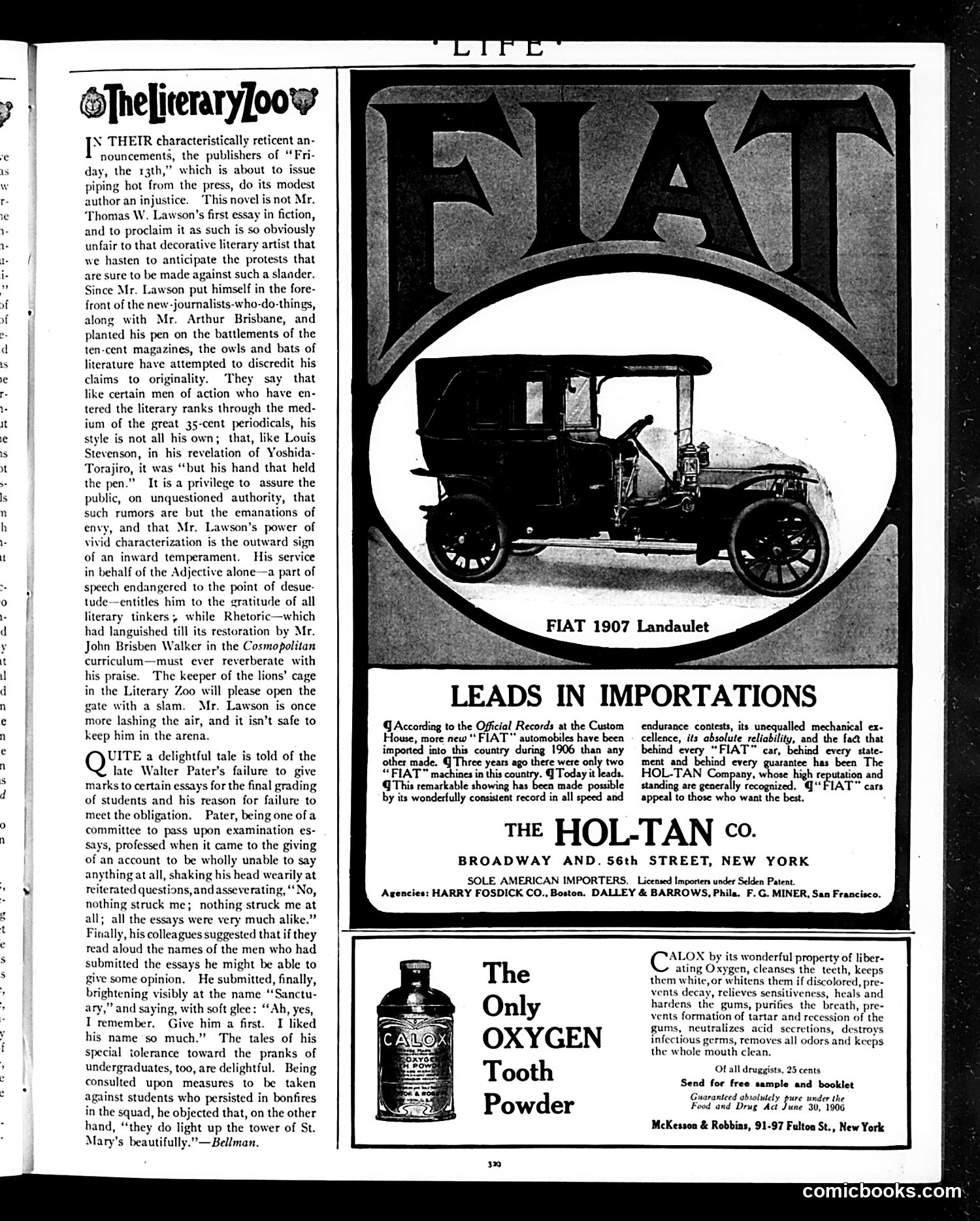
This page is primarily a literary column critiquing Thomas W. Lawson's novel "Friday, the 13th." The critic defends Lawson against accusations that his work imitates other journalists-turned-writers like Arthur Brisbane, arguing his vivid characterization reflects "inward temperament" rather than mere imitation. The column includes a humorous anecdote about a committee chairman who, when asked to evaluate student essays, responds with exasperation: "Ah, yes, I remember...Give him a first. I liked his name so much." The page also features period advertisements: a FIAT 1907 automobile promoting its reliability and importation record, and Calox tooth powder advertisement claiming it's "The Only OXYGEN Tooth Powder."
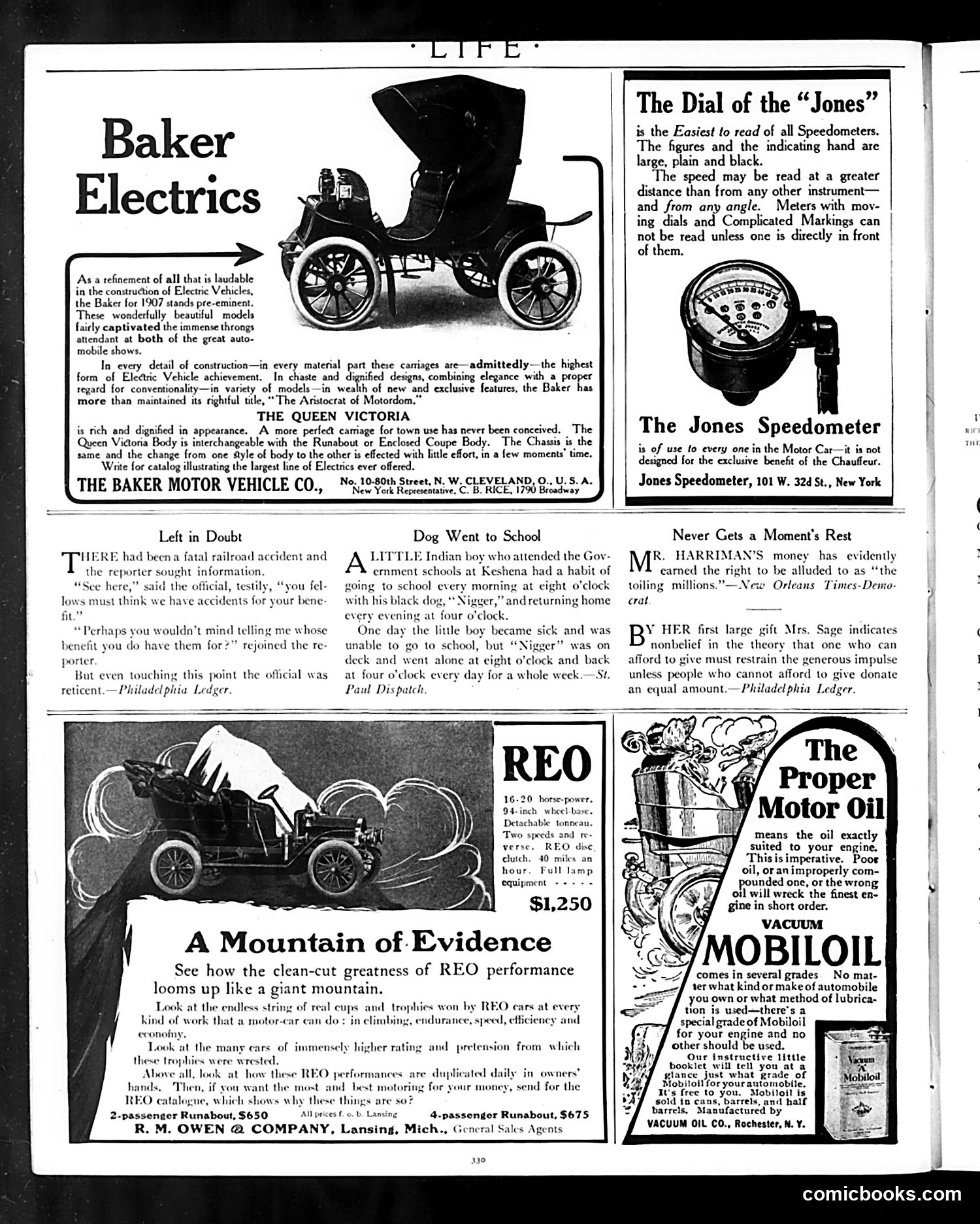
This page is primarily **advertising**, not satire or political commentary. It features three automobile ads from the early 1900s: 1. **Baker Electrics** - promotes electric vehicles as elegant, dignified alternatives to gas-powered cars, emphasizing their use at automobile shows and appeal to wealthy buyers. 2. **REO** - showcases performance statistics (horsepower, speed, torque) with the headline "A Mountain of Evidence," positioning REO cars as proven winners in competitions and races. 3. **Vacuum Mobiloil** - an oil product ad emphasizing proper lubrication for engines, warning that wrong oil will damage vehicles. The Jones Speedometer advertisement in the upper right is a complementary automotive product ad. There is no political satire or social commentary visible on this page. The small humorous stories ("Left in Doubt," "Dog Went to School," "Never Gets a Moment's Rest") are brief anecdotes unrelated to the ads.
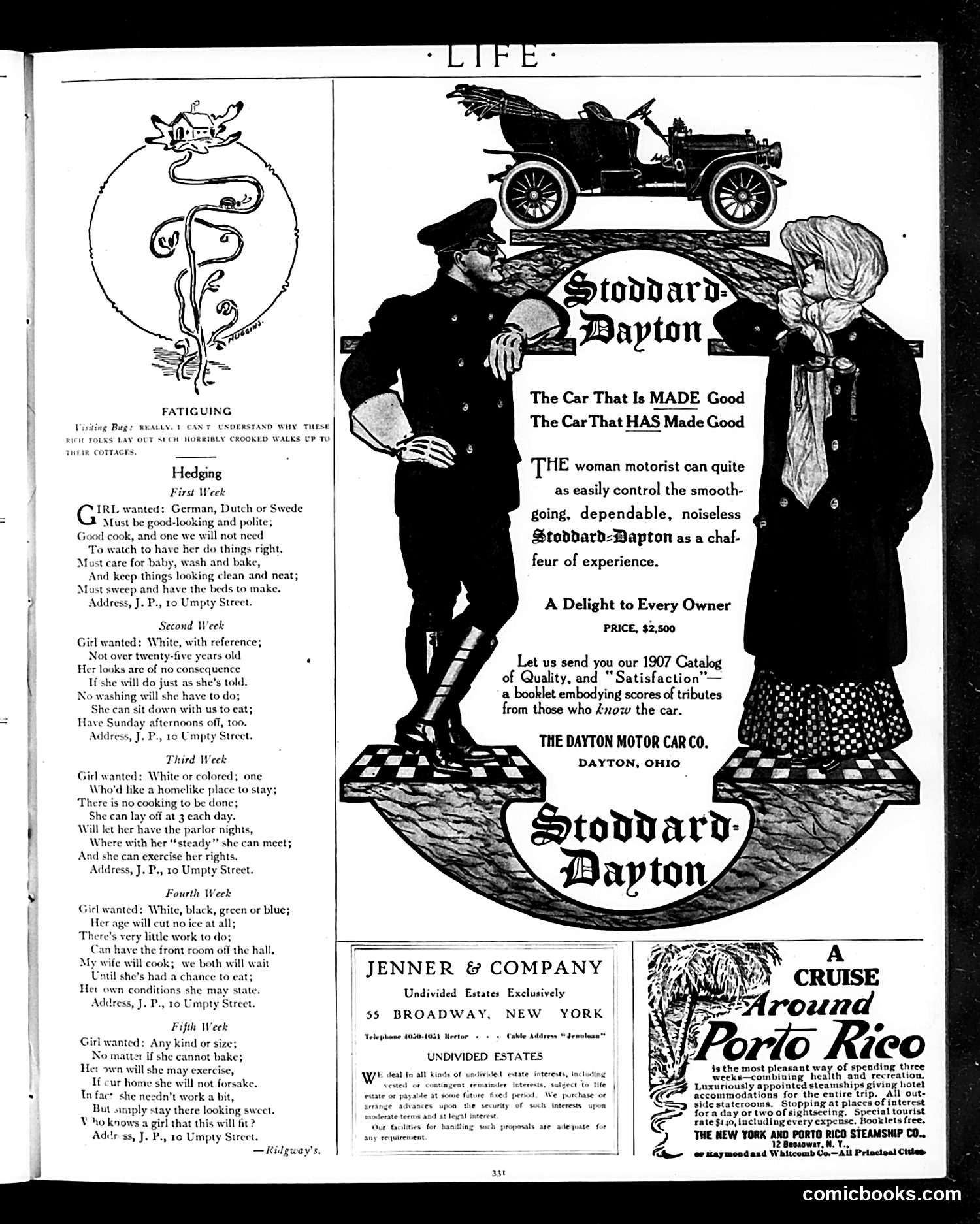
This page is primarily **advertising and classified content** rather than satirical cartoons. The left side contains a medical caduceus symbol labeled "FATIGUING" (with a humorous poem about exhausting cottage walks) and five "Girl Wanted" classified ads seeking domestic help under specific conditions—satirizing rigid employer expectations of the era. The right side features a large **Stoddard-Dayton automobile advertisement** (1907), marketing the car as easy for women drivers to control. Below that is a **Jenner & Company** real estate notice and a **Puerto Rico cruise advertisement**. The only genuine satire is the "Hedging" section's employment ads, which mock Victorian-era class consciousness and domestic labor hierarchies by presenting increasingly absurd employer demands.
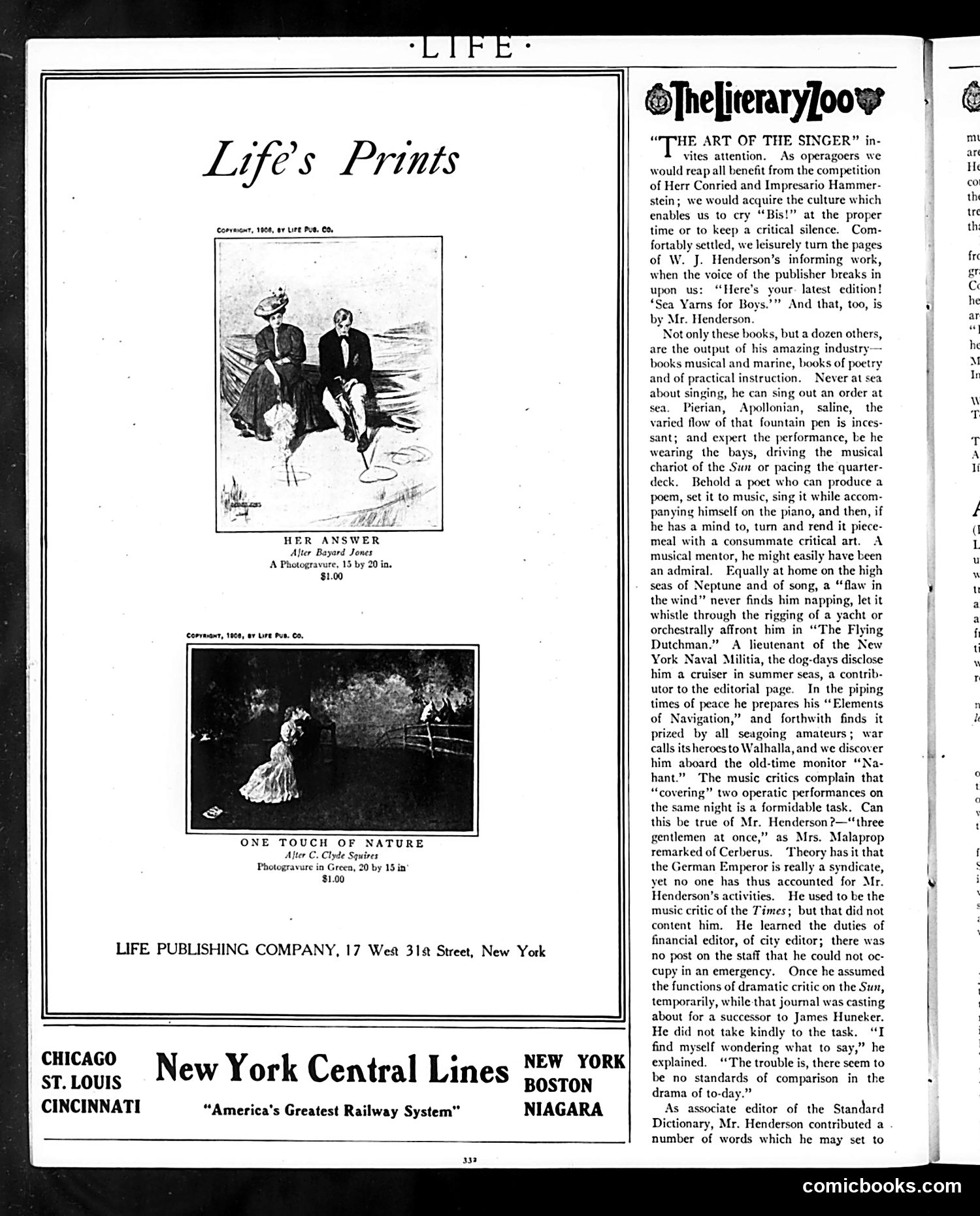
This page contains two photogravures titled "Her Answer" and "One Touch of Nature" by Life Publishing Company. These appear to be sentimental or romantic theatrical scenes rather than political satire—consistent with Life's mix of humor, commentary, and cultural content. The right column features "The Literary Zoo," discussing W. J. Henderson's work as a music and drama critic. The text humorously catalogs his varied expertise—from opera to naval literature—suggesting he's a prolific but somewhat scattered intellectual figure. The piece gently mocks his broad interests and the challenge of reviewing diverse performances. The bottom advertises New York Central Lines railroad service. Overall, this is primarily cultural/entertainment content with light satire rather than hard political commentary.
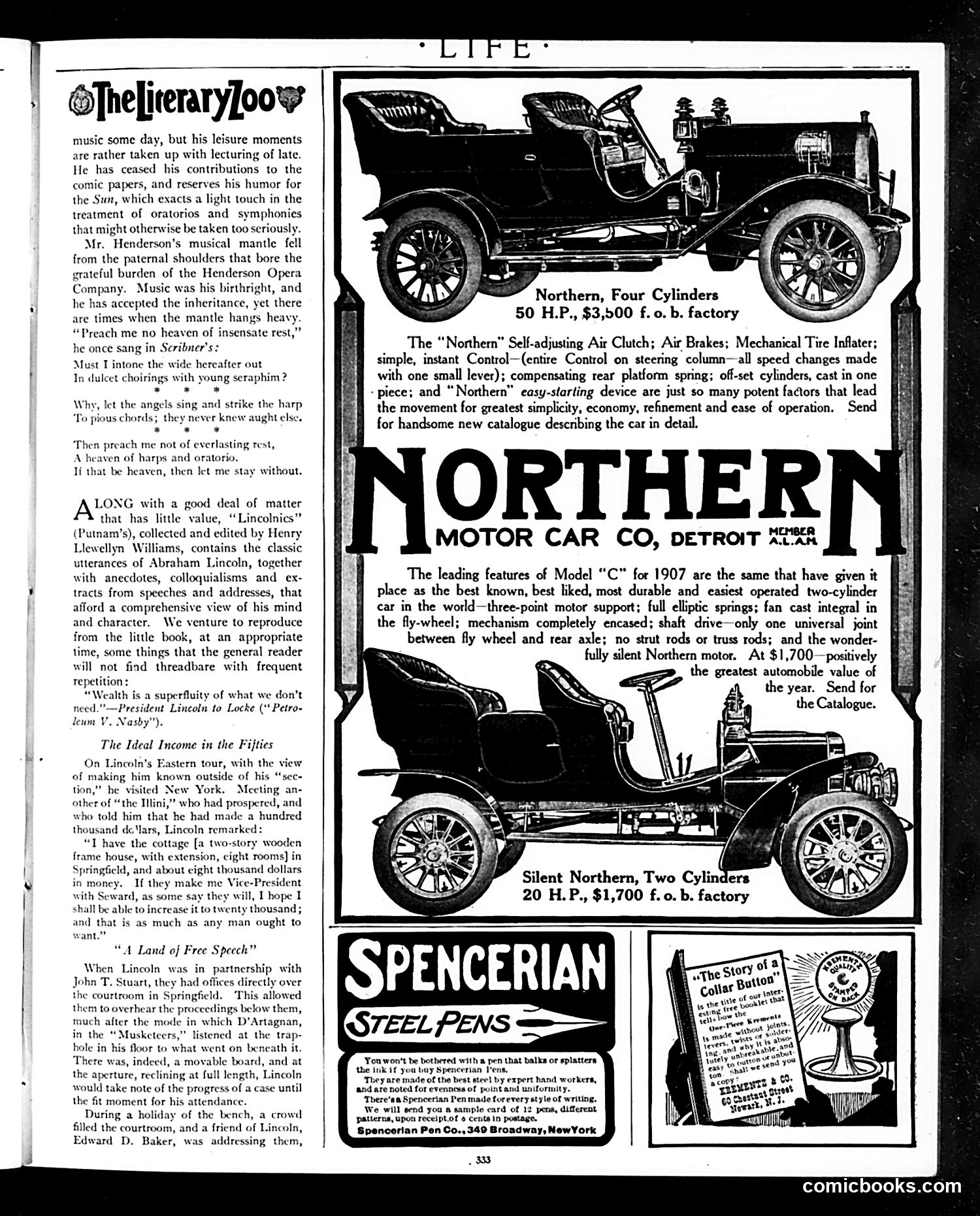
This page is **primarily advertising**, not satire or editorial cartoons. The main content consists of: 1. **"The Literary Zoo"** - A brief essay (left column) discussing a musician named Henderson and Lincoln anecdotes, with literary quotes. This appears to be a regular column feature, not satire. 2. **Northern Motor Car advertisements** - Two large car ads (center/right) showcasing the Northern automobile company's models: a four-cylinder and two-cylinder vehicle. These are straightforward product advertisements with technical specifications and pricing. 3. **Spencerian Steel Pens advertisement** (bottom) - A commercial ad for writing implements. There are no political cartoons or satirical content on this page. It represents typical early 20th-century *Life* magazine content mixing light editorial pieces with commercial advertisements.
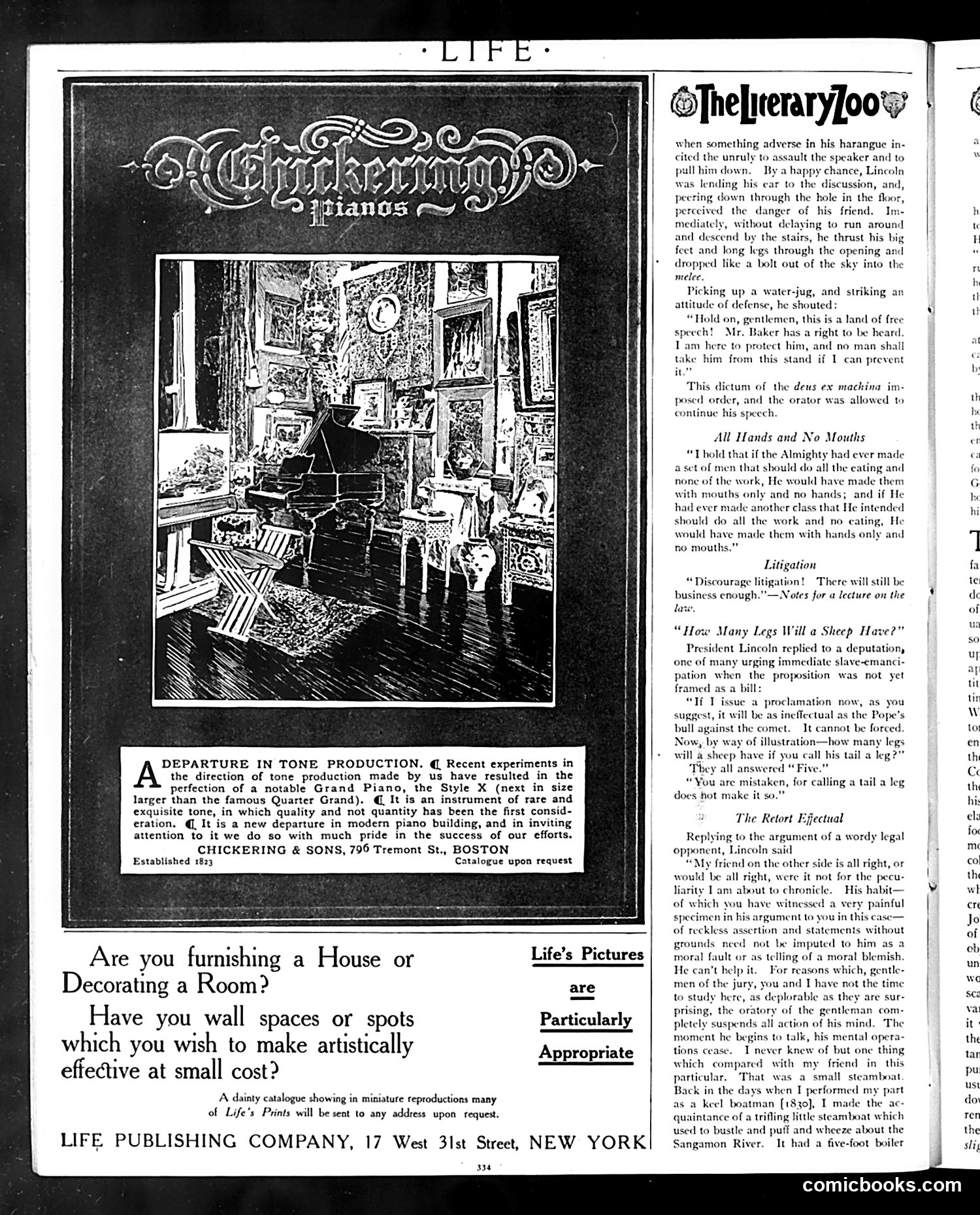
This page features "The Literary Zoo," a column presenting anecdotes about President Abraham Lincoln. The illustrated engraving at top shows Lincoln intervening in a street brawl to protect a speaker's right to free speech—a tale emphasizing Lincoln's physical courage and commitment to democratic principles. The text collects several Lincoln stories illustrating his wit and practical wisdom: his argument that God designed humans with both hands and mouths for work and eating; his response to abolitionists demanding immediate emancipation (using the absurd example of calling a sheep's tail a leg to show declarations don't change reality); and his courtroom rebuke of a verbose opponent, comparing the man's loss of mental function while speaking to a malfunctioning steamboat. These anecdotes present Lincoln as both physically brave and intellectually sharp—a folk hero of common sense and moral clarity.
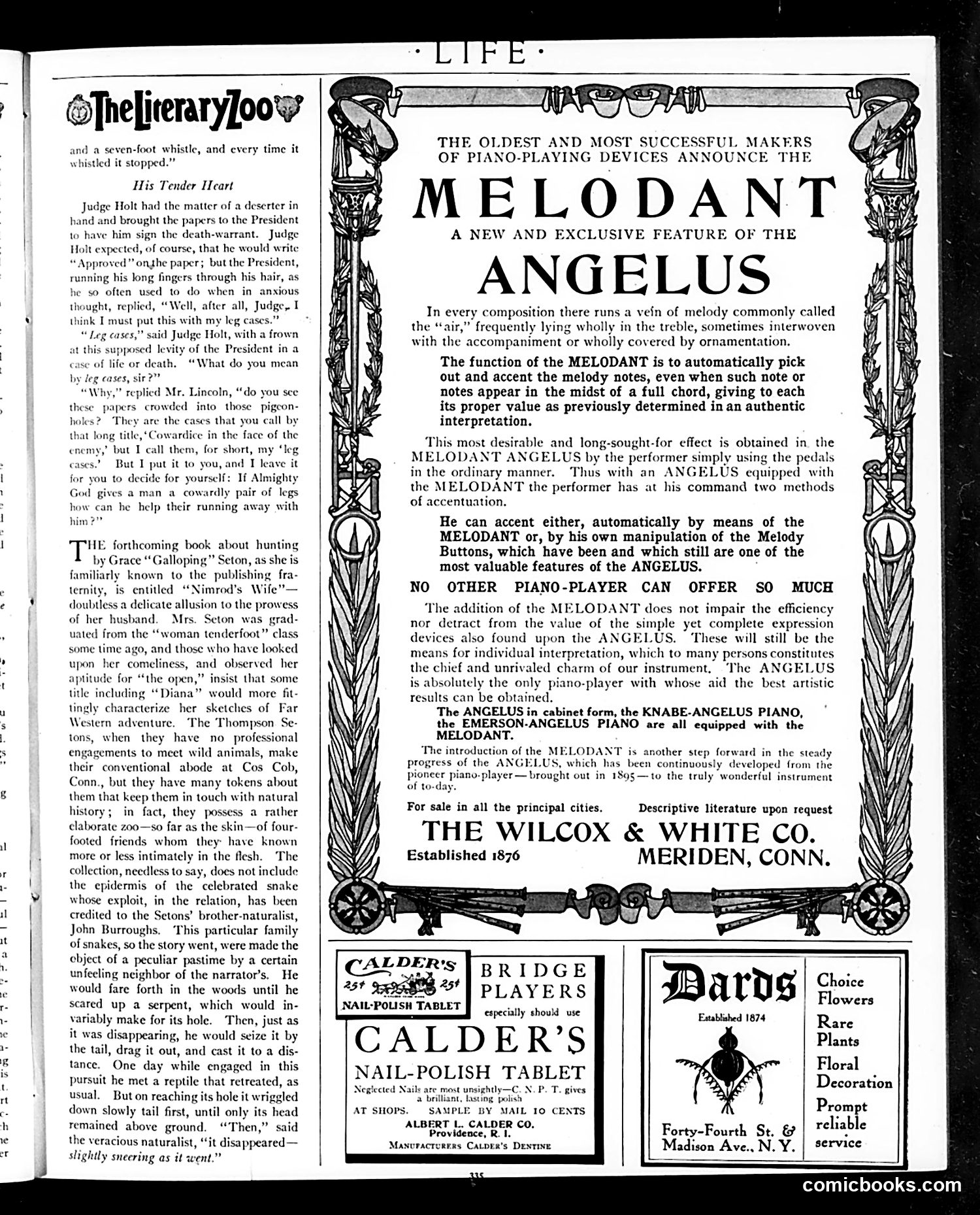
This page is primarily **advertising**, not satire. The left side contains two humorous anecdotes from "The Literary Zoo" column: 1. **"His Tender Heart"** depicts President Lincoln's compassionate approach to military desertion cases. When asked to approve execution warrants, Lincoln supposedly called them his "leg cases"—arguing that cowardly legs aren't the soldier's moral fault, so he couldn't execute them. This portrays Lincoln as mercifully reluctant to sign death sentences. 2. **"Nimrod's Wife"** humorously discusses Grace "Galloping" Seton's forthcoming hunting book, with wordplay about her nickname and a tall tale about a snake that vanishes into its hole while appearing to "sneer." The **right two-thirds** advertises the **Melodant Angelus**, a piano player device that automatically highlights melody notes within chords. Supporting ads promote Calder's Nail-Polish Tablets, Bridge Players products, and Dard's Flowers. There is no political satire on this page—it's lifestyle/consumer content typical of Life magazine's mixed editorial-advertising format.
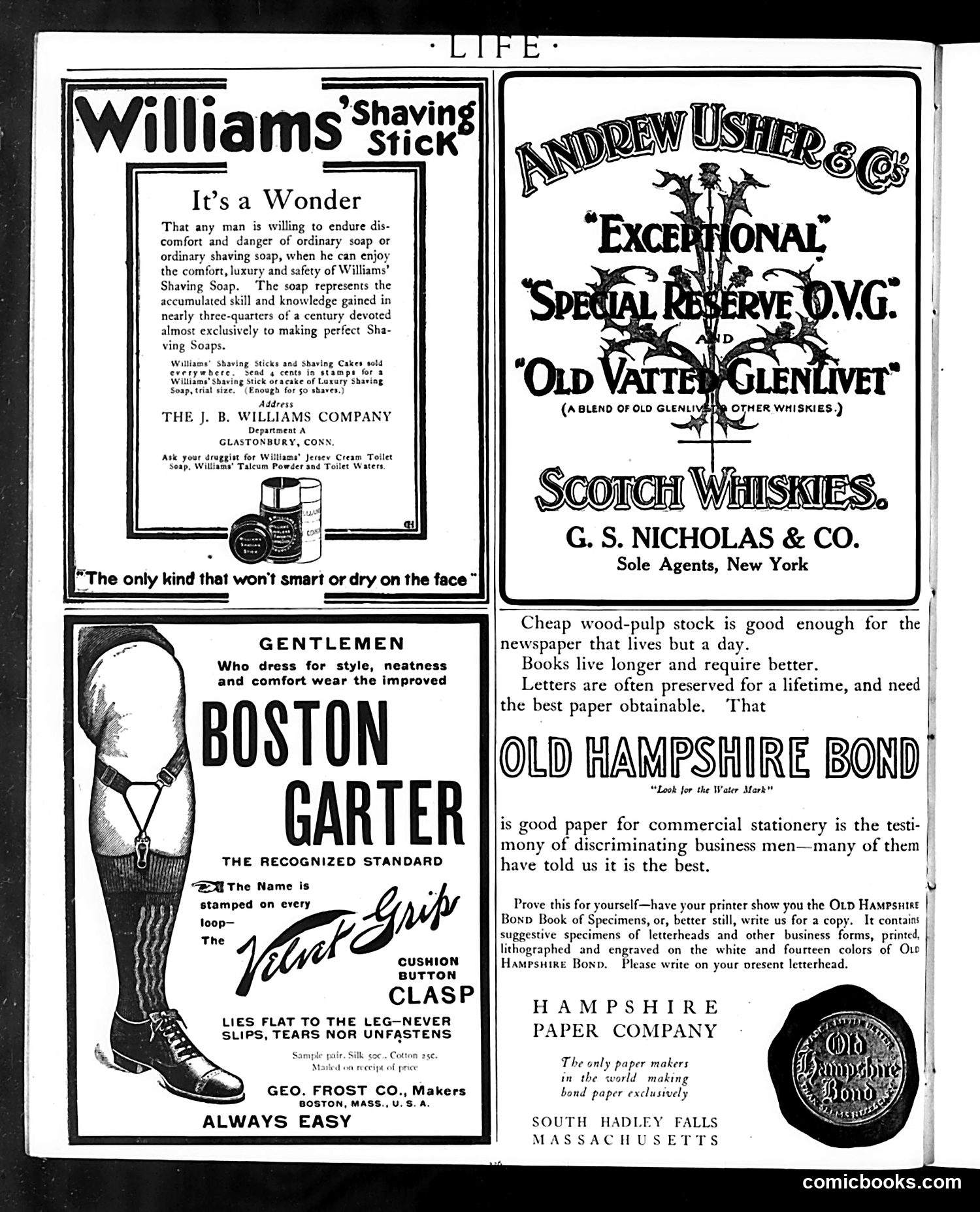
This page contains **no cartoons or satire**—it's primarily a collection of product advertisements typical of early 20th-century magazines. The ads promote: - **Williams' Shaving Stick**: Emphasizes comfort and safety over "ordinary soap," appealing to gentlemen's grooming standards - **Boston Garter**: A men's garter with a "cushion button clasp" that "lies flat to the leg—never slips," marketed as the "recognized standard" - **Old Hampshire Bond**: Premium paper stock, distinguished from cheap "wood-pulp" newspaper stock, positioned for letters and business correspondence meant to last - **Scotch Whiskies**: Two brands sold by G.S. Nicholas & Co. The implicit social messaging reflects **Edwardian-era values**: men of means and refinement deserve quality products—better grooming supplies, reliable clothing accessories, and durable stationery befitting correspondence. The advertisements assume a prosperous male readership concerned with appearance, respectability, and permanence.
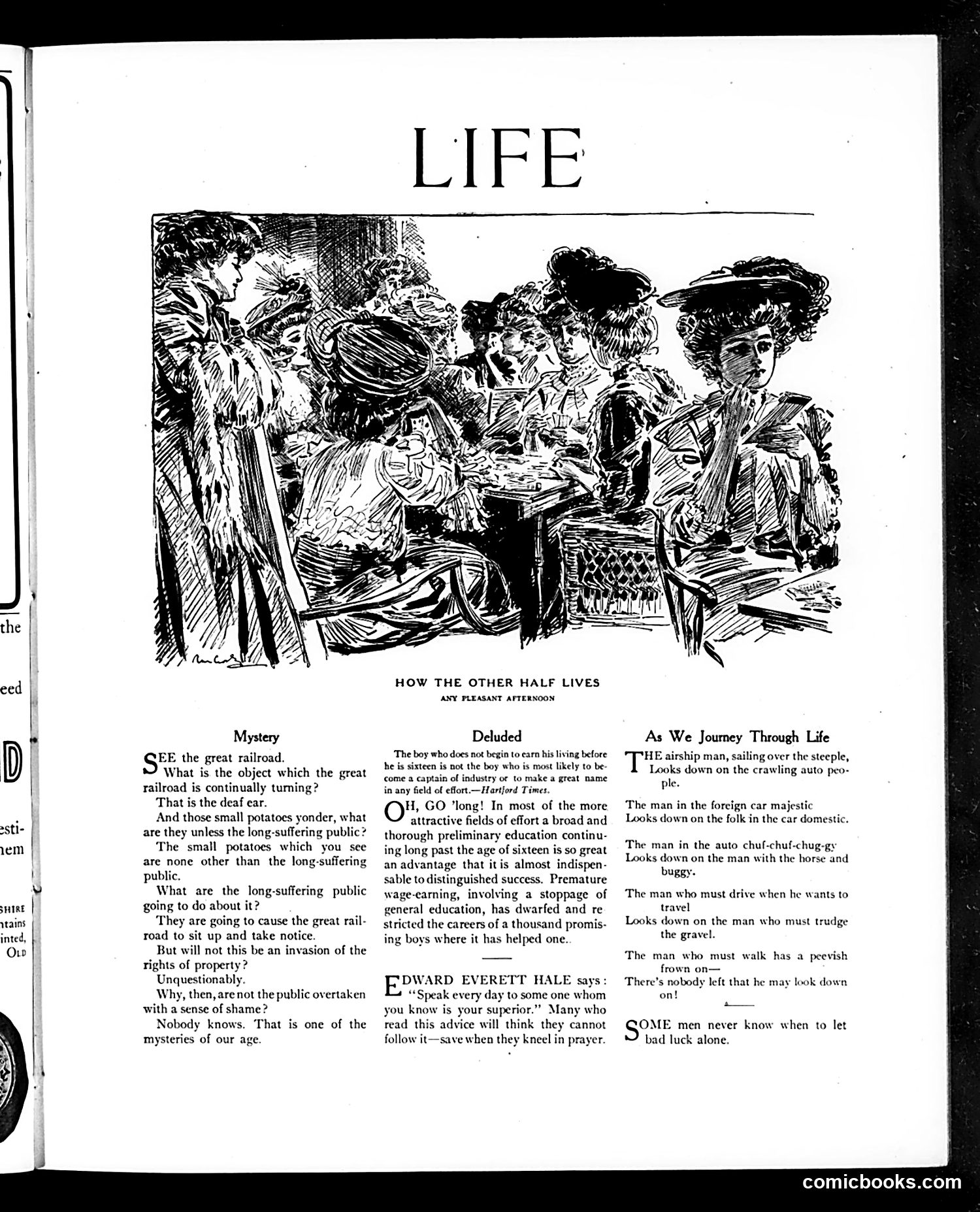
This page satirizes class hierarchy and social hypocrisy in early 20th-century America through three separate pieces: **"Mystery"** mocks railroad monopolies ignoring public complaints ("deaf ear") while exploiting ordinary people ("small potatoes"). It questions why the public accepts this mistreatment. **"Deluded"** counters a newspaper claim that boys should work by age 16. Life argues extensive education actually produces greater success than premature wage-earning, which stunts promising careers. **"As We Journey Through Life"** presents a humorous social pyramid: airship pilots look down on auto drivers, auto drivers on horse-buggy users, walkers on... nobody. The final figure has no one beneath him to condescend to—satirizing how everyone attempts social superiority, creating absurd hierarchy. The illustration "How the Other Half Lives" (title referencing Jacob Riis's famous poverty photography) shows wealthy women at leisure, contrasting with the text's social commentary about class consciousness and inequality.
This editorial page compares America's political stability favorably to turbulent conditions abroad. The author discusses three international crises: **England**: The Liberal Party threatens to curtail the House of Lords' power over education legislation—presented as radical compared to American institutions. **France**: Church-State conflict involving government seizure of religious properties and dictation of worship conditions. The author finds this contrary to American ideals of religious freedom, though acknowledges France's complex historical context. **Germany**: Brief mention of government action against Socialists regarding election funding. The cartoons (illustrations of children or figures) appear decorative rather than satirical commentary. The overall tone reflects American exceptionalism—portraying the U.S. as remarkably stable and measured compared to European upheaval, while acknowledging other nations' internal complexities warrant patience rather than judgment.
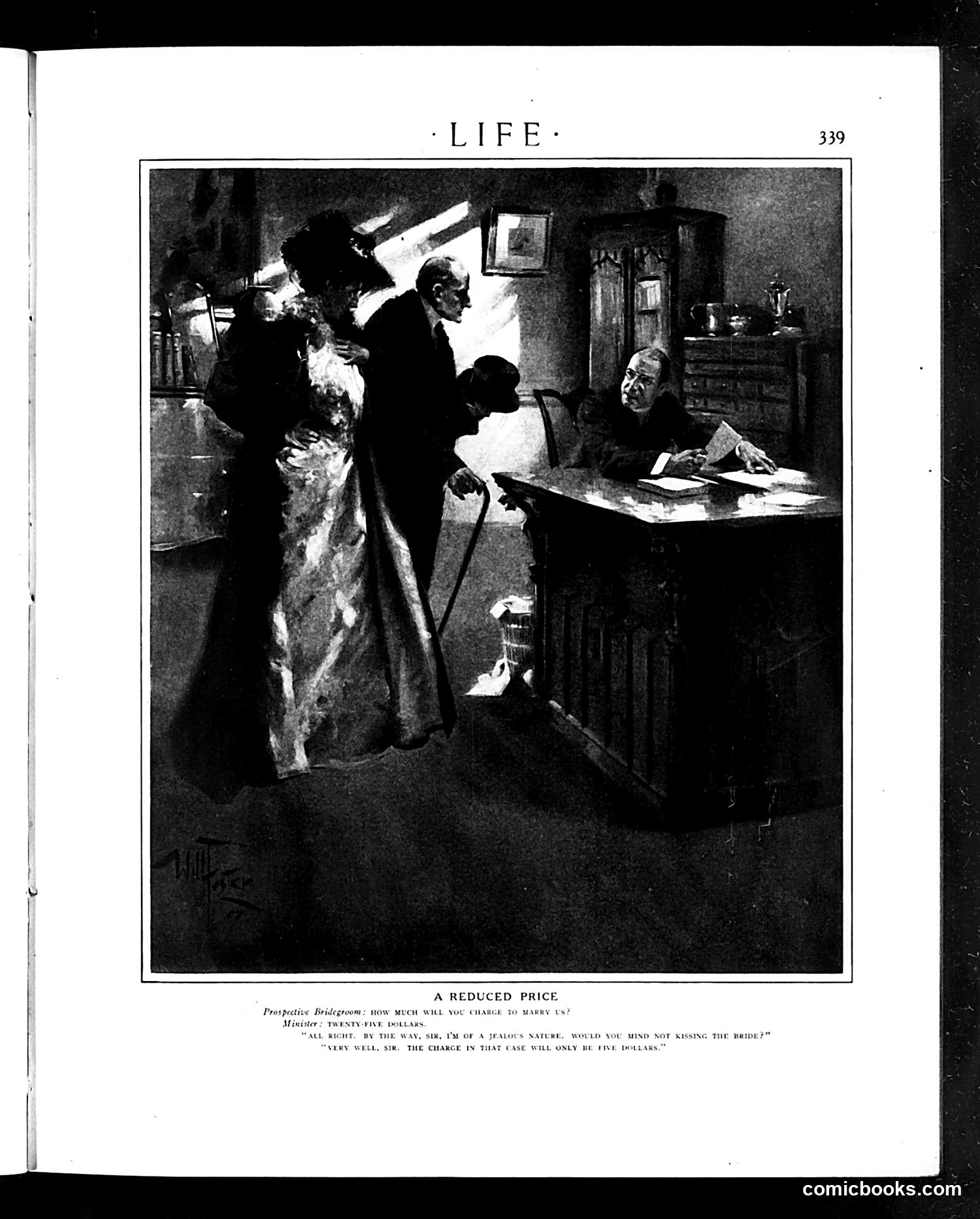
This satirical cartoon depicts a marriage negotiation scene. A prospective bridegroom asks how much the bride's family will charge for marriage; the answer is twenty-five dollars. When the minister expresses moral concern—questioning whether kissing the bride is appropriate given the transaction's mercenary nature—he's told the charge in that case will only be five dollars. The satire mocks the commercialization of marriage, suggesting that by reducing matrimony to a financial transaction, even its romantic or sacred elements become commodified and priced. The joke undercuts both the bridegroom's haggling and the family's willingness to monetize every aspect of the union, including physical affection, exposing the crass materialism behind what should be a spiritual or emotional commitment.
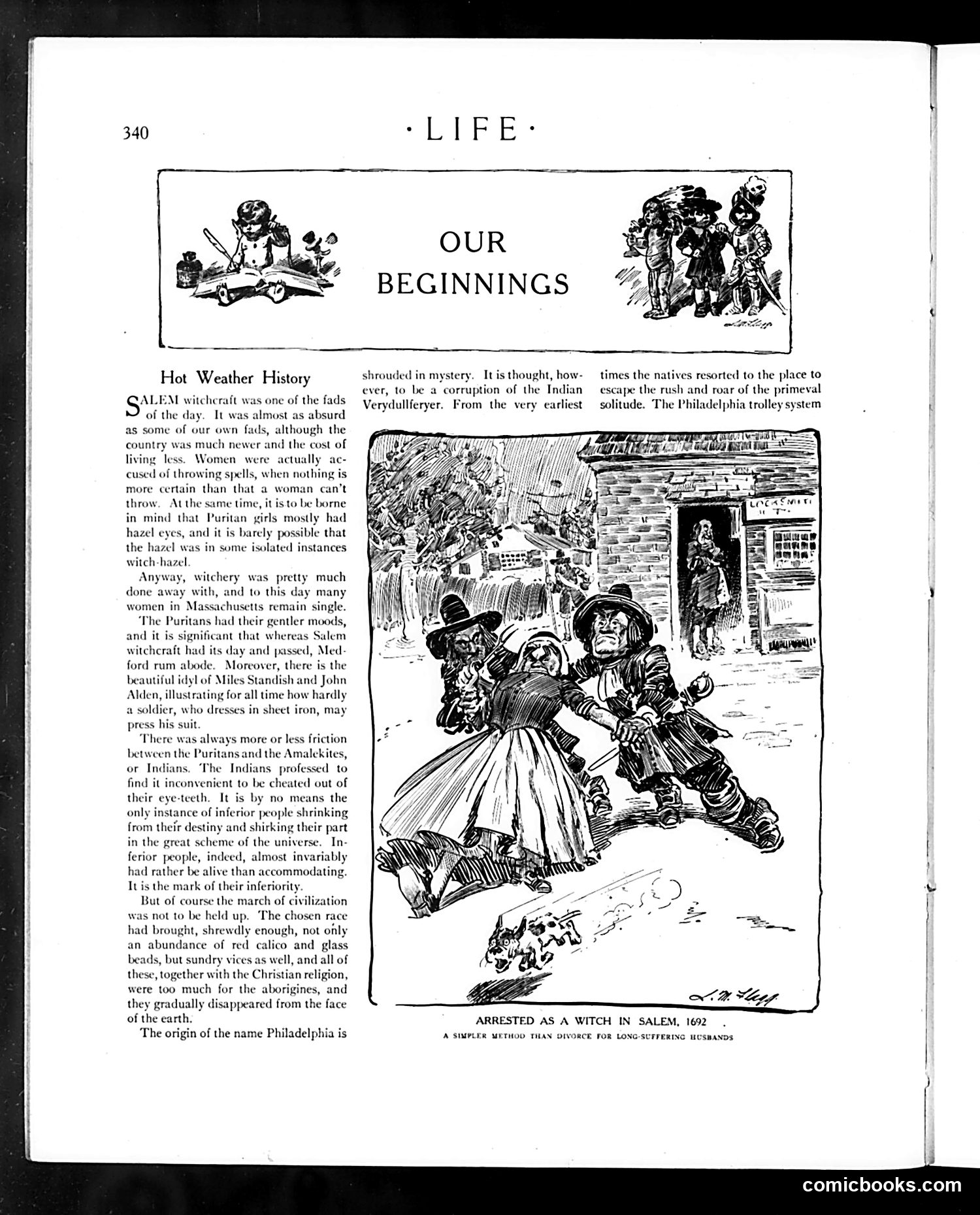
This Life magazine page satirizes early American history through the lens of 1920s social attitudes. The main cartoon depicts a woman being arrested as a witch in Salem (1692), captioned as "A simpler method than divorce for long-suffering husbands"—the joke being that accusing women of witchcraft was essentially a convenient way to rid oneself of an unwanted wife. The accompanying text discusses Salem witchcraft fads, Puritan attitudes, and Native American displacement with casual, dismissive language typical of the era. The satire targets both historical Puritans and contemporary attitudes: it mocks old superstitions while implying modern men still resent women's independence (note: "many women in Massachusetts remain single"). The broader point appears to be darkly comic commentary on how civilizations justify eliminating inconvenient people—whether indigenous populations or difficult wives—as inevitable "progress."
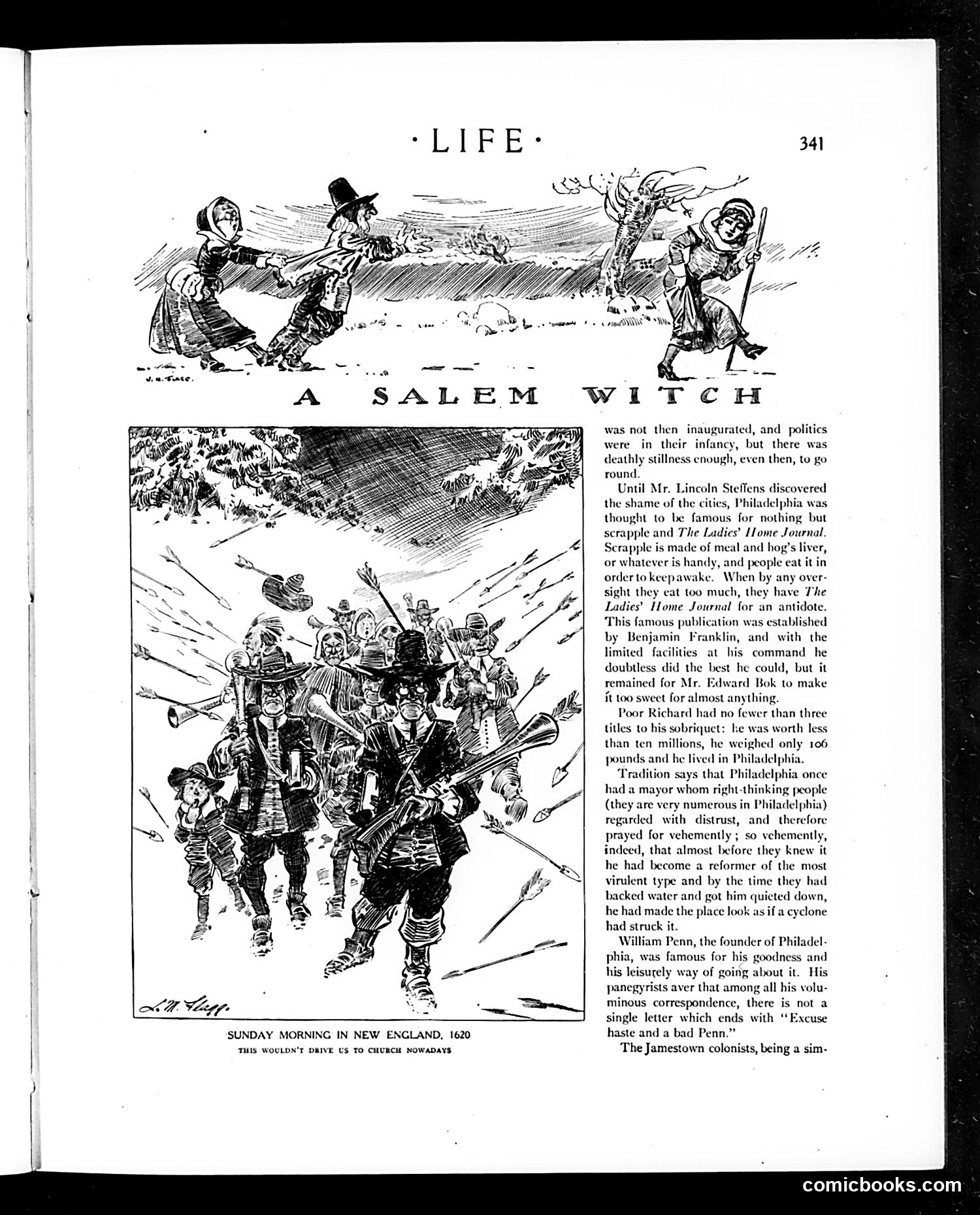
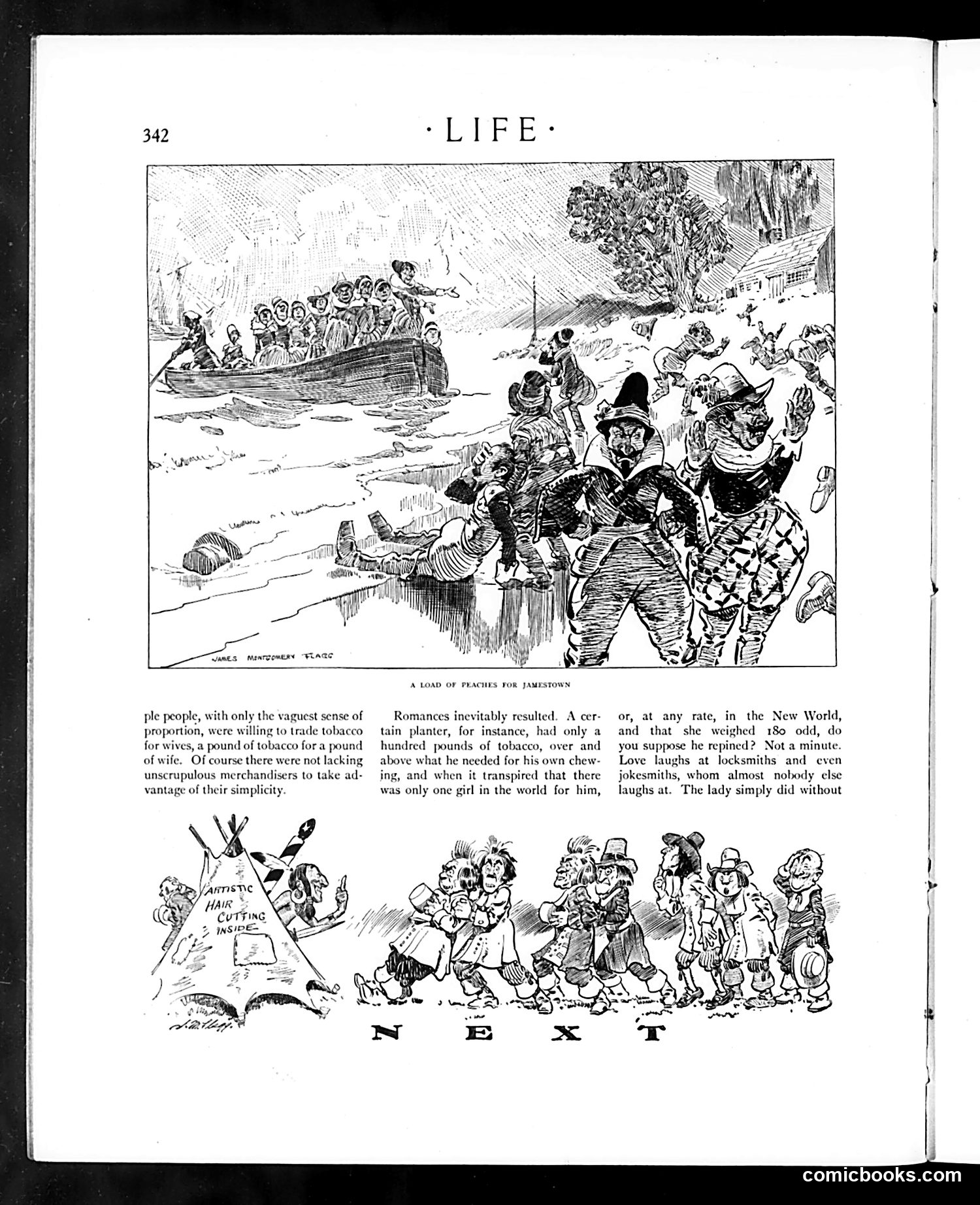
This is a satirical article about early American colonial history, accompanied by two cartoons mocking Puritan severity. The top cartoon, "A Salem Witch," depicts colonial authorities persecuting an accused witch—referencing the actual Salem witch trials (1692), where hysteria led to executions. The caption "This wouldn't drive us to church nowadays" sarcastically suggests modern people wouldn't need such extreme coercion to attend services. The lower cartoon shows "Sunday Morning in New England, 1620," depicting colonists being forcibly driven to church—illustrating the rigid religious compulsion of Puritan society. The accompanying text humorously contrasts colonial Philadelphia's historical reputation (scrapple and *The Ladies' Home Journal*) with modern reformers like Lincoln Steffens and editor Edward Bok. It also praises William Penn's virtue while poking fun at Poor Richard (Benjamin Franklin's alter ego) for his modest circumstances. The overall satire mocks both Puritan intolerance and celebrates how American society has supposedly evolved beyond such religious severity—while gently ribbing contemporary figures and institutions.
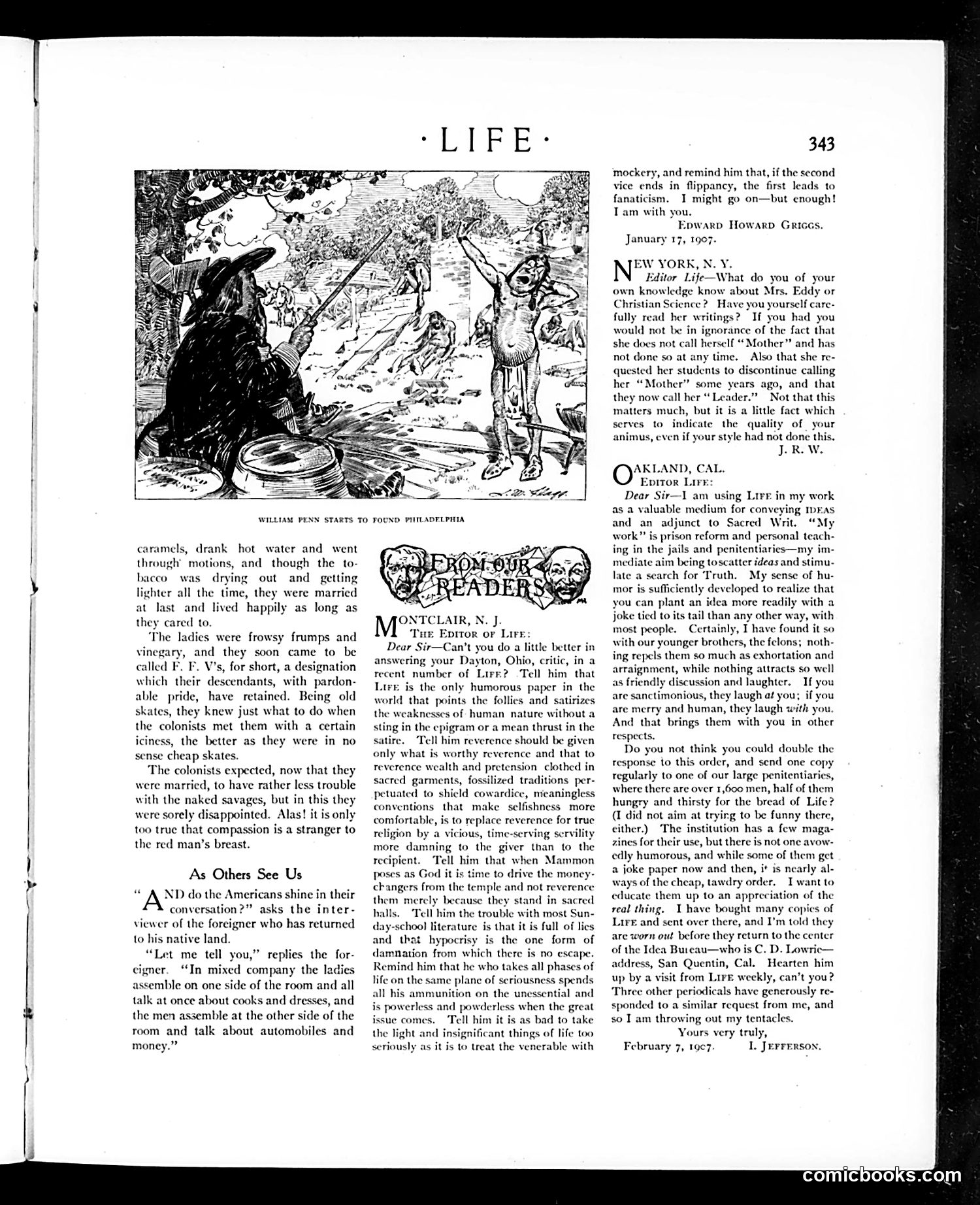
The main cartoon depicts **William Penn founding Philadelphia**, showing the historical figure meeting with Native Americans. The caption is straightforward historical illustration rather than satire. The page primarily consists of **reader letters to the editor**, a common Life magazine feature. Notable letters include: 1. **From Montclair, NJ**: A lengthy defense of Life's satirical mission, arguing the magazine rightfully mocks "reverence wealth and pretension" and exposes hypocrisy in religion and Sunday-school teaching. This suggests Life faced criticism for being irreverent toward sacred institutions. 2. **From New York**: A correction about Mary Baker Eddy (Christian Science founder), noting she doesn't call herself "Mother"—implying Life had criticized her or her followers on this point. 3. **From Oakland, CA**: A correspondent describing using Life in prison reform work. The page illustrates Life's role as a **satirical social critic** addressing American weaknesses: materialism, hypocrisy, gender dynamics, and religious pretension. The letters reveal both defenders and critics of its irreverent approach.
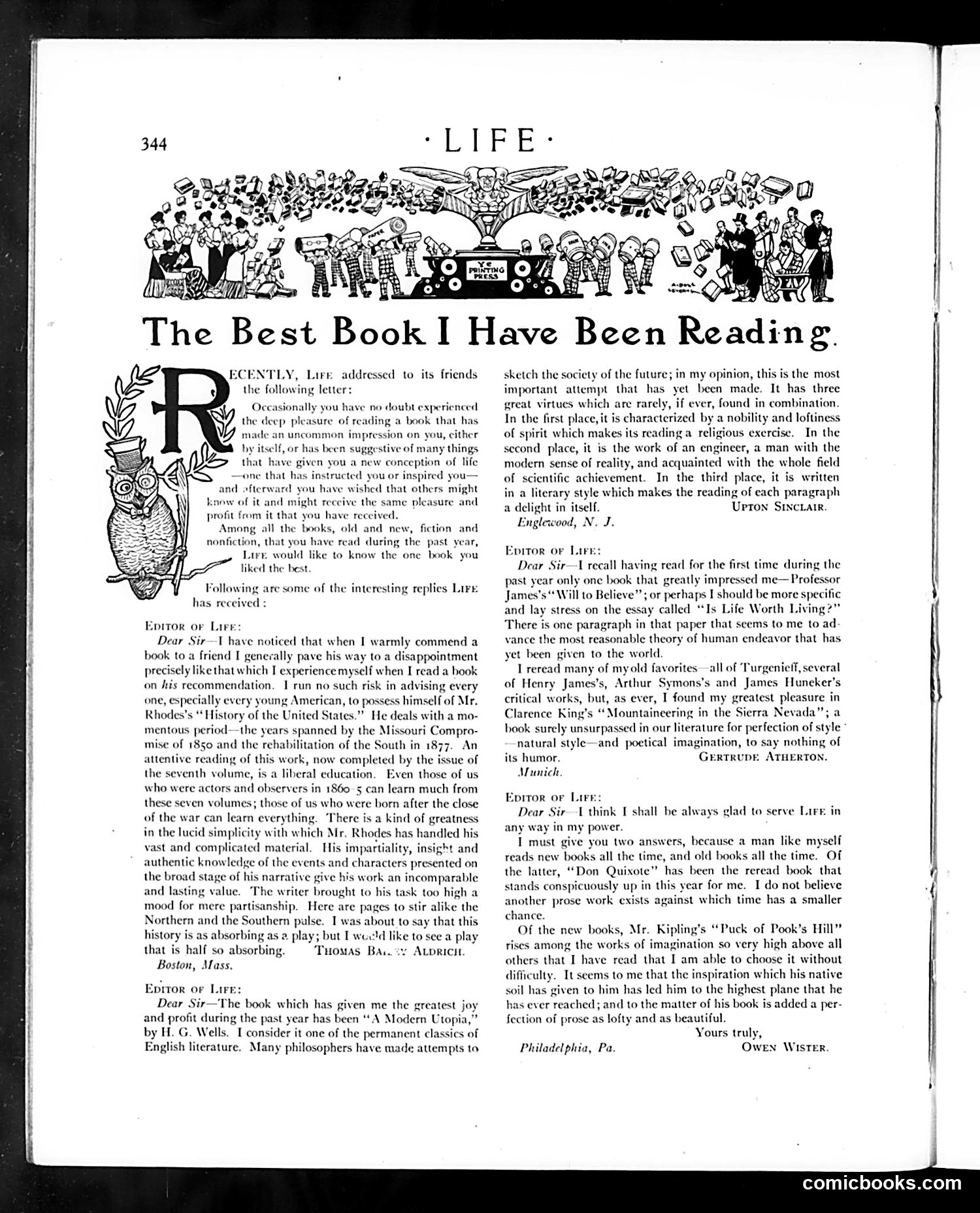
This is not a political cartoon but rather a reader-response feature. Life magazine solicited letters from prominent readers about their favorite books of the past year. The page showcases replies from notable literary figures including **Thomas Bailey Aldrich** (recommending Rhodes's "History of the United States"), **Upton Sinclair** (praising H.G. Wells's "A Modern Utopia"), and others praising works by William James and Clarence King. The decorative header shows a printing press with celebrating figures—visualizing the democratizing power of books and publishing. This reflects early 1900s intellectual culture: Life positioned itself as a forum for cultivated opinion, featuring respected authors discussing serious literature (history, philosophy, essays) rather than entertainment. The feature demonstrates the magazine's aspirations to literary authority and its audience's engagement with substantive reading.
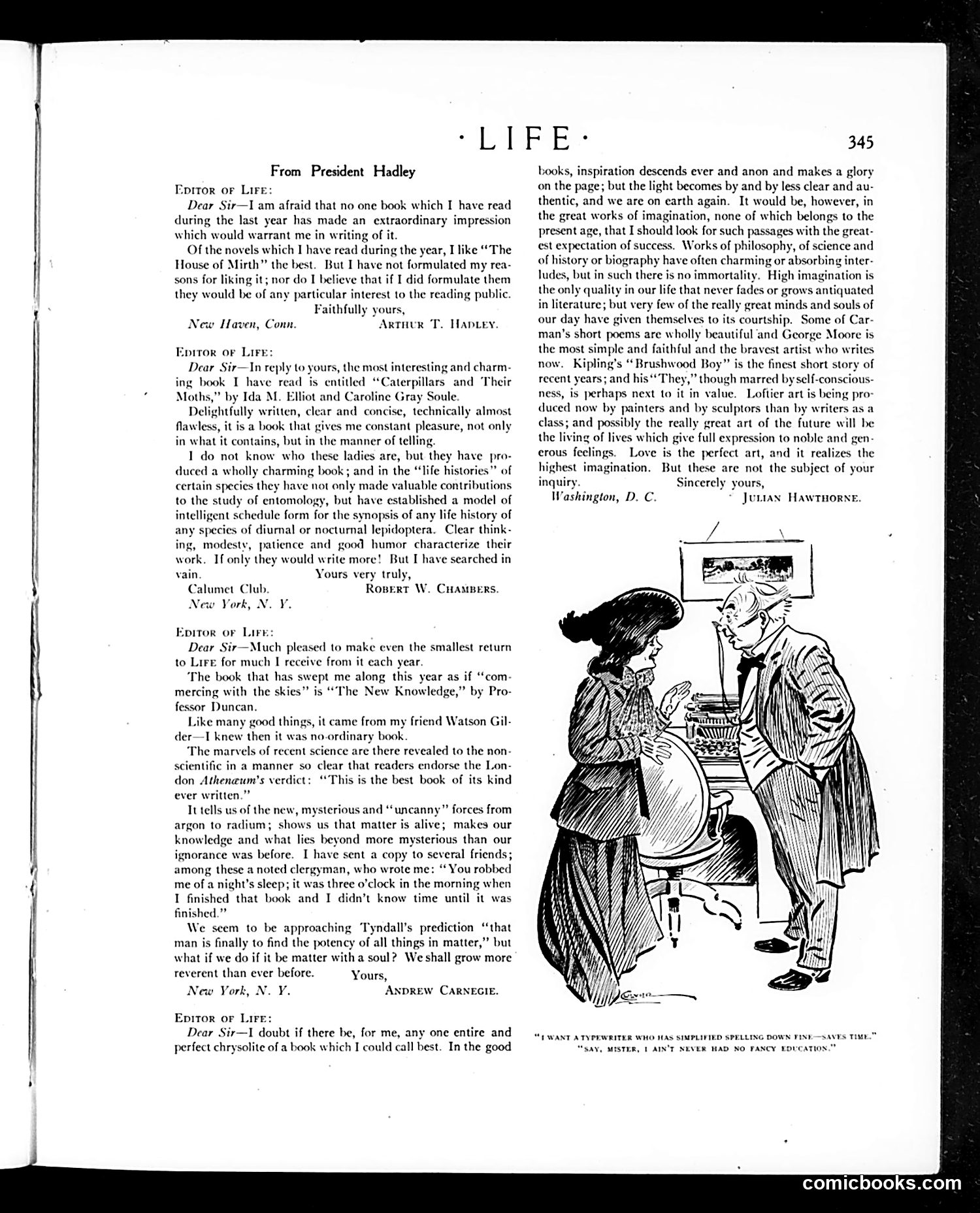
This page presents readers' letters to Life's editor responding to a query about the best book they'd read that year. Notable respondents include President Arthur T. Hadley (of Yale), Robert W. Chambers (a popular novelist), and Andrew Carnegie (the industrialist philanthropist). The cartoon depicts a typewriter salesman pitching to a woman, with his sales pitch visible in the caption below: he claims his machine has "simplified spelling" so well that "Day, sister, I ain't never had no fancy education" — a joke mocking both overly-simplified spelling reform movements and the salesman's own poor grammar, which ironically contradicts his product's promise. The letters themselves discuss serious literature (Edith Wharton's *House of Mirth*), scientific works (*Caterpillars and Their Moths*, *The New Knowledge*), and literary merit — contrasting sharply with the cartoon's crude humor about education and literacy.
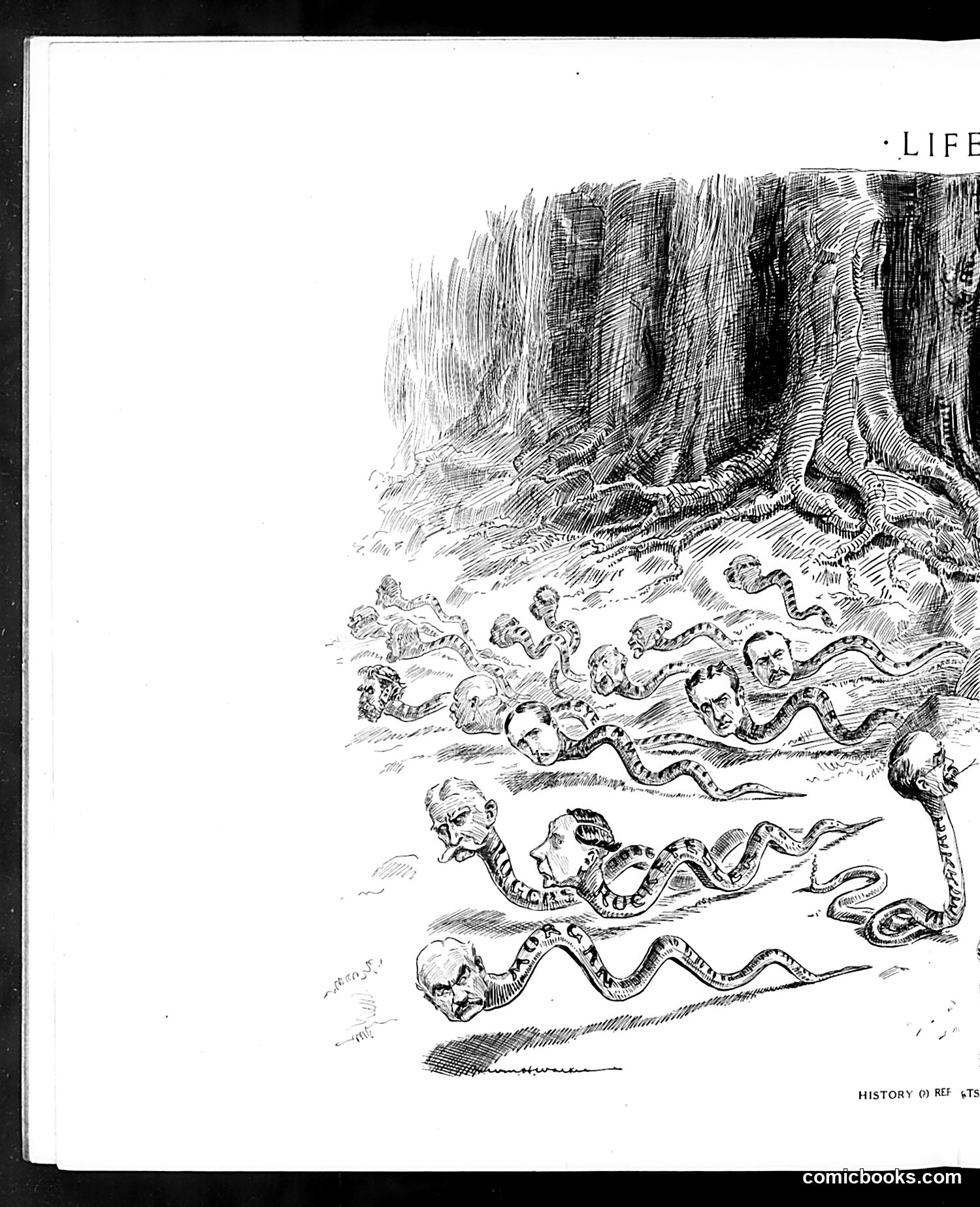
This appears to be a satirical cartoon depicting human figures with serpentine bodies crawling beneath a towering cliff or rocky outcropping. The style suggests early-to-mid 20th century American political satire from *Life* magazine. The imagery likely represents a commentary on political or social hierarchies—the massive geological formation looming above the crawling human-serpent hybrids suggests oppression, subjugation, or those "beneath" authority. The hybrid creature design (human heads with snake bodies) implies dehumanization or degradation of the depicted group. Without clearer identifying captions or visible dates, I cannot definitively identify which specific political figures or events this references. The text fragment "HISTORY @) REF §TS" is too garbled by OCR to clarify context. The cartoon's exact satirical target remains unclear.
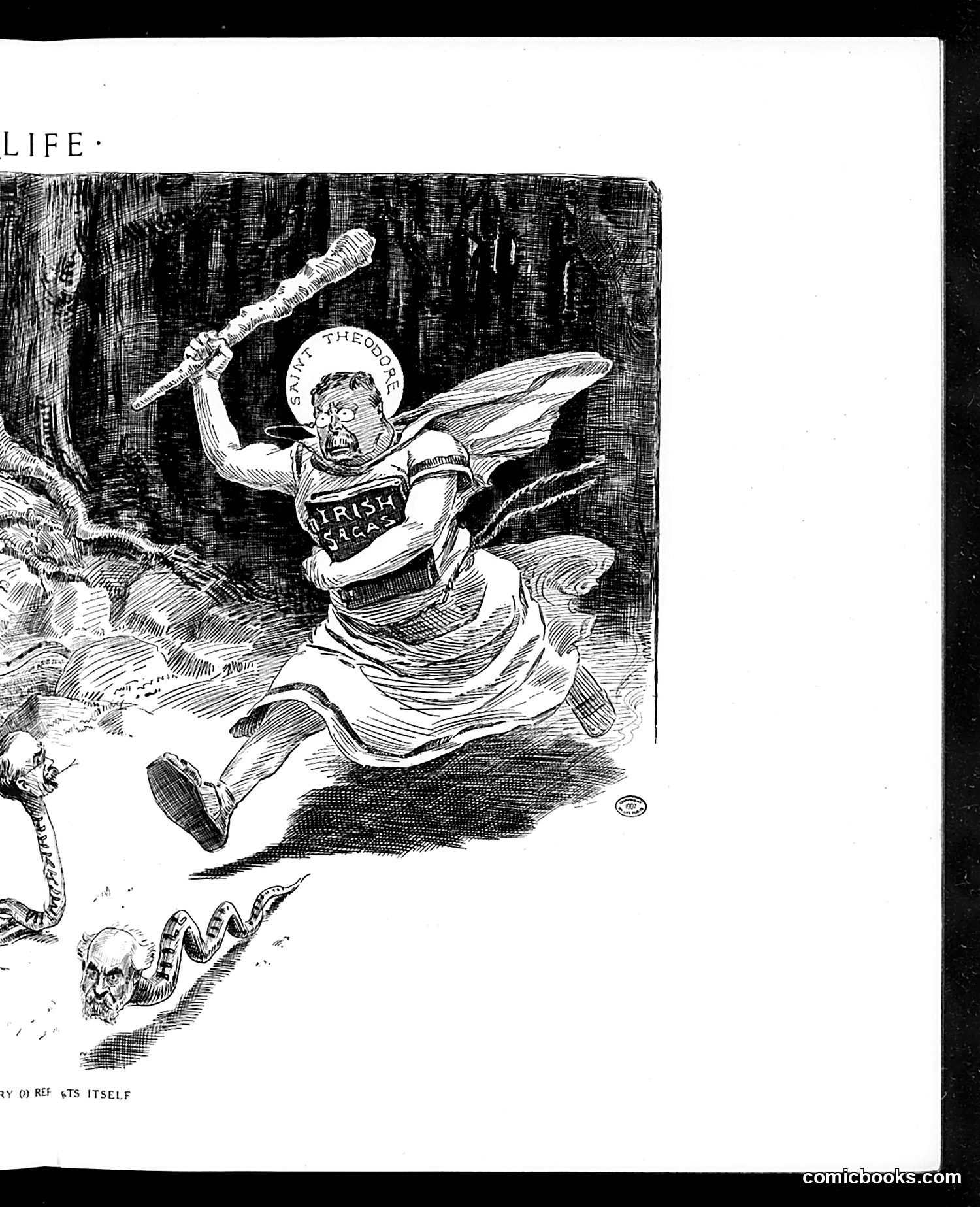
This satirical illustration depicts a figure labeled "Saint Theodore" wearing an "Irish Brigade" uniform, wielding a club or staff while in dynamic motion. The character has a halo and appears angelic, suggesting ironic sainthood. Below the figure is what appears to be a serpent or snake. The cartoon likely references Irish-American military service (the Irish Brigade fought in the American Civil War) combined with religious imagery. The saint figure and snake may evoke Saint Patrick (known for banishing snakes from Ireland), creating a layered satire about Irish identity, Catholicism, and American patriotism. The exact satirical point remains unclear without full context about Life magazine's date and specific contemporary events, but it appears to mock or comment on Irish-American cultural representation during this period.
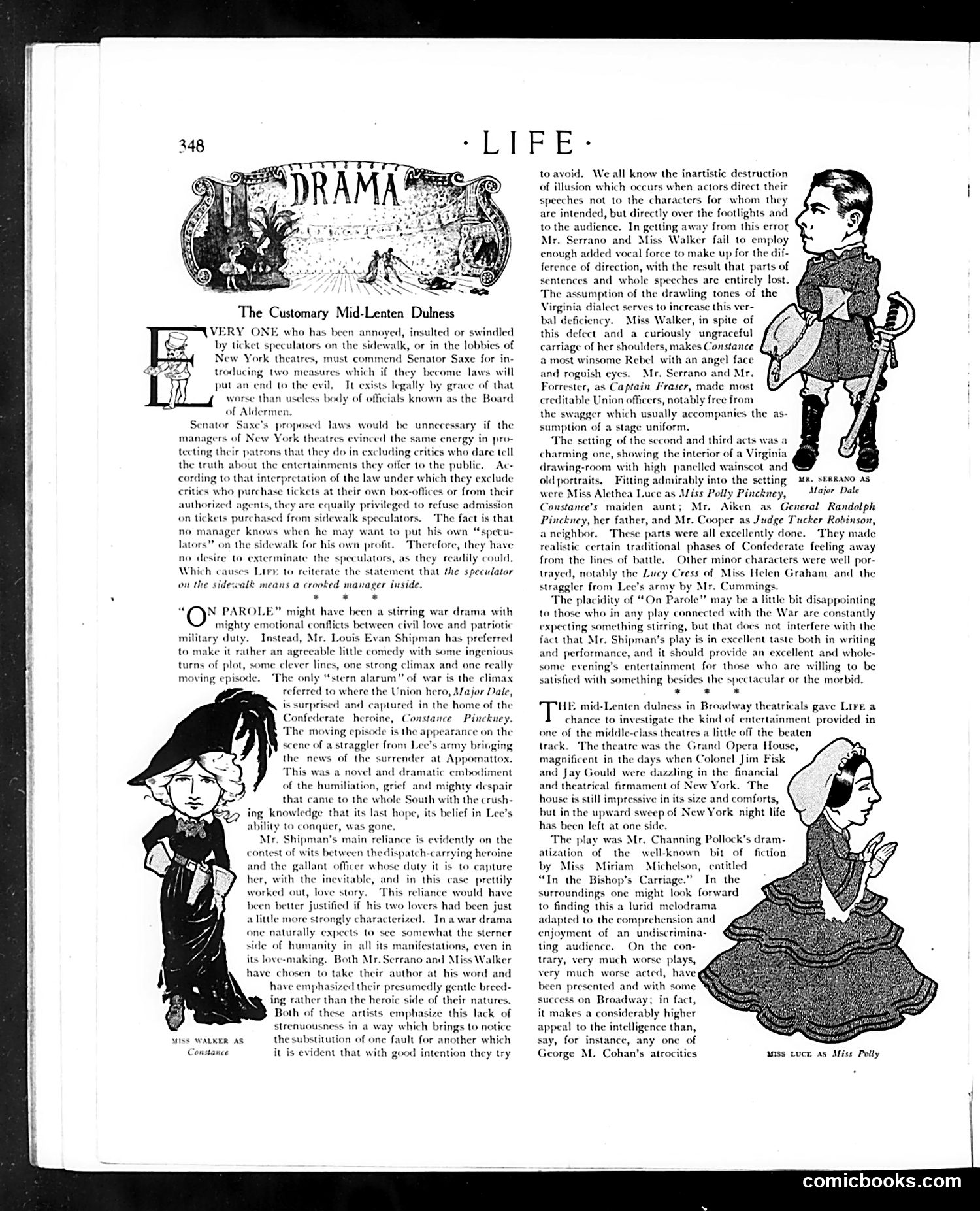
This page reviews a Broadway play called **"On Parole,"** a Civil War drama about a Confederate heroine named Constance Pinckney and a Union officer, Major Dale. The critic praises the play's climax—when a straggler brings news of Lee's surrender at Appomattox—as genuinely moving. However, the review criticizes the lead actors (Mr. Serrano and Miss Walker) for emphasizing "gentle breeding" over heroic strength. The critic faults them for playing scenes without sufficient vocal projection and for adopting a Virginia drawl that muffles dialogue. The caricature sketches on the page mock these performance choices. The page also contains commentary on theater ticket scalping and calls for Senator Saxe's proposed legislation to eliminate sidewalk speculators—blaming theater managers for permitting the practice since they profit from it themselves.
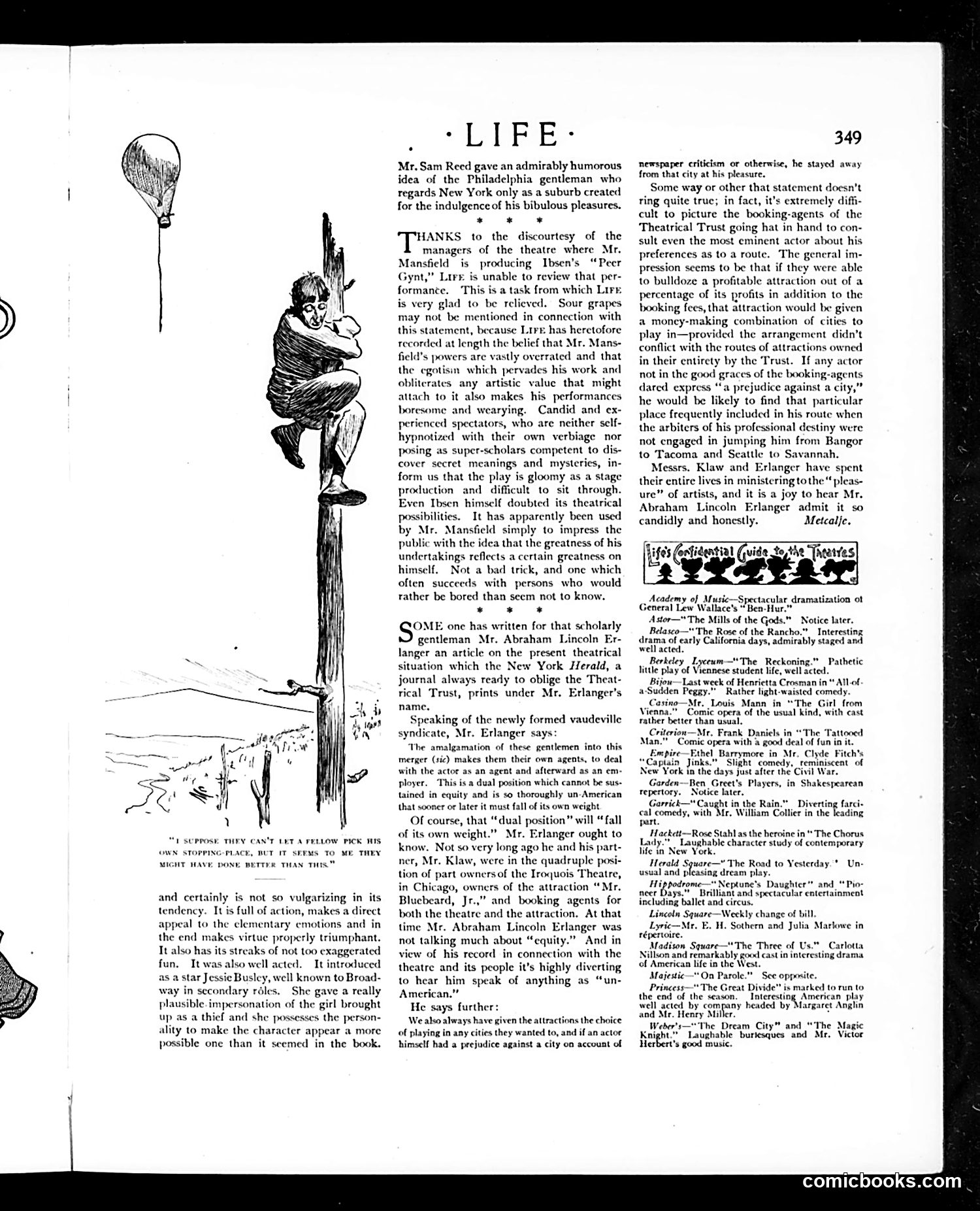
The page critiques **Abraham Lincoln Erlanger**, a powerful theatre mogul, for hypocrisy regarding actor exploitation. Erlanger publicly condemned a vaudeville syndicate's "dual position" (acting as both agent and employer) as "un-American," yet Life exposes his own similar abuses. The cartoon (left) depicts a figure clinging to a tall pole—likely representing a performer trapped or controlled by theatrical management. The caption suggests lack of choice in working conditions. Life's point: Erlanger and his partner Klaw previously held multiple conflicting roles (theatre owners, producers, and booking agents for the same shows), giving them exploitative control over actors. His sanctimonious criticism of others' business practices rings hollow given his documented record. The article sarcastically notes his claims about actor freedom "doesn't ring quite true," exposing corporate hypocrisy during the era of the "Theatrical Trust"—a monopoly controlling American theatre.
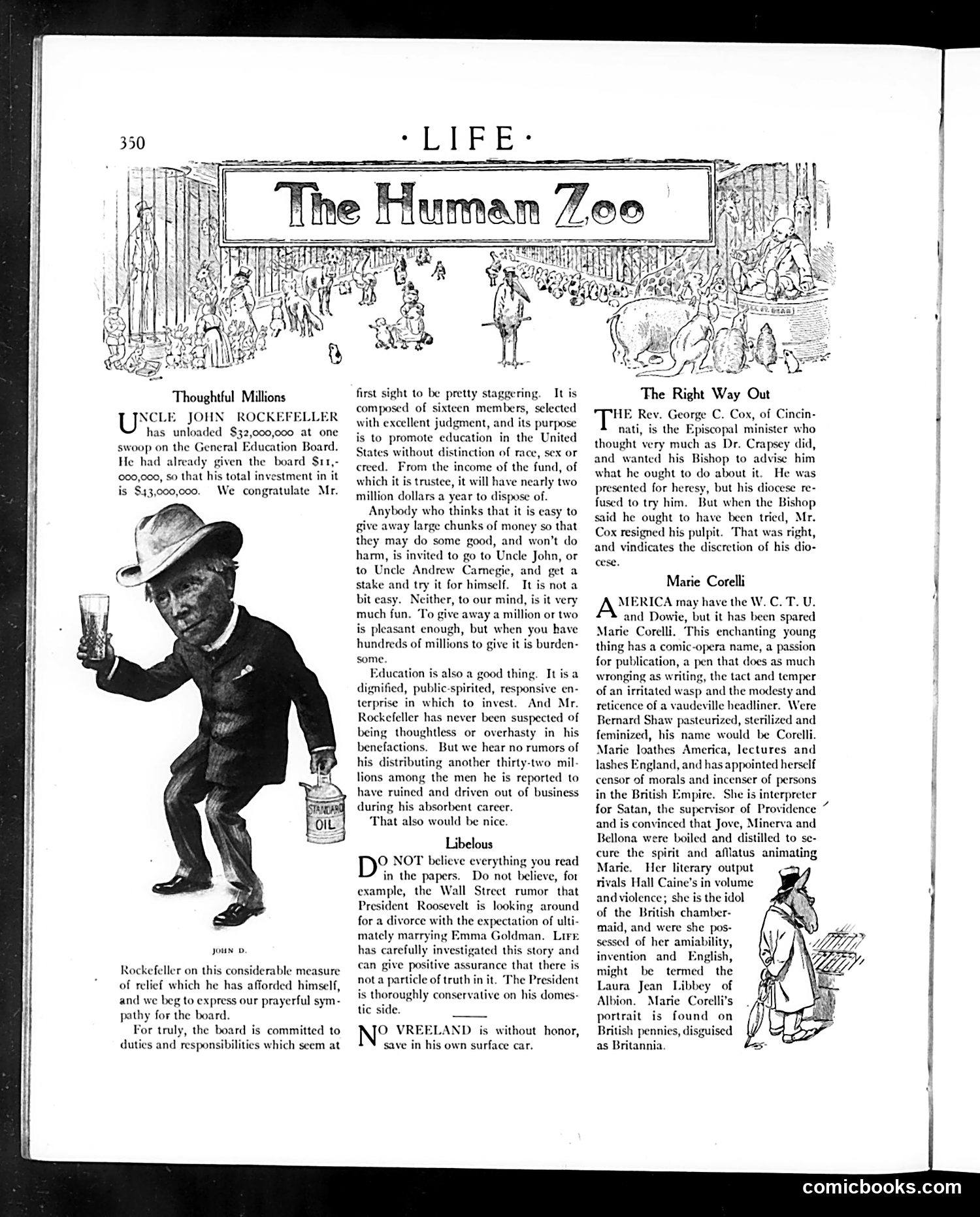
This *Life* magazine page satirizes wealthy philanthropists and contains celebrity gossip. The main cartoon depicts **John D. Rockefeller** as a caricatured figure pouring oil, mocking his $32 million donation to the General Education Board. The satire's point: while Rockefeller touts educational charity, *Life* sardonically notes he's never compensated the businessmen he allegedly "ruined" during his monopolistic career—suggesting his philanthropy conveniently ignores his own victims. The page also ridicules **Marie Corelli**, a British author, as pretentious and sanctimonious. *Life* attacks her as vain, temperamental, and hypocritical—condemning America while lecturing it, despite lacking the talents of comparable writers. The joke plays on her popularity among working-class British women ("chamber-maids"), suggesting her appeal is lowbrow despite her self-importance. A brief section dismisses a Wall Street rumor about President Roosevelt divorcing to marry **Emma Goldman** (an anarchist), calling it absurd.
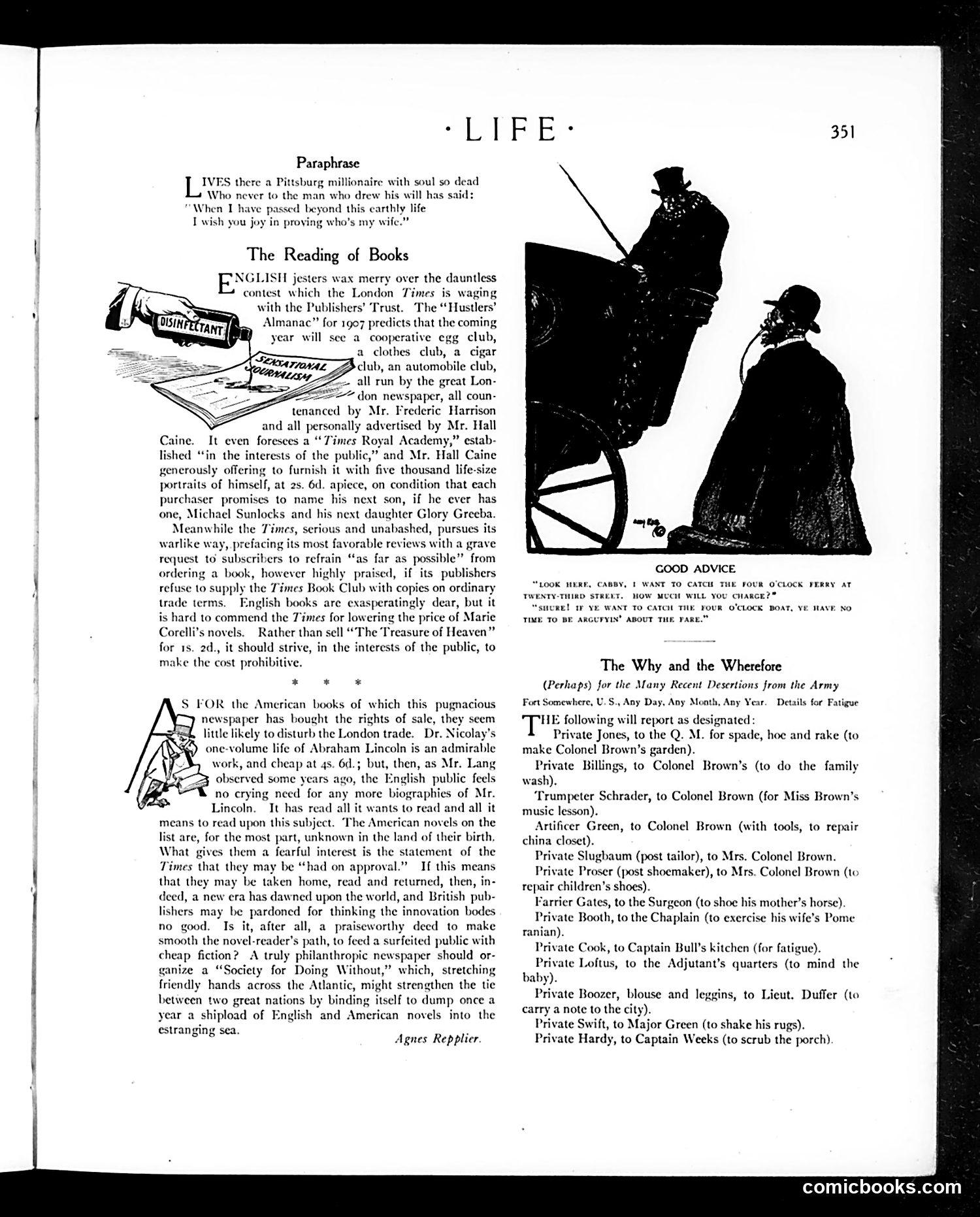
This 1907 *Life* magazine page contains satirical commentary on publishing and the book trade. The main cartoon (upper right, labeled "Good Advice") depicts a cab driver pressuring a passenger about ferry fare—a joke about New York working-class impatience with haggling over small costs. The text articles mock the *London Times* newspaper's aggressive competition against British publishers' cooperative book club, sarcastically suggesting the *Times* will spawn absurd spinoff ventures. Satirist Agnes Repplier ridicules both sides: the *Times* for aggressive tactics, and British publishers for charging prohibitively high prices (18. 2d. for Marie Corelli novels). The bottom section, "The Why and the Wherefore," lists soldiers' assigned duties that reveal military corruption—privates are being sent to do personal chores (gardening, housework, music lessons) for Colonel Brown rather than military work. This satirizes how officers exploited enlisted men for domestic labor, explaining why soldiers deserted the army.
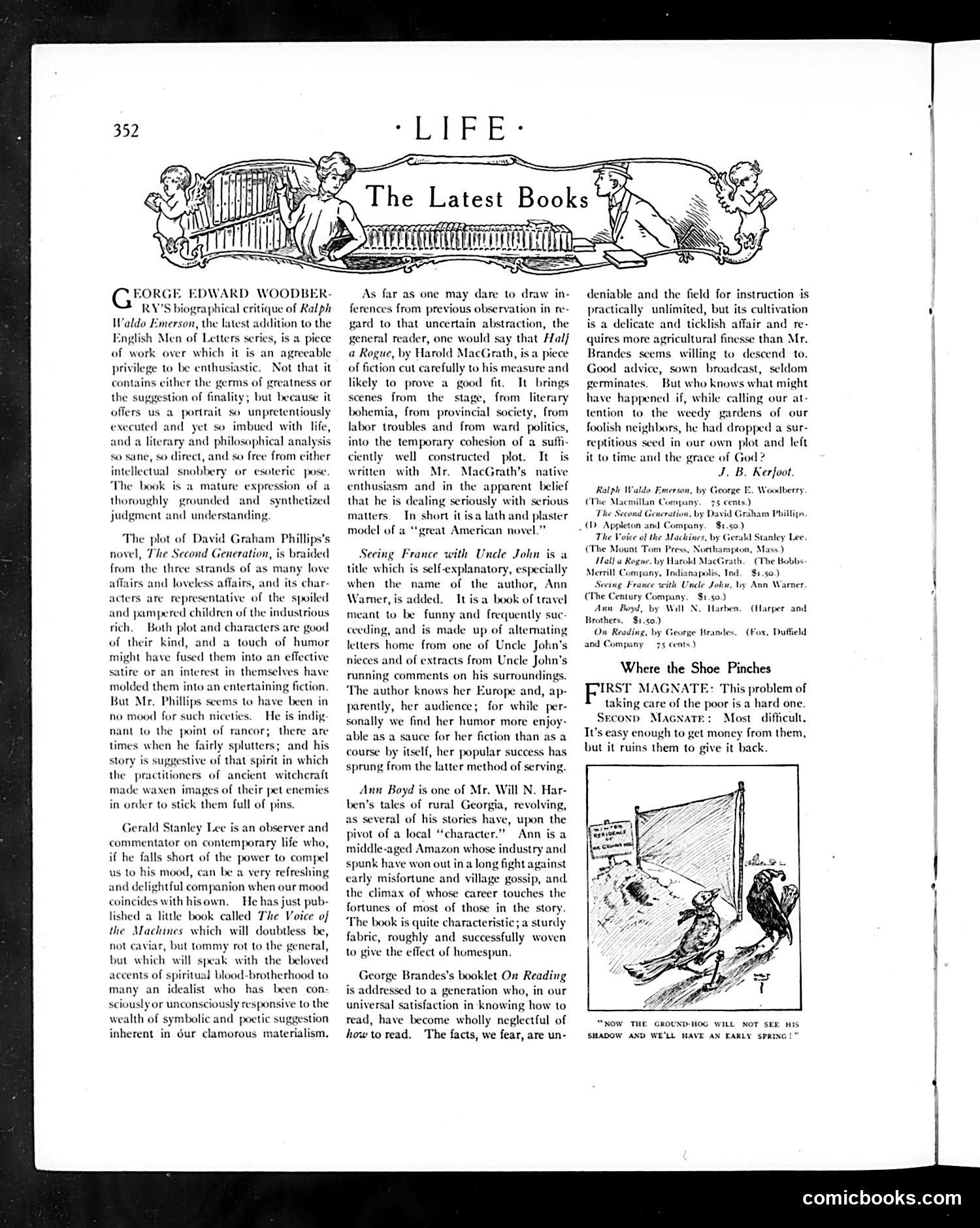
This page from *Life* magazine presents literary criticism rather than political satire. It reviews five contemporary books, including works by Harold MacGrath and David Graham Phillips. The one cartoon present—captioned "Where the Shoe Pinches"—illustrates a folk saying about financial hardship. It depicts a groundhog checking its shadow, with the caption promising early spring. This is a humorous visual aside accompanying a brief, unrelated quip about the difficulty of maintaining shoe quality. The page's substance is book criticism: the reviewer praises George Edward Woodberry's biographical study of Ralph Waldo Emerson, critiques Phillips's *The Second Generation* as socially indignant rather than artfully satirical, and evaluates travel narratives and rural fiction by contemporary authors. No political commentary or social satire is present—this is straightforward literary journalism typical of *Life*'s cultural coverage.
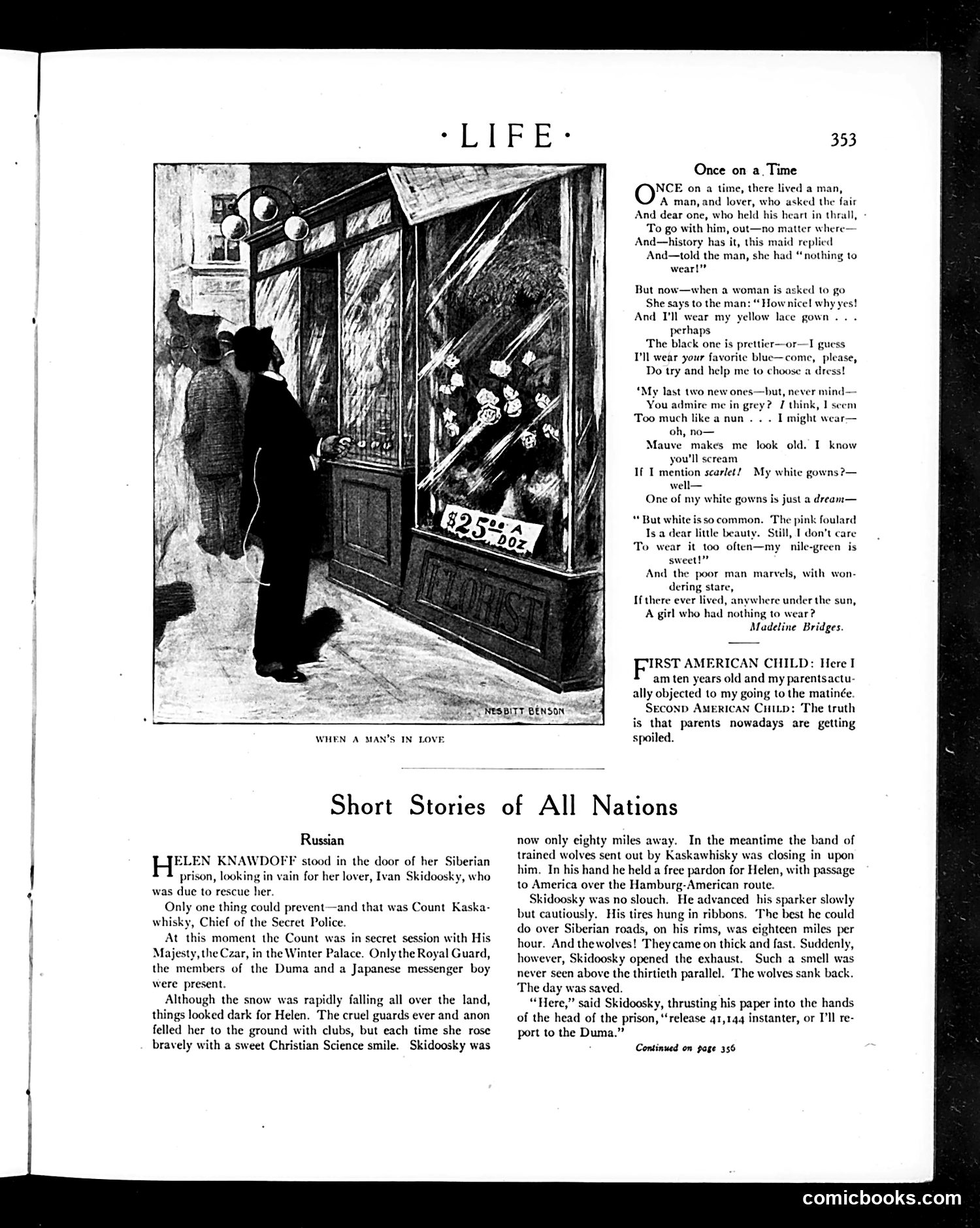
**The Main Cartoon:** Nesbitt Benson's illustration shows a man gazing at a dress shop window while a woman stands beside him. The accompanying poem, "Once on a Time" by Madeline Bridges, contrasts old and new courtship dynamics. **The Joke:** The satire plays on the famous 1857 poem "Nothing to Wear" by William Allen Butler. Historically, when asked to elope, a woman claimed she had nothing suitable to wear. Now, the satirist suggests, women have *too many* options—obsessively debating between yellow lace, blue, grey, scarlet, white, pink, and nile-green gowns while the bewildered man watches helplessly. **The Social Commentary:** This mocks both female vanity and the modern woman's newfound consumer power and independence. The final couplet sardonically asks whether any woman anywhere still lacks clothing—suggesting modern abundance has replaced scarcity. The bottom section contains an absurdist Russian spy story parodying melodramatic adventure tales, featuring comically Russian-sounding names and implausible plot elements.
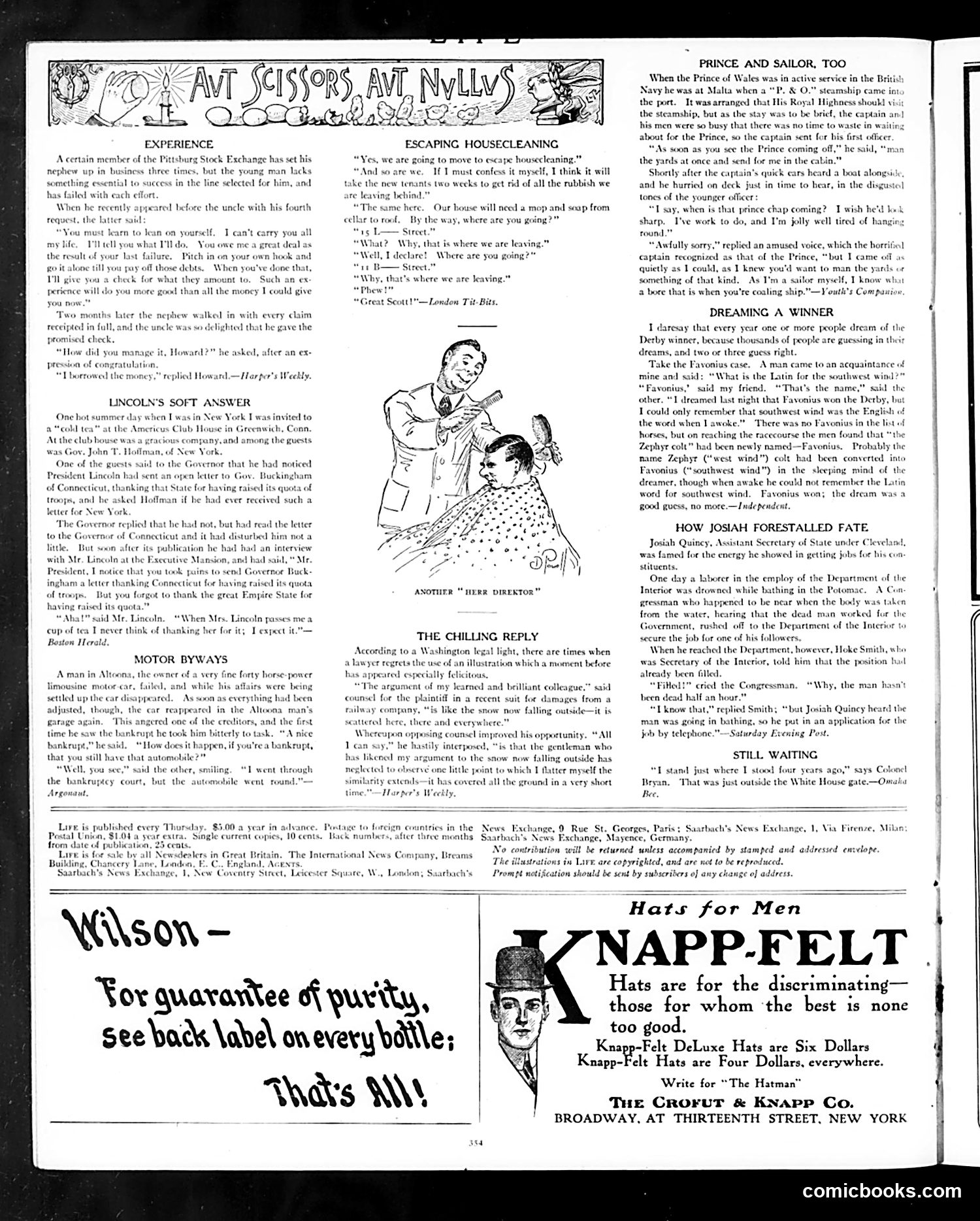
This page from *Life* magazine contains several humorous anecdotes and advertisements rather than traditional political cartoons. **Key Stories:** 1. **"Experience"** - A moral tale about a nephew learning self-reliance when his uncle refuses further financial support, teaching through hard experience rather than handouts. 2. **"Lincoln's Soft Answer"** - An anecdote portraying Abraham Lincoln as gracious and humble, refusing to take credit for kindnesses, contrasting with others' expectations of gratitude. 3. **"Motor Byways"** - A joke about bankruptcy: a man keeps his automobile because it literally "went round" the bankruptcy court proceedings. 4. **"Prince and Sailor"** - A story about the Prince of Wales maintaining humility while serving in the British Navy, respecting a ship's captain's authority despite royal rank. The cartoons illustrate Victorian-era values: self-improvement, humility in leadership, and social hierarchy tempered by personal character. The advertisements (Wilson liquor, Knapp-Felt hats) occupy the lower portion.
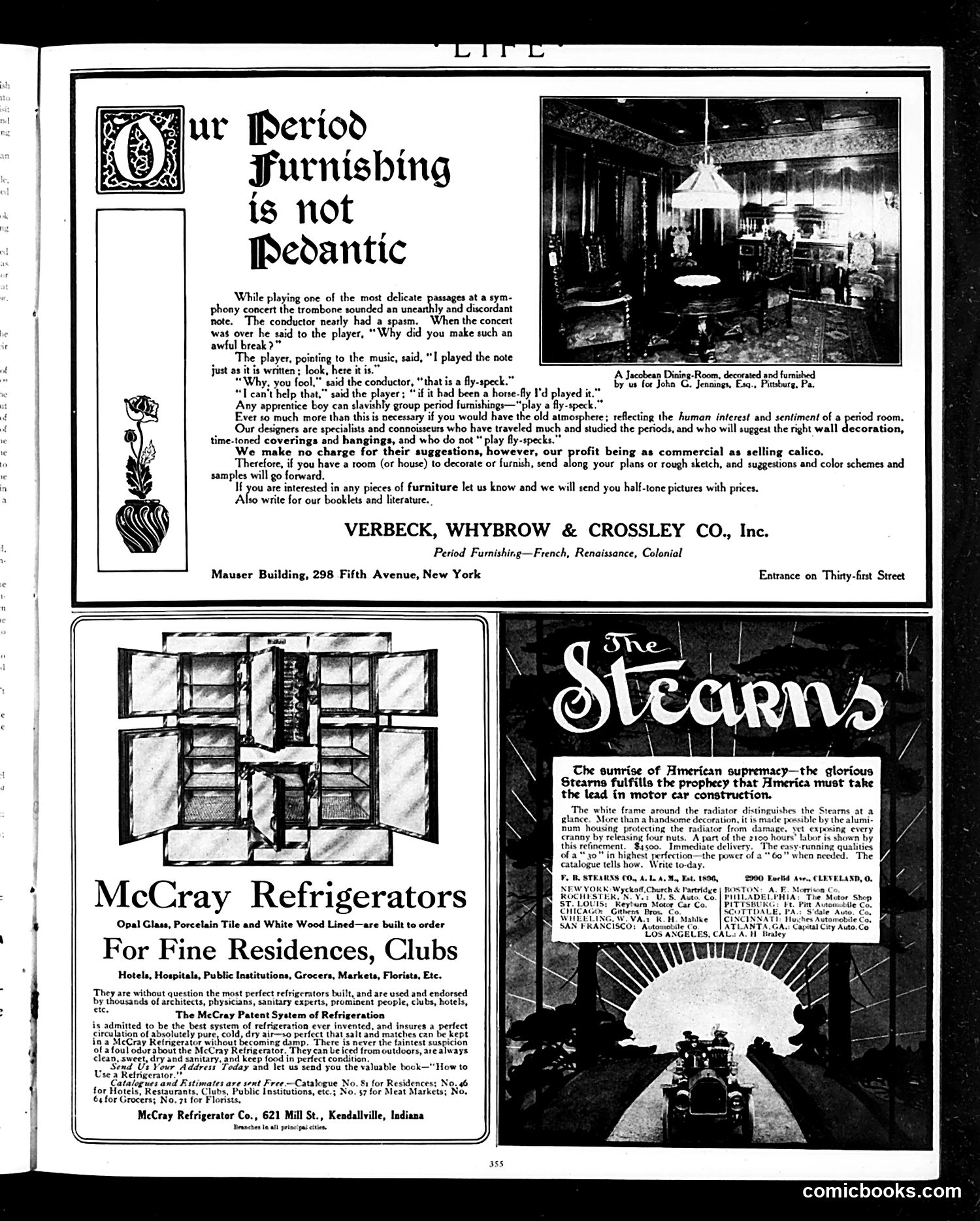
This page contains primarily **advertisements** rather than political cartoons, though the top features a brief humorous anecdote about period furnishing. The **opening cartoon/joke** satirizes overly pedantic interior design: a conductor berates a trombonist for playing a tiny note (a "fly-speck") exactly as written. The joke's moral—that slavish adherence to rules misses the spirit of the thing—introduces an advertisement for Verbeck, Whybrow & Crossley Co., which claims their designers understand period furnishing intelligently rather than mechanically copying past styles. The remaining content consists of three full-page **luxury advertisements** from the early 1900s: - **McCray Refrigerators** for wealthy homes and institutions - **The Stearns** automobile, promoting American manufacturing supremacy - All emphasize quality, exclusivity, and professional expertise The page reflects the magazine's audience: affluent readers interested in sophisticated home design and luxury goods. The tone throughout is aspirational and appeals to educated taste rather than mass-market concerns.
This page from *Life* magazine contains two satirical serial story installments mocking melodramatic fiction conventions: **"In America":** A Russian couple (Ivan and Helen Skidoosky) face expulsion from an American hotel for being divorced. The joke satirizes both immigrant stereotypes (the obviously Russian surname) and American moral hypocrisy—the proprietor enforces strict marital standards while the couple faces absurd exile to Staten Island. References to Mark Twain and Peter Dunne (real humorists) suggest this is parody. **"Mexican":** A priest is more interested in poker winnings than his parish; a Mexican character ("Hot Tamale"—a derogatory term) threatens lovers; a cowboy named John Smith arrives to marry Juanita and "educate her properly" before running for Senate. This mockingly combines period adventure-story clichés: villainous foreigners, noble Americans, and ridiculous coincidences. Both stories exaggerate penny-dreadful plotting to ridicule their implausibility and ethnic stereotypes. The page also contains unrelated piano and stationery advertisements.
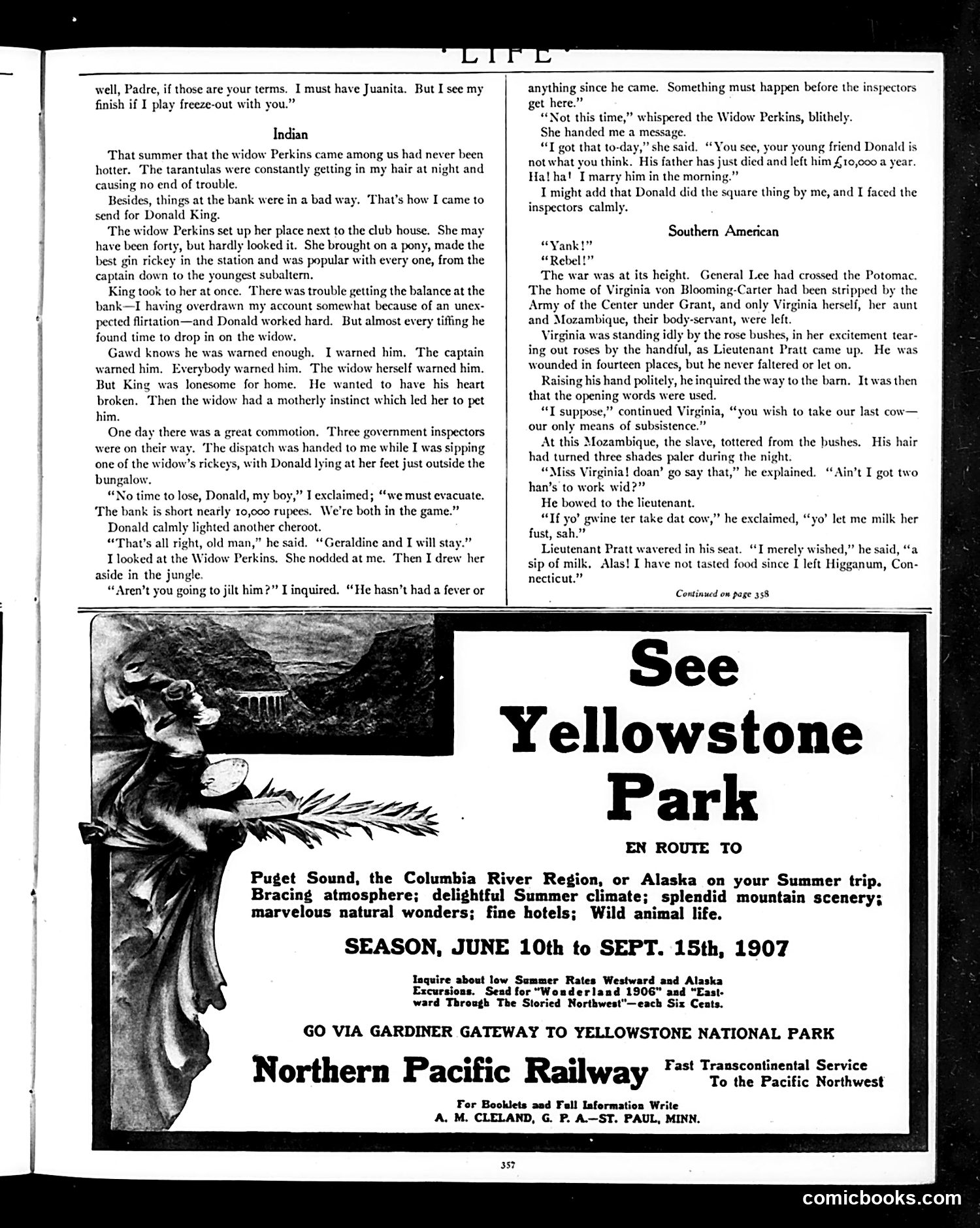
This page contains two short satirical stories typical of Life's humor circa 1907: **"Indian"**: A cautionary tale about a lovesick British colonial official (Donald King) in India who nearly ruins his financial position through infatuation with the Widow Perkins. The satire mocks romantic foolishness and the incompetence of colonial administrators—King's salvation comes not through his own virtue but through unexpected inheritance, allowing him to marry the widow and redeem his embezzlement before inspectors arrive. **"Southern American"**: A Civil War-era sketch playing on Lost Cause mythology and racial stereotypes. A Confederate officer approaches a Virginia plantation, expecting to requisition the family's last cow. The enslaved character Mozambique's emotional appeal—offering his labor instead—causes the Union officer to hesitate, sentimentally. The joke invokes the "faithful servant" trope to satirize both Northern mercy and Southern desperation. The adjacent advertisement promotes Yellowstone Park tourism via Northern Pacific Railway.
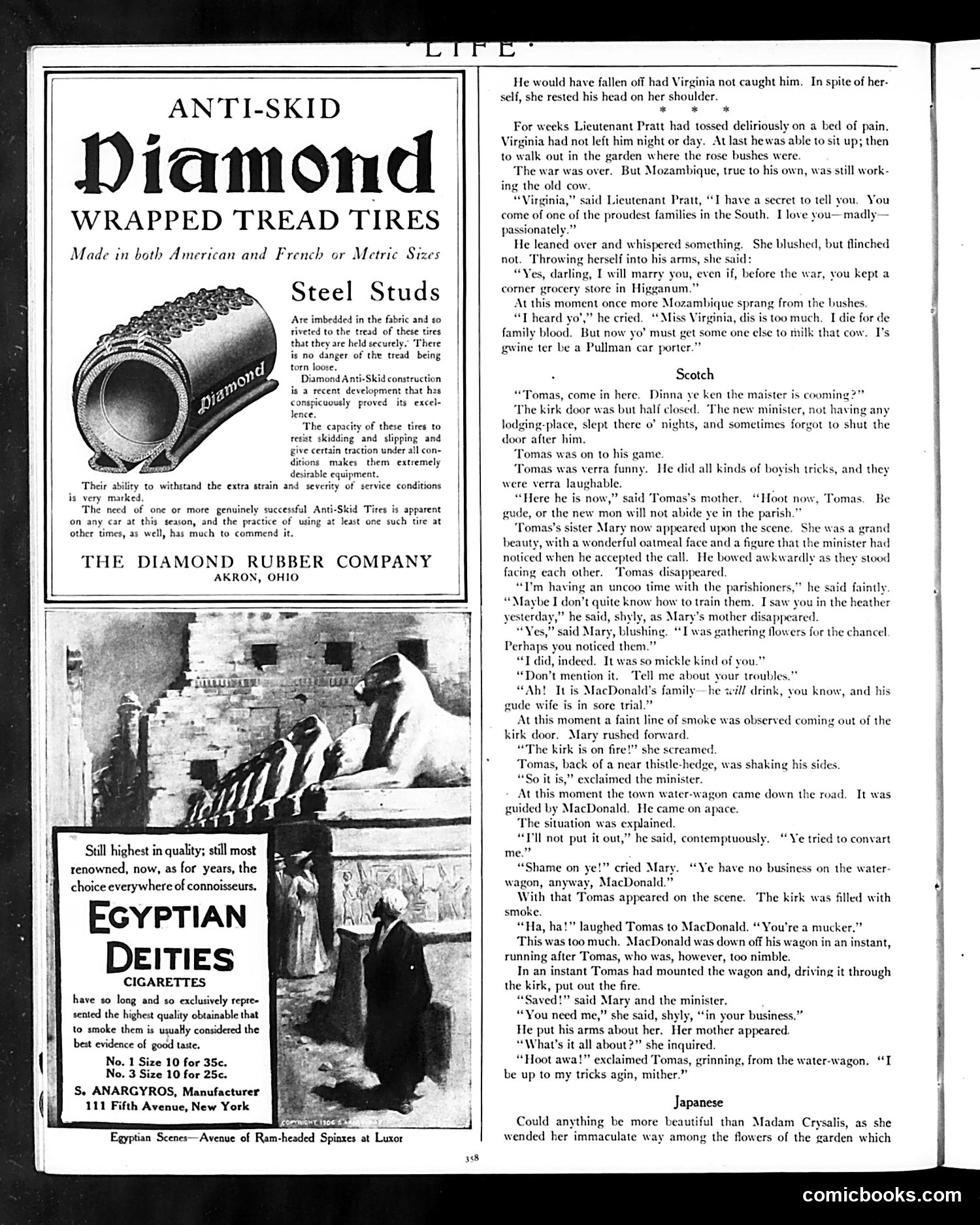
This page combines advertisements with serialized fiction stories. The ads promote Diamond brand anti-skid tires and Egyptian Deities cigarettes—products pitched to affluent consumers through claims of quality and reliability. The editorial content presents three brief humorous stories with ethnic stereotypes typical of early 20th-century American humor. "Virginia" depicts a romance interrupted by "Mozambique," a Black servant character speaking in exaggerated dialect who announces he'll become a Pullman porter. "Scotch" features a Scottish minister and parishioners with heavy brogue and comedic misunderstandings. The final story fragment (Japanese) appears to continue this pattern. These stories rely on racial and ethnic caricature for comedic effect—a common but now-offensive convention in period publications. Modern readers should recognize this reflects attitudes of the era, not contemporary values. The juxtaposition of luxury advertising with entertainment content typifies how *Life* marketed to its educated, middle-class readership.
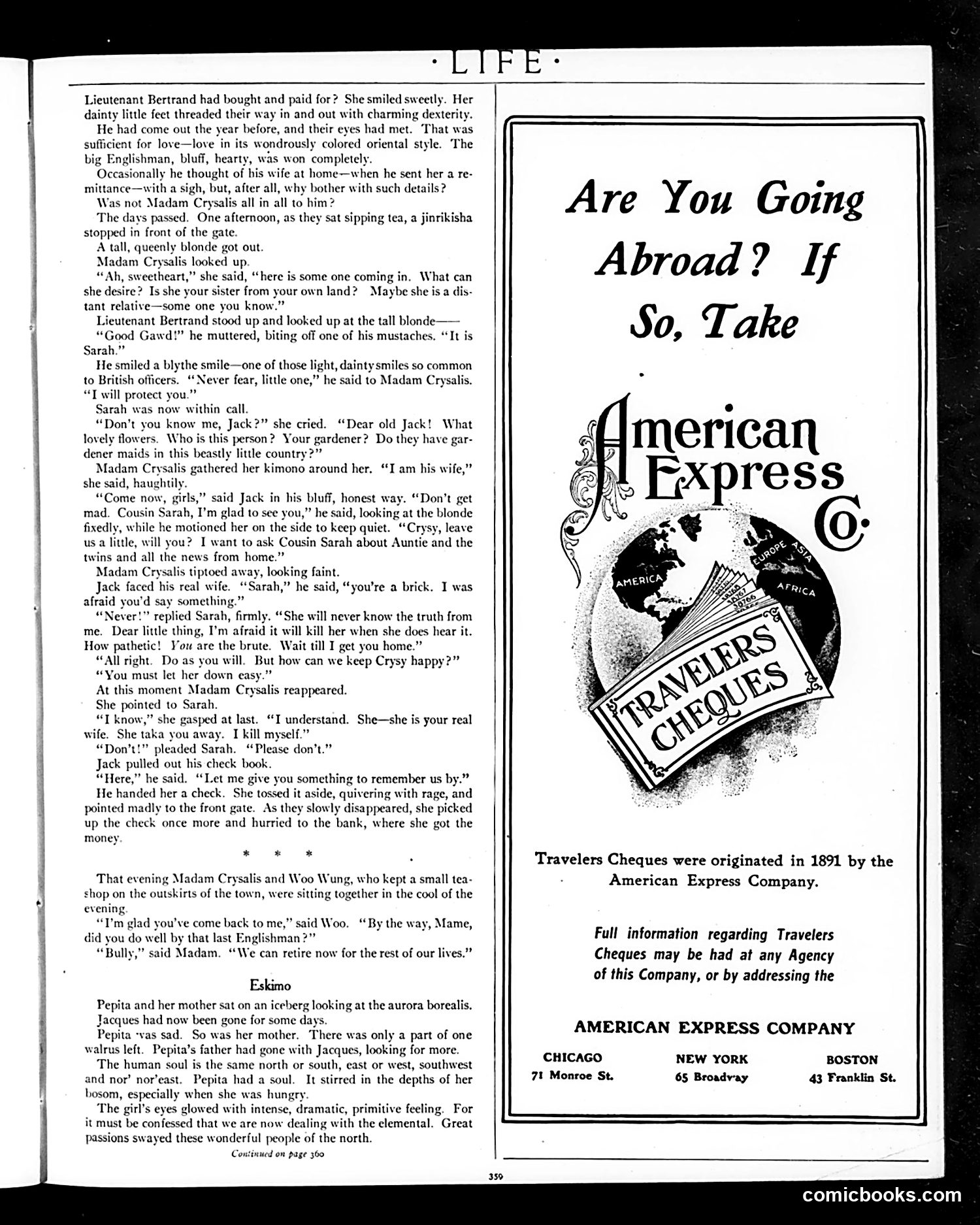
This page contains a serialized short story (continued from page 350) satirizing British colonial attitudes and romantic entanglements in Asia. The narrative follows Lieutenant Bertrand, a British officer who maintains a relationship with "Madam Crysalis," an Asian woman, while his actual wife Sarah arrives unexpectedly. The satire targets the hypocrisy of British imperial masculinity: Bertrand's casual infidelity, his attempted deception, and ultimately his attempt to "buy off" his Asian mistress with a check—which she eagerly accepts and rushes to cash. The final reveal—that Madam Crysalis was cynically manipulating him all along—subverts the condescending "exotic woman" stereotype. The page's right side features an American Express Travelers Cheques advertisement, promoting their service for international travelers (originated 1891), juxtaposing conveniently with the story's theme of money changing hands across continents.
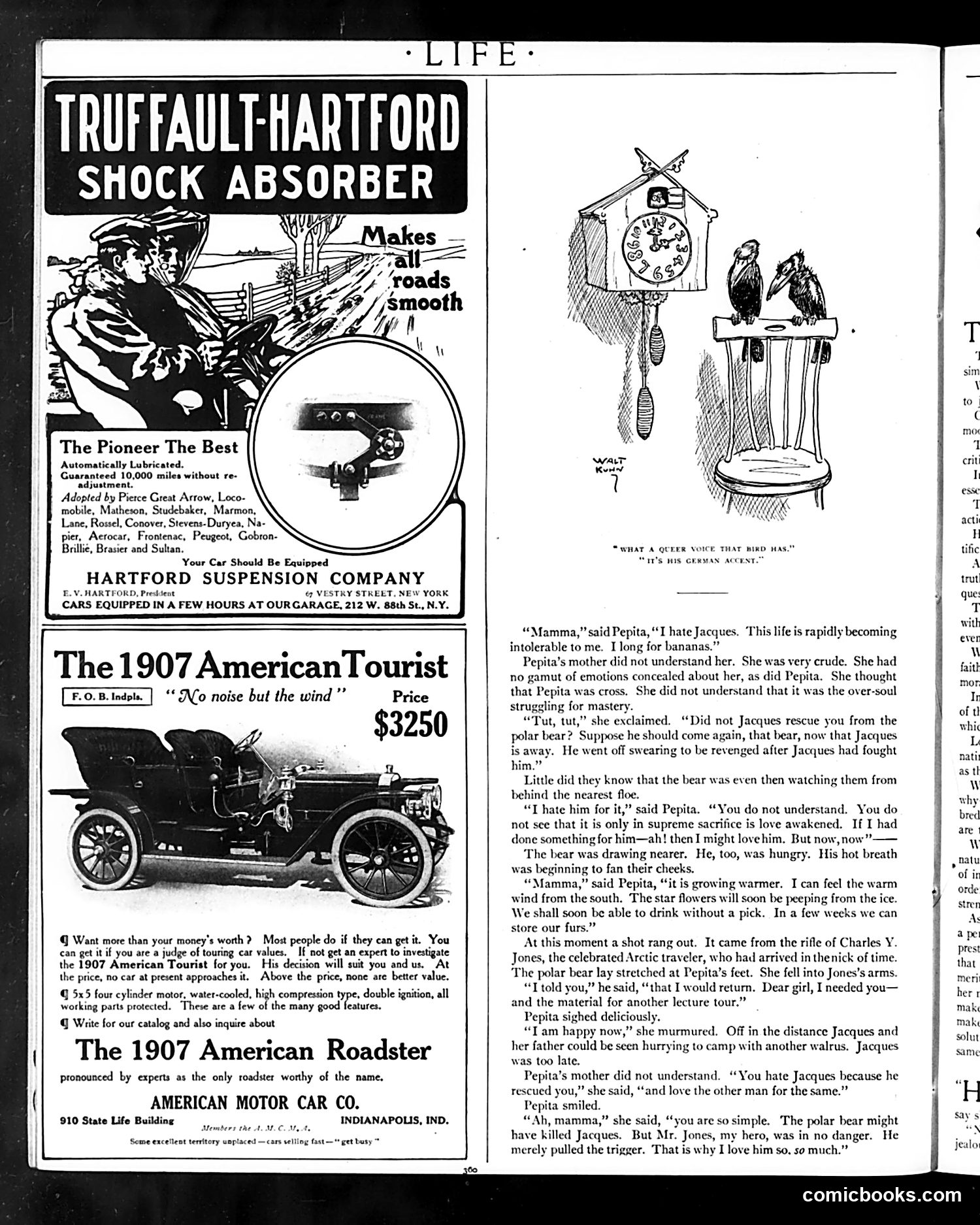
This page combines automobile advertisements with a satirical short story. The ads promote early 1900s cars (the 1907 American Tourist and Roadster) emphasizing reliability and value—typical marketing for the nascent automobile industry. The cartoon/story mocks melodramatic romantic fiction popular in the era. It features Pepita, a emotionally overwrought young woman in an Arctic setting, who despises her rescuer Jacques but loves Charles Y. Jones solely because he shot a polar bear—requiring no personal sacrifice or danger on his part. The satire targets the absurdity of overwrought literary romanticism, particularly the notion that women's love is arbitrary and based on performative heroism rather than genuine character. The German-accented bird observing the scene adds whimsical absurdism to the mockery of literary pretension.
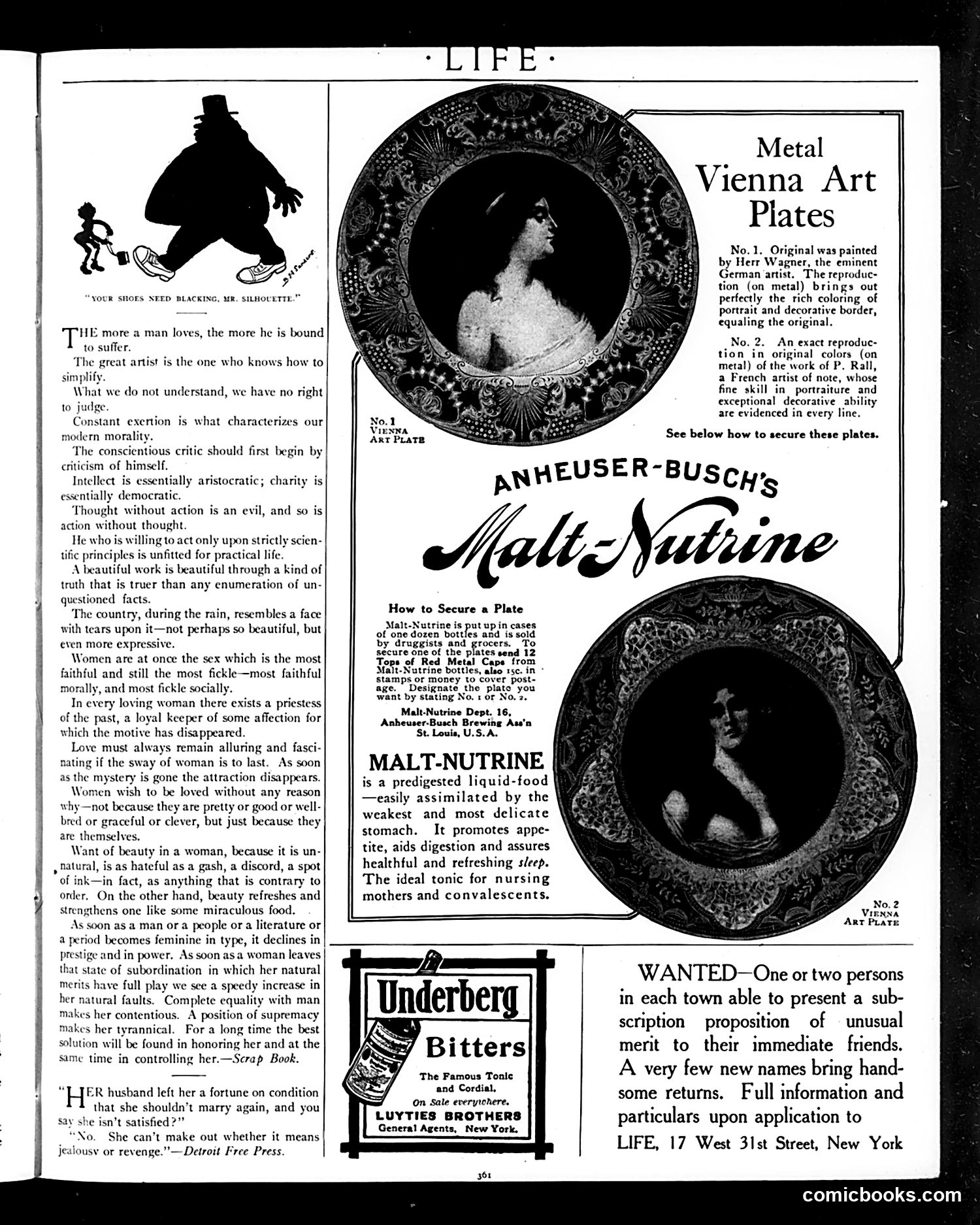
The main cartoon (top left) shows a silhouette of a portly man being addressed by a shoe-shiner with the caption "Your shoes need blacking, Mr. Silhouette." The joke plays on the word "silhouette"—a dark outline or shadow of a figure. Since a silhouette *is* entirely black, suggesting the man's shoes need blackening is absurd; they're already part of his all-black shadow form. It's a visual pun mocking either pompous figures or the shoe-shiner's obsequiousness. The page is primarily advertising for Malt-Nutrine (a Anheuser-Busch "predigested liquid-food" tonic) and Underberg Bitters, with metal Vienna Art plates offered as premiums. The lengthy philosophical text column appears to be filler content typical of *Life* magazine's satirical/humorous format, discussing gender relations and human nature in a somewhat cynical tone reflective of early 20th-century attitudes.
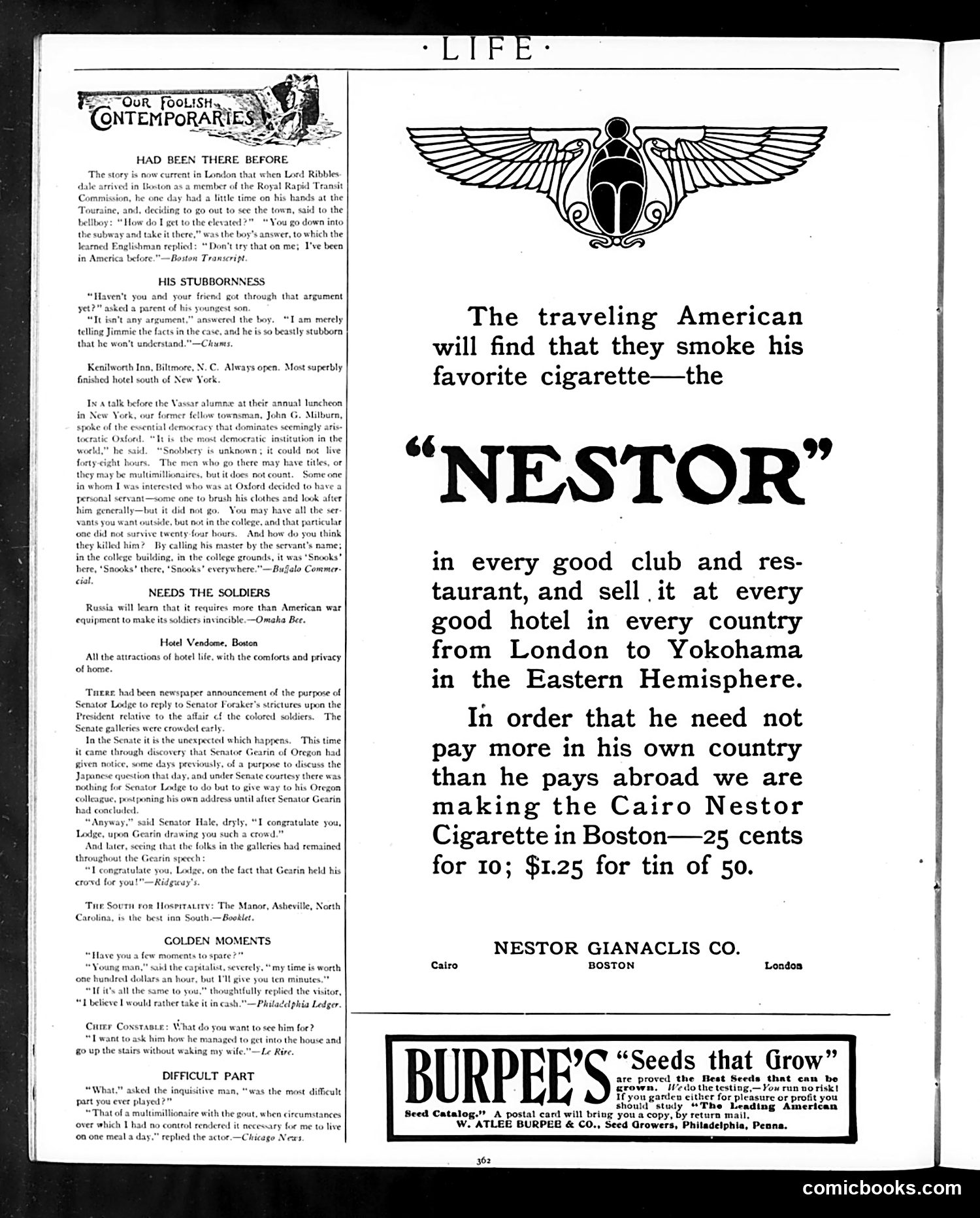
This page is primarily a **cigarette advertisement**, not political satire. The Nestor Gianaclis Company markets their Egyptian cigarettes to American travelers, claiming they're already sold internationally "from London to Yokohama." The ad's pitch: American travelers abroad smoke Nestor cigarettes everywhere, so the company is now manufacturing them in Boston to keep domestic prices competitive with international ones (25 cents for 10). The left column contains unrelated brief anecdotes and hotel advertisements—typical filler content for Life magazine's humor section. These include jokes about stubbornness, hotel recommendations, and commentary on Russian soldiers. At bottom is a Burpee Seeds catalog advertisement. The page reflects early 20th-century marketing: positioning imported luxury goods as cosmopolitan and globally accessible to affluent American travelers.
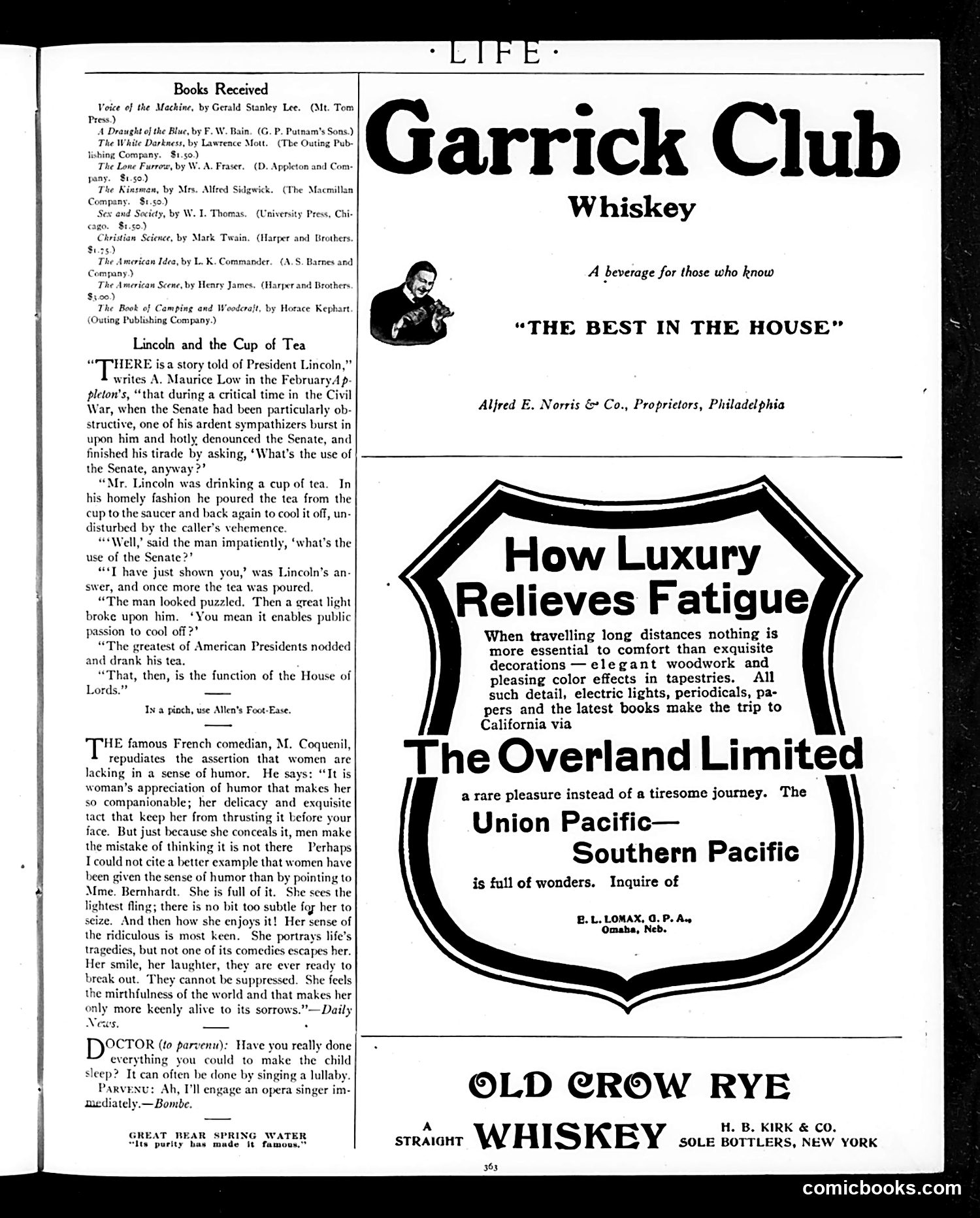
This page is primarily **advertising and book reviews**, not satirical content. The main elements are: **Editorial Content:** - A anecdote about President Lincoln using a teacup demonstration to explain the Senate's function as a "cooling off" mechanism for public passion - A brief piece on French comedian Coquelin's views that women possess humor but tactfully conceal it, citing Sarah Bernhardt as an example - A joke about a wealthy person hiring an opera singer to lull a child to sleep **Advertisements:** The page features multiple liquor and travel ads: Garrick Club Whiskey, Old Crow Rye, and the Overland Limited train service to California via Union Pacific–Southern Pacific. **Historical Context:** The Lincoln anecdote reflects early 20th-century reverence for Lincoln as a statesman; the Bernhardt reference assumes reader familiarity with the famous actress. The advertisements reflect the era's acceptance of alcohol marketing in mainstream publications. This is primarily a commercial page with light editorial content rather than political satire.
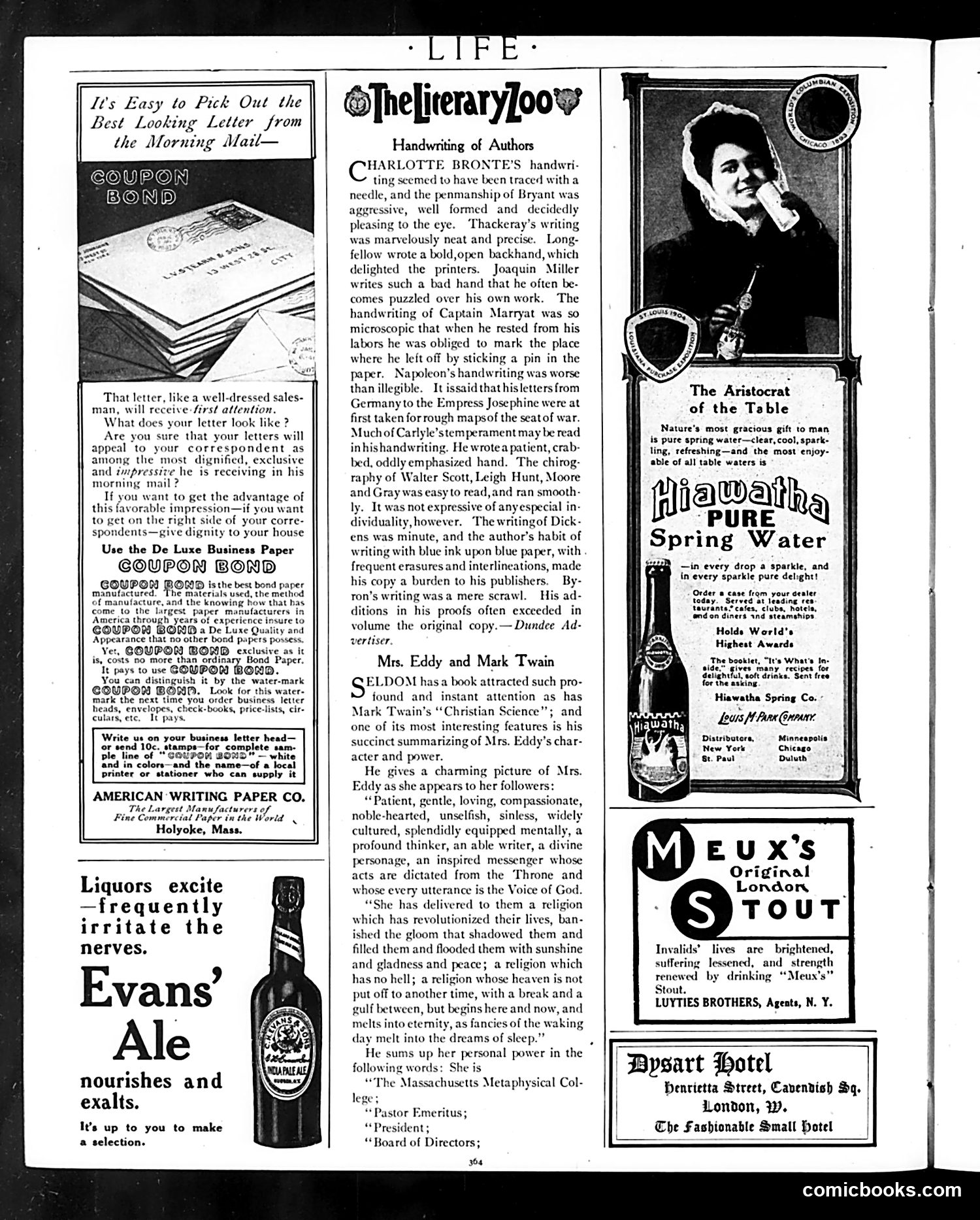
This page is primarily **advertising and literary content**, not political satire. The main feature, "The Literary Zoo," discusses famous authors' handwriting styles—Charlotte Brontë's delicate script, Thackeray's neat penmanship, Napoleon's illegible scrawl, Dickens's messy blue-ink revisions. It's a straightforward literary curiosity piece with no satirical intent. A secondary article compares **Mrs. Eddy** (founder of Christian Science) and **Mark Twain**, noting Twain's book "Christian Science" humorously summarizes Eddy as her followers see her—perfectly patient, sinless, divinely inspired. The irony appears gentle rather than cutting. The rest comprises advertisements: Coupon Bond stationery, Evans' Ale ("nourishes and exalts"), Hiawatha Spring Water, Meux's Stout, and Dysart Hotel. These ads use typical early-20th-century marketing appeals about quality and respectability. **No significant political cartoon or satire appears on this page.**
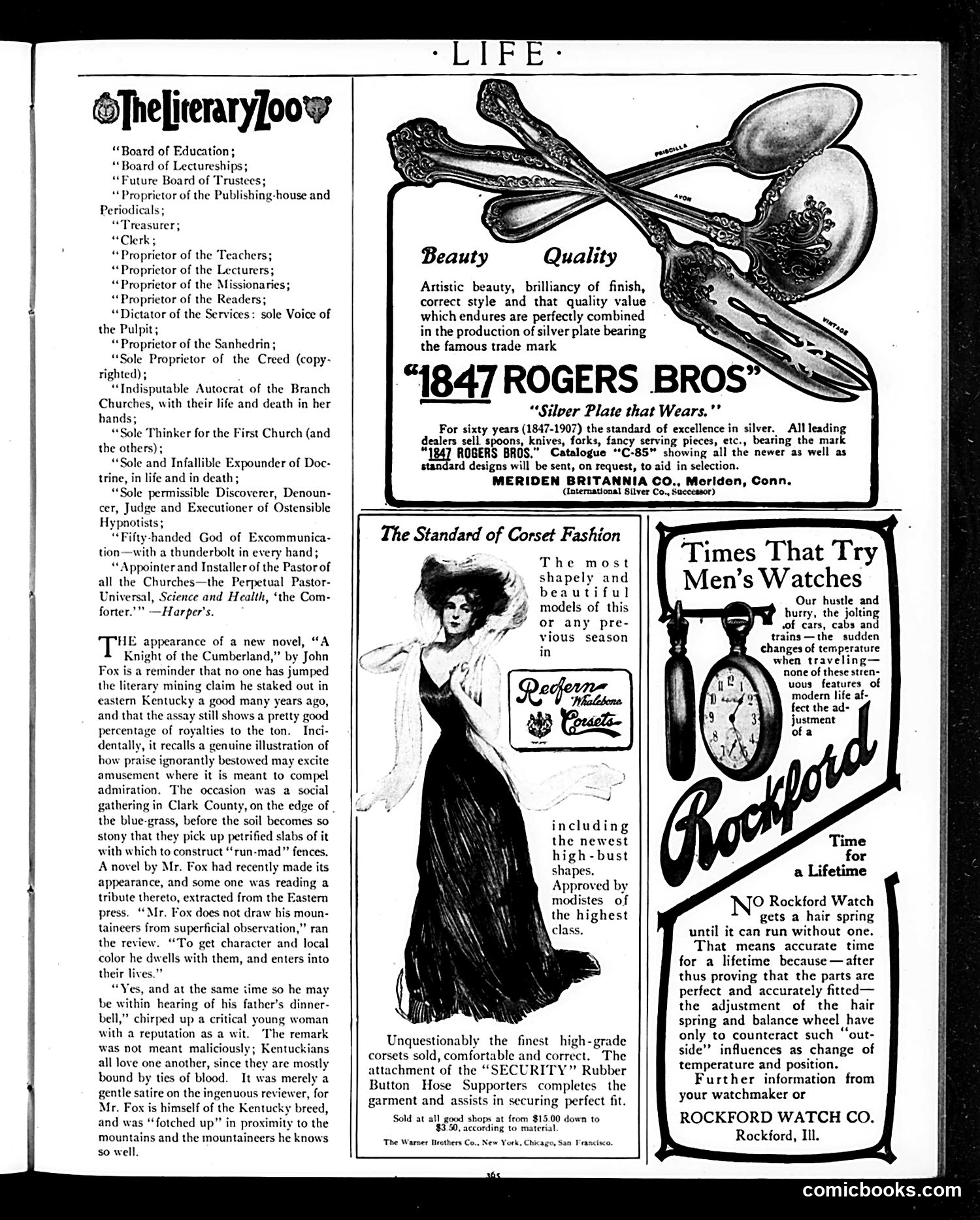
This page presents Life magazine's signature satirical feature, "The Literary Zoo," which mockingly catalogs various social and religious authority figures as if they were specimens—"Board of Education," "Proprietor of the Publishing-house," "Dictator of the Services," etc. The satire suggests these figures have monopolistic, self-aggrandizing control over institutions like churches, education, and publishing. The main article discusses John Fox Jr.'s novel "A Knight of the Cumberland," praising his authentic Kentucky mountain characters. A critic's comment is humorously undercut: when someone notes Fox lives among mountaineers to capture them authentically, a witty woman replies he does so to be "within hearing of his father's dinner-bell"—implying his literary authenticity is merely convenient proximity to home, deflating pretentious literary claims. The remainder consists of period advertisements for silverware, corsets, and watches—typical of Life's commercial content.
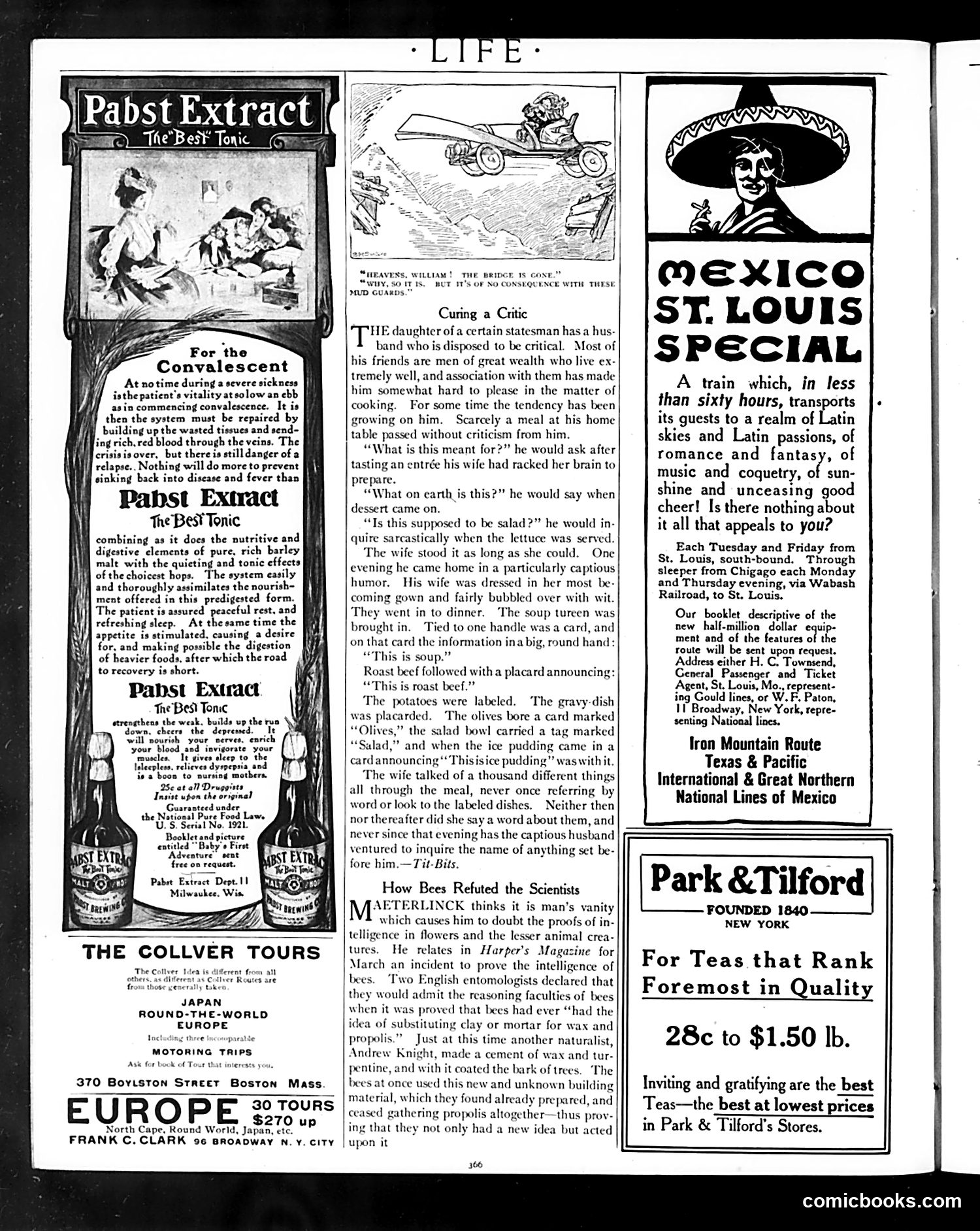
This page contains mostly **advertisements** mixed with two short humorous pieces typical of early 20th-century Life magazine. **"Curing a Critic"** satirizes a wealthy, hypercritical husband who constantly complains about his wife's cooking. His exasperated wife's solution: she labels every dish at dinner ("This is soup," "This is roast beef," etc.). The husband, thus mocked by the obvious labeling, stops criticizing. The joke targets upper-class pretension and the absurdity of perpetual fault-finding. **"How Bees Refuted the Scientists"** (incomplete on this page) discusses intelligence in animals—referencing an anecdote from *Harper's Magazine* about bees supposedly proving scientists wrong about animal reasoning ability. The bulk of the page features period **patent medicine advertising** (Pabst Extract tonic for recovery) and **travel promotions** (European tours, Mexico rail service), reflecting early 1900s publishing economics where advertisements subsidized content.
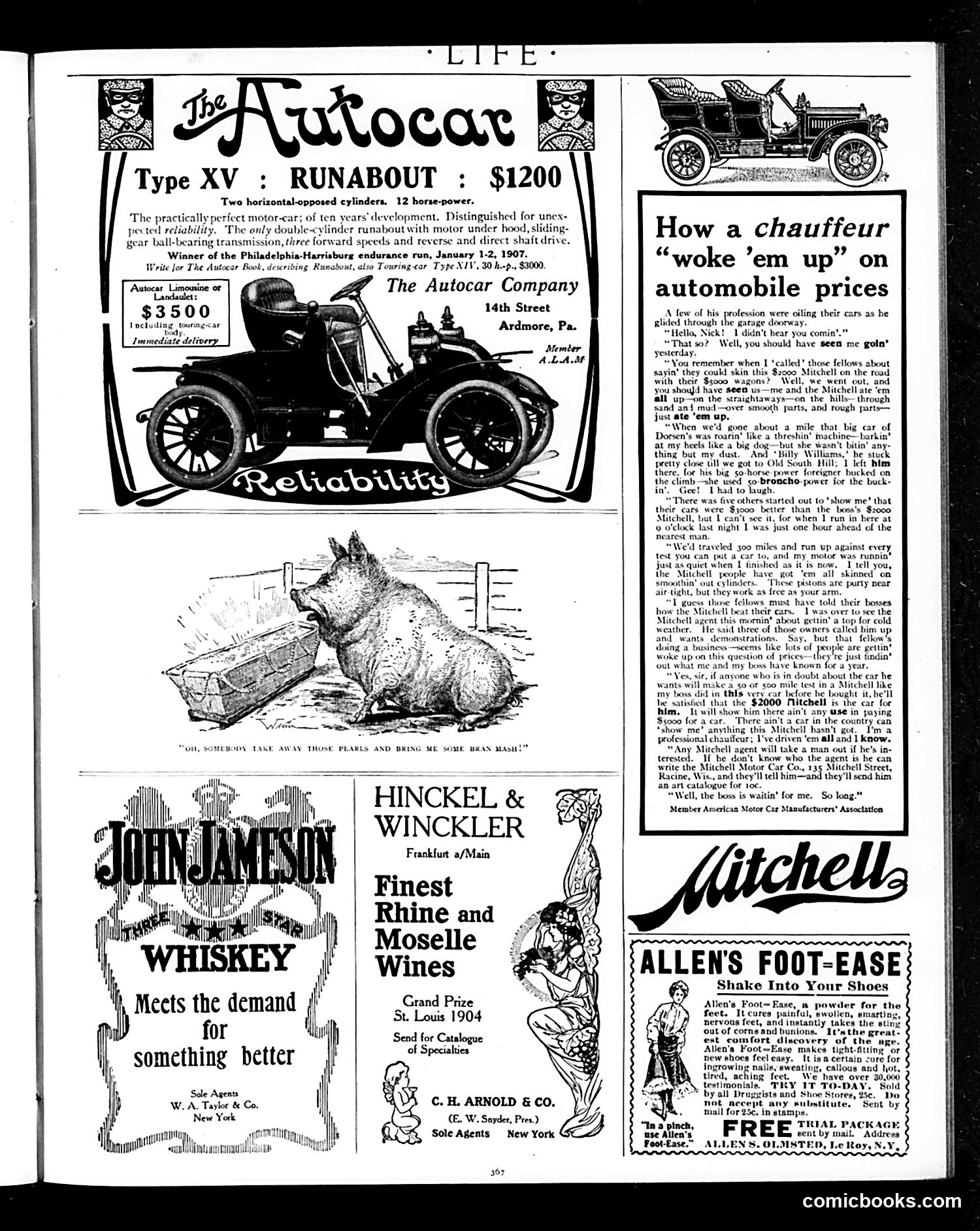
This page is primarily **automobile advertising** from early 1900s Life magazine, not political satire. The main content features: **The Autocar Type XV Runabout** ($1,200)—a two-cylinder car advertised as "practically perfect" and reliable, winner of a 1907 endurance race. **The large narrative** titled "How a chauffeur 'woke 'em up' on automobile prices" is a testimonial where a Mitchell car chauffeur boasts that his $2,000 Mitchell outperformed five competing vehicles ($8,000-$9,000 range) over 300 miles. The point: the Mitchell offers superior value—newer buyers shouldn't overpay for expensive cars when the Mitchell delivers equivalent performance cheaper. **Other ads include:** John Jameson Whiskey, Hinckel & Winckler wines, and Allen's Foot-Ease powder. The cartoon at bottom—a pig refusing pearls for bran—appears unrelated to automobiles; its meaning is unclear from context. This reflects early-1900s consumer culture: competitive automobile pricing and aggressive marketing through testimonials.
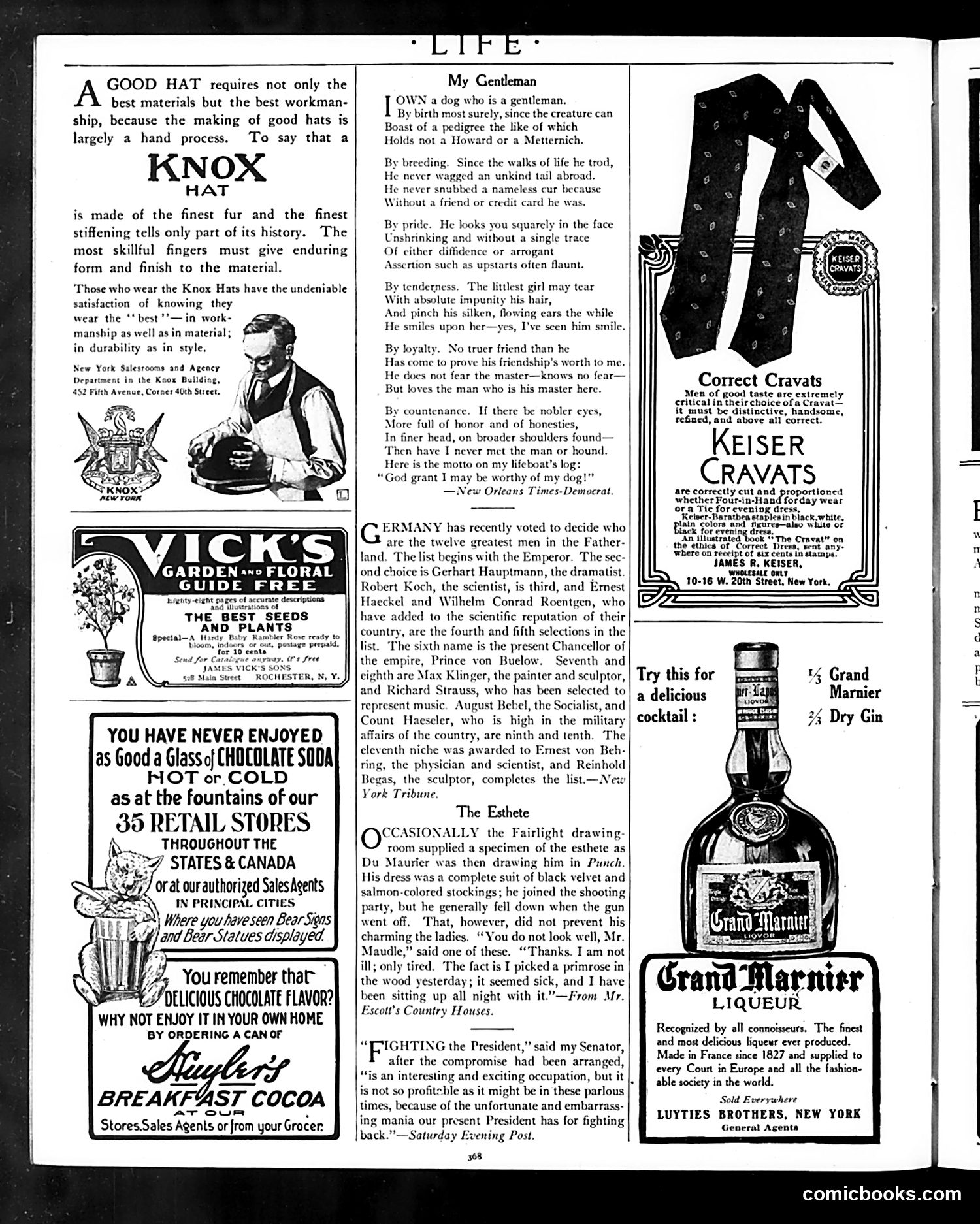
This page is primarily **advertisements and literary content** rather than political cartoons. The ads promote Knox Hats, Vick's seeds, chocolate soda, and breakfast cocoa—typical early 20th-century commercial pitches. The editorial content includes: 1. **"My Gentleman"** — a sentimental poem praising a dog's noble character, using aristocratic references (Howards, Metternichs) ironically to elevate a pet's virtue over human pretension. 2. **German "Greatest Men"** article — reporting Germany's vote on twelve greatest citizens, listing Kaiser, scientists (Koch, Röntgen), artists (Strauss), and politicians. This appears informational rather than satirical. 3. **"The Esthete"** — a brief sketch mocking 1890s-era artistic pretension (black velvet, salmon stockings), referencing illustrator Du Maurier's satirical *Punch* drawings of affected aesthetes who were impractical and vain. The page reflects *Life*'s mix of genteel satire, social commentary, and consumer advertising typical of the magazine's early era.
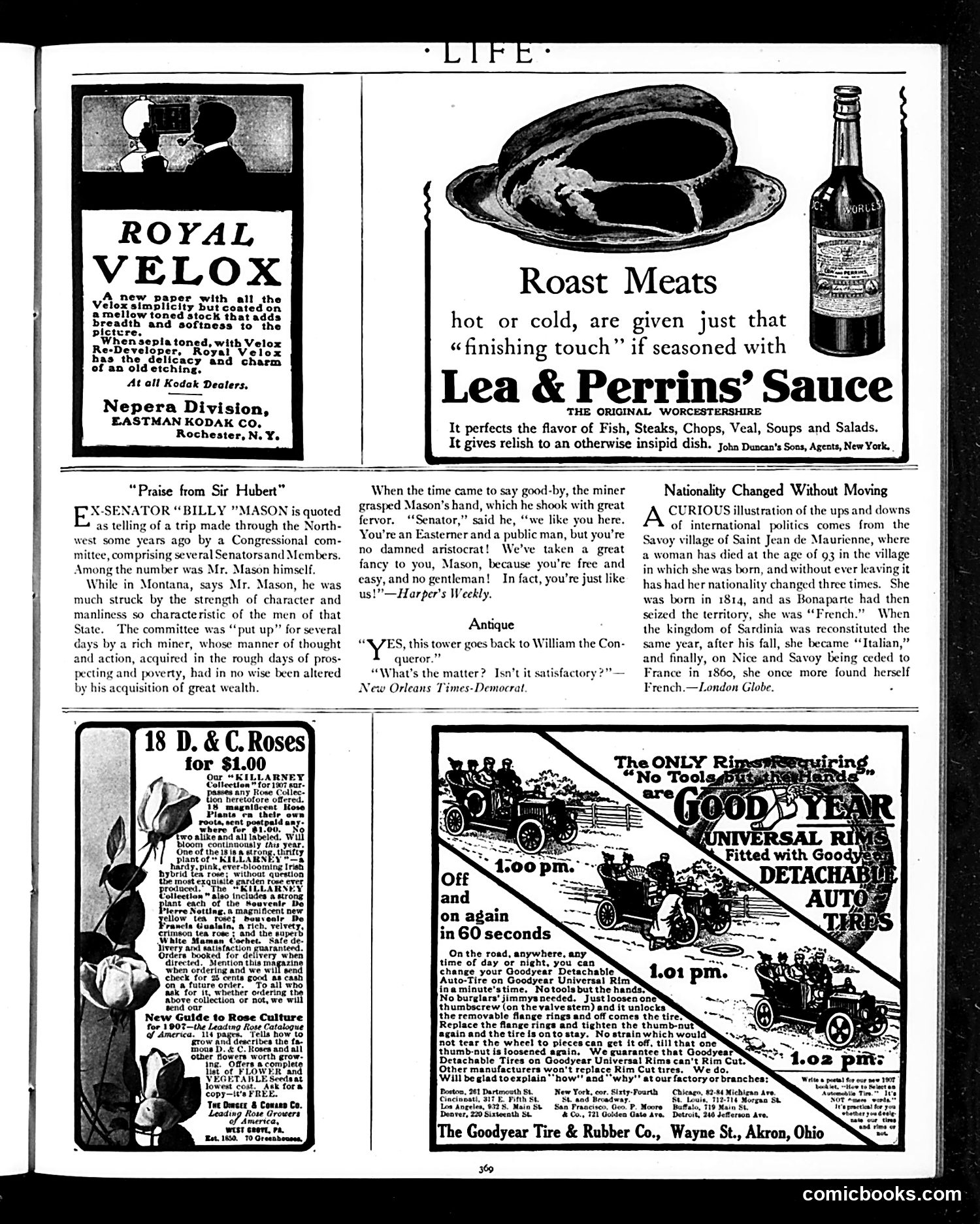
This page is primarily **advertisements** rather than political satire. The main content includes: **Notable Advertisement:** The Goodyear tire ad features an illustrated sequence showing a car with a detachable tire rim that can be changed in 60 seconds—highlighting a practical automotive innovation for the era when tire changes were time-consuming roadside ordeals. **Other Ads:** Kodak photographic paper (Velox), Lea & Perrins sauce, rose seeds, and a floral catalog occupy the remaining space. **Anecdote Section:** "Praise from Sir Hubert" presents Senator Billy Mason recounting a Montana encounter with a self-made miner who respects Mason for being "free and easy" rather than aristocratic—a popular theme celebrating American egalitarianism and rejecting Old World pretension. **Brief Item:** "Nationality Changed Without Moving" humorously notes a French woman whose nationality shifted three times without leaving her village, due to territorial changes between 1814-1860. The page reflects early 1900s consumer culture and light social commentary rather than sharp political cartoon satire.
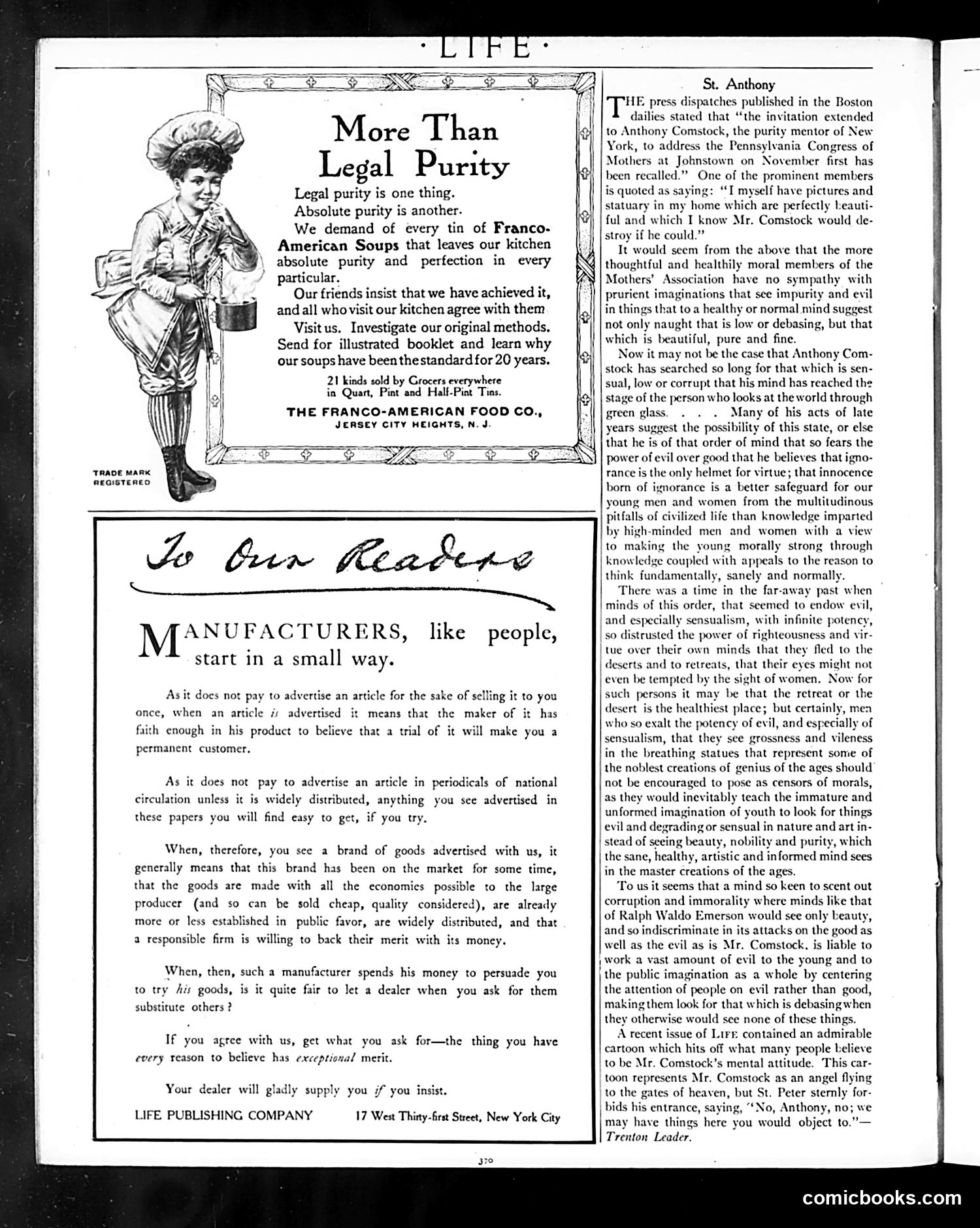
This page contains a Franco-American Soups advertisement (top left) and editorial commentary on **Anthony Comstock**, the famous American vice crusader. **The Advertisement**: Uses a domestic imagery of a cook to promote soup purity and quality—ironic given the page's main content. **The Editorial ("St. Anthony")**: Criticizes Comstock's censorship agenda. The piece reports that the Pennsylvania Congress of Mothers **recalled an invitation** for Comstock to speak, with members objecting that he would demand destruction of their art and statuary as "impure." **The Satire's Point**: Life mocks Comstock's moral crusade as obsessive and counterproductive. The editorial argues that his long search for "sensuality" has warped his perception—he sees evil where healthy minds see beauty. It suggests **ignorance-based morality** (Comstock's approach) is inferior to education paired with reason. This reflects early-20th-century tension between progressive reformers and traditional moral guardians over what constituted appropriate knowledge for youth.
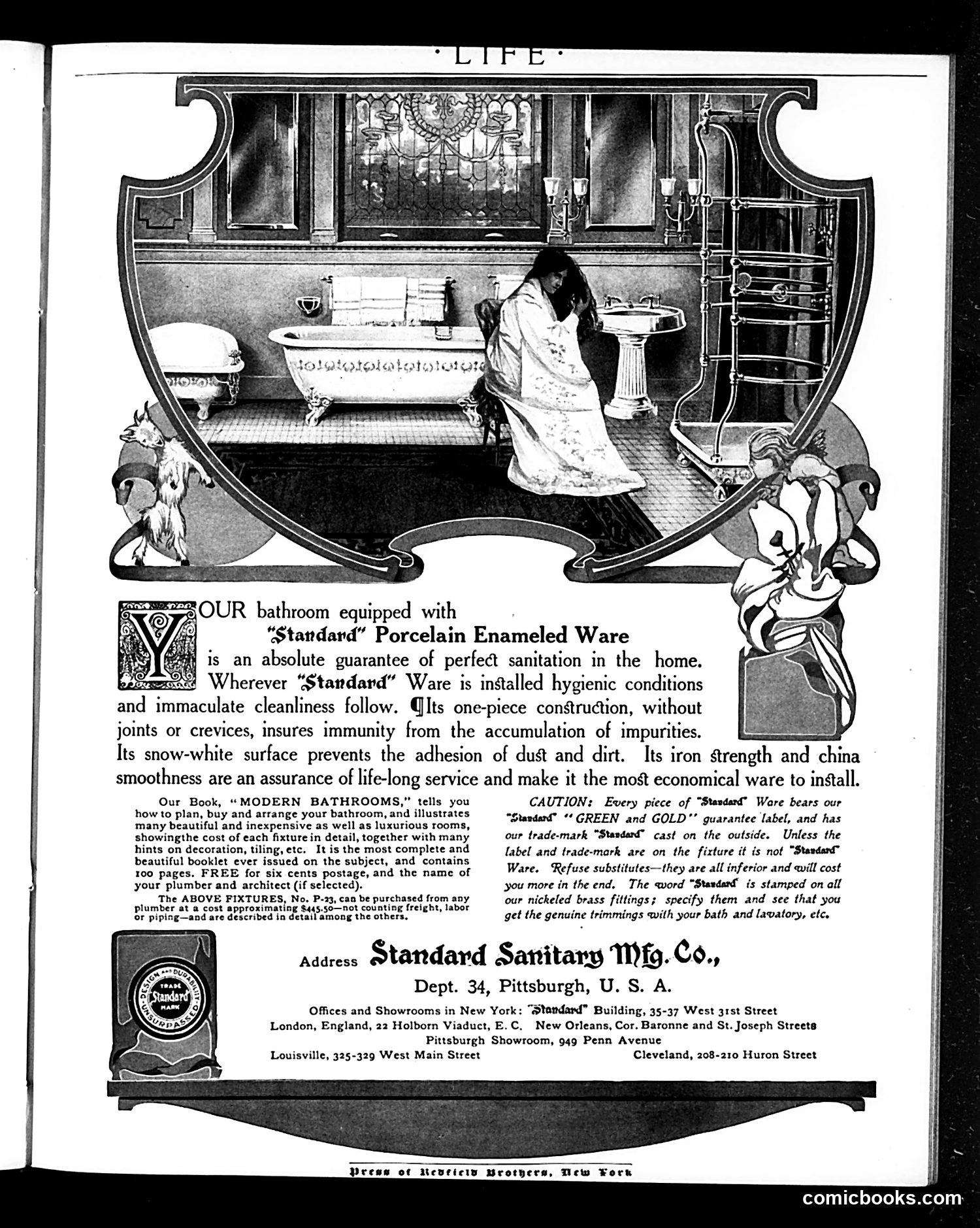
This is primarily a **bathroom fixtures advertisement**, not a political cartoon. It promotes "Standard" brand porcelain enameled ware manufactured by Standard Sanitary Mfg. Co. of Pittsburgh. The illustrated scene depicts a woman in a bathroom with a bathtub, pedestal sink, and fixtures—presented as the epitome of modern home sanitation. The decorative border features cherubs and ornamental elements typical of early 20th-century advertising design. The advertisement emphasizes the product's hygienic superiority: one-piece construction without crevices that could harbor impurities, snow-white surface preventing dust accumulation, and durability. A caution section warns consumers against inferior substitutes, instructing them to verify the "Standard" trademark and "GREEN and GOLD" guarantee label on fixtures. The ad includes pricing ($445.50 for the displayed setup) and lists multiple showrooms across major American cities plus London. There is no satire or political commentary—this is straightforward product marketing typical of Life magazine's commercial content.
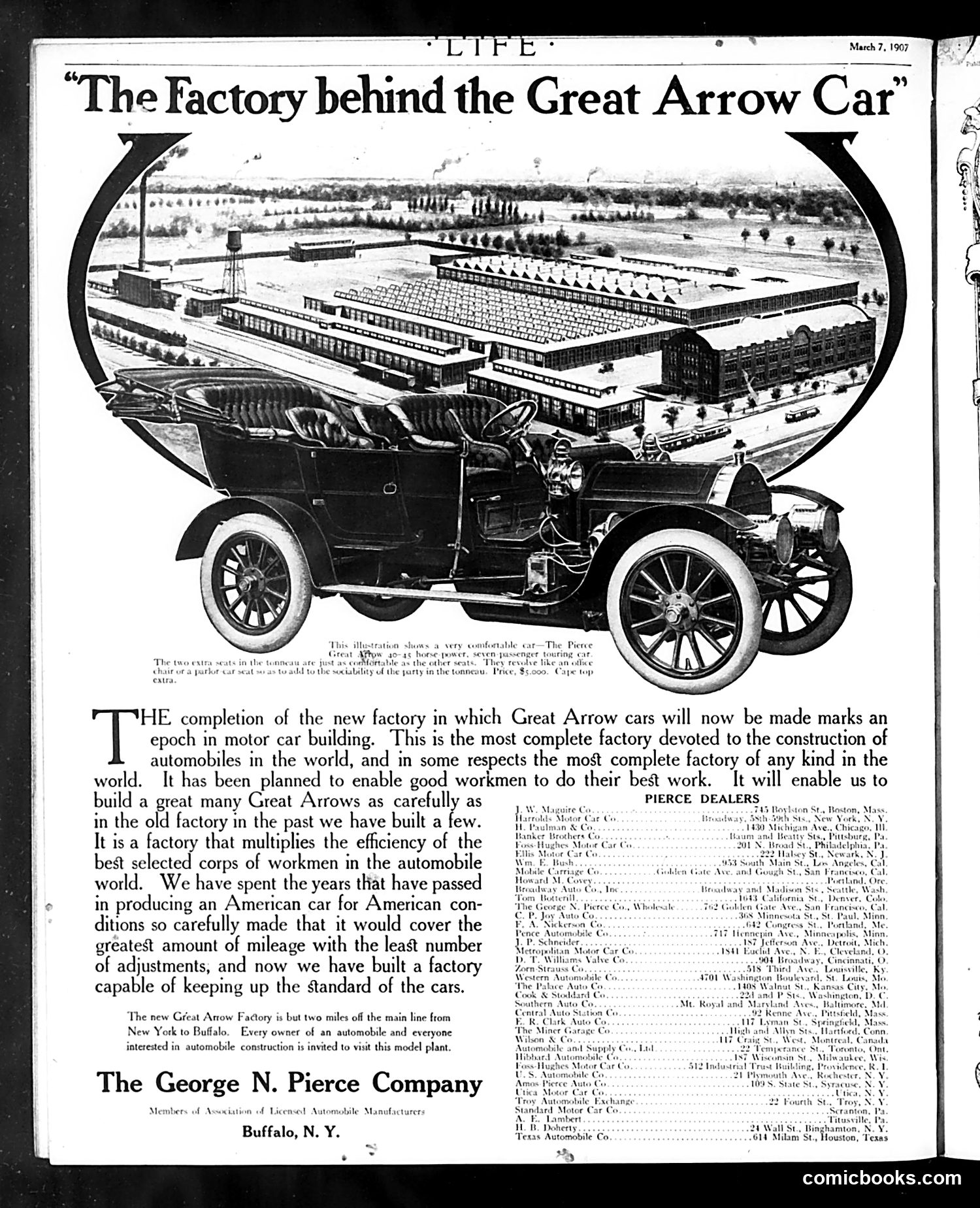
This is primarily **advertising**, not satire. The George N. Pierce Company is promoting their new factory for the "Great Arrow" automobile, using Life magazine's March 7, 1907 issue as a platform. The page shows an early 1900s touring car and an aerial factory photograph, accompanied by corporate boasting about manufacturing efficiency and quality control. The text emphasizes American engineering and workmanship—claims that they've spent years perfecting a car "for American conditions" and now possess a factory capable of maintaining consistent standards. The "epoch in motor car building" language reflects genuine enthusiasm about industrial progress during the automobile's rapid commercialization. Rather than mocking the company, Life's inclusion suggests either paid advertising or genuine editorial interest in manufacturing innovation. The extensive dealer list at right indicates Pierce was a significant automotive manufacturer of the period, though the company is largely forgotten today. This represents early automotive advertising's appeal to both technological pride and consumer confidence.