
Life, 1907-03-07 · page 17 of 52
Life — March 7, 1907 — page 17: what you’re looking at
What you’re looking at
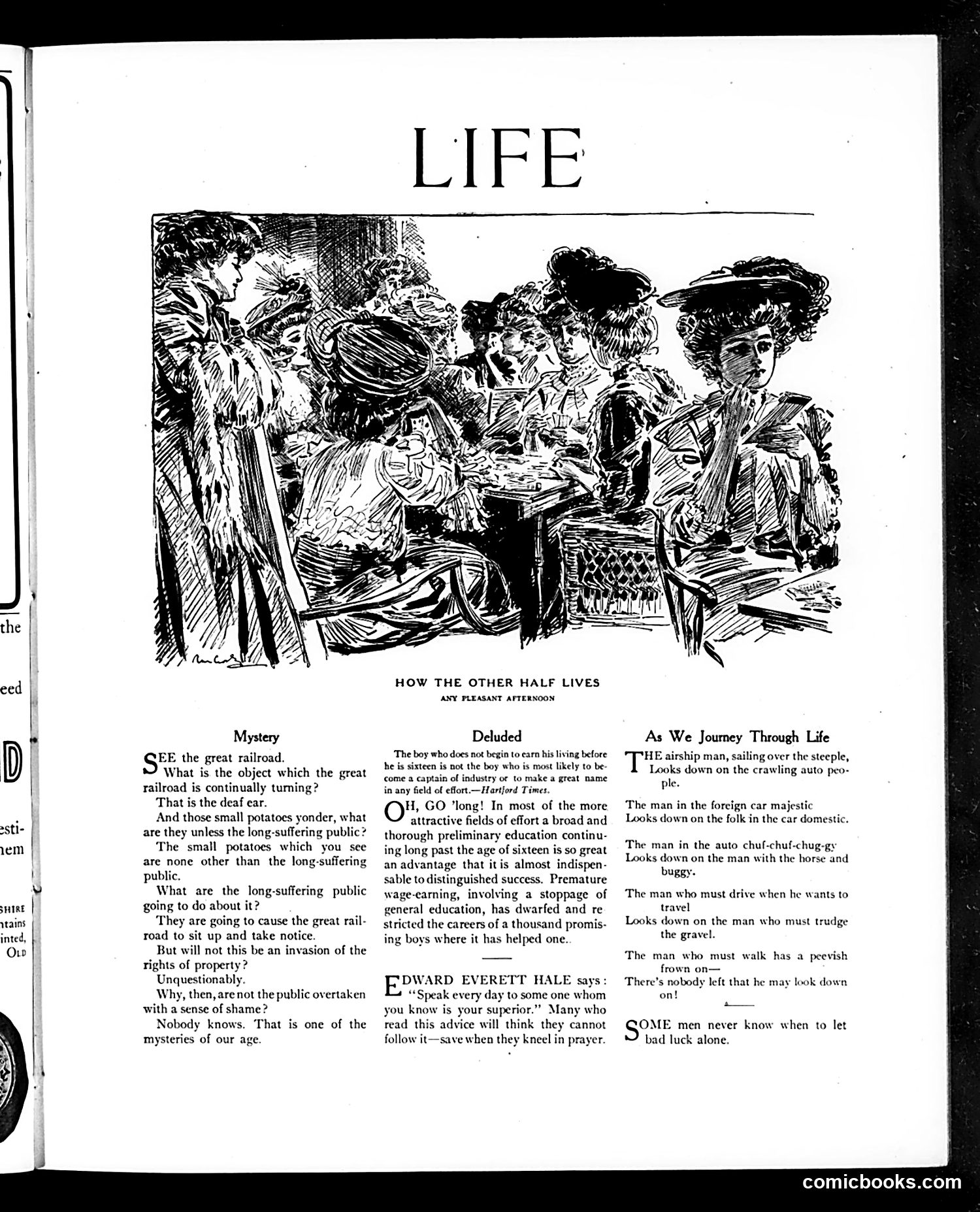
This page satirizes class hierarchy and social hypocrisy in early 20th-century America through three separate pieces: **"Mystery"** mocks railroad monopolies ignoring public complaints ("deaf ear") while exploiting ordinary people ("small potatoes"). It questions why the public accepts this mistreatment. **"Deluded"** counters a newspaper claim that boys should work by age 16. Life argues extensive education actually produces greater success than premature wage-earning, which stunts promising careers. **"As We Journey Through Life"** presents a humorous social pyramid: airship pilots look down on auto drivers, auto drivers on horse-buggy users, walkers on... nobody. The final figure has no one beneath him to condescend to—satirizing how everyone attempts social superiority, creating absurd hierarchy. The illustration "How the Other Half Lives" (title referencing Jacob Riis's famous poverty photography) shows wealthy women at leisure, contrasting with the text's social commentary about class consciousness and inequality.
📄 Transcribed text from this page (OCR, searchable)
Machine-transcribed from the original scan — historical spelling and the odd misread are preserved.
e SHIRE tains inted, Ou Sai Mystery S EE the great railroad. What is the object which the great railroad is continually tuming? That is the deaf ear. And those small potatoes yonder, what are they unless the long-suffering public? The small potatoes which you see are none other than the long-suffering public. What are the long-suffering public going to do about it? They are going to cause the great rail- toad to sit up and take notice. But will not this be an invasion of the rights of property? Unquestionably. Why, then, are not the public overtaken with a sense of shame? Nobody knows. That is one of the mysteries of our age. HOW THE OTHER HALF LIVES ANY PLEASANT AFTERNOON Deluded The boy who does not begin to carn his living before he is sixteen is not the boy who is most likely to be- come a captain of industry or to make a great name in any field of effort.—Hartjord Times. H, GO ‘long! In most of the more attractive fields of effort a broad and thorough preliminary education continu- ing long past the age of sixteen is so great an advantage that itis almost indispen- sable to distinguished success. Premature wage-carning, involving a stoppage of general education, has dwarfed and re stricted the careers of a thousand promis- ing boys where it has helped one. DWARD EVERETT HALE says: “Speak every day to some one whom you know is your superior.” Many who read this advice will think they cannot follow it—save when they kneel in prayer. As We Journey Through Life HE airship man, sailing over the steeple, Looks down on the crawling auto peo- ple. ‘The man in the foreign car majestic Looks down on the folk in the car domestic. The man in the auto chuf-chuf-chug-gy Looks down on the man with the horse and buggy. The man who must drive when he wants to travel Looks down on the man who must trudge the gravel. The man who must walk has a peevish frown on— There's nobody left that he may look down on! OME men never know when to let bad luck alone. comicbooks.com