
Life, 1907-03-07 · page 32 of 52
Life — March 7, 1907 — page 32: what you’re looking at
What you’re looking at
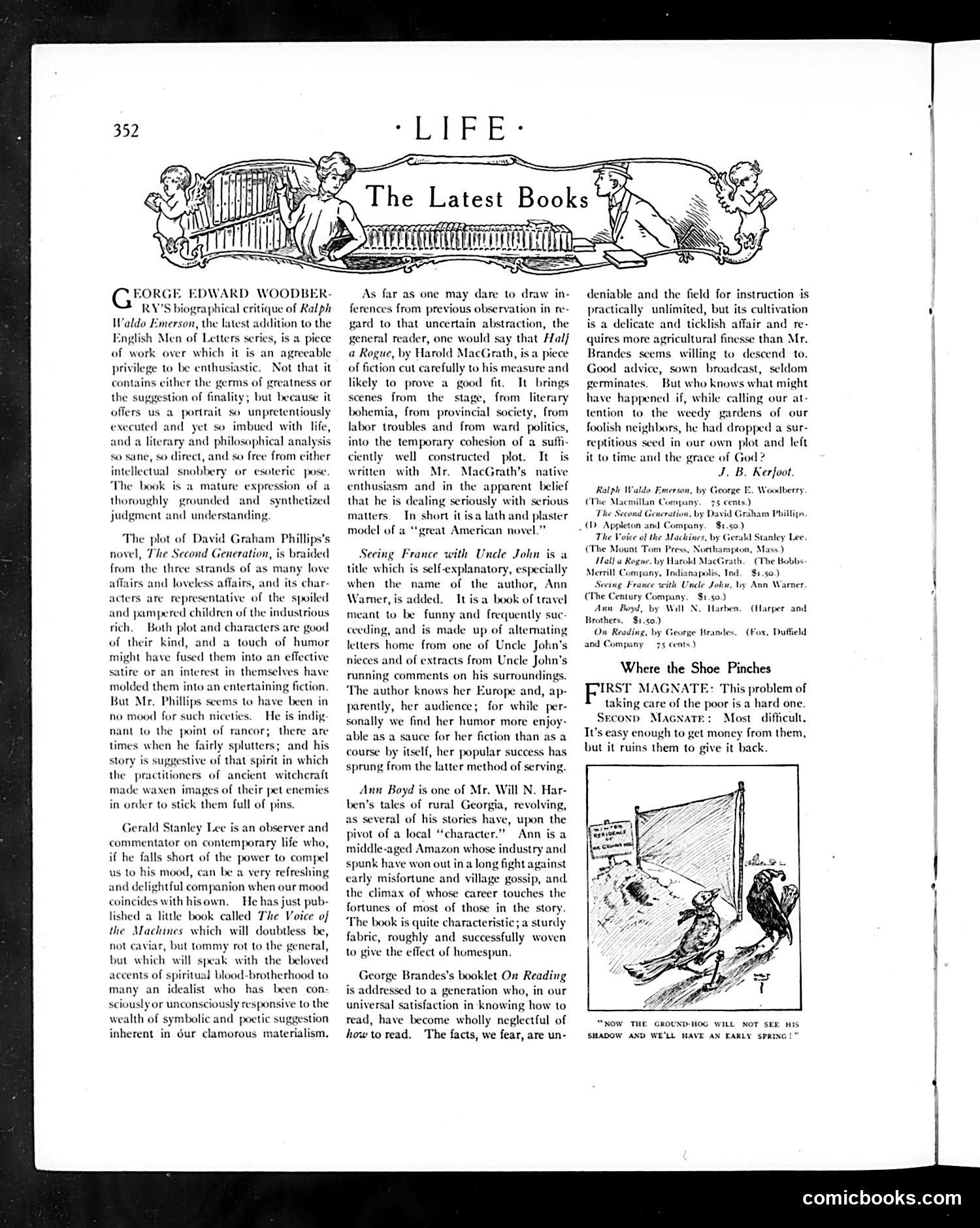
This page from *Life* magazine presents literary criticism rather than political satire. It reviews five contemporary books, including works by Harold MacGrath and David Graham Phillips. The one cartoon present—captioned "Where the Shoe Pinches"—illustrates a folk saying about financial hardship. It depicts a groundhog checking its shadow, with the caption promising early spring. This is a humorous visual aside accompanying a brief, unrelated quip about the difficulty of maintaining shoe quality. The page's substance is book criticism: the reviewer praises George Edward Woodberry's biographical study of Ralph Waldo Emerson, critiques Phillips's *The Second Generation* as socially indignant rather than artfully satirical, and evaluates travel narratives and rural fiction by contemporary authors. No political commentary or social satire is present—this is straightforward literary journalism typical of *Life*'s cultural coverage.
📄 Transcribed text from this page (OCR, searchable)
Machine-transcribed from the original scan — historical spelling and the odd misread are preserved.
EORGE EDWARD WOODBER- RY’S biographical critique of Ralph Waldo Emerson, the latest addition to the English Men of Letters series, is a piece of work over which it is an agreeable privilege to be enthusiastic. Not that it contains either the germs of greatness or the suggestion of finality; but because it offers us a portrait’ so unpretentiously executed and yet so imbued with life, and a literary and philosophical analysis so sane, so direct, and so free from either intellectual snobbery or esoteric pose. The book is a mature expression of a thoroughly grounded and nthetized judgment and understanding The plot of David Graham Phillips’s novel, The Second Generation, ided from the three strands of as many love is br affairs and loveless affairs, and its char- acters are representative of the spoiled and pampered children of the industrious rich. Both plot and characters are good of their kind, and a touch of humor might have fused them into an effective satire or an interest in themselves have molded them into an entertaining fiction, But Mr. Phillips seems to have been in s. He is indig nant to the point of rancor; there are times when he fairly splutters; and his story is suggestive of that spirit in which the practitioners of ancient witchcraft made waxen images of their pet enemies in order to stick them full of pins. no mood for such nice! Gerald Stanley Lee is an observer and commentator on contemporary life who, if he falls short of the power to compel us to his mood, can be a very refreshing and delightful companion when our mood coincides with hisown. He has just pub- lished a little book called The Voice of the Machines which will doubtless be, not ca , but tommy rot to the general, but which will speak with the beloved accents of spiritual blood-brotherhood to many an idealist who has been con- sciously or unconsciously responsive to the wealth of symbolic and poetic suggestion inherent in dur clamorous materialism, far as one may dare to draw in- ferences from previous observation in re- gard to that uncertain abstraction, the general reader, one would say that Halj a Rogue, by Harold MacGrath, isa piece of fiction cut carefully to his measure and likely to prove a good fit. It brings scenes from the stage, from lite bohemia, from provincial society, from labor troubles and from ward politics, into the temporary cohesion of a suffi- ciently well constructed plot. It is written with Mr. MacGrath’s native enthusiasm and in the apparent belief that he is dealing seriously with serious matters. In short itisa lath and plaster model of a “great American novel.” Seeing France with Uncle John is a title which is self-explanatory, especially when the name of the author, Ann Wamer, is added. It is a book of travel meant to be funny and frequently suc. ceeding, and is made up of altemating letters home from one of Uncle John’ nieces and of extracts from Uncle John’s running comments on his surroundings ‘The author knows her Europe and, ap- parently, her audience; for while per- sonally we find her humor more enjoy- able as a sauce for her fiction than as a course by itself, her popular success has sprung from the latter method of serving. Ann Boyd is one of Mr. Will N. Har- ben's tales of rural Georgia, revolving, as several of his stories have, upon the pivot of a local ‘‘character.” Ann is a middle-aged Amazon whose industry and spunk have won out ina long fight against early misfortune and village gossip, and. the climax of whose career touches the fortunes of most of those in the story. ‘The book is quite characteristic; a sturdy fabric, roughly and successfully woven to give the effect of homespun. George Brandes’s booklet On Reading is addressed to a generation who, in our universal satisfaction in knowing how to read, have become wholly neglectful of howto read. The facts, we fear, are un- wractically unlimited, but its cultivation a delicate and ticklish affair and re- quires more agricultural finesse than Mr. Brandes seems willing to descend to. Good advice, sown broadcast, seldom germinates. But who knows what might have happened if, while calling our at- tention to the weedy gardens of our foolish neighbors, he had dropped a sur- reptitious seed in our own plot and left it to time and the grace of God ? J. B. Kerfoot. Ralph Waldo Emerson, by George FE. Woodberry (The Macmillan Company. 75 cents.) The Second neration, by David Graham Phillips (Appleton and Company. $1.50.) The Voice of the Machines, by Gerakl Stanley Lee. (The Mount Tom Press, Northampton, Mass.) Half « Rogue. by Narokl McGrath. (The Bobs Merrill Company, Ind s. Ind. $1.50.) Seeing France with Uncle John, by Aun Warner. (The Century Company. $1.50.) Ann Boyd, by Will N. Harben. (Ha Brothers, $1.50.) On Reading, by ( per and Brandes. (Fox, Duffield ari and Company — 75 cents.) Where the Shoe Pinches IRST MAGNATE: This problem of taking care of the poor is a hard one. Srconp MaGNatrE: Most difficult, It's easy enough to get money from them, but it ruins them to give it back. “NOW THE GROUNDHOG WILL NoT SEE MIS SHADOW AND WE'LL HAVE AN EARLY SPRING!” comicbooks.com deniable and the field for instruction is