
Life, 1907-03-07 · page 8 of 52
Life — March 7, 1907 — page 8: what you’re looking at
What you’re looking at
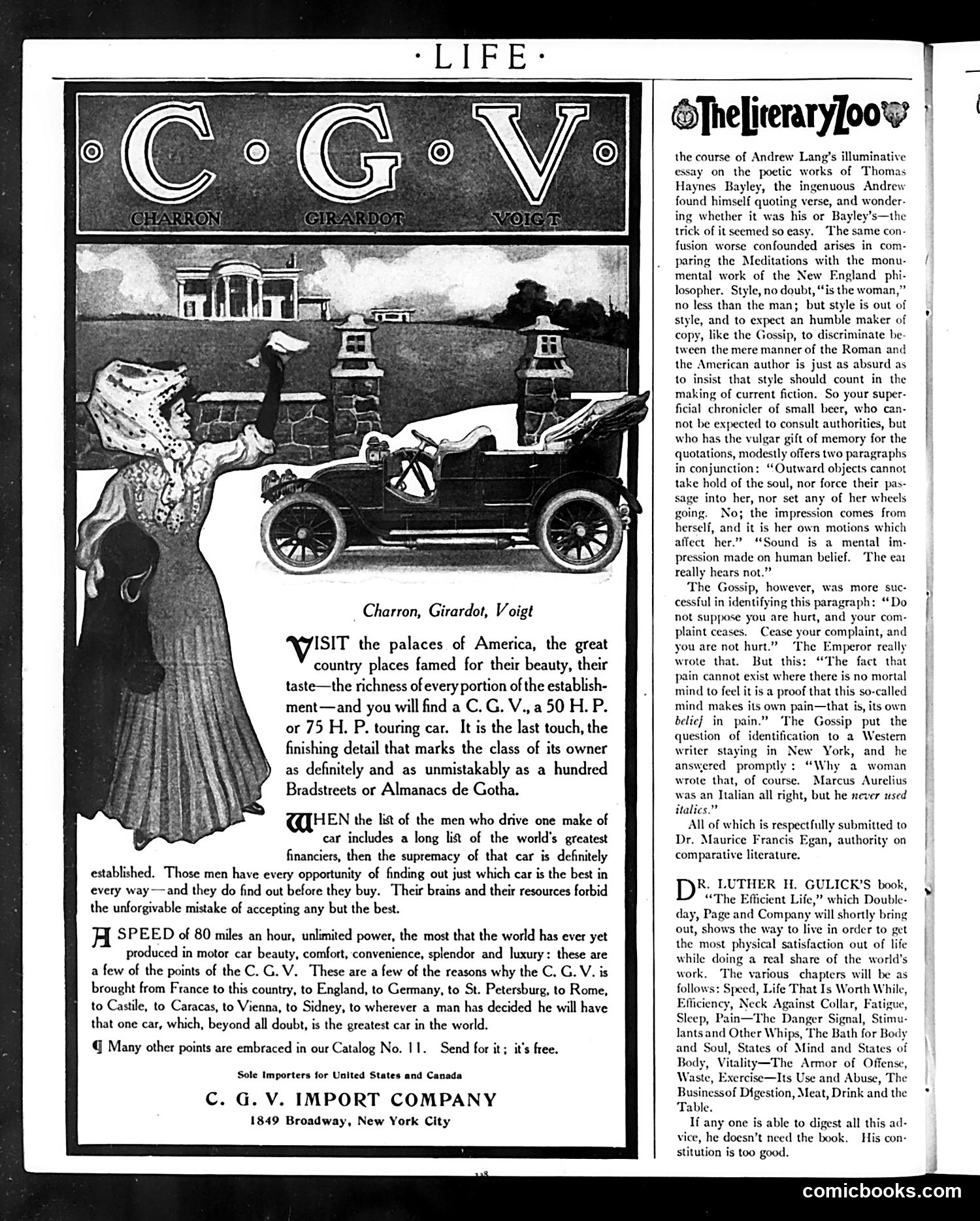
This page is primarily a **car advertisement**, not political satire. The upper portion advertises the C.G.V. (Charron, Girardot, Voigt)—a French luxury automobile. The decorative illustration shows an elegantly dressed woman in period clothing beside a touring car, emphasizing the vehicle's association with wealth and refined taste. The advertisement emphasizes the car's prestige, claiming it rivals famous European makes like Bradstreets and Almanacs de Gotha. It highlights specifications: 50-75 H.P., 80 mph top speed, and availability worldwide. The right column discusses literary matters unrelated to the car, including Thomas Haynes Bayley and style in writing—content typical of *Life* magazine's mixed editorial/advertising format of the early 20th century.
📄 Transcribed text from this page (OCR, searchable)
Machine-transcribed from the original scan — historical spelling and the odd misread are preserved.
Charron, Girardot, Voigt visit the palaces of America, the great country places famed for their beauty, their taste—the richness of every portion of the establish- ment—and you will find a C. G. V., a 50 H. P. or 75 H. P. touring car. It is the last touch, the finishing detail that marks the class of its owner as definitely and as unmistakably as a hundred Bradstreets or Almanacs de Gotha. HEN the list of the men who drive one make of car includes a long list of the world's greatest financiers, then the supremacy of that car is definitely established. Those men have every opportunity of finding out just which car is the best in every way —and they do find out before they buy. Their brains and their resources forbid the unforgivable mistake of accepting any but the best. A SPEED of 80 miles an hour, unlimited power, the most that the world has ever yet produced in motor car beauty, comfort, convenience, splendor and luxury: these are a few of the points of the C.G.V. These are a few of the reasons why the C. G. V. is brought from France to this country, to England, to Germany, to St. Petersburg, to Rome, to Castile, to Caracas, to Vienna, to Sidney, to wherever a man has decided he will have that one car, which, beyond all doubt, is the greatest car in the world. @ Many other points are embraced in our Catalog No. 11. Send for it; it's free. Sole Importers for United States and Canada Cc. G. V. IMPORT COMPANY 1849 Broadway, New York City GIhefireraryfoo'y the course of Andrew Lang’s illuminative essay on the poetic works of Thomas Haynes Bayley, the ingenuous Andrew found himself quoting verse, and wonder- ing whether it was his or Bayley’s—the trick of it seemed so easy. The same con- fusion worse confounded arises in com- paring the Meditations with the monu- mental work of the New England phi- losopher. Style, no doubt, “is the woman,” no less than the man; but style is out of style, and to expect an humble maker of copy, like the Gossip, to discriminate be- tween the mere manner of the Roman and the American author is just as absurd as to t that style should count in the making of current fiction. So your super- ficial chronicler of small beer, who can- not be expected to consult authorities, but who has the vulgar gift of memory for the quotations, modestly offers two paragraphs. in conjunction: “Outward objects cannot take hold of the soul, nor force their pas- sage into her, nor set any of her wheels going. No; the impression comes from herself, and it is her own motions which affect her.” “Sound is a mental im- pression made on human belief. The ear really hears not.” The Gossip, however, was more suc- cessful in identifying this paragraph: “Do not suppose you are hurt, and your com- plaint ceases. Cease your complaint, and you are not hurt.” The Emperor really wrote that. But this: “The fact that pain cannot exist where there is no mortal mind to feel it is a proof that this so-called mind makes its own pain—that is, its own belief in pain.” ‘The Gossip put the question of identification to a Western writer staying in New York, and he answered promptly: “Why a woman wrote that, of course. Marcus Aurelius was an Italian all right, but he never used italics.” All of which is respectfully submitted to Dr. Maurice Francis Egan, authority on comparative literature. R. LUTHER H. GULICK’S book, “The Efficient Life,” which Double- day, Page and Company will shortly bring out, shows the way to live in order to get the most physical satisfaction out of life while doing a real share of the world’s work. The various chapters will be as Speed, Life That Is Worth While, Efficiency, Neck Against Collar, Fatigue, Sleep, Pain—The Danger Signal, Stimu- lants and Other Whips, The Bath for Body and Soul, States of Mind and States of ‘The Armor of Offense, rcise—Its Use and Abuse, The Businessof Digestion, Meat, Drink and the Table. If any one is able to digest all this ad- vice, he doesn’t need the book. His con- stitution is too good. comicbooks.com