
Life, 1907-03-07 · page 25 of 52
Life — March 7, 1907 — page 25: what you’re looking at
What you’re looking at
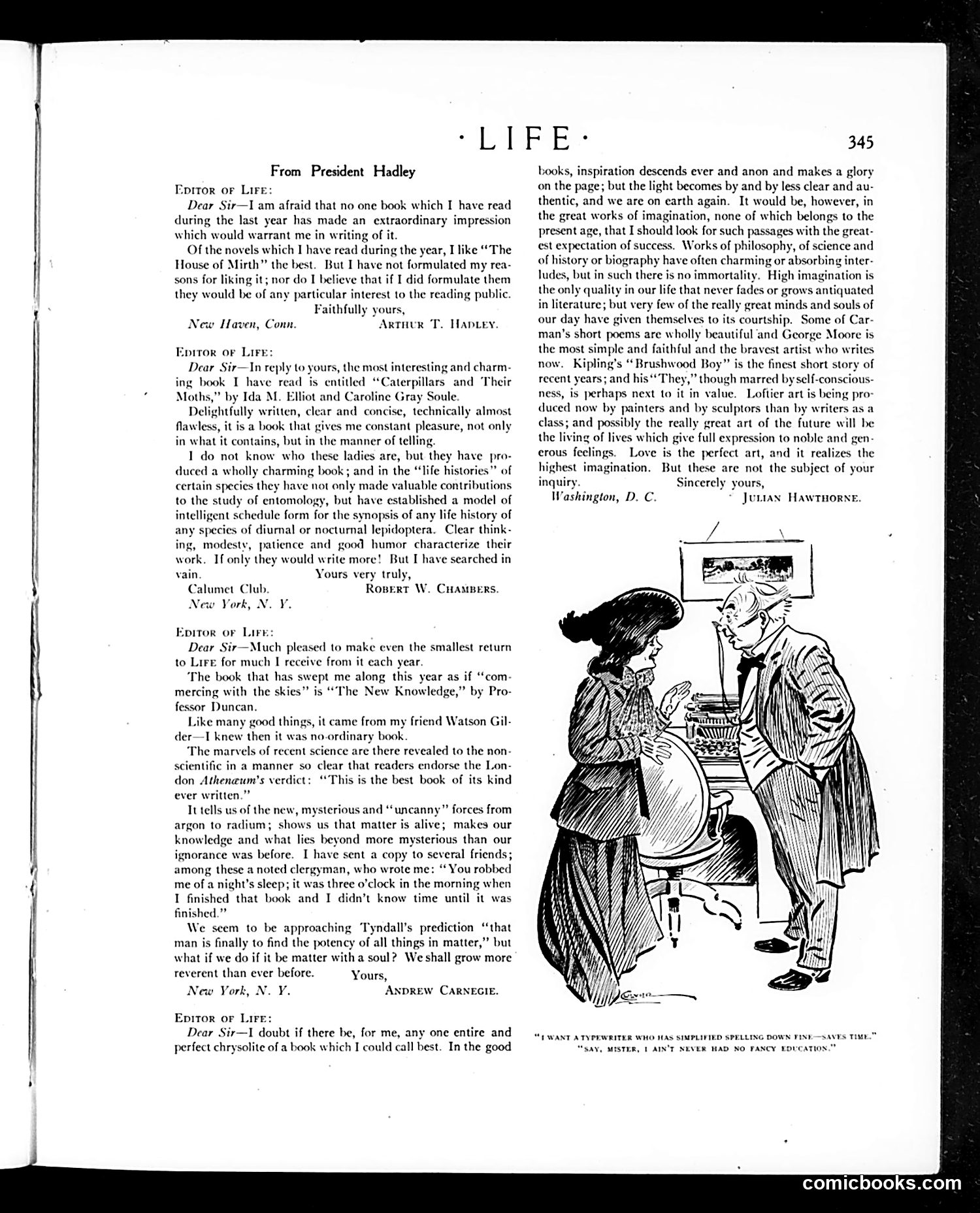
This page presents readers' letters to Life's editor responding to a query about the best book they'd read that year. Notable respondents include President Arthur T. Hadley (of Yale), Robert W. Chambers (a popular novelist), and Andrew Carnegie (the industrialist philanthropist). The cartoon depicts a typewriter salesman pitching to a woman, with his sales pitch visible in the caption below: he claims his machine has "simplified spelling" so well that "Day, sister, I ain't never had no fancy education" — a joke mocking both overly-simplified spelling reform movements and the salesman's own poor grammar, which ironically contradicts his product's promise. The letters themselves discuss serious literature (Edith Wharton's *House of Mirth*), scientific works (*Caterpillars and Their Moths*, *The New Knowledge*), and literary merit — contrasting sharply with the cartoon's crude humor about education and literacy.
📄 Transcribed text from this page (OCR, searchable)
Machine-transcribed from the original scan — historical spelling and the odd misread are preserved.
eee — From President Hadley Eprtor or Lire: Dear Sir—I am afraid that no one book which I have read during the last year has made an extraordinary impression which would warrant me in writing of it. Of the novels which I have read during the year, I like “The House of Mirth” the best. But I have not formulated my rea- sons for liking it; nor do I believe that if I did formulate them they would be of any particular interest to the reading public. Faithfully yours, New Haven, Conn. Artuur T. Haptey. Eprror or Lire Dear Sir—In reply to yours, the most interesting and charm- ing book I have read is entitled ‘Caterpillars and Their Moths,” by Ida M. jot and Caroline Soule. Delightfully written, clear and concise, technically almost flawless, it is a book that gives me constant pleasure, not only in what it contains, but in the manner of telling. 1 do not know who these ladies are, but they have pro- duced a wholly charming book ; and in the “life histories” of certain species they have not only made valuable contributions to the study of entomology, but have established a model of intelligent schedule form for the synopsis of any life history of any species of diurnal or nocturnal lepidoptera. Clear think- ing, modesty, patience and good humor characterize their work. If only they would write more! But I have searched in vain, Yours very truly, Calumet Club. Ropert W. CHAMBERS. New York, N.Y. Epitor or Lire: Dear Sir—Much pleased to make even the smallest return to Lire for much I receive from it each year ‘The book that has swept me along this year as if “com- mercing with the skies” is “The New Knowledge,” by Pro- fessor Duncan. Like many good things, it came from my friend Watson Gil- der—I knew then it was no.ordinary book. The marvels of recent science are there revealed to the non- scientific in a manner so clear that readers endorse the Lon- don Atheneum's verdict: “This is the best book of its kind ever written.” 1 tells us of the new, mysterious and “uncanny” forces from argon to radium; shows us that matter is alive; makes our knowledge and what lies beyond more mysterious than our ignorance was before. I have sent a copy to several friends; among these a noted clergyman, who wrote me: “You robbed me of a night’s sleep; it was three o’clock in the morning when I finished that book and I didn’t know time until it was finished.” We seem to be approaching ‘Tyndall's prediction “that man is finally to find the potency of all things in matter,” but what if we do if it be matter with a soul? We shall grow more reverent than ever before. Yours, New York, N.Y. ANDREW CARNEGIE. Epritor or Lr Dear Sir—1 doubt if there be, for me, any one entire and perfect chrysolite of a book which I could call best. In the good “WANT A TYPEWRITER WHO HAS SIMPLIF -LIFE: 345 books, inspiration descends ever and anon and makes a glory on the page; but the light becomes by and by less clear and au- thentic, and we are on earth again. It would be, however, in the great works of imagination, none of which belongs to the present age, that I should look for such passages with the great- est expectation of success. Works of philosophy, of science and of history or biography have often charming or absorbing inter- ludes, but in such there is no immortality. High imagination is the only quality in our life that never fades or grows antiquated in literature; but very few of the really great minds and souls of our day have given themselves to its courtship. Some of Car- man’s short poems are wholly beautiful and George Moore is the most simple and faithful and the bravest artist who writes now. Kipling’s ‘Brushwood Boy” is the finest short story of recent years; and his“They,” though marred by self-conscious- ness, is perhaps next to it in value. Loftier art is being pro- duced now by painters and by sculptors than by writers class; and possibly the really great art of the future will be the living of lives which give full expression to noble and gen crous feelings. Love is the perfect art, and it realizes the highest imagination. But these are not the subject of your inquiry. yours, Washington, D. C. JULIAN: Hawtuorse. TINE—SAvES Tate.” SPELLING Dow “SAY, MISTER, | AIN'T NEVER MAD NO FANCY EDUCATION comicbooks.com