
Life, 1907-03-07 · page 24 of 52
Life — March 7, 1907 — page 24: what you’re looking at
What you’re looking at
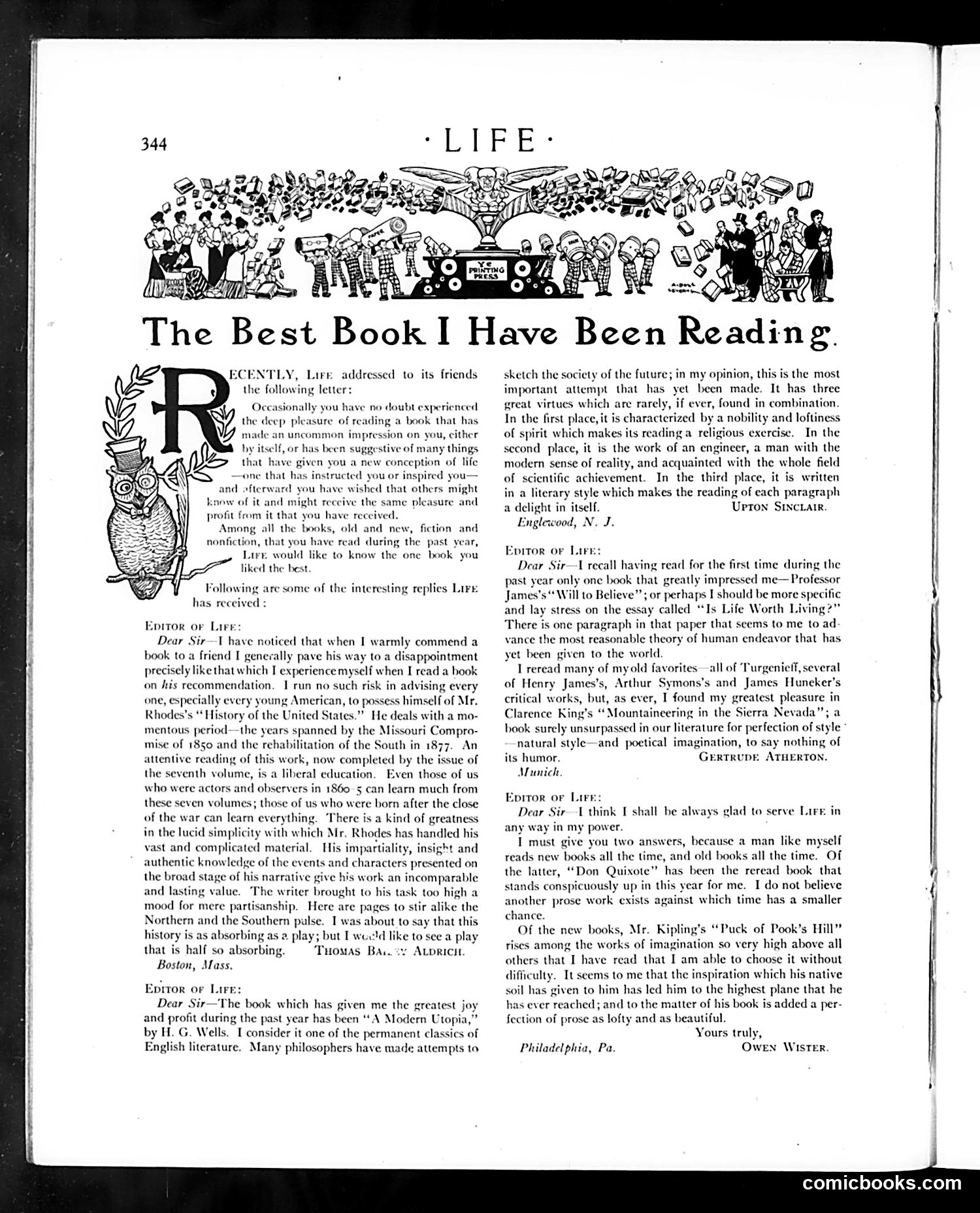
This is not a political cartoon but rather a reader-response feature. Life magazine solicited letters from prominent readers about their favorite books of the past year. The page showcases replies from notable literary figures including **Thomas Bailey Aldrich** (recommending Rhodes's "History of the United States"), **Upton Sinclair** (praising H.G. Wells's "A Modern Utopia"), and others praising works by William James and Clarence King. The decorative header shows a printing press with celebrating figures—visualizing the democratizing power of books and publishing. This reflects early 1900s intellectual culture: Life positioned itself as a forum for cultivated opinion, featuring respected authors discussing serious literature (history, philosophy, essays) rather than entertainment. The feature demonstrates the magazine's aspirations to literary authority and its audience's engagement with substantive reading.
📄 Transcribed text from this page (OCR, searchable)
Machine-transcribed from the original scan — historical spelling and the odd misread are preserved.
ECENTLY, Lire addressed to its friends the following letter: Occasionally you have no doubt experienced the deep pleasure of reading a book that has made an uncommon impression on you, cither by itself, or has been suggestive of many things that have given you a new conception of life one that has instructed you or inspired you— and afterward you have wished that others might know of it and might receive the same pleasure and profit from it that you have received. Among all the books, old and new, fiction 3 nonfiction, that you have read during the past y Lirr, would like to know the one book you liked the best Following are some of the interesting replies Lire has received : Eprror or Lire: Dear Sir—1 have noticed that when I warmly commend a book to a friend I generally pave his way to a disappointment precisely likethat which I experience myself when I read a book on his recommendation. I run no such risk in advising every one, especially every young American, to possess himself of Mr. Rhodes’s “History of the United States.” He deals with a mo- mentous period—the years spanned by the Missouri Compro- mise of 1850 and the rehabilitation of the South in 1877. An attentive reading of this work, now completed by the issue of the seventh volume, is a liberal education. Even those of us. who were actors and observers in 1860.5 can learn much from these seven volumes; those of us who were born after the close of the war can learn everything. ‘There is a kind of greatness in the lucid simplicity with which Mr, Rhodes has handled his vast and complicated material ity, insight and authentic knowledg. and lasting value. The writer brought to his task too high a mood for mere partisanship. Here are pages to stir alike the Northern and the Southern pulse. I wa a i history is as absorbing as @ play; but I wuld like to see a play that is half so absorbing. Tuomas Bas. ev ALpRICH. Boston, Mass. DiToR oF LIFE: Dear Sir—The book which has given me the greatest joy and profit during the past year has been “A Modern Utopia,” by H. G. Wells, I consider it one of the permanent classics of English literature. Many philosophers have made attempts to e Best Book I Have Been Reading. sketch the society of the future; in my opinion, this is the most important attempt that has yet been made. It has three great virtues which are rarely, if ever, found in combination. In the first place, it is characterized by a nobility and loftiness of spirit which makes its reading a religious exercise. In the second place, it is the work of an engineer, a man with the modern sense of reality, and acquainted with the whole field of scientific achievement. In the third place, it is written in a literary style which makes the reading of each paragraph a delight in itself. Upton SIncrair. Englewood, N. J. Epitor or Lire: Dear Sir—I recall having read for the first time during the past year only one book that greatly impressed me— Professor James's“ Will to Believe” ; or perhaps I should be more specific and lay stress on the essay called ‘Is Life Worth Living?” There is one paragraph in that paper that seems to me to ad vance the most reasonable theory of human endeavor that has yet been given to the world. I reread many of myold favorites —all of Turgenietf, several of Henry James's, Arthur Symons’s and James Huneker critical works, but, as ever, I found my greatest pleasure in Clarence King’s “Mountaineering in the Sierra Nevada”; a hook surely unsurpassed in our literature for perfection of style * natural style—and poetical imagination, to say nothing of its humor. GrRTRUDE ATHERTON. Manich. Eprror or Lire: Dear Sir-1 think I shall be always glad to serve Lire in any way in my power. I must give you two answers, because a man like myself reads new books all the time, and old books all the time. Of the latter, ‘Don Quixote” has been the reread book that stands conspicuously up in this year for me. I do not believe another prose work exists against which time has a smaller chance. Of the new books, Mr. Kipling’s “Puck of Pook’s Hill” rises among the works of imagination so very high above all others that I have read that I am able to choose it without difficulty. It seems to me that the inspiration which his native soil has given to him has led him to the highest plane that he has ever reached; and to the matter of his book is added a per- fection of prose as lofty and as beautiful. Yours truly, Owen WISTER. Philadelphia, Pa. comicbooks.com