
Life, 1907-03-07 · page 31 of 52
Life — March 7, 1907 — page 31: what you’re looking at
What you’re looking at
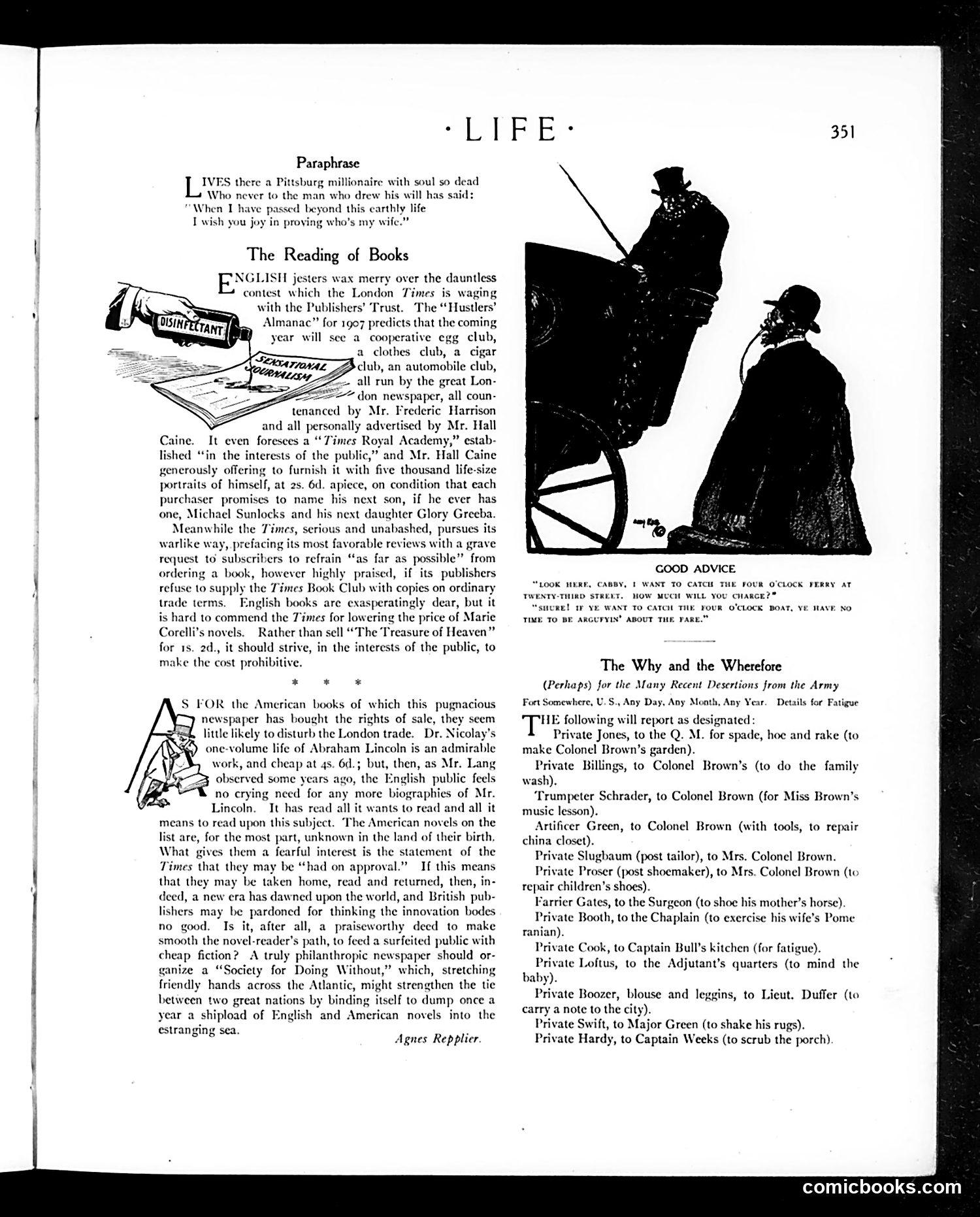
This 1907 *Life* magazine page contains satirical commentary on publishing and the book trade. The main cartoon (upper right, labeled "Good Advice") depicts a cab driver pressuring a passenger about ferry fare—a joke about New York working-class impatience with haggling over small costs. The text articles mock the *London Times* newspaper's aggressive competition against British publishers' cooperative book club, sarcastically suggesting the *Times* will spawn absurd spinoff ventures. Satirist Agnes Repplier ridicules both sides: the *Times* for aggressive tactics, and British publishers for charging prohibitively high prices (18. 2d. for Marie Corelli novels). The bottom section, "The Why and the Wherefore," lists soldiers' assigned duties that reveal military corruption—privates are being sent to do personal chores (gardening, housework, music lessons) for Colonel Brown rather than military work. This satirizes how officers exploited enlisted men for domestic labor, explaining why soldiers deserted the army.
📄 Transcribed text from this page (OCR, searchable)
Machine-transcribed from the original scan — historical spelling and the odd misread are preserved.
-LIFE- 351 Paraphrase IVES there a Pittsburg millionaire with soul so dead Who never to the man who drew his will has said: “When I have passe thly life I wish you joy in proving who's my wife.” | The Reading of Books NGLISH jesters wax merry over the dauntless contest which the London Times is waging with the Publishers’ Trust. The ‘Hustlers’ Almanac” for 1907 predicts that the coming, ar will see a cooperative egg club, a clothes club, a cigar Z club, an automobile club, = all run by the great Lon- ZEEE _ Son newspaper, all coun- tenanced by Mr. Frederic Harrison and all personally advertised by Mr. Hall It even foresees a “Times Royal Academy,” estab- shed ‘tin the interests of the public,” and Mr. Hall Caine gencrously offering to furnish it with five thousand life-size portraits of himself, at 2s. 6d. apiece, on condition that each purchaser promises to name his next son, if he ever has one, Michael Sunlocl d his next daughter Glory Greeba. Meanwhile the Times, serious and unabashed, pursues its warlike way, prefacing its most favorable reviews with a grave request to subscribers to refrain “as far as possible” from a book, however highly praised, if its publishers \ refuse to supply the Times Book Club with copies on ordinary trade terms. English books are exasperatingly dear, but it is hard to commend the Times for lowering the price of Marie Corelli’s nov Rather than sell “The Treasure of Heaven” for 18. 2d., it should strive, in the interests of the public, to make the cost prohibitive. beyond this ea ordering * * * S FOR the American books of which this pugnacious newspaper has bought the rights of sale, they seem little likely to disturb the London trade. Dr. Nicolay one-volume life of Abraham Lincoln is an admirable work, and cheap at 4s. 6d.; but, then, as Mr. Lang observed some years ago, the English public feels no crying need for any more biographies of Mr. Lincoln. It hi I it wants to read and all it means to read upon this subject. ‘The American novels on the list are, for the most part, unknown in the land of their birth What gives them a fearful interest is the statement of the Times that they may be “had on approval.” If this means { that they may be taken home, read and returned, then, in- deed, a new era has dawned upon the world, and British pub- | lishers may be pardoned for thinking the innovation bodes H no good. Is it, after all, a praiseworthy deed to mi smooth the novel-reader’s path, to feed a surfeited public with cheap fiction? A truly philanthropic newspaper should or- ganize a “Society for Doing Without,” which, stretching friendly hands across the Atlantic, might strengthen the tie between two great nations by binding itself to dump once a year a shipload of English and American novels into the estranging sea. —e Agnes Repplier. GOOD ADVICE “LOOK ERE, CABBY, I WANT TO CATCH THE FOUR O'CLOCK FERRY AT TWENTY-THIRD STREET. HOW MUCH WILL YOU CHARGE?” “SHURE! IF YE WANT TO CATCH THE YOUR O'CLOCK BOAT, YE HAVE No TIME TO BE ARGUTYIN" ABOUT THE FARE.” The Why and the Wherefore (Perhaps) for the Many Recent Desertions from the Army Fort Somewhere, U.S., Any Day, Any Month, Any Year. Details for Fatigue HE following will report as designated: Private Jones, to the Q. M. for spade, hoe and rake (to make Colonel Brown’s garden). Private Billings, to Colonel Brown's (to do the family wash). ‘Trumpeter Schrader, to Colonel Brown (for Miss Brown’s music lesson). Artificer Green, to Colonel Brown (with tools, to repair china closet). Private Slugbaum (post tailor), to Mrs. Colonel Brown. Private Proser (post shoemaker), to Mrs. Colonel Brown (to repair children’s shoes). Farrier Gates, to the Surgeon (to shoe his mother’s horse) Private Booth, to the Chaplain (to exercise his wife’s Pome ranian). Private Cook, to Captain Bull’s kitchen (for fatigue). Private Loftus, to the Adjutant’s quarters (to mind the baby). Private Boozer, blouse and leggins, to Lieut. Duffer (to carry a note to the city). Private Swift, to Major Green (to shake his rugs). Private Hardy, to Captain Weeks (to scrub the porch). comicbooks.com