
Life, 1907-03-07 · page 18 of 52
Life — March 7, 1907 — page 18: what you’re looking at
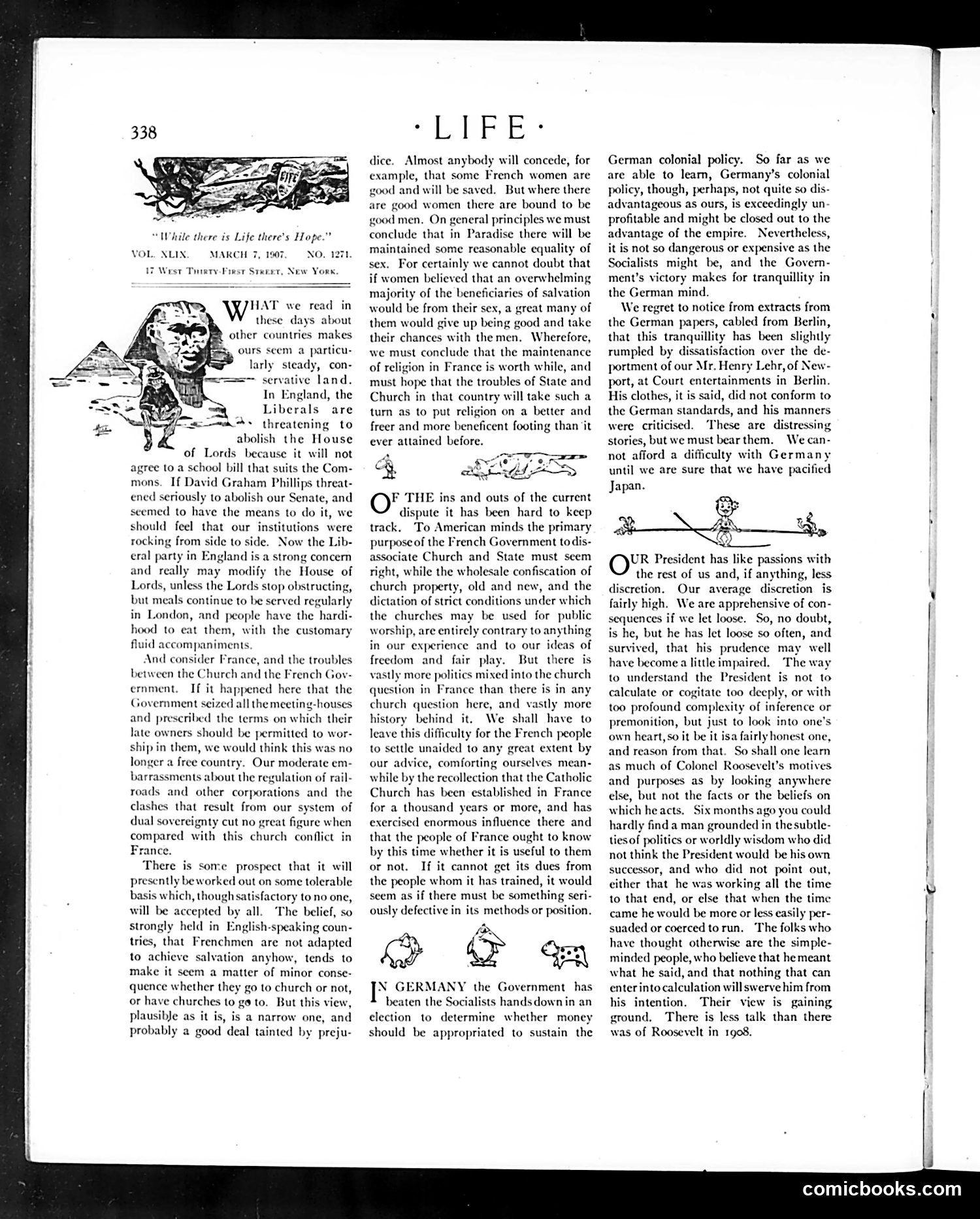
What you’re looking at
This editorial page compares America's political stability favorably to turbulent conditions abroad. The author discusses three international crises: **England**: The Liberal Party threatens to curtail the House of Lords' power over education legislation—presented as radical compared to American institutions. **France**: Church-State conflict involving government seizure of religious properties and dictation of worship conditions. The author finds this contrary to American ideals of religious freedom, though acknowledges France's complex historical context. **Germany**: Brief mention of government action against Socialists regarding election funding. The cartoons (illustrations of children or figures) appear decorative rather than satirical commentary. The overall tone reflects American exceptionalism—portraying the U.S. as remarkably stable and measured compared to European upheaval, while acknowledging other nations' internal complexities warrant patience rather than judgment.
📄 Transcribed text from this page (OCR, searchable)
Machine-transcribed from the original scan — historical spelling and the odd misread are preserved.
“While there is Life there’s Hope.” VOL. NLIX. MARCH 7, 1907, NO, 1271. West Triety-Fiesr Steet, New Yors HAT we read in these days about other countries makes ours seem a particu- larly steady, con- f——=— servative land. In England, the Liberals are [a em + threatening to abolish the House of Lords because it will not agree to a school bill that suits the Com- mons. If David Graham Phillips threat- ened seriously to abolish our Senate, and seemed to have the means to do it, we should feel that our institutions were rocking from side to side. Now the Lib- cral party in England is a strong concern and really may modify the House of Lords, unless the Lords stop obstructing, but meals continue to be served regularly in London, and people have the hardi- hood to eat them, with the customary fluid accompaniments. : And consider France, and the troubles between the Church and the French Gov- ernment. If it happened here that the Government seized all the meeting-houses and prescribed the terms on which their late owners should be permitted to wor- ship in them, we would think this was no longer a free country. Our moderate em- barrassments about the regulation of rail- roads and other corporations and the clashes that result from our system of dual sovereignty cut no t figure when compared with this church conflict in Franc There is some prospect that it will presently be worked out on some tolerable basis which, though satisfactory to no one, will be accepted by all. ‘The belief, so strongly held in English-speaking coun- tries, that Frenchmen are not adapted to achieve salvation anyhow, tends to make it seem a matter of minor conse- quence whether they go to church or not, or have churches to go to. But this view, plausibJe as it is, is a narrow one, and probably a good deal tainted by preju- -LIFE: dice. Almost anybody will concede, for example, that some French women are zood and will be saved. But where there are good women there are bound to be good men. On general principles we must conclude that in Paradise there will be maintained some reasonable equality of For certainly we cannot doubt that if women believed that an overwhelming majority of the beneficiaries of salvation would be from their sex, a great many of them would give up being good and take their chances with the men. Wherefore, we must conclude that the maintenance of religion in France is worth while, and must hope that the troubles of State and Church in that country will take such a turn as to put religion on a better and freer and more beneficent footing than it ever attained before. THE ins and outs of the current dispute it has been hard to keep track. To American minds the primary purpose of the French Government to dis: associate Church and State must scem right, while the wholesale confiscation of church property, old and new, and the dictation of strict conditions under which the churches may be used for public worship, are entirely contrary to anything in our experience and to our ideas of freedom and fair play. But there is vastly more politics mixed into the church question in France than there is in any church question here, and vastly more history behind it. We shall have to leave this difficulty for the French people to settle unaided to any great extent by our advice, comforting ourselves mean- while by the recollection that the Catholic Church has been established in France for a thousand years or more, and has exercised enormous influence there and that the people of France ought to know by this time whether it is useful to them or not. If it cannot get its dues from the people whom it has trained, it would seem as if there must be something seri- ously defective in its methods or position. N GERMANY the Government has beaten the Socialists hands down in an election to determine whether money should be appropriated to sustain the German colonial policy. So far as we are able to leam, Germany's colonial policy, though, perhaps, not quite so dis- advantageous as ours, is exceedingly un- profitable and might be closed out to the advantage of the empire. Nevertheless, it is not so dangerous or expensive as the Socialists might be, and the Govern- ment’s victory makes for tranquillity in the German mind. We regret to notice from extracts from the German papers, cabled from Berlin, that this tranquillity has been slightly rumpled by dissatisfaction over the de- portment of our Mr. Henry Lehr, of New- port, at Court entertainments in Berlin. His clothes, it is said, did not conform to. the German standards, and his manners were criticised. These are distressing stories, but we must bear them. We can- not afford a difficulty with Germany until we are sure that we have pacified Japan. UR President has like passions with the rest of us and, if anything, less discretion. Our average discretion is fairly high. We are apprehensive of con- sequences if we let loose. So, no doubt, is he, but he has let loose so often, and survived, that his prudence may well have become a little impaired. The way to understand the President is not to calculate or cogitate too deeply, or with too profound complexity of inference or premonition, but just to look into one's own heart, so it be it isa fairly honest one, and reason from that. So shall one learn as much of Colonel Roosevelt’s motives and purposes as by looking anywhere else, but not the facts or the beliefs on which he acts, Six months ago you could hardly find a man grounded in thesubtle- ties of politics or worldly wisdom who did not think the President would be his own successor, and who did not point out, either that he was working all the time to that end, or else that when the time came he would be more or less easily per- suaded or coerced to run, The folks who have thought otherwise are the simple- minded people, who believe that hemeant what he said, and that nothing that can enter into calculation will swerve him from his intention. Their view is gaining ground, There is less talk than there was of Roosevelt in 1908. comicbooks.com