
Life, 1907-03-07 · page 29 of 52
Life — March 7, 1907 — page 29: what you’re looking at
What you’re looking at
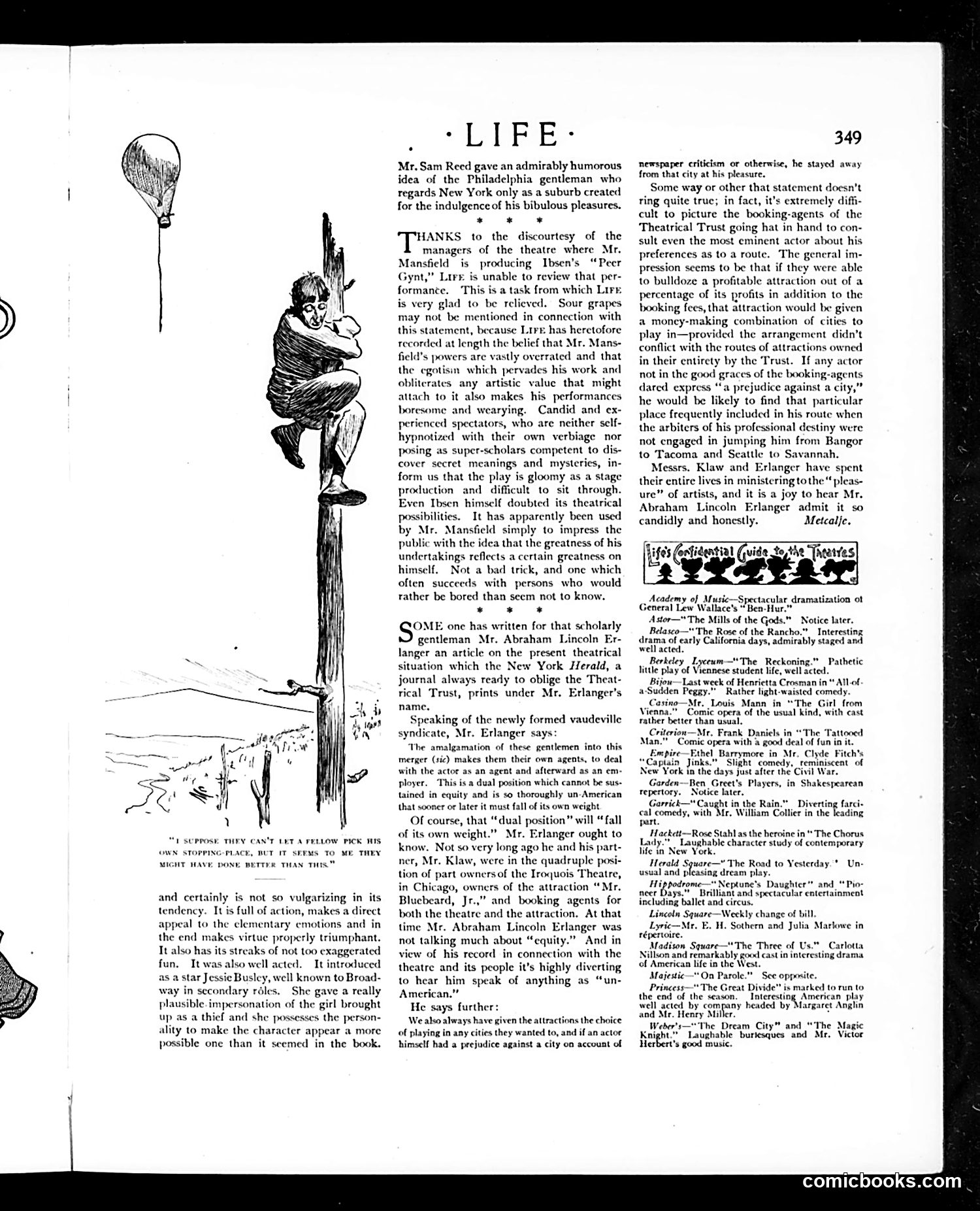
The page critiques **Abraham Lincoln Erlanger**, a powerful theatre mogul, for hypocrisy regarding actor exploitation. Erlanger publicly condemned a vaudeville syndicate's "dual position" (acting as both agent and employer) as "un-American," yet Life exposes his own similar abuses. The cartoon (left) depicts a figure clinging to a tall pole—likely representing a performer trapped or controlled by theatrical management. The caption suggests lack of choice in working conditions. Life's point: Erlanger and his partner Klaw previously held multiple conflicting roles (theatre owners, producers, and booking agents for the same shows), giving them exploitative control over actors. His sanctimonious criticism of others' business practices rings hollow given his documented record. The article sarcastically notes his claims about actor freedom "doesn't ring quite true," exposing corporate hypocrisy during the era of the "Theatrical Trust"—a monopoly controlling American theatre.
📄 Transcribed text from this page (OCR, searchable)
Machine-transcribed from the original scan — historical spelling and the odd misread are preserved.
“1 SUPPOSE THEY CAN'T LET A FELLOW PICK HIS, OWN STOPPING-PLACE, BUT IT SERSS TO ME THEY MIGHT WAVE DONE BETTER THAN THIS” and certainly is not so vulgarizing in its tendency. It is full of action, makes a direct appeal to the elementary emotions and in the end makes virtue properly triumphant. It also has its streaks of not too exaggerated fun. It was also well acted. It introduced as a star Jessie Busley, well known to Broad- way in secondary réles. She gave a really plausible.impersonation of the girl brought up as a thief and she possesses the person- ality to make the character appear a more possible one than it seemed in the book. “RES Mr. Sam Reed gave an admirably humorous idea of the Philadelphia gentleman who regards New York only as a suburb created for the indulgence of his bibulous pleasures. * # * HANKS to the discourtesy of the managers of the theatre where Mr. Mansfield is producing Ibsen's “Peer Gynt,” Lire is unable to review that per- formance. This is a task from which Lirr is very glad to be relieved. Sour grapes may not be mentioned in connection with this statement, because Lrre has heretofore recorded at length the belief that Mr. Mans- field’s powers are vastly overrated and that the egotism which pervades his work and obliterates any artistic value that might attach to it also makes his performances boresome and wearying. Candid and ex- perienced spectators, who are neither sclf- hypnotized with their own verbiage nor posing as super-scholars competent to dis- cover secret meanings and mysteries, in- form us that the play is gloomy as a stage production and difficult to sit through. Even Ibsen himself doubted its theatrical possibilities. It has apparently been used by Mr. Mansfield simply to impress the public with the idea that the greatness of his undertakings reflects a certain greatness on himself. Not a bad trick, and one which often succeeds with persons who would rather be bored than seem not to know. * * * OME one has written for that scholarly gentleman Mr. Abraham Lincoln Er- langer an article on the present theatrical situation which the New York Herald, a journal always ready to oblige the Theat- rical Trust, prints under Mr. Erlanger’s name. Speaking of the newly formed vaudeville syndicate, Mr. Erlanger says: ‘The amalgamation of these gentlemen into this merger (sic) makes them their own agents, to deal with the actor as an agent and afterward as an em- ployer. ‘This is a dual position which cannot be sus- tained in equity and is so thoroughly un-American that sooner of later it must fall of its own weight Of course, that ‘dual position” will “fall of its own weight.” Mr. Erlanger ought to know. Not so very long ago he and his part- ner, Mr. Klaw, were in the quadruple posi- tion of part owners of the Iroquois Theatre, in Chicago, owners of the attraction “Mr, Bluebeard, Jr.,” and booking agents for both the theatre and the attraction. At that time Mr. Abraham Lincoln Erlanger was not talking much about “equity.” And in view of his record in connection with the theatre and its people it's highly diverting to hear him speak of anything as “un- He says further: We also always have given the altractions the choice of playing in any cities they wanted to, and if an actor himself had a prejudice against a city on account of 349 newspaper criticism or otherwise, he stayed away from that city at his pleasure. Some way or other that statement doesn't ring quite truc; in fact, it's extremely diffi- cult to picture the booking-agents of the Theatrical Trust going hat in hand to con- sult even the most eminent actor about his preferences as to a route. The general im- pression seems to be that if they were able to bulldoze a profitable attraction out of a percentage of its profits in addition to the booking fees, that attraction would be given a money-making combination of cities to play in—provided the arrangement didn’t conflict with the routes of attractions owned in their entirety by the Trust. If any actor not in the good graces of the booking-agents dared express ‘a prejudice against a city,” he would be likely to find that particular place frequently included in his route when the arbiters of his professional destiny were not engaged in jumping him from Bangor to Tacoma and Seattle to Savannah. Messrs. Klaw and Erlanger have spent their entire lives in ministering tothe“ pleas- ure” of artists, and it is a joy to hear Mr. Abraham Lincoln Erlanger admit it so candidly and honestly. Metcalje. [ites (Cofigentint Guide tothe Tatatves Academy of Music—Spectacular dramatization ot General Lew Wallace's “Ben-Hur.” Asor—"The Mills of the Gods.” Notice later. Belasco—" The Rose of the Rancho.” Interesting drama of early California days, admirably staged and well acted. Berkeley Lyceum—"The Reckonin little play of Viennese student life, well acted. Bijou—Last week of Henrietta Crosman in “ All-of aSudden Peggy.” Rather light-waisted comedy. (Casino—Mr. Louis Mann in “The Girl from Vienna.” Comic opera of the usual kind, with cast rather better than usual. Criterion—Mr. Frank Daniels in “The Tattooed Man." Comic opera with & good deal of fun in it. Empire—Fthel Barrymore in Mr. Clyde Fitch's “Captain Jinks.” Slight comedy, reminiscent of New York in the days just after the Civil War. Garden—Ben Greet’s Players, in Shakespearean repertory. Notice later. Garrick Caught in the Rain. Divertng farci cal comedy, with Mr, William Collier in the leading part. Hackett—Rose Stahl as the heroine in "The Chorus Laughable character study of contemporary ‘ew York. Herald Square—* The Road to Yesterday." Un- usual and pleasing dream play. Hippodrome—" Neptune's Daughter and." Pio- acer Days." Brilliant and spectacular entertainment including ballet and circus. Lincoln Square—Weekly change of bill. Lyric—Mr. E. H. Sothern and Julia Marlowe in répertoire. Madison Square—"The Three of Us." Carlotta Nillson and remarkably good cast in interesting drama of American life in the West. Majestie—""On Parole." Sce oppenite. Princess—" The Great Divide" is marked to run to the end of the season. Interesting American play well acted by company headed by Margaret Anglin and Mr-itenty Miller. Weber's—"'The Dream City and "The Magic Knight.” Laughable burkesques and Mr. Victor Herbert's good music. Pathetic comicbooks.com