
Life, 1907-03-07 · page 28 of 52
Life — March 7, 1907 — page 28: what you’re looking at
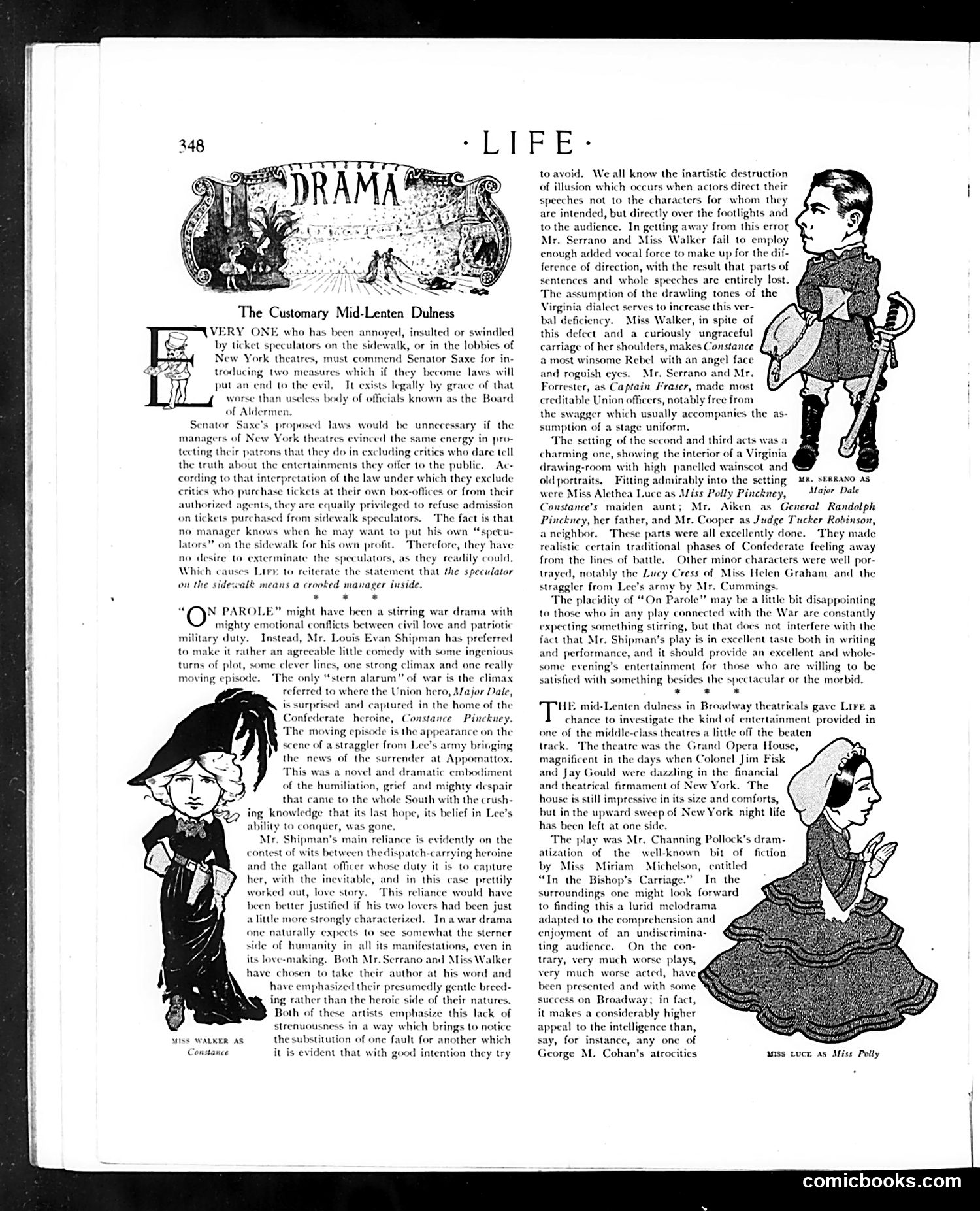
What you’re looking at
This page reviews a Broadway play called **"On Parole,"** a Civil War drama about a Confederate heroine named Constance Pinckney and a Union officer, Major Dale. The critic praises the play's climax—when a straggler brings news of Lee's surrender at Appomattox—as genuinely moving. However, the review criticizes the lead actors (Mr. Serrano and Miss Walker) for emphasizing "gentle breeding" over heroic strength. The critic faults them for playing scenes without sufficient vocal projection and for adopting a Virginia drawl that muffles dialogue. The caricature sketches on the page mock these performance choices. The page also contains commentary on theater ticket scalping and calls for Senator Saxe's proposed legislation to eliminate sidewalk speculators—blaming theater managers for permitting the practice since they profit from it themselves.
📄 Transcribed text from this page (OCR, searchable)
Machine-transcribed from the original scan — historical spelling and the odd misread are preserved.
The Customary Mid-Lenten Dulness RY ONE who has been annoyed, insulted or swindled by ticket speculators on the sidewalk, or in the lobbies of New York theatres, must commend Senator Saxe for in- troducing two measures which if they become laws will put an end to the evil, Tt exists legally by grace of that worse than useless body of officials known as the Board of Aldermen, ator Saxe’s proposed laws would be unnecessary if the agers of New York theatres evinced the same energy in pro- tecting their patrons that they do in excluding critics who dare tell the truth about the entertainments they offer to the public. Ac- cording to that interpretation of the law under which they exclude critics who purchase tickets at their own box-offices or from their authorized agents, they are equally privileged to refuse admission on tick The fact is that no manager knows when he may want to put his own “ lators” on the sidewalk for his own profit. ‘Therefore, they have desire to exterminate the speculators, as they readily could. Which causes Lire to reiterate the statement that the speculator on the sidewalk means a crooked manager inside. + 2 & mai s purchased from sidewalk speculators. spetu- ne x@) PAROLE” might have been a stirring war drama with mighty emotional conflicts between civil love and patriotic military duty. Instead, Mr. Louis Evan Shipman has preferred to make it rather an agreeable little comedy with some ingenious turns of plot, some clever lines, one strong climax and one really ‘The only is the climax referred to where the Union hero, Major Dale, is surprised and captured in the home of the Confederate heroine, Constance Pinckney. The moving episode is the appearance on the scene of a straggler from Lee’s army bringing the news of the surrender at Appomattox. ‘This was a novel and dramatic of the humiliation, grief and mighty despair that came to the whole South with the erush- ing knowledge that its last hope, its belief in Lee's ability to conquer, was gone. Mr. Shipman’s main reliance is evident! moving episode. stern alarum” of mbodiment on the contest of wits between thedispatch-carrying heroine and the gallant officer whose duty it is to capture her, with the inevitable, and in this case prettily worked out, love story. This reliance would have been better justified if his two lovers had been just alittle more strongly characterized. In a war drama pects to see somewhat the sterner side of humanity in all its manifestations, even in its love-making. Both Mr. Serrano and Miss Walker have chosen to take their author at his word and have emphasized their presumedly gentle breed- ing rather than the heroic side of their natures. Both of these artists emphasize this lack of strenuousness in a way which brings to notice the substitution of one fault for another which it is evident that with good intention they try one naturally. ¢ MISS WALKER AS Constance -LIFE: to avoid. We all know the inartistic destruction of illusion which occurs when actors direct their speeches not to the characters for whom they are intended, but directly over the footlights and to the audience. In getting away from this error Mr. Serrano and Miss Walker fail to employ enough added vocal force to make up for the dif- ference of direction, with the result that parts of sentences and whole speeches are entirely lost. ‘The assumption of the drawling tones of the Virginia dialect serves to increase this ver- bal deficiency. Miss Walker, in spite of this defect and a curiously ungraceful carriage of her shoulders, makes Constance a most winsome Rebel with an angel face and roguish eyes. Mr. Serrano and Mr. Forrester, as Captain Fraser, made most creditable Union officers, notably free from the swagger which usually accompanies the 3 sumption of a stage uniform. ‘The setting of the second and third acts was a charming onc, showing the interior of drawing-room with high panelled wainscot and old portraits, Fitting admirably into the setting &. stRRANO AS were Miss Alethea Luce as Miss Polly Pinckney, Maier Date Constance’s. maiden aunt; Mr. Aiken as General Randolph Pinckney, her father, and Mr. Cooper as Judge Tucker Rol ancighbor. ‘These parts were all excellently done. ‘They made realistic certain traditional phases of Confederate feeling away from the lines of battle. Other minor characters were well por- trayed, notably the Lucy Cress of Miss Helen Graham and the straggler from Lee's army by Mr. Cummings. The placidity of “On Parole” may be a little bit disappointing to those who in any play connected with the War are constantly pecting something stirring, but that docs not interfere with the fact that Mr. Shipman’s play is in excellent taste both in writing and performance, and it should provide an excellent and whole- some evening's entertainment for those who are willing to be satisfied with something besides the spectacular or the morbid. * * 8 son, HE mid-Lenten dulness in Broadway theatricals gave Live a chance to investigate the kind of entertainment provided in one of the middle-class theatres a little off the beaten track. ‘The theatre was the Grand Opera House, magnificent in the days when Colonel Jim Fisk and Jay Gould were dazzling in the financial and theatrical firmament of New York. The house is still impressive in its size and comforts, but in the upward sweep of New York night life has been left at one side. ‘The play was Mr. Channing Pollock’s dram- atization of the well-known bit of fiction by Miss Miriam Michelson, entitled “Tn the Bishop's Carriage.” In the surroundings one might look forward to finding this a lurid melodrama adapted to the comprehension and enjoyment of an undiscrimina- ting audience. On the con- trary, very much worse plays, y much worse acted, have been presented and with some y; in fact, bly higher appeal to the intelligence than, say, for instance, any one of George M. Cohan’s atrocities success on Broadwa es a considera MISS LUCE AS Miss Polly comicbooks.com