
A complete issue · 60 pages · 1905
Life — December 7, 1905
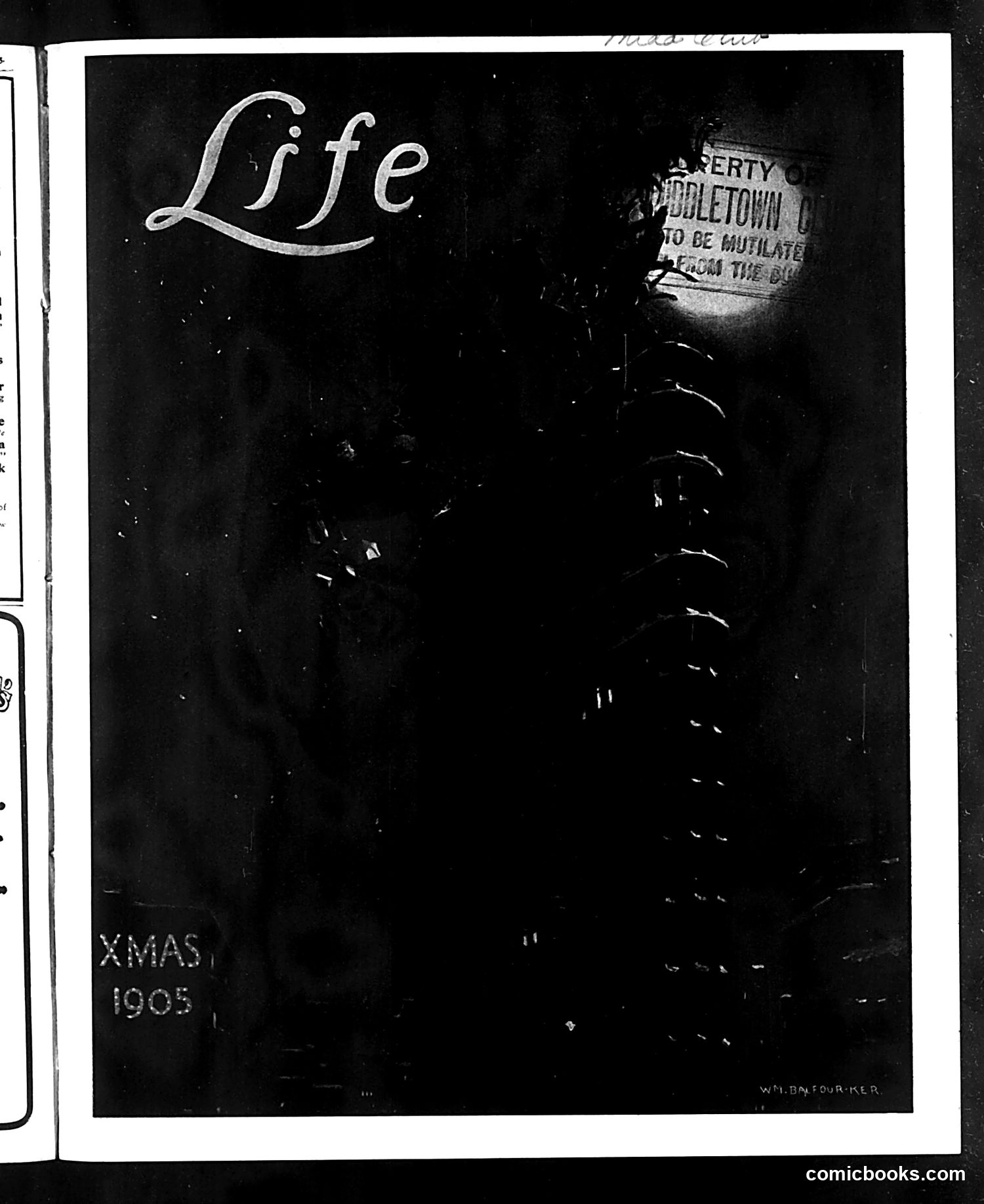
This appears to be a **Life magazine cover from Christmas 1905**. The image is extremely dark and difficult to parse, showing what seems to be a silhouetted figure against a black background. Visible text includes "Life" at the top in decorative lettering and "XMAS 1905" in the lower left corner. There's also partially visible text on the right that mentions "LIBERTY" and "CHARLESTOWN" with references to "DUPLICATED" and "FROM THE," though the full context is unclear. Given the extreme darkness of the image, the specific satirical content or figure being caricatured cannot be reliably identified from this reproduction. The poor image quality makes detailed analysis of the intended political or social commentary impossible.
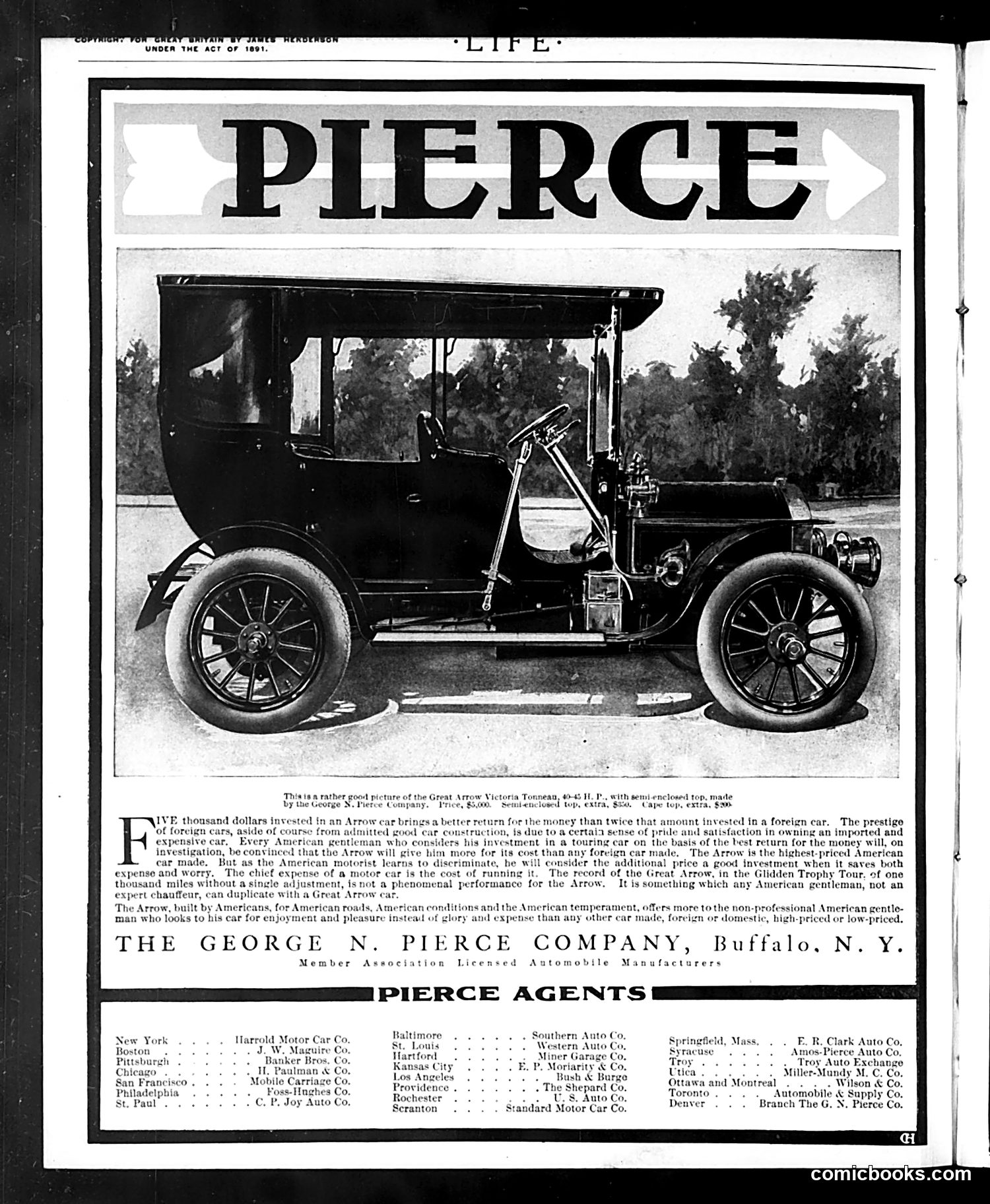
This is **primarily an automobile advertisement**, not political satire. The page features a Pierce-Arrow automobile manufactured by the George N. Pierce Company of Buffalo, N.Y. The advertising text argues that investing $5,000 in a Pierce-Arrow car provides better returns than investing the same amount in a foreign automobile. It emphasizes American manufacturing superiority, patriotic pride, and the car's proven performance (referencing victory in the "Glidden Trophy Tour"). The accompanying image shows a side-view photograph of the vehicle—a formal, early 20th-century motorcar with an enclosed cabin, large spoked wheels, and open-air driving controls. Rather than satirical commentary, this represents straightforward corporate advertising leveraging American nationalist sentiment to promote domestic automobile manufacturing.
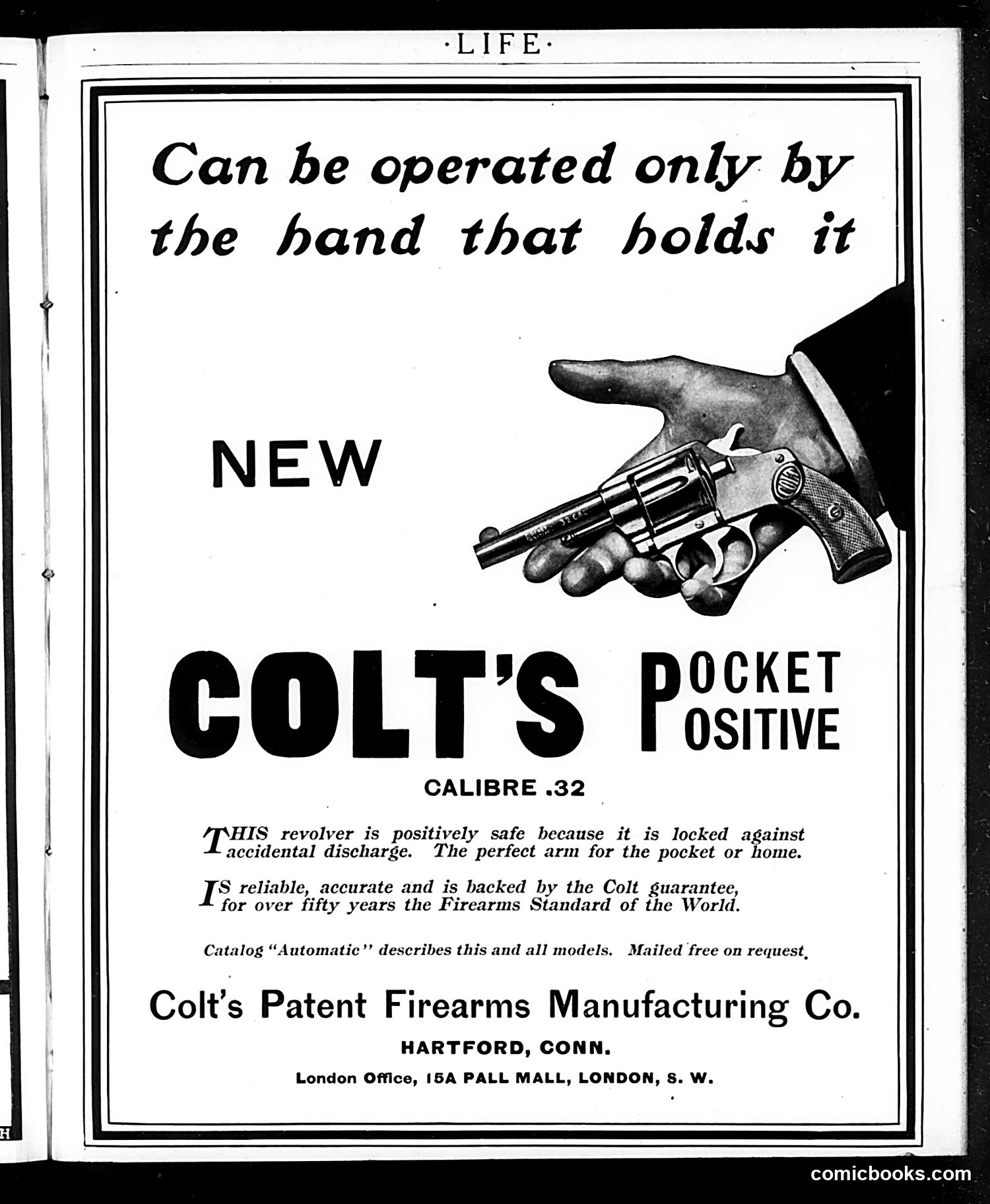
This is **not satire or a political cartoon** — it's a straightforward product advertisement for Colt's Patent Firearms Manufacturing Co. The page advertises the "Pocket Positive" revolver in .32 caliber, featuring an illustration of a hand holding the weapon. The marketing emphasizes safety features ("locked against accidental discharge") and positions it as ideal "for the pocket or home." The only notable historical detail is the company's claim of being "the Firearms Standard of the World" with "over fifty years" of guarantee—suggesting this ad dates to around 1900 or shortly thereafter. There is no satirical content, political commentary, or caricature present. This is period advertising from Life magazine's commercial pages.
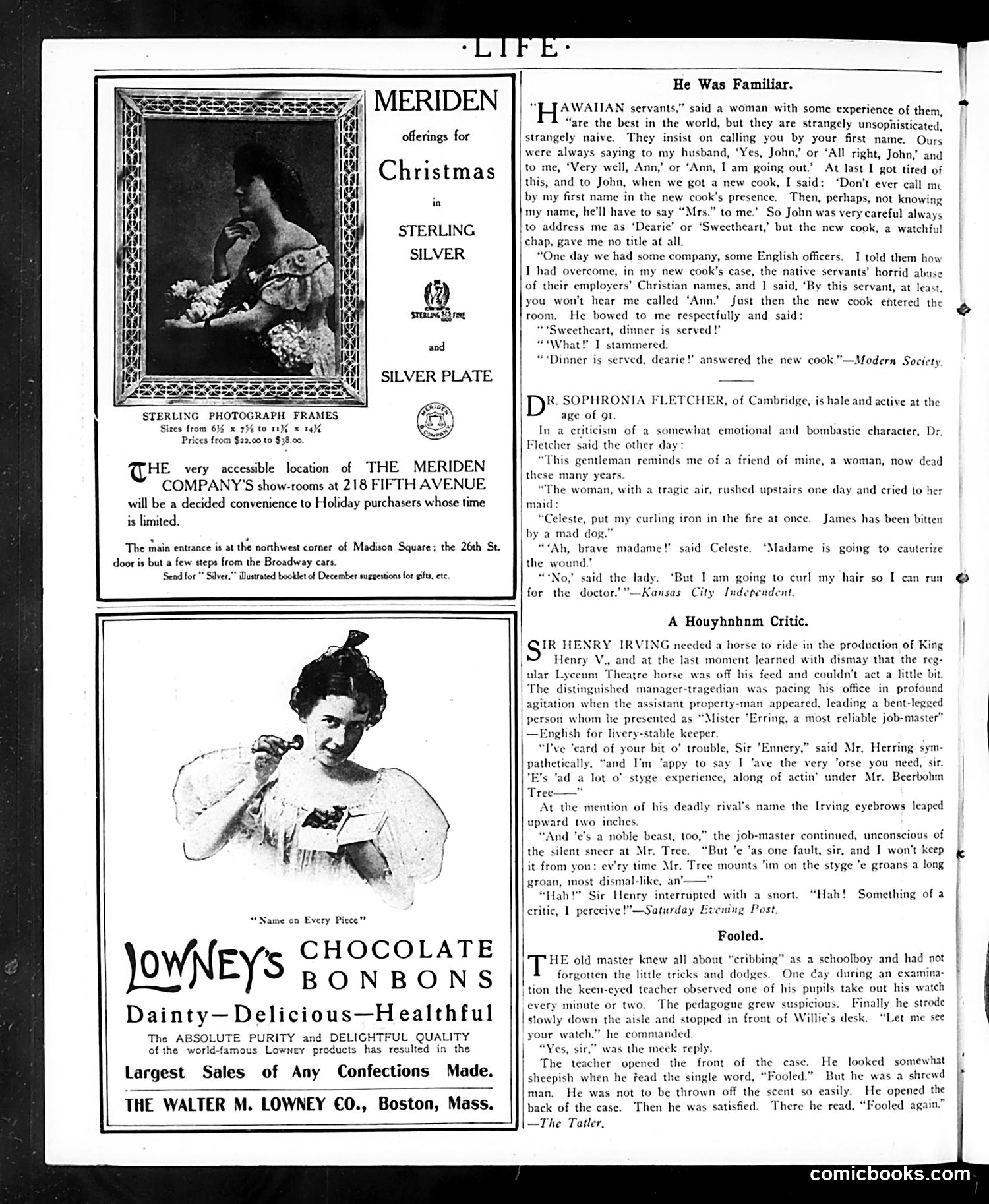
This page is primarily **advertising and humor columns** rather than political satire. The advertisements include Meriden sterling silver Christmas gifts and Lowney's chocolate bonbons. The humor sections contain three anecdotes: 1. **"He Was Familiar"** — mocks Hawaiian servants' informality with white employers, poking fun at cultural misunderstandings. 2. **"A Houyhnhnm Critic"** — satirizes theater pretension, specifically Sir Henry Irving needing a horse for a King Henry V production. The joke involves wordplay on "Mr. Tree" (likely actor Beerbohm Tree), with the horse's groaning during performances. 3. **"Fooled"** — a schoolboy prank where a teacher is tricked into opening his watch case to find it empty. These are genteel, early-20th-century humor pieces rather than sharp political commentary.
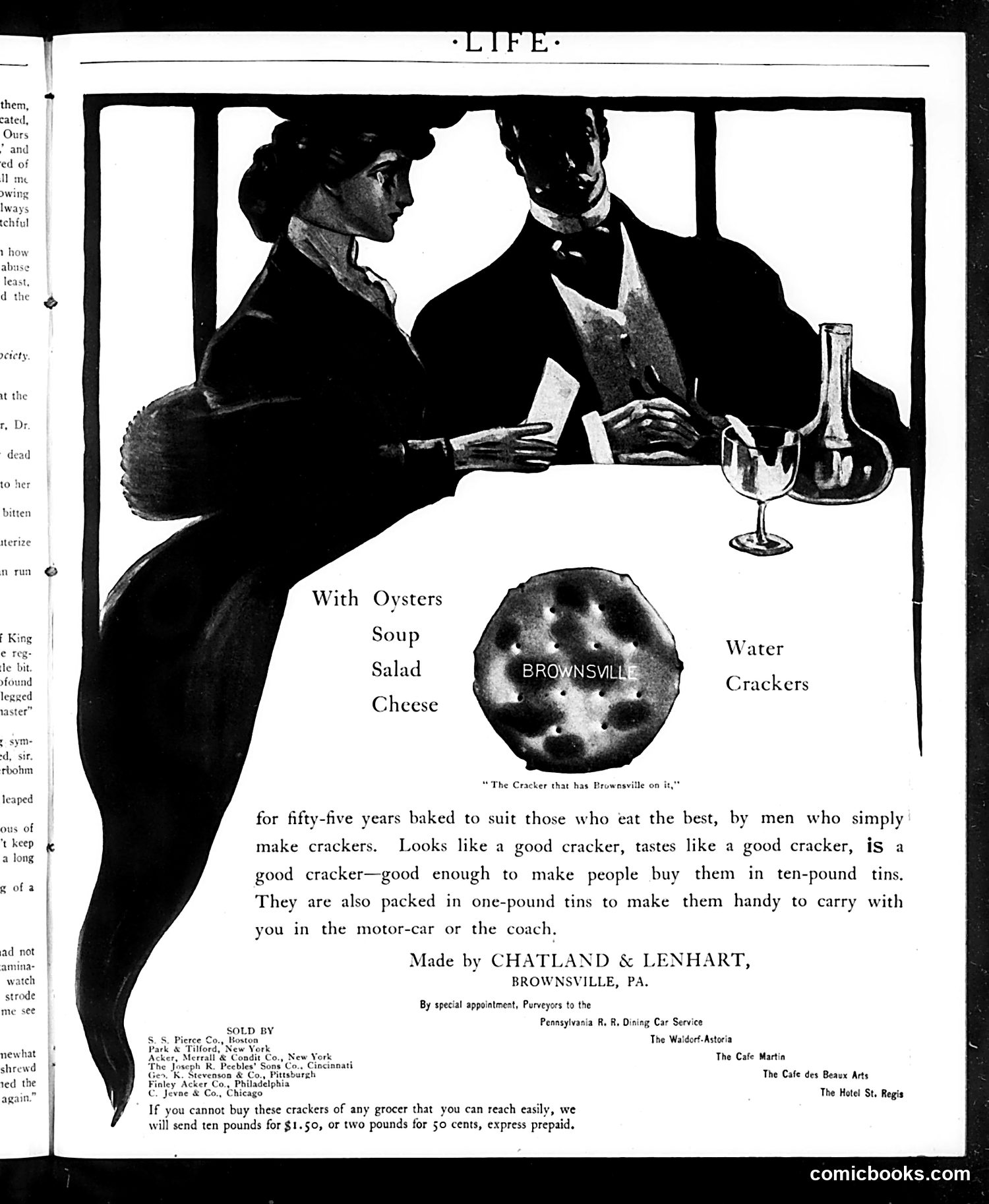
This page is primarily **a advertisement for Brownsville water crackers**, not political satire. The illustration shows an elegantly dressed couple at a formal dinner, with the woman in profile on the left and the man facing right. The ad lists menu items ("With Oysters / Soup / Salad / Cheese / Water / Crackers") to suggest the crackers' refined positioning. The advertisement emphasizes the product's 55-year history and quality ("good enough to make people buy them in ten-pound tins"). It includes distribution information for major cities and hotels, positioning Brownsville crackers as appropriate for fine dining and travel. There is no political commentary or satire present—this is straightforward period advertising using stylish illustration to appeal to affluent consumers.
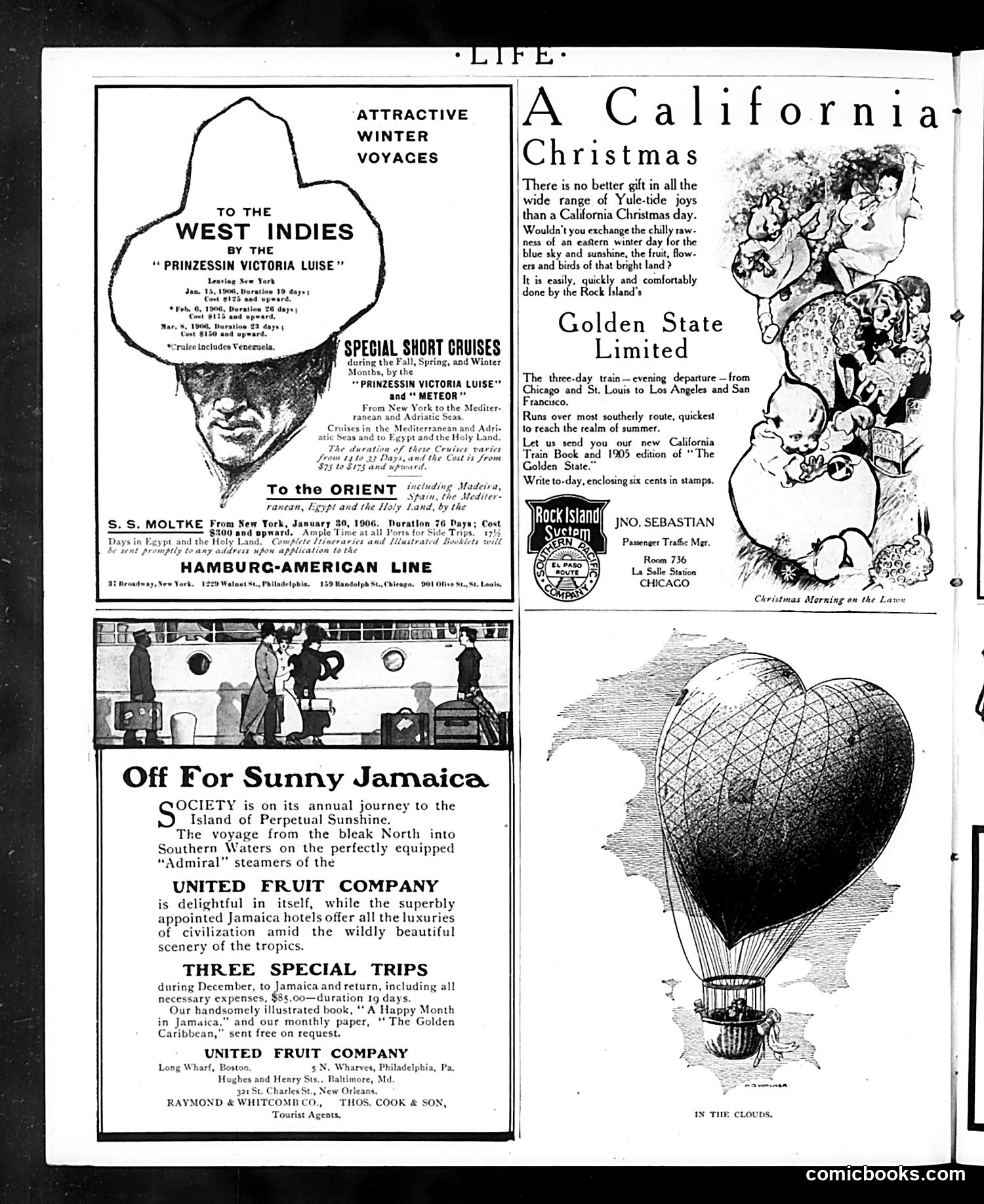
This page is primarily **advertising content** from what appears to be an early 1900s issue of *Life* magazine. The left side features cruise line advertisements (Hamburg-American Line, West Indies voyages, and Jamaica trips), while the right side advertises the Golden State Limited train and California Christmas travel. The only visual humor appears to be the decorative illustrations: a stylized map-shaped head for the West Indies cruises (possibly suggesting travelers' heads being filled with exotic destination ideas), and a whimsical hot air balloon illustration labeled "In the Clouds." There is **no political satire** on this page. The content reflects period advertising conventions promoting leisure travel and holiday destinations to wealthy audiences.
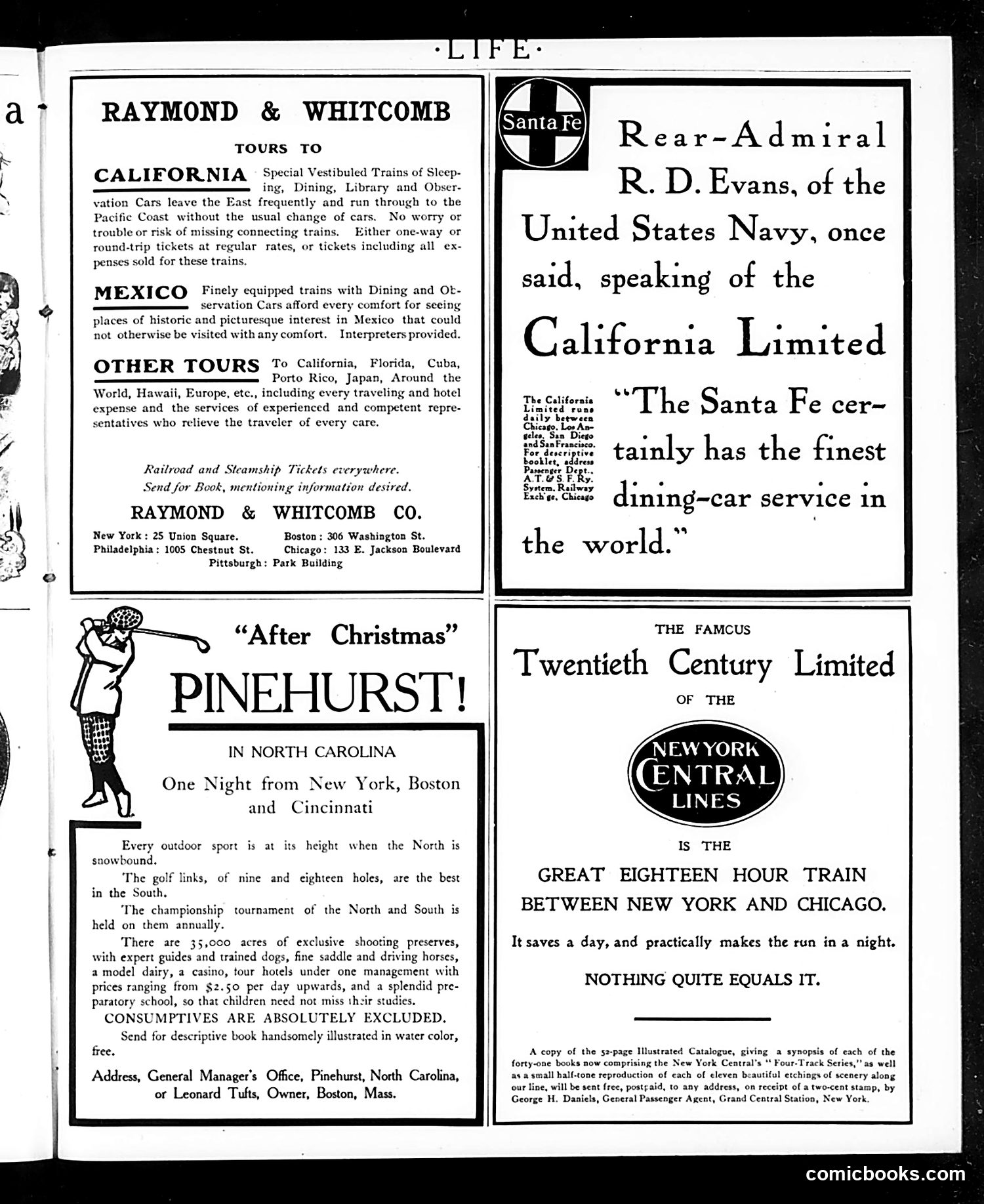
This page is primarily **advertising content** from a vintage *Life* magazine, not satirical cartoons. The ads promote travel and leisure services: 1. **Raymond & Whitcomb Co.** offers railroad tours to California, Mexico, and worldwide destinations. 2. **Pinehurst, North Carolina** advertises as a winter golf destination with exclusive shooting preserves and riding facilities. The illustration shows a golfer mid-swing. The text notes "consumptives are absolutely excluded"—a historical reference to tuberculosis sanitariums that were common in that era, with Pinehurst positioning itself as a healthy resort for the wealthy. 3. **Santa Fe Railway** quotes Rear-Admiral R.D. Evans praising the "California Limited" train's dining-car service. 4. **New York Central Lines** promotes the "Twentieth Century Limited," an eighteen-hour train between New York and Chicago. This reflects early 20th-century luxury travel marketing.
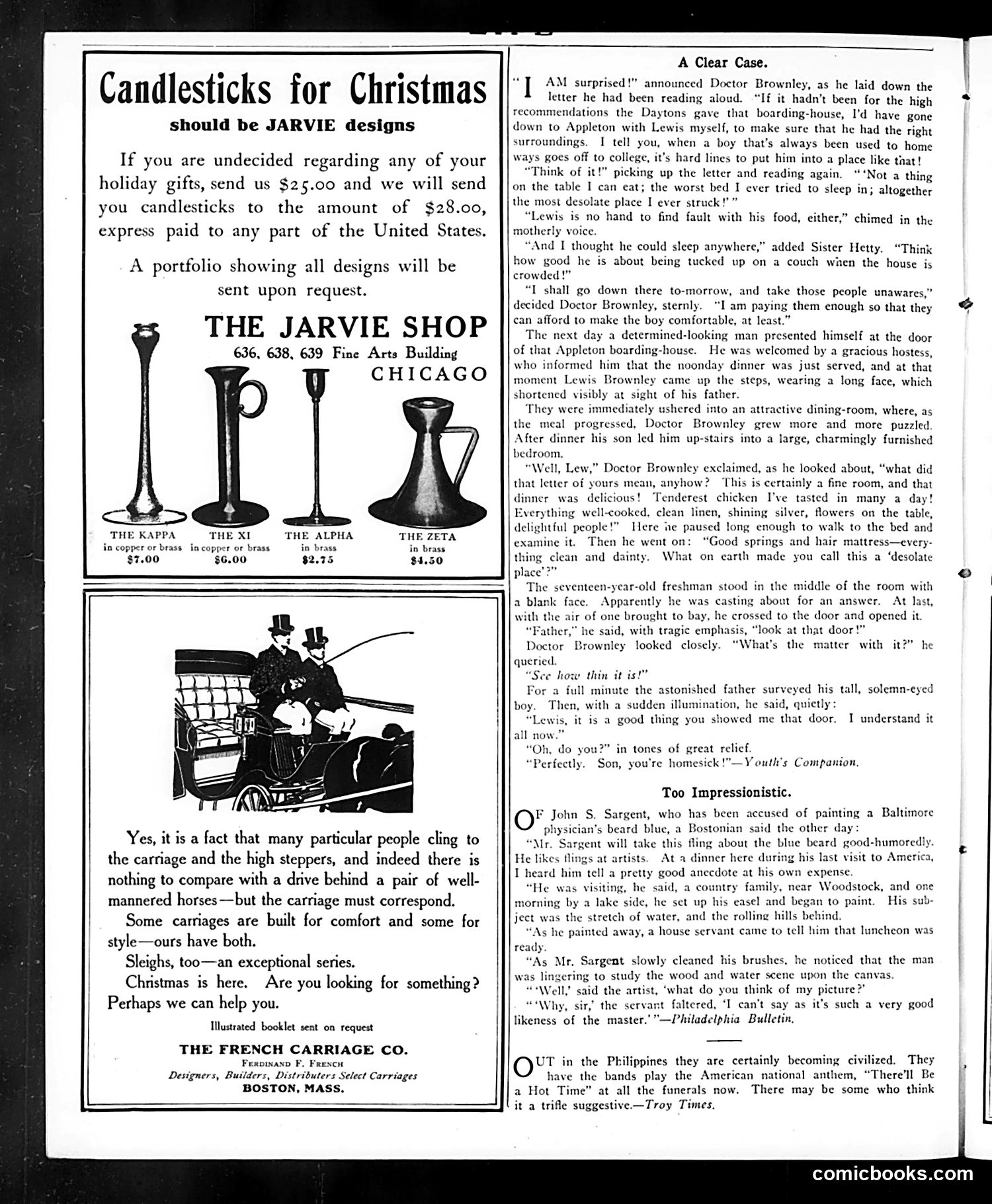
This is primarily **advertising and short humorous stories**, not political satire. **Left side advertisements:** - The Jarvie Shop sells brass candlesticks ($2.75–$8.00) - The French Carriage Company advertises sleighs and carriages with an illustration of well-dressed passengers **Right side contains three brief anecdotes:** 1. **"A Clear Case"** — A doctor visits a boarding house and realizes his tenant Lewis actually lives in squalor, not comfort as claimed 2. **"Too Impressionistic"** — An artist painting a Baltimore physician's portrait is complimented; he admits it's actually a good likeness of the doctor's wife 3. **"Out in the Philippines"** — Notes that Philippine bands now play the American national anthem at funerals These are lighthearted *Life* magazine humor pieces from the early 1900s, not political cartoons with deeper satirical meaning.
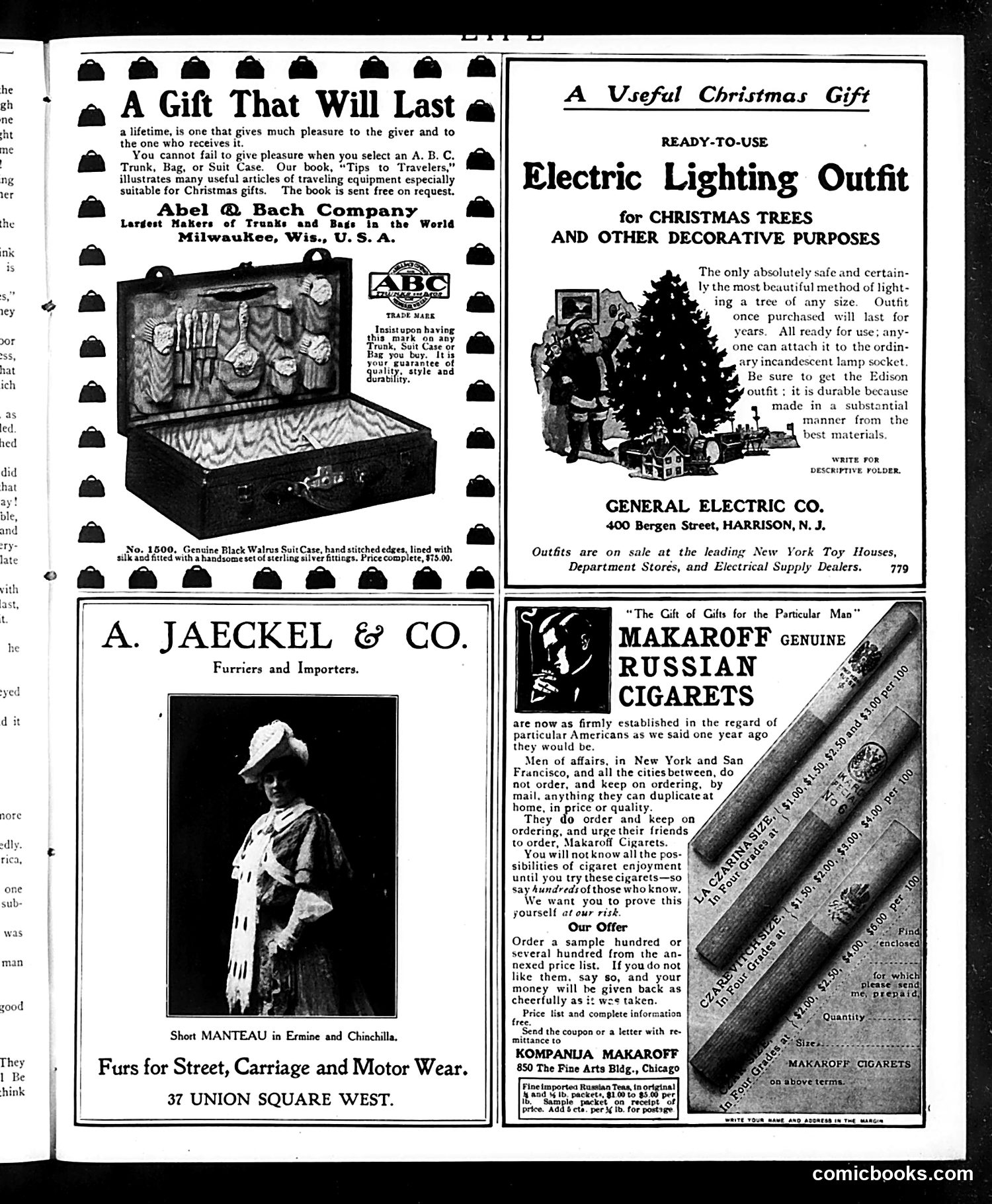
This page contains **advertisements, not political cartoons or satire**. The four ads promote: 1. **Abel & Bach Company** (Milwaukee): Luxury traveling suit cases, positioned as an ideal Christmas gift 2. **General Electric Company**: Electric lighting outfits for Christmas trees, marketed as "absolutely safe" and durable 3. **A. Jaeckel & Co.** (Union Square West): Fur coats and mantels for women, showing a "Short MANTEAU in Ermine and Chinchilla" 4. **Makaroff Cigars**: Russian cigars marketed to "men of affairs" in major cities These are straightforward holiday gift advertisements from what appears to be an early 20th-century *Life* magazine issue. There is no political satire, social commentary, or caricature present on this particular page—it functions as a commercial section rather than editorial content.
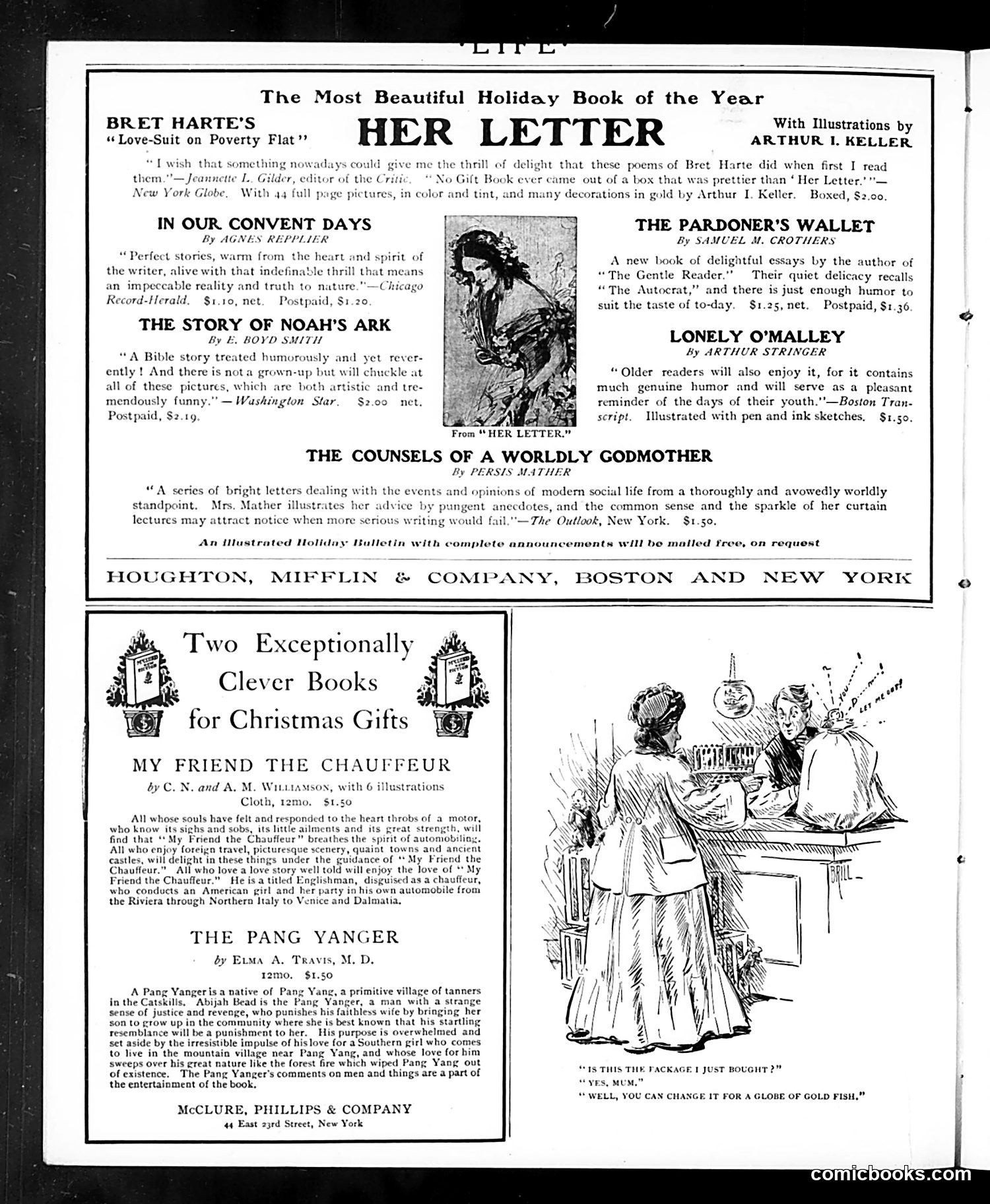
This page is primarily **advertising for holiday books** published by Houghton Mifflin and McClure, Phillips & Company, circa early 1900s. It features no political cartoons or satire. The main illustration shows a domestic Christmas gift scene: a woman presenting a wrapped package to a man. The dialogue reads: "IS THIS THE PACKAGE I JUST BOUGHT?" / "YES, MUM." / "WELL, YOU CAN CHANGE IT FOR A GLOBE OF GOLD FISH." This is gentle **domestic humor** about gift-giving anxiety—the woman worries her purchase may displease the recipient, so she offers an exchange option. It's not satirical but rather illustrates the holiday shopping experience for the page's advertised book audience. The books advertised include titles on family life, religion, and travel narratives—typical genteel holiday gift selections for the era's educated middle class.
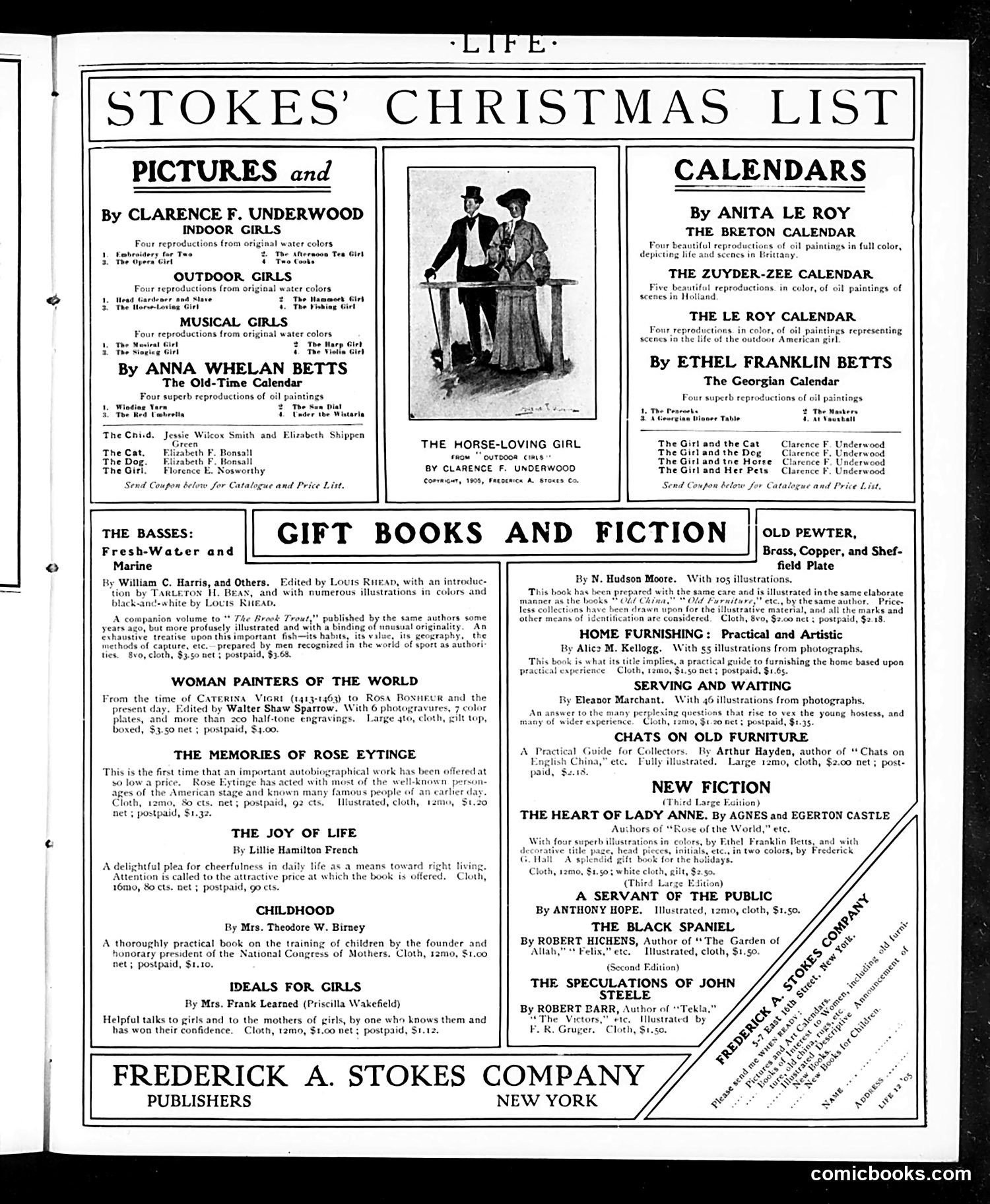
This page is primarily a **Christmas gift catalog** from Frederick A. Stokes Company publishers, not a political cartoon. It advertises books and calendars available for the 1908 holiday season. The central illustration shows **two men in formal Victorian dress** (top hats and coats) appearing to examine or discuss something together—likely meant to evoke gentlemanly gift-giving or selection. The page lists illustrated books and calendars featuring outdoor scenes and girls, plus fiction titles. There is **no political satire or social commentary** visible. This is a straightforward commercial advertisement showcasing holiday gift options from Stokes' catalog, organized by category (pictures, calendars, gift books, and new fiction).
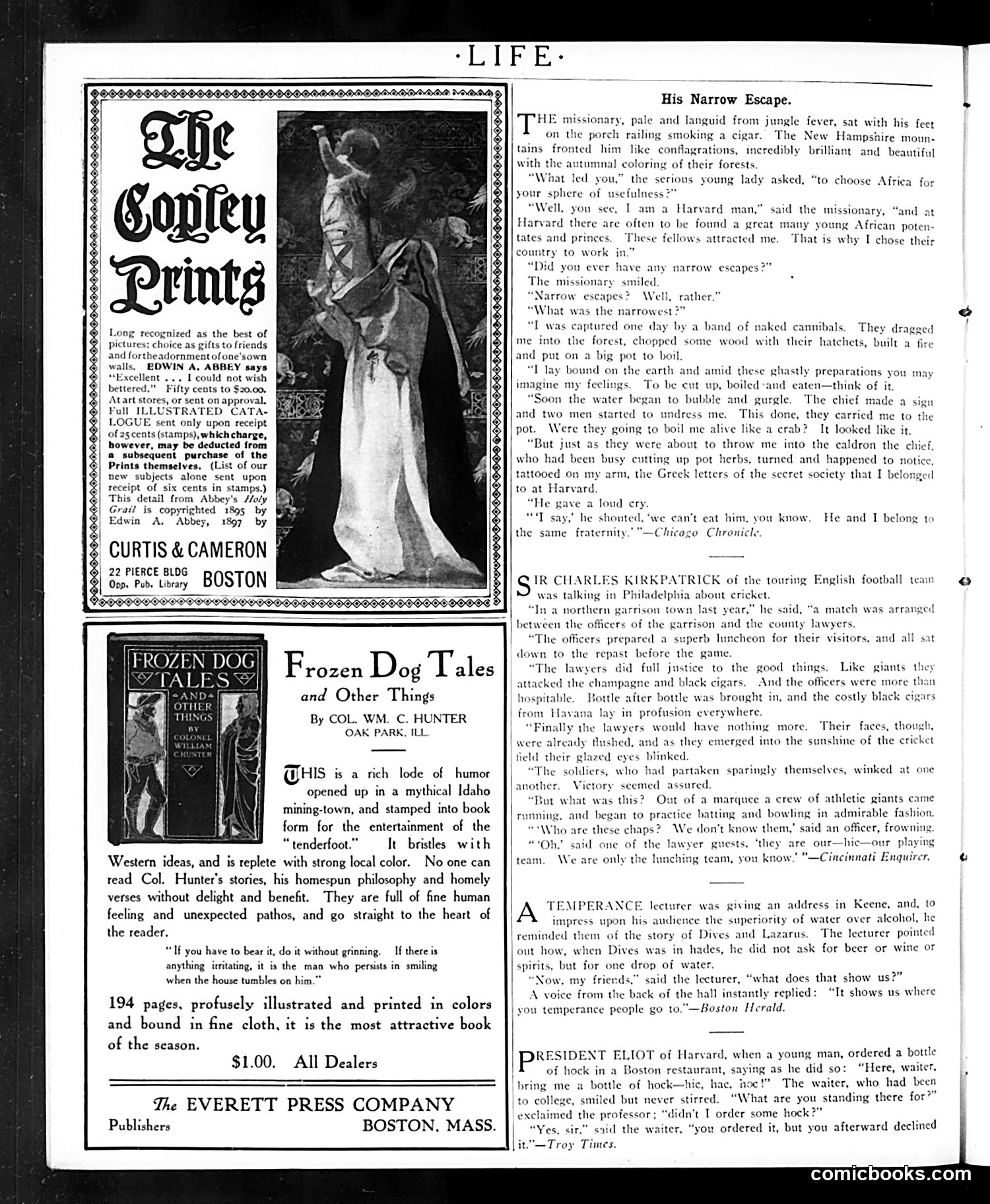
This page is primarily **advertising and literary content** rather than political satire. The main visual element is "The Godfrey Prints"—an advertisement featuring a dramatic engraving of a woman in classical dress, promoting decorative art prints by Edwin A. Abbey. The text content consists of three separate anecdotes (titled "His Narrow Escape," about a missionary in Africa; a story about English cricketers and lawyers; and a temperance lecture anecdote) that appear designed to entertain readers with humorous or moralistic tales. There are also advertisements for "Frozen Dog Tales" by Col. W.C. Hunter and "The Everett Press Company." No clear political cartoons or partisan satire are visible on this page. It represents Life's mixed format of advertising, illustrations, and light humor pieces.
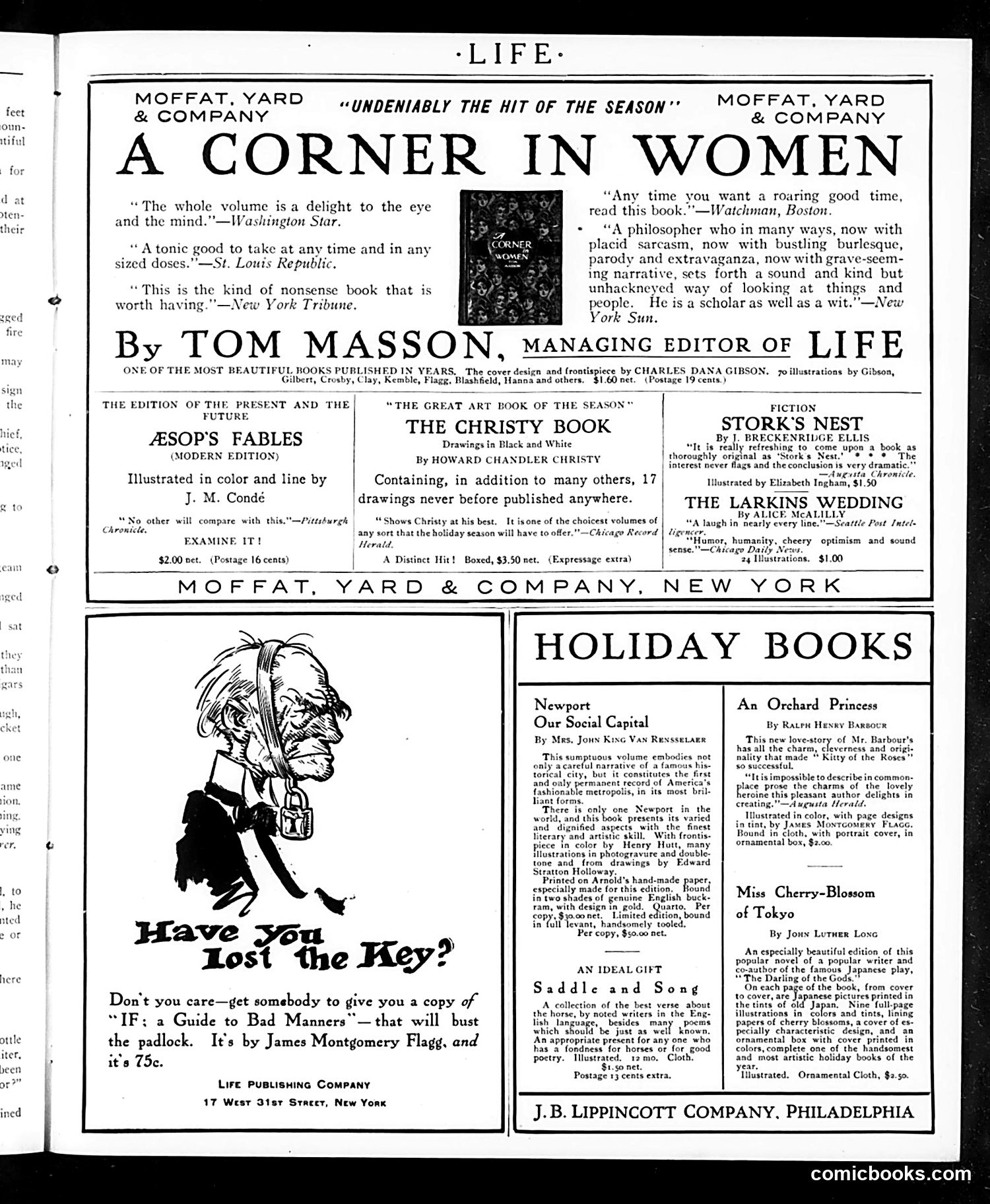
This page is primarily **advertising and book promotions** rather than political satire. The dominant visual element is a caricatured face labeled "Have you Lost the Key?" promoting James Montgomery Flagg's book *"If: a Guide to Bad Manners"* (75 cents). The exaggerated facial features and crude drawing style appear to mock someone, though the specific target is unclear from the image alone. The rest of the page advertises holiday books from publishers Moffat, Yard & Company, Life Publishing Company, and J.B. Lippincott Company. These include *A Corner in Women* by Tom Masso (Life's managing editor), Aesop's Fables, The Christy Book, and various other titles with brief promotional quotes. The page functions as a **book advertisement section** rather than editorial satire.
This is an **advertisement, not a cartoon or satirical content**. It's a full-page ad from Life magazine for Chickering & Sons pianos, established 1823, located at 796 Tremont Street, Boston. The ad promotes their "Quarter Grand" piano—a compact grand piano model positioned as ideal for homes with limited space. It emphasizes the instrument's small footprint, portability, and affordability compared to full-size uprights. The ornate decorative border is typical of early 20th-century print advertising design. There is no political satire, social commentary, or caricature here. This is straightforward commercial promotion using the aesthetic conventions of the period—elaborate typography and ornamentation to convey luxury and quality to potential customers.
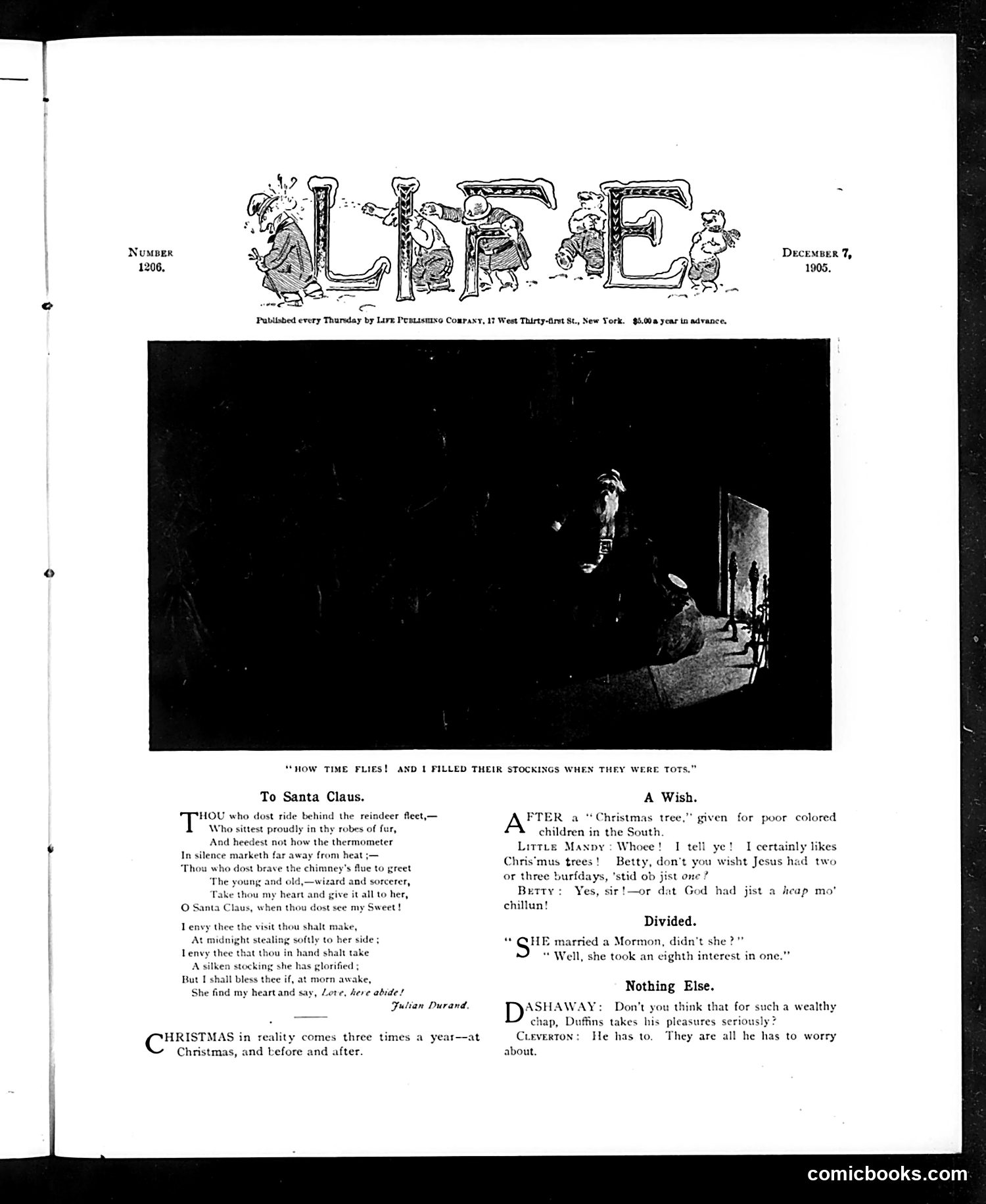
This page contains several Christmas-themed pieces of humor: **Main Illustration**: A dramatic nighttime scene showing a figure (Santa Claus) entering through a chimney or doorway—a visual accompanying the romantic poem "To Santa Claus" by Julian Durand, which asks Santa to deliver the speaker's heart to his beloved. **"A Wish"**: A dialect-humor piece featuring two poor Black children discussing a Christmas tree. They express wishes for Jesus to have had multiple incarnations or for God to provide more abundance. This reflects the era's common (and offensive) practice of depicting African Americans in exaggerated dialect for comic effect. **"Divided"**: A brief joke about a woman marrying a Mormon man—satirizing polygamy by suggesting she owns only an "eighth interest" in her husband, alluding to multiple wives. **"Nothing Else"**: A quip about a wealthy man's only concerns being his leisure pursuits, suggesting he has no serious responsibilities or worries. The humor ranges from sentimental romance to social satire about wealth and religious practice.
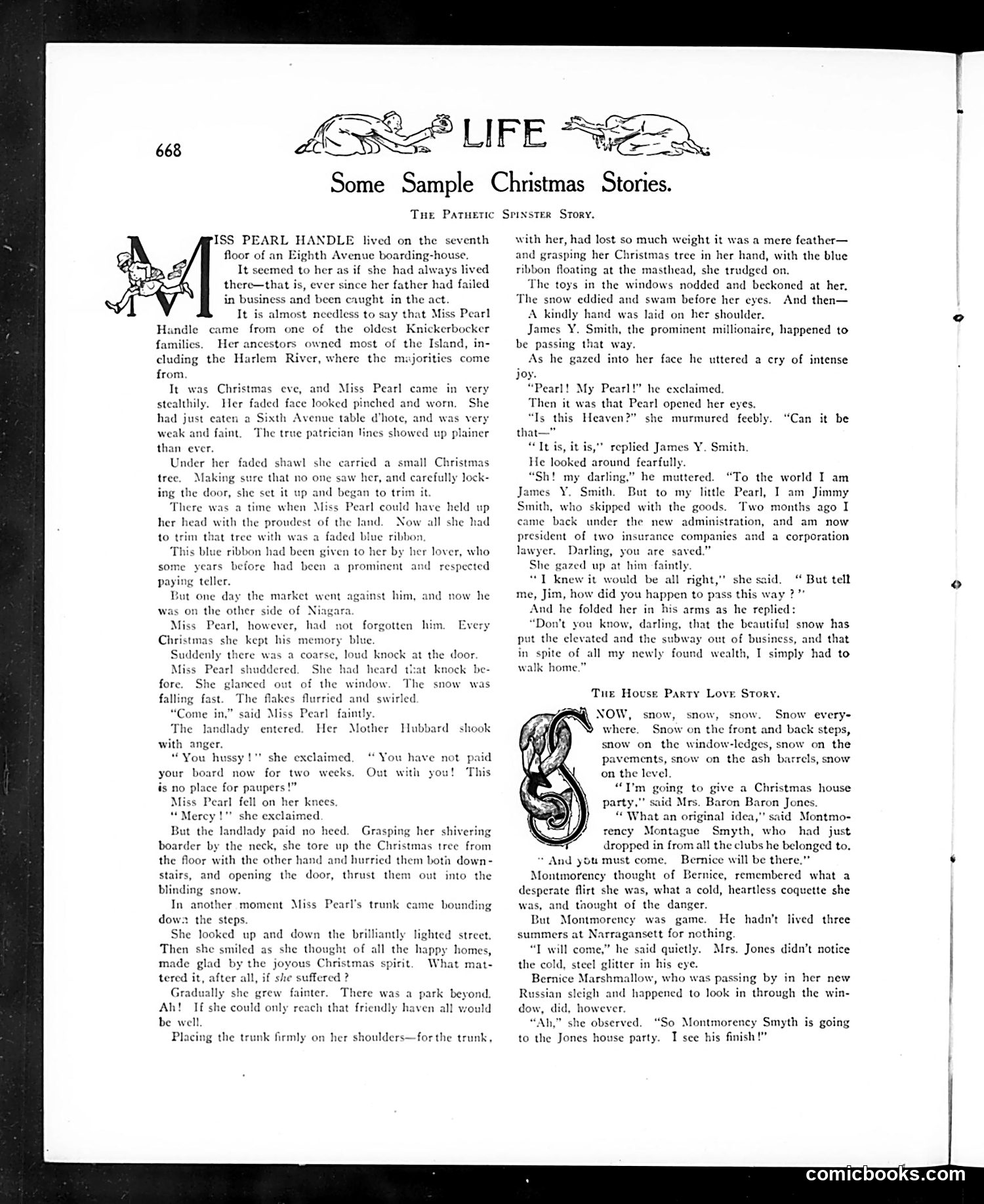
This page contains two satirical Christmas tales mocking sentimental Victorian holiday fiction. **"The Pathetic Spinster Story"** ridicules melodramatic rags-to-riches narratives. Miss Pearl Handle, an impoverished descendant of wealthy "Knickerbocker families," lives in a boarding house after her father's business failure. Evicted on Christmas Eve while carrying a small tree, she nearly freezes—until a mysterious gentleman rescues her. The twist: he's James Y. Smith, her former lover who "skipped with the goods" (embezzled) but has returned as a successful insurance lawyer under the "new administration." **"The House Party Love Story"** (beginning lower right) parodies society-page gossip about Mrs. Baron Jones hosting a Christmas party and Montmorency Smyth's attendance, poking fun at the shallow social climbing of wealthy circles. The satire targets both the overwrought sentimentality of popular Christmas literature and the hypocrisy of wealthy society—particularly how financial crime (embezzlement) could be overlooked if the perpetrator later achieved respectability.
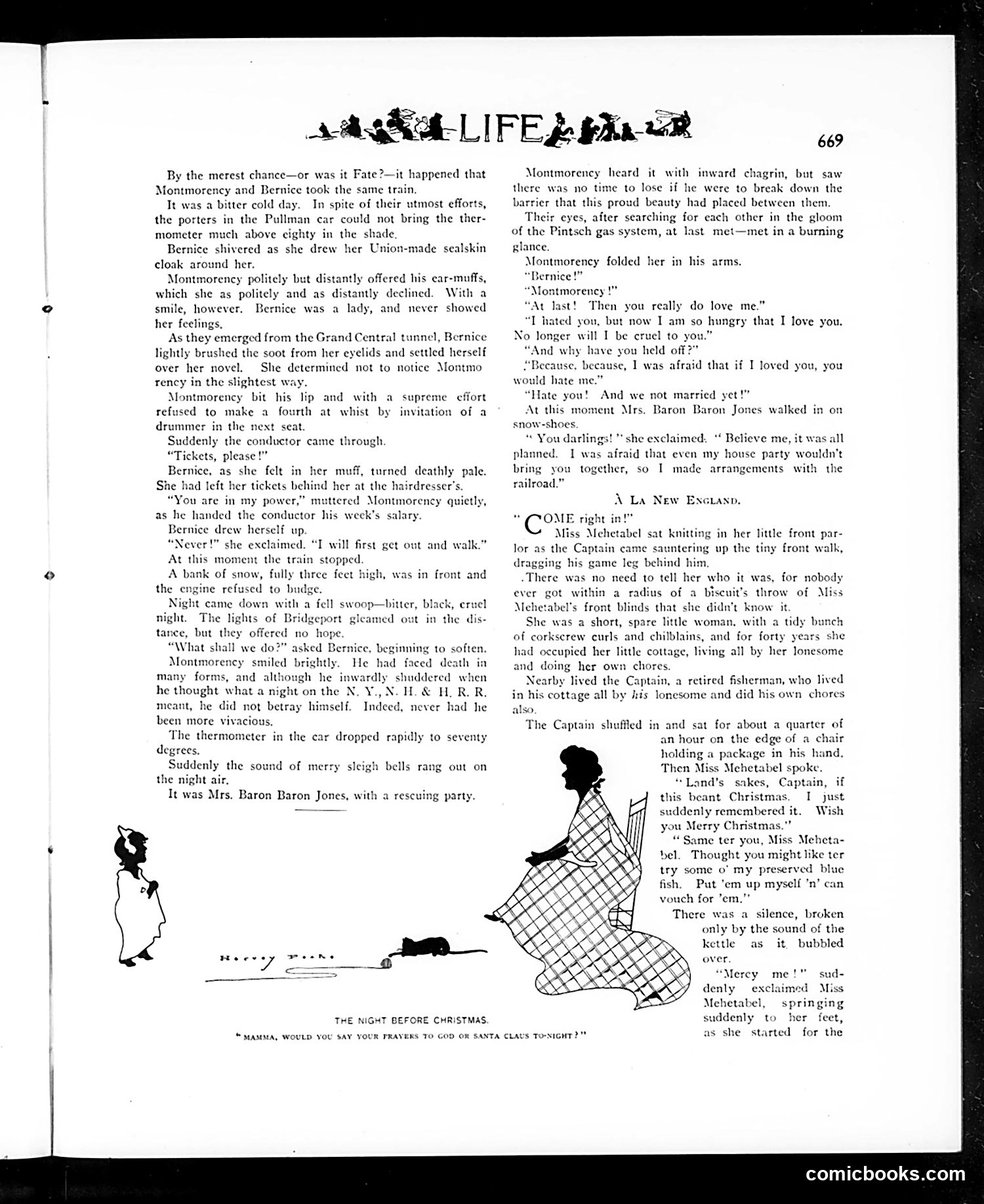
This page contains two distinct romantic comedy narratives typical of early-20th-century Life magazine humor. **The Main Story (Top):** A romantic drama featuring characters named Bernice and Montmorency stranded on a cold train. The satire mocks the period's social pretense: two people who affect indifference toward each other are forced together by circumstance (lost tickets, snowstorm). The humor lies in how quickly pride dissolves when faced with genuine hardship—Bernice admits she loves Montmorency only because she's hungry. A society hostess (Mrs. Baron Baron Jones) conveniently "rescues" them, revealing she orchestrated the entire situation as matchmaking. **The Cartoon:** Shows a small illustration captioned "The Night Before Christmas" with a child asking about prayers to God or Santa—light holiday humor. **"A La New England" (Bottom):** A gentler New England romance featuring Miss Mehetabel and a retired Captain—established local characters with predictable domestic routines. Both stories employ the era's standard romantic formula: pride before the fall, staged coincidences, and sentimental resolution. The satire targets upper-class affectation and contrived courtship rituals.
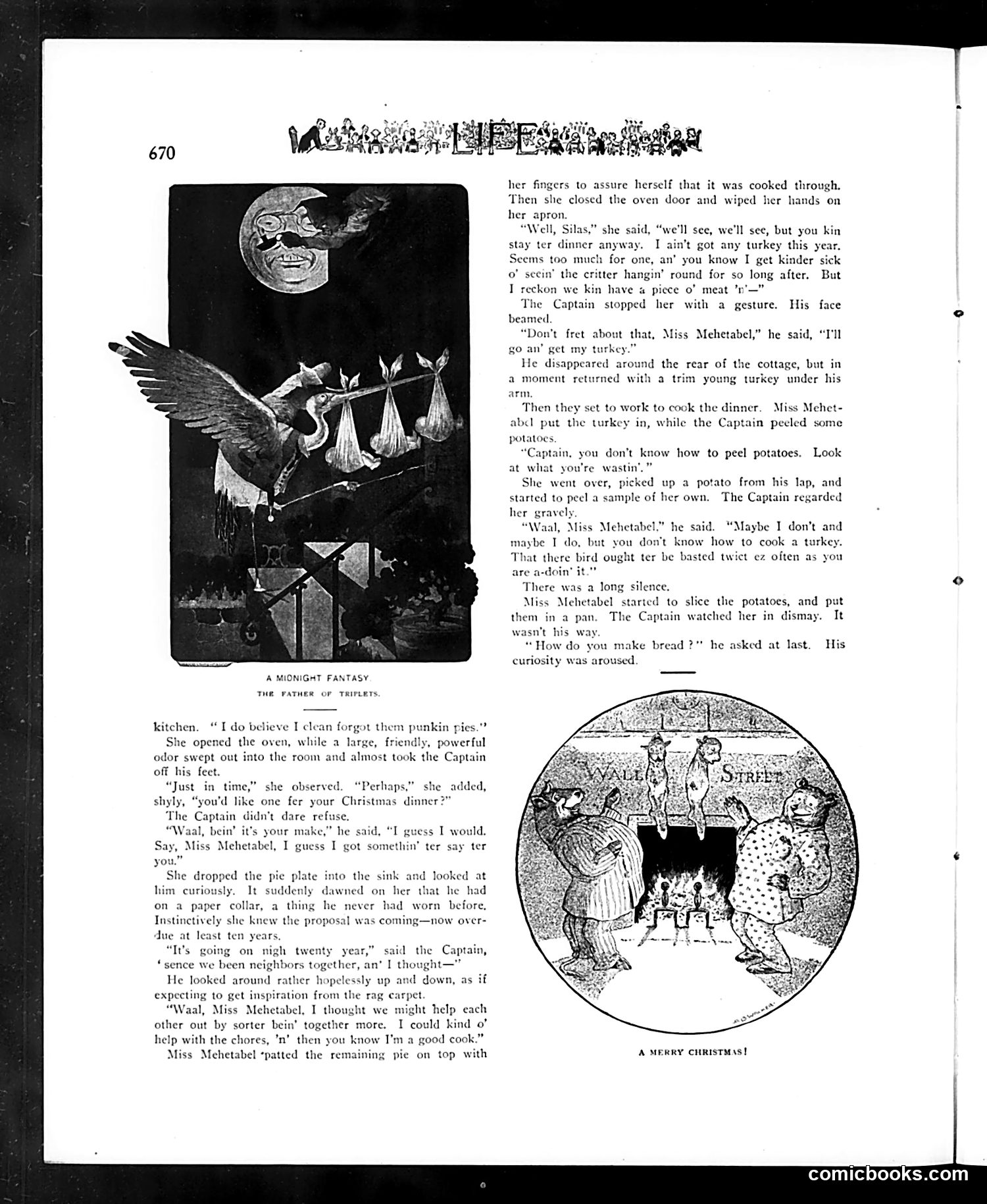
This is a humorous romantic story, not political satire. It depicts a rural courtship between two elderly neighbors, Captain Silas and Miss Mehetabel, using rural dialect and domestic comedy. The narrative shows Silas awkwardly proposing marriage after twenty years of neighborly proximity. The joke centers on their incompatible housekeeping styles: when they attempt to cook Christmas dinner together, they bicker over cooking methods—he criticizes her potato-peeling, she mocks his turkey-basting technique, he questions her bread-making. The satire gently mocks rural courtship rituals and the clash of independent household management styles. The caption "The Father of Triplets" (referring to the three cooking disputes) plays on the idea that their marriage will produce conflict, not children. The Christmas setting adds sentimental domesticity to what is fundamentally a comedy about stubborn independence meeting reluctant compromise.
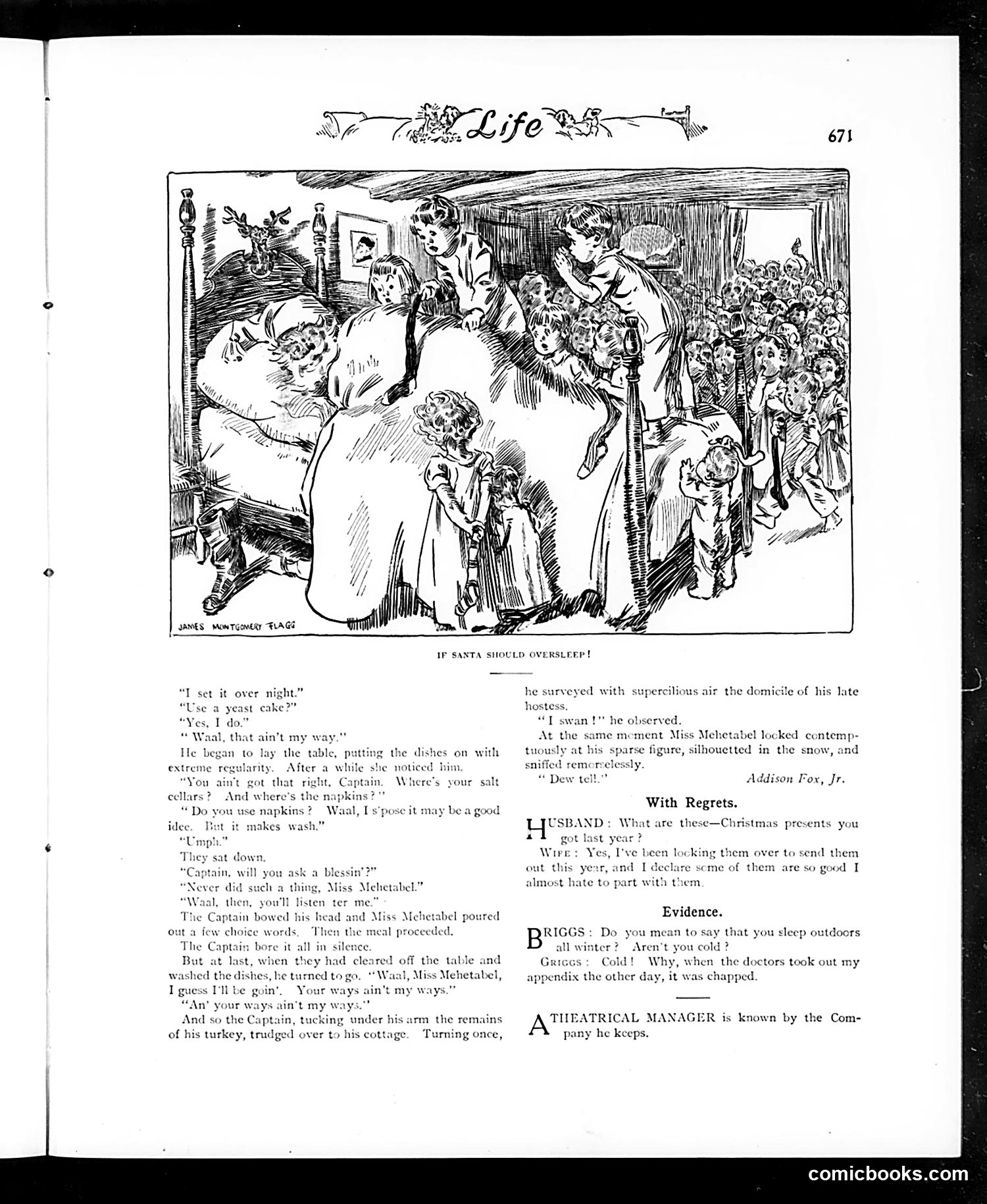
This cartoon satirizes **Christmas dinner hospitality gone wrong**. The large central illustration shows a woman (Miss Mehetabel) hosting what appears to be an awkward holiday meal with a visiting Captain. The accompanying text reveals their uncomfortable dynamic: the Captain is critical and condescending about her cooking methods ("Use a yeast cake?" he sniffs), while she grows contemptuous of his "sparse figure." The humor lies in the **clash between holiday hospitality expectations and reality**—the woman tries to be a gracious hostess despite the Captain's rude, supercilious corrections about salt cellars and cooking technique. He ultimately leaves in a huff, "trudging over to his cottage" with leftover turkey. The page also includes unrelated brief jokes ("With Regrets," "Evidence," "A Theatrical Manager") typical of Life's miscellaneous comic content. The overall satire mocks both pretentious guests and the social strain of forced holiday gatherings.
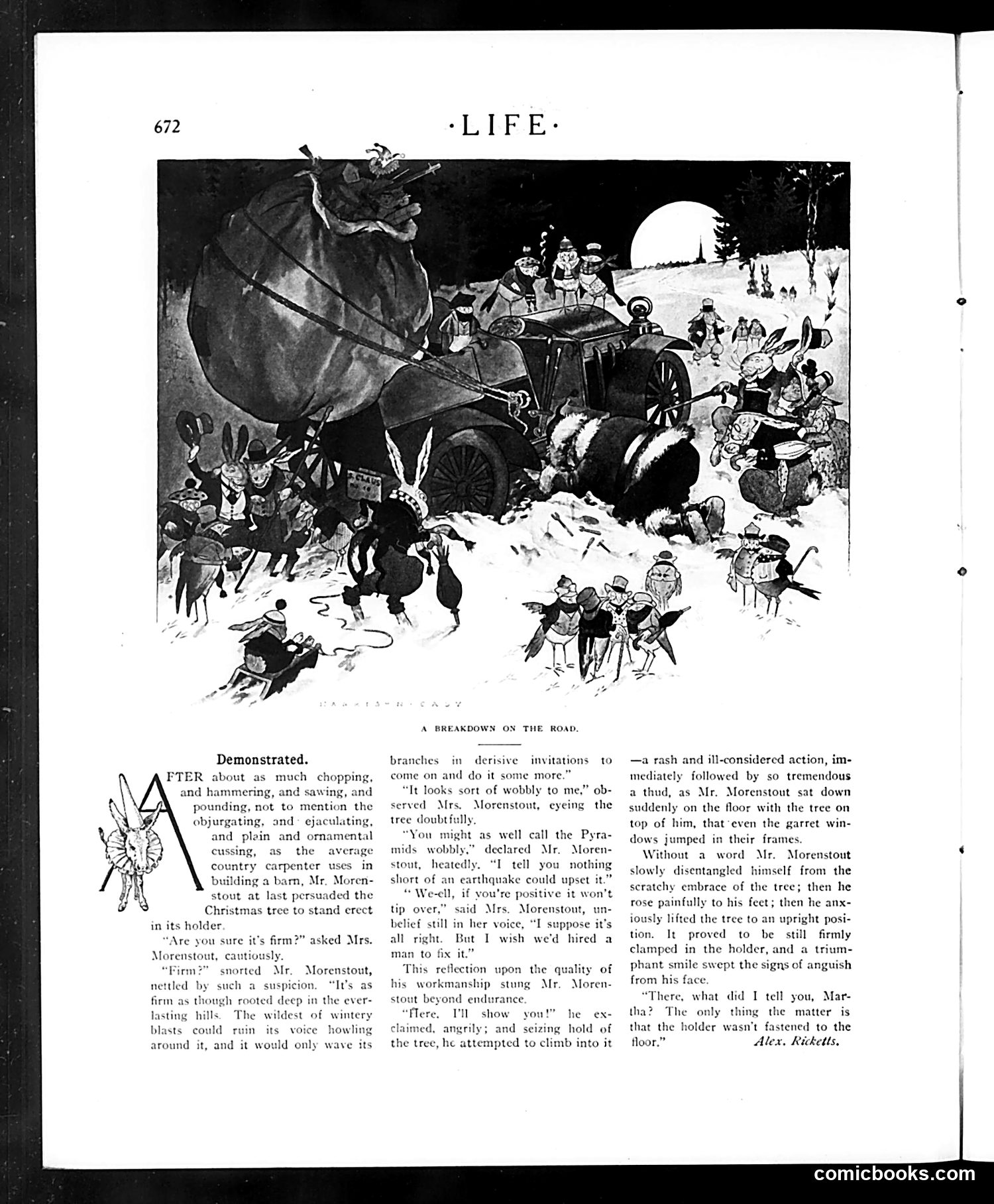
This page contains two separate humorous domestic scenes. The main illustration shows a Christmas tree installation mishap: Mr. Morenstout, after extensive effort securing a Christmas tree in its holder, boastfully insists it's immovable—"firm as though rooted deep in the everlasting hills." His skeptical wife remains unconvinced. When he attempts to demonstrate its stability by climbing into the tree to prove his point, the entire tree collapses on top of him with a tremendous crash. The humor derives from classic domestic comedy: male pride and overconfidence leading to physical humiliation, followed by the ironic twist that despite his injury, the tree's holder was actually never properly secured to the floor. His triumphant vindication is undercut by this admission of his actual failure. The second scene titled "A Breakdown on the Road" (top illustration) appears to depict Santa's sleigh and reindeer experiencing travel troubles.
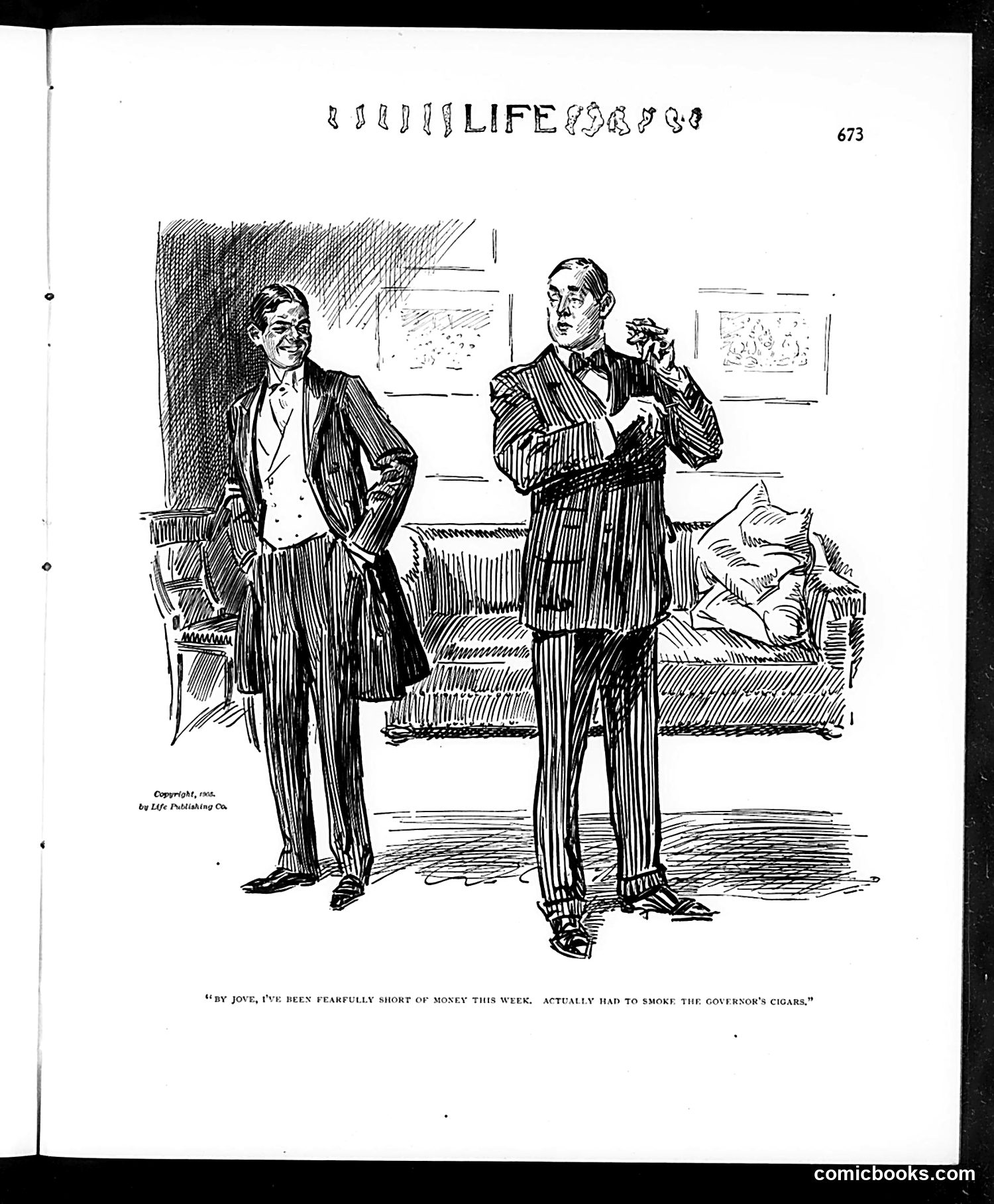
This is a single-panel cartoon from *Life* magazine (page 673) depicting two well-dressed men in an indoor setting. The man on the right is speaking, holding what appears to be a flower or small object, while the man on the left listens with an amused expression. The caption reads: "By Jove, I've been fearfully short of money this week. Actually had to smoke the Governor's cigars." The joke hinges on social hierarchy and pretension. The speaker is ironically complaining about financial hardship while admitting he had to resort to smoking a Governor's cigars—suggesting either his own wealth is normally sufficient for better cigars, or he's making light of borrowing the Governor's expensive possessions. It's satire of upper-class anxiety about maintaining appearances despite temporary money troubles.
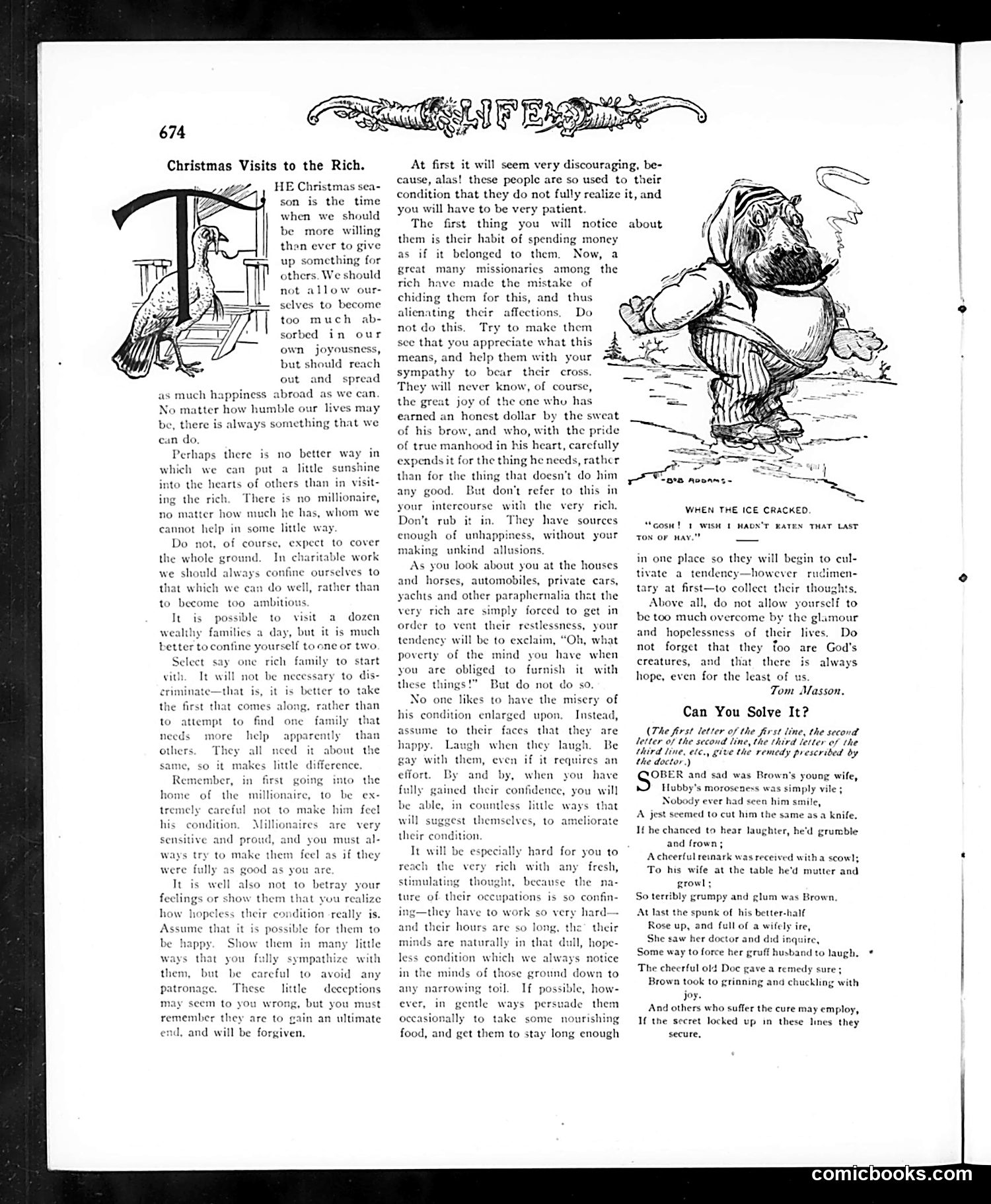
This is satirical advice on "Christmas Visits to the Rich," a tongue-in-cheek article mocking wealthy people as pitiable figures requiring charitable pity from ordinary citizens. The satire inverts traditional charity: instead of helping the poor, readers are encouraged to visit millionaires as if they were the truly disadvantaged. The article portrays the rich as emotionally impoverished, trapped by their compulsory consumption (houses, yachts, automobiles), and suffering from a "poverty of the mind." The cartoon illustrations show figures in uncomfortable situations, reinforcing the absurd premise that wealth equals misery. The accompanying section "Can You Solve It?" presents riddles, maintaining the magazine's humorous tone. The piece critiques Gilded Age excess and the emotional emptiness of materialism, suggesting that the wealthy are actually victims of their own lifestyle—a progressive critique dressed in comic irony typical of Life magazine's satirical approach to social inequality.
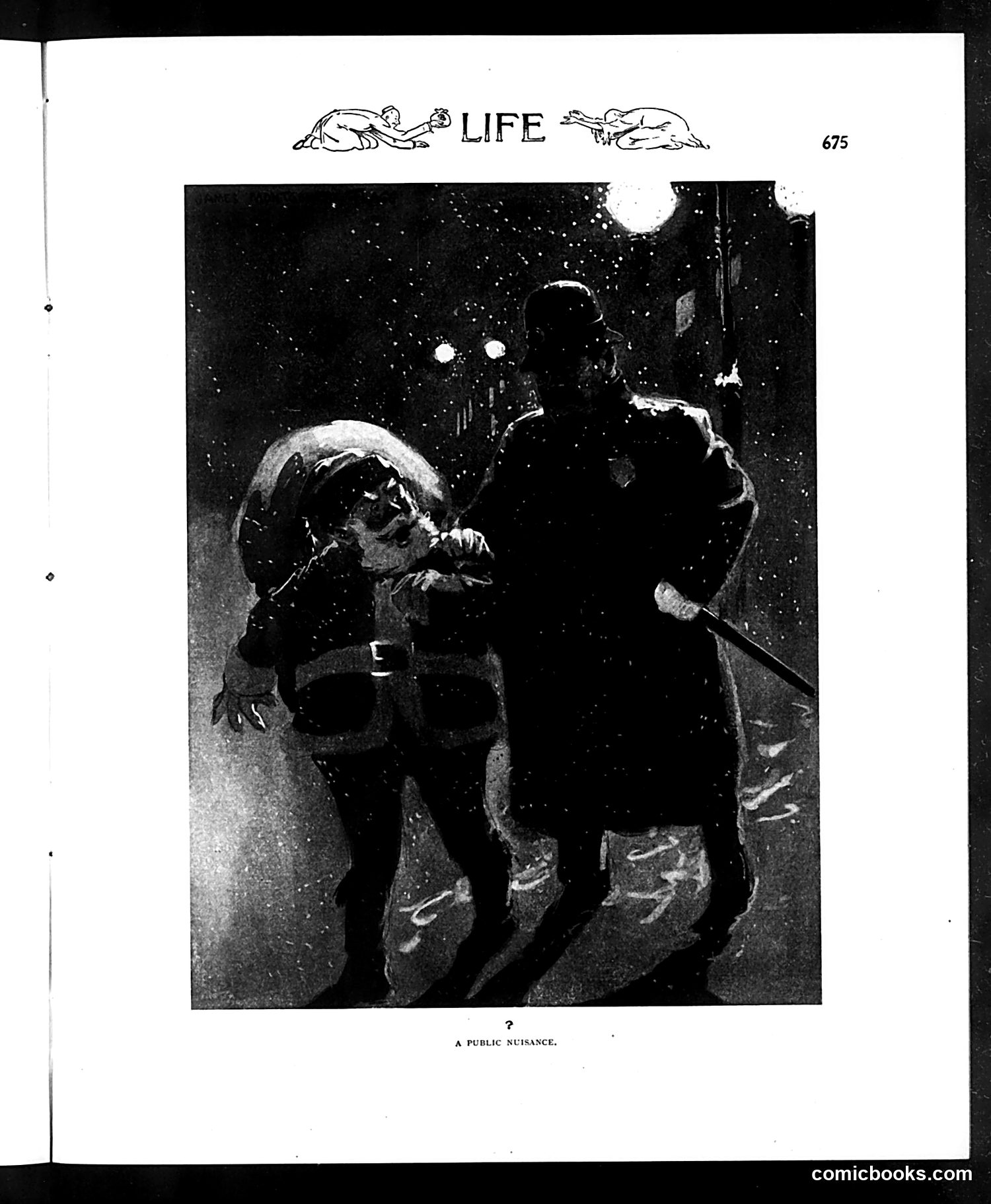
This appears to be a satirical cartoon from Life magazine depicting two figures in what looks like a nighttime street scene. The image shows silhouetted characters, with one wearing a hat and appearing to be engaged in some kind of altercation or confrontation. The caption "A PUBLIC NUISANCE" suggests social commentary on disruptive urban behavior. Without clearer visibility of specific identifying details or additional context text, I cannot definitively identify the particular figures being caricatured or pinpoint the exact historical reference. The style and page number (675) indicate this is from an early 20th-century Life issue, but the specific satirical target remains unclear from the image alone.
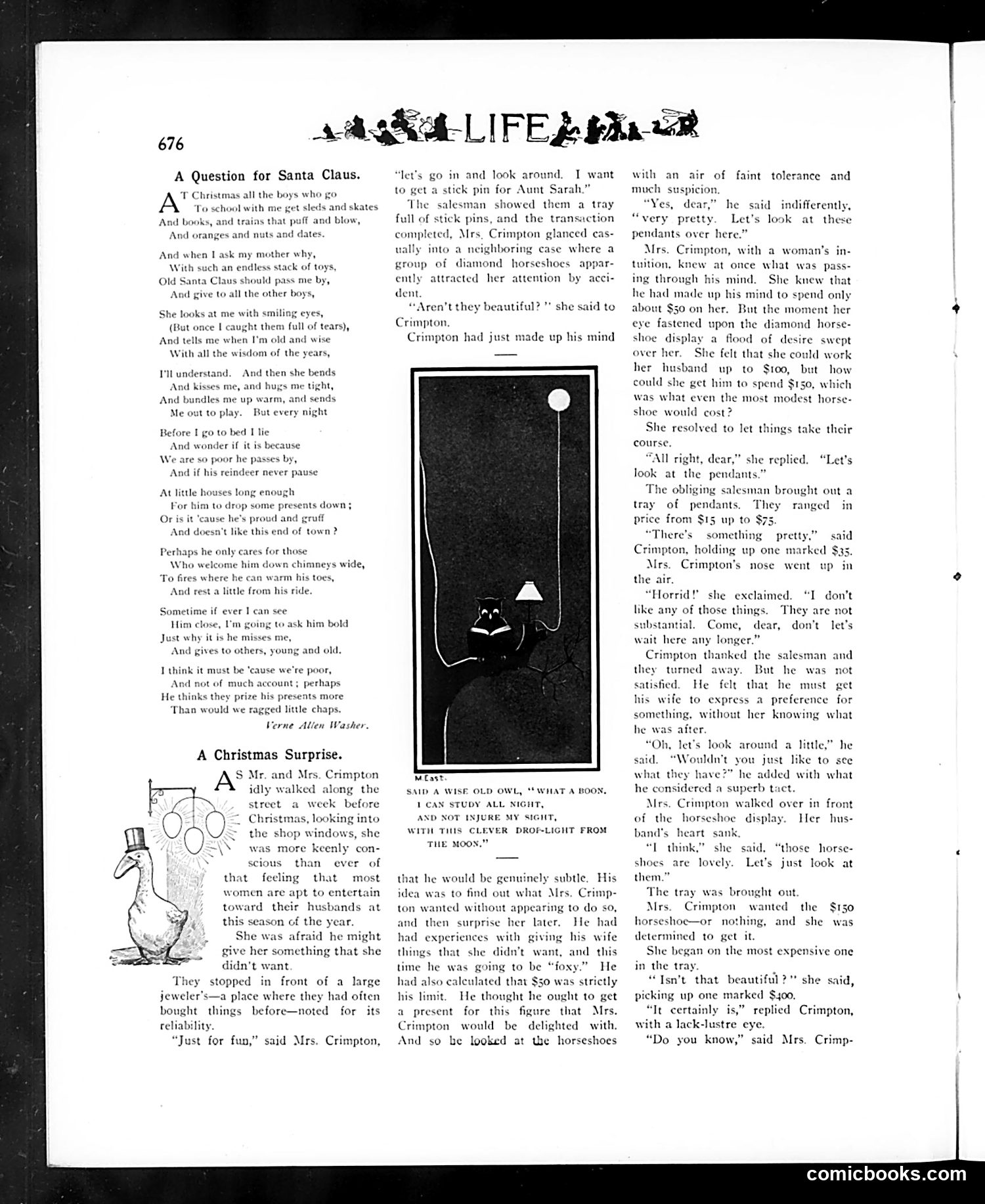
This page contains two Christmas-themed stories from *Life* magazine's satirical humor section. **"A Question for Santa Claus"** is a sentimental poem by a poor child questioning why Santa doesn't visit their impoverished neighborhood, wondering if Santa only favors wealthy families with "wide chimneys." It reflects early 20th-century class anxieties about economic inequality during the holiday season. **"A Christmas Surprise"** is a humorous short story about marital dynamics. Mr. Crimpton wants to surprise his wife with a thoughtful gift by secretly discovering her preferences—he's set a $50 budget. However, Mrs. Crimpton deliberately guides him toward an expensive diamond horseshoe brooch she actually desires, knowing she must manipulate him into spending more money. The satire targets both husbands' attempts at being "clever" and wives' shrewd manipulation of their spouses during gift-giving season—portraying Christmas shopping as a subtle domestic power struggle.
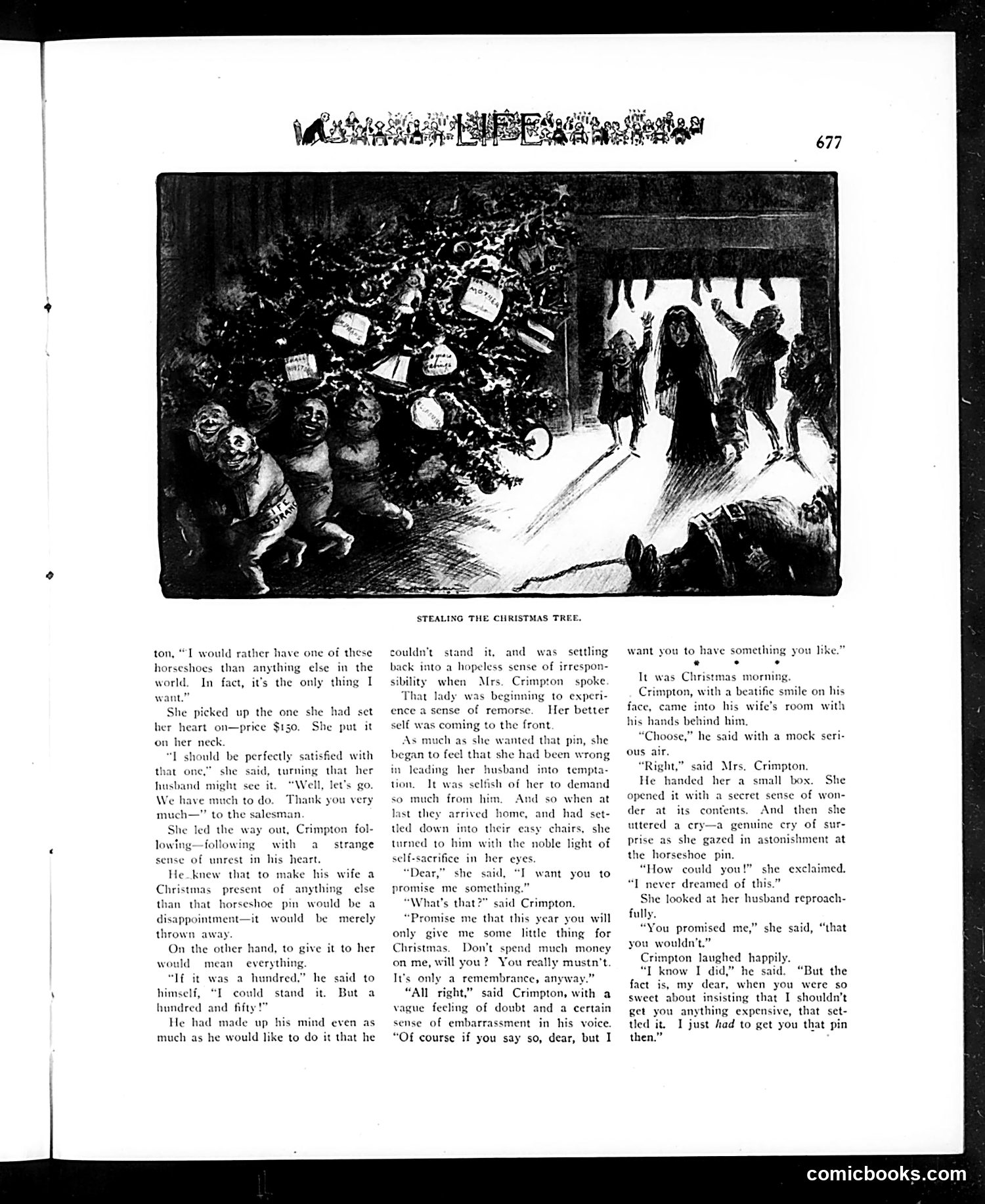
This page presents a satirical domestic comedy about marital economics and self-sacrifice. Mr. and Mrs. Crimpton visit a jeweler where she admires an expensive horseshoe pin ($130—a substantial sum in the early 1900s). Recognizing the financial burden on her husband, she nobly insists he buy her nothing expensive for Christmas, claiming she wants only a modest remembrance. The satire targets both spouses: her performative self-denial (designed to manipulate him into buying the pin anyway) and his predictable capitulation to her "sacrifice." On Christmas morning, he presents her with the exact pin she coveted, justifying the expense by claiming her noble renunciation made him *feel obligated* to buy it. The joke exposes the transparent psychology of domestic gift-giving—where apparent selflessness functions as emotional leverage to secure desired luxuries. The cartoon above (titled "Stealing the Christmas Tree") appears unrelated to the text.
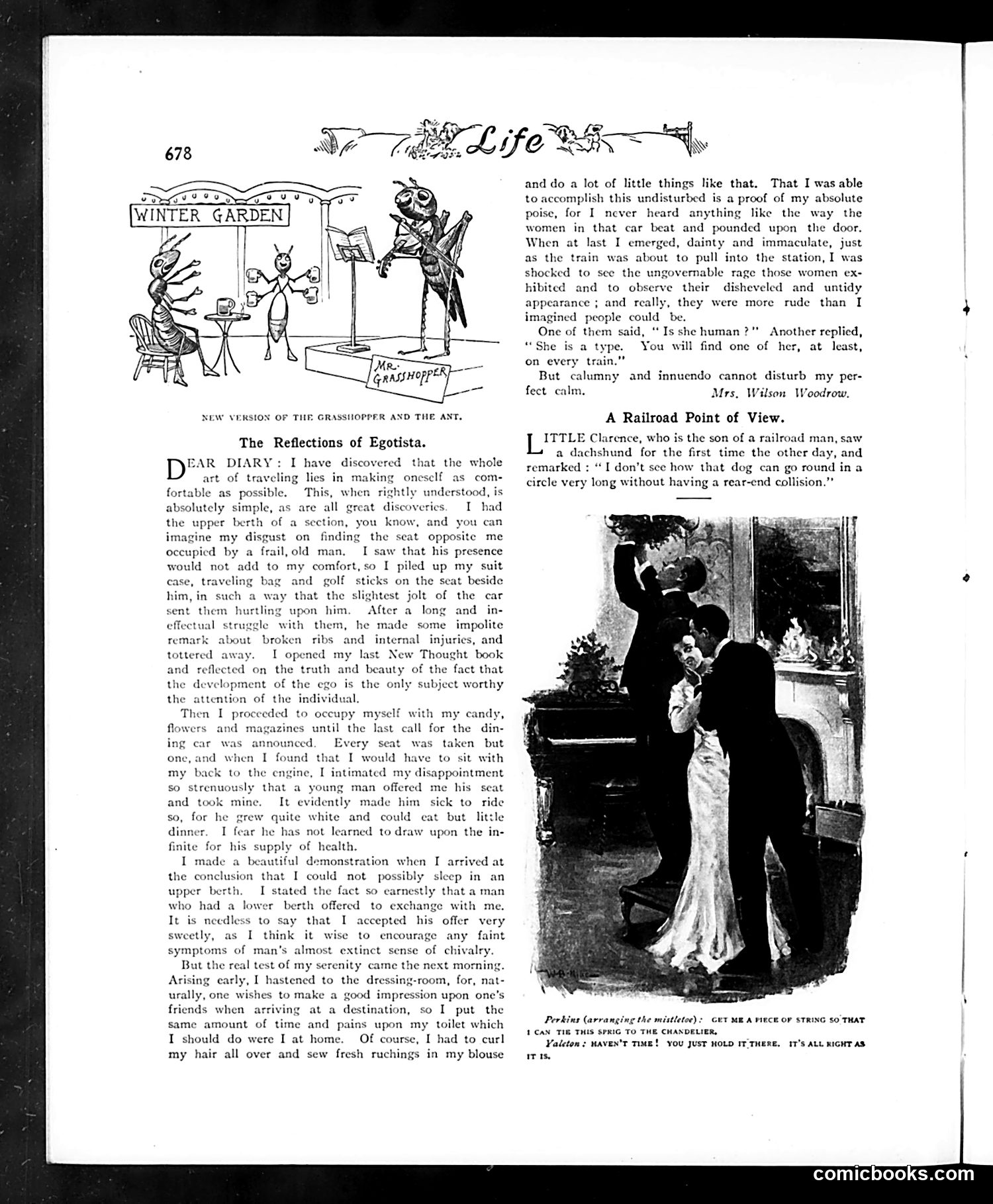
**"The Reflections of Egotista"** satirizes extreme self-centeredness disguised as spiritual enlightenment. The diary entry describes a train passenger who deliberately inconveniences others—hoarding seats, monopolizing bathroom time, accepting sacrifices from fellow travelers—while justifying this rudeness through "New Thought" philosophy (a popular early 20th-century self-help movement emphasizing ego development). The satire peaks when other passengers, exhausted and disheveled, call her out, but she dismisses their "calumny" as proof of her superior "perfect calm." The author's attribution to "Mrs. Wilson Woodrow" (likely mocking First Lady Ellen Wilson) adds social commentary. **"A Railroad Point of View"** is a brief joke: a railroad man's son sees a dachshund and quips that its elongated body resembles a train that couldn't navigate a circle without a "rear-end collision"—crude railroad humor. The page mocks both self-absorbed narcissism dressed in spiritual language and working-class practical comedy.
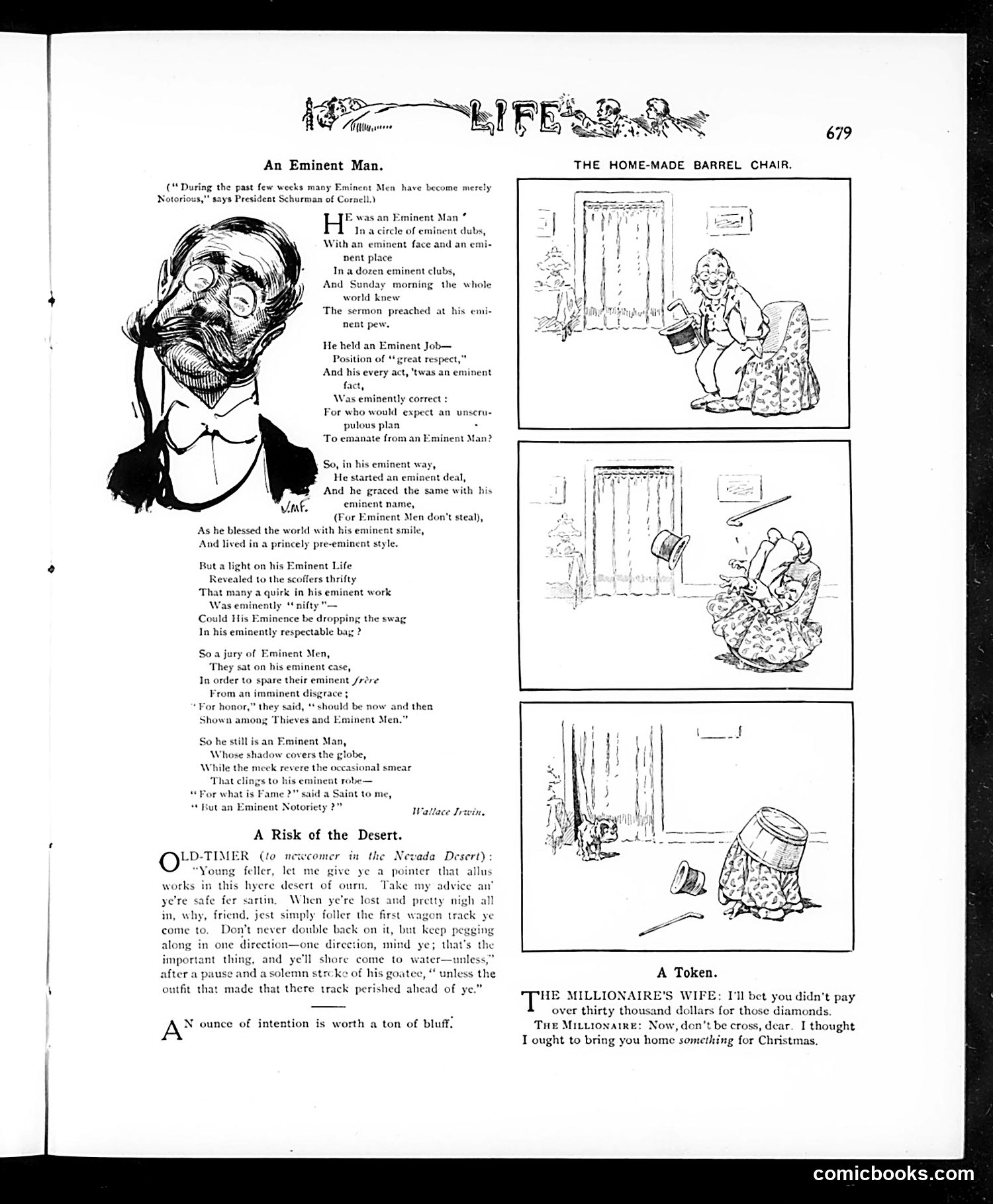
**"An Eminent Man"** satirizes prominent figures who maintain respectable public images while engaging in questionable dealings. The poem, attributed to Wallace Irwin, mocks how society blindly trusts "Eminent Men" in prestigious clubs and positions, assuming their status guarantees virtue. The caricatured face suggests a specific public figure (likely referencing a contemporary scandal), and the satire climaxes when such a man faces a jury of peers who protect him to avoid "imminent disgrace"—suggesting corruption within elite circles protects the powerful. **"The Home-Made Barrel Chair"** is instructional humor showing how to construct furniture from household materials, relevant to early-20th-century DIY culture. **"A Risk of the Desert"** offers frontier wisdom about navigation: follow wagon tracks when lost, but beware if the original outfit perished. **"A Token"** is a brief domestic joke about gift-giving and marital diplomacy during Christmas season. The page's core message critiques how eminence and social position shield wrongdoing from accountability.
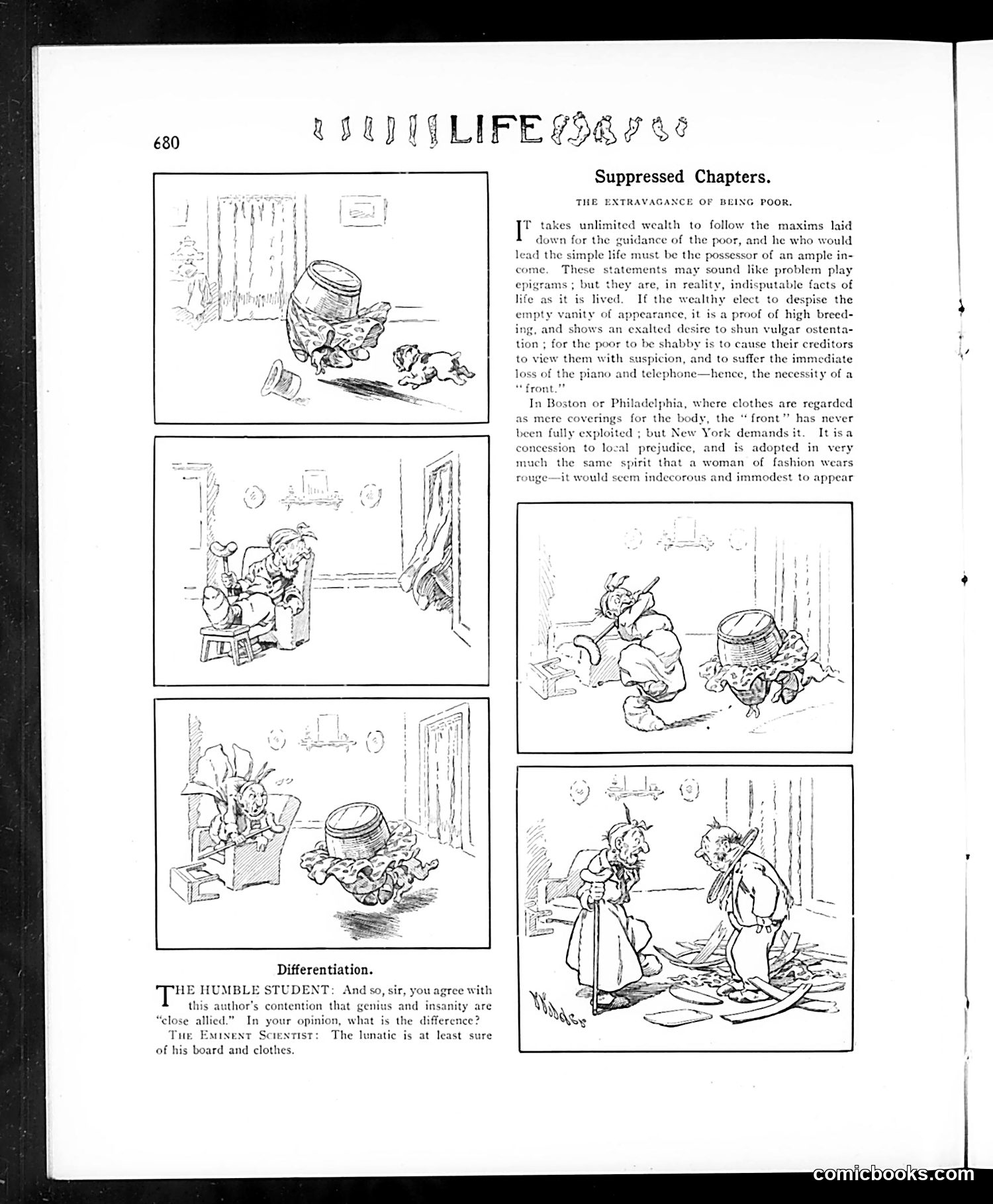
This page contains two distinct satirical pieces: **"Differentiation"** (bottom): A short joke contrasting a "humble student" with an "eminent scientist" debating genius versus insanity. The scientist's punchline—that a lunatic at least has guaranteed food and shelter—satirizes the precarious economic position of intellectuals and the poor, suggesting that even madness offers security unavailable to struggling scholars. **"Suppressed Chapters: The Extravagance of Being Poor"** (right side): A longer satirical essay mocking social hypocrisy about poverty and appearance. It argues that while the wealthy can afford shabby clothes as a sign of refined indifference to fashion, the poor *must* maintain a respectable appearance ("front") to avoid creditors' suspicion and social shame. The accompanying cartoons illustrate poor families struggling with domestic disorder and poverty. The satire critiques how society expects the poor to maintain appearances they cannot afford, while the rich enjoy the luxury of indifference. Both pieces critique class inequality through ironic inversion of conventional morality.
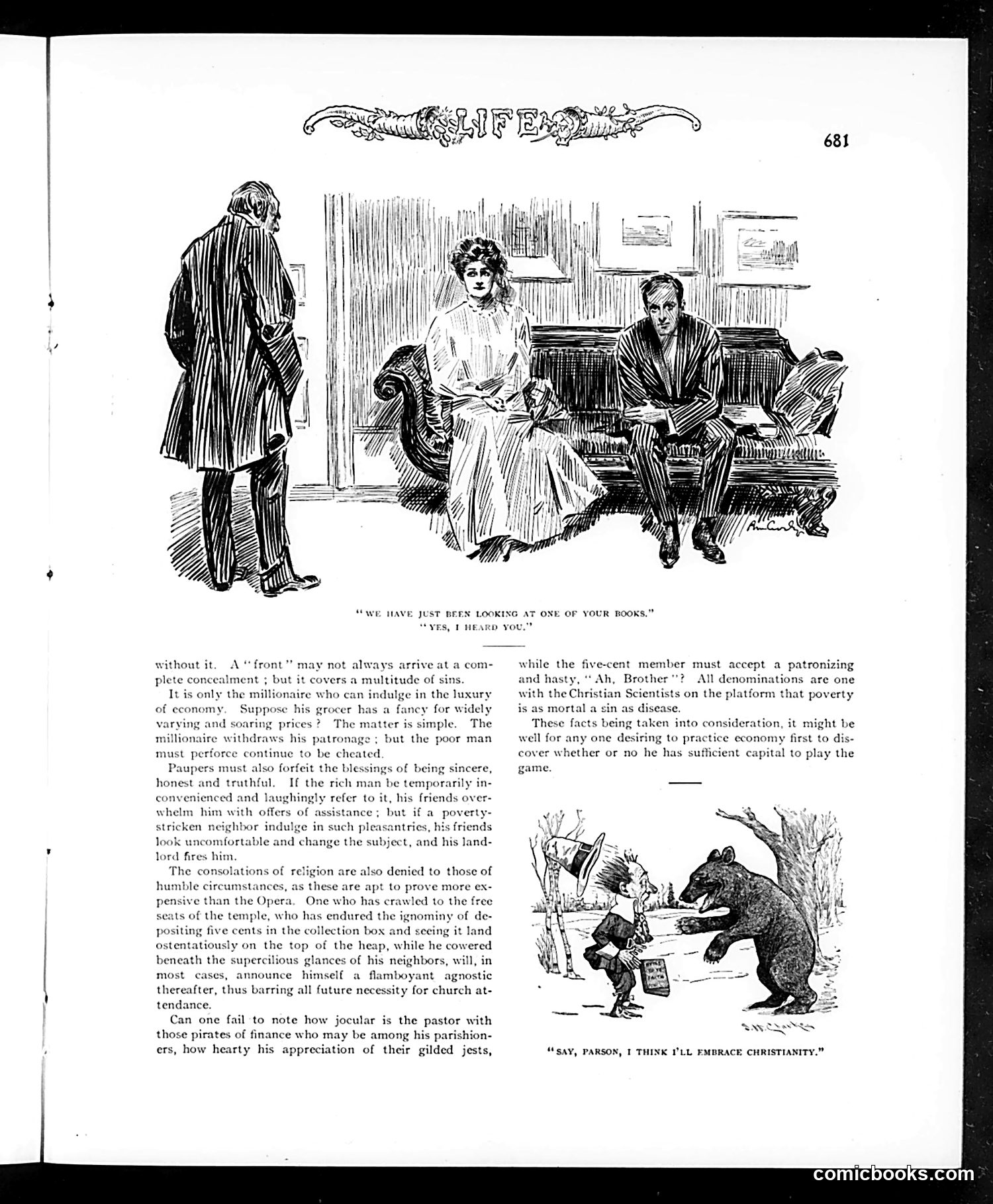
This page contains two satirical pieces critiquing hypocrisy in American religious and social institutions. **Upper cartoon**: A man discusses a book with what appears to be a wealthy couple in a drawing room. The caption "We have just been looking at one of your books"/"Yes, I heard you" suggests social awkwardness—likely mocking literary pretension or superficial cultural engagement among the affluent. **Main text**: A scathing essay argues that churches practice economic discrimination. The wealthy enjoy pastor's warmth and acceptance despite moral failings, while poor parishioners face condescension. The author notes that poor people who donate their meager five cents experience public humiliation, leading them to reject Christianity entirely rather than endure further embarrassment. **Lower cartoon**: A ragged, impoverished man tells a parson he'll "embrace Christianity," but the context makes clear this is bitter irony—he won't actually convert because the church has demonstrated it reserves dignity and acceptance for the rich. The satire's central point: **American churches are hypocritical institutions that commodify morality, welcoming the wealthy while shaming the poor.**
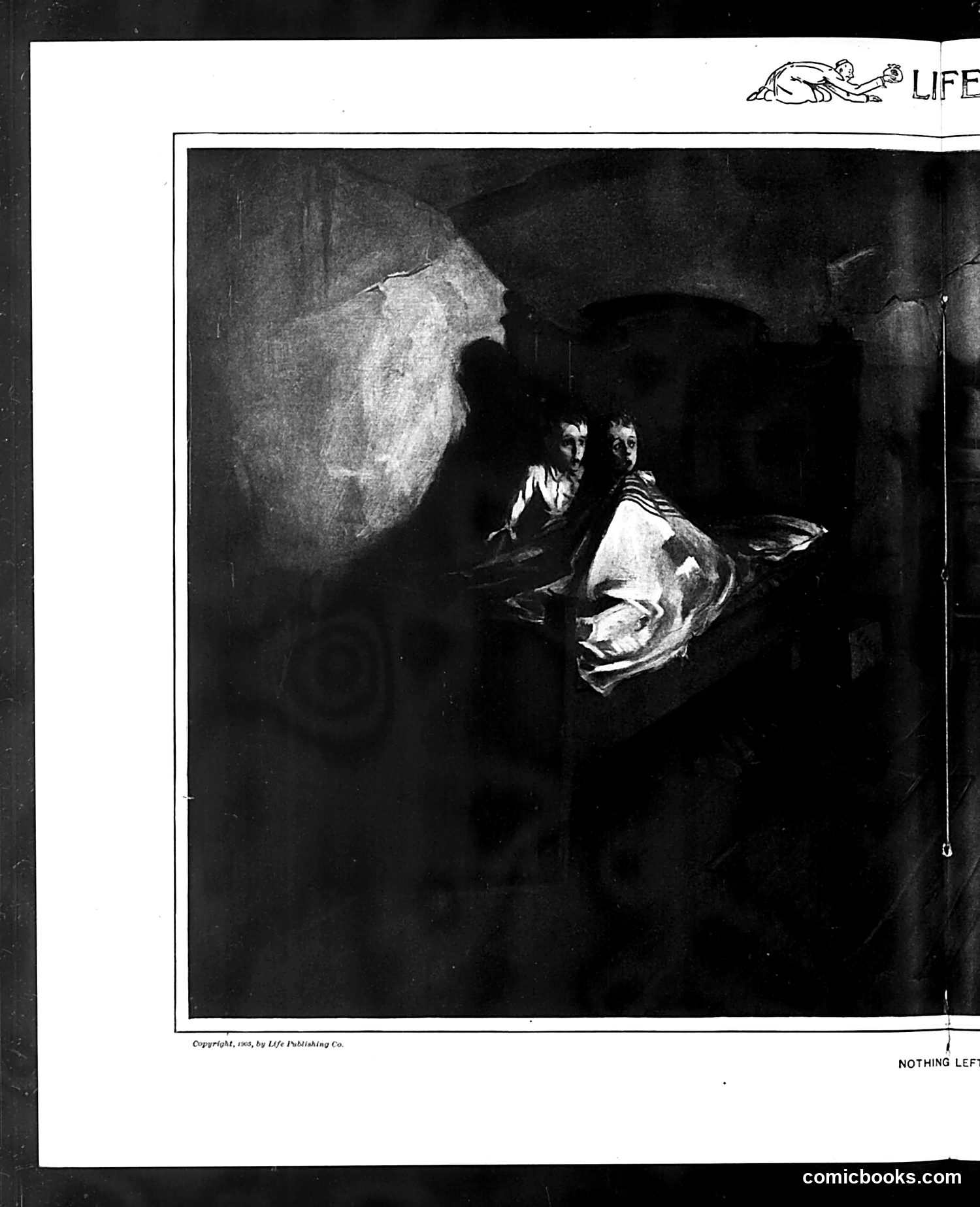
This appears to be a dramatic illustration from Life magazine (copyright date likely 1903, based on OCR). The image shows two figures in dark clothing observing a ghostly or luminous face appearing on a wall—possibly representing a supernatural apparition or vision. The style suggests this is likely political or social satire, though without clearer identifying details or accompanying caption text visible in the OCR, I cannot confidently identify the specific figures or the precise contemporary reference being lampooned. The haunting imagery could reference spiritualism (popular in that era), political ghosts from the past, or a specific scandal or controversy of 1903. To accurately explain what point the cartoon makes, I would need either a caption or clearer context than the image alone provides.
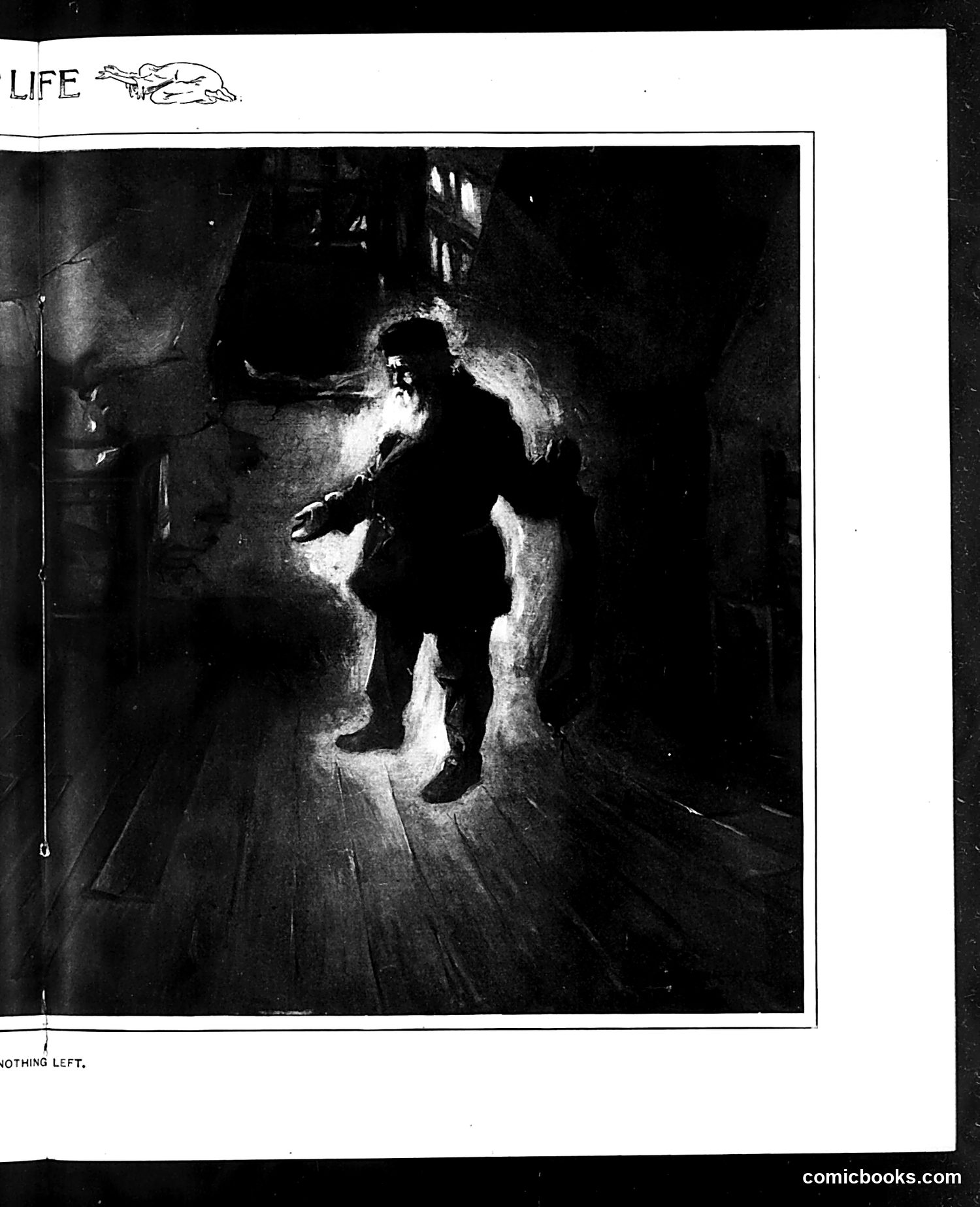
This appears to be a dramatic illustration from Life magazine showing a solitary figure in what looks like a dark, confined space—possibly a basement, bunker, or prison cell. The figure is depicted in silhouette against lighter walls, creating stark contrast. The partial caption reads "NOTHING LEFT," suggesting themes of desolation, loss, or desperation. Without the complete text or additional context, the specific political or social commentary remains unclear. The image's stark, expressionistic style and confined setting suggest commentary on human suffering, poverty, or wartime devastation—common subjects for Life's satirical content during the 20th century. However, without the full caption and publication date, identifying the specific figure or historical reference would require speculation beyond what the image alone supports.
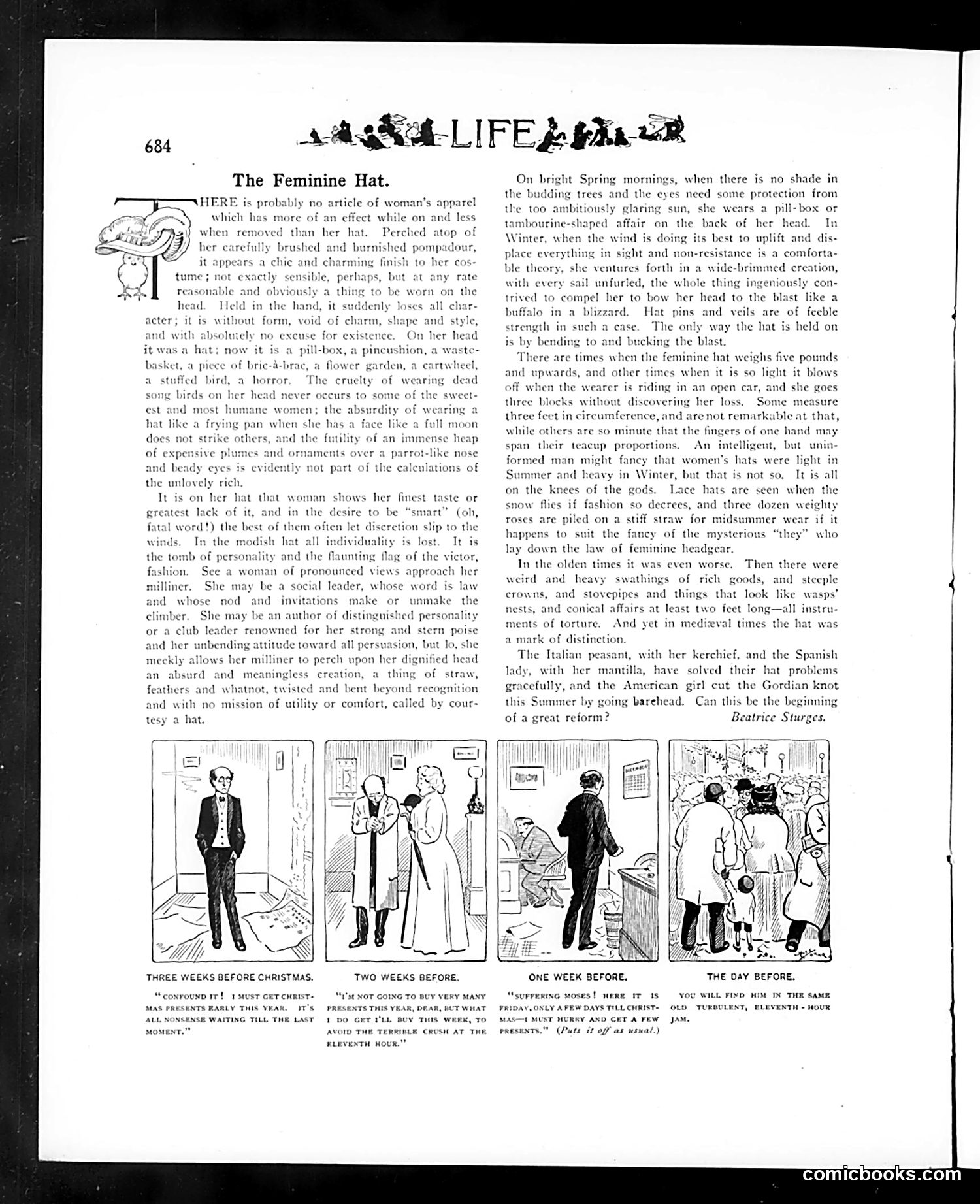
This article satirizes women's fashionable hats of the early 20th century. The author argues that while hats appear elegant when worn, they're impractical, uncomfortable, and illogical—yet women prioritize fashion over sense. The piece mocks how hat sizes and weights vary absurdly by whim rather than season, how they're difficult to secure in wind, and how they require women to contort their bodies uncomfortably. The satire contrasts fashionable Western women with Italian peasants and Spanish ladies, who solve the "hat problem" practically with simple kerchiefs and mantillas. The accompanying comic strip depicts a man's escalating frustration as his wife repeatedly claims she must shop early to avoid crowds—yet arrives home empty-handed each time. The central joke: women's adherence to arbitrary fashion dictates (symbolized by mysterious "they") overrides practical judgment, making the feminine hat emblematic of female irrationality regarding style.
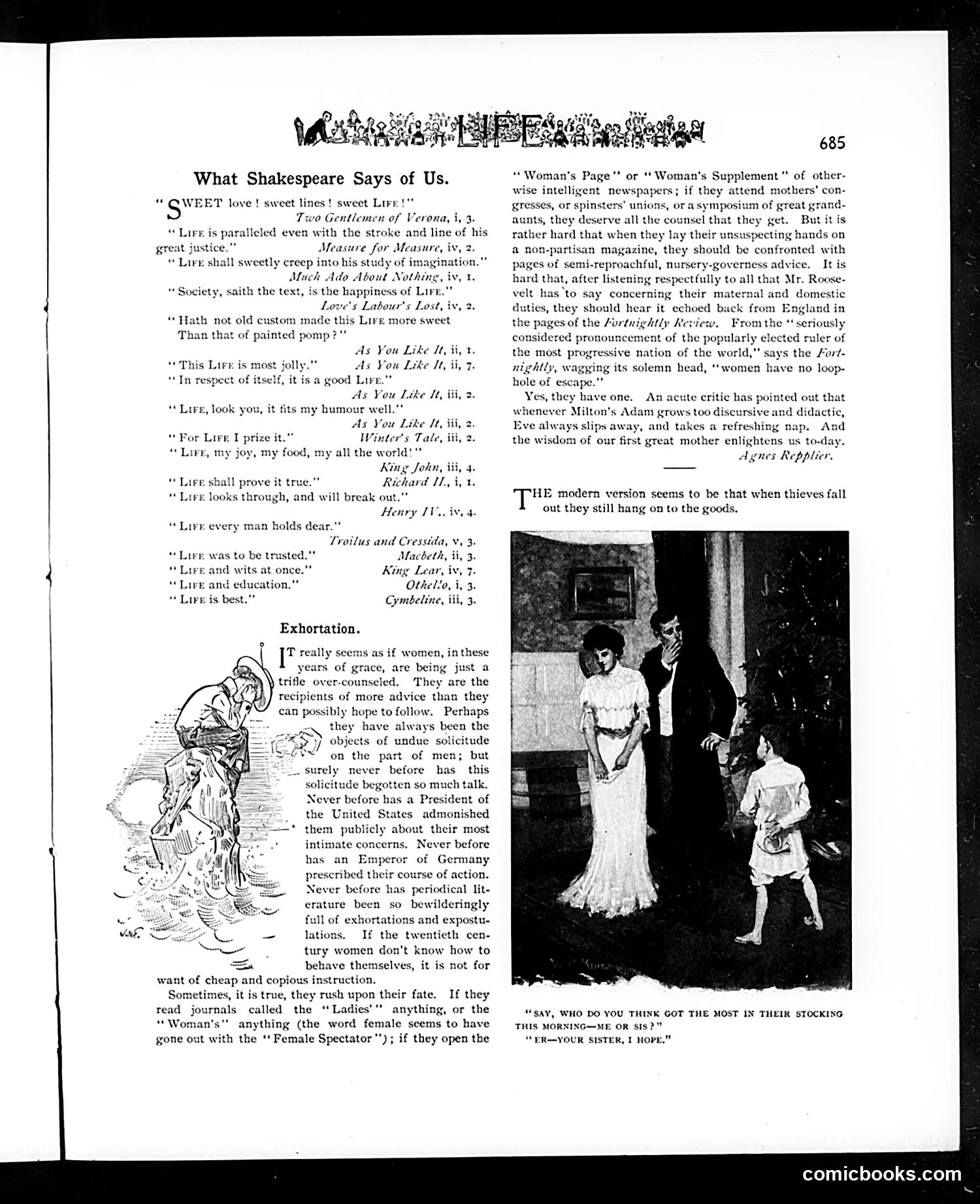
This page satirizes the excessive advice directed at women in the early 20th century. The text argues that women are being over-counseled by presidents, emperors, newspapers, and periodicals about their behavior and conduct—an unprecedented phenomenon. The **left cartoon** depicts a figure (likely representing advice-givers or society) pouring endless streams of guidance onto women, visually emphasizing the overwhelming nature of unsolicited counsel. The **right photograph** shows what appears to be a domestic scene with the caption about stockings—likely illustrating the trivial nature of much "women's advice," contrasting grand political pronouncements with petty household concerns. The page opens with Shakespeare quotes about "life" to establish that wisdom about living isn't new, then pivots to mock modern experts (Roosevelt is explicitly mentioned) for treating women like children needing instruction. The satire's point: if twentieth-century women lack sense, it's not from insufficient guidance—they're drowning in it.
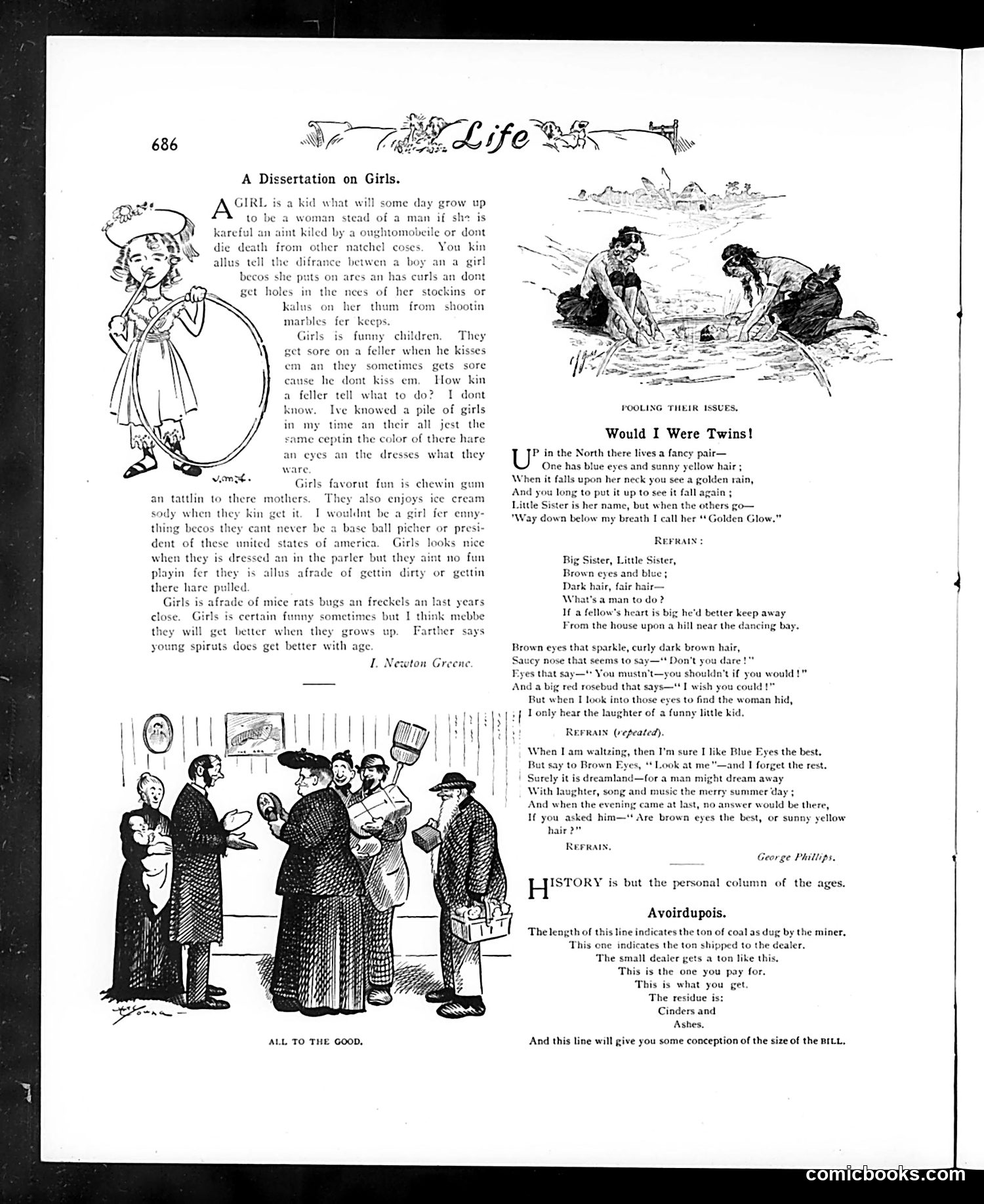
This page contains three distinct pieces of satire from *Life* magazine: 1. **"A Dissertation on Girls"** (left): A humorous essay by L. Newton Greene stereotyping girls' behavior—they're accident-prone, enjoy tattling and chewing gum, fear mice and getting dirty. The accompanying cartoon shows adults discussing girls, likely parents or guardians. The satire mocks both sentimental attitudes about girlhood and their perceived frivolity. 2. **"Would I Were Twins!"** (right, top): A romantic poem about two sisters—one with blue eyes and blonde hair, the other with brown eyes. The refrain expresses the speaker's romantic dilemma choosing between them. This appears gentle satire of sentimental Victorian romance tropes rather than sharp political commentary. 3. **"Avoirdupois"** (right, bottom): This is economic/consumer satire. The diagram shows how coal dealers cheat customers: the line indicating coal "dug by the miner" is longest, the amount "shipped to the dealer" shorter, what "you pay for" shorter still, but "what you get" is smallest—with the difference being "cinders and ashes." This exposes fraud in the coal trade.
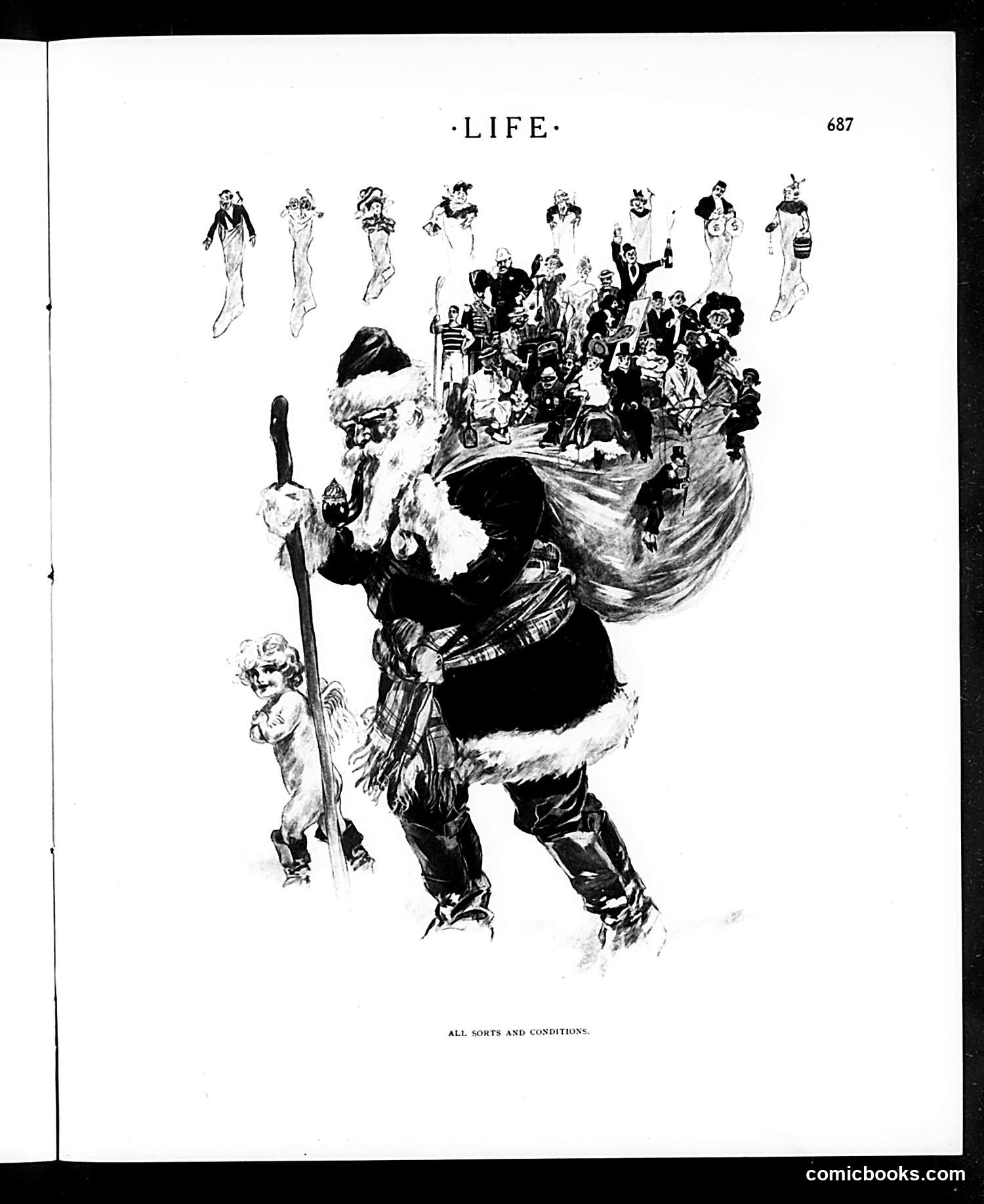
This satirical illustration depicts Santa Claus as a massive figure carrying a sack overflowing with diverse people representing different social classes and conditions. The caption "All Sorts and Conditions" suggests commentary on wealth distribution or social inequality during the Christmas season. The smaller figures floating above Santa appear to represent various social types—wealthy individuals, working people, and others—possibly satirizing the notion that Santa (or charitable giving/holiday spirit) serves "all sorts" equally. The composition critiques either the inadequacy of seasonal charity to address class divisions, or perhaps the irony of Christmas goodwill claims amid persistent social stratification. The artistic style and *Life* magazine context suggest early-to-mid 20th century American social commentary.
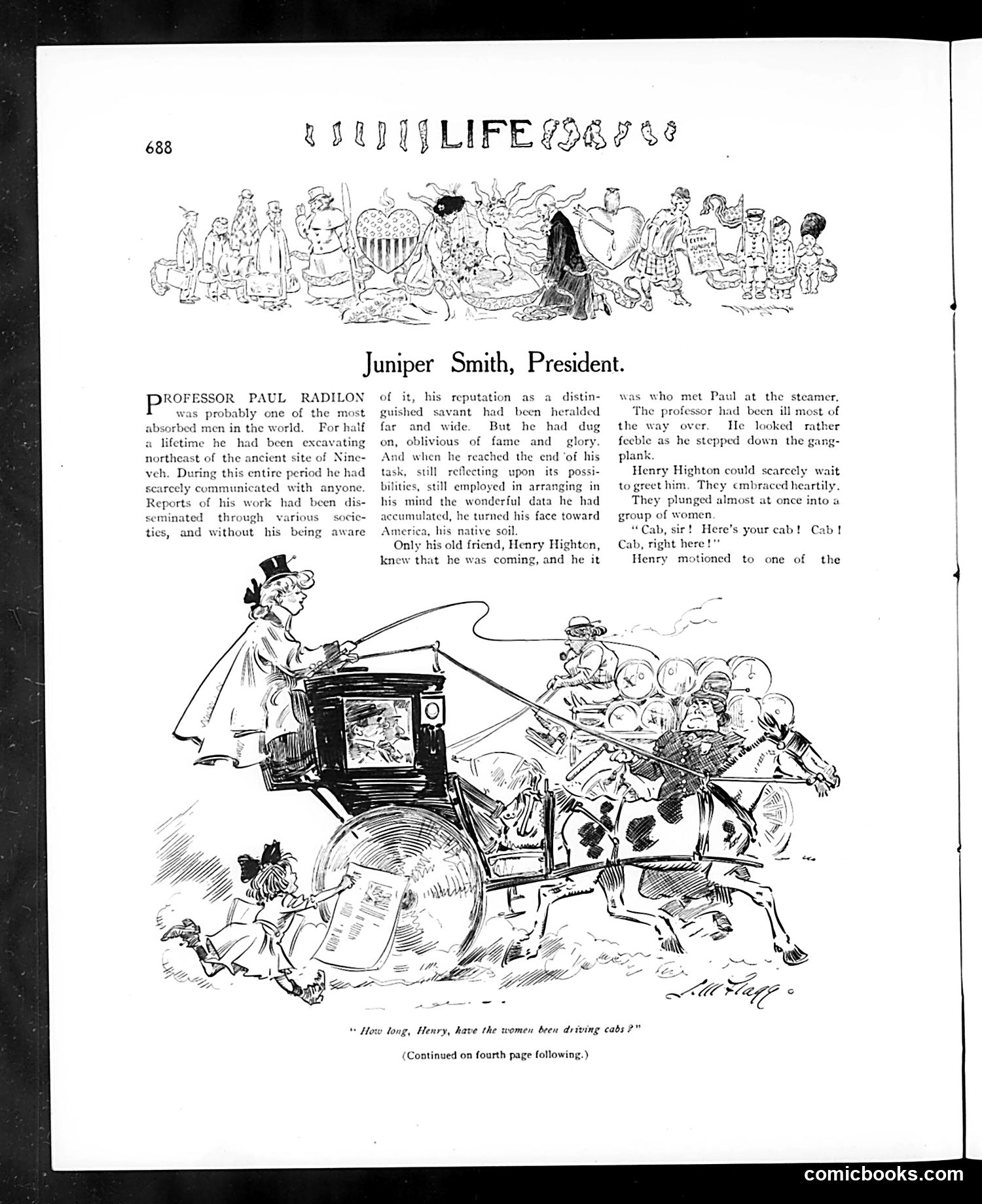
This page from *Life* magazine features a satirical story titled "Juniper Smith, President" about Professor Paul Radilon, an absent-minded scholar returning from archaeological digs in Nineveh (ancient Mesopotamia). The main cartoon depicts a chaotic, whimsical scene: women are driving a cab pulled by what appears to be an unusual creature or contraption laden with baggage. The humor centers on Henry Highton's surprised question: "How long, Henry, have the women been driving cabs?" **The satire targets:** - Women's changing social roles, likely referencing WWI-era shifts when women entered the workforce in unprecedented numbers - The "New Woman" phenomenon of the early 20th century—women working in traditionally male occupations like taxi-driving - The implied shock/humor of this social change presented through the oblivious professor's return to a transformed society The cartoonist uses the professor's disconnection from current events as a framing device to highlight social upheaval. This reflects *Life* magazine's tradition of satirizing contemporary social anxieties through humorous exaggeration.
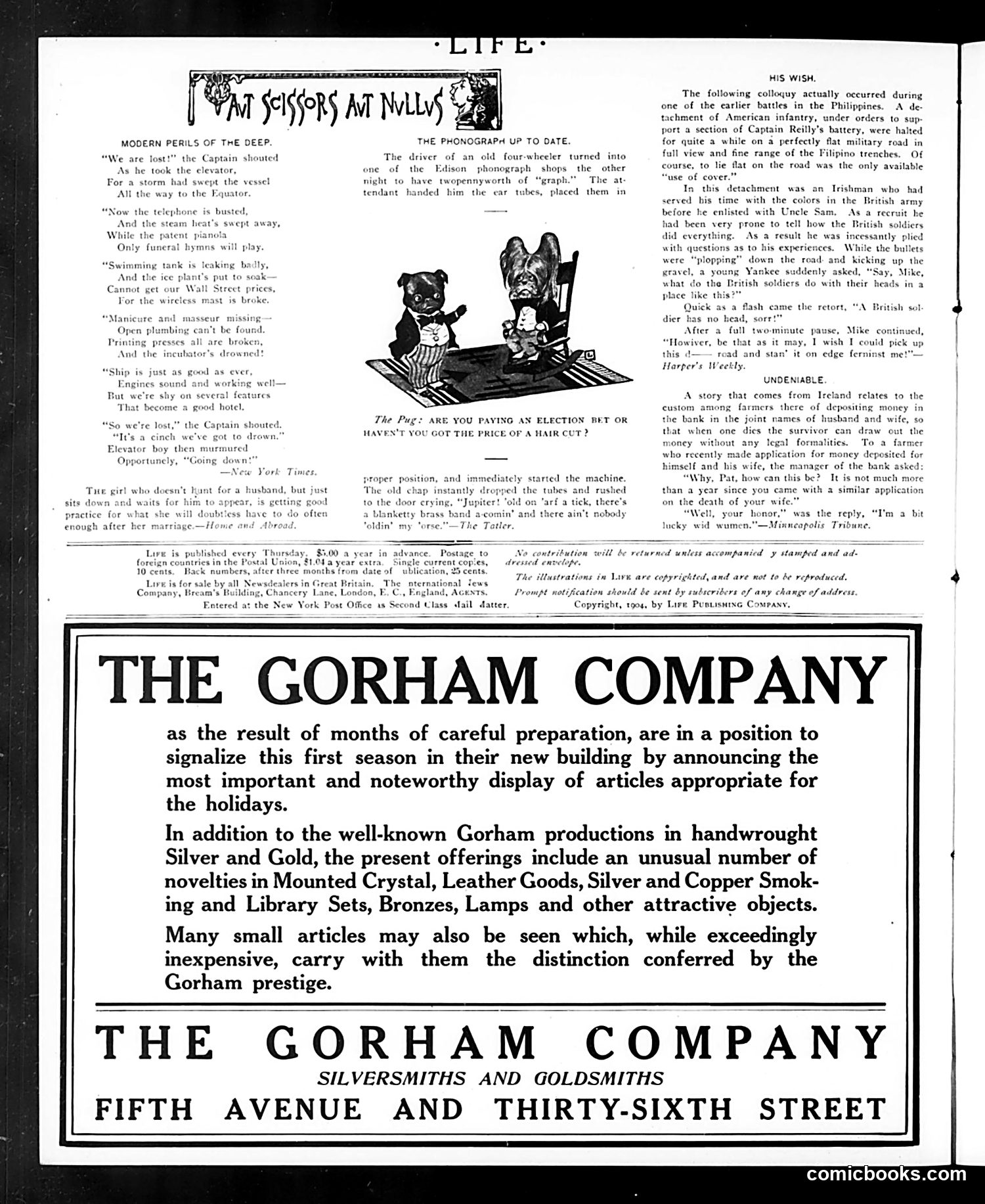
This page contains three distinct elements: **"Modern Perils of the Deep"** and **"The Phonograph Up to Date"** are satirical poems mocking contemporary anxieties—urban infrastructure hazards (elevators, pianos, plumbing) and new technology (phonographs). **"The Pug"** cartoon depicts two working-class men, one asking if the other is dodging an election bet or can't afford a haircut. This references early 1900s concerns about gambling and working-class financial struggles, while the pug dog suggests lower-class respectability issues. **"His Wish"** describes an actual anecdote from the Philippine-American War, where an Irish-American soldier serving under fire wishes he could pick up a wounded officer and carry him to safety—touching on themes of military duty, ethnic immigrant service, and combat reality. The page is primarily dominated by a **Gorham Company advertisement** for luxury silverware and holiday goods, positioning the satirical content as filler around commercial messaging—typical Life magazine layout of the era.
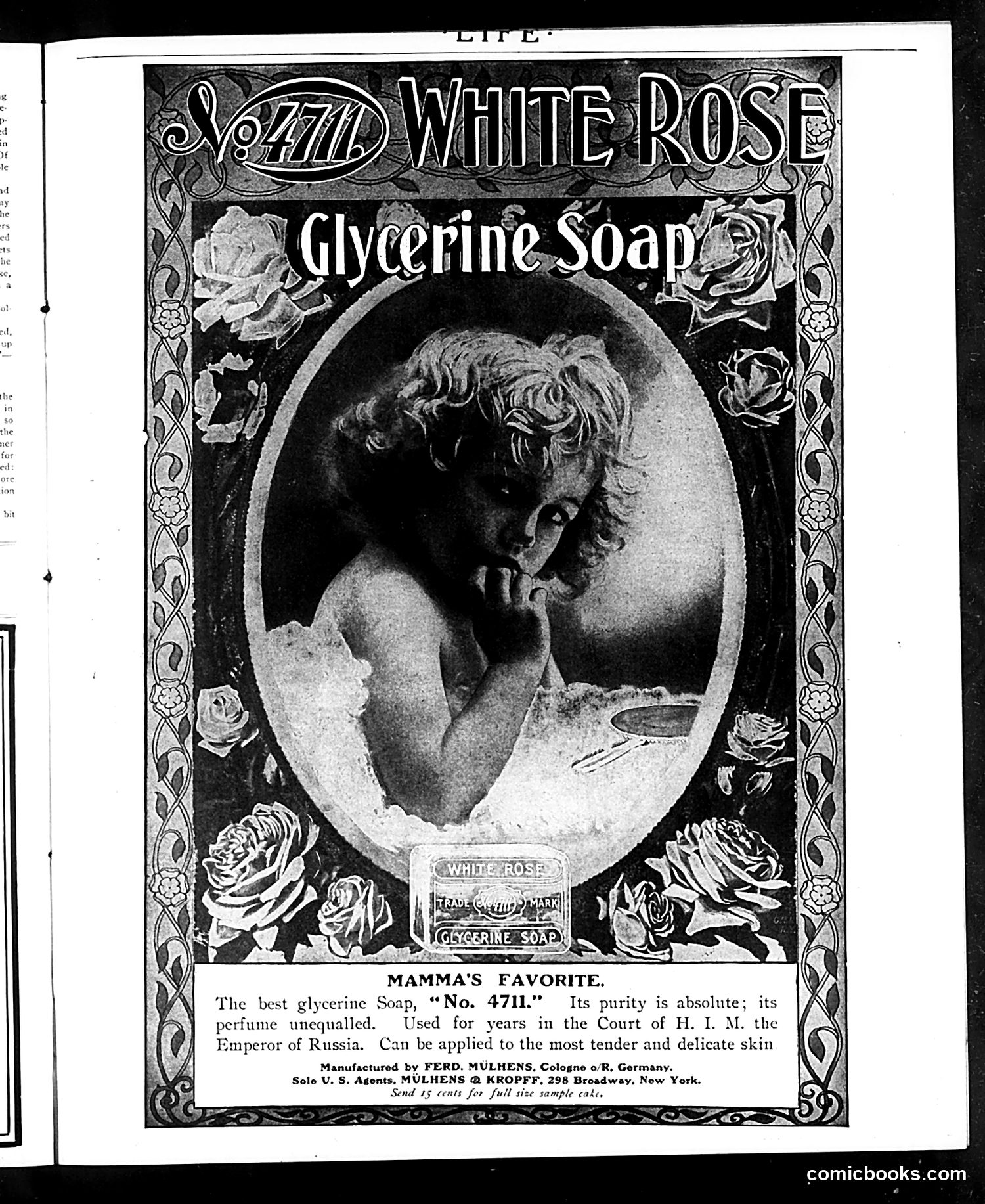
This is a **product advertisement**, not political satire. It promotes "No. 4711" glycerine soap manufactured by a German company (Ferd. Mülhens of Cologne). The ad uses a cherub or baby figure in an oval frame surrounded by decorative roses to convey gentleness and purity. The tagline "Mamma's Favorite" appeals to mothers concerned with tender skin care. The advertisement claims prestige by mentioning use "in the Court of H.I.M. the Emperor of Russia"—a common marketing strategy in the early 1900s, leveraging imperial endorsement for credibility. The ornate decorative border and classical imagery were typical of period advertising design. This represents straightforward product marketing rather than editorial commentary or satire.
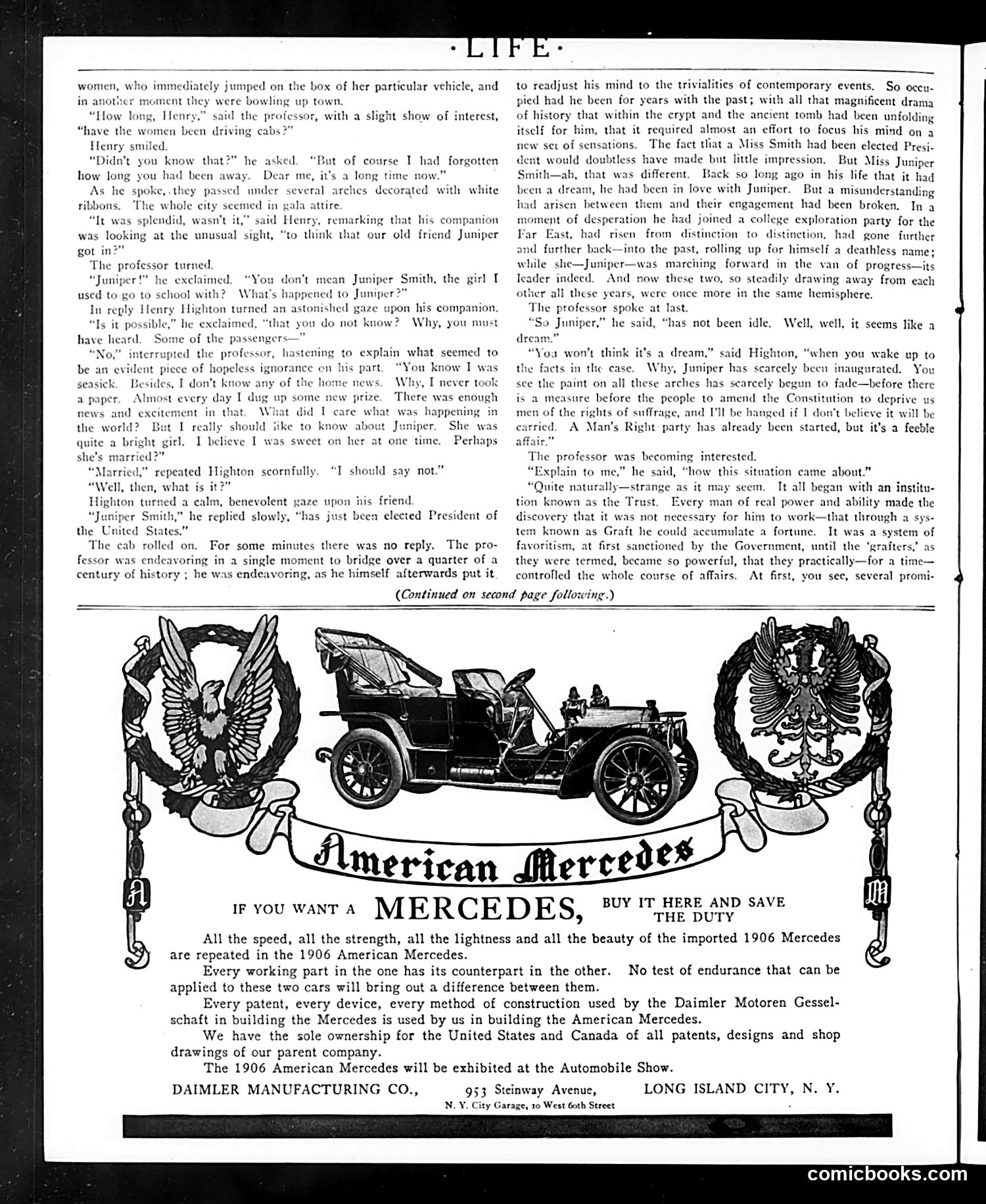
This page contains a serialized fictional story about a professor who encounters his old flame, Juniper Smith, now elected **President of the United States**—a satirical premise for the early 1900s when women couldn't vote, let alone hold office. The story mocks contemporary politics through this fantasy scenario. A character explains that Juniper rose to power after a system of "Graft" and "Trusts" corrupted government. Men accumulated fortunes through favoritism, prompting reform movements like "A Man's Right party"—likely satirizing actual women's suffrage debates by inverting them. The bottom half is a **Mercedes automobile advertisement** claiming the American-made version equals the imported German model, emphasizing patent ownership and manufacturing superiority. The satire targets both political corruption and gender role debates of the era, using an absurdist premise (female president) to comment on real institutional problems.
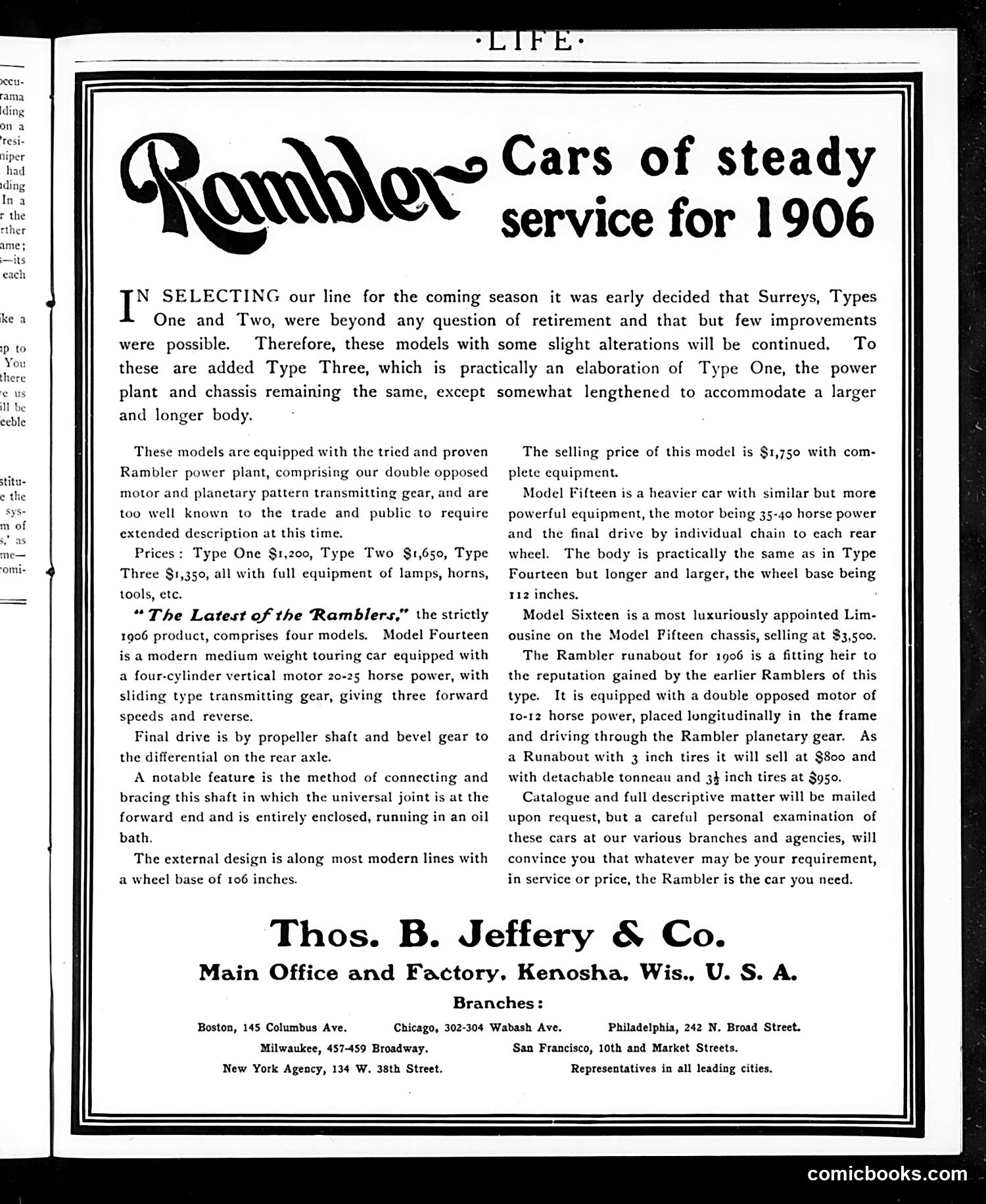
This is **not a cartoon or satire**, but rather a full-page **automobile advertisement** for the Rambler car company (Thomas B. Jeffery & Co.). The ad announces the 1906 model lineup, emphasizing reliability and incremental improvements rather than radical redesign. It describes four new models—Types Fourteen through Sixteen plus a runabout—with technical specifications (horsepower, transmission type, wheel base) and prices ranging from $800 to $3,500. The rhetorical strategy appeals to conservative buyers: existing models are "beyond any question of retirement," suggesting proven dependability. The company positions itself as nationally established, listing branches in major cities from Boston to San Francisco. For modern readers: this represents early automotive marketing, when cars were luxury goods requiring detailed technical explanation and personal inspection at dealerships.
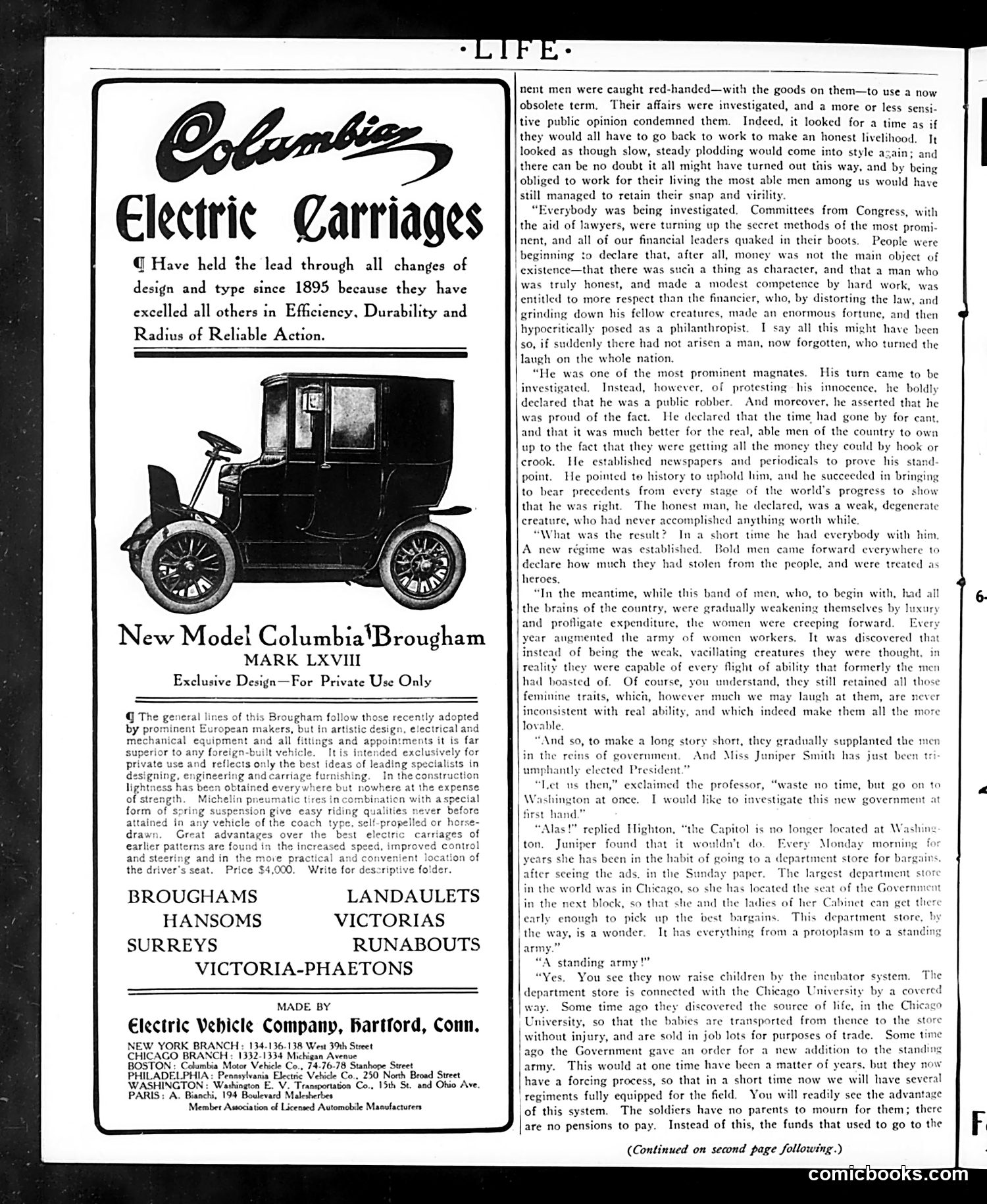
This Life magazine page is dominated by a **Columbia Electric Carriages advertisement** featuring the "New Model Columbia Brougham Mark LXVIII." The ad emphasizes the vehicle's efficiency, durability, and reliability since 1895. The right column contains **narrative fiction or editorial content** (OCR partially corrupted) discussing political corruption and reform. The text describes prominent financiers being "caught red-handed," investigated by Congressional committees, and forced to confront public condemnation. It appears to reference a specific magnate who provocatively declared himself a "public robber" and established newspapers defending wealthy men's right to accumulate wealth "by hook or crook." The passage then shifts to describing women's advancement into the workforce, suggesting they proved capable despite being previously underestimated. **Without clearer OCR or publication date confirmation**, the specific scandal referenced remains unclear—though the anti-corruption sentiment suggests this addresses early 20th-century muckraking era controversies.
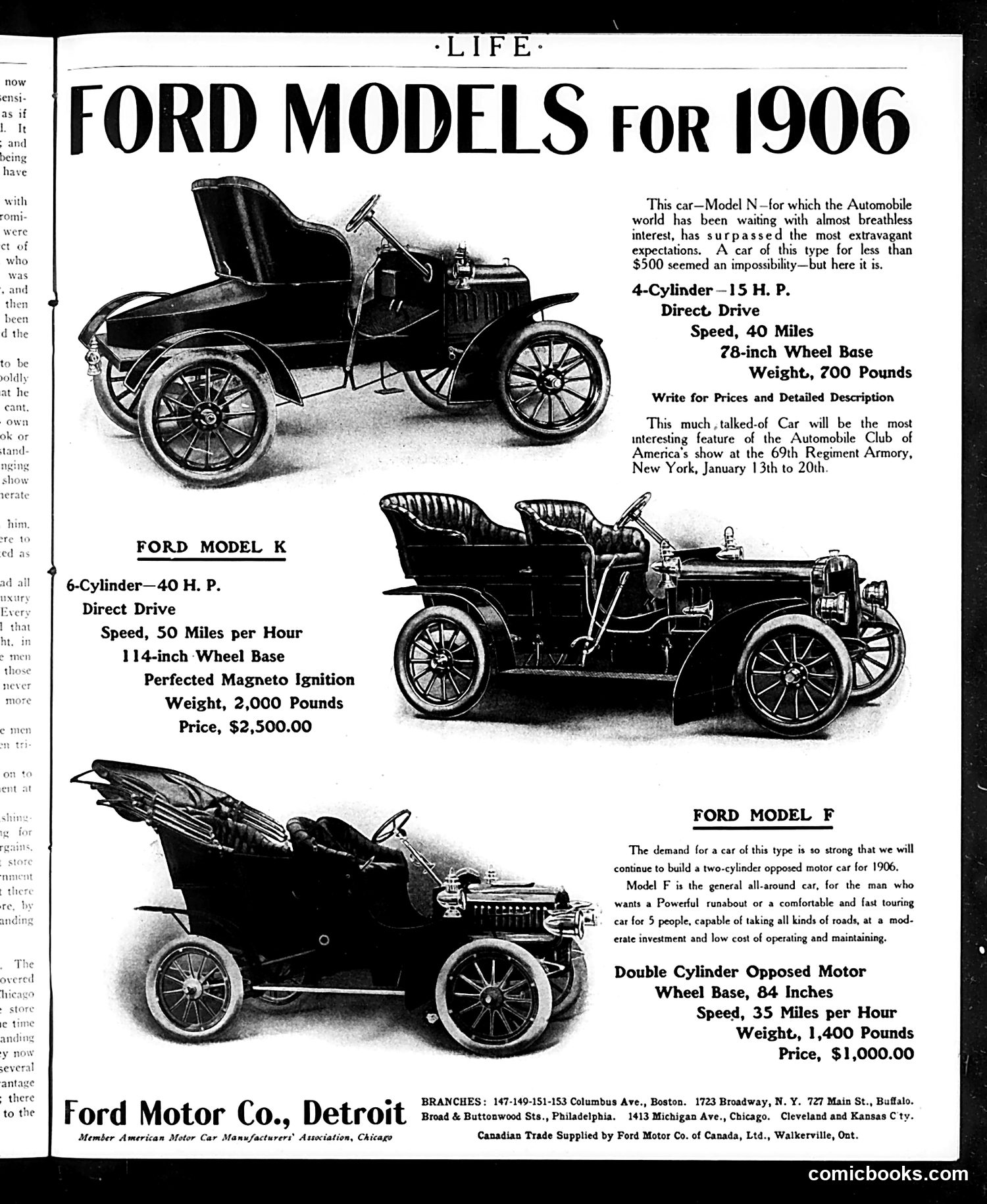
This is not a political cartoon but a **product advertisement** for Ford Motor Company's 1906 automobile lineup, published in *Life* magazine. The page showcases three Ford models with specifications and prices: - **Model N**: A 4-cylinder, 15 H.P. car priced under $500—presented as revolutionary for making automobiles affordable to ordinary Americans - **Model K**: A premium 6-cylinder, 40 H.P. vehicle at $2,500 - **Model F**: A mid-range 2-cylinder car at $1,000 The significance lies in the **Model N's affordability claim**. Ford is marketing this vehicle as democratizing automobile ownership—previously, cars were luxury goods for the wealthy. The advertisement emphasizes performance specs (speed, wheel base, weight) to reassure buyers of quality despite the low price. This represents an early moment in Ford's strategy of mass-market automobile manufacturing, preceding the Model T (1908) by two years.
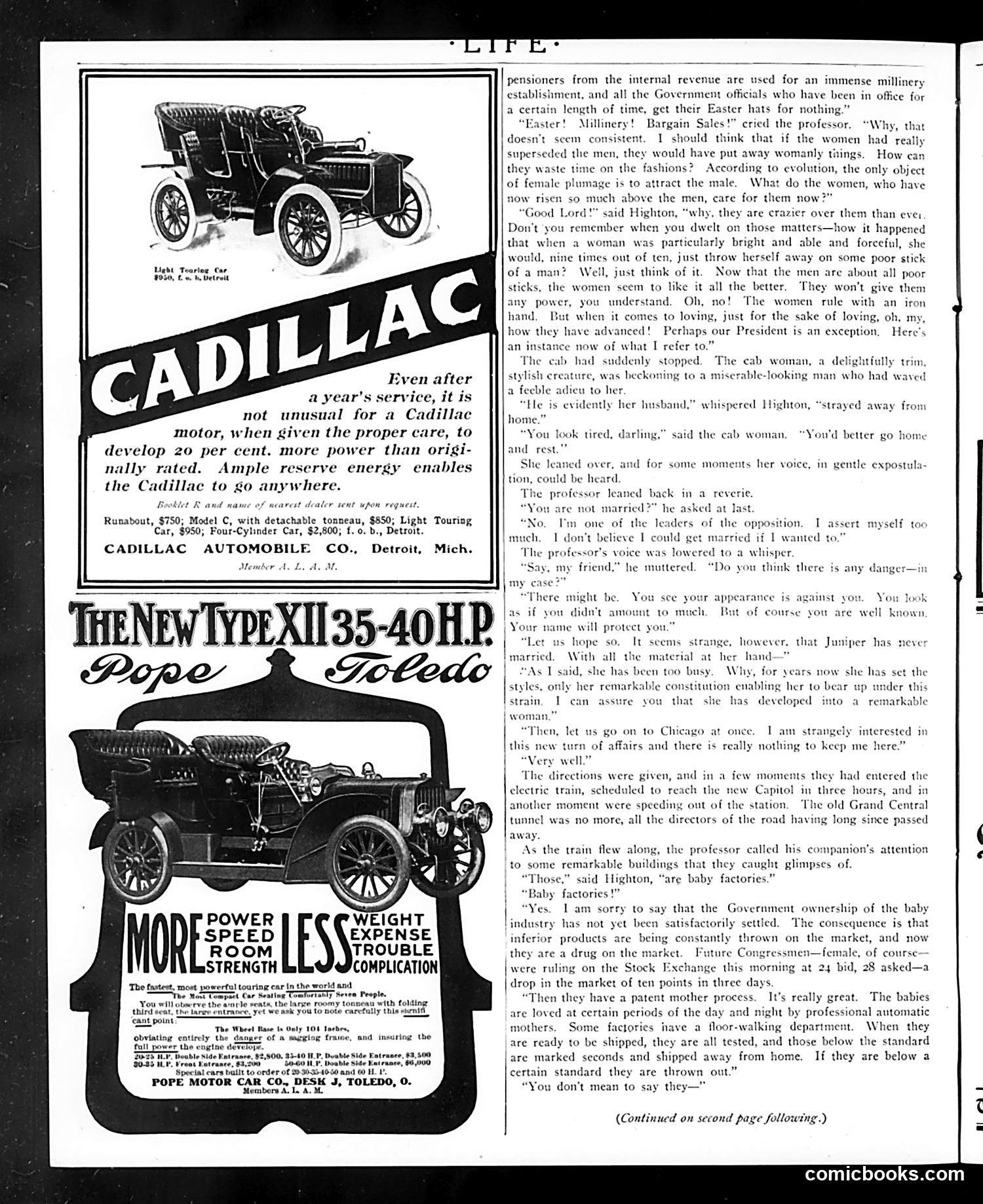
This page presents **satirical fiction about a future society where women have achieved political and economic dominance**, alongside period automobile advertisements. The narrative excerpt depicts a professor and companion observing a female cab driver who supports her idle husband—illustrating the satire's central joke: despite women's supposed "supersession" of men, they remain emotionally devoted to them and invested in fashion and appearance. The professor notes the contradiction between female advancement and traditional female interests. The story references "baby factories" (likely government institutions), suggesting a speculative-fiction critique of progressive social reforms. The satire appears to mock both feminist aspirations and the contradictions the author perceived in women's liberation movements of the era. The accompanying **Cadillac and Pope Toledo automobile advertisements** represent standard early-1900s marketing, emphasizing power, reliability, and value—contrasting sharply with the satirical text about social upheaval.
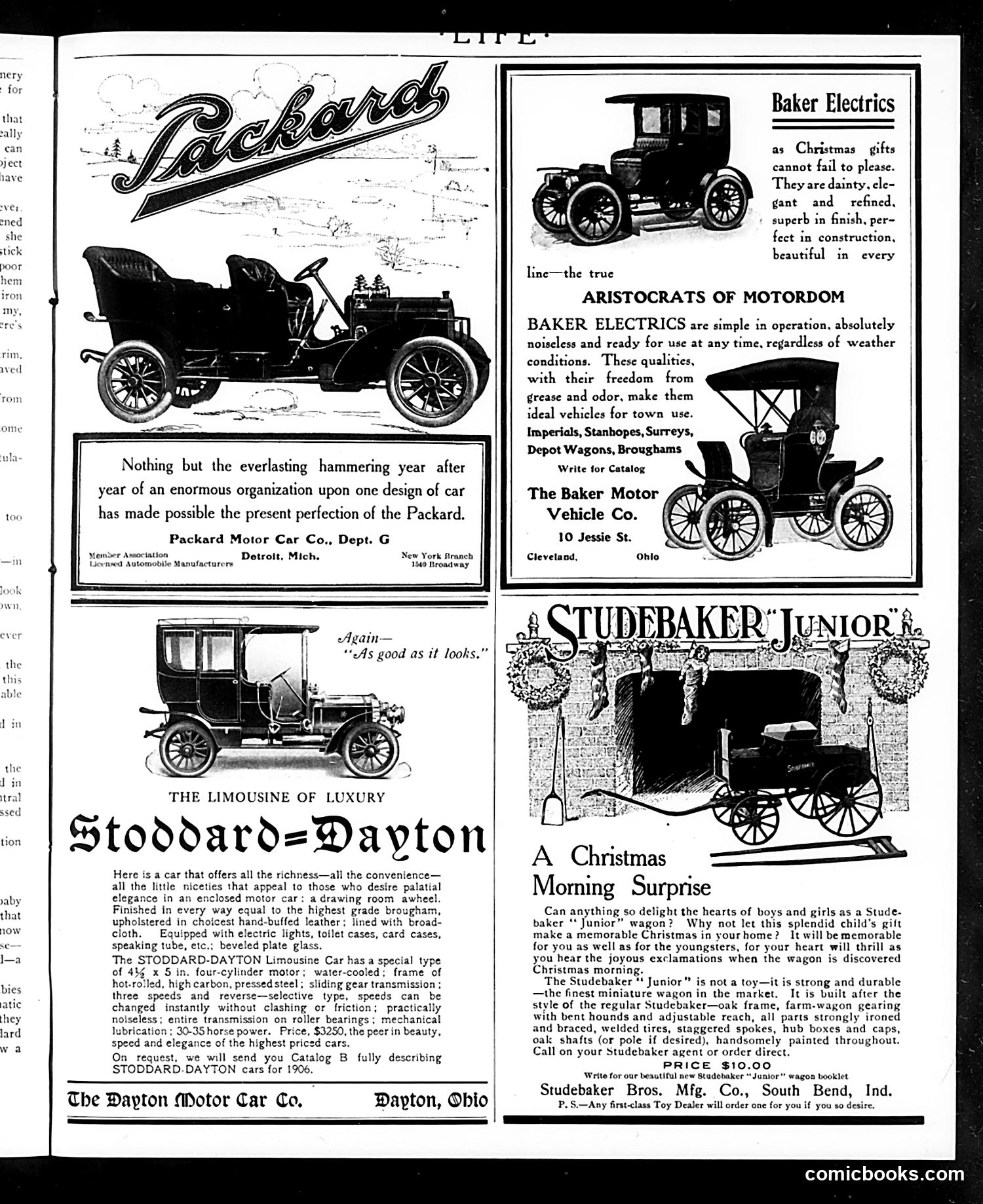
This page contains **no cartoons or satire**—it is purely **automobile advertising**. Four manufacturers promote luxury vehicles as Christmas gifts: 1. **Packard** emphasizes perfection through organizational consistency 2. **Baker Electrics** markets electric cars as refined, quiet, odor-free vehicles ideal for town use by wealthy women 3. **Stoddard-Dayton** promotes an expensive enclosed limousine ($3,250) with luxurious amenities like electric lights and toilets 4. **Studebaker Junior** advertises a toy wagon ($10) for children, emphasizing durability and realistic design The implicit social commentary is **class-based**: these ads target wealthy Americans for whom automobiles represent status symbols and leisure. Electric cars are specifically pitched as appropriate for refined, genteel users. The Studebaker ad suggests even children of the wealthy should own miniature versions of adult vehicles. There is no satirical critique visible—this reflects genuine early-automotive-era marketing aimed at the affluent.
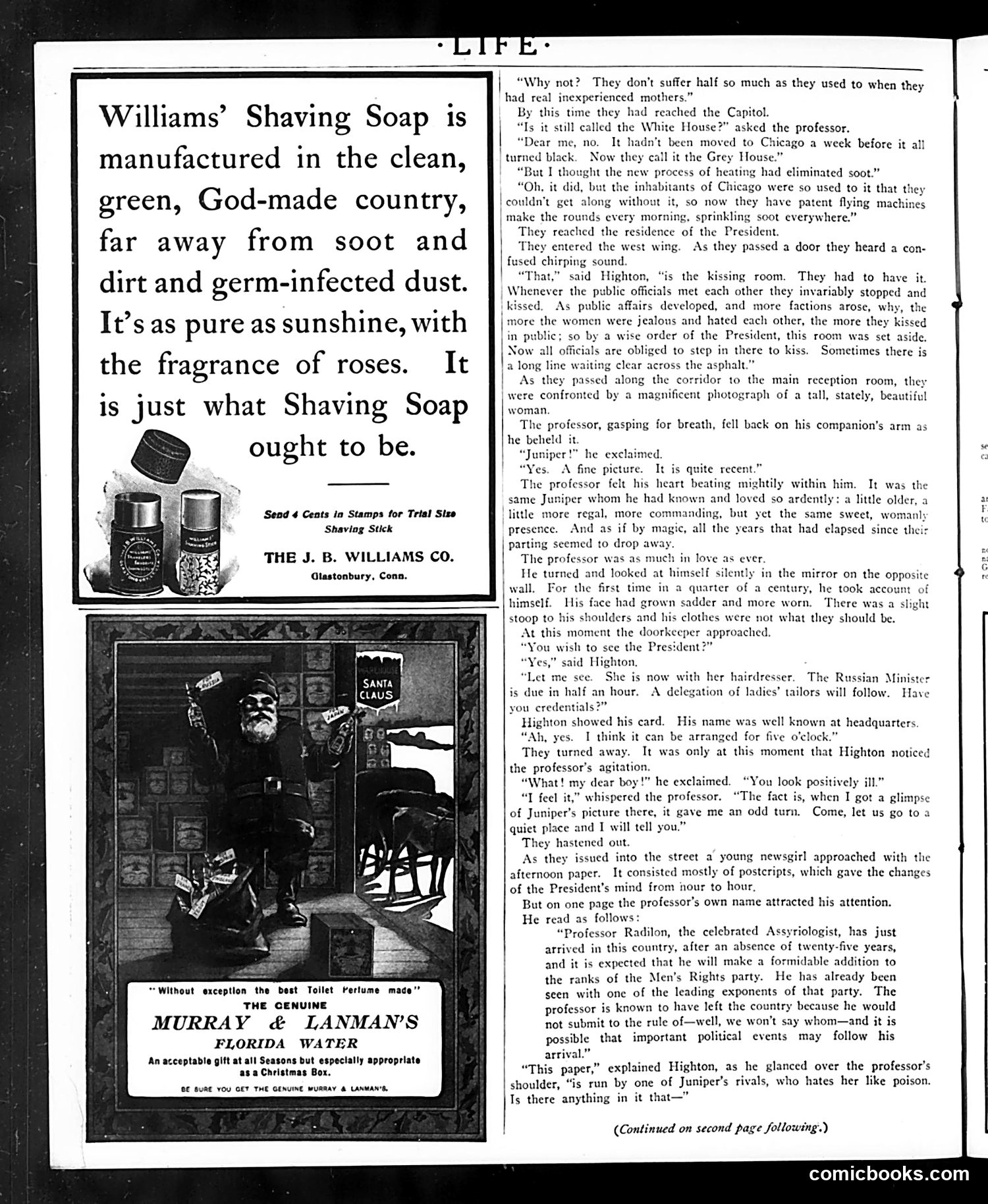
This page contains two advertisements (Williams' Shaving Soap and Murray & Lanman's Florida Water) alongside a serialized satirical story about a professor visiting Washington, D.C. The narrative satirizes early 20th-century America through a European professor's perspective. Key satirical points include: **Chicago dominance**: The joke that Chicago's influence has literally blackened the White House ("Grey House"), and the President now employs "patent flying machines" to sprinkle soot everywhere—mocking Chicago's industrial pollution and political clout. **Government kissing protocol**: Officials are so fractious that a dedicated "kissing room" exists to force civility, suggesting politicians' hypocrisy and performative harmony. **The female President**: A woman heads the government, shocking the professor. She prioritizes appointments with hairdressers and "ladies' tailors," satirizing both female leadership stereotypes and political frivolity. The professor's romantic rediscovery of "Juniper" (the President, apparently) adds melodramatic irony to the political commentary.
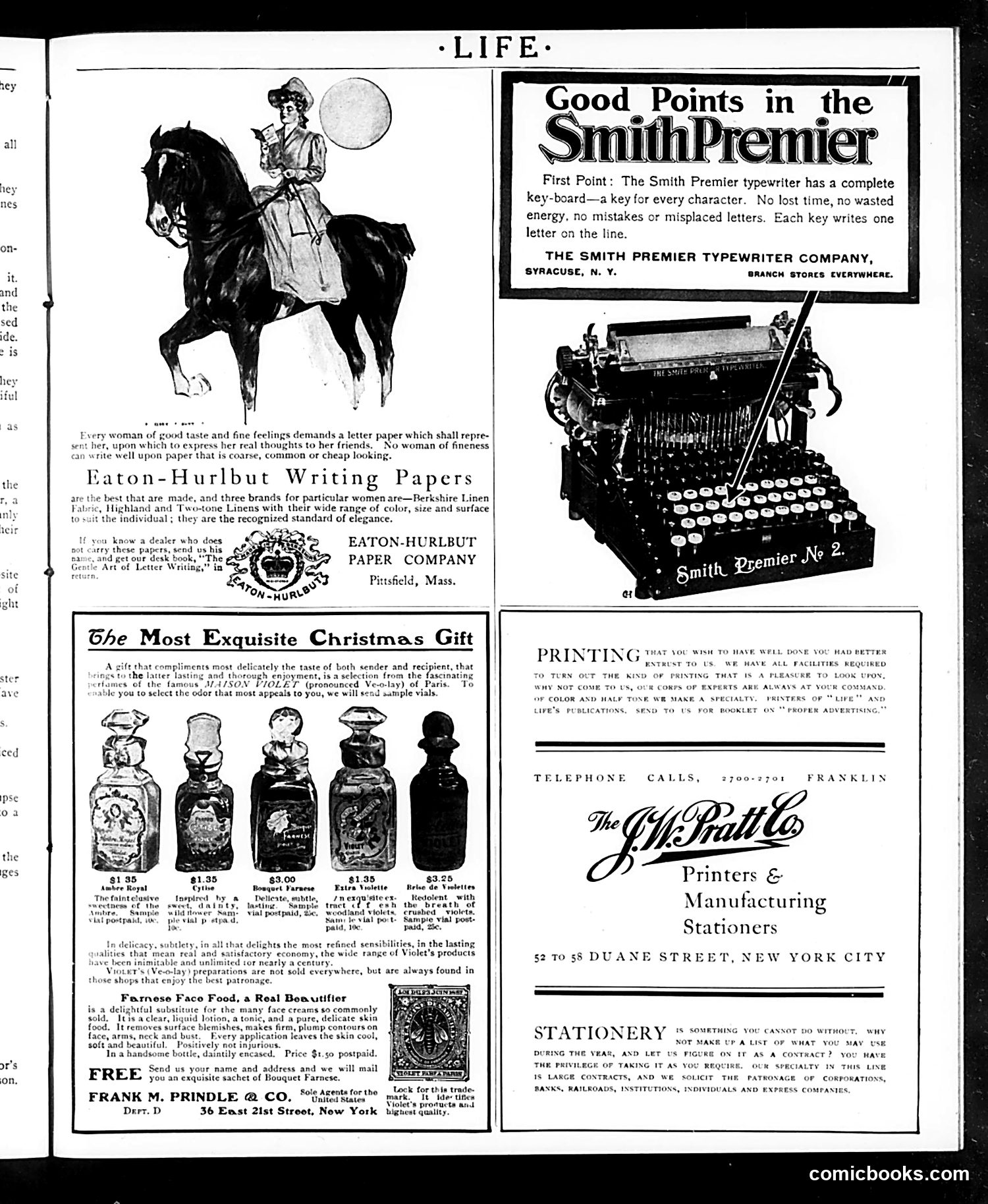
This page is **primarily advertising**, not political satire. It contains multiple product advertisements from the early 20th century targeting upper-class consumers. The prominent image shows a woman on horseback, illustrating an advertisement for **Eaton-Hurlbut Writing Papers**—the copy emphasizes that refined women require quality stationery to express their "real thoughts to her friends," appealing to notions of genteel femininity and social status. Other advertisements include: - **Smith Premier typewriters** (complete keyboard, no wasted effort) - **Violet perfume** (subtle luxury for discerning tastes) - **Farnese Face Food** (a skin beautifier promising "firm, plump contours") - **Printing and stationery services** for businesses The overall message reflects early 1900s class consciousness: quality paper, writing instruments, and appearance products signaled refinement and social standing. There is no political cartoon or satirical commentary visible—this is commercial advertising aimed at affluent readers.
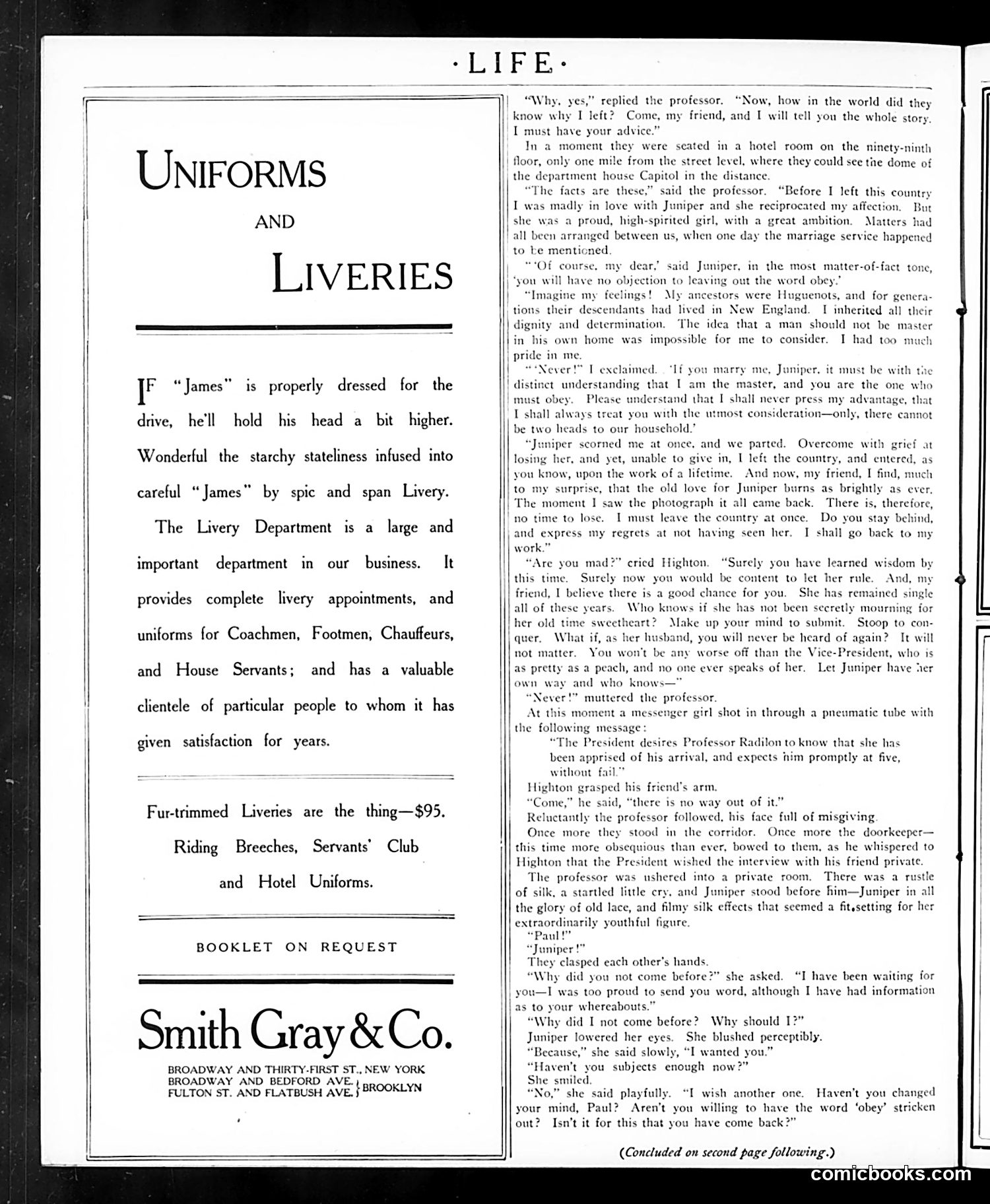
This page contains a serialized fictional story (not a political cartoon) from Life magazine, accompanied by an advertisement for Smith Gray & Co. livery services. **The Story's Context:** The narrative depicts a gender-role conflict common to early 20th-century satire. A proud professor of Huguenot descent refused to marry Juniper unless she agreed to "obey" in the marriage vows—a standard marital expectation then. She refused; he left the country. Years later, he's summoned back by "the President" (context unclear from this excerpt). **The Satire:** The humor targets rigid masculine pride. The professor's friend Highton suggests he should now accept Juniper ruling the household, sarcastically noting the Vice-President endures the same emasculation without complaint—a dig at contemporary politics, though the specific reference is unclear. **The Advertisement:** Promotes formal livery uniforms for servants and coachmen, emphasizing respectability through proper dress—a class-consciousness marker of the era. The story reflects anxieties about shifting gender dynamics in this period.
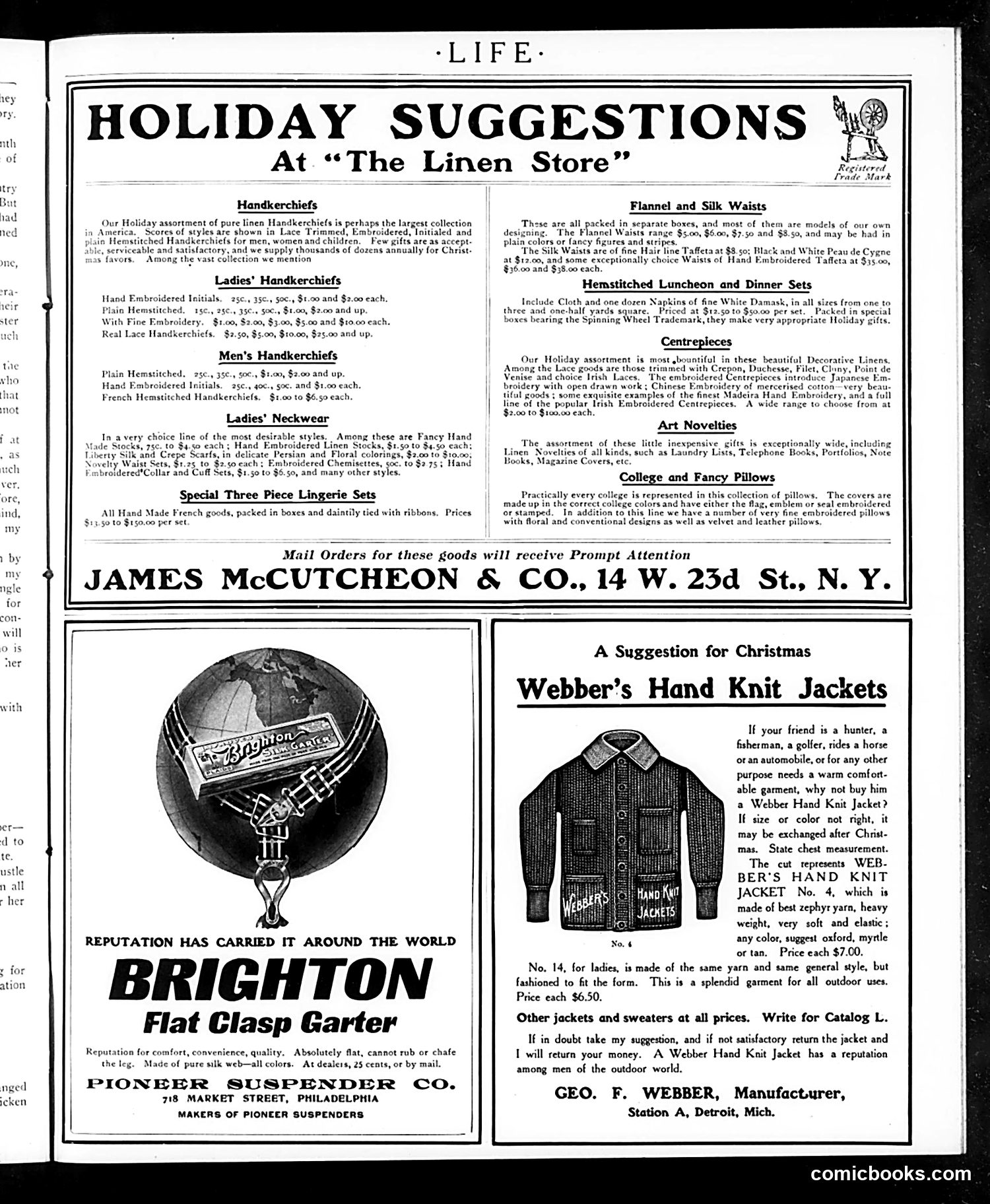
This is primarily a **retail advertising page** from Life magazine, not a political cartoon. It features holiday shopping suggestions from multiple merchants circa early 1900s. The main content includes advertisements for: - **James McCutcheon & Co.** (linen store): handkerchiefs, neckwear, waists, and embroidered linens - **Brighton Flat Clasp Garter** (suspenders): emphasizes comfort and quality, marketed as having "carried its reputation around the world" - **Webber's Hand Knit Jackets**: wool jackets for outdoor enthusiasts (hunters, fishermen, golfers), priced at $6.50-$7.00 The page reflects **turn-of-the-century consumer culture**, showcasing luxury gift items (hand-embroidered linens, French goods) aimed at middle/upper-class holiday shoppers. Prices range from 25 cents to $150, indicating a tiered market. No satire or political commentary is present—this is straightforward commercial advertising typical of Life's revenue model during this period.
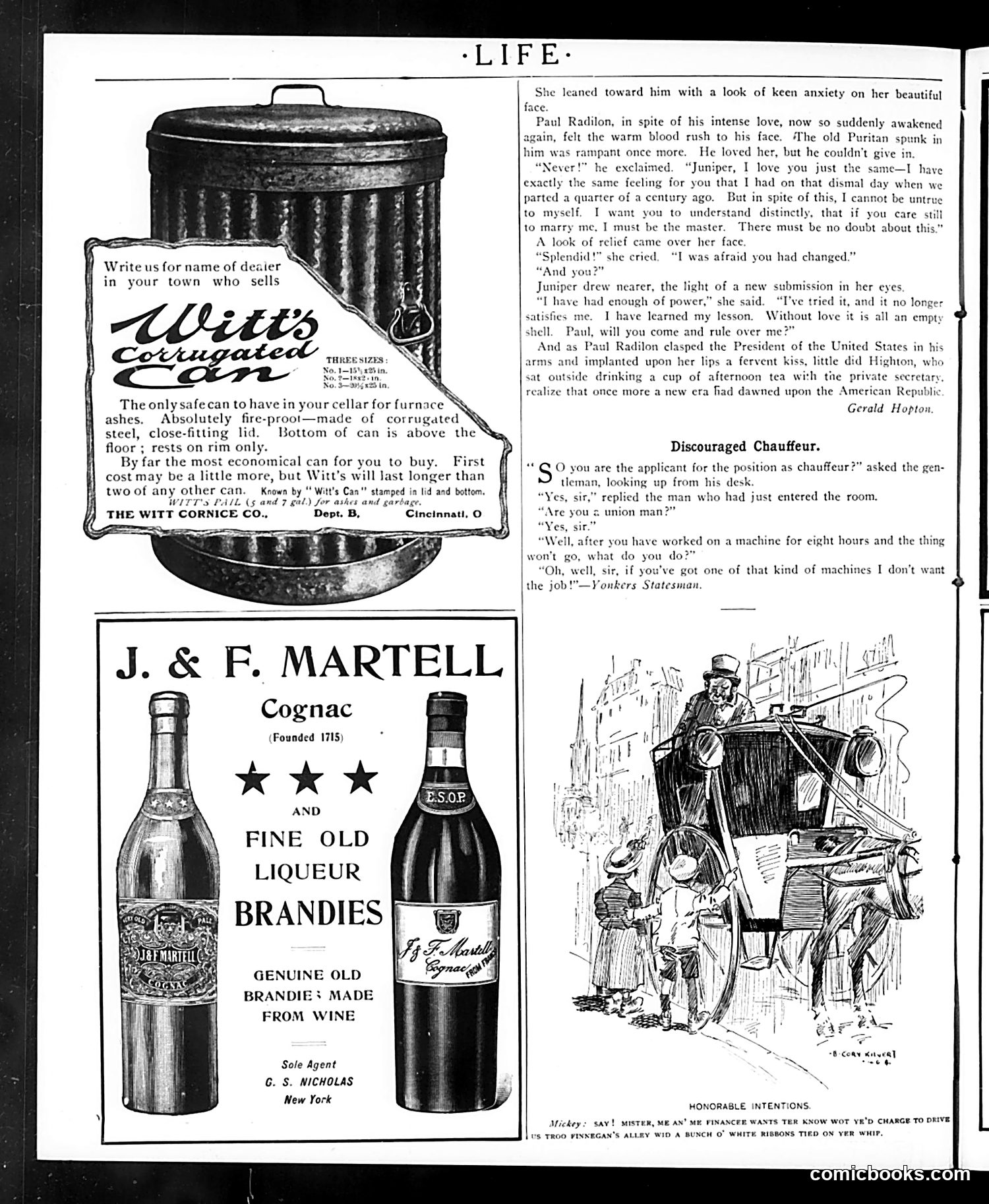
This page contains mostly **advertisements and humor pieces**, not political cartoons. **The ads** promote a Witt's ash can (fireproof storage) and J. & F. Martell Cognac brandy. **The humor pieces** include: 1. **"Discouraged Chauffeur"**: A job applicant rejects a chauffeur position after learning the employer has unreliable machinery—satirizing labor disputes and worker frustration with poor equipment. 2. **"Honorable Intentions"** (bottom): A comic exchange where "Mickey" asks a driver to charge for transporting them through an alley decorated with white ribbons, likely referencing wedding decorations. The humor appears to involve working-class courtship customs. 3. **A serialized romance story** (top right): Depicts a woman named Juniper and man named Paul Radilon reconciling after 25 years, with a subplot involving a U.S. President—typical sentimental fiction of the era. The page reflects **early 20th-century American humor**: labor tensions, class distinctions, and romantic melodrama were standard Life magazine content.
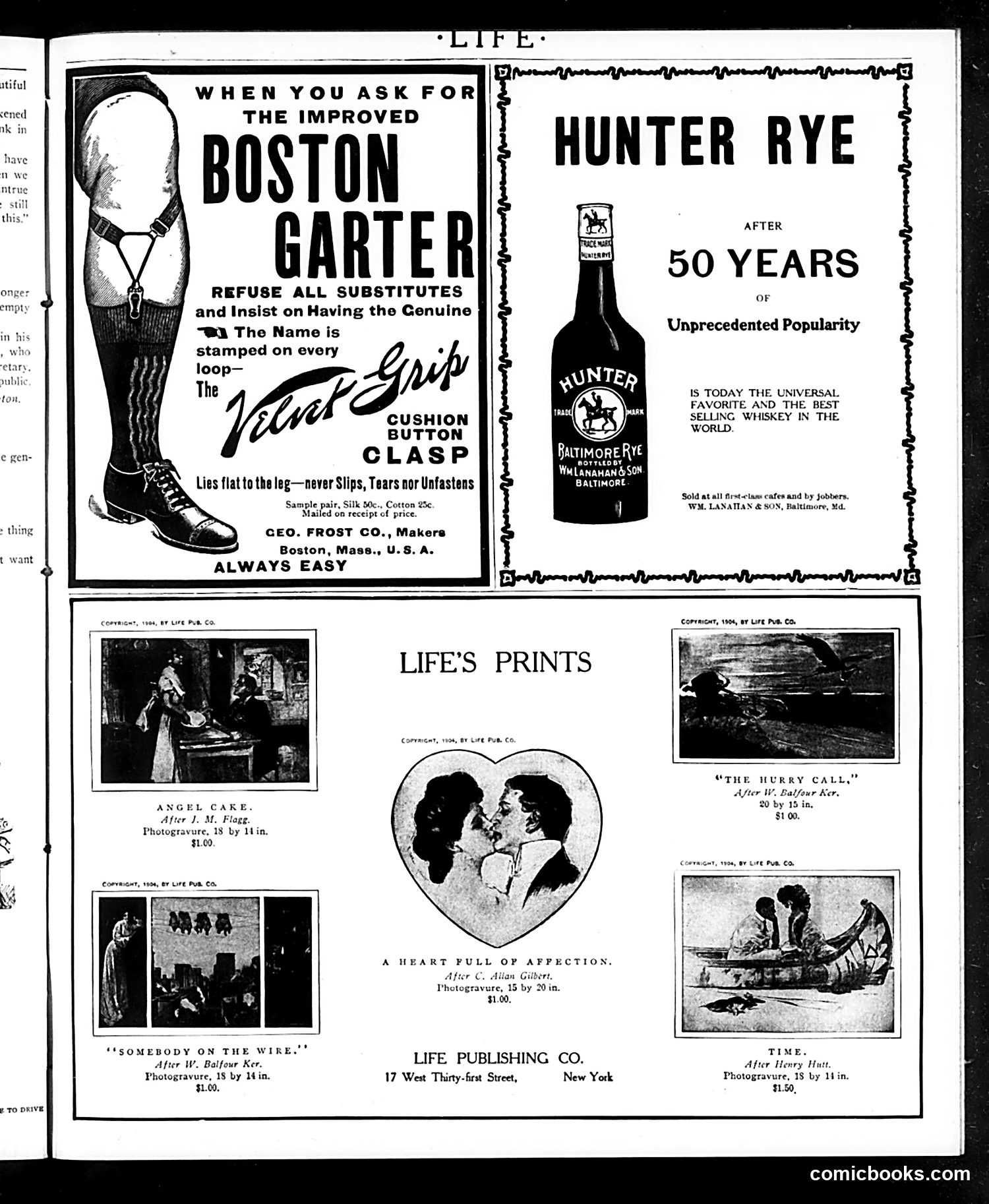
This is primarily an **advertising page** from an early 1900s issue of Life magazine, not political satire. The top features two product advertisements: 1. **Boston Garter** (left): An ad for men's garters—elastic leg bands that held up socks. The imagery shows a woman's leg in a garter, emphasizing the product's practical features: it won't slip, tear, or unfasten. The "Velvet Grip" cushion clasp was the manufacturer's innovation. 2. **Hunter Rye Whiskey** (right): A spirits advertisement celebrating 50 years of popularity, marketed as "the universal favorite" whiskey. The lower half shows **"Life's Prints"**—offerings from Life Publishing Company's art reproduction service. These are photogravure reproductions of popular artworks by contemporary artists (Flagg, Balfour Ker, Allan Gilbert, Henry Hutt), priced $1.00-$1.50, available by mail order. The page reflects early 20th-century consumer culture and the magazine's dual role as satirical publication and commercial marketplace.
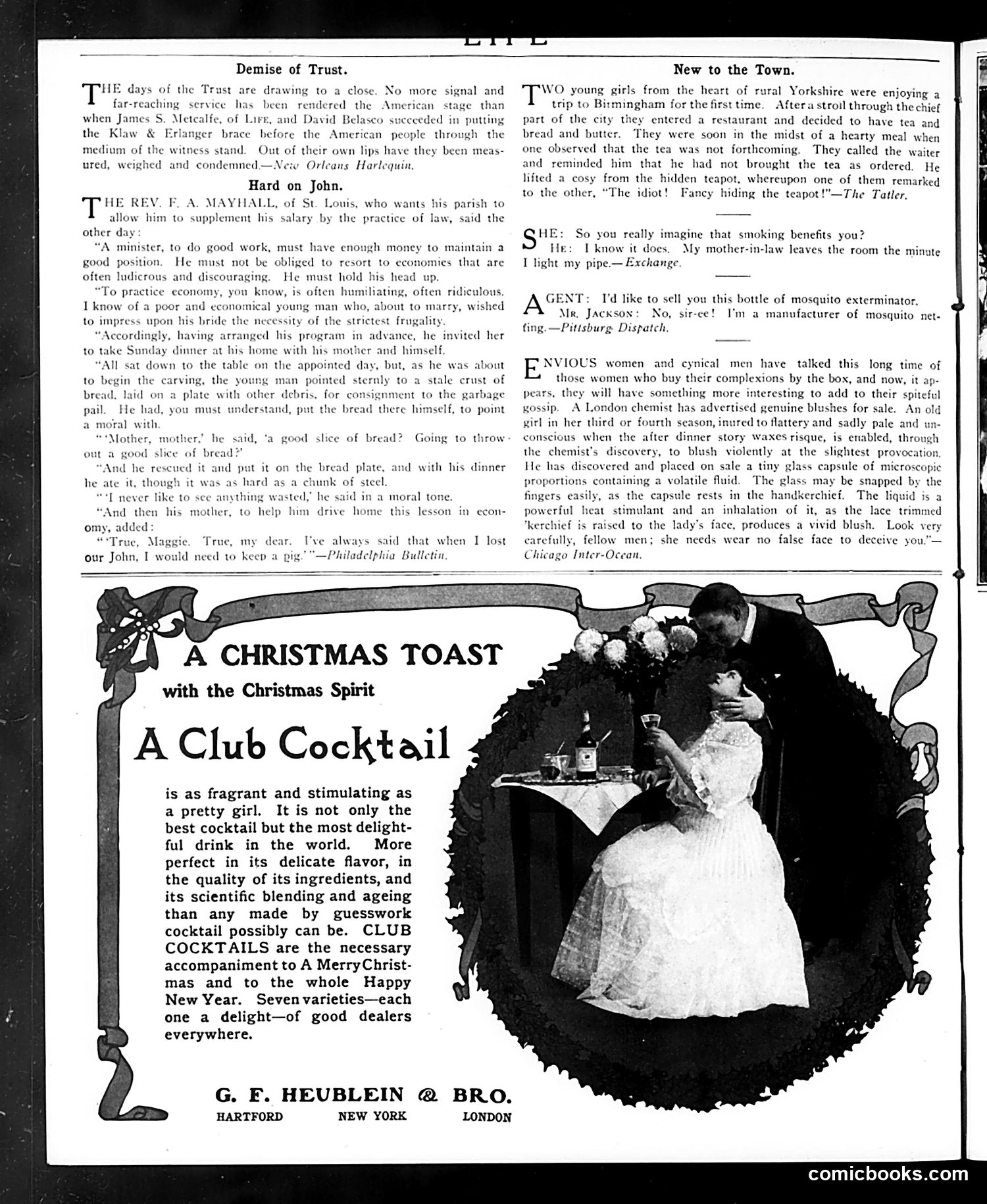
This page contains several **humorous anecdotes and satirical pieces** typical of Life magazine's format: **"Demise of Trust"** references a legal scandal involving theatrical producers Klaw & Erlanger, who faced testimony about trust violations in an American theater case. **"Hard on John"** is a moral tale mocking ministerial hypocrisy: a clergyman invites his fiancée to dinner to demonstrate frugality by conspicuously placing stale bread as refuse—only to have his mother deliver the punchline, suggesting he'd need to "keep a pig" after losing his previous fiancé "John" (likely a male romantic interest, implying hidden scandal). **"New to the Town"** contains mild humor about rural Yorkshire girls unfamiliar with restaurant customs, and brief jokes about smoking and mosquito products. The **lower advertisement** promotes Club Cocktails by G.F. Heublein & Bro., using romantic imagery to market their product as superior to homemade versions—appropriate for the pre-Prohibition era. The page reflects early 20th-century satirical sensibilities: theatrical gossip, class-based humor, and gender-focused jabs.
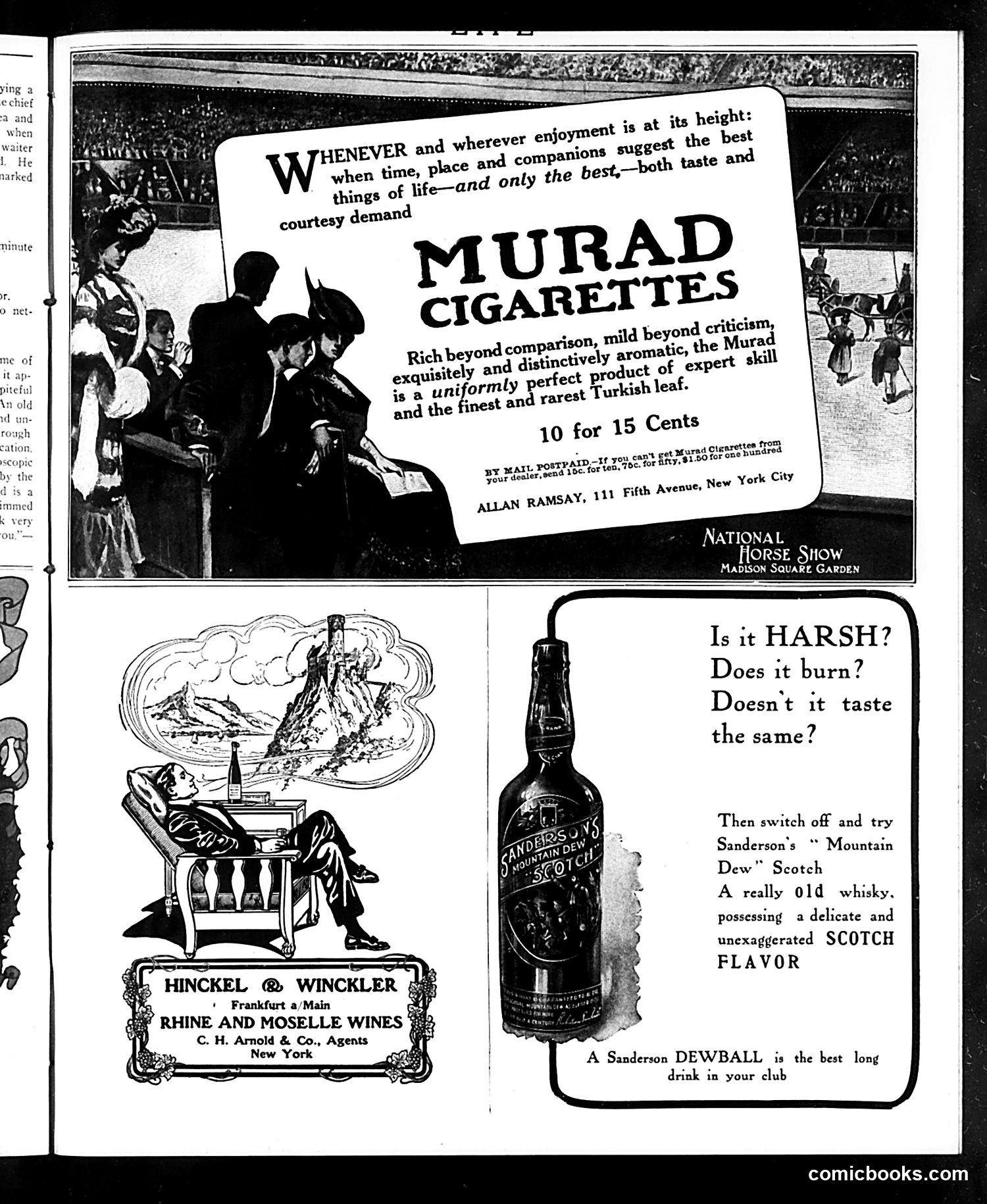
This page consists primarily of **advertisements** rather than satirical editorial content. The three ads shown are: 1. **Murad Cigarettes** (top): Features a horse show at Madison Square Garden. The ad emphasizes luxury and refinement—"the finest and rarest Turkish leaf"—priced at 10 for 15 cents. This appeals to wealthy patrons of high-society events. 2. **Hinckel & Winckler Rhine and Moselle Wines** (bottom left): A decorative ad for German wines, marketed through a New York agent. 3. **Sanderson's Mountain Dew Scotch** (bottom right): Compares its whisky favorably to competitors, claiming superior quality and flavor for club consumption. These ads reflect early 20th-century luxury marketing targeting affluent consumers, with emphasis on imported products and social prestige. The page offers little satirical commentary—it's primarily commercial content typical of Life magazine's advertising sections.
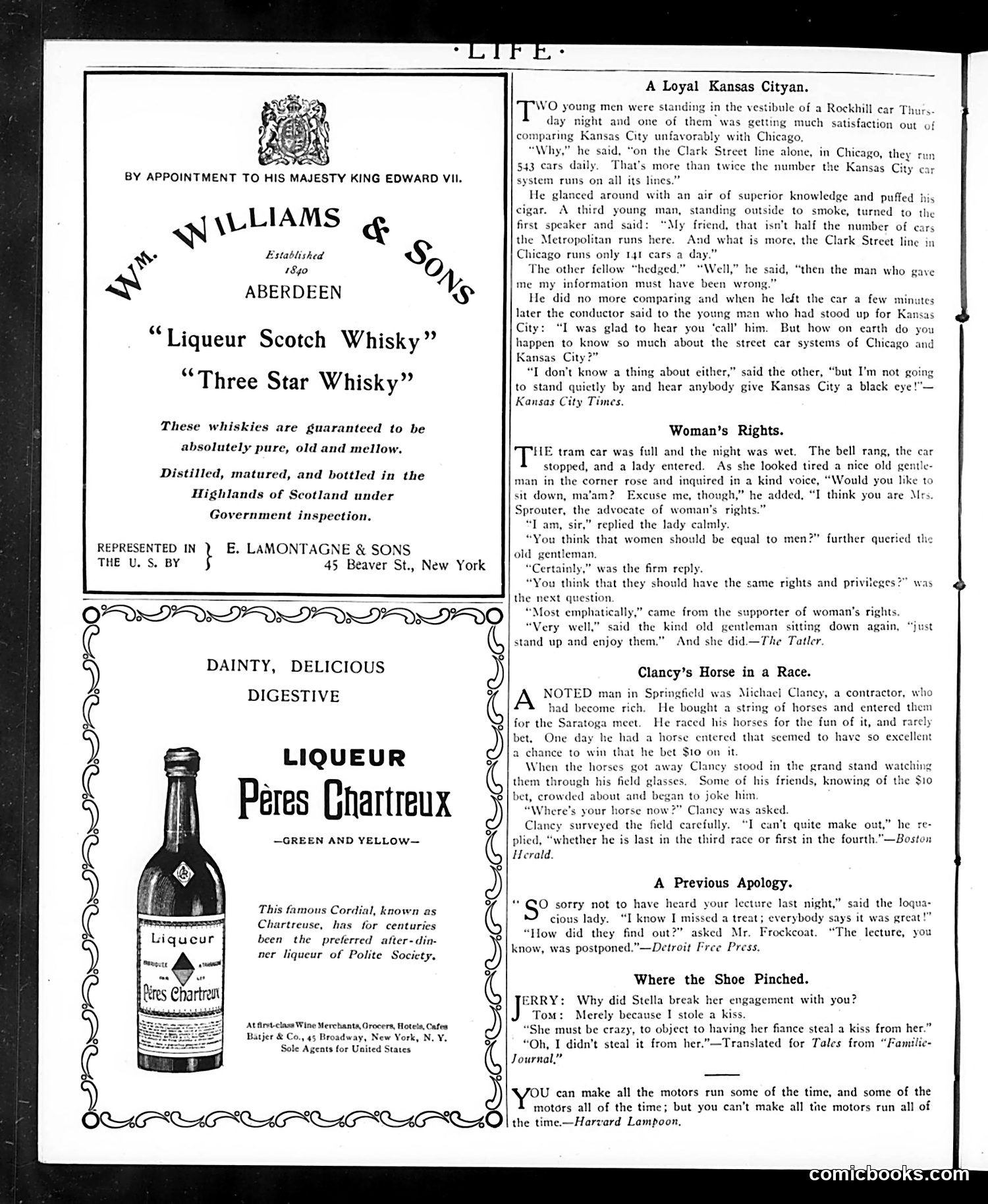
This page is primarily **advertisements** (Williams & Sons whisky, Pères Chartreaux liqueur) with several brief **humorous anecdotes** in the right column. The satirical content includes: 1. **"A Loyal Kansas Cityan"**: A young man defends Kansas City's streetcar system against Chicago comparisons. The joke: he admits afterward he knows nothing about either city's transit—he simply couldn't bear Kansas City being insulted. It's gentle satire about civic pride and bluffing. 2. **"Woman's Rights"**: A condescending gentleman offers his seat to a women's rights advocate, then sits back down with the quip "just stand up and enjoy them"—mocking her equality claims by sarcastically suggesting she should *practice* equality by standing. The humor relies on the gentleman's smug hypocrisy. 3. **"Clancy's Horse in a Race"**: A wealthy contractor watches his racehorse through field glasses but cannot determine which race his horse is in—absurdist humor about distraction or poor observation. These are lightweight, class-conscious jokes typical of early-1900s American humor magazines.
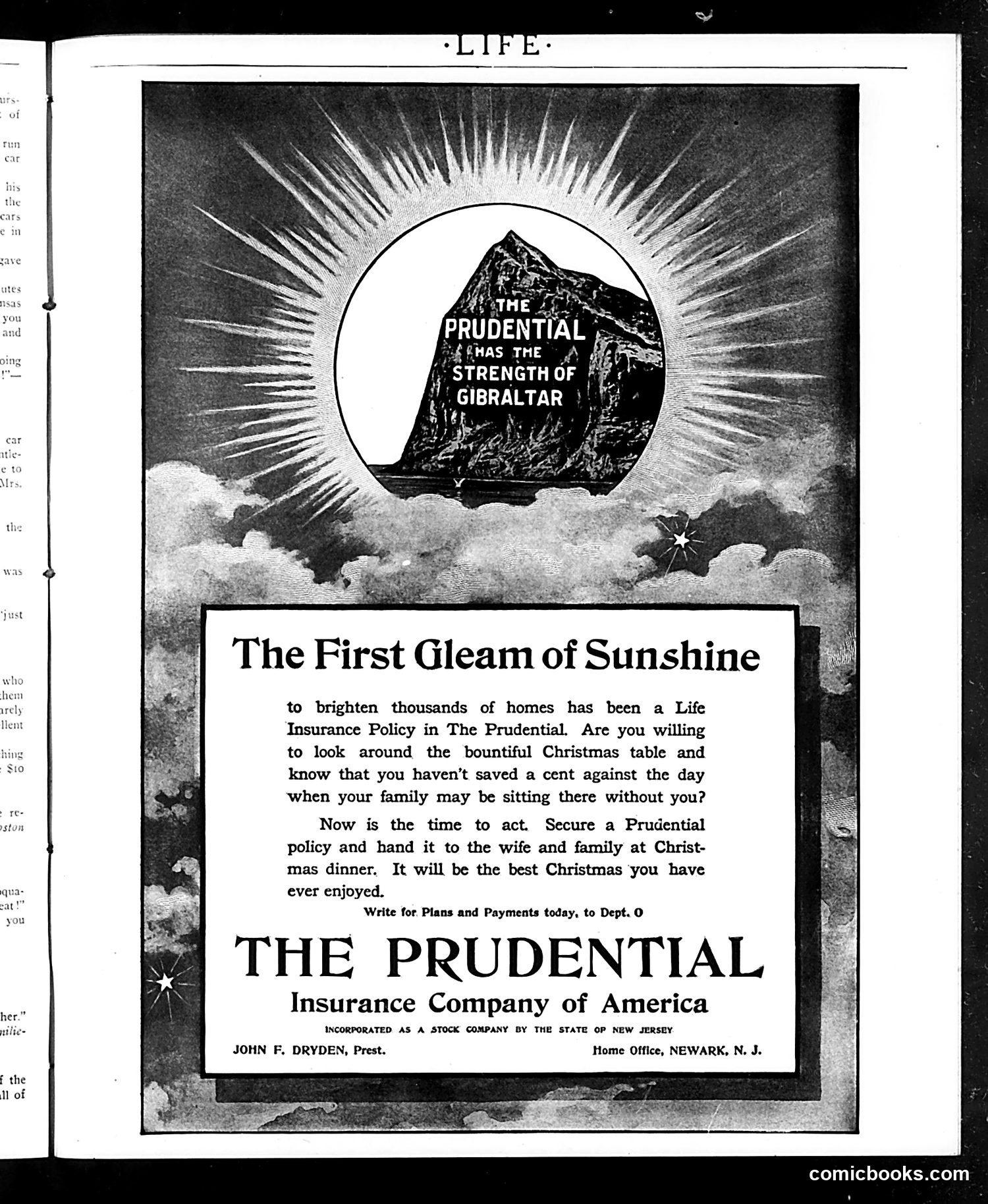
This is **not a cartoon or satire** — it's a **full-page advertisement** for The Prudential Insurance Company of America. The image shows the Rock of Gibraltar emerging from clouds with radiating light, symbolizing strength and stability. The ad uses emotional appeal: it urges readers to purchase life insurance as a Christmas gift to protect their families against their own death. The copy exploits anxiety about financial security and family welfare, framing insurance as an act of love and responsibility. The "satire" or humor that *Life magazine* audiences would recognize lies in the **publication itself** satirizing such earnest, emotionally manipulative advertising. Early 20th-century *Life* was known for mocking consumer culture and corporate messaging. Readers would view this ad with ironic distance — the very over-the-top sincerity ("best Christmas you have ever enjoyed") was *Life's* target.
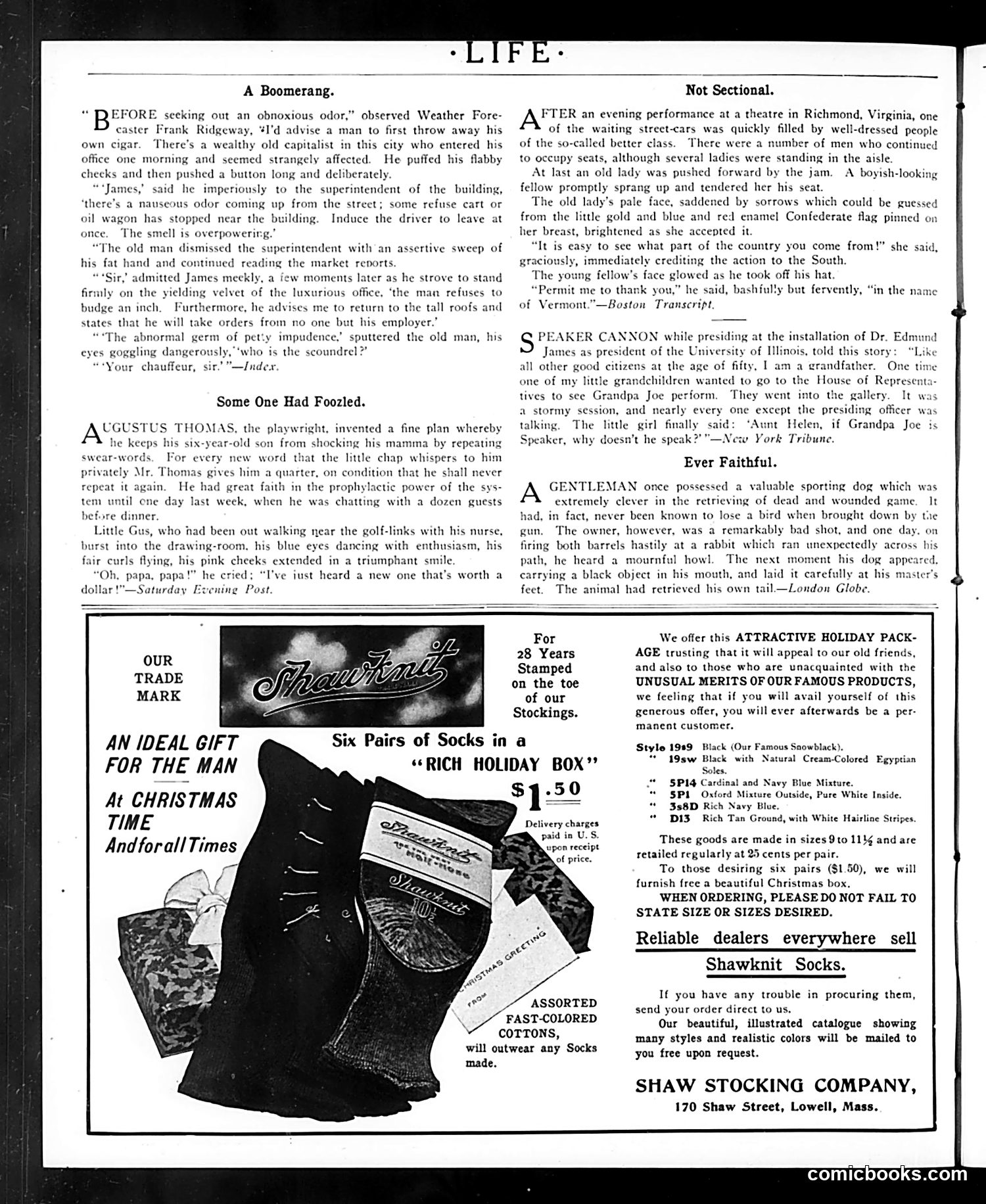
This page contains three satirical anecdotes and an advertisement, typical of Life's early humor format. **"A Boomerang"**: Mocks a wealthy capitalist who complains about street odors to his building superintendent, only to discover the "nauseous odor" is his own chauffeur—a comeuppance joke about class hypocrisy. **"Some One Had Foozled"**: Playwright Augustus Thomas's scheme to prevent his young son from swearing by paying him per new word backfires when the boy proudly announces he's learned a "new one worth a dollar" at dinner—satirizing misguided parenting logic. **"Not Sectional"**: A Northern man wins a Richmond lady's gratitude by offering his seat on a streetcar; she credits his courtesy to Southern values, but he's from Vermont—gentle satire on regional stereotypes and assumptions about civility. The bottom half is a **Shawknit Socks advertisement** offering six pairs in a "Rich Holiday Box" for $1.50—standard period marketing, not satire.
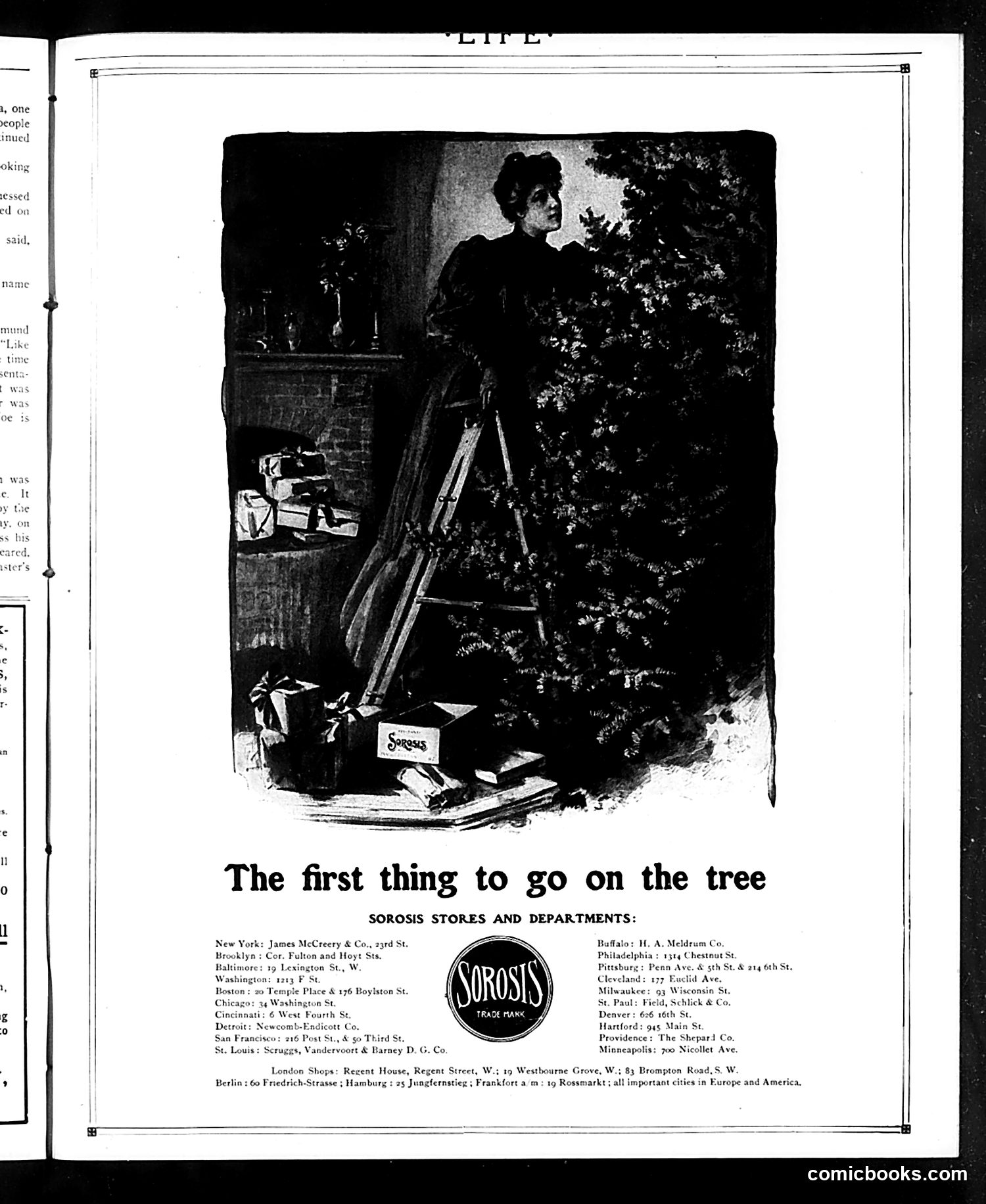
This is primarily a **Sorosis department store advertisement** rather than editorial satire. The image shows a woman decorating a Christmas tree, with the headline "The first thing to go on the tree." The phrase is a play on words: it likely refers both to decorations placed *on* a Christmas tree and to items that sell out quickly during holiday shopping season. By showing a woman preparing her tree, the ad suggests Sorosis offers the merchandise shoppers need for their Christmas preparations. The advertisement lists Sorosis locations across major American cities (New York, Boston, Chicago, etc.) plus international shops in London, Berlin, and Hamburg, emphasizing the store's reach and prestige as a major retailer. This appears to be a standard early-20th-century department store holiday advertisement rather than political commentary or social satire.
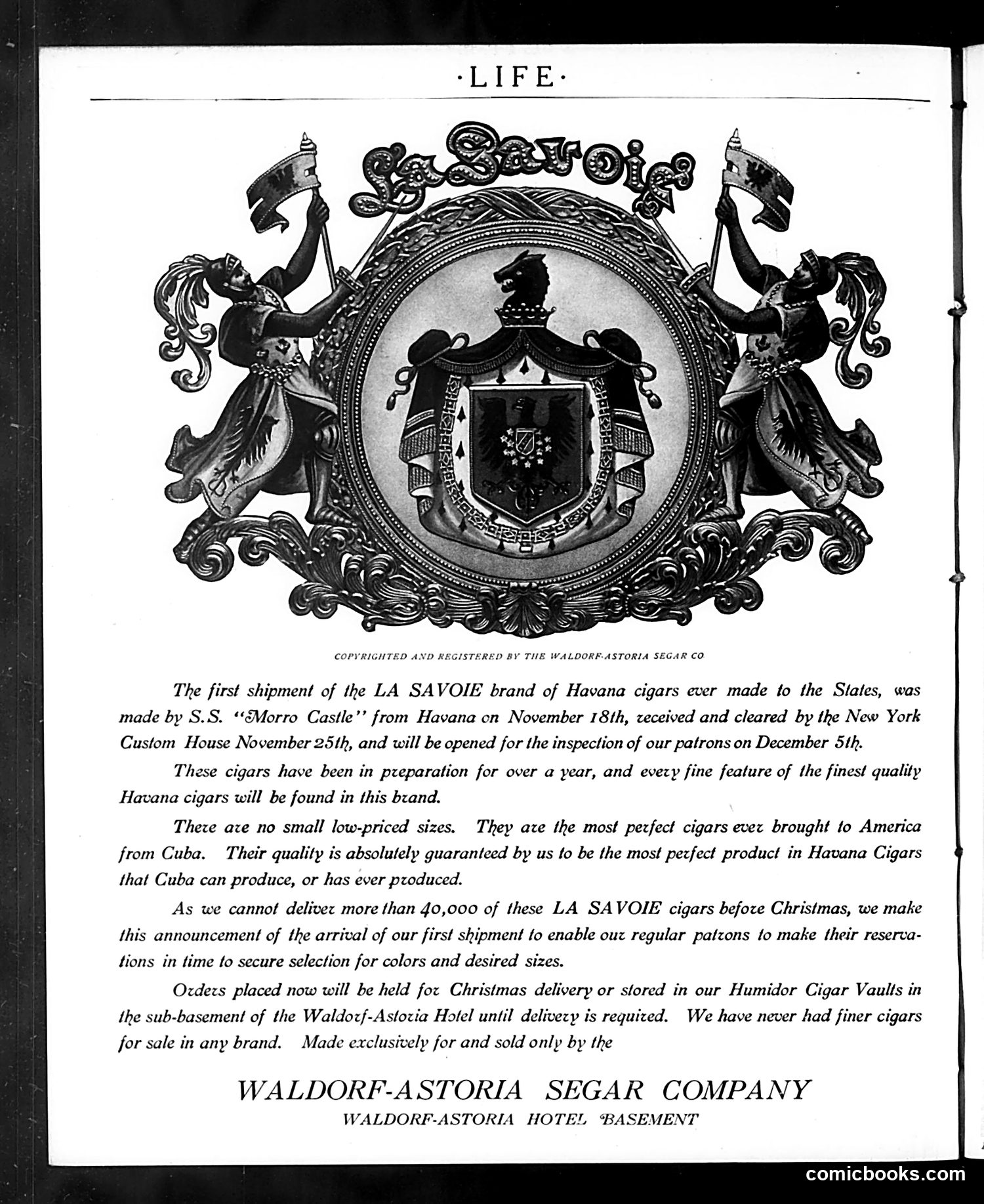
This is **not a cartoon or satire**—it's a luxury advertisement disguised as editorial content in *Life* magazine. The ornate coat-of-arms illustration serves as branding for the Waldorf-Astoria Segar Company's new "LA SAVOIE" brand of Havana cigars. The elaborate heraldic design with two figures holding flags conveys prestige and exclusivity. The text announces the first U.S. shipment of these premium Cuban cigars, arriving via S.S. "Morro Castle" in late November for December sales. The company emphasizes scarcity (only 40,000 available before Christmas) and supreme quality, with guarantees that these are "the most perfect cigars ever brought to America." Notably, customers can reserve cigars for storage in the Waldorf-Astoria Hotel's basement "Humidor Cigar Vaults" until delivery is needed—a luxury service reflecting the product's high-end market positioning. The ad targets wealthy patrons of the prestigious Manhattan hotel, leveraging the venue's reputation to sell premium imported goods.
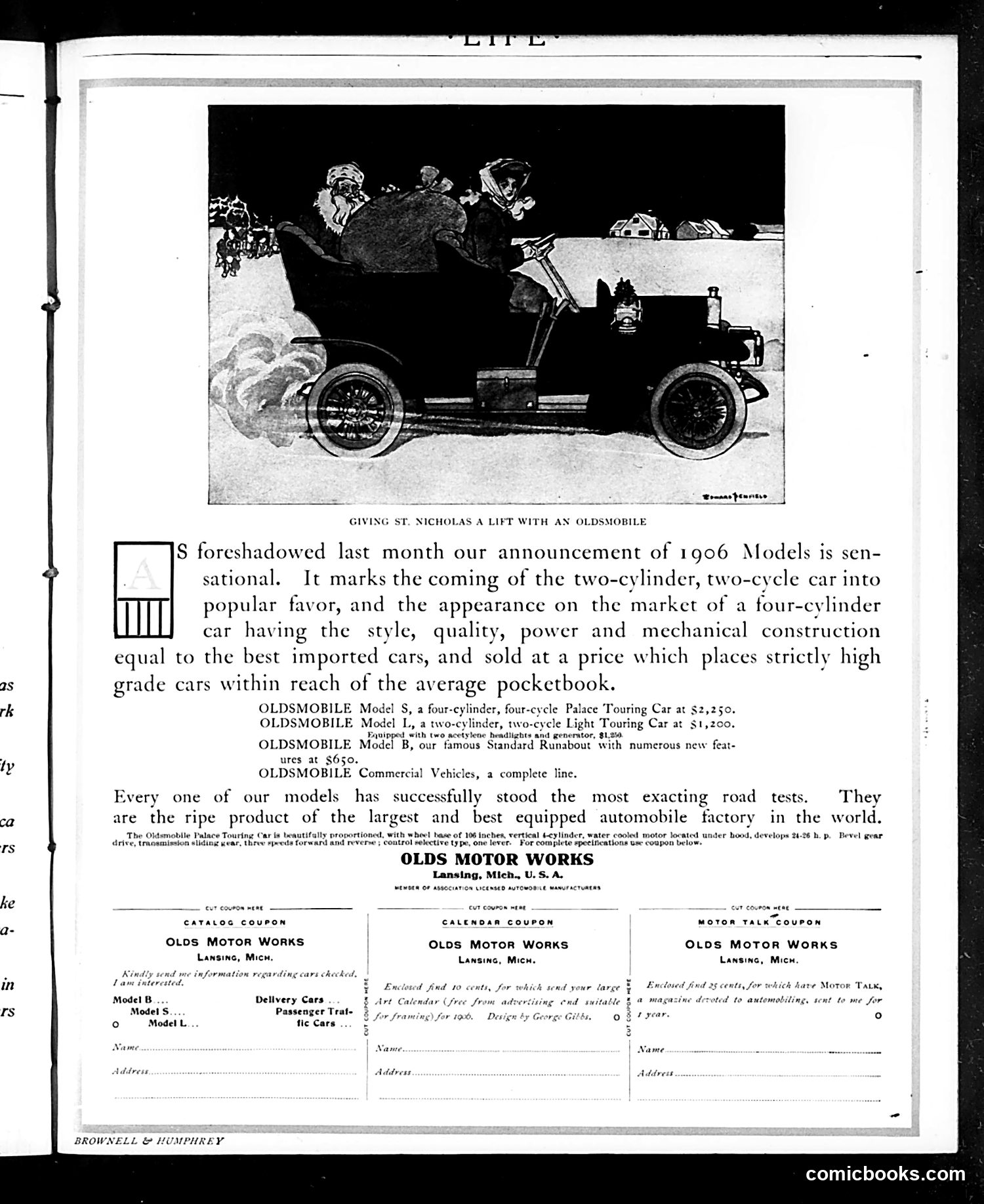
This page is primarily **Oldsmobile advertising** rather than political satire. The illustration shows Santa Claus (St. Nicholas) being given a ride in a 1906 Oldsmobile automobile—a visual pun suggesting the car is so desirable it's like receiving a luxury gift. The joke's context: In 1906, automobiles were still novel luxuries. By depicting Santa delivering himself via Oldsmobile, the ad humorously positions the car as the ultimate present. The ad copy emphasizes affordability ("within reach of the average pocketbook") and quality, marketing four-cylinder models as competitive with expensive imported cars. The three coupons below allow readers to request catalogs, calendars, and technical information—standard early advertising practice. This is fundamentally a commercial appeal using gentle humor and aspirational imagery rather than political commentary.
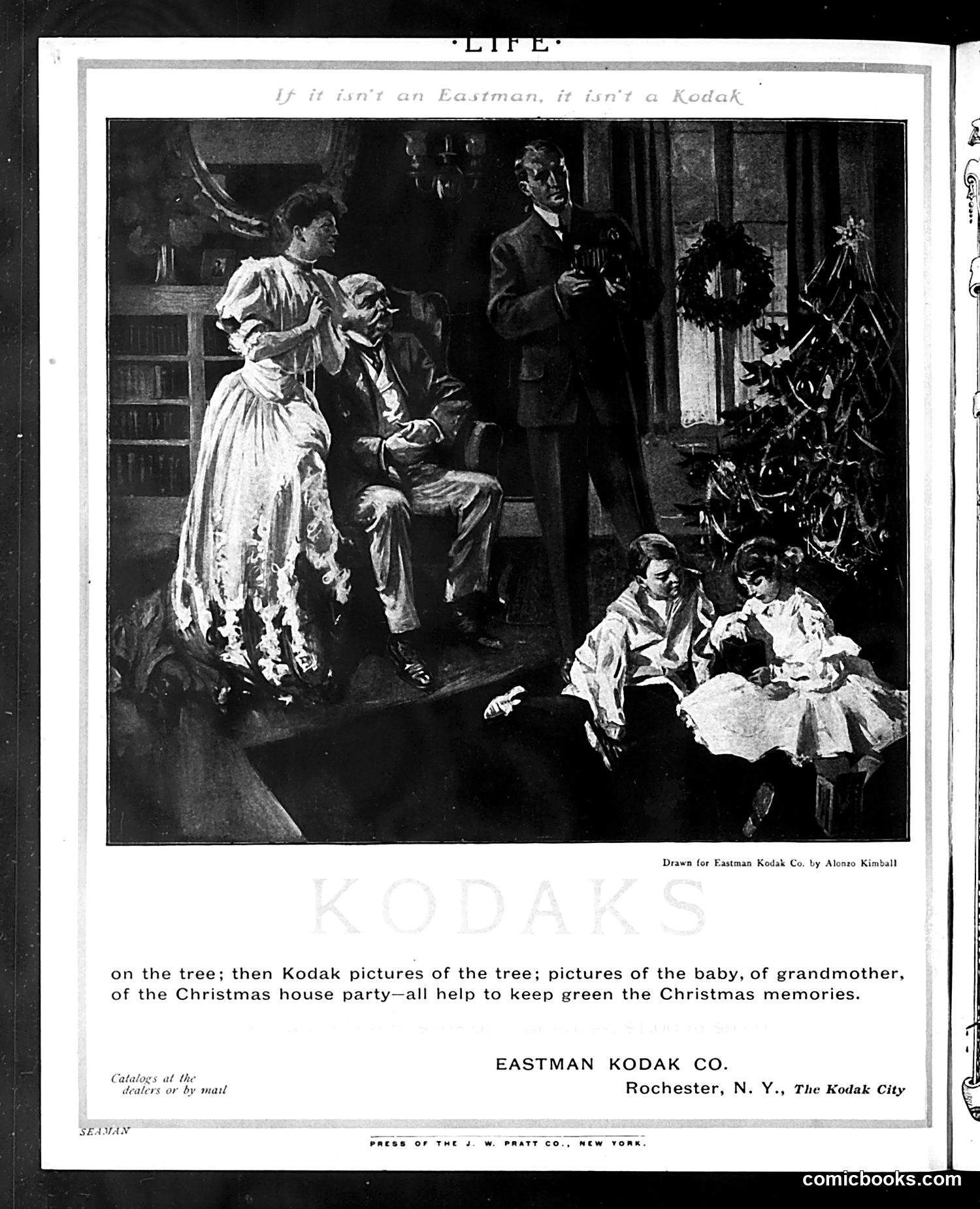
This is a **Kodak advertisement**, not a political cartoon. Artist Alonzo Kimball drew this scene depicting an idealized early-20th-century Christmas celebration with a decorated tree, well-dressed family members (adults and children), and a festive house party setting. The ad's message is straightforward commercial persuasion: Kodak cameras help preserve Christmas memories through photography. The tagline "If it isn't an Eastman, it isn't a Kodak" (visible at top) emphasizes brand dominance. There is **no satire or political commentary**—this is aspirational lifestyle advertising targeting middle-class families, promoting photography as essential to commemorating holidays. The imagery reflects period standards of domestic leisure and family togetherness.