
Life, 1905-12-07 · page 33 of 60
Life — December 7, 1905 — page 33: what you’re looking at
What you’re looking at
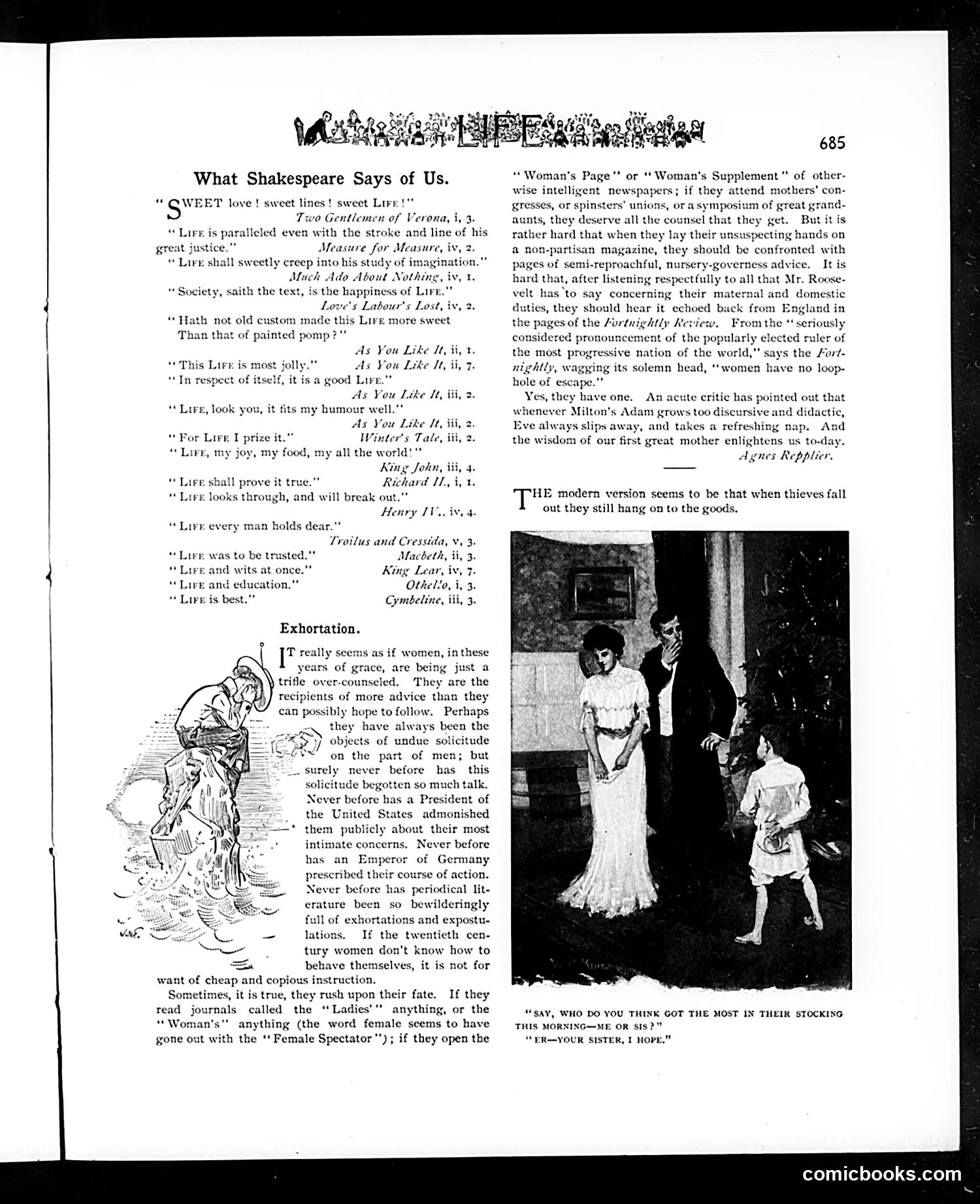
This page satirizes the excessive advice directed at women in the early 20th century. The text argues that women are being over-counseled by presidents, emperors, newspapers, and periodicals about their behavior and conduct—an unprecedented phenomenon. The **left cartoon** depicts a figure (likely representing advice-givers or society) pouring endless streams of guidance onto women, visually emphasizing the overwhelming nature of unsolicited counsel. The **right photograph** shows what appears to be a domestic scene with the caption about stockings—likely illustrating the trivial nature of much "women's advice," contrasting grand political pronouncements with petty household concerns. The page opens with Shakespeare quotes about "life" to establish that wisdom about living isn't new, then pivots to mock modern experts (Roosevelt is explicitly mentioned) for treating women like children needing instruction. The satire's point: if twentieth-century women lack sense, it's not from insufficient guidance—they're drowning in it.
📄 Transcribed text from this page (OCR, searchable)
Machine-transcribed from the original scan — historical spelling and the odd misread are preserved.
What Shakespeare Says of Us. “ Ss” =T love ! sweet lines ! sweet Lire!" 10 Gentlemen of Verona, i, 3. “Lire is paralleled even with the stroke and line of his great justic Measure for Measure, iv, “Lire shall sweetly creep into his study of imagination.” Much Ado About Nothing, “ Society, saith the text, is the happiness of Lire. Li Labour's Lost, iv, “Hath not old custom made this Lire more sweet Than that of painted pomp?” ” As You Like UH, ii, 1. “This Lire is most jolly.” As You Like It, ii, 7. ‘In respect of itself, it is a good Lire.” As You Like It, iii, 2. “Lire, look you, it fits my humour well.” As You Like It, Winter's Tale, iii, joy, my food, my all the world!” King John, iii, 4. i" Richard IT, i, 1. nd will break ou! Henry IV. ivy 4 “Por Lir “ Lire, my prize it.” “Lire shall prove it tru “ Lire looks through, ‘* Lire every man holds dear."" voilus and Cressida, Vy Macbeth, ii, King Lear i Othello, i, 3. Cymbeline, iti, 3. “Lire s to be trusted." “Lire and wits “Lire and education. * Lire is best.” Exhortation. as if women, inthese ¢ being just a "They are the pients of more advice than they can possibly hope to follow. Perhaps they have always been the objects of undue solicitude ¢V~" on the part of men; but surely never before has this solicitude begotten so much talk. Never before has a President of the United States admonished —* them publicly about their most intimate concerns. Never before has an Emperor of Germany prescribed their course of action. Never before has periodical lit- erature been so bewilderingly full of exhortations and expostu- lations. If the twentieth cen- tury women don’t know how to behave themselves, it is not for want of cheap and copious instruction. Sometimes, it is true, they rush upon their fate. If they read journals called the ‘ Ladies anything, or the “Woman's” anything (the word female scems to have gone out with the ‘* Female Spectator’); if they open the Fe eee 685 “Woman's Page wi or “Woman's Supplement" of other- ¢ intelligent newspaper tend mothers’ con- gresses, or spinsters’ unions, or a symposium of great grand- aunts, they deserve all the counsel that they get. But itis rather hard that when they lay their unsuspecting hands on an magazine, they should be confronted with pages of semi-reproachful, nursery-governess advice. It is ard that, after listening respectfully to all that Mr. Roos velt ng their mate ‘to say concert land domestic duties, they should hear it echoed back from England in the pages of the /urtnightly Review, From the * seriously considered pronouncement of the popularly the most progressive nation of the world, ected ruler of s the Fort- nightly, wagging its solemn head, “women have no loop- hole of ” Yes, the An acute critic has pointed out that am grows too discursive and didactic, gnes R epplic HE modern version scems to be that when thieves fall out they still hang on to the goods. “SAY, WHO DO YOU THIN THIS MORN! OR sis “ ER—YOUR SISTER, I HOPE, GOT THE MOST IN THEIR STOCKING comicbooks.com