
Life, 1905-12-07 · page 54 of 60
Life — December 7, 1905 — page 54: what you’re looking at
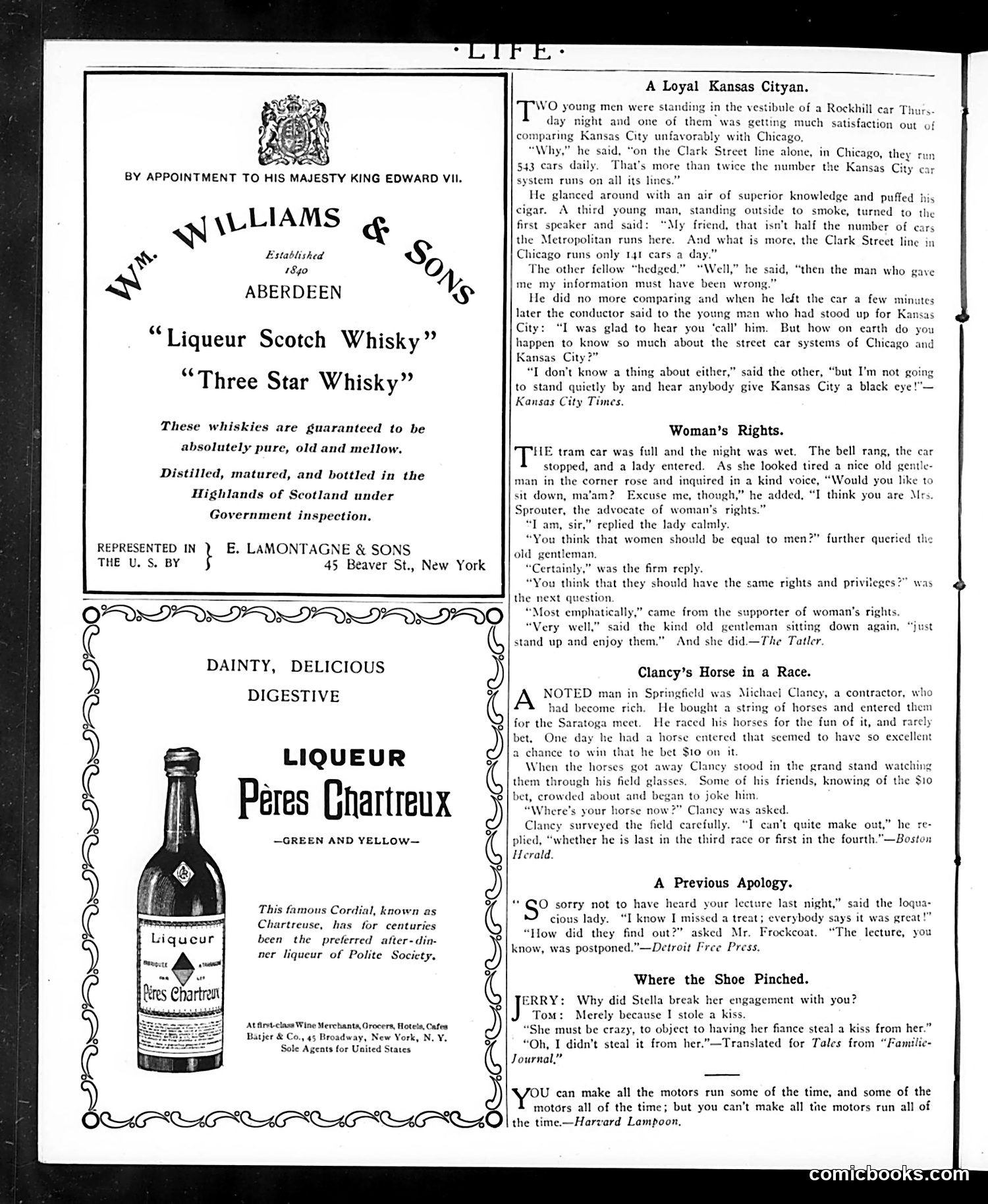
What you’re looking at
This page is primarily **advertisements** (Williams & Sons whisky, Pères Chartreaux liqueur) with several brief **humorous anecdotes** in the right column. The satirical content includes: 1. **"A Loyal Kansas Cityan"**: A young man defends Kansas City's streetcar system against Chicago comparisons. The joke: he admits afterward he knows nothing about either city's transit—he simply couldn't bear Kansas City being insulted. It's gentle satire about civic pride and bluffing. 2. **"Woman's Rights"**: A condescending gentleman offers his seat to a women's rights advocate, then sits back down with the quip "just stand up and enjoy them"—mocking her equality claims by sarcastically suggesting she should *practice* equality by standing. The humor relies on the gentleman's smug hypocrisy. 3. **"Clancy's Horse in a Race"**: A wealthy contractor watches his racehorse through field glasses but cannot determine which race his horse is in—absurdist humor about distraction or poor observation. These are lightweight, class-conscious jokes typical of early-1900s American humor magazines.
📄 Transcribed text from this page (OCR, searchable)
Machine-transcribed from the original scan — historical spelling and the odd misread are preserved.
BY APPOINTMENT TO HIS MAJESTY KING EDWARD VII. \LLIAMS ¢ N Established S 1840 ABERDEEN “Liqueur Scotch Whisky’ “Three Star Whisky” These whiskies are guaranteed to be absolutely pure, old and mellow. Distilled, matured, and bottled in the Highlands of Scotland under Government inspection. REPRESENTED IN } E. LAMONTAGNE & SONS THE U. S. BY r | | | ) 45 Beaver St., New York DPRIIVIDD-WDMVO DAINTY, DELICIOUS DIGESTIVE LIQUEUR Peres Ghartreux —GREEN AND YELLOW— creed This famous Cordial, known as Chartreuse, has for centuries been the preferred atter-din- ner liqueur of Polite Society. At firetclasa Wine Merchanta Grocers, Hotels, Cafes Batjer & Co., 45 Broadway, New York, N.Y. Sole Agents for United States SCAG A Loyal Kansas Cityan. Tro young men were standing in the vestibule of a Rockhill car Thurs. day night and one of them was getting much satisfaction out of comparing Kansas City unfavorably with Chicago, “Why,” he said, “on the Clark Street line alone, in Chicago, they 543 cars daily. That's more than twice the number the Kansas Cit system runs on all its lines.” He glanced around with an air of superior knowledge and puffed his cigar. A third young man, standing outside to smoke, turned to the first speaker and said: “My friend, that isn’t half the number of cars the Metropolitan runs here. And what is more, the Clark Street line ir Chicago runs only 141 cars a da; The other fellow “hedged.” “Well,” he said, “then the man who gave me my information must have been wrong.’ He did no more comparing and when he left the car a few mi later the conductor said to the young man who had stood up for Kansas City: “I was glad to hear you ‘call’ him. But how on earth do you happen to know so much about the street car systems of Chicago and Kansas Cit: “I don't know a thing about either,” said the other, “but I’m not to stand quietly by and hear anybody give Kansas City a black ey Kansas City Times. Woman’s Rights. HIE tram car was full and the night was wet. The bell rang, the car stopped, and a lady entered. As she looked tired a nice old gentle- man in the corner rose and inquired in a kind voice, “Would you like to sit down, ma'am? cuse me, though,” he added, “I think you are Mrs. Sprouter, the advocate of woman's rights.” “Iam, sir,” replied the lady calmly. “You think that women should be equal to men?” further queried the old gentleman, “Certainly,” was the firm reply. “You think that they should have the same rights and privileges?” was the next question. “Most emphatically,” came from the supporter of woman's rights. Jery well,” said the kind old gentleman sitting down again, stand up and enjoy them.” And she did —The Tatler, Clancy’s Horse in a Race. NOTED man in Springfield was Michael Clancy, a contractor, who had become rich. He bought a string of horses and entered th for the a cet. He raced his hor for the fun of it, and rarely bet. One day he had a horse entered that scemed to have so excellent a chance to win that he bet $io on it When the horses got away Clancy stood in the grand stand them through his field glasses. Some of his friends, knowing of the $10 bet, crowded about and began to joke him “Where's your horse now?” Clancy was asked. Clancy surveyed the field carefully. “I can't quite make out,” he re- plied, “whether he is last in the third race or first in the fourth.”—Bosten Herald. A Previous Apology. O sorry not to have heard your lecture last night,” said the loqua- cious lady. “I know I missed a treat; everybody says it was great!” “How did they find out?” asked Mr. Frockcoat. “The lecture, you know, was postponed.”—Detroit Free Press. Where the Shoe Pinched. ERRY: Why did Stella break her engagement with you? Tom: Merely because I stole a kiss. “She must be crazy, to object to having her fiance steal a kiss from her.” “Oh, I didn’t steal it from her.”—Translated for Tales from “Familie- Journa OU can make all the motors run some of the time, and some of the motors all of the time; but you can’t make all the motors run all of the time.—Harvard Lampoon,