
Life, 1905-12-07 · page 25 of 60
Life — December 7, 1905 — page 25: what you’re looking at
What you’re looking at
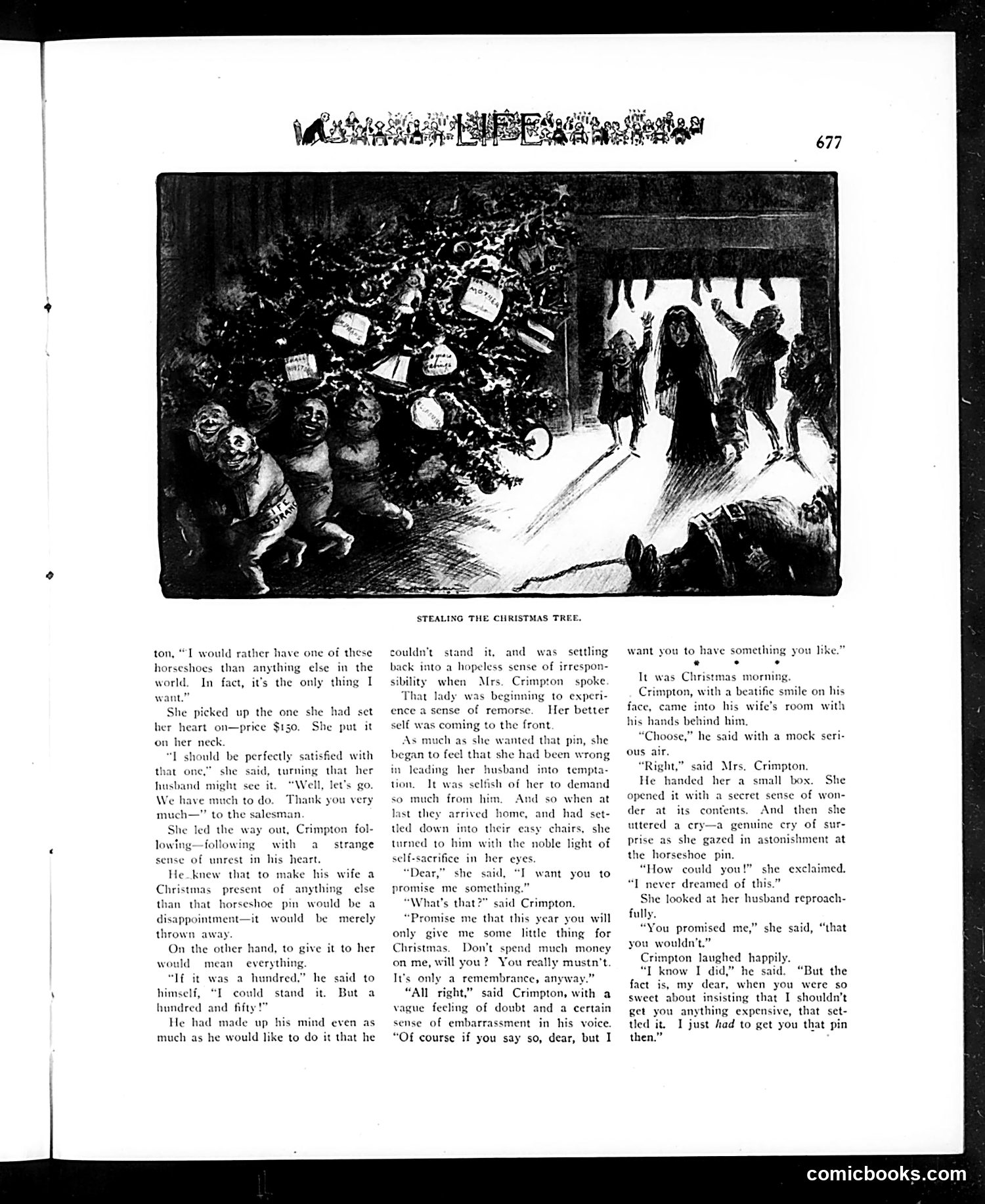
This page presents a satirical domestic comedy about marital economics and self-sacrifice. Mr. and Mrs. Crimpton visit a jeweler where she admires an expensive horseshoe pin ($130—a substantial sum in the early 1900s). Recognizing the financial burden on her husband, she nobly insists he buy her nothing expensive for Christmas, claiming she wants only a modest remembrance. The satire targets both spouses: her performative self-denial (designed to manipulate him into buying the pin anyway) and his predictable capitulation to her "sacrifice." On Christmas morning, he presents her with the exact pin she coveted, justifying the expense by claiming her noble renunciation made him *feel obligated* to buy it. The joke exposes the transparent psychology of domestic gift-giving—where apparent selflessness functions as emotional leverage to secure desired luxuries. The cartoon above (titled "Stealing the Christmas Tree") appears unrelated to the text.
📄 Transcribed text from this page (OCR, searchable)
Machine-transcribed from the original scan — historical spelling and the odd misread are preserved.
ton, “LT would rather have one of these horseshoes than anything else in the world. In fact, it’s the only thing I want.” She picked up the one she had set her heart on—price $130. She put it on her neck. “] should be perfectly satisfied with that she said, turning that her husband might see it. “Well, let's go. We have much to do. Thank you very —"" to the salesman. : led the way out, Crimpton fol- lowing—iollowing with a strange sense of unrest in his heart. He knew that to make his wife a Christmas present of anything else than that horseshoe pin would be disappointment—it would be merely thrown away On the other hand, to give it to her would mean everything. “If it was a hundred,” he said to himseli, could stand it, But a hundred and fifty!” He had made up his mind even as much as he would like to do it that he STEALING THE CHRISTMAS TRE couldn't. stand it, and was settling back into a hopeless sense of irrespor pility when Mrs. Crimpton spoke That lady was beginning to experi- ence a sense of remorse. Her better self was coming to the front As much as she wanted that pin, she began to feel that she had been wrong in leading her husband into tempta- tion. It was selfish of her to demand so much from him. And so when at last they arrived home, and had set- tled down into their easy chairs, she turned to him with the noble light of self-sacrifice in her eyes. “Dear,” she said, “I want you to promise me something.” “What's that?” said Crimpton. “Promise me that this year you will only give me some little thing for Christmas, Don’t spend much money on me, will you? You really mustn't It’s only a remembrance, anyway “AIL right,” said Crimpton, with a vague feeling of doubt and a certain sense of embarrassment in his voice. “Of course if you say so, dear, but I want you to have something you like.” . ° . It was Christmas morning. Crimpton, with a beatific smile on his face, came into his wife's room w his hands behind him. “Choose,” he said with a mock seri- ous air. “Right,” said Mrs. Crimpton. He handed her a small box. She opened it with a secret sense of won- der at its contents. And then she uttered a cry—a genuine cry of sur- prise as she gazed in astonishment at the horseshoe pin. “How could you!” she exclaimed. “I never dreamed of this.” She looked at her husband reproach- fully, “You promised me,” she said, “that you wouldn't.” Crimpton laughed happily. “I know I did,” he said. “But the fact is, my dear, when you were so sweet about insisting that I shouldn't get you anything expensive, that set- tled it, I just had to get you that pin then.” comicbooks.com