
Life, 1905-12-07 · page 29 of 60
Life — December 7, 1905 — page 29: what you’re looking at
What you’re looking at
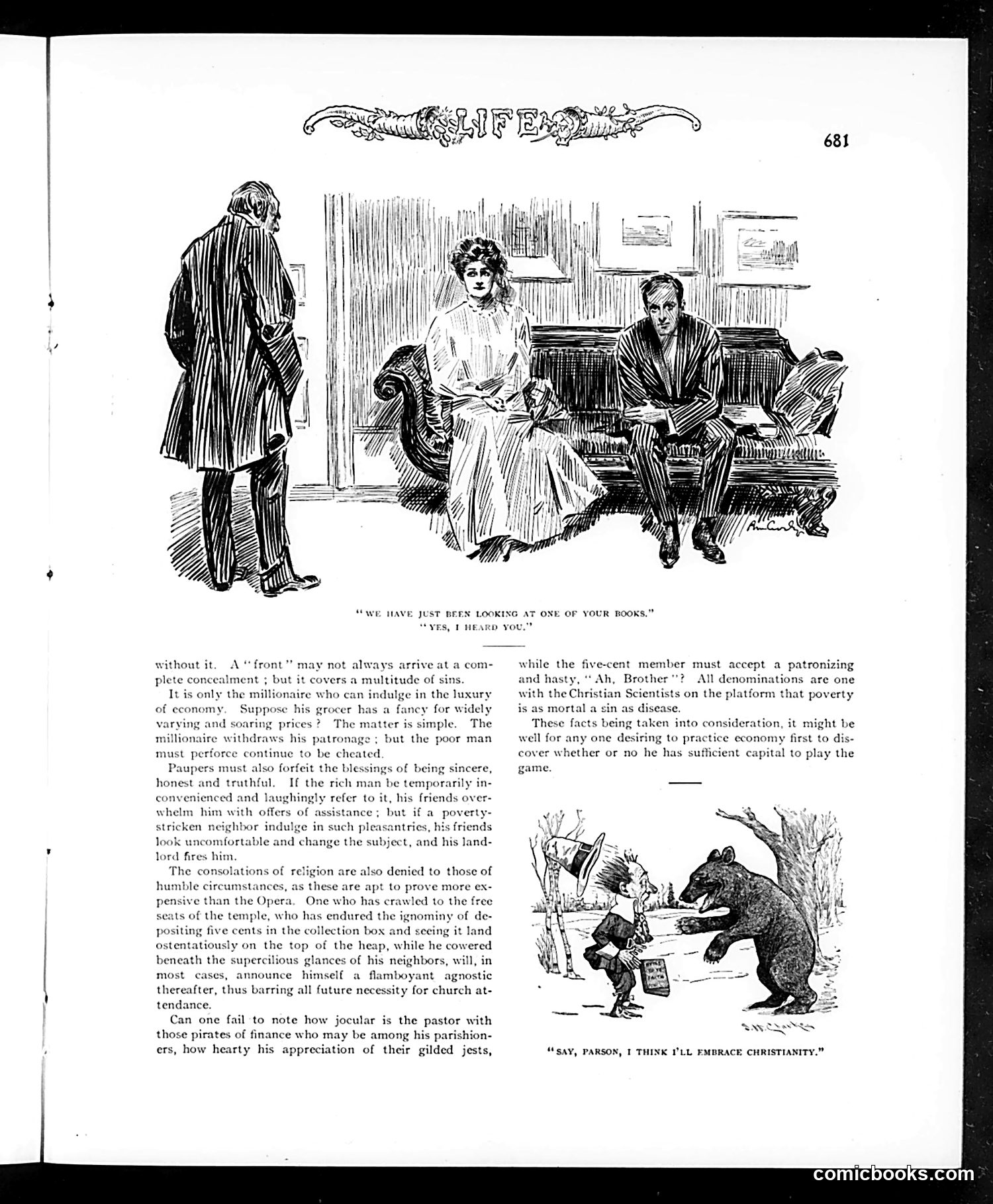
This page contains two satirical pieces critiquing hypocrisy in American religious and social institutions. **Upper cartoon**: A man discusses a book with what appears to be a wealthy couple in a drawing room. The caption "We have just been looking at one of your books"/"Yes, I heard you" suggests social awkwardness—likely mocking literary pretension or superficial cultural engagement among the affluent. **Main text**: A scathing essay argues that churches practice economic discrimination. The wealthy enjoy pastor's warmth and acceptance despite moral failings, while poor parishioners face condescension. The author notes that poor people who donate their meager five cents experience public humiliation, leading them to reject Christianity entirely rather than endure further embarrassment. **Lower cartoon**: A ragged, impoverished man tells a parson he'll "embrace Christianity," but the context makes clear this is bitter irony—he won't actually convert because the church has demonstrated it reserves dignity and acceptance for the rich. The satire's central point: **American churches are hypocritical institutions that commodify morality, welcoming the wealthy while shaming the poor.**
📄 Transcribed text from this page (OCR, searchable)
Machine-transcribed from the original scan — historical spelling and the odd misread are preserved.
“WE HAVE JUST BEEN LOOKING AT ONE OF YOUR BOOKS.” “YES, I HEARD you.” “front? may not always arrive a’ without it plete concealment ; but it covers a multitude of It is only the millionaire who can indulge in the luxury of economy. Suppose his grocer h fancy for widely ¢ prices? The imple. The millionaire withdraws his patre ; but the poor man must perforce continue to be cheated a com- varying and soar Paupers must a honest and trathful. If the rich man be temporarily in- enced and laughingly refer to it, his friends over- relm him with offers of assi but if a poverty- stricken neighbor indulge in his friends look uncomfortable and change lord fires him. The consolations of religion are also denied to those of so forfeit the blessings of being sincere, humble circumstances, as these are apt to prove more pensive than the Opera who has crawled to the s of the temple, who has endured the ignominy of de- positing five cents in the collection box and seeing it land ostentatiously on the top of the heap, while he cowered beneath the supercilious glances of his neighbors, will, in most cases, announce himself a flamboyant agnostic thereafter, thus barring all future necessity for church at- tendance. Can one fail to note how jocular is the pastor with those pirates of finance who may be among his parishion- ers, how hearty his appreciation of their gilded jests, \) 681 while the five-cent member must accept a patronizing Ah, Brother"? All denominations are one n Scientists on the platform that poverty and hasty with the Christ is as mortal a sin as disease. These s being taken into consideration, it might be well for any one desiring to practice economy first to dis- cover whether or no he has sufficient capital to play the game. TANTS SS “SAY, PARSON, I THINK I'LL EMBRACE CHRISTIANITY.”