
A complete issue · 36 pages · 1922
Judge — July 22, 1922
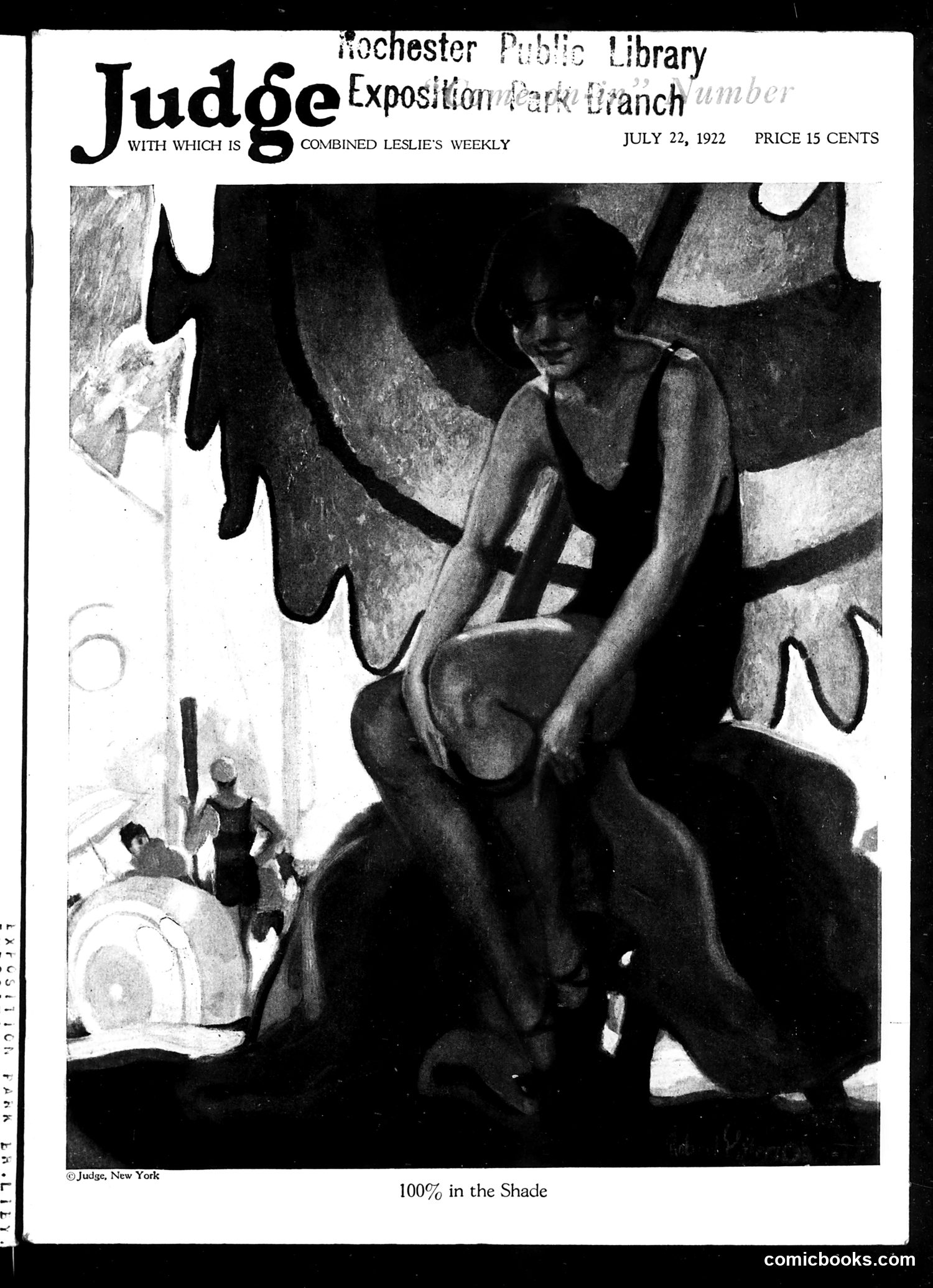
This Judge magazine cover from July 22, 1922 depicts a woman sitting in what appears to be a giant elephant or similar creature's shadow, with a caption reading "100% in the Shade." The image likely comments on extreme heat during summer 1922, playing on the common phrase about temperature ("it's 100 degrees in the shade"). The woman's relaxed posture suggests she's found relief from oppressive heat by sheltering under the animal's shadow. The cartoon appears to be a straightforward joke about summer discomfort rather than overt political satire, though the exact context of why an elephant specifically was chosen remains unclear from the image alone. It reflects how ordinary Americans experienced and discussed weather during this period.
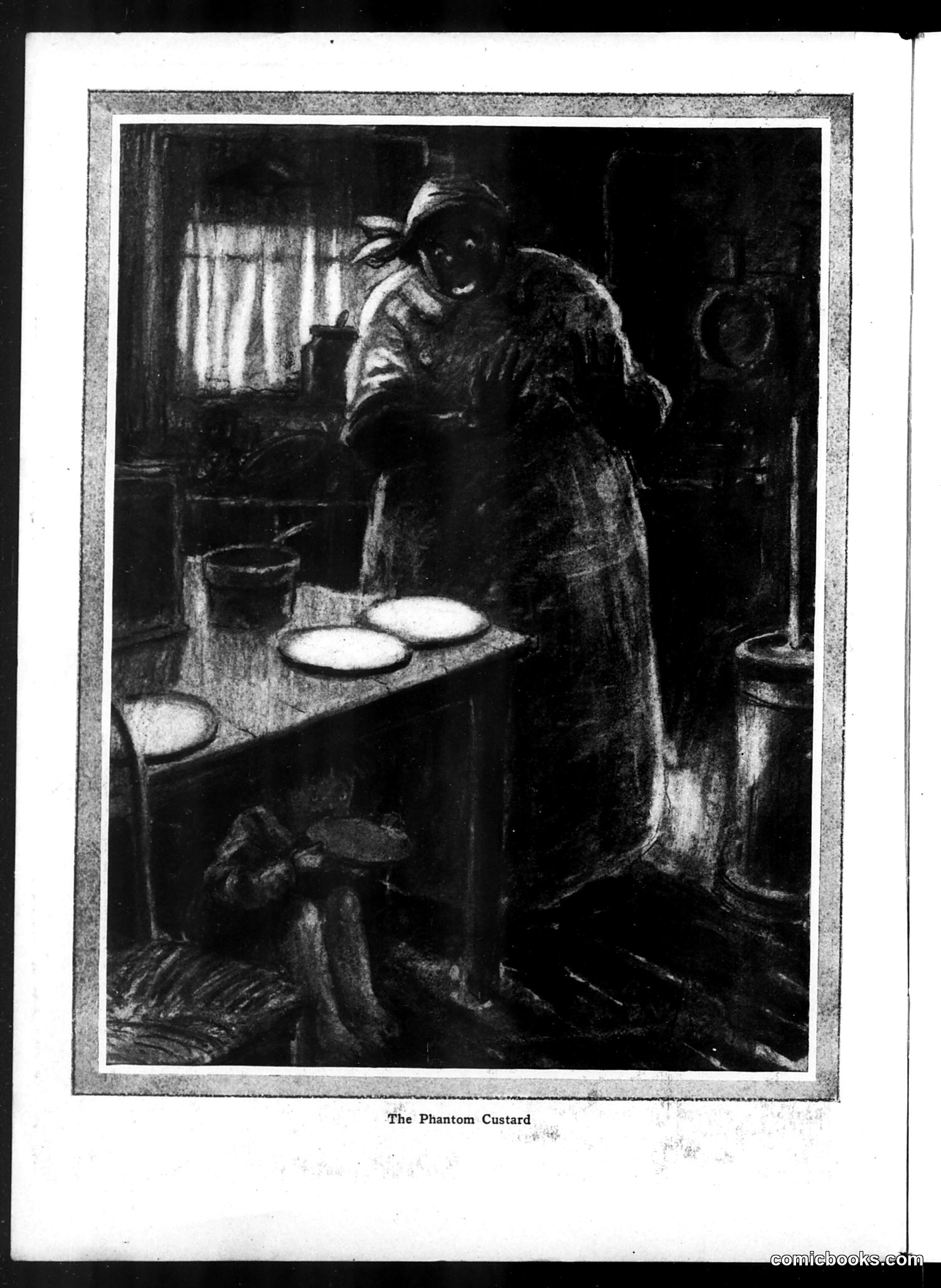
This illustration from *Judge* magazine depicts a domestic scene with dark comedic intent. A figure stands at a table with two plates of custard while another person appears distressed or ill in the background. The caption "The Phantom Custard" suggests the custard itself is the subject of satirical commentary. Without additional context from the magazine's date or surrounding articles, the exact reference is unclear. However, this likely references either a contemporary food scandal, poisoning incident, or public health concern involving custard or similar desserts. The "phantom" title implies the custard's mysterious or problematic nature—possibly something that appeared safe but proved dangerous, or a product that disappeared from markets. The illustration's dark tone emphasizes the satirical critique of whatever food-related issue *Judge* was lampooning.
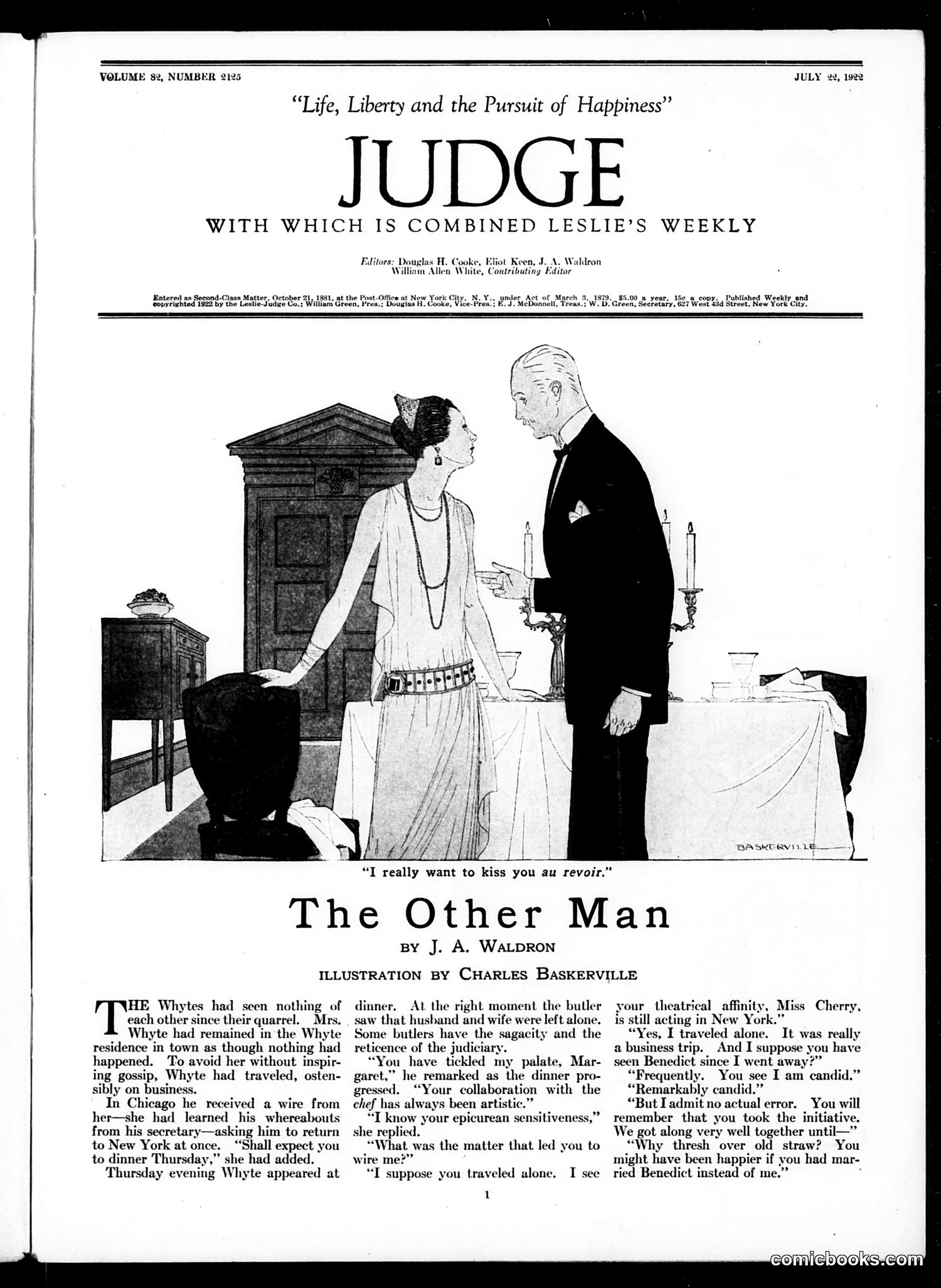
This illustration accompanies a serialized story titled "The Other Man" by J.A. Waldron, drawn by Charles Baskerville. The image depicts a domestic drama: a well-dressed man in formal evening wear confronts a woman in an elegant gown, with the caption "I really want to kiss you au revoir." The scene appears to be set in an affluent household (note the formal furniture and fireplace). The composition suggests a moment of romantic tension or infidelity—a common theme in 1920s fiction. The "other man" likely refers to a romantic rival or illicit lover, reflecting Jazz Age anxieties about marriage fidelity. The French phrase "au revoir" (goodbye) hints at a clandestine affair or farewell between lovers, typical melodramatic subject matter for Judge's serialized fiction during this period.
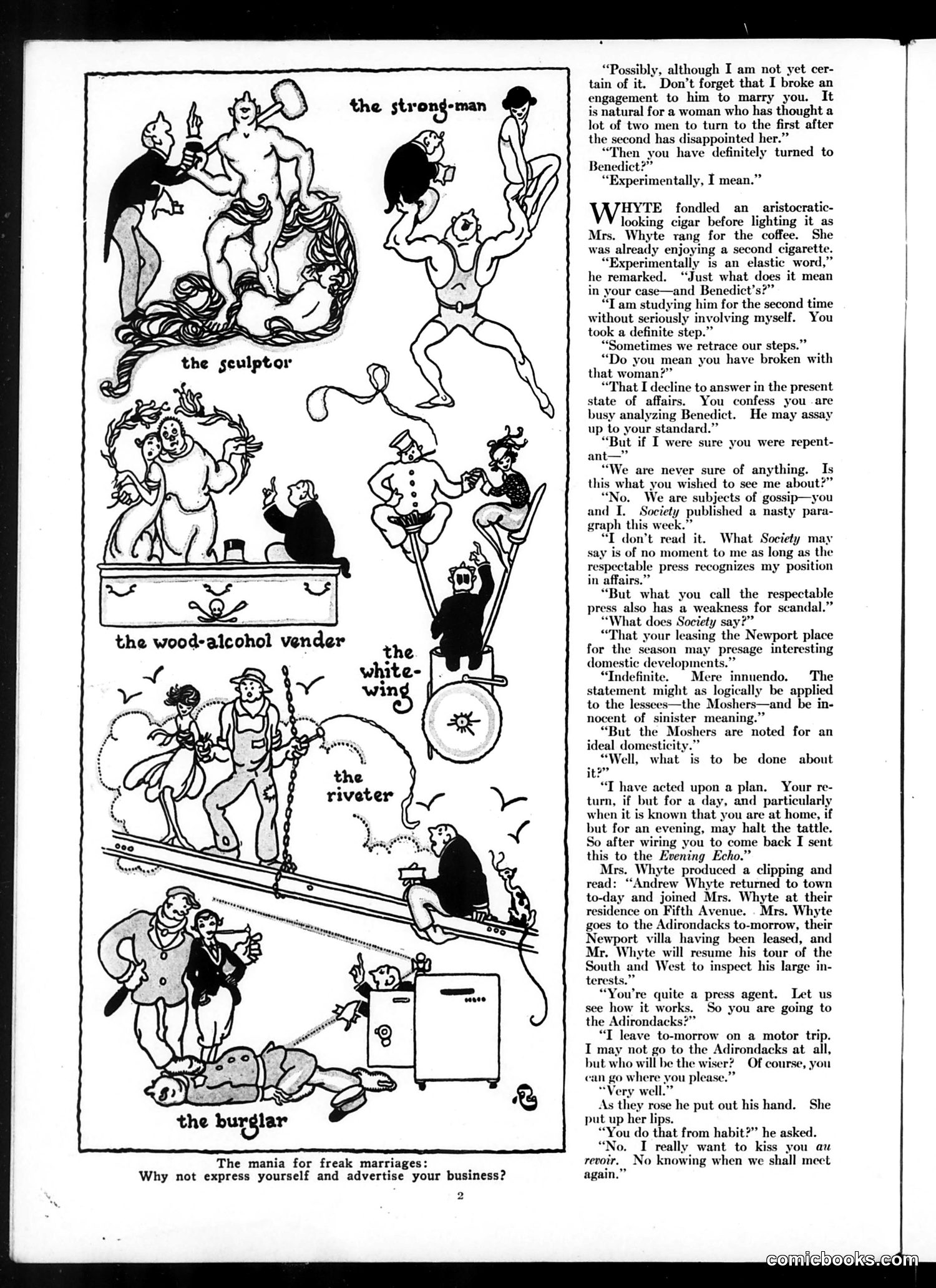
This page contains two distinct elements: **Left side:** A satirical illustration titled "The mania for freak marriages: Why not express yourself and advertise your business?" depicts various unconventional professions as potential marriage partners—a strong-man, sculptor, wood-alcohol vendor, riveter, burglar, and white-wing (street cleaner). The caption mocks the era's apparent trend of women marrying men from unusual or lower-status occupations, suggesting this represents a broader social loosening of marriage conventions. **Right side:** Prose dialogue between characters named Whyte and Benedict discusses a woman's broken engagement and potential remarriage. The conversation references *Society* magazine's gossip column, revealing period anxieties about public scandal and social reputation among the wealthy. Together, the page satirizes early 20th-century shifts in marriage norms and the role of gossip media in scrutinizing unconventional unions.
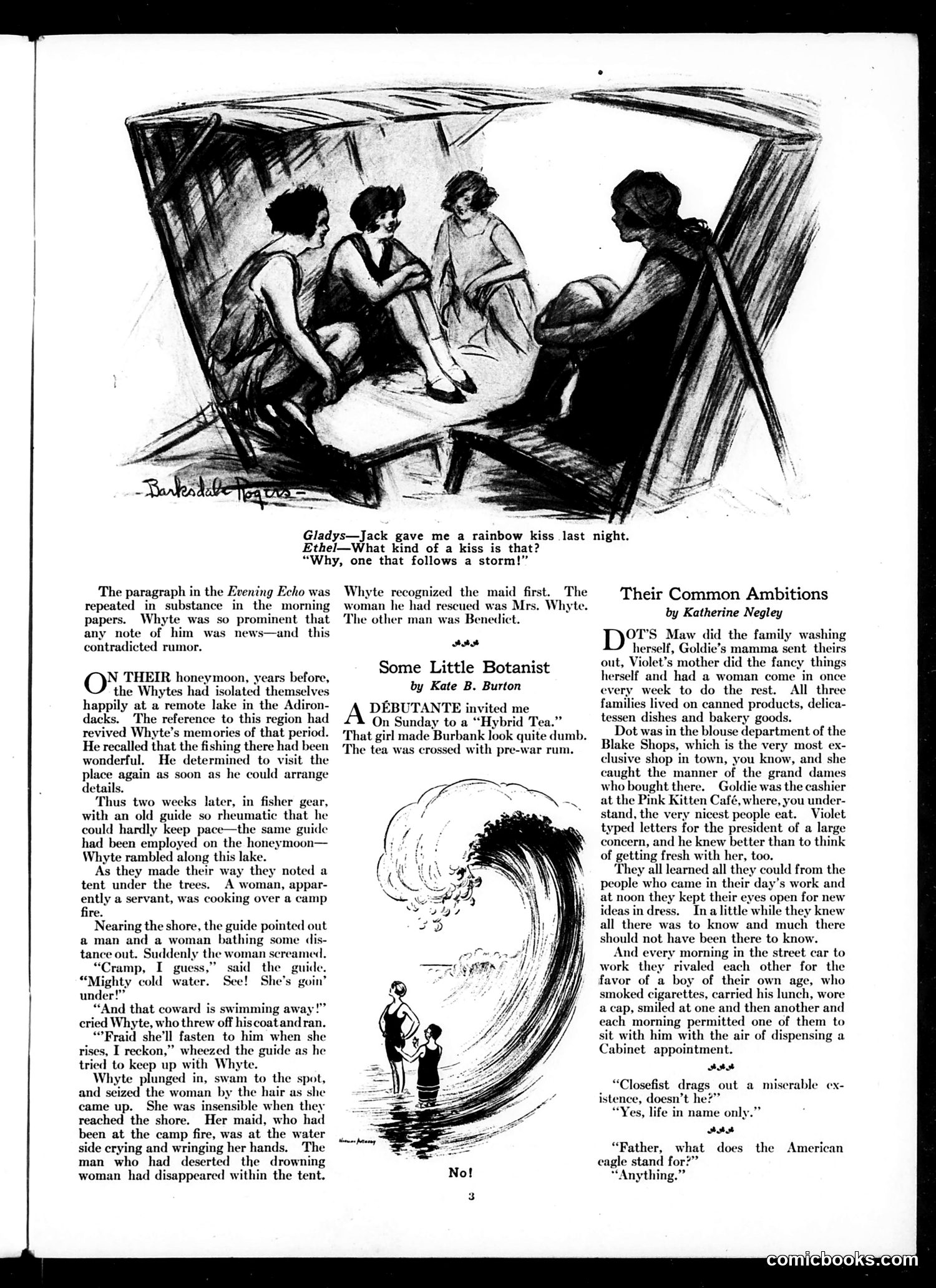
The top cartoon depicts a social scenario about romantic behavior. A woman named Gladys mentions receiving a "rainbow kiss" from Jack, which Ethel questions. The punchline—"one that follows a storm"—is a flirtatious double entendre about kissing after an argument or conflict. The main text article "Their Common Ambitions" by Katherine Negley satirizes working-class aspiration. It describes the Dot family's modest circumstances and their employment in retail and service positions. The humor derives from depicting their genuine pride in menial work and limited social mobility as their earnest life goal. The illustration "No!" depicts a swimming mishap, likely illustrating one of the anecdotes in the surrounding text about Whyte's earlier adventures. This represents Judge's typical early-20th-century satirical approach to class and social humor.
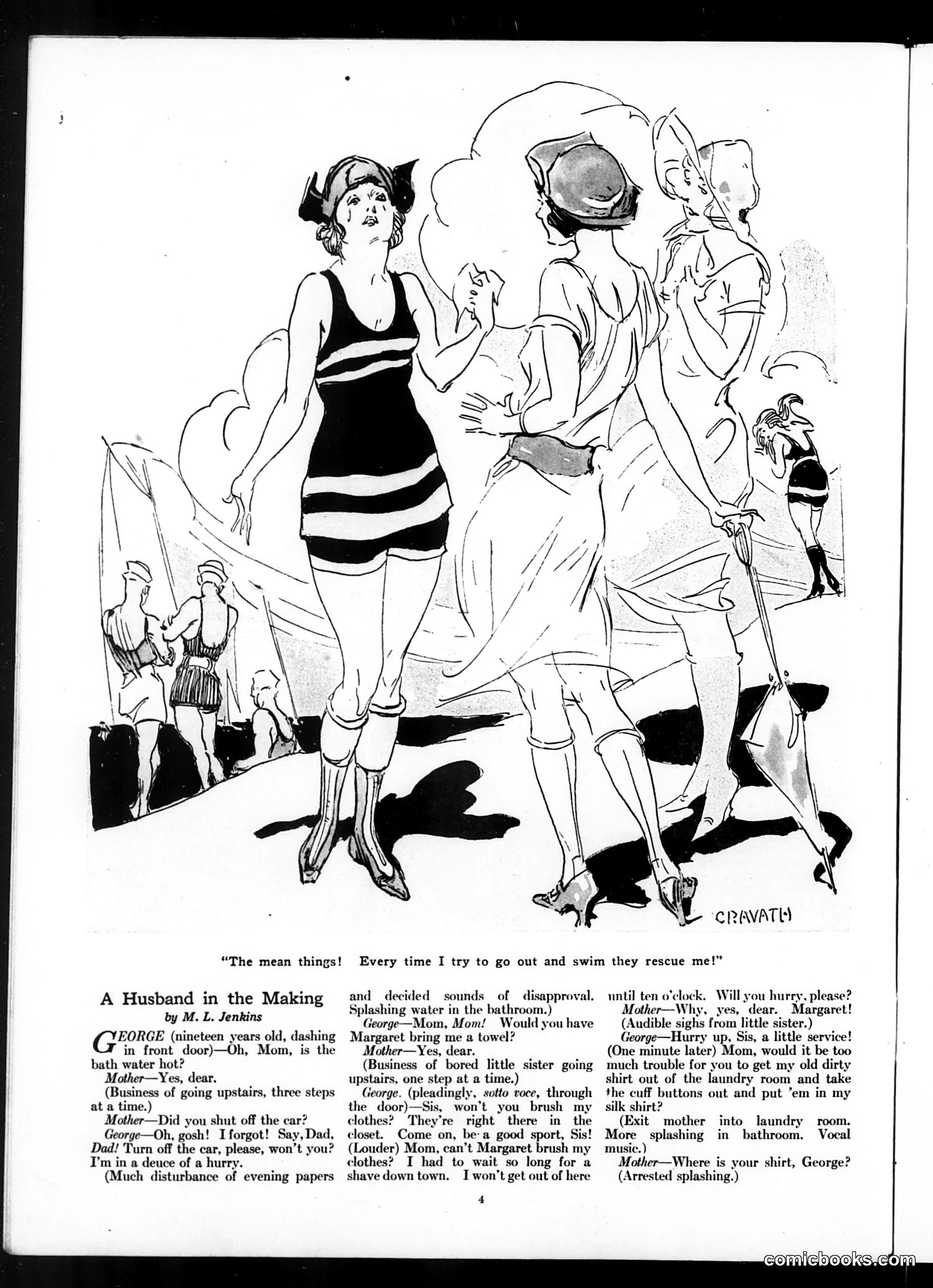
This is a domestic comedy sketch by M.L. Jenkins, illustrated by Cravath. The humor centers on a teenage boy (George, nineteen years old) navigating household chores and family dynamics while attempting to maintain his dignity. The cartoon satirizes early-20th-century gender roles: George is repeatedly interrupted by family demands—fetching towels, brushing clothes, retrieving his sister from the bathroom. The caption "The mean things! Every time I try to go out and swim they rescue me!" suggests he's being thwarted from leisure by domestic responsibilities traditionally assigned to women. The satire gently mocks both the overburdened youth and the family's reliance on him, illustrating social expectations about domestic labor and masculinity during this era.
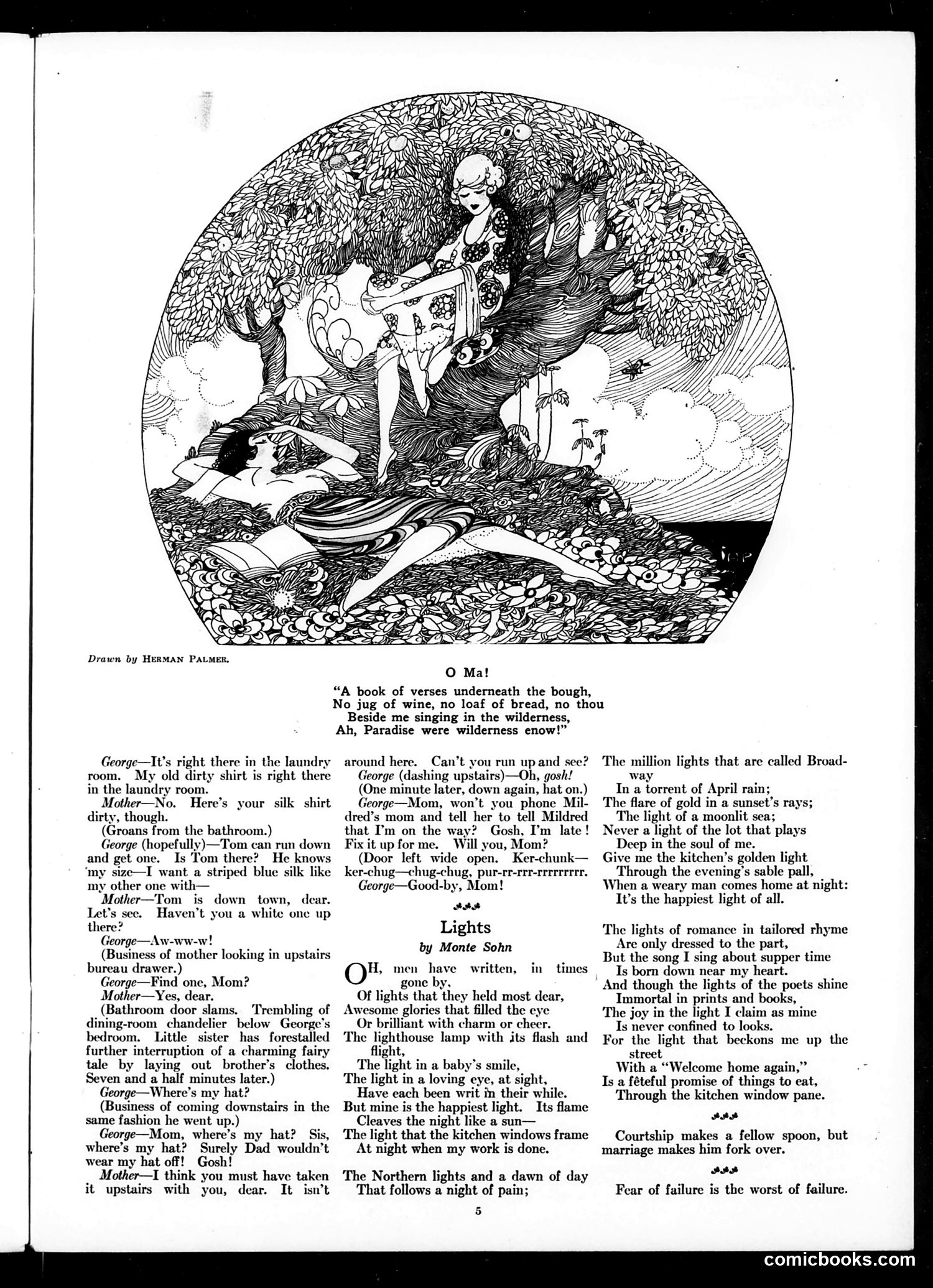
This page contains two distinct pieces: **Top Illustration ("O Ma!"):** Herman Palmer's drawing depicts an idealized pastoral scene—figures relaxing beneath a tree with flowing, ornamental foliage. The caption quotes Omar Khayyam's *Rubáiyát*, romanticizing simple wilderness pleasures. This appears to be decorative rather than satirical. **"George" Comic Strip:** A domestic humor sequence showing a young man (George) frantically preparing to see a girl named Mildred, requesting his mother's help locating clothes and making phone calls. The humor derives from his disorganization and his mother's patient exasperation—typical early 20th-century family comedy. **"Lights" Poem (by Monte Sohn):** A sentimental poem celebrating domestic happiness, specifically the "kitchen window light" welcoming a tired husband home. It contrasts romantic literary imagery with working-class domestic contentment. **Bottom Aphorisms:** Brief jokes about courtship and marriage, using wordplay ("fork over"). The page reflects common Judge themes: gentle domestic satire, sentimentality about home life, and the contrast between literary idealism and practical reality—with working-class domestic love presented as superior to poetic romance.
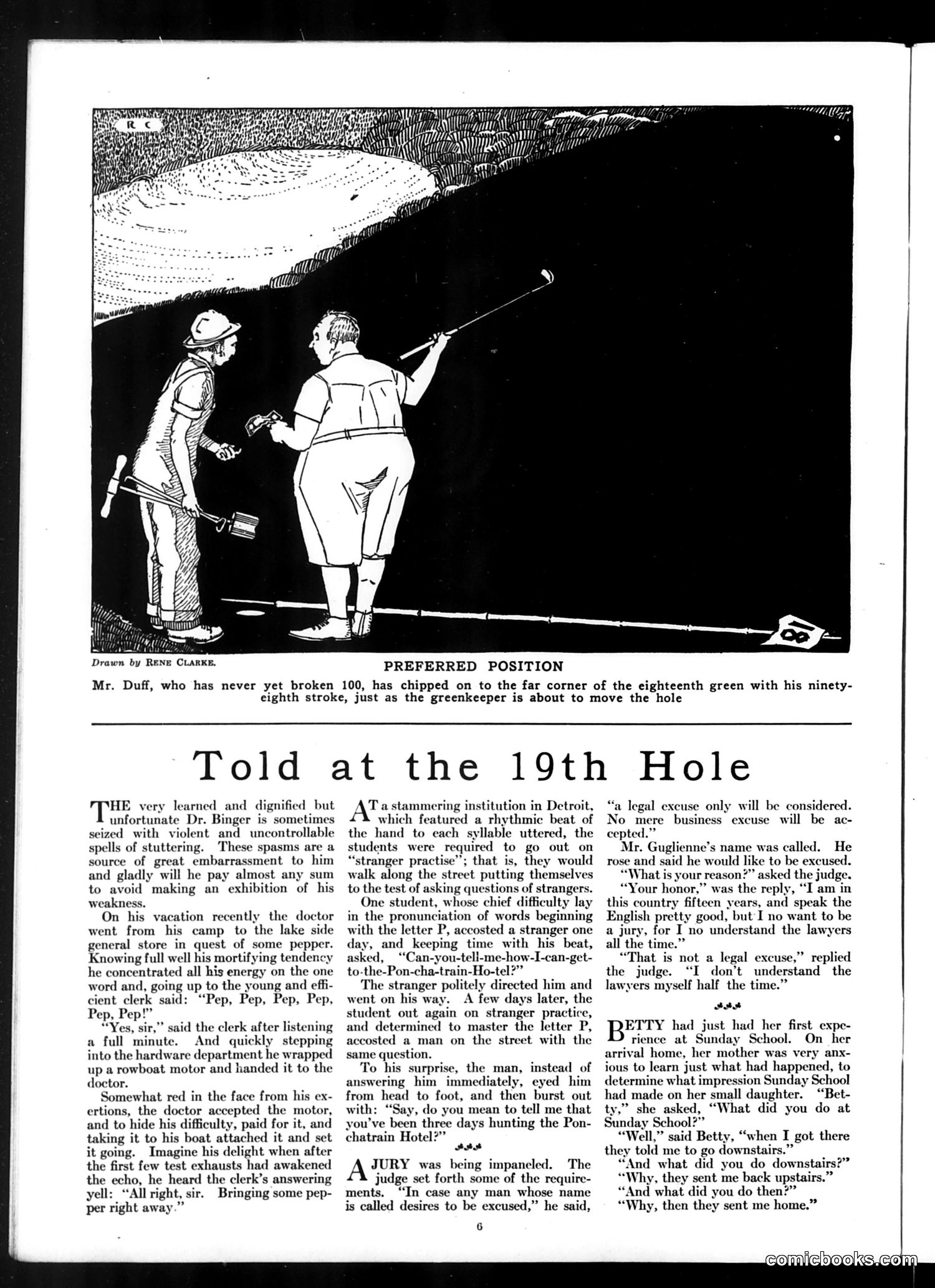
This page contains four humorous anecdotes illustrated with cartoons, typical of Judge magazine's format. **Top cartoon:** Shows a golfer ("Mr. Duff") who has never broken 100, cheating by moving his ball to a better position while the greenkeeper isn't looking—satirizing golf etiquette violations. **The stories below** are light comedy pieces: 1. **Dr. Binger's stutter:** A doctor with a severe stammer tries to buy pepper but repeats "Pep" so many times the clerk returns with a rowboat motor—a pun on "pep" (energy/power). 2. **Speech therapy mishap:** A student practicing pronunciation of words beginning with "P" asks a stranger three times about "the Pon-cha-train Hotel," exhausting the stranger's patience. 3. **Jury duty excuse:** A naturalized immigrant claims he can't serve because he doesn't understand lawyers—the judge humorously admits he doesn't either. 4. **Betty at Sunday School:** A child is sent back and forth between rooms until sent home entirely—suggesting Sunday School chaos or her being unwelcome. These are gentle, era-appropriate humor pieces reflecting early-20th-century American life and speech impediments as comedy fodder.
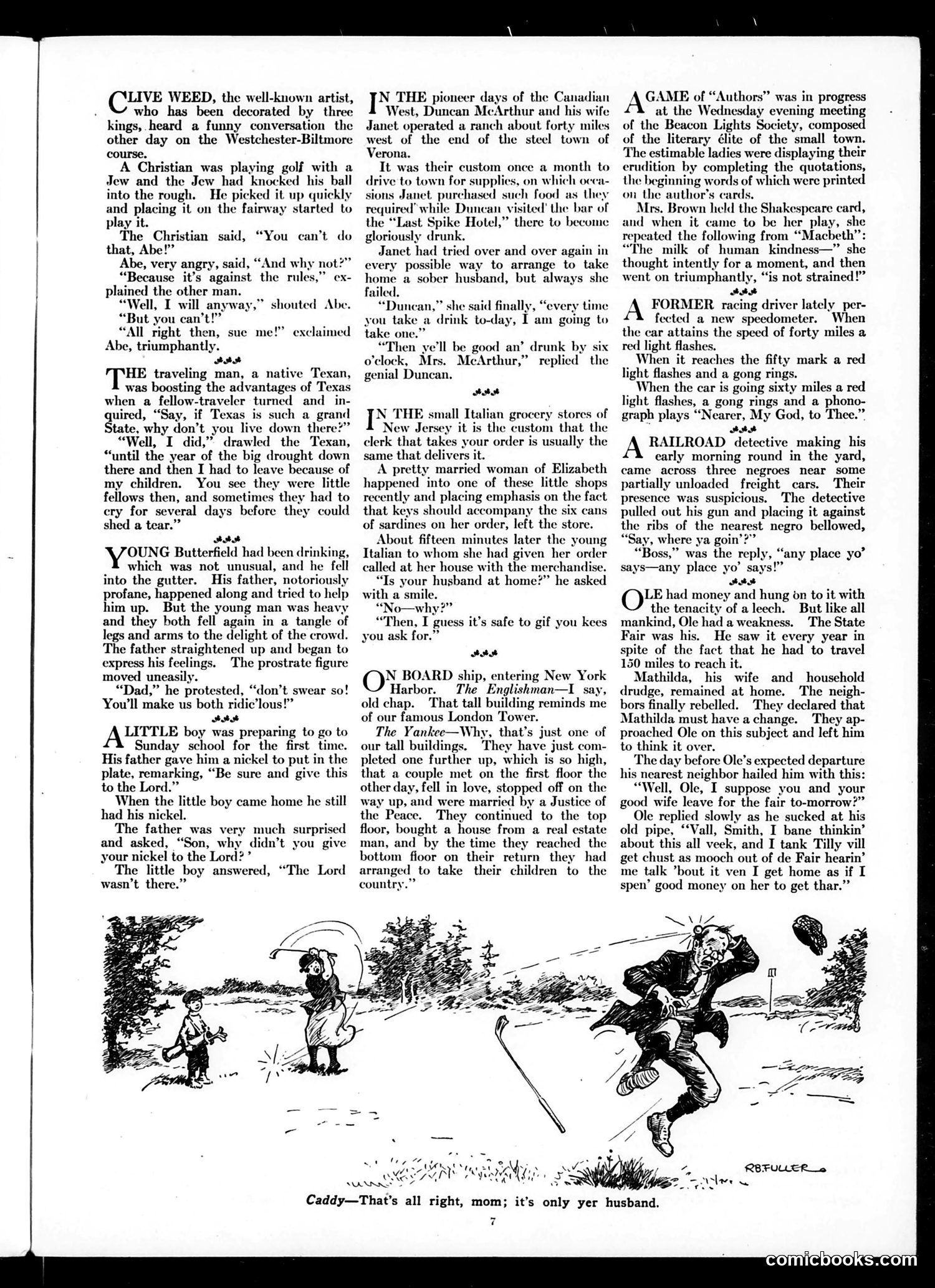
This page contains several humorous anecdotes and one cartoon. The main cartoon depicts a golfer who has hit a ball wildly off-course, striking a man in the head. The caddy reassures the golfer's wife with "Caddy—That's all right, mom; it's only yer husband," implying the husband's value is negligible. The text stories include jokes about Christian and Abel playing golf, a traveling Texan boasting about frontier hardships, a young boy's religious naiveté, and various domestic humor pieces about Italian grocers, ship passengers, and marital finances. The overall tone is genteel, middle-class humor typical of early 20th-century American magazines—light domestic satire with no apparent political content.
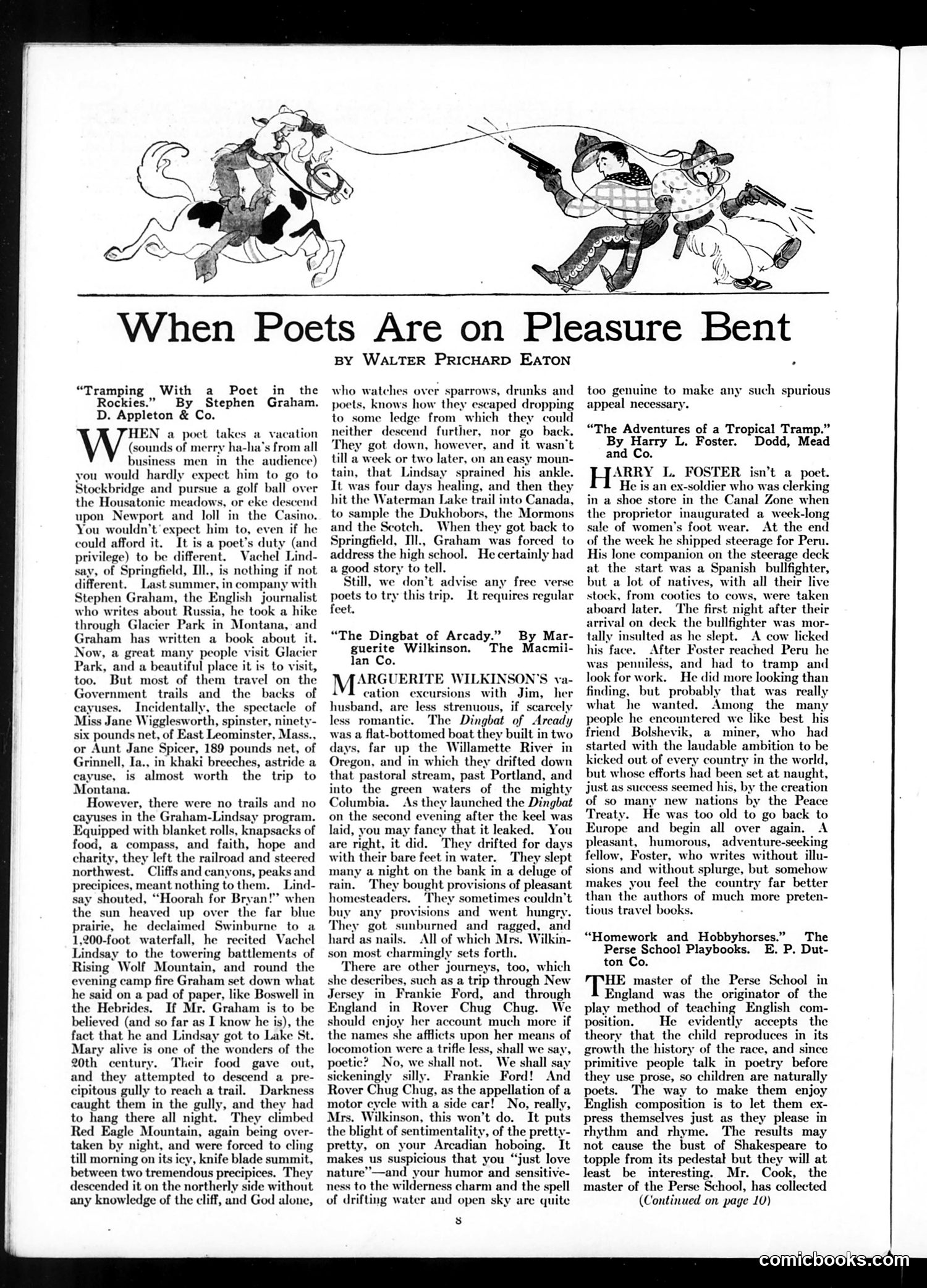
This satirical essay mocks the romantic notion of poets roughing it in nature. Author Walter Prichard Eaton reviews two travel books by poets and their companions: Stephen Graham's account of hiking with Vachel Lindsay through Glacier Park, Montana, and Margarette Wilkinson's river journey down the Willamette. The humor targets the gap between poets' bohemian self-image and reality. The cartoons show poets being dragged reluctantly on adventures, contrasting their affected artistic personas with practical discomfort. Eaton gently ridicules Lindsay's theatrical dramatics (shouting "Hoorah for Bryan!" at waterfalls, reciting poetry to mountains) and the poets' near-death experiences from poor planning—hanging on cliff-sides overnight, running out of food. The satire suggests poets pursue such trips to seem "different" and authentic, yet lack the competence of ordinary outdoorsmen. The final caution—"we don't advise any free verse poets to try this trip"—humorously implies their survival depends on luck, not skill.
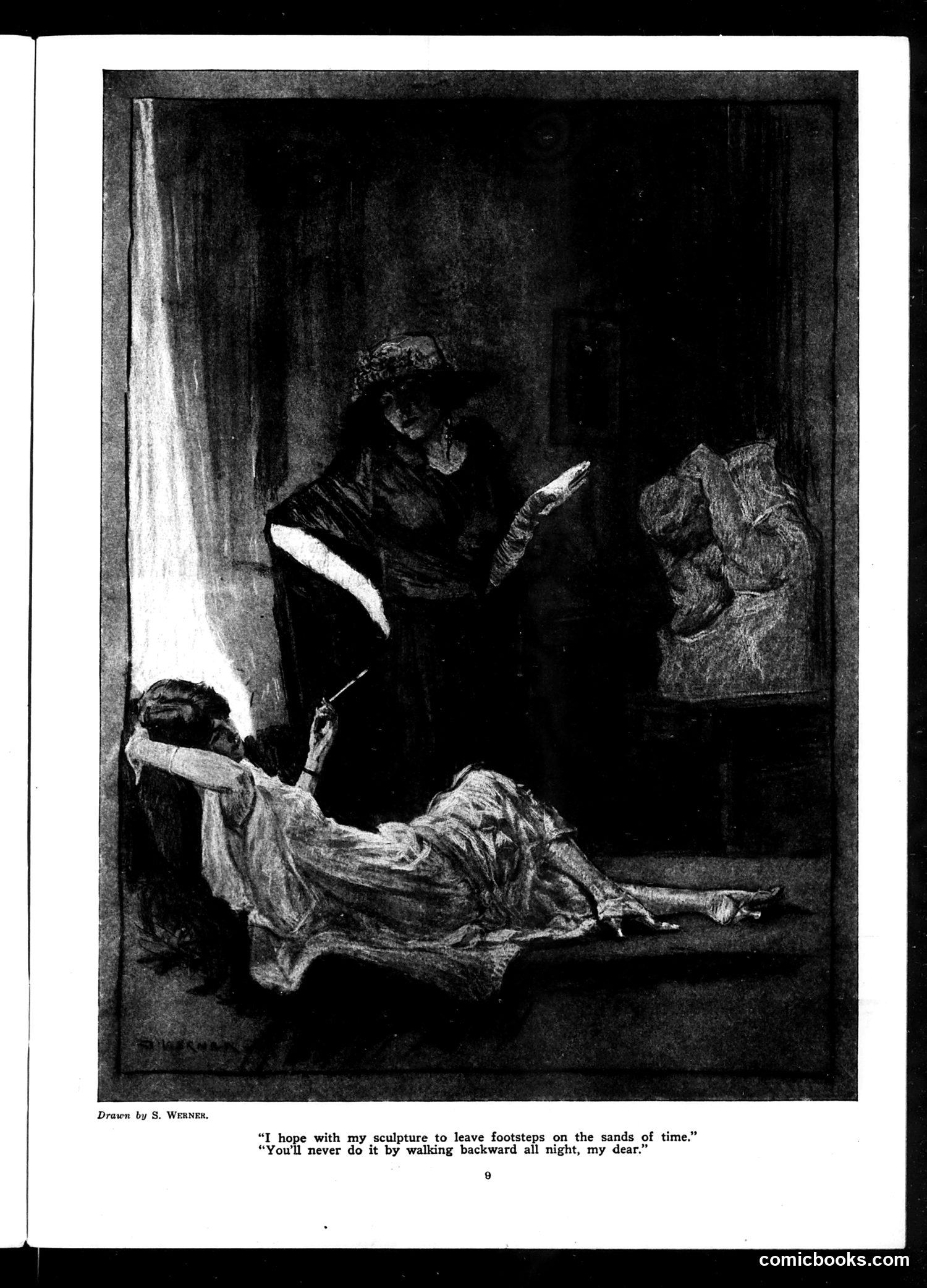
This is a satirical cartoon by S. Werner depicting an artist (likely a sculptor) with pretensions of creating enduring work. The figure reclining on the floor appears to be critiquing the standing artist's ambitions. The joke plays on the literal phrase "leave footsteps on the sands of time"—a metaphor meaning to make a lasting impact. The seated figure mocks this aspiration by pointing out the artist is literally walking backward, making the comment absurd and humorous. The satire targets artistic pretension: the grandiose sculptor's lofty claims about legacy are undercut by the absurd image of backward movement, suggesting the artist's methods are counterproductive or foolish. The "my dear" suggests condescension toward such inflated artistic ego.
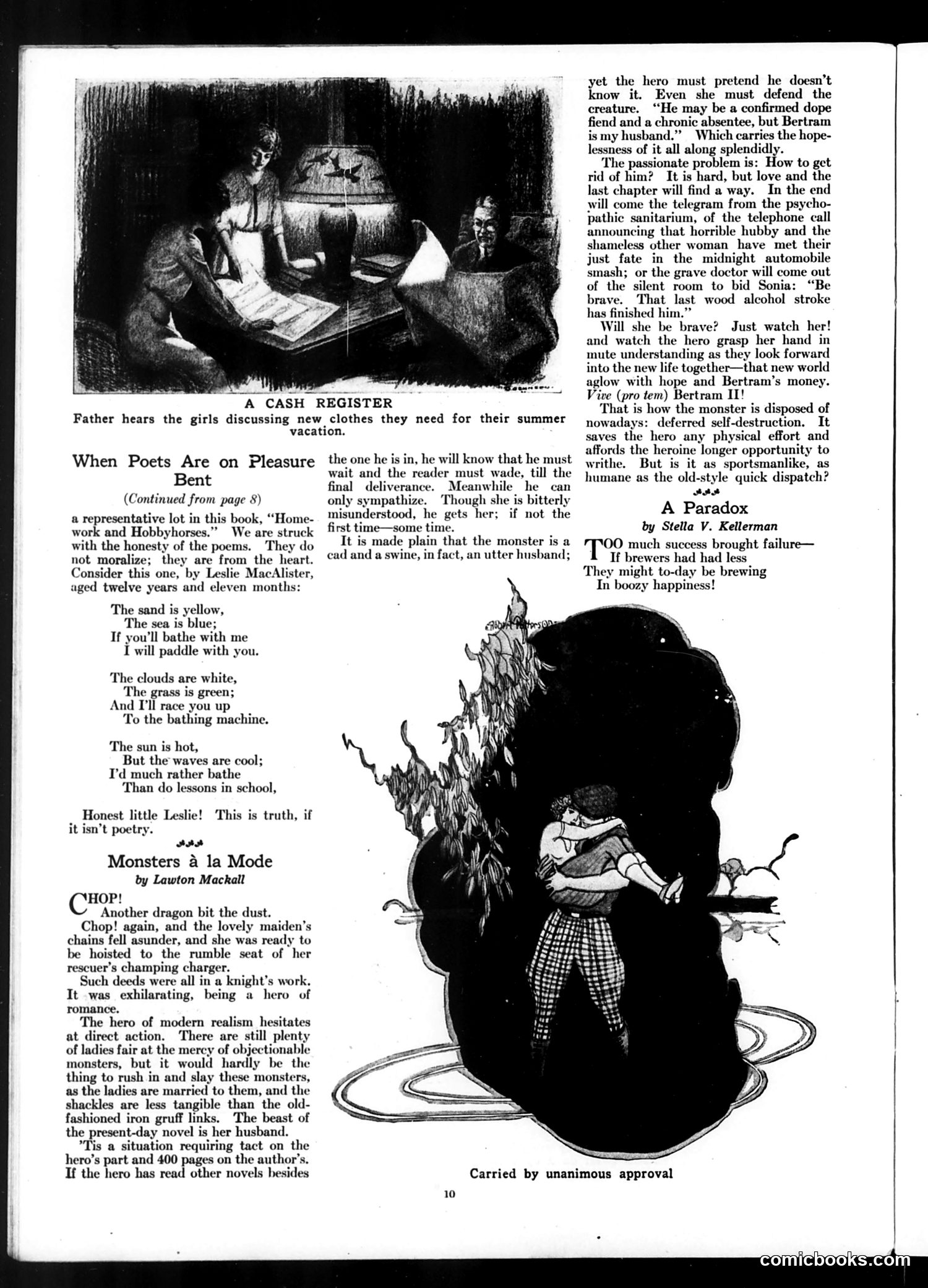
**"A Cash Register"** (top cartoon): A father overhears his daughters discussing expensive new clothes needed for summer vacation, ironically depicted as a "cash register"—the daughters are literally machines dispensing his money. This satirizes the financial burden of children's fashion demands. **"Monsters à la Mode"** (main article by Lawton Mackall): A literary satire contrasting medieval romance heroes (who slayed dragons to rescue maidens) with modern novelists' heroes. In contemporary fiction, the "monster" is the heroine's own husband—a cad, drunkard, or adulterer—yet the hero cannot simply rescue her through action. Instead, he must wait 400 pages for the husband's convenient death (sanitarium telegram, car crash, or poisoning) to achieve his goal. Mackall mocks this as cowardly compared to direct medieval heroism, questioning whether deferred solutions are "sportsmanlike" or "humane." **"A Paradox"** (Kellerman poem): A brief joke suggesting breweries' success corrupted them; had they remained small, they'd still enjoy honest "boozy happiness."
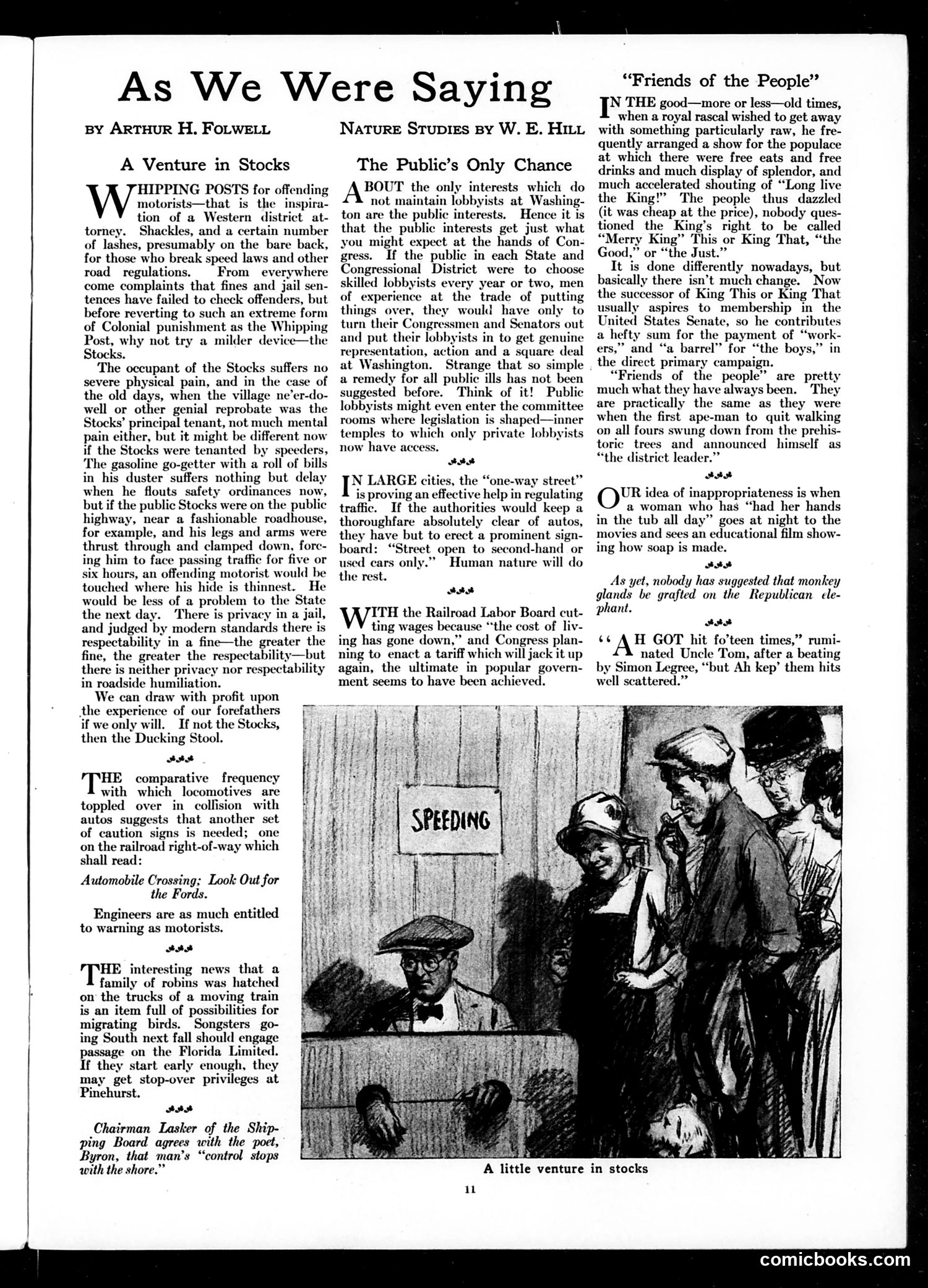
This page from **Judge** magazine contains satirical commentary on early 20th-century American problems, paired with a cartoon illustration. The main text attacks **reckless motorists** speeding on public roads. The author proposes using colonial-era "stocks" (public restraint devices) to shame wealthy speeders—arguing that fines don't deter those with money, but public humiliation would. The satire targets the privileged classes who flout safety laws without consequence. The accompanying cartoon shows a man caught in stocks at a "SPEEDING" sign, with onlookers jeering—illustrating this punishment concept. Secondary pieces mock **lobbying culture** (only private interests have representatives in Washington), traffic regulation (one-way streets work because people avoid used cars), and railroad labor disputes. The humor relies on exaggerated solutions to modern problems—suggesting we return to medieval punishment for contemporary driving violations—to critique the ineffectiveness of existing enforcement and class-based justice.
This is a **humor submission page** from Judge magazine, not political satire. The header announces Judge pays $10 weekly for the best submitted stories. The page contains three short humorous anecdotes: 1. **First Prize**: A sentimental dialogue between an elderly Southern planter and his longtime enslaved worker Tony, making a pact to report back from the afterlife—with the punchline that Tony requests the planter return "in de day time" (implying fear of ghosts). 2. **Second Prize**: A child's innocent negotiation at a soda fountain, manipulating the clerk's kindness by spending his nickels separately. 3. Additional brief jokes including: an Indian describing a car accident caused by repeated drinking ("we go along purty good...then along come bridge"), a lady's Pekingese escaping through a fence with an Italian gardener's comical solution, and folk remedies involving insects. These represent **period vernacular humor**—using dialect comedy and slapstick scenarios typical of early 20th-century American magazines. The ethnic/racial caricatures reflect attitudes of that era.
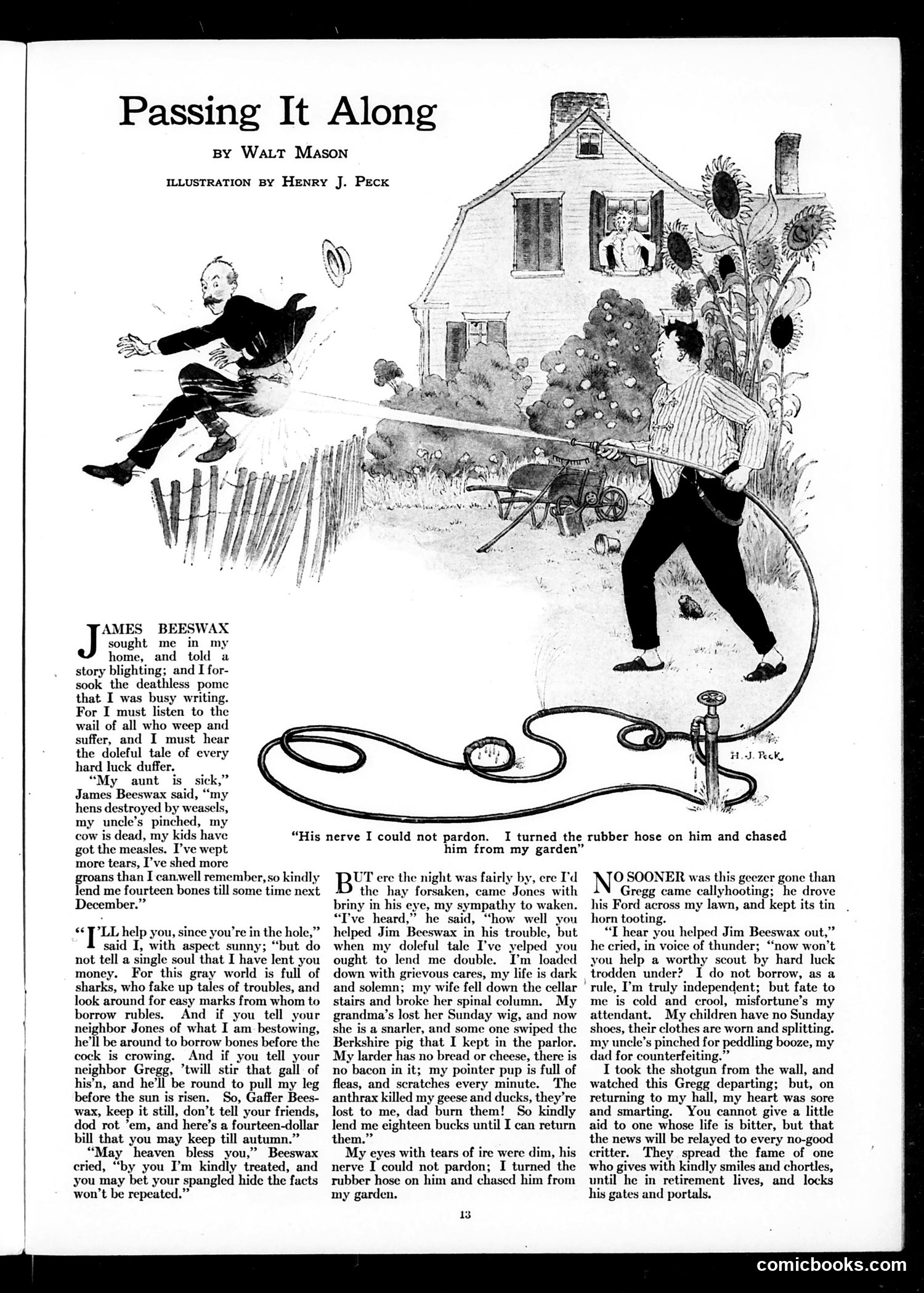
This humorous story by Walt Mason satirizes how a single act of charity spreads through social networks, creating endless requests from opportunists. The narrator lends money to James Beeswax on condition of secrecy. However, word spreads immediately: Jones appears claiming equal hardship and demanding double the amount. When refused, Gregg arrives next, driving across the narrator's lawn demanding aid. The moral: generosity, once known, becomes public knowledge that attracts parasitic borrowers. Each person claims worse misfortunes (dead cows, measles, broken spinal columns, dead geese, counterfeiting relatives). The narrator, exhausted by cascading requests, eventually chases them away with a rubber hose and shotgun. The satire targets grifters and chronic complainers who exploit compassion, plus the impossibility of private charity in gossip-driven communities. The illustration humorously shows the escalating chaos of unwanted visitors.
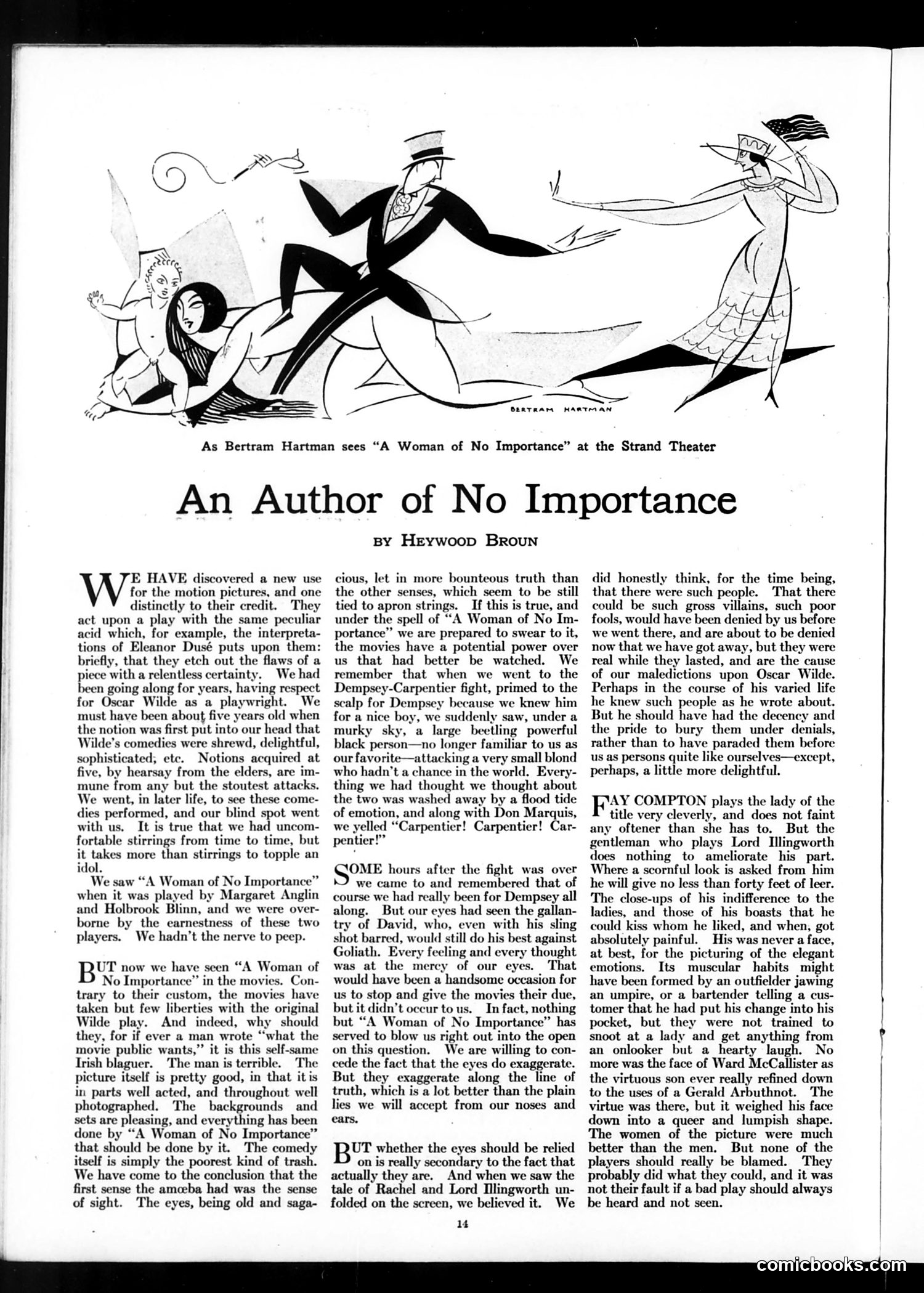
This article by Heywood Broun uses Oscar Wilde's play "A Woman of No Importance" (shown in the cartoon as a chaotic theatrical scene) to critique Wilde himself and expose cinema's unique power to reveal truth. **The satire's point:** Broun admits he long respected Wilde as a playwright based on childhood assumptions passed down by elders—never questioning this inherited opinion. However, seeing the play adapted to film stripped away the actors' (Margaret Anglin and Holbrook Blinn's) ability to obscure the work's fundamental weakness: the script itself is "the poorest kind of trash." **Key argument:** Film's visual directness—what Broun calls the "amoeba's first sense"—exposes artistic flaws "with relentless certainty" in ways stage performances mask through interpretation. He illustrates this with the Dempsey-Carpentier fight, where raw visual evidence overrode his preexisting bias. **The joke:** Wilde, famous for declaring "the public wants," has ironically provided a vehicle proving cinema's superior honesty—inadvertently destroying his own reputation in the process.
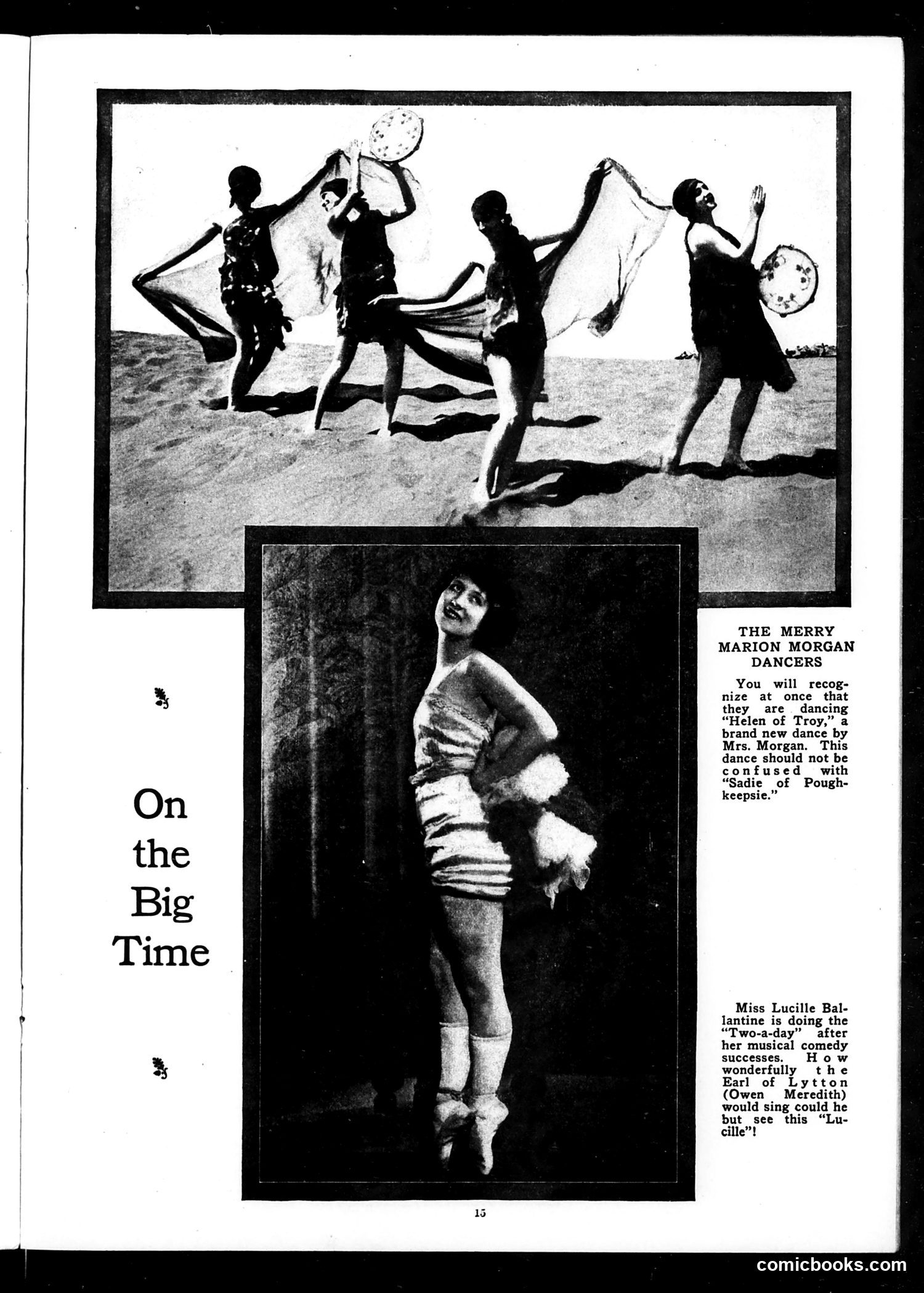
This page features entertainment content rather than political satire. The top image shows the Marion Morgan Dancers performing a new modern dance interpretation of "Helen of Troy," with five figures in flowing costumes on a beach. The text humorously distinguishes this serious classical dance from a presumably less sophisticated piece called "Sadie of Poughkeepsie." The lower section profiles Miss Lucille Ballantine, a musical comedy performer who is apparently expanding into vaudeville ("Two-a-day"). The joke references Owen Meredith (pen name of the Earl of Lytton, a 19th-century poet), suggesting that if Meredith could see Ballantine perform, he would be inspired to write poetry about her—a compliment to her talent and appeal. The page celebrates contemporary theatrical and dance trends of the era, particularly the modernist dance movement influenced by figures like Marion Morgan.
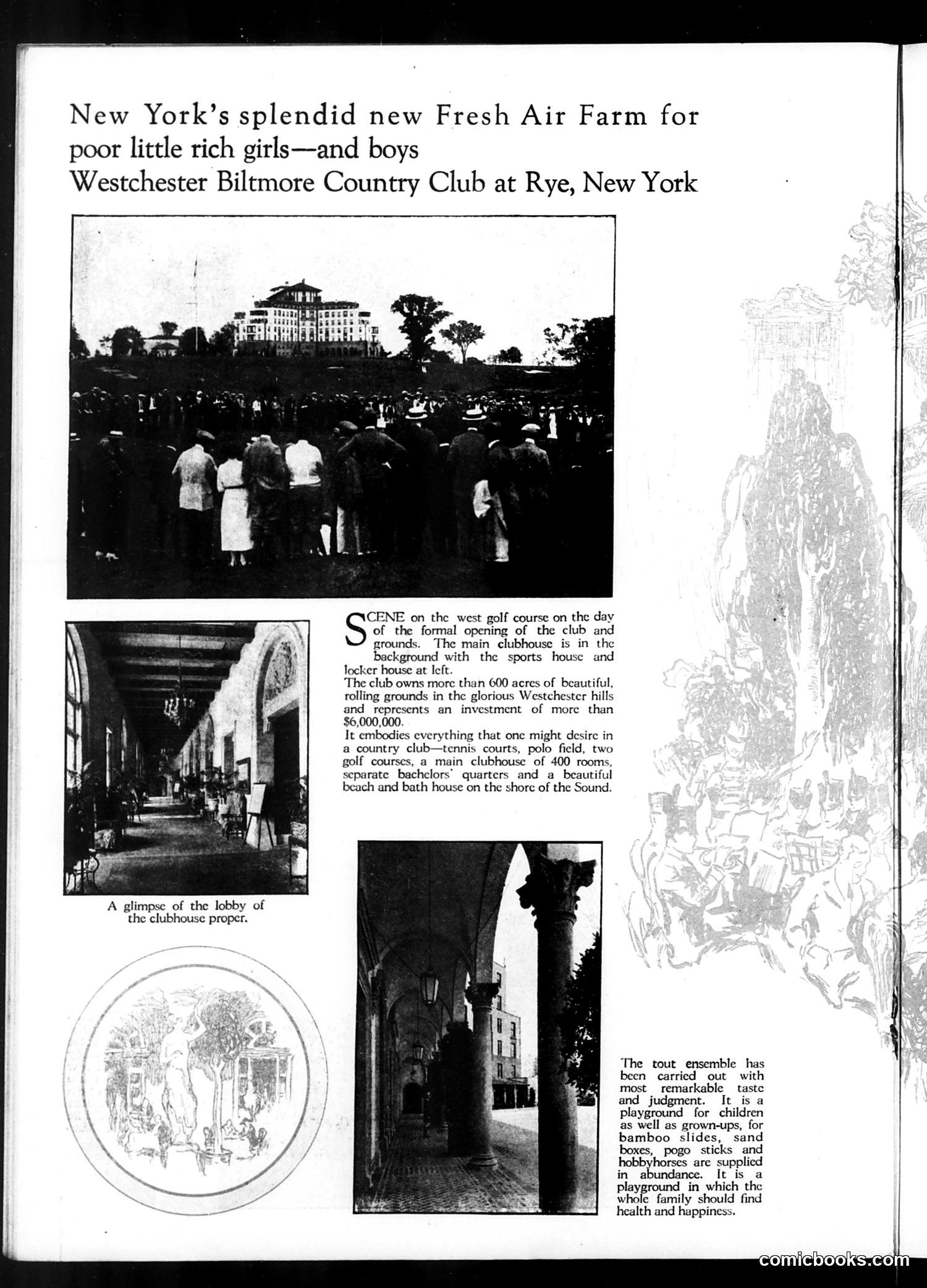
This is **not a satirical cartoon** but rather a **promotional advertisement** disguised as editorial content—a common Judge magazine practice. The satire lies in the **ironic headline**: "Fresh Air Farm for poor little rich girls—and boys." The Westchester Biltmore Country Club is explicitly a luxury establishment for wealthy families (600 acres, $6 million investment, polo fields, 400-room clubhouse). Calling it a "Fresh Air Farm" mockingly invokes actual charitable Fresh Air programs that provided poor urban children respite in the countryside. The joke: wealthy children don't need charity—they already have everything. By labeling an elite resort as a "Fresh Air Farm," Judge satirizes the pretentious self-regard of the wealthy, suggesting their children receive the same "character-building" benefits as poor children, just in incomparably luxurious surroundings. The photographs show the clubhouse, lobby, grounds, and architectural details—all meant to impress and demonstrate opulence while the headline undercuts the presentation with gentle ridicule of class privilege.
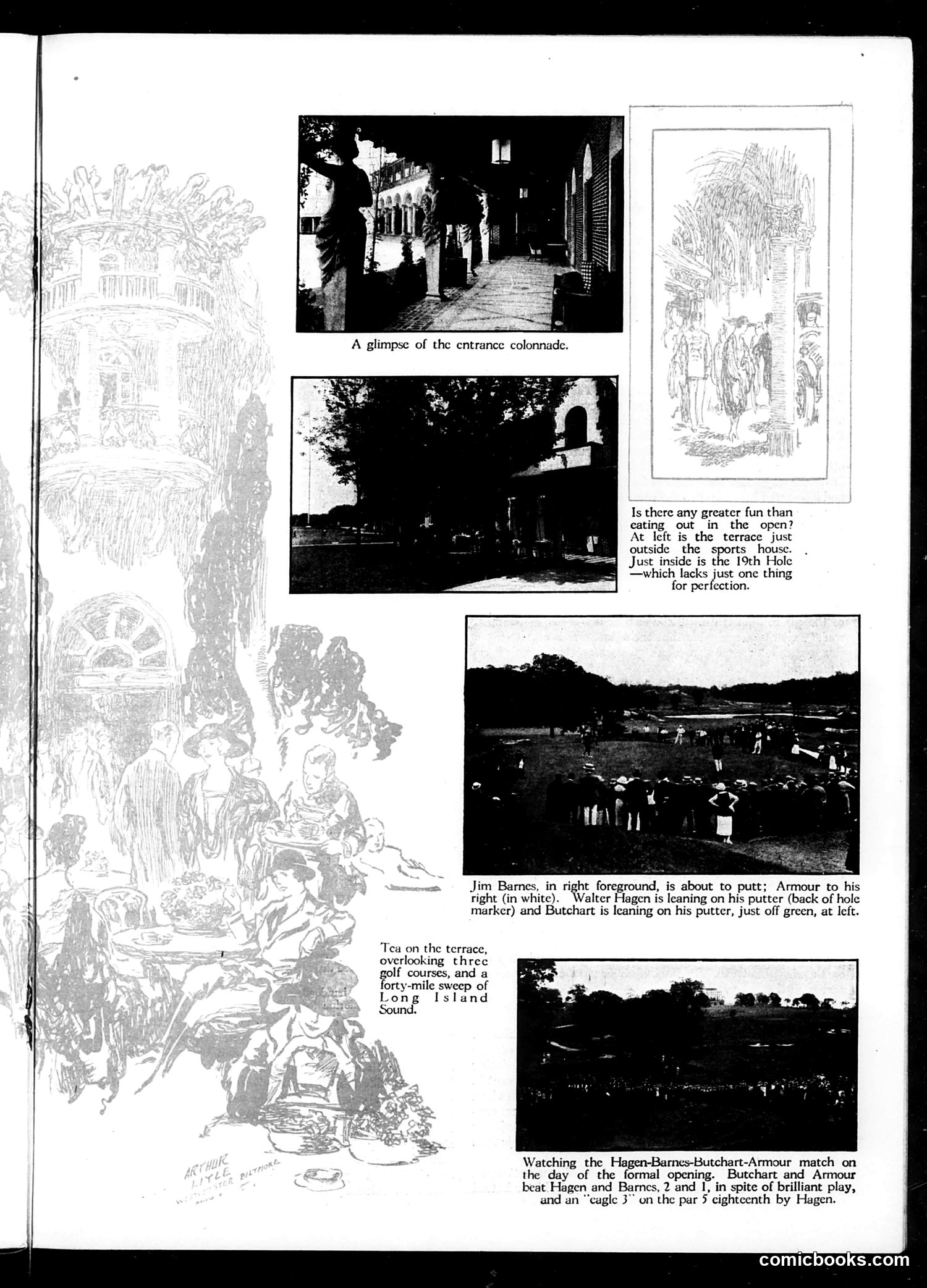
This page documents the opening of an upscale golf club, likely in the 1920s based on the styling. It's not primarily satirical—rather, it's a society/sports feature showing prominent professional golfers of the era: Jim Barnes, Tommy Armour, Walter Hagen, and Butchart competing in a match. The "satire" is gentle: the text asks "Is there any greater fun than eating out in the open?" while showing the exclusive terrace overlooking three golf courses and Long Island Sound. The 19th Hole reference (the clubhouse bar) jokes that the facility "lacks just one thing for perfection"—implying alcohol, likely a jab at Prohibition-era restrictions. The match itself (Butchart-Armour defeating Hagen-Barnes despite Hagen's eagle) provides sports content for readers interested in golf's professional scene during this period.
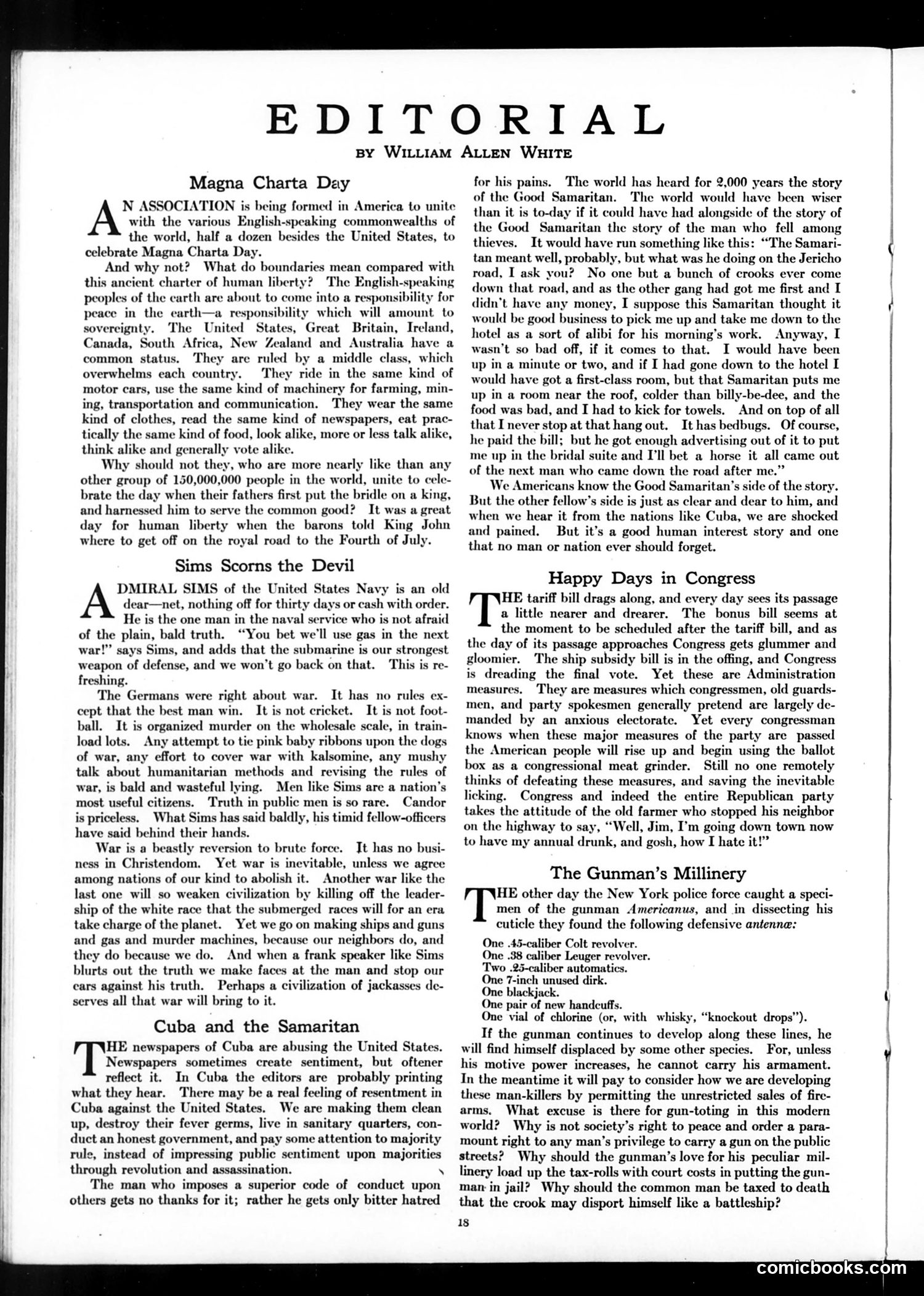
This editorial page by William Allen White comprises three opinion pieces—no cartoons are visible. **"Magna Charta Day"** proposes English-speaking nations (U.S., Britain, Canada, Australia, etc.) unite to celebrate the Magna Charta, arguing their shared middle-class culture, technology, and values make them natural allies for promoting peace and liberty globally. **"Sims Scorns the Devil"** praises Admiral William Sims for frankly acknowledging war's brutal reality—that submarines and gas will be used in future conflicts. White criticizes others' squeamishness about warfare's true nature, arguing honest military assessment is more valuable than romanticized notions of "civilized" combat. **"Cuba and the Samaritan"** defends American intervention in Cuba, noting that while Cuban newspapers resent U.S. pressure for sanitation and honest government, these reforms replace the previous system of revolutionary violence and assassination—implying American governance imposes superior standards. All three pieces reflect early-20th-century American expansionism and Anglo-Saxon cultural superiority assumptions common to the era.
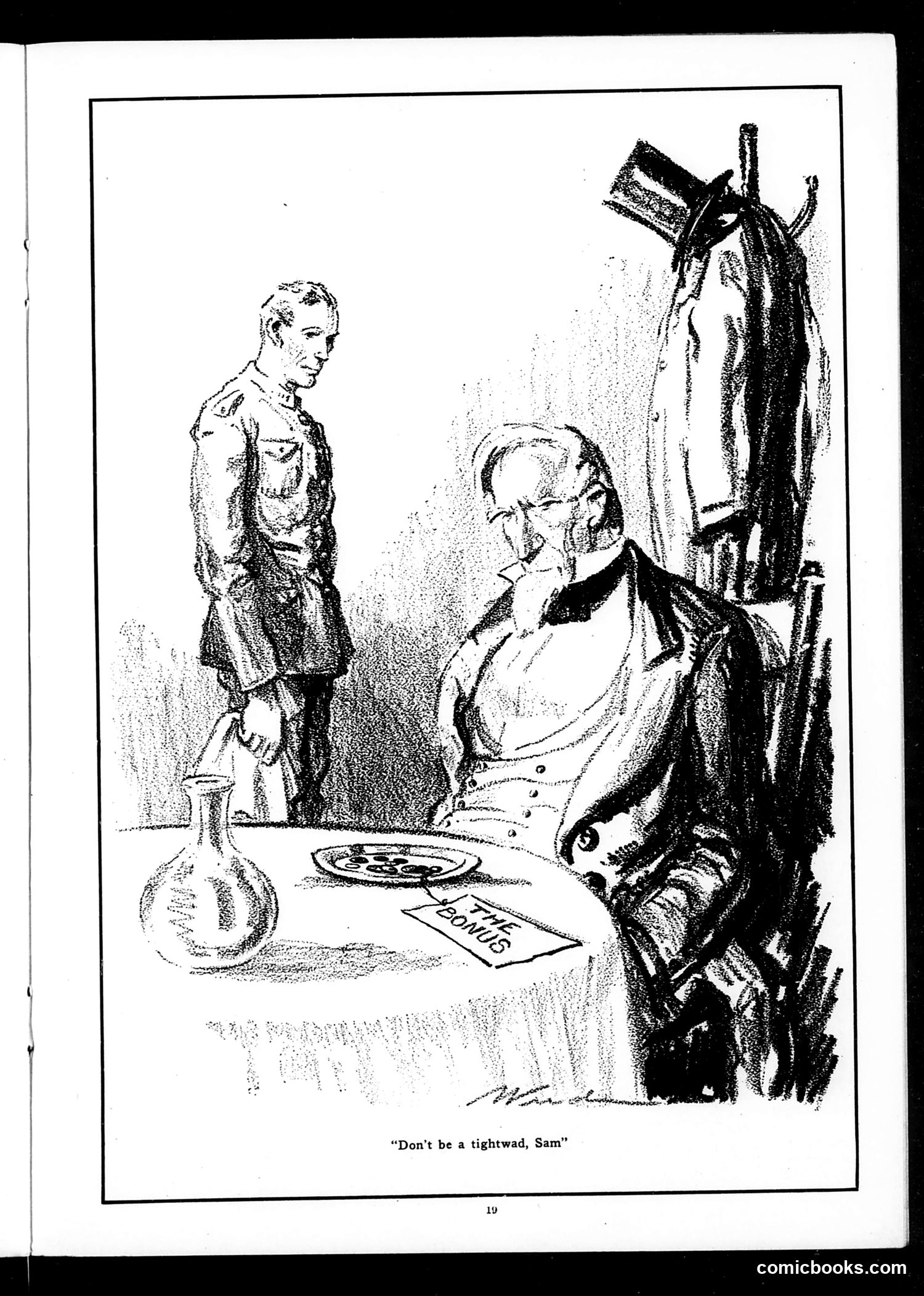
This is a single satirical cartoon from *Judge* magazine depicting a scene at a dining table. A seated, portly gentleman in formal attire appears to be a person of authority or wealth, while a younger man stands nearby. On the table are a wine bottle, plate, and what appears to be a document labeled "BONUS." The caption reads: "Don't be a tightwad, Sam." The cartoon satirizes stingy behavior regarding bonuses or financial rewards. The younger figure seems to be requesting or expecting more generous compensation, while the older man resists. Without additional context about the specific historical moment, the identities of "Sam" and the other figure remain unclear, though the cartoon critiques miserliness toward subordinates or employees during what was likely a period of labor tensions or wage disputes.
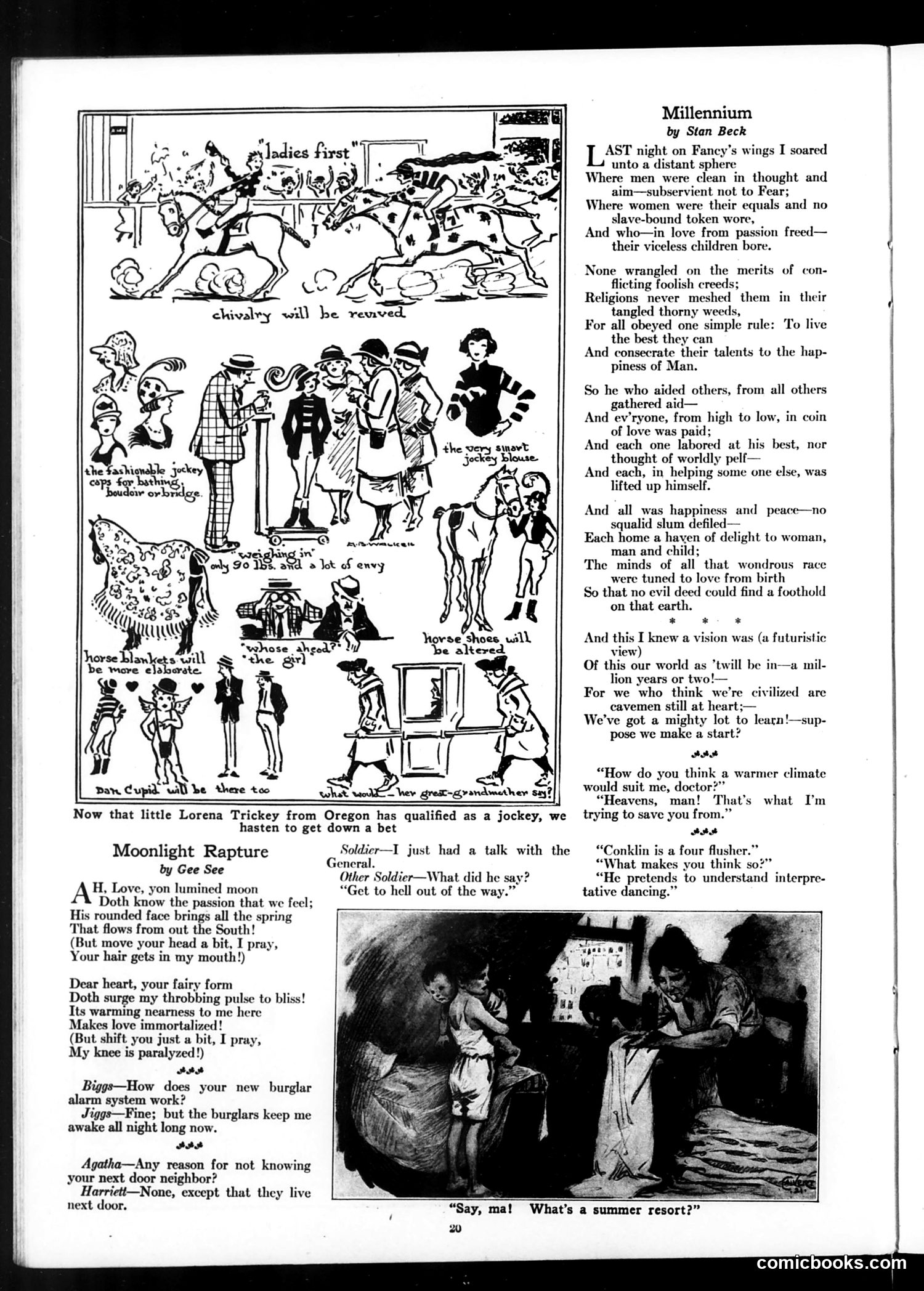
This page contains three distinct pieces of satire: **"Moonlight Rapture"** parodies romantic poetry by contrasting flowery declarations of love with physical discomfort—the speaker's hair gets in the lover's mouth; his knee becomes paralyzed. It mocks overly sentimental Victorian romance language. **"Millennium"** by Stan Beck presents an idealistic utopian vision where people are virtuous, religions coexist peacefully, and society operates on mutual aid rather than profit. The poem then deflates this fantasy, concluding that humans remain "cavemen still at heart" despite claiming civilization—a cynical commentary on 1920s society's lack of moral progress. **Brief jokes** include one about a burglar alarm that ironically keeps the owner awake, and a reference to "little Lorena Trickey from Oregon" becoming a jockey (likely a contemporary news item). The photograph at bottom shows what appears to be a domestic or poverty scene, captioned with a child asking about "summer resorts"—highlighting economic inequality. Overall, the page satirizes romantic pretense, false claims of civilization, and social hypocrisy.
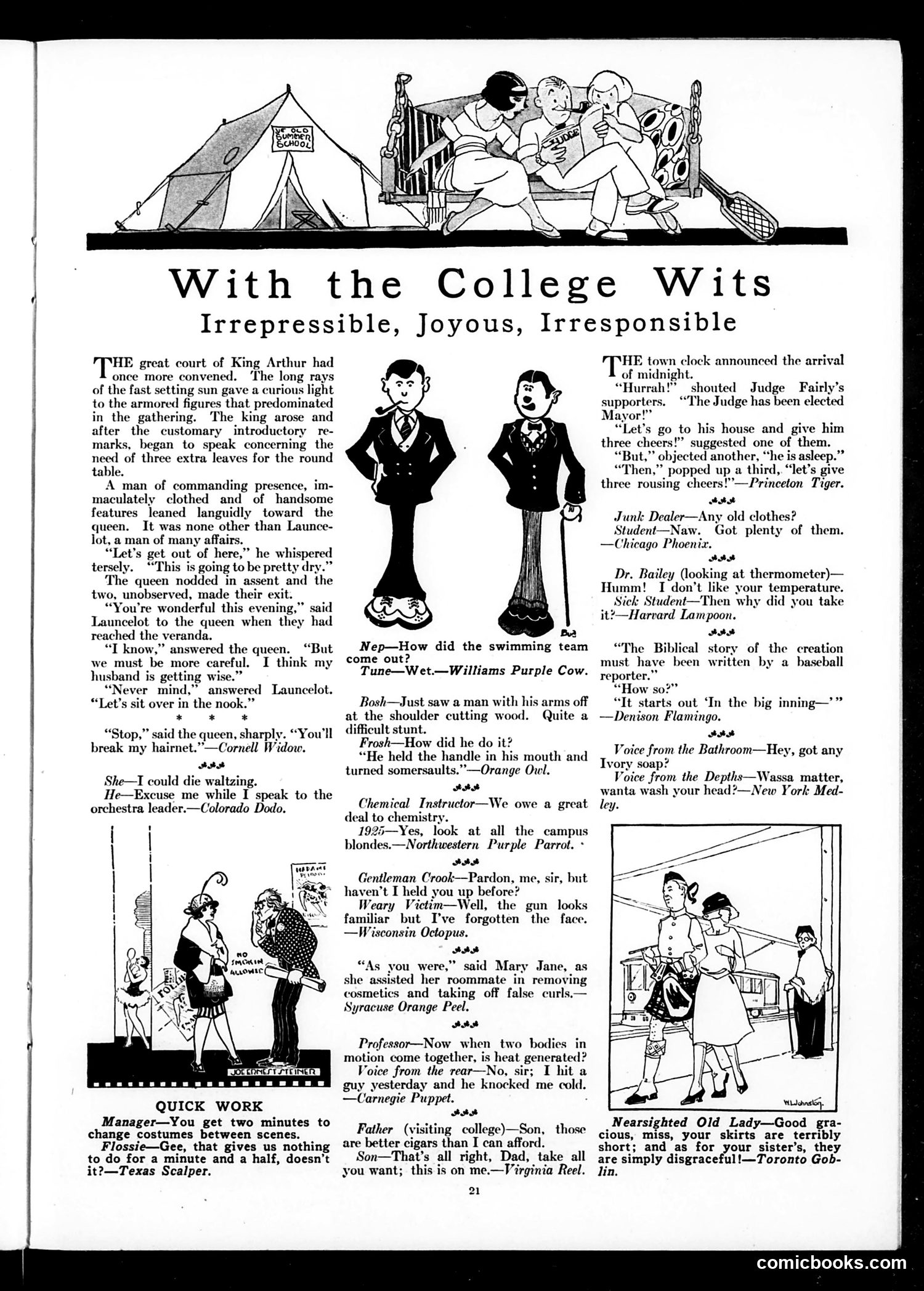
This page collects humor from college newspapers, a recurring Judge feature. The lead piece satirizes Arthurian romance by transplanting it to contemporary college life: Lancelot and Queen Guinevere sneak away from King Arthur's court because a formal meeting will be "pretty dry"—mocking both overwrought literary allusions and college students' impatience with authority. The surrounding one-liners target typical 1920s college life: hazing ("three rousing cheers" for a sleeping mayor), student poverty, chemistry class boredom, dating customs, and changing hemlines. The "nearsighted old lady" joke at bottom criticizes modern fashion—specifically women's shorter skirts, a cultural flashpoint in the era. The humor assumes readers recognize these are *student* publications competing for wit. The sophistication lies in how casually college life is mocked as frivolous and rule-breaking, while Arthurian legend receives the same treatment, suggesting both are equally absurd.
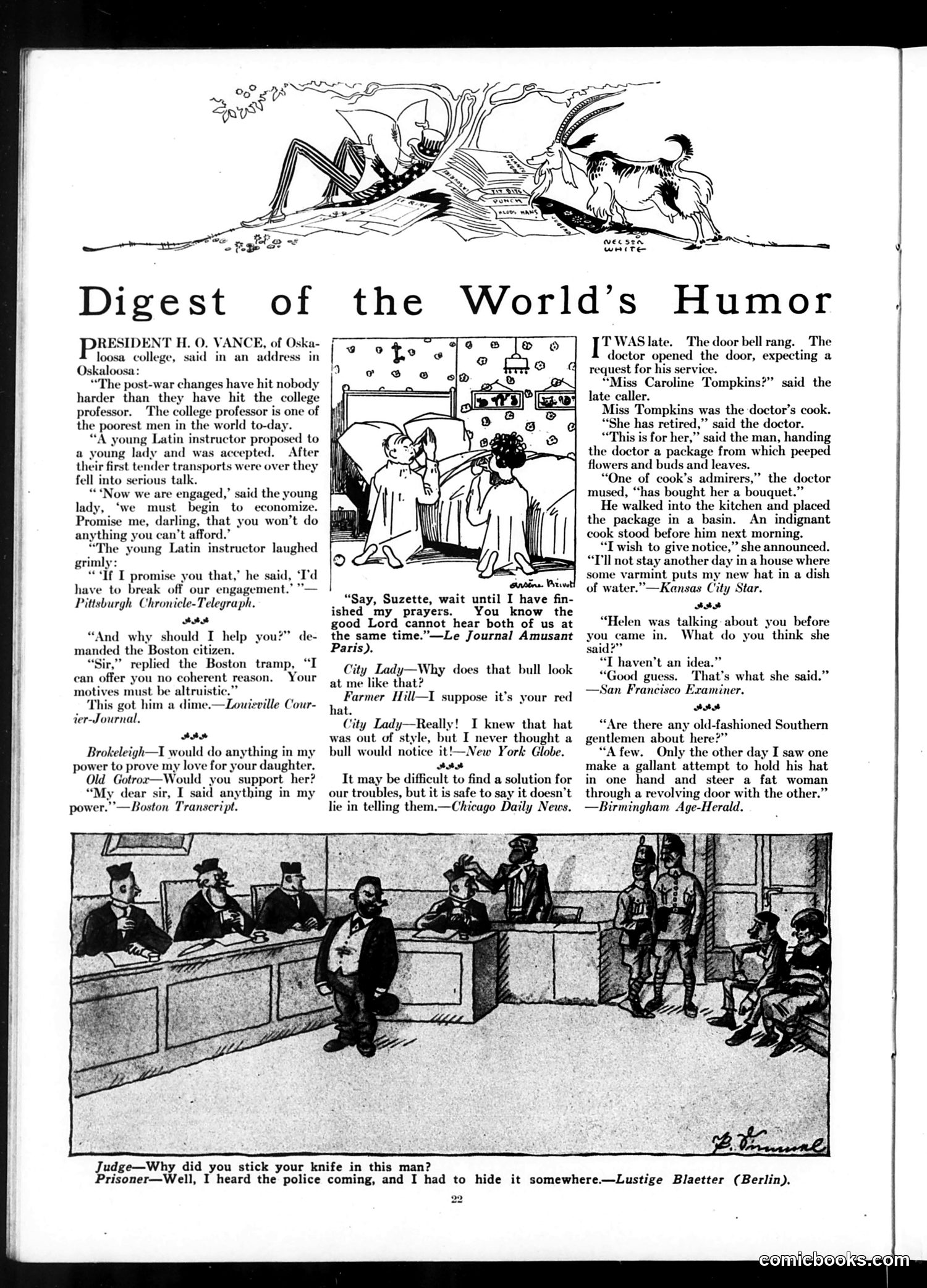
This page compiles short humorous anecdotes from various sources, arranged as a "digest" format popular in early 20th-century magazines. **Key jokes:** - A poor college professor jokes that if he promised to economize, he'd have to break off his engagement—satirizing academia's low wages - A Latin instructor proposes to a woman; once engaged, she demands he economize, but he refuses, calling her altruistic demands hypocritical - A cook receives flowers in a vase but mistakes the hat-shaped bouquet arrangement for her new hat placed in water—physical comedy based on miscommunication - A prisoner admits he hid his knife "somewhere" (in the victim) to avoid police—dark humor relying on literal interpretation **Bottom cartoon:** A courtroom scene where a prisoner's explanation for stabbing someone—hiding the knife "somewhere" when police approached—plays on the absurdity of his logic. The humor reflects turn-of-century sensibilities: class consciousness about poor professors, gender dynamics in courtship, and slapstick misunderstandings. These are reprinted from international sources (Paris, Berlin newspapers), suggesting Judge's cosmopolitan editorial reach.
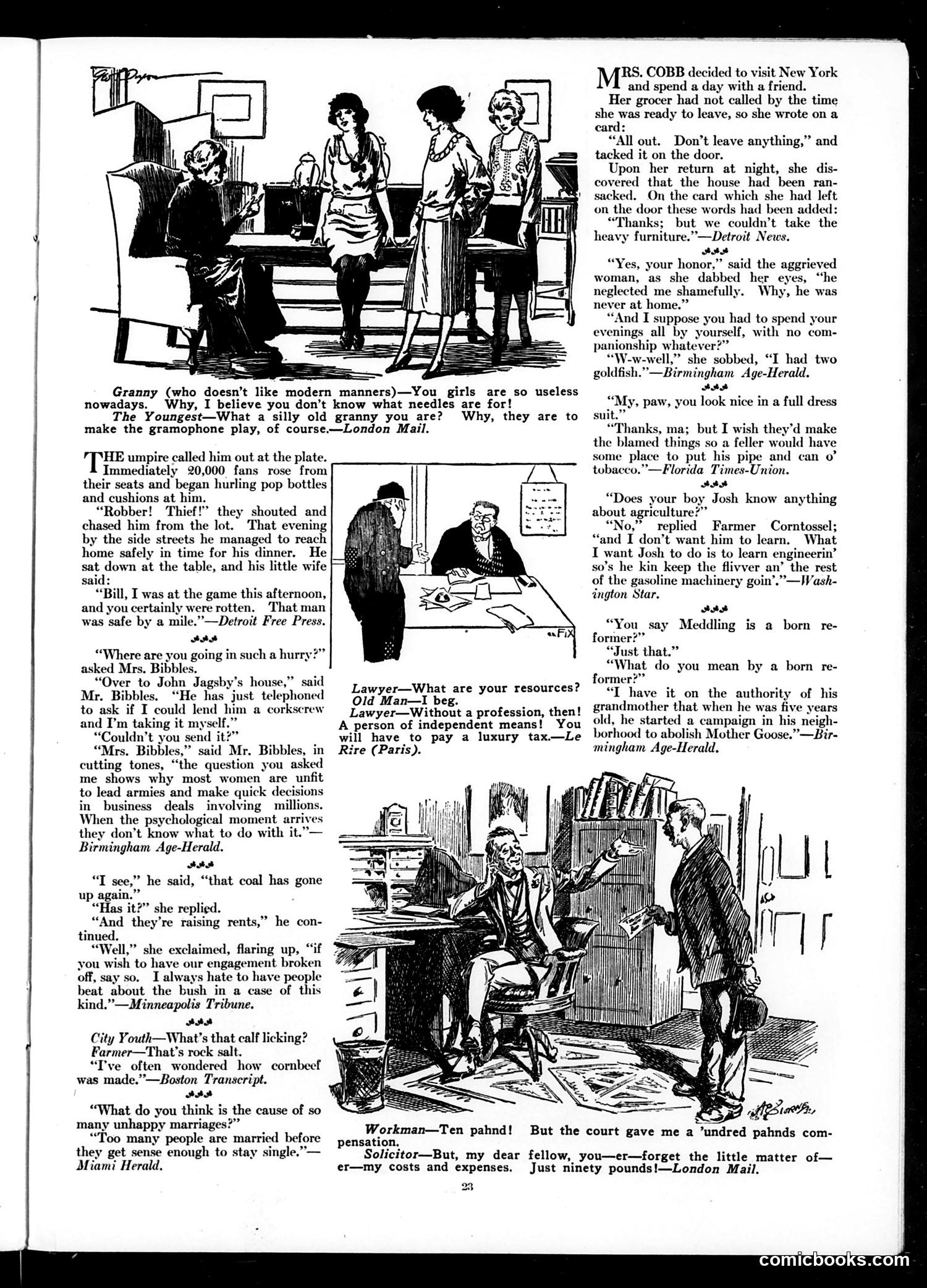
This page contains multiple short satirical pieces mocking early 20th-century social attitudes and modern changes: **"Granny" joke**: Ridicules older generations' obsolescence—a grandmother doesn't understand that phonograph needles have replaced sewing needles, highlighting generational disconnection from technology. **Baseball umpire story**: Satirizes violent fan behavior at baseball games (20,000 fans pelting the umpire with bottles), yet the umpire's wife—who actually attended—confirms he deserved it, mocking both mob mentality and domestic dynamics. **Other vignettes** mock: women's unfitness for decision-making, engagement drama over economic complaints, women's independence concerns, luxury taxes, and farmers' preference for machinery over agricultural knowledge. The overarching satirical targets appear to be: rapid social/technological change, generational conflicts, gender role anxieties, class concerns, and American consumer culture. The humor relies on contemporary readers recognizing these debates as relevant to their moment.
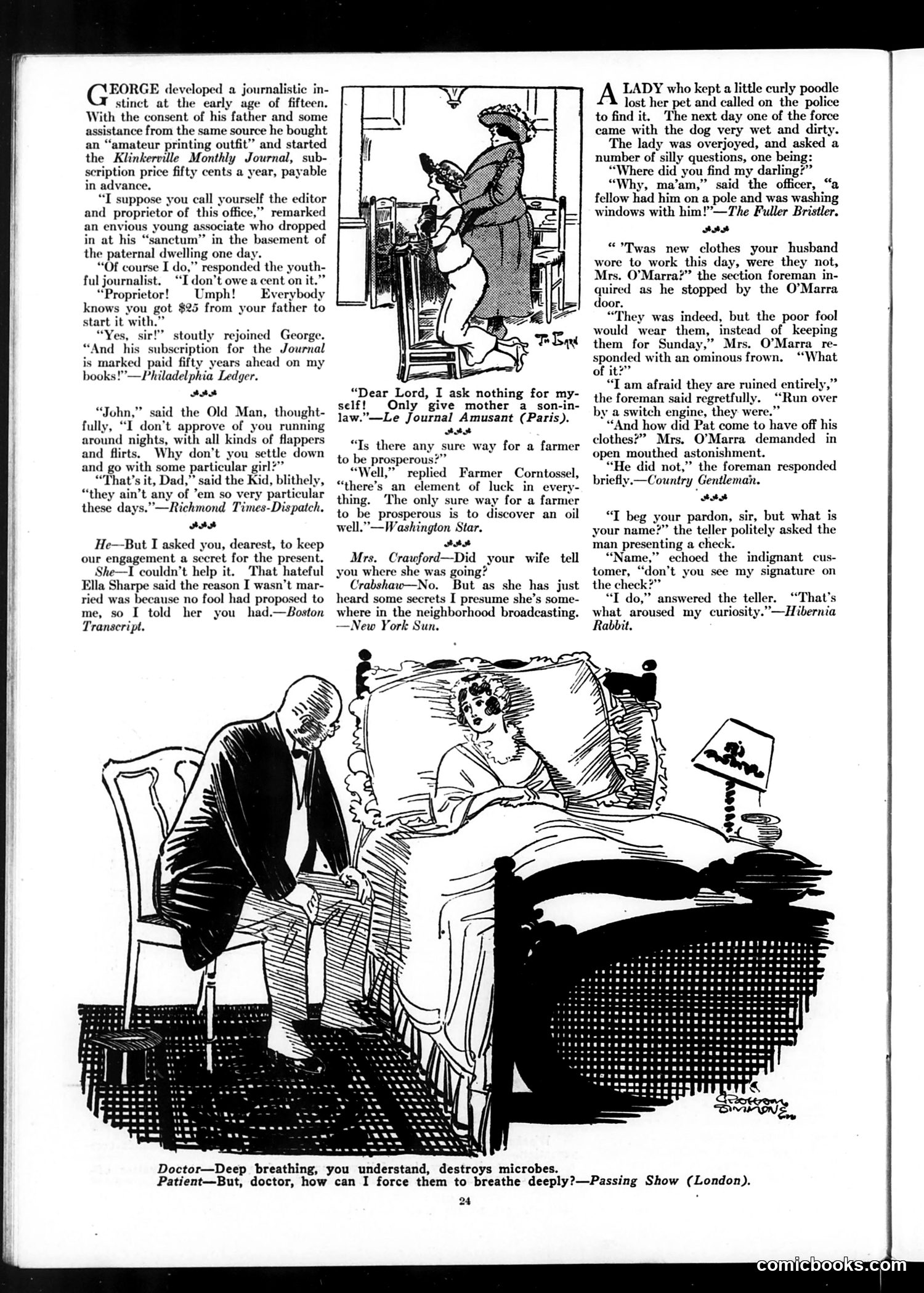
This page contains multiple short humorous anecdotes typical of early 20th-century American satire, plus one cartoon. **The anecdotes** mock various social types: a pretentious teenage publisher claiming financial independence while funded by his father; a young man avoiding commitment to girlfriends; people spreading gossip; a farmer's wife upset her husband ruined new clothes in a workplace accident; a customer offended when a bank teller questions his illegible signature. **The main cartoon** depicts a doctor advising a patient that "deep breathing destroys microbes," to which the patient replies he cannot force microbes to breathe deeply—a joke about medical advice's logical absurdity. **Recurring themes** include social pretension, domestic comedy, the foolishness of ordinary people, and gentle mockery of courtship and marriage. The humor relies on wordplay and situational irony rather than political commentary. The magazine targets middle-class American audiences with relatable domestic scenarios presented as entertainment.
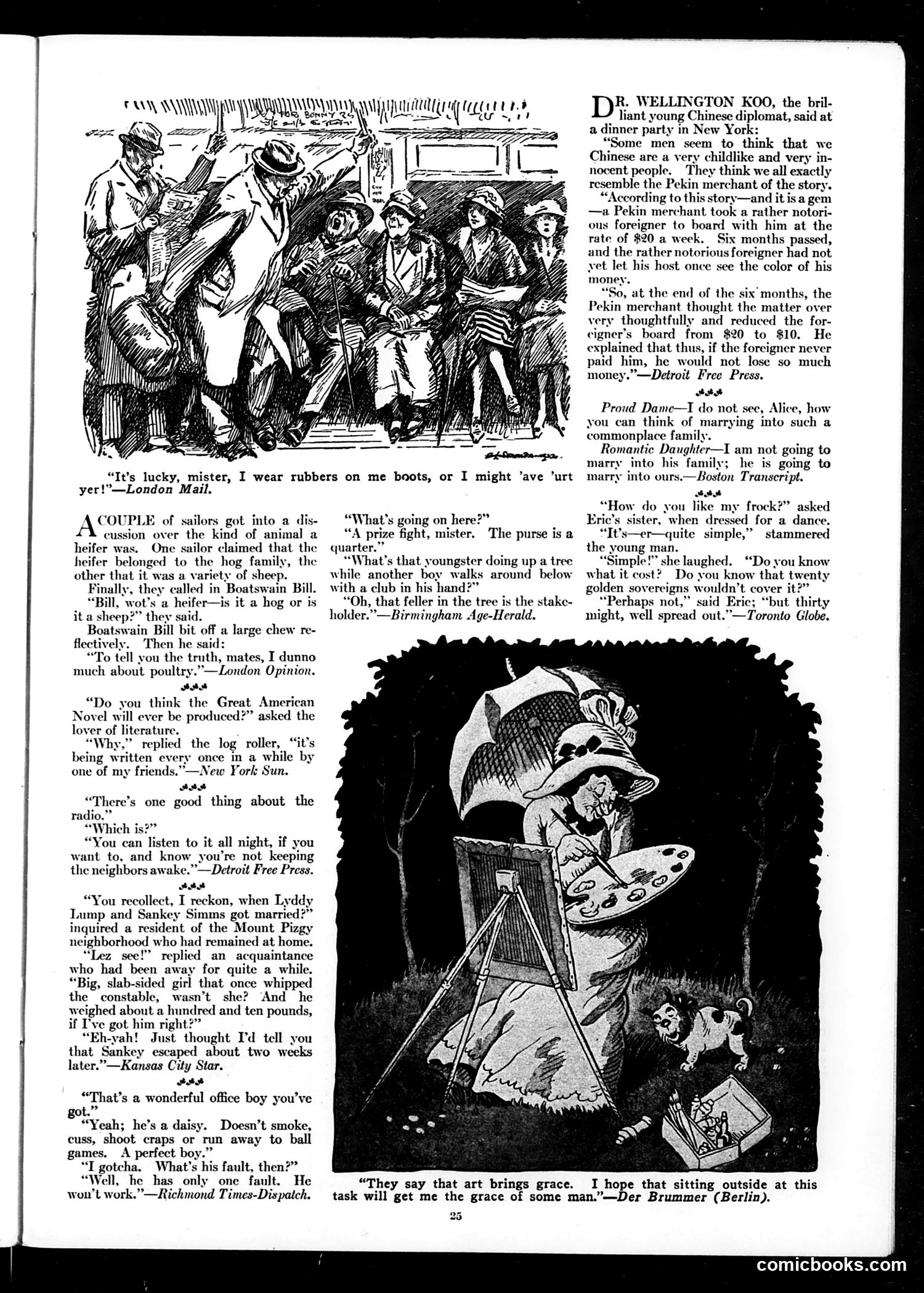
This page from the satirical magazine **Judge** contains multiple short humorous anecdotes and one political cartoon rather than a single unified piece. The main cartoon (lower right) appears to depict an artist or writer working outdoors, hoping his labor will bring him "grace" or favor from passersby — a joke about struggling artists seeking patronage or recognition. The text snippets are brief jokes mocking various subjects: sailors' ignorance (confusing a heifer with poultry), the mass-production of mediocre literature, radio's constant availability, rural gossip, office workers who don't work, and children's playground "gambling." Most notably, the top section features **Dr. Wellington Koo**, a real Chinese diplomat, recounting a story about a Chinese merchant reducing a foreigner's room-and-board rates after the foreigner fails to pay for six months — satirizing perceived Chinese cleverness in dealing with unreliable Western clients. This reflects early 20th-century American attitudes toward Chinese business practices. The anecdotes collectively represent typical Judge humor: domestic situations, gender dynamics, and class observations aimed at middle-class American readers.
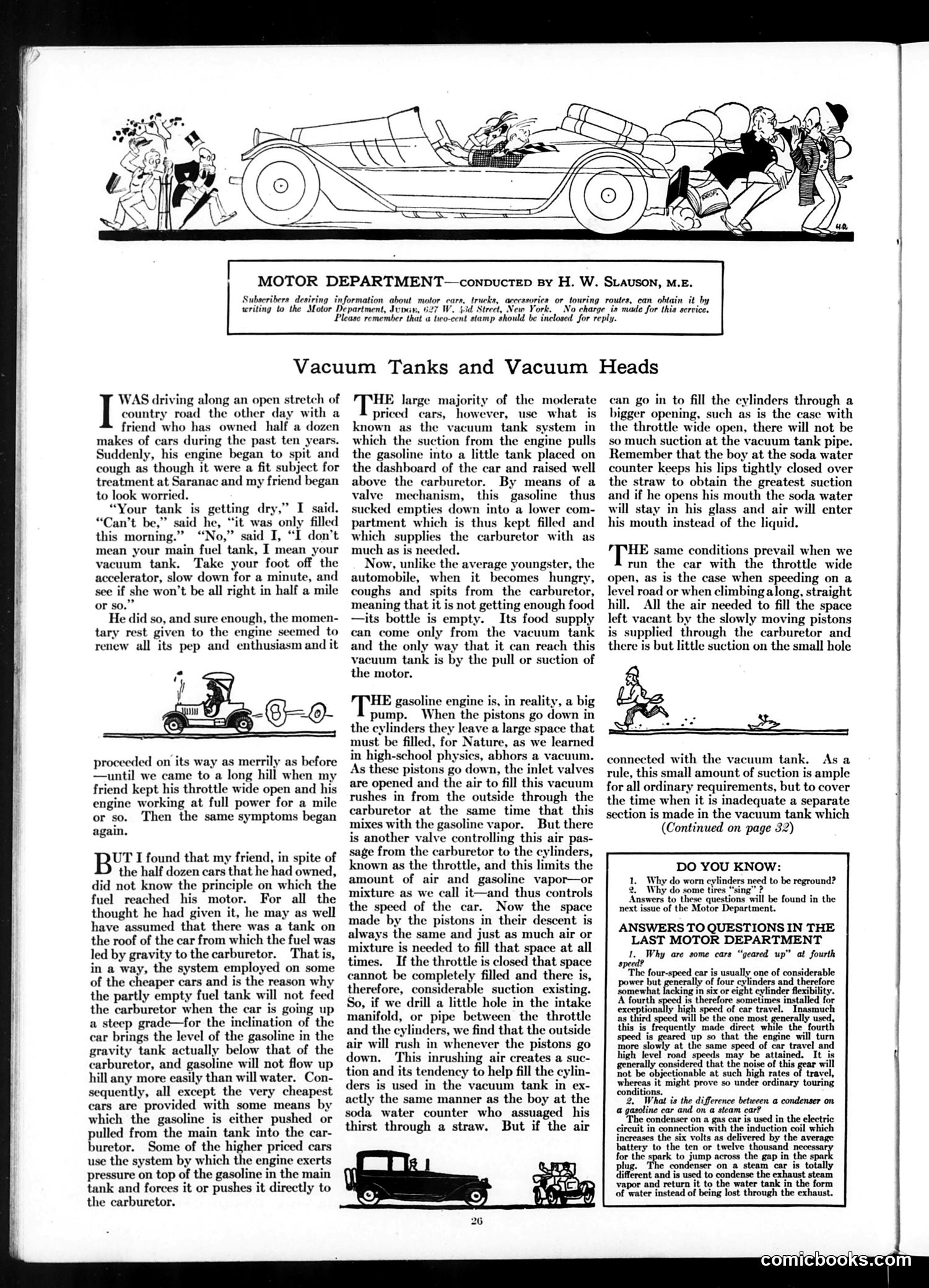
This is a **technical educational article**, not satire or political commentary. H.W. Slauson, the Motor Department editor, explains how vacuum tanks function in early automobiles to modern readers unfamiliar with the technology. The piece uses a narrative framework—the author driving with a friend whose car sputters on hills—to illustrate a common problem: owners didn't understand *why* their fuel systems failed under certain conditions. Slauson explains that unlike gravity-feed systems on cheap cars, most moderate-priced automobiles use a vacuum tank mounted on the dashboard. The engine's suction pulls gasoline from the main tank into this upper reservoir, which then gravity-feeds the carburetor. The humor is gentle pedagogical irony: the friend owns multiple cars but doesn't grasp the mechanical principle making them run. This reflects Judge's role in the 1910s-20s as both satire *and* practical information source for middle-class automobile owners navigating unfamiliar technology.
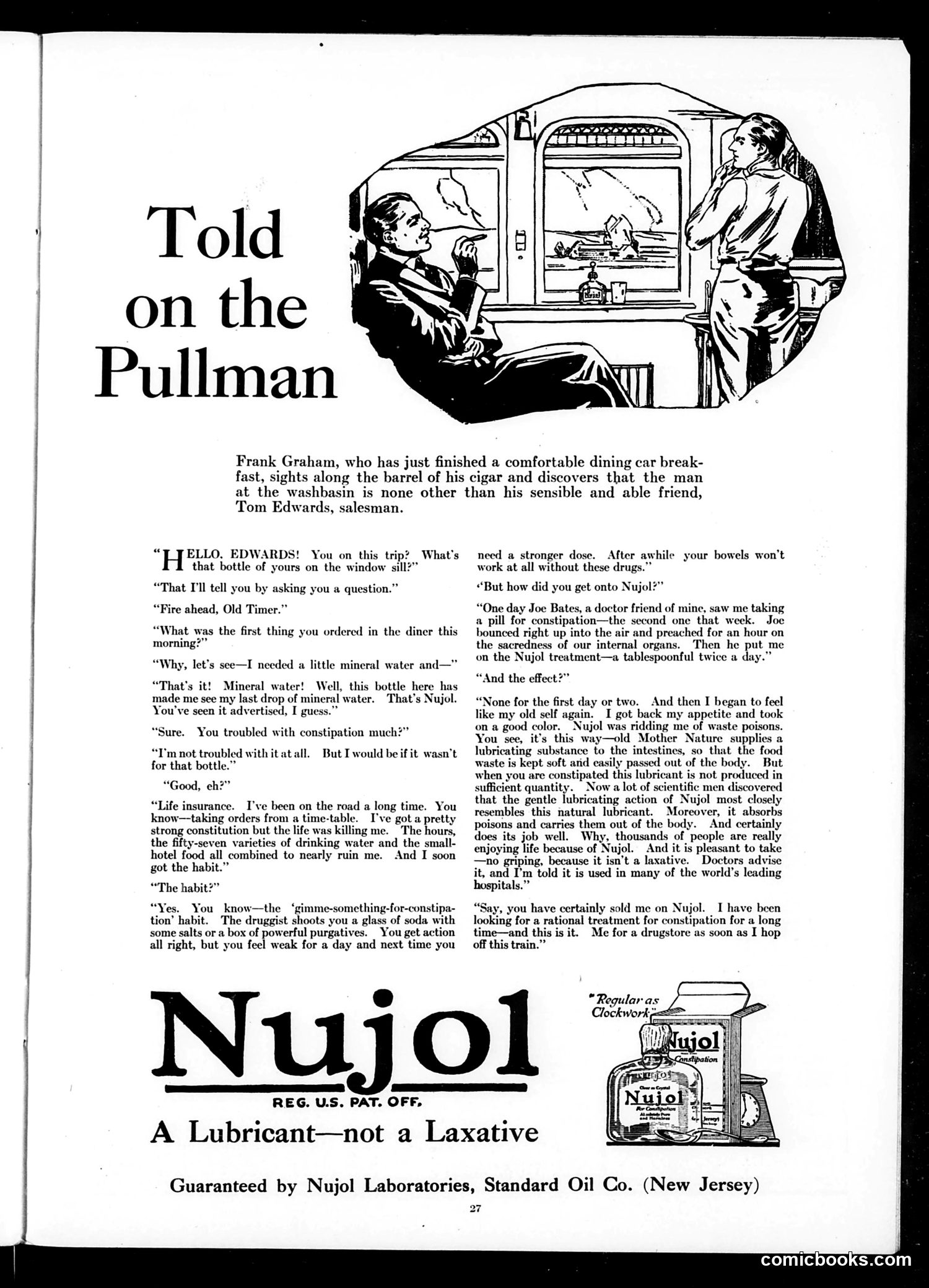
This page is primarily a **product advertisement** disguised as a comic narrative. Two traveling salesmen meet on a Pullman train car, where one (Edwards) pitches Nujol, a mineral oil laxative, to the other (Graham). The "satire" is gentle corporate propaganda: Edwards uses a doctor's endorsement and pseudo-scientific language to frame Nujol as a "lubricant, not a laxative"—distinguishing it from harsh purgatives that caused dependency. He attributes his good health and productivity to the product, converting Graham into a customer. **The context a modern reader misses:** In the early 20th century, constipation was treated with aggressive patent medicines. Nujol's marketing emphasized gentleness and "natural" bodily function—a genuine product improvement positioned through relatable everyman dialogue. The Pullman setting adds prestige (luxury train travel) while the salesman-to-salesman pitch creates false peer credibility, a common advertising technique of the era.
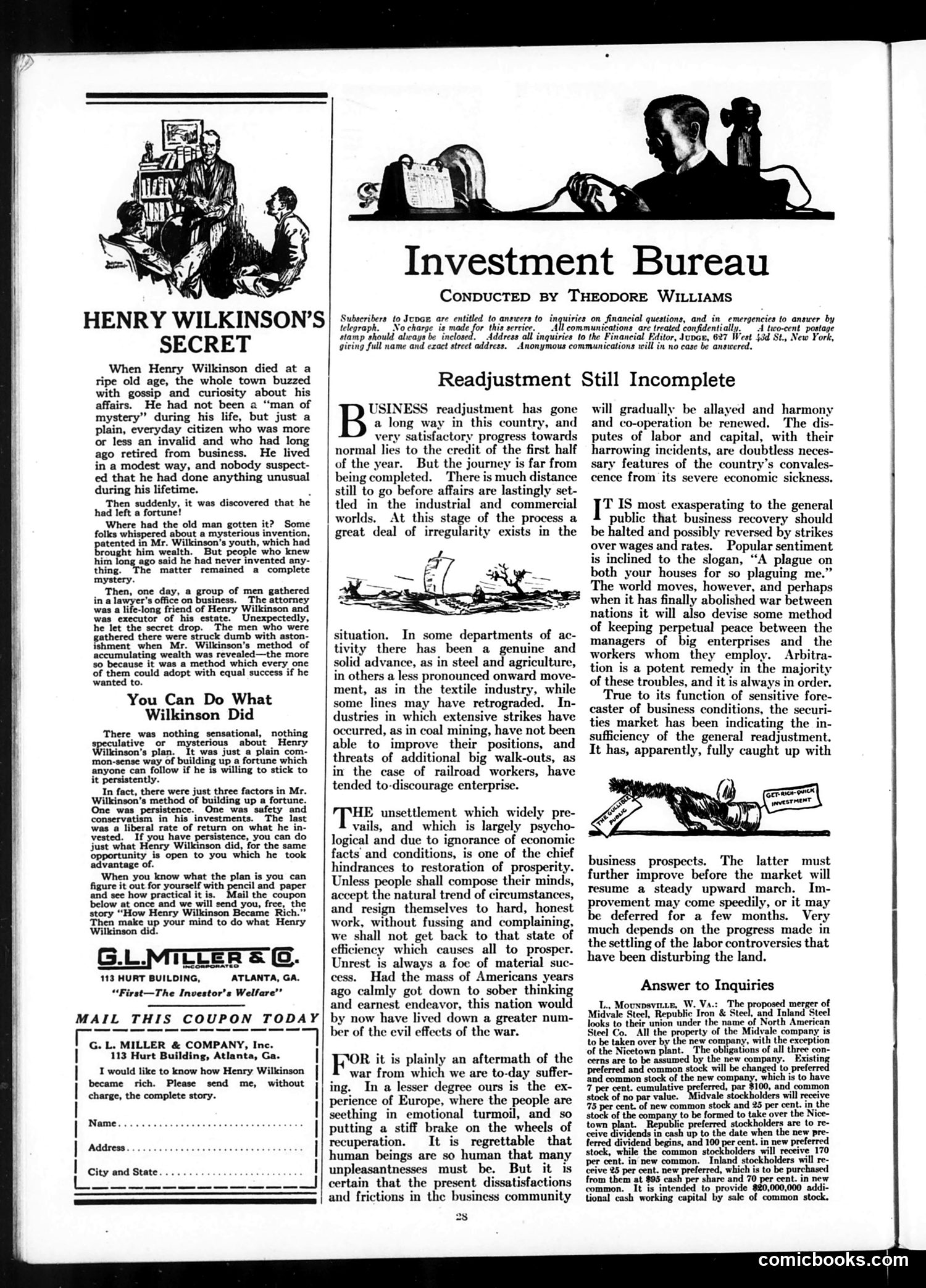
This page combines a financial advertisement with commentary on post-WWI economic recovery. **The Main Content:** The left side presents a narrative advertisement for G.L. Miller & Company's investment service. "Henry Wilkinson's Secret" is a rags-to-riches story that reveals the supposed mystery of how an ordinary man built wealth: through persistence, conservative investments, and patience. The ad uses this fictional narrative to attract readers to request the full story, positioning the investment bureau as offering legitimate wealth-building advice. **The Right Side - "Readjustment Still Incomplete":** This editorial discusses post-war economic recovery, acknowledging uneven progress across industries. It notes that strikes and labor unrest in coal mining and railroads are hindering recovery, while steel and agriculture have advanced. The piece expresses concern about ongoing "unsettle[ment]" and psychological barriers to prosperity. **Context:** This appears to be from the early 1920s, when America was transitioning from wartime to peacetime economy. The juxtaposition suggests financial optimism (the Wilkinson narrative) alongside realistic concerns about labor strife and incomplete industrial adjustment. The tone reflects moderate conservatism in financial advice.
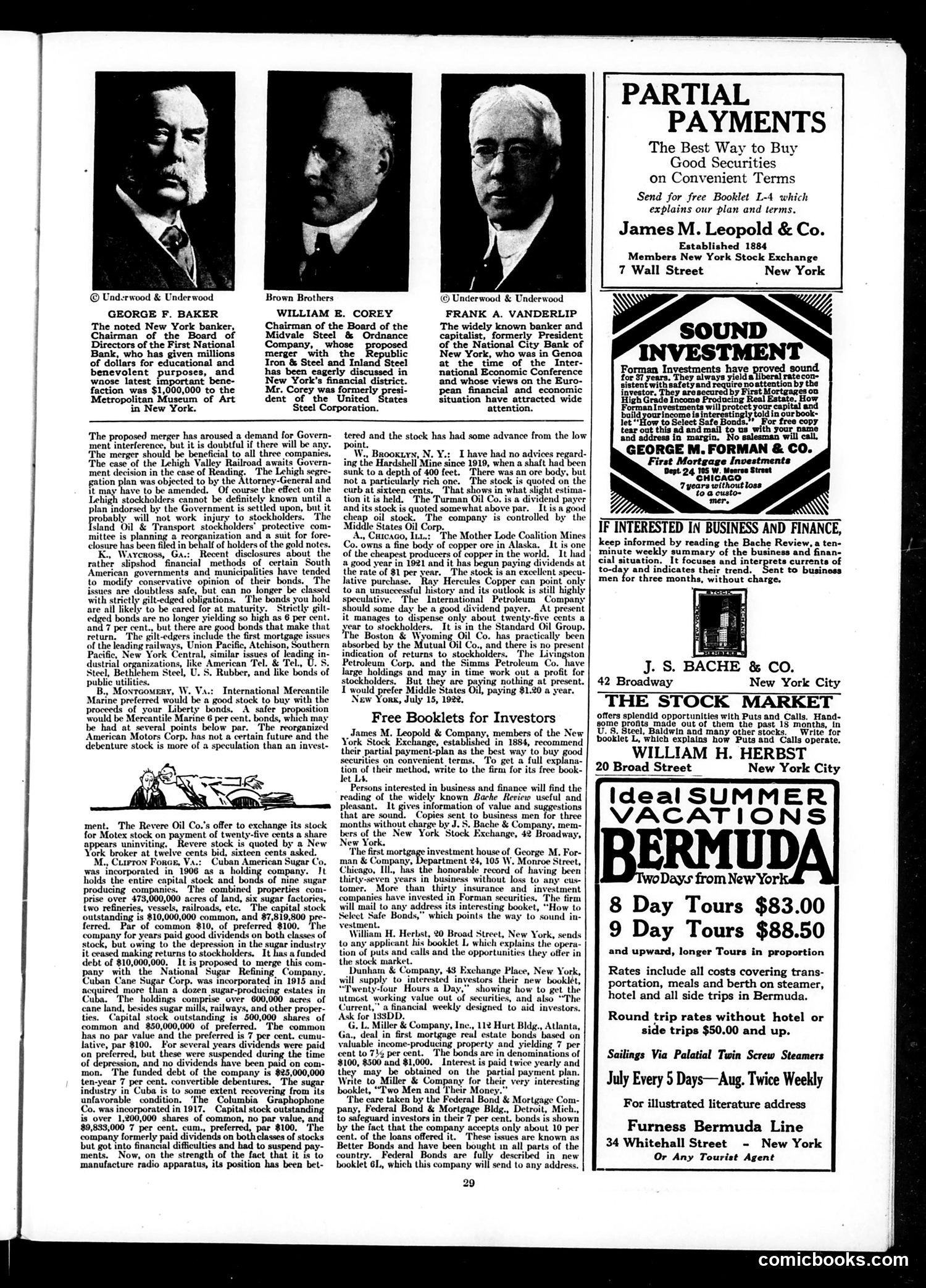
This page is primarily **financial journalism and advertising**, not political satire. The three photographs show prominent 1920s bankers—George F. Baker (First National Bank), William E. Corey (steel industry), and Frank A. Vanderlip (National City Bank)—accompanying discussion of a proposed steel industry merger that had generated debate about government intervention. The text addresses investor concerns about railroad reorganizations, South American bond safety, and stock recommendations. The advertisements promote investment services, including brokerage houses and a Bermuda vacation package. **No political cartoon or satirical content is visible on this page.** It represents Judge magazine functioning as a general-interest publication covering finance and business for wealthy readers, alongside typical period advertising. The financial advice and company profiles were the editorial substance.
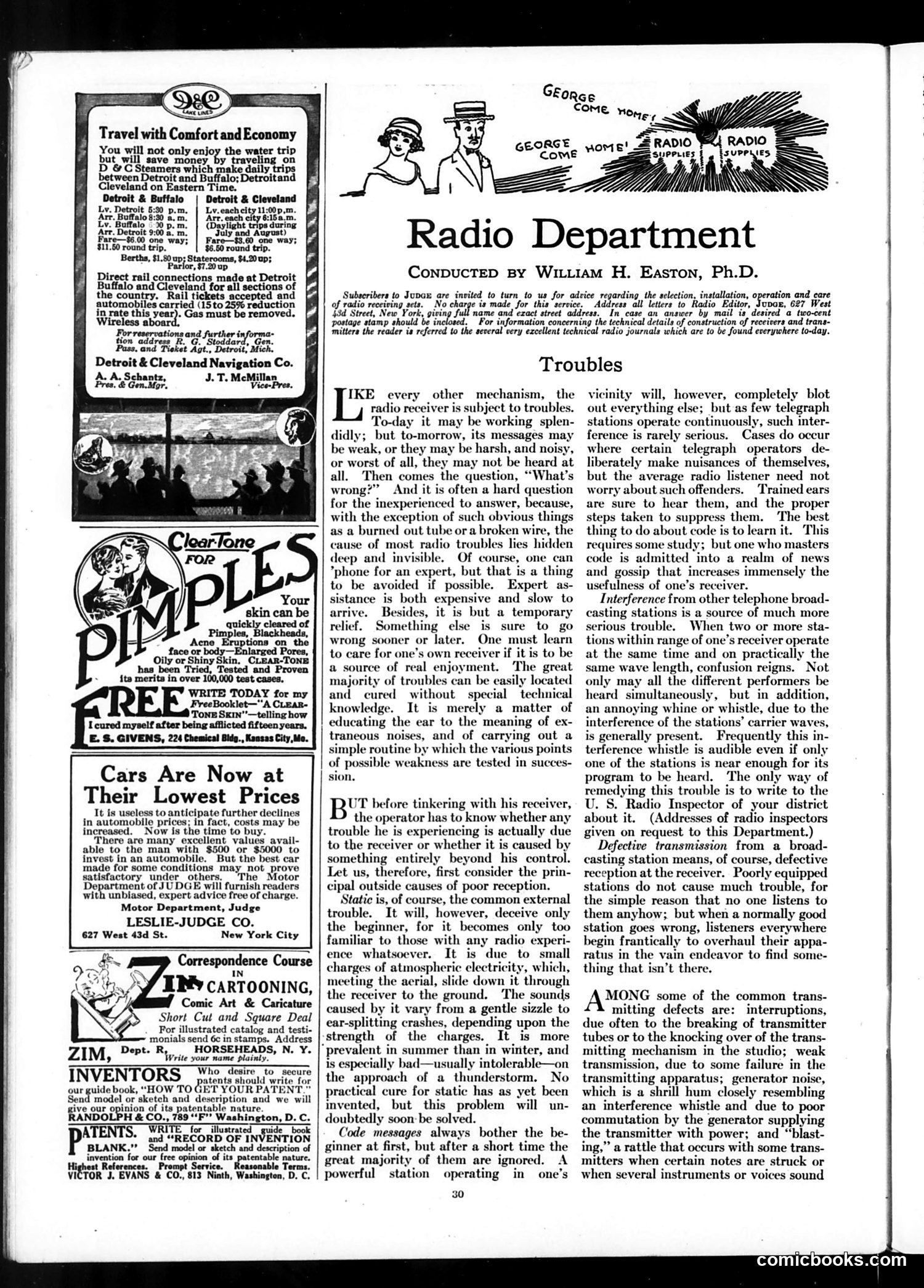
This page is primarily **advertising and a radio advice column**, not political satire. The upper portion features a "Radio Department" column conducted by William H. Easton, Ph.D., addressing technical radio receiver troubles—a timely topic in the 1920s when home radio was new and popular. The column discusses common problems like static, weak reception, and interference, offering practical guidance to amateur radio enthusiasts. The remainder is filled with period advertisements: steamship travel deals, skincare products (ClearTone), automobile sales pitches, correspondence courses in cartooning, and patent/invention services. The small cartoon vignette at top shows a man and woman saying "George, come home!" with "Radio" and "Supply" text—a lighthearted reference to radio's growing social prominence, suggesting it was distracting husbands from domestic life. The page reflects 1920s consumer culture and the radio boom rather than political commentary.
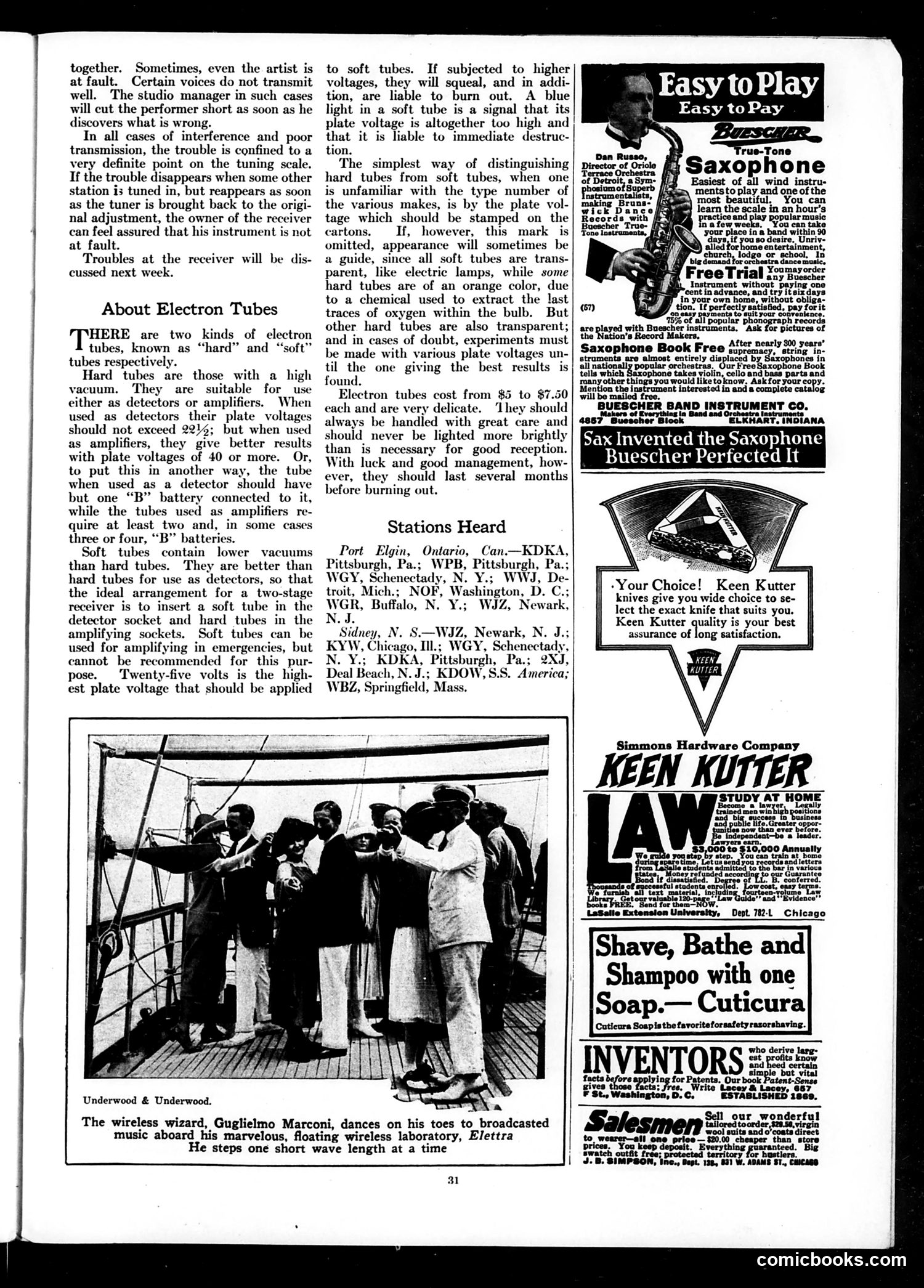
This page is primarily **educational and advertising content**, not political satire. The main article discusses electron tubes for early radio receivers—distinguishing "hard" (high vacuum) from "soft" (lower vacuum) tubes, their proper voltages, and handling. This reflects the 1920s radio boom when home receivers were novel technology requiring technical guidance. The photograph shows **Guglielmo Marconi**, the Italian radio pioneer, dancing aboard his research vessel *Elettra*. The caption's pun ("He steps one short wave length at a time") plays on radio terminology—a lighthearted celebration of Marconi as the "wireless wizard" of modern technology. The remaining space contains period advertisements for a saxophone, law school correspondence courses, cutlery, and other products. The page represents how Judge mixed educational radio content with commercial advertising during the early broadcasting era.
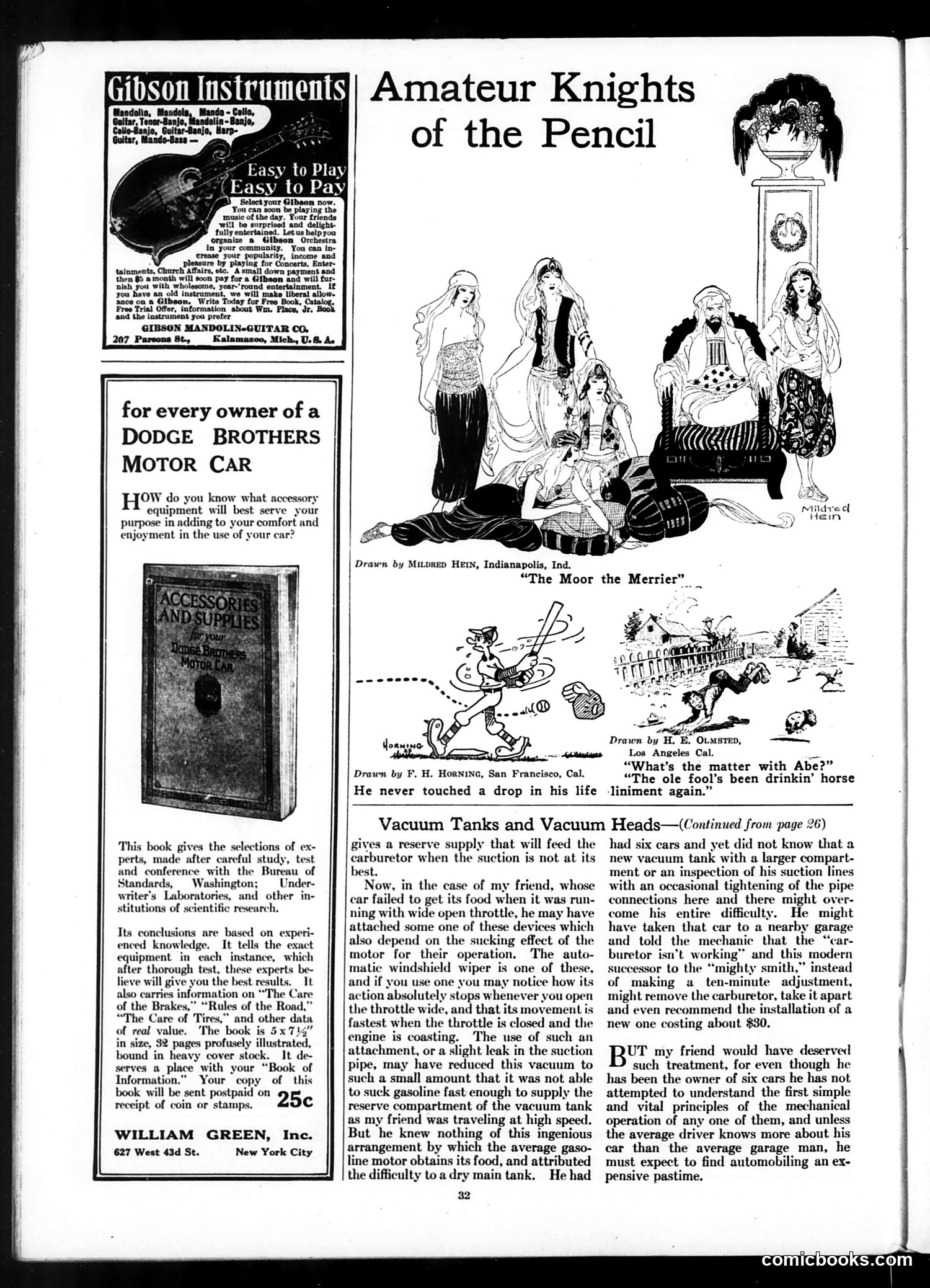
This page features three humorous cartoons drawn by different artists. "The Moor the Merrier" depicts costumed figures in what appears to be theatrical or costume party dress. "What's the matter with Abe?" shows a rural character who has drunk horse liniment (a topical medicinal rub, not meant for consumption), playing on period humor about rural ignorance and accidental poisoning scenarios common in early 20th-century comedy. The page is primarily filled with advertisements—Gibson musical instruments, Dodge Brothers automobiles, and William Green's accessories manual. The bulk of the content discusses automotive vacuum tank mechanics, explaining how drivers' ignorance of basic car function leads to expensive garage repairs. The satirical point: average car owners are mechanically illiterate, making them vulnerable to unnecessary service costs.
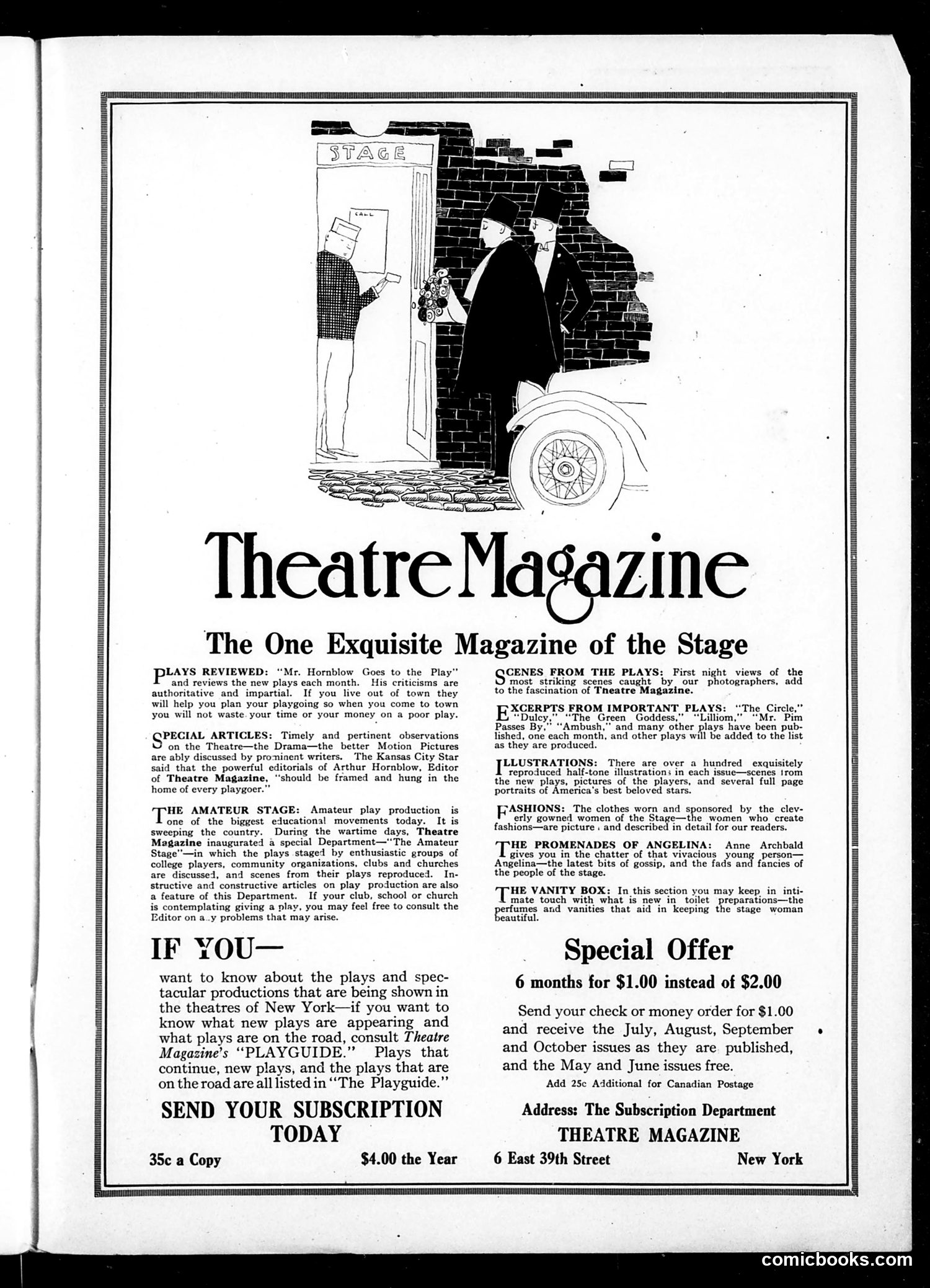
This is primarily an advertisement for *Theatre Magazine*, described as "The One Exquisite Magazine of the Stage." The small illustration at the top depicts a typical 1920s scene: a well-dressed man and woman arriving by automobile at a theatre stage door, while an attendant checks credentials—representing the glamorous theatrical world the magazine promises to cover. The ad emphasizes the magazine's appeal to theatre-goers by offering authoritative play reviews, behind-the-scenes photographs, fashion coverage from stage actresses, and gossip columns. It notably includes a section on "The Amateur Stage," reflecting the era's enthusiasm for community theatre production. The "Special Offer" promoting six months for $1.00 (instead of $2.00) targets readers eager to stay informed about Broadway productions and entertainment culture during the prosperous 1920s. The magazine positioned itself as essential reading for anyone interested in theatre, fashion, and stage celebrity culture.
This is an **advertisement page**, not a cartoon. It promotes Judge magazine's subscriber services to modern readers circa early 20th century. Judge offered three free expert consultation departments: 1. **Motor** (automobiles) — H.W. Slauson, an automotive engineer, advised on car repairs, purchases, and touring information 2. **Radio** — William H. Easton, a radio authority, helped subscribers select equipment and troubleshoot the then-novel radio telephone technology 3. **Investment** — Theodore Williams advised on securities, serving investors with portfolios from small amounts to $70,000 The pitch emphasizes these services required **no additional cost** beyond subscription and positioned Judge as a comprehensive lifestyle magazine serving readers' practical needs in an era of rapid technological change (automobiles and radio were still relatively new). The experts' credentials and claims of impartial judgment were meant to establish credibility and justify subscription value.