
Judge, 1922-07-22 · page 20 of 36
Judge — July 22, 1922 — page 20: what you’re looking at
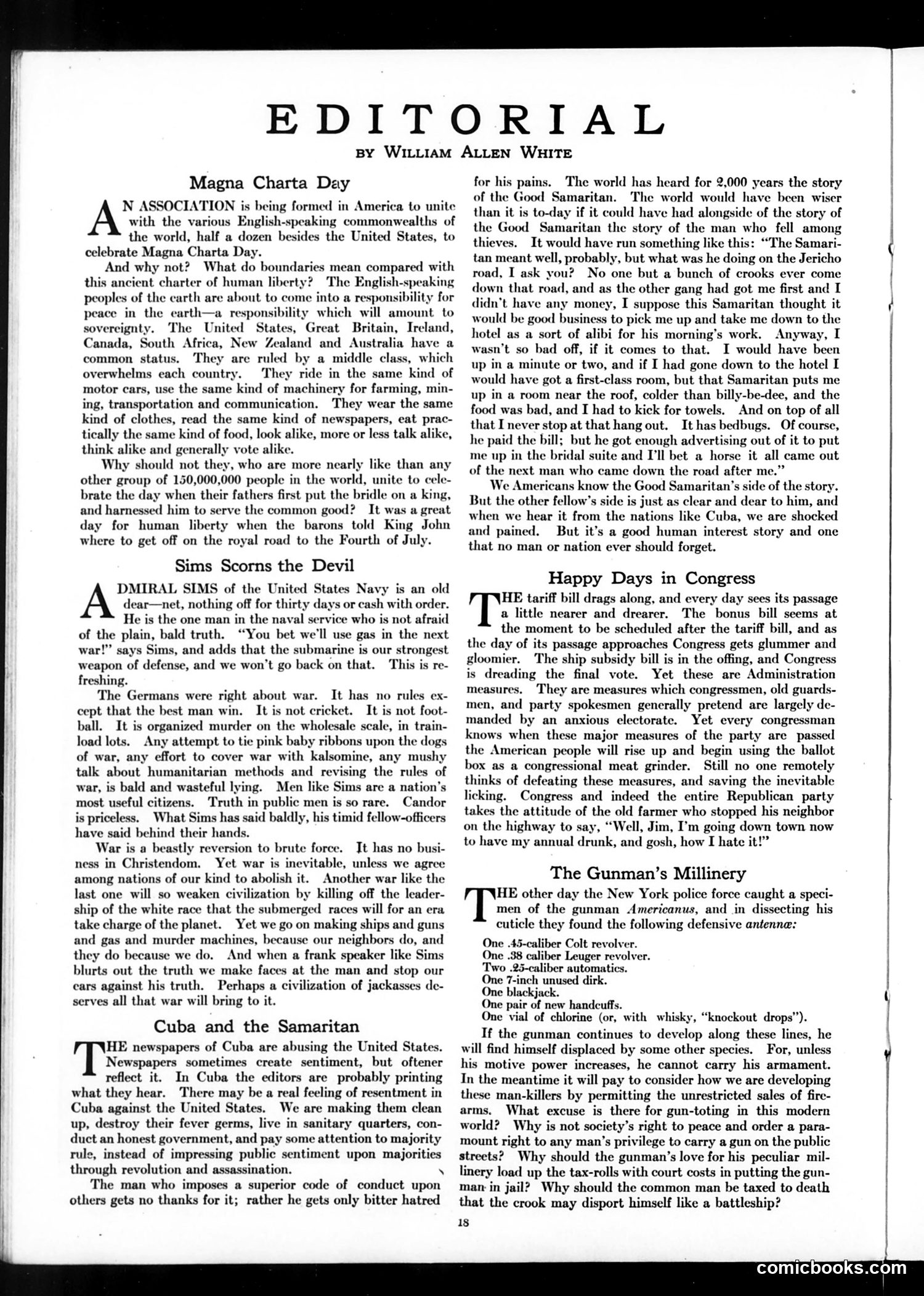
What you’re looking at
This editorial page by William Allen White comprises three opinion pieces—no cartoons are visible. **"Magna Charta Day"** proposes English-speaking nations (U.S., Britain, Canada, Australia, etc.) unite to celebrate the Magna Charta, arguing their shared middle-class culture, technology, and values make them natural allies for promoting peace and liberty globally. **"Sims Scorns the Devil"** praises Admiral William Sims for frankly acknowledging war's brutal reality—that submarines and gas will be used in future conflicts. White criticizes others' squeamishness about warfare's true nature, arguing honest military assessment is more valuable than romanticized notions of "civilized" combat. **"Cuba and the Samaritan"** defends American intervention in Cuba, noting that while Cuban newspapers resent U.S. pressure for sanitation and honest government, these reforms replace the previous system of revolutionary violence and assassination—implying American governance imposes superior standards. All three pieces reflect early-20th-century American expansionism and Anglo-Saxon cultural superiority assumptions common to the era.
📄 Transcribed text from this page (OCR, searchable)
Machine-transcribed from the original scan — historical spelling and the odd misread are preserved.
EDITORIAL BY WILLIAM ALLEN WHITE Magna Charta Day A N ASSOCIATION is being formed in America to unite with the various English-speaking commonwealths of the world, half a dozen besides the United States, to celebrate Magna Charta Day. And why not? What do boundaries mean compared with this ancient charter of human liberty? The English-speaking peoples of the earth are about to come into a responsibility for peace in the earth—a responsibility which will amount to sovereignty. The United States, Great Britain, Ireland, Canada, South Africa, New Zealand and Australia have a common status. They are ruled by a middle class, which overwhelms each country. They ride in the same kind of motor cars, use the same kind of machinery for farming, min- ing, transportation and communication. They wear the same kind of clothes, read the same kind of newspapers, eat prac- tically the same kind of food, look alike, more or less talk alike, think alike and generally vote alike. Why should not they, who are more nearly like than any other group of 150,000,000 people in the world, unite to cele- brate the day when their fathers first put the bridle on a king, and harnessed him to serve the common good? It was a great day for human liberty when the barons told King John where to get off on the royal road to the Fourth of July. Sims Scorns the Devil A DMIRAL SIMS of the United States Navy is an old dear—net, nothing off for thirty days or cash with order. He is the one man in the naval service who is not afraid of the plain, bald truth. “You bet we'll use gas in the next war!” says Sims, and adds that the submarine is our strongest weapon of defense, and we won't go back on that. This is re- freshing. The Germans were right about war. It has no rules ex- cept that the best man win. It is not cricket. It is not foot- ball. It is organized murder on the wholesale scale, in train- load lots. Any attempt to tie pink baby ribbons upon the dogs of war, any effort to cover war with kalsomine, any mushy talk about humanitarian methods and revising the rules of war, is bald and wasteful lying. Men like Sims are a nation’s most useful citizens. Truth in public men is so rare. Candor is priceless. What Sims has said baldly, his timid fellow-officers have said behind their hands. War is a beastly reversion to brute force. Tt has no busi- ness in Christendom. Yet war is inevitable, unless we agree among nations of our kind to abolish it. Another war like the last one will so weaken civilization by killing off the leader- ship of the white race that the submerged races will for an era take charge of the planet. Yet we go on making ships and guns and gas and murder machines, because our neighbors do, and they do because we do, And when a frank speaker like Sims blurts out the truth we make faces at the man and stop our ears against his truth. Perhaps a civilization of jackasses de- serves all that war will bring to it. Cuba and the Samaritan HE newspapers of Cuba are abusing the United States. I Newspapers sometimes create sentiment, but oftener reflect it. In Cuba the editors are probably printing what they hear. There may be a real feeling of resentment in Cuba against the United States. We are making them clean up, destroy their fever germs, live in sanitary quarters, con- duct an honest government, and pay some attention to majority rule, instead of impressing public sentiment upon majorities through revolution and assassination. \ The man who imposes a superior code of conduct upon others gets no thanks for it; rather he gets only bitter hatred for his pains. The world has heard for 2,000 years the story of the Good Samaritan. The world would have been wiser than it is to-day if it could have had alongside of the story of the Good Samaritan the story of the man who fell among thieves. It would have run something like this: “The Samari- tan meant well, probably, but what was he doing on the Jericho road, I ask you? No one but a bunch of crooks ever come down that road, and as the other gang had got me first and I didn’t have any money, I suppose this Samaritan thought it would be good business to pick me up and take me down to the hotel as a sort of alibi for his morning’s work. Anyway, I wasn’t so bad off, if it comes to that. I would have been up in a minute or two, and if I had gone down to the hotel I would have got a first-class room, but that Samaritan puts me up in a room near the roof, colder than billy-be-dee, and the food was bad, and I had to kick for towels. And on top of all that I never stop at that hang out. It has bedbugs. Of course, he paid the bill; but he got enough advertising out of it to put me up in the bridal suite and I'll bet a horse it all came out of the next man who came down the road after me.” We Americans know the Good Samaritan’s side of the story. But the other fellow’s side is just as clear and dear to him, and when we hear it from the nations like Cuba, we are shocked and pained. But it’s a good human interest story and one that no man or nation ever should forget. Happy Days in Congress HE tariff bill drags along, and every day sees its passage | a little nearer and drearer. The bonus bill seems at the moment to be scheduled after the tariff bill, and as the day of its passage approaches Congress gets glummer and gloomier. The ship subsidy bill is in the offing, and Congress is dreading the final vote. Yet these are Administration measures. They are measures which congressmen, old guards- men, and party spokesmen generally pretend are largely de- manded by an anxious electorate. Yet every congressman knows when these major measures of the party are passed the American people will rise up and begin using the ballot box as a congressional meat grinder. Still no one remotely thinks of defeating these measures, and saving the inevitable licking. Congress and indeed the entire Republican party takes the attitude of the old farmer who stopped his neighbor on the highway to say, “Well, Jim, I’m going down town now to have my annual drunk, and gosh, how I hate it!” The Gunman’s Millinery JHE other day the New York police force caught a speci- men of the gunman Americanus, and in dissecting his cuticle they found the following defensive antenna: One .45-caliber Colt revolver. One .38 caliber Leuger revolver. Two .25-caliber automatics. One 7-inch unused dirk. One blackjack. One pair of new handcuffs. One vial of chlorine (or, with whisky, “knockout drops”). If the gunman continues to develop along these lines, he will find himself displaced by some other species. For, unless his motive power increases, he cannot carry his armament. In the meantime it will pay to consider how we are developing these man-killers by permitting the unrestricted sales of fire- arms. What excuse is there for gun-toting in this modern world? Why is not society’s right to peace and order a para- mount right to any man’s privilege to carry a gun on the public streets? Why should the gunman’s love for his peculiar mil- linery load up the tax-rolls with court costs in putting the gun- man in jail? Why should the common man be taxed to death that the crook may disport himself like a battleship? 18 comicbooks.com