
Judge, 1922-07-22 · page 4 of 36
Judge — July 22, 1922 — page 4: what you’re looking at
What you’re looking at
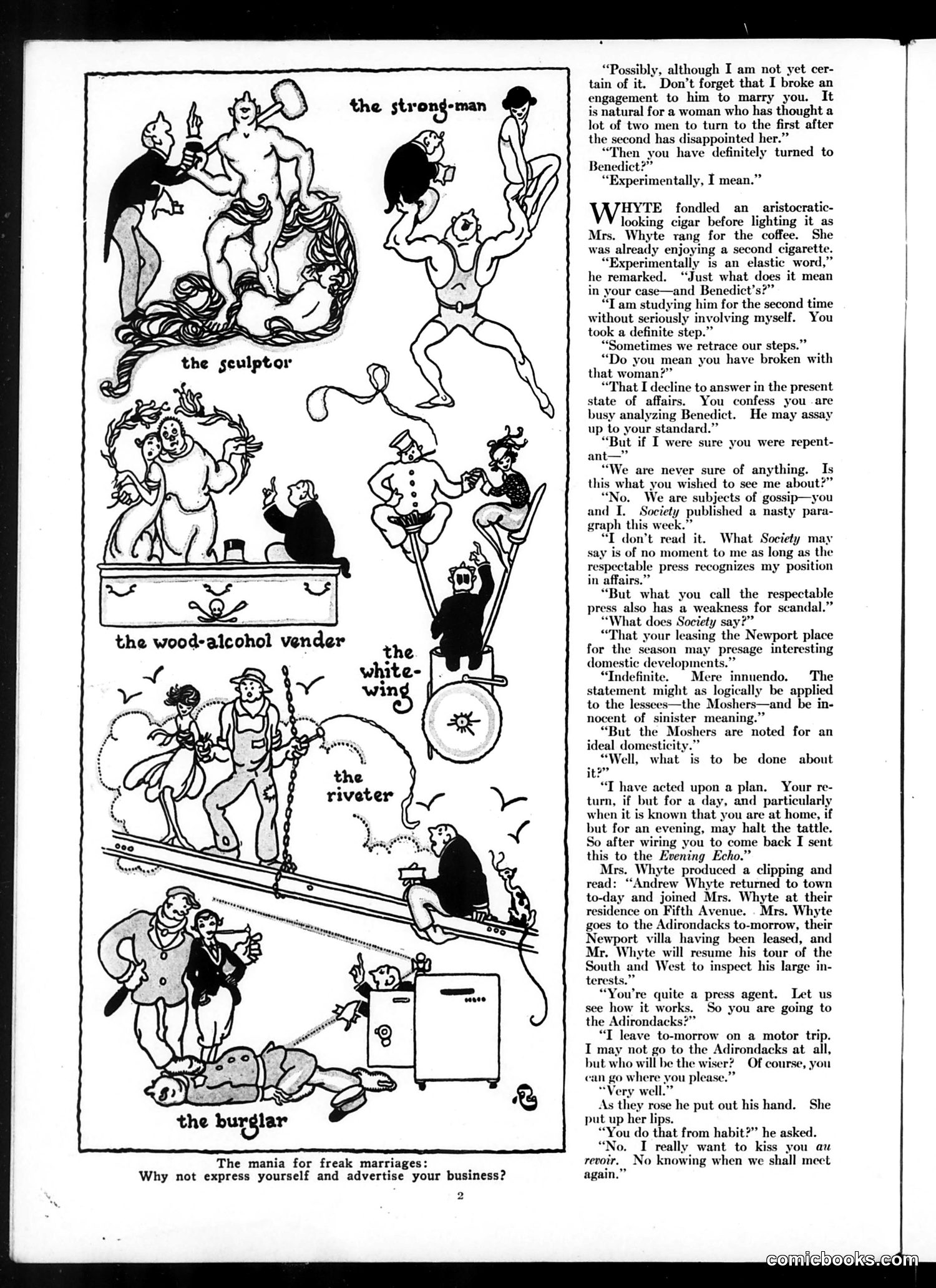
This page contains two distinct elements: **Left side:** A satirical illustration titled "The mania for freak marriages: Why not express yourself and advertise your business?" depicts various unconventional professions as potential marriage partners—a strong-man, sculptor, wood-alcohol vendor, riveter, burglar, and white-wing (street cleaner). The caption mocks the era's apparent trend of women marrying men from unusual or lower-status occupations, suggesting this represents a broader social loosening of marriage conventions. **Right side:** Prose dialogue between characters named Whyte and Benedict discusses a woman's broken engagement and potential remarriage. The conversation references *Society* magazine's gossip column, revealing period anxieties about public scandal and social reputation among the wealthy. Together, the page satirizes early 20th-century shifts in marriage norms and the role of gossip media in scrutinizing unconventional unions.
📄 Transcribed text from this page (OCR, searchable)
Machine-transcribed from the original scan — historical spelling and the odd misread are preserved.
“Possibly, although I am not yet cer- tain of it. Don’t forget that I broke an engagement to him to marry you. It is natural for a woman who has thought a lot of two men to turn to the first after the second has disappointed her.” “Then you have definitely turned to Benedict?” “Experimentally, I mean.” HYTE fondled an_aristocratic- looking cigar before lighting it as Mrs. Whyte rang for the coffee. She was already enjoying a second cigarette. “Experimentally is an elastic word,” he remarked. “Just what does it mean in your case—and Benedict's?” “T am studying him for the second time without seriously involving myself. You took a definite step.” “Sometimes we retrace our steps.” “Do you mean you have broken with that woman?” “That I decline to answer in the present state of affairs. You confess you .are busy analyzing Benedict. He may assay up to your standard.” “But if I were sure you were repent- “We are never sure of anything. Is this what you wished to see me about?” “No. We are subjects of gossip—you and I. Society published a nasty para- graph this week.” “I don’t read it. What Society may Si s of no moment to me as long as the respectable press recognizes my position in affairs.” “But what you call the respectable press also has a weakness for scandal.” “What does Society say?” your leasing the Newport place on may presage interesting elopments.” . Mere innuendo, The statement might as logically be applied to the lessees—the Moshers—and be in- nocent of ister meaning.” “But the Moshers are noted for an ideal domesti “Well, what is to be done about it?” “I have acted upon a plan. Your re- turn, if but for a day, and particularly when it is known that you are at home, if but for an evening, may halt the tattle. So after wiring you to come back I sent this to the Evening Echo.” Mrs. Whyte produced a clipping and read: “Andrew Whyte returned to town to-day and joined Mrs. Whyte at their residence on Fifth Avenue. . Mrs. Whyte goes to the Adirondacks to-morrow, their Newport villa having been leased, and Mr. Whyte will resume his tour of the South and West to inspect his large in- te 3. You're quite a press agent. Let us see how it worl So you are going to the Adirondack: “I leave to-morrow on a motor trip. I may not go to the Adirondacks at all, but who will be the wiser? Of course, you can go where you please.” Jery we b 1 As dhey rose he put out his hand. She ur ir put up her lips. the x8) . “You do that from habit?” he asked. “No. I really want to kiss you au The mania for freak marriages: revoir. No knowing when we shall meet Why not express yourself and advertise your business? again.” 2