
Judge, 1922-07-22 · page 8 of 36
Judge — July 22, 1922 — page 8: what you’re looking at
What you’re looking at
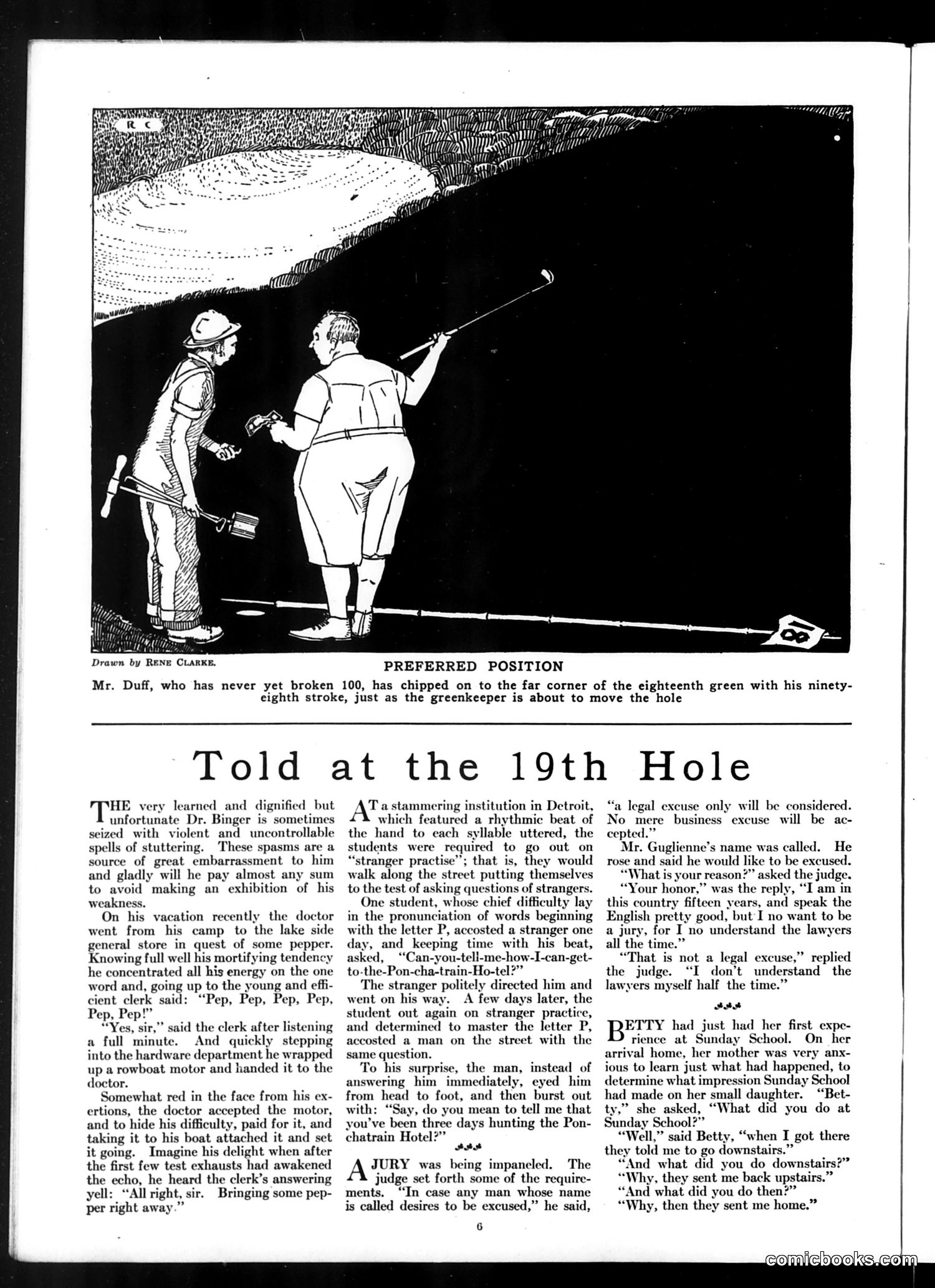
This page contains four humorous anecdotes illustrated with cartoons, typical of Judge magazine's format. **Top cartoon:** Shows a golfer ("Mr. Duff") who has never broken 100, cheating by moving his ball to a better position while the greenkeeper isn't looking—satirizing golf etiquette violations. **The stories below** are light comedy pieces: 1. **Dr. Binger's stutter:** A doctor with a severe stammer tries to buy pepper but repeats "Pep" so many times the clerk returns with a rowboat motor—a pun on "pep" (energy/power). 2. **Speech therapy mishap:** A student practicing pronunciation of words beginning with "P" asks a stranger three times about "the Pon-cha-train Hotel," exhausting the stranger's patience. 3. **Jury duty excuse:** A naturalized immigrant claims he can't serve because he doesn't understand lawyers—the judge humorously admits he doesn't either. 4. **Betty at Sunday School:** A child is sent back and forth between rooms until sent home entirely—suggesting Sunday School chaos or her being unwelcome. These are gentle, era-appropriate humor pieces reflecting early-20th-century American life and speech impediments as comedy fodder.
📄 Transcribed text from this page (OCR, searchable)
Machine-transcribed from the original scan — historical spelling and the odd misread are preserved.
Drawn by RENE CLARKE. Mr. oe mW, SY it PREFERRED POSITION OME le Duff, who has never yet broken 100, has chipped on to the far corner of the eighteenth green with his ninety- eighth stroke, just as the greenkeeper is about to move the hole Told at the 19th Hole HE very learned and dignified but infortunate Dr. Binger is sometimes ed with violent and uncontrollable spells of stuttering. These spasms are a source of great embarrassment to him and gladly will he pay almos to avoid making an exhibition of his weaknes On his vacation recently the doctor went from his camp to the lake side general store in quest of some pepper. Knowing full well his mortifying tendency he concentrated all his energy on the one word and, going up to the young and effi- cient clerk said: “Pep, Pep, Pep, Pep, Pep, Pep! said the clerk after listening a full minute. And quickly stepping into the hardware department he wrapped up a rowboat motor and handed it to the doctor. Somewhat red in the face from his ex- ertions, the doctor accepted the motor, and to hide his difficulty, paid for it, and taking it to his boat attached it and set it going. Imagine his delight when after the first few test exhausts had awakened the echo, he heard the clerk’s answering yell: “Allright, sir. Bringing some pep- per right away.” AX ammering institution in Detroit, which featured a rhythmic beat of the hand to each syllable uttered, the students were required to go out on “stranger practise’; that is, they would walk along the street putting themselv to the test of asking questions of strangers. One student, whose chief difficulty lay in the pronunciation of words beginning with the letter P, accosted a stranger one day, and keeping time with his beat, asked, “‘Can-you-tell- me-how-I-can-get- to-the-Pon-cha-train-Ho-tel: The stranger politely directed him and went on his way. A few days later, the student out again on stranger practice, and determined to master the letter P, accosted a man on the street with the same question. To his surprise, the man, instead of answering him immediately, eyed him from head to foot, and then burst out with: “Say, do you mean to tell me that you’ve been three days hunting the Pon- chatrain Hotel?” sae JURY was being impaneled. The judge set forth some of the require- ments. “In case any man whose name is called desires to be excused,” he said, 6 oe this country fifteen years, and speak the English pretty good, but I no want to be a jury, for I no understand the lawyers all the time.” “That is not a legal excuse,” replied the judge. “I don’t understand the lawyers myself half the time.” FIt BETTY had just had her first. expe- lence at Sunday School. On her arrival home, her mother was very anx- ious to learn just what had happened, to determine what impression Sunday School had made on her small daughter. “‘Bet- ty,” she asked, “What did you do at Sunday School?” “Well,” said Betty, “when I got there they told me to go downstairs.” “And what did you do downstairs?” “Why, they sent me back upstairs.” “And what did you do then?” “Why, then they sent me home.”