
Judge, 1922-07-22 · page 13 of 36
Judge — July 22, 1922 — page 13: what you’re looking at
What you’re looking at
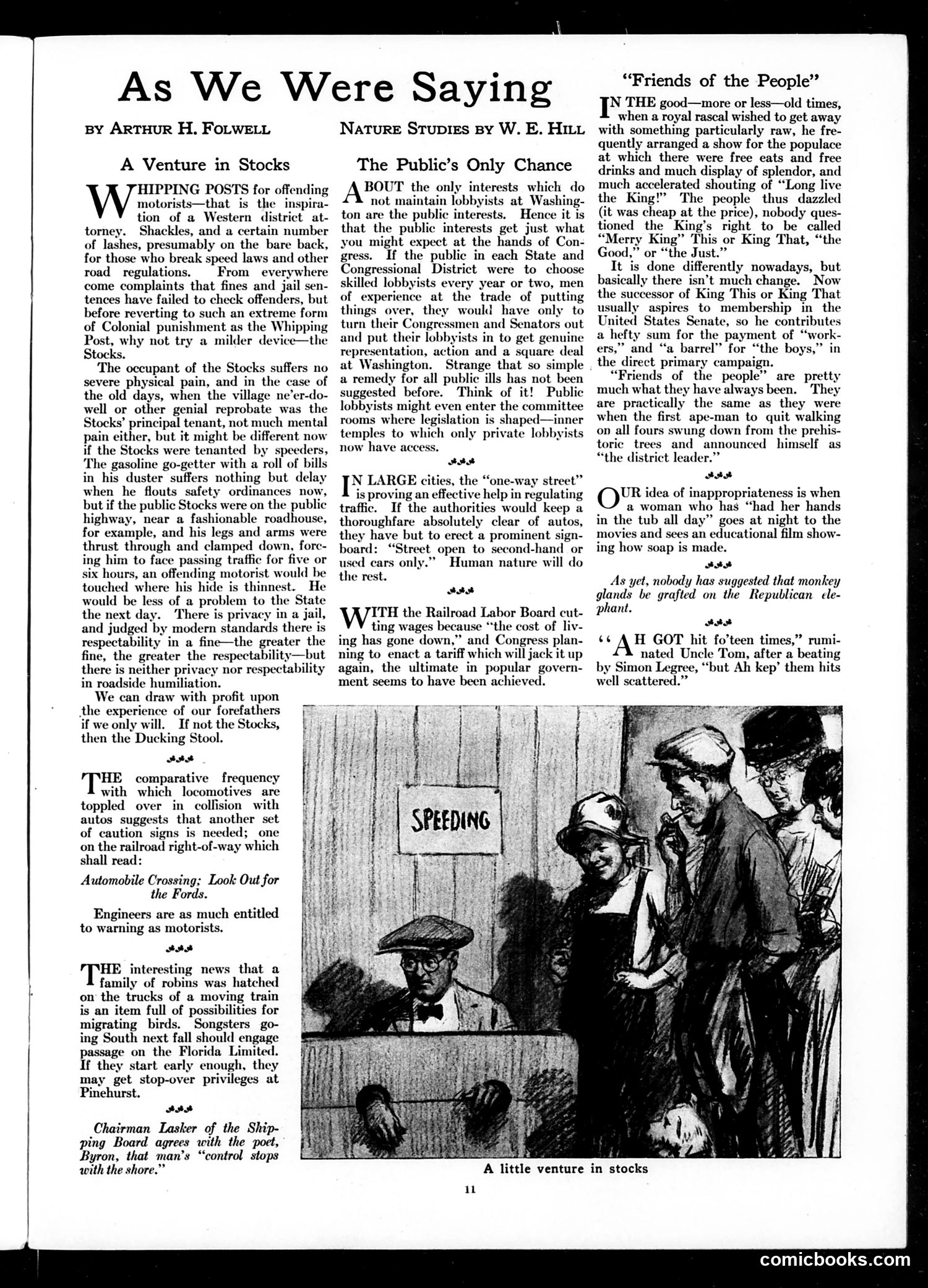
This page from **Judge** magazine contains satirical commentary on early 20th-century American problems, paired with a cartoon illustration. The main text attacks **reckless motorists** speeding on public roads. The author proposes using colonial-era "stocks" (public restraint devices) to shame wealthy speeders—arguing that fines don't deter those with money, but public humiliation would. The satire targets the privileged classes who flout safety laws without consequence. The accompanying cartoon shows a man caught in stocks at a "SPEEDING" sign, with onlookers jeering—illustrating this punishment concept. Secondary pieces mock **lobbying culture** (only private interests have representatives in Washington), traffic regulation (one-way streets work because people avoid used cars), and railroad labor disputes. The humor relies on exaggerated solutions to modern problems—suggesting we return to medieval punishment for contemporary driving violations—to critique the ineffectiveness of existing enforcement and class-based justice.
📄 Transcribed text from this page (OCR, searchable)
Machine-transcribed from the original scan — historical spelling and the odd misread are preserved.
As We Were Saying By ARTHUR H. FoLWELL A Venture in Stocks HIPPING POSTS for offending motorists—that is the ii a tion of a Western district at- torney. Shackles, and a certain number of lashes, presumably on the bare back, for those who break speed laws and other road regulations. From everywhere come complaints that fines and jail sen- tences have failed to check offenders, but before reverting to such an extreme form of Colonial punishment as the Whipping Post, why not try a milder device—the Stocks. The occupant of the Stocks suffers no severe physical pain, and in the c the old days, when the village ne’er-do- well or other genial reprobate was the Stocks’ principal tenant, not much mental pain either, but it might be different now if the Stocks were tenanted by speeders, The gasoline go-getter with a roll of bills in his duster suffers nothing but delay when he flouts safety ordinances now, but if the public Stocks were on the public highway, near a fashionable roadhouse, for example, and his legs and arms were thrust through and clamped down, forc- ing him to face passing traffic for five or six hours, an offending motorist would be touched where his hide is thinnest. He would be less of a problem to th the next day. There is privacy and judged by modern standards respectability in a fine—the greate fine, the greater the respectabili there is neither privacy nor respectability in roadside humiliation. We can draw with profit upon the experience of our forefathers if we only will. If not the Stocks, then the Ducking Stool. SIS TH comparative frequency with which locomotives are toppled over in collision with autos suggests that another set of caution signs is needed; one on the railroad right-of-way which shall read: Automobile Crossing; Look Out for the Fords. there is the Engineers are as much entitled to warning as motorists. Ph ad HE interesting news that a family of robins was hatched on the trucks of a moving train is an item full of possibilities for migrating birds. Songsters go- ing South next fall should engage passage on the Florida Limited. If they start early enough, they may get stop-over privileges at Pinehurst. PAF Chairman Lasker of the Ship- ping Board agrees with the poet, Byron, that man’s “control stops with the shore.” Nature Stupiss sy W. E. Hitt The Public’s Only Chance BOUT the only interests which do not maintain lobbyists at Washing- ton are the public interests. Hence it is that the public interests get just what you might expect at the hands of Con- gress. If the public in each State and Congressional District were to choose skilled lobbyists every year or two, men of experience at the trade of putting things over, they would have only to turn their Congressmen and Senators out and put their lobby: in to get genuine representation, action and a square deal at Washington. Strange that so simple a remedy for all public ills has not been suggested before. Think of it! Public lobbyists might even enter the committee rooms where legislation is shaped—inner temples to which only private lobbyists now have access. Rad N LARGE cities, the “one-way street” is proving an effective help in regulating traffic. If the authorities would keep a thoroughfare absolutely clear of autos, they have but to erect a prominent sign- board: “Street open to second-hand or used cars only.” Human nature will do the rest. SAS ITH the Railroad Labor Board cut- ting wages because “the cost of liv- ing has gone down,” and Congress plan- ning to enact a tariff which will jack it up again, the ultimate in popular govern- ment seems to have been achieved. memiceunaaunn nce A ata NE il “Friends of the People” W THE good—more or less—old times, when a royal rascal wished to get away with something particularly raw, he fre- quently arranged a show for the populace at which there were free eats and free drinks and much display of splendor, and much accelerated shouting of “Long live the King!” The people thus dazzled (it was cheap at the price), nobody ques- tioned the King’s right to be called “Merry King” This or King That, “the Good,” or “the Just.” It is done differently nowadays, but basically there isn’t much change. Now the successor of King This or King That usually aspires to membership in the United States Senate, so he contributes a hefty sum for the payment of “work- ers,” and “a barrel” for “the boys,” in the direct primary campaign. “Friends of the people” are pretty much what they have always been. They are practically the same as they were when the first ape-man to quit walking on all fours swung down from the prehis- toric tr and announced himself as “the district leader.” tet UR idea of inappropriateness is when a woman who has “had her hands in the tub all day” goes at night to the movies and sees an educational film show- ing how soap is made. ald As yet, nobody has suggested that monkey glands be grafted on the Republican ele- phant. Rad ‘(AH GOT hit fo’teen times,” rumi- nated Uncle Tom, after a beating by Simon Legree, “but Ah kep’ them hits well scattered.” comicbooks.com