
Judge, 1922-07-22 · page 32 of 36
Judge — July 22, 1922 — page 32: what you’re looking at
What you’re looking at
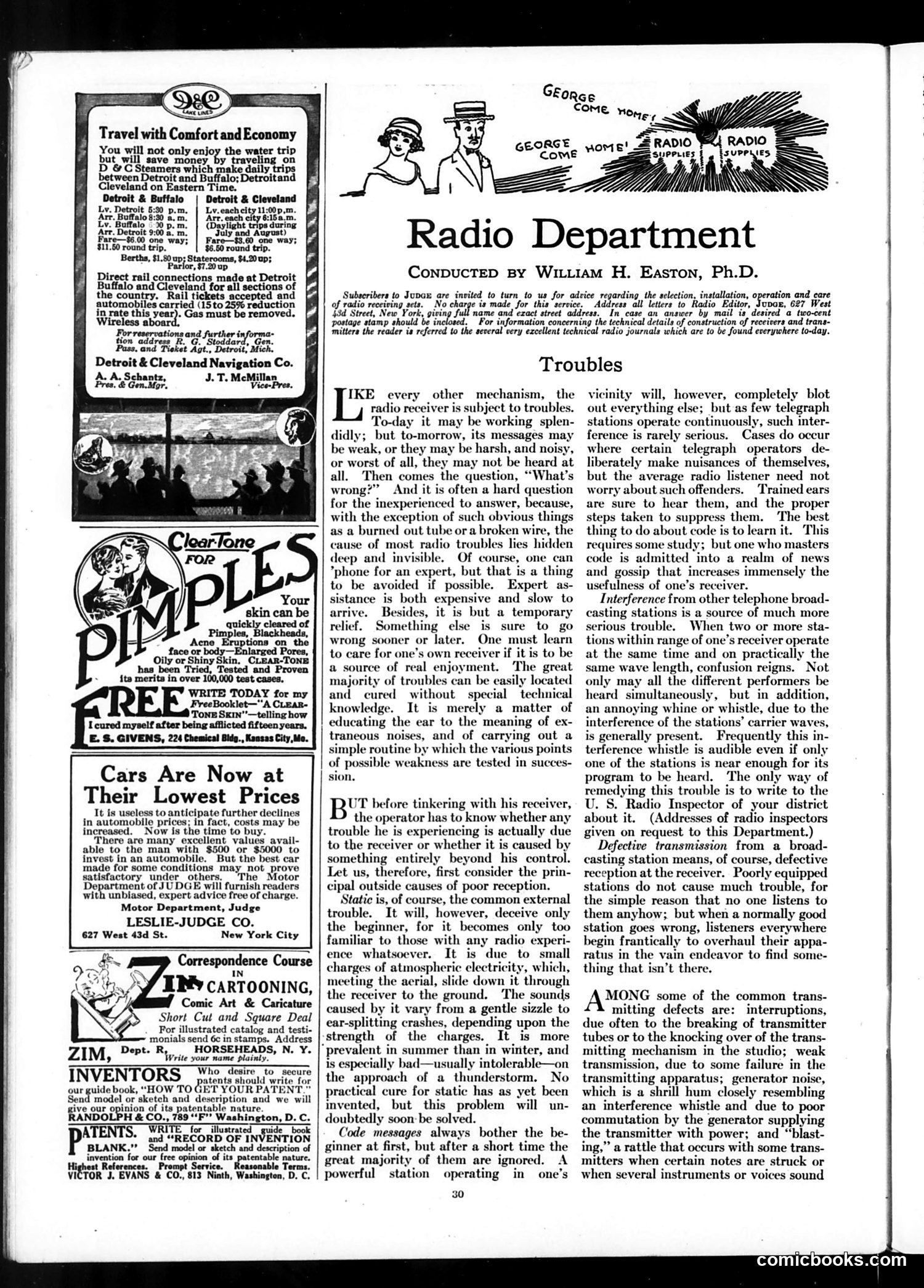
This page is primarily **advertising and a radio advice column**, not political satire. The upper portion features a "Radio Department" column conducted by William H. Easton, Ph.D., addressing technical radio receiver troubles—a timely topic in the 1920s when home radio was new and popular. The column discusses common problems like static, weak reception, and interference, offering practical guidance to amateur radio enthusiasts. The remainder is filled with period advertisements: steamship travel deals, skincare products (ClearTone), automobile sales pitches, correspondence courses in cartooning, and patent/invention services. The small cartoon vignette at top shows a man and woman saying "George, come home!" with "Radio" and "Supply" text—a lighthearted reference to radio's growing social prominence, suggesting it was distracting husbands from domestic life. The page reflects 1920s consumer culture and the radio boom rather than political commentary.
📄 Transcribed text from this page (OCR, searchable)
Machine-transcribed from the original scan — historical spelling and the odd misread are preserved.
Travel with Comfort and Economy xe will not only enlo; the water trip but, will save mon traveling on D&c Steamers wh which make daily trips between Detroit and Buffalo; Detroitand Cleveland on Eastern Time. 86.00 one ‘way; $11.50 round trip, i 60 round trip. Berths, $1.80 up; Staterooms, $4.20up; Parlor, $7.20 up Direct rail connections made at Detroit Buffalo and Cleveland for all sections of the country. ickets accepted and Rail t automobiles carried (15 to 25% reduction {pate this this year). Gas must be removed. Fc rossceasions rther informa- tion address BG Stoddard. G Pass, and Ticket Agt., Detroit, Mich, Detroit & Cleveland Navigation Co. A. A.S. .T. MeMil Actitatons, 1 T-Mttite, Sa Ss body—Enlarged Pores, oy or Shiny Skin, CLEAR-TONE has been Tried, Tested and Proven ite merits in over 100,000 test cases. WRITE TODAY for my FreeBooklet—"A CLEAR- Tone SKIN"—telling how I cured myself after being afflicted fifteen years. E. S. GIVENS, 224 Chemical Bldg., Kansas City,Mo. Cars Are Now at Their Lowest Prices It is useless to anticipate further declines in automobile prices; in fact, costs may be increased. Now is the time to buy. ‘There are many excellent values avail- able to the man with $500 or $5000 to invest in an automobile. But the best car made for some conditions may not prove satisfactory under others. ‘The Motor Department of JUDGE wili furnish readers unbiased, expert advice free of charge. Motor Department, Judge LESLIE-JUDGE CO. 627 West 43d St. New York City witl Correspondence Course IN Comic Art & Caricature Short Cut and Square Deal For illustrated catalog and testi- monials send 6c in stamps. Address Dept. R, HORSEHEADS, N. Y. Write your name plainty. INVENTO: Who desire to ‘Secure atents should our ude Book, “HOW TO GET YOUR PA’ Send model or'sketch and description and we ZIM, ive our opinion of its patentable nature. RAAB PBN £o., 789 “F”’ Washington, D. C. RITE for illustrated guide book ATENTS. SsRECORD OF INVENTION BLANK.”’ Send model or sketch and description of invention for our fre opinion of its patentable nature. Highest Refer Prompt Service. Terms. VIETOR J. EVANS & CO. 813 Ninth, Washington, D.C: CEoRce Radio Department ConpucTEeD By Wituiam H. Easton, Ph.D. Subscribers to Jupae are invited to turn to us for advice regarding the selection, installation, oj af sad receiving ses. | No change ix made for ths service name and exact street address. For information concerning the tecknical details of construction of receivers and trans- 43d Street, New York, givin postage stamp should be incl \ddress all letters to Radio Edit In case an answer by mail is dé ‘mitters the reader is referred to the several very excellent technical radio journals which are to be found everywhere to-day. Troubles IKE every other mechanism, the radio receiver is subject to troubles. ‘o-day it may be working splen- didly; but to-morrow, its messages may be weak, or they may be harsh, and noisy, or worst of all, they may not be heard at all. Then comes the question, “What's wrong?” And it is often a hard question for the inexperienced to answer, because, with the exception of such obvious things as a burned out tube ora broken wire, the cause of most radio troubles lies hidden deep and invisible. Of course, one can *phone for an expert, but that is a thing to be avoided if possible. Expert as- sistance is both expensive and slow to arrive. Besides, it is but a temporary relief. Something else is sure to go wrong sooner or later. One must learn to care for one’s own receiver if it is to be a source of real enjoyment. The great majority of troubles can be easily located and cured without special technical knowledge. It is merely a matter of educating the ear to the meaning of ex- traneous noises, and of carrying out a simple routine by which the various points of possible weakness are tested in succes- sion. UT before tinkering with his receiver, the operator has to know whether any trouble he is experiencing is actually due to the receiver or whether it is caused by something entirely beyond his control. Let us, therefore, first consider the prin- cipal outside causes of poor reception. Static is, of course, the common external trouble. It will, however, deceive only the beginner, for it becomes only too familiar to those with any radio experi- ence whatsoever. It is due to small charges of atmospheric electricity, which, meeting the aerial, slide down it through the receiver to the ground. The sounds caused by it vary from a gentle sizzle to ear-splitting crashes, depending upon the strength of the charges. It is more ‘prevalent in summer than in winter, and is especially bad—usually intolerable—on the approach of a thunderstorm. No practical cure for static has as yet been invented, but this problem will un- doubtedly soon: be solved. Code messages always bother the be- ginner at first, but after a short time the great majority of them are ignored. A powerful station operating in one’s 30 vicinity will, however, completely blot out everything e but as few telegraph stations operate continuously, such inter- ference is rarely serious. Cases do occur where certain telegraph operators de- liberately make nuisances of themselves, but the average radio listener need not worry about such offenders. Trained ears are sure to hear them, and the proper steps taken to suppress them. The best thing to do about code is to learn it. This requires some study; but one who masters code is admitted into a realm of news and gossip that increases immensely the usefulness of one’s receiver. Interference from other telephone broad- casting stations is a source of much more serious trouble. When two or more sta- tions within range of one’s receiver operate at the same time and on practically the same wave length, confusion reigns. Not only may all the different performers be heard simultaneously, but in addition, an annoying whine or whistle, due to the interference of the stations’ carrier waves, is generally present. Frequently this in- terference whistle is audible even if only one of the stations is near enough for its program to be heard. The only way of remedying this trouble is to write to the U. S. Radio Inspector of your district about it. (Addresses of radio inspectors given on request to this Department.) Defective transmission from a broad- casting station means, of course, defective reception at the receiver. Poorly equipped stations do not cause much trouble, for the simple reason that no one listens to them anyhow; but when a normally good station goes wrong, listeners everywhere begin frantically to overhaul their appa- ratus in the vain endeavor to find some- thing that isn’t there. MONG some of the common trans- mitting defects are: interruptions, due often to the breaking of transmitter tubes or to the knocking over of the trans- mitting mechanism in the studio; weak ion, due to some failure in the ing apparatus; generator noise, which is a shrill hum closely resembling an interference whistle and due to poor commutation by the generator supplying the transmitter with power; and “blast- ing,” a rattle that occurs with some trans- mitters when certain notes are struck or when several instruments or voices sound comicbooks.com