
Judge, 1922-07-22 · page 16 of 36
Judge — July 22, 1922 — page 16: what you’re looking at
What you’re looking at
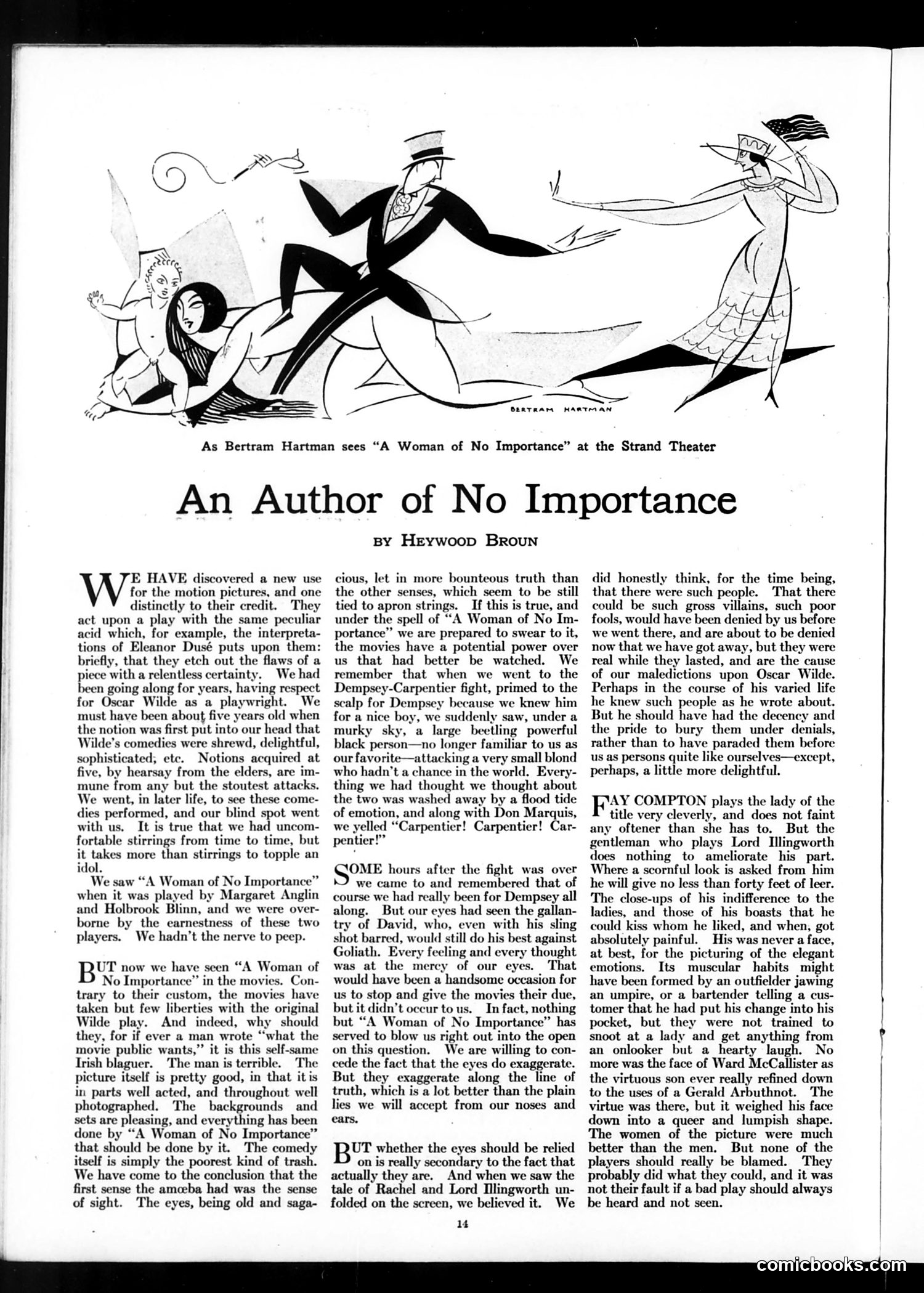
This article by Heywood Broun uses Oscar Wilde's play "A Woman of No Importance" (shown in the cartoon as a chaotic theatrical scene) to critique Wilde himself and expose cinema's unique power to reveal truth. **The satire's point:** Broun admits he long respected Wilde as a playwright based on childhood assumptions passed down by elders—never questioning this inherited opinion. However, seeing the play adapted to film stripped away the actors' (Margaret Anglin and Holbrook Blinn's) ability to obscure the work's fundamental weakness: the script itself is "the poorest kind of trash." **Key argument:** Film's visual directness—what Broun calls the "amoeba's first sense"—exposes artistic flaws "with relentless certainty" in ways stage performances mask through interpretation. He illustrates this with the Dempsey-Carpentier fight, where raw visual evidence overrode his preexisting bias. **The joke:** Wilde, famous for declaring "the public wants," has ironically provided a vehicle proving cinema's superior honesty—inadvertently destroying his own reputation in the process.
📄 Transcribed text from this page (OCR, searchable)
Machine-transcribed from the original scan — historical spelling and the odd misread are preserved.
OERTRAM HARTMAN As Bertram Hartman sees “A Woman of No Importance” at the Strand Theater An Author of No Importance E HAVE discovered a new use for the motion pictures, and one distinctly to their credit. They act upon a play with the same peculiar acid which, for example, the interpreta- tions of Eleanor Dusé puts upon them: briefly, that they etch out the flaws of a piece with a relentless certainty. We had been going along for years, having respect for Oscar Wilde as a playwright. We must have been about five years old when the notion was first put into our head that Wilde’s comedies were shrewd, delightful, sophisticated, etc. Notions acquired at five, by hearsay from the elders, are im- mune from any but the stoutest attacks. We went, in later life, to see these come- dies performed, and our blind spot went with us. It is true that we had uncom- fortable stirrings from time to time, but it takes more than stirrings to topple an idol. We saw “A Woman of No Importance” when it was played by Margaret Anglin and Holbrook Blinn, and we were over- borne by the earnestness of these two players. We hadn’t the nerve to peep. UT now we have seen “A Woman of Vo Importan in the movies. Con- trary to their custom, the movies have taken but few liberties with the original ilde play. And indeed, why should y, for if ever a man wrote “what the public wants,” it is this self-same Trish blaguer. The man is terrible. picture itself is pretty good, in tha $ in parts well acted, and throughout well photographed. The backgrounds and sets are pleasing, and everything has been done by “A Woman of No Importance” that should be done by it. The comedy itself is simply the poorest kind of trash. We have come to the conclusion that the first sense the amoeba had was the sense of sight. The eyes, being old and saga- By HEywoop Broun cious, let in more bounteous truth than the other senses, which seem to be still tied to apron strings. If this is true, and under the spell of “A Woman of No Im- portance” we are prepared to swear to it, the movies have a potential power over us that had better be watched. We remember that when we went to the Dempsey-Carpentier fight, primed to the scalp for Dempsey because we knew him for a nice boy, we suddenly saw, under a murky sky, a large beetling powerful n—no longer familiar to us as e—attacking a very small blond who hadn't a chance in the world. Every- thing we had thought we thought about the two was washed away by a flood tide of emotion, and along with Don Marquis, we yelled “Carpentier! Carpentier! Car- pentier!”” OME hours after the fight was over we came to and remembered that of course we had really been for Dempsey all along. But our eyes had seen the gallan- try of David, who, even with his sling shot barred, would still do his best against Goliath. Every feeling and every thought was at the mercy of our ey That would have been a handsome occasion for us to stop and give the movies their due, but it didn’t occur to us. In fact, nothing but “A Woman of No Importance” has served to blow us right out into the open on this question. We are willing to con- cede the fact that the eyes do exaggerate. But they exaggerate along the line of truth, which is a lot better than the plain lies we will accept from our noses and ears. UT whether the eyes should be relied on is really secondary to the fact that actually they are. And when we saw the tale of Rachel and Lord Illingworth un- folded on the screen, we believed it. We 14 did honestly think, for the time being, that there were such people. That there could be such gross villains, such poor fools, would have been denied by us before we went there, and are about to be denied now that we have got away, but they were real while they lasted, and are the cause of our maledictions upon Oscar Wilde. Perhaps in the course of his varied life he knew such people as he wrote about. But he should have had the decency and the pride to bury them under denials, rather than to have paraded them before us as persons quite like ourselves—except, perhaps, a little more delightful. ‘AY COMPTON plays the lady of the title very cleverly, and does not faint any oftener than she has to. But the gentleman who plays Lord Illingworth does nothing to ameliorate his part. Where a scornful look is asked from him he will give no less than forty feet of leer. The close-ups of his indifference to the ladies, and those of his boasts that he could kiss whom he liked, and when, got absolutely painful. His was never a face, at best, for the picturing of the elegant emotions. Its muscular habits might have been formed by an outfielder jawing an umpire, or a bartender telling a cus- tomer that he had put his change into his pocket, but they were not trained to snoot at a lady and get anything from an onlooker but a hearty laugh. No more was the face of Ward McCallister as the virtuous son ever really refined down to the uses of a Gerald Arbuthnot. The virtue was there, but it weighed his face down into a queer and lumpish shape. The women of the picture were much better than the men. But none of the players should really be blamed. They probably did what they could, and it was not their fault if a bad play should always be heard and not seen. gs Comicbooks.co