
Judge, 1922-07-22 · page 28 of 36
Judge — July 22, 1922 — page 28: what you’re looking at
What you’re looking at
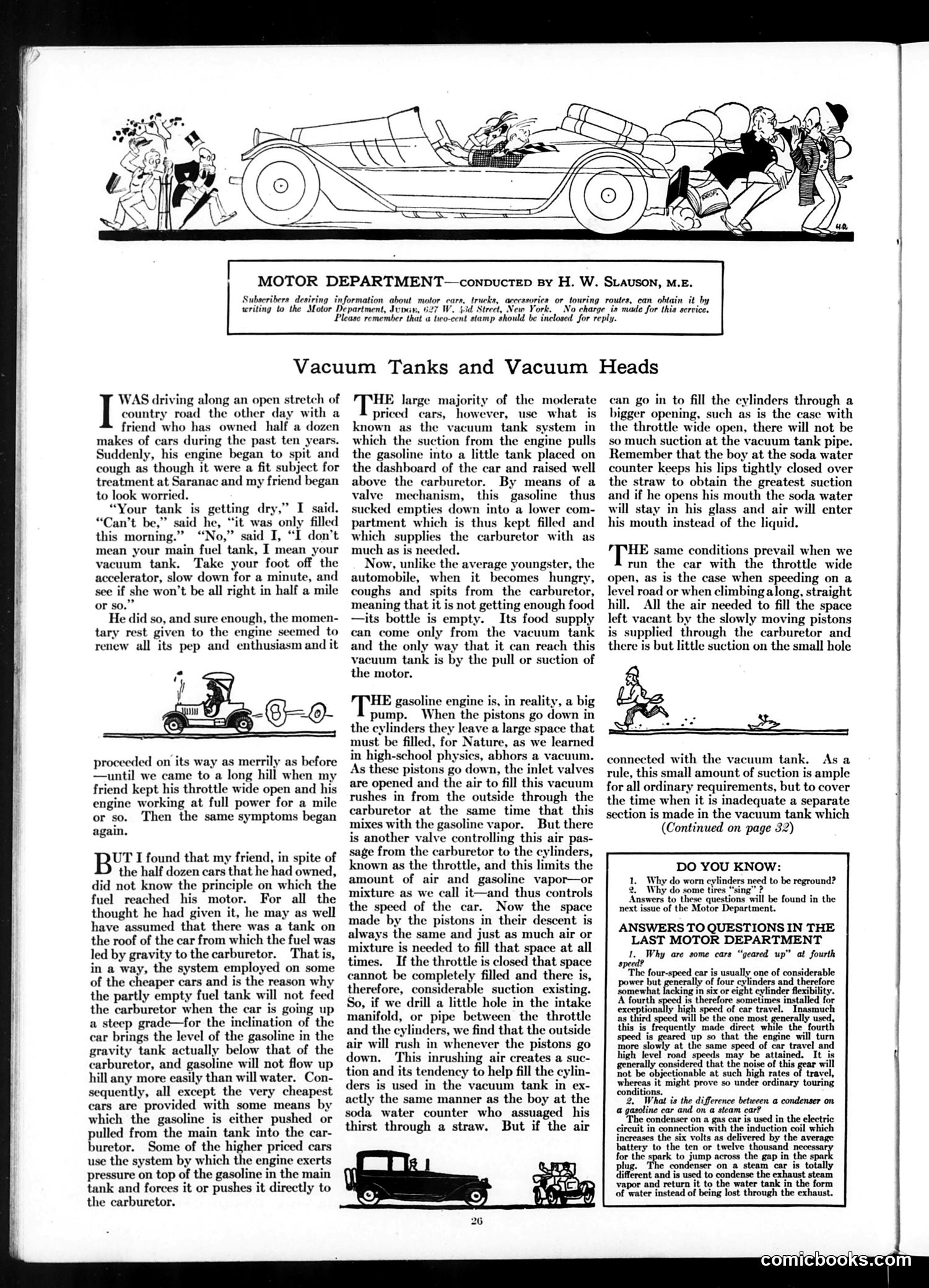
This is a **technical educational article**, not satire or political commentary. H.W. Slauson, the Motor Department editor, explains how vacuum tanks function in early automobiles to modern readers unfamiliar with the technology. The piece uses a narrative framework—the author driving with a friend whose car sputters on hills—to illustrate a common problem: owners didn't understand *why* their fuel systems failed under certain conditions. Slauson explains that unlike gravity-feed systems on cheap cars, most moderate-priced automobiles use a vacuum tank mounted on the dashboard. The engine's suction pulls gasoline from the main tank into this upper reservoir, which then gravity-feeds the carburetor. The humor is gentle pedagogical irony: the friend owns multiple cars but doesn't grasp the mechanical principle making them run. This reflects Judge's role in the 1910s-20s as both satire *and* practical information source for middle-class automobile owners navigating unfamiliar technology.
📄 Transcribed text from this page (OCR, searchable)
Machine-transcribed from the original scan — historical spelling and the odd misread are preserved.
Subscribers desiring information abor writing to the Motor Department, dvi Please remember MOTOR DEPARTMENT—conpuctep sy H. W. Stauson, M.E. molor cars, trucks, accessories or touring routes, can obtain it by rk. No charge ix made for this service. rat a tweo-cent stamp should be inelosed for reply. 2, 627 W. pid Street, New York. Vacuum Tanks and Vacuum Heads country road the other day with a friend who has owned half a dozen makes of cars during the past ten years. Suddenly, his engine began to spit and cough as though it were a fit subject for treatment at Saranac and my friend began to look worried “Your tank is getting dry,” I said. “Can't be,” said he, “it was only filled this morning.” “No,” said I, “I don’t mean your main fuel tank, I mean your vacuum tank. Take your foot off the accelerator, slow down for a minute, and see if she won’t be all right in half a mile or so.” He did so, and sure enough, the momen- tary rest given to the engine seemed to renew all its pep and enthusiasm and it I WAS driving along an open stretch of proceeded on its way as merrily as before —until we came to a long hill when my friend kept his throttle wide open and his engine working at full power for a mile or Then the same symptoms began agai UT I found that my friend, in spite of the half dozen cars that he had owned, did not know the principle on which the fuel reached his motor. For all the thought he had given it, he may as well have assumed that there was a tank on the roof of the car from which the fuel was led by gravity to the carburetor. That is, in a way, the system employed on some of the cheaper cars and is the reason why the partly empty fuel tank will not feed the carburetor when the car is going up a steep grade—for the inclination of the car brings the level of the gasoline in the gravity tank actually below that of the carburetor, and gasoline will not flow up hill any more easily than will water. Con- sequently, all except the very cheapest cars are provided with some means by which the gasoline is either pushed or pulled from the main tank into the car- buretor. Some of the higher priced cars use the system by which the engine exerts pressure on top of the gasoline in the main tank and forces it or pushes it directly to the carburetor. [HE large majority of the moderate priced cars, however, use what is known as the vacuum tank em in which the suction from the engine pulls the gasoline into a little tank placed on the dashboard of the car and raised well above the carburetor. By means of a valve mechanism, this gasoline thus sucked empties down into a lower com- partment which is thus kept filled and which supplies the carburetor with as much as is needed. Now, unlike the average youngster, the automobile, when it becomes hungry, coughs and spits from the carburetor, meaning that it is not getting enough food —its bottle is empty. Its food supply can come only from the vacuum tank and the only way that it can reach this vacuum tank is by the pull or suction of the motor. "THE gasoline engine is, in reality, a big pump. When the pistons go down in the cylinders they leave a large space that must be filled, for Nature, as we learned in high-school physics, abhors a vacuum. As these pistons go down, the inlet valves are opened and the air to fill this vacuum rushes in from the outside through the carburetor at the same time that this mixes with the gasoline vapor. But there is another valve controlling this air pas- sage from the carburetor to the inders, known as the throttle, and this limits the amount of air and gasoline vapor—or mixture as we call it—and thus controls the speed of the car. Now the space made by the pistons in their descent is always the same and just as much air or mixture is needed to fill that space at all times. If the throttle is closed that space cannot be completely filled and there 4 therefore, considerable suction existi So, if we drill a little hole in the intake manifold, or pipe between the throttle and the cylinders, we find that the outside air will rush in whenever the pistons go down. This inrushing air creates a suc- tion and its tendency to help fill the n- ders is used in the vacuum tank in ex- actly the same manner as the boy at the soda water counter who assuaged his thirst through a straw. But if the air can go in to fill the cylinders through a bigger opening, such as is the case with the throttle wide open, there will not be so much suction at the vacuum tank pipe. Remember that the boy at the soda water counter keeps his lips tightly closed over the straw to obtain the greatest suction and if he opens his mouth the soda water will stay in his glass and air will enter his mouth instead of the liquid. *pRE same conditions prevail when we run the car with the throttle wide open, as is the case when speeding on a level road or when climbing along, straight hill. All the air needed to fill the space left vacant by the slowly moving pistons is supplied through the carburetor and there is but little suction on the small hole connected with the vacuum tank. As a Tule, this small amount of suction is ample for all ordinary requirements, but to cover the time when it is inadequate a separate section is made in the vacuum tank which (Continued on page 32) DO YOU KNOW: 1. Why do worn cylinders need to be reground? 2. Why do some tires “sing” vers to these questions will be found in the next issue of the Motor Department. ANSWERS TO QUESTIONS IN THE LAST MOTOR DEPARTMENT 1. Why are some cars “geared up” at fourth speed? The four-speed car is usually one of considerable power but fr erally of four cylinders and therefore somewhat lacking in six or eight cylinder flexibility. A fourth is therefore sometimes installed for exceptionally high speed of car travel. Inasmuch as third speed will be the one most. generally this is frequently made direct while the. fourth speed is geared up so that the engine will turn more slowly at the same speed of car travel and high level road speeds may be attained. at is generally considered that the noise of this 1 not be objectionable at such high rates of travel whereas it might prove so under ordinary touring ‘hat is the difference between a condenser on @ gasoline car and on a steam car? ‘The condenser on a gas car is used in the electric circuit in connection with the induction coil which increases the six volts as delivered by the average battery to the ten or twelve thousand necessat for the spark to jump across the gap in the spark plug. ‘The condenser on a steam car is totally different and is used to condense the exhaust steam vapor and return it to the water tank in the form of water instead of being lost through the exhaust.