
Judge, 1922-07-22 · page 10 of 36
Judge — July 22, 1922 — page 10: what you’re looking at
What you’re looking at
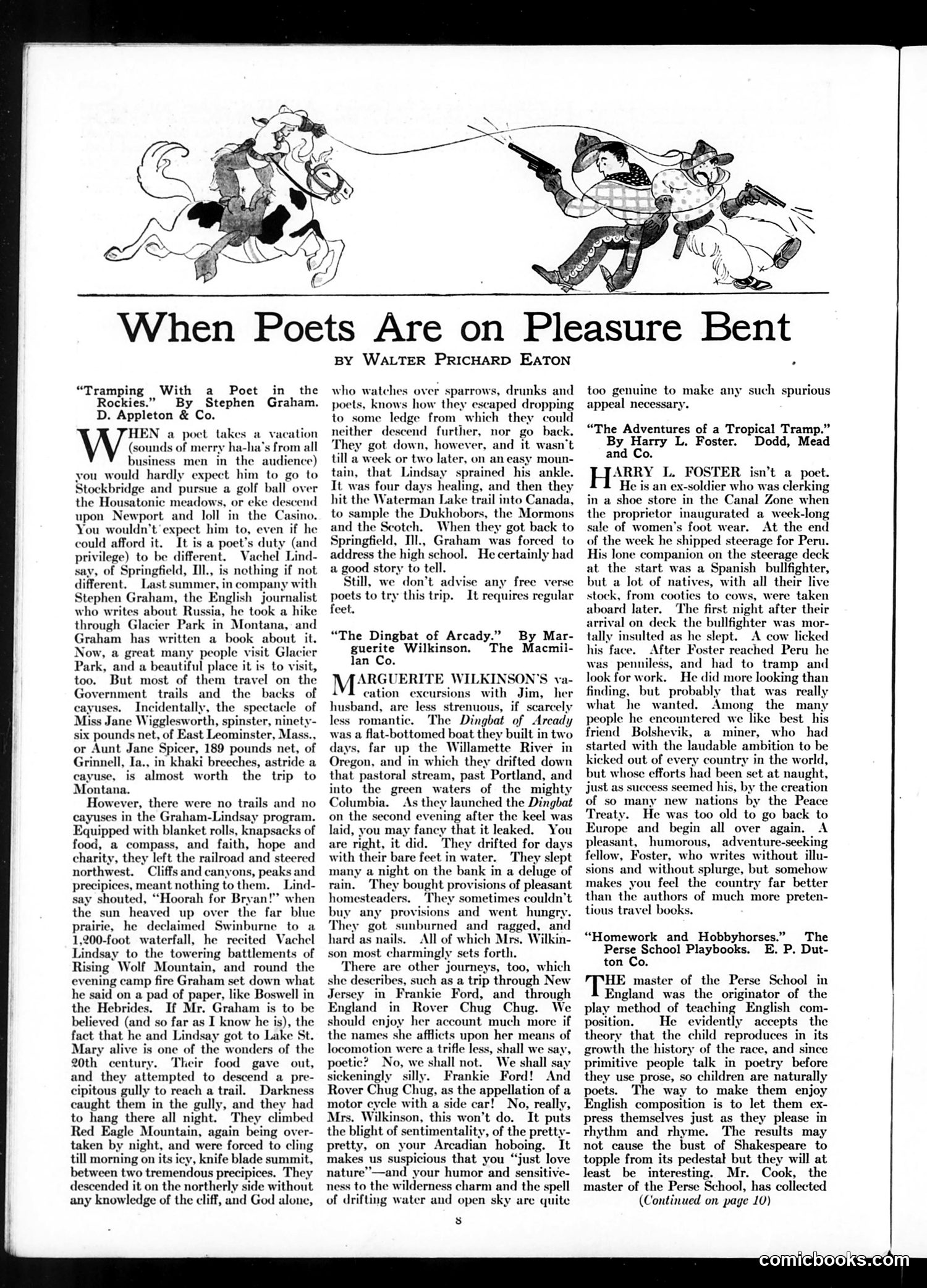
This satirical essay mocks the romantic notion of poets roughing it in nature. Author Walter Prichard Eaton reviews two travel books by poets and their companions: Stephen Graham's account of hiking with Vachel Lindsay through Glacier Park, Montana, and Margarette Wilkinson's river journey down the Willamette. The humor targets the gap between poets' bohemian self-image and reality. The cartoons show poets being dragged reluctantly on adventures, contrasting their affected artistic personas with practical discomfort. Eaton gently ridicules Lindsay's theatrical dramatics (shouting "Hoorah for Bryan!" at waterfalls, reciting poetry to mountains) and the poets' near-death experiences from poor planning—hanging on cliff-sides overnight, running out of food. The satire suggests poets pursue such trips to seem "different" and authentic, yet lack the competence of ordinary outdoorsmen. The final caution—"we don't advise any free verse poets to try this trip"—humorously implies their survival depends on luck, not skill.
📄 Transcribed text from this page (OCR, searchable)
Machine-transcribed from the original scan — historical spelling and the odd misread are preserved.
When Poets Are on Pleasure Bent “Tramping With a Poet in the Rockies.” By Stephen Graham. D. Appleton & Co. HEN a poct tak (sounds of merry ha- business men in the audience) you would hardly expect him to go to Stockbridge and pursue a golf ball over the Housatonic meadows, or eke desi upon Newport and loll in the Casino. You wouldn't expect him to, even if he could afford it. It is a poet’s duty (and privilege) to be different. Vachel Lind- say, of Springfield, Ill, is nothing if not different. Last summer, in company with Stephen Graham, the English journalist who writes about Russia, he took a hike through Glacier Park in Montana, and Graham has written a book about it. Now, a great many people Glacier Park, and a beautiful place it is to visit, too. But most of them travel on the Government trails and the backs of i ly, the spectacle of Jane Wigglesworth, spinster, ninety- six pounds net, of East Leominster, Mass., or Aunt Jane Spicer, 189 pounds net, of Grinnell, Ta. khaki breeches, astride a cayuse, is almost worth the trip to Montana. How ver, there were no trails and no in the Graham-Lindsay program. Raaiiped with blanket rolls, knapsacks of food, a compass, and faith, hope and charity, they left the railroad and steered northwest. Cliffs and canyons, peaks and precipices, meant nothing to them. —_ Lind- say shouted, “Hoorah for Bryan!” when the sun heaved up over the far blue priv, he dec! delined Swinburne to a 1,200-foot waterfall, he recited Vachel Lindsay to the towering battlements of Rising Wolf Mountain, and round the evening camp fire Graham set down what he said on a pad of paper, like Boswell in the Hebrides. If Mr. Graham is to be believed (and so far as I know he is), the fact that he and Lindsay got to Lake St. Mary alive is one of the wonders of the 20th century. Their food gave out, and they attempted to descend a pre- cipitous gully to reach a trail. Darkness caught them in the gully, and they had to hang there all night. They climbed Red Eagle Mountain, again being over- taken by night, and were forced to cling till morning on its icy, knife blade summit, between two tremendous precipices. They descended it on the northerly side without any knowledge of the cliff, and God alone, BY WALTER PRICHARD EATON who watches over sparrows, drunks and poets, knows how they escaped dropping to some ledge from which they could neither descend further, nor go back. They got down, however, and it wasn't till a week or two later, on an easy moun- ta that Li ) rained ankle. It was four days healing, and then they hit the Waterman I trail into Canada, to sample the Dukhobors, the Mormons and the Scotch. When they got back to Springfield, Ill., Graham was forced to address the high school. He certainly had a good story to tell. Still, we don’t advise any free verse poets to try this trip. It requires regular feet. “The Dingbat of Arcady.” By Mar- guerite Wilkinson. The Macmil- Jan Co. NV ARGUERITE WILKINSON'S va- 4¥2 cation excursions with Jim, her husband, are les nuous, if scarcely ess romantic. The Dingbat of Arcady flat-bottomed boat they built in two far up the Willamette River in nd in which they drifted down al stream, past Portland, and into the green waters of the mighty Columbia. As they launched the Dingbat on the second evening after the keel was laid, you may fancy that it leaked. You are right, it did. They drifted for days with their bare feet in water. They slept many a night on the bank in a deluge of rain. They bought pro ns of pleasant y sometimes couldn't y any s and went hungry. y got sunburned and ragged, and hard as nails. All of which Mrs. Wilkin- son most charmingly sets forth. There are other journeys, too, which she describes, such as a trip through New Jersey in Frankie Ford, and through England in Rover Chug Chug. We should enjoy her account much more if the names she afflicts upon her means of locomotion were a trifle less, shall we poetic? No, we shall not. We shall say sickeningly silly. Frankie Ford! And Rover Chug Chug, as the appellation of a motor cycle with a side car! No, really, Mrs. Wilkinson, this won’t do. It puts the blight of sentimentality, of the pretty- pretty, on your Arcadian hoboing. It makes us suspicious that you “just love nature”—and your humor and sensitive- ness to the wilderness charm and the spell of drifting water and open sky are quite 3 too genuine to make any such spurious appeal necessary. “The Adventures of a Tropical Tramp.” By Harry L. Foster. Dodd, Mead and Co. HARRY L. FOSTER isn’t a poet. He is an ex-soldier who was clerking in a shoe store in the Canal Zone when the proprietor inaugurated a week-long sale of women’s foot wear. At the end of the week he shipped steerage for Peru. His lone companion on the steerage deck at the start was a Spanish bullfighter, but a lot of nati with all their live stock, from cooties to cows, were taken aboard later. The first night after their arrival on d the bullfighter was _mor- tall ulted as he slept. A cow licked his f. After Foster reached Peru he was penniless, and had to tramp and look for work. He did more looking than finding, but probably that was really what he wanted. Among the many people he encountered we like best _his friend Bolshevik, a miner, who had started with the laudable ambition to be kicked out of every country in the world, but whose efforts had been set at naught, , is, by the creation new nations by the Peace He was too old to go back to Europe and begin all over again. A pleasant, humorous, adventure-seeking fellow, Foster, who writes without illu- and without splurge, but somehow you feel the country far better than the authors of much more preten- tious travel bocks. “Homework and Hobbyhorses.” The Perse School Playbooks. E. P. Dut- ton Co. if (ets master of the Perse School in England was the originator of the play method of teaching English com- position. He evidently accepts the theory that the child reproduces in its growth the history of the race, and since primitive people talk in poetry before they use prose, so children are naturally poets. The way to make them enjoy English composition is to let them ex- press themselves just as they please in rhythm and rhyme. The results may not cause the bust of Shakespeare to topple from its pedestal but they will at least be interesting. Mr. Cook, the master of the Perse School, has collected (Continued on page 10)