
Judge, 1922-07-22 · page 3 of 36
Judge — July 22, 1922 — page 3: what you’re looking at
What you’re looking at
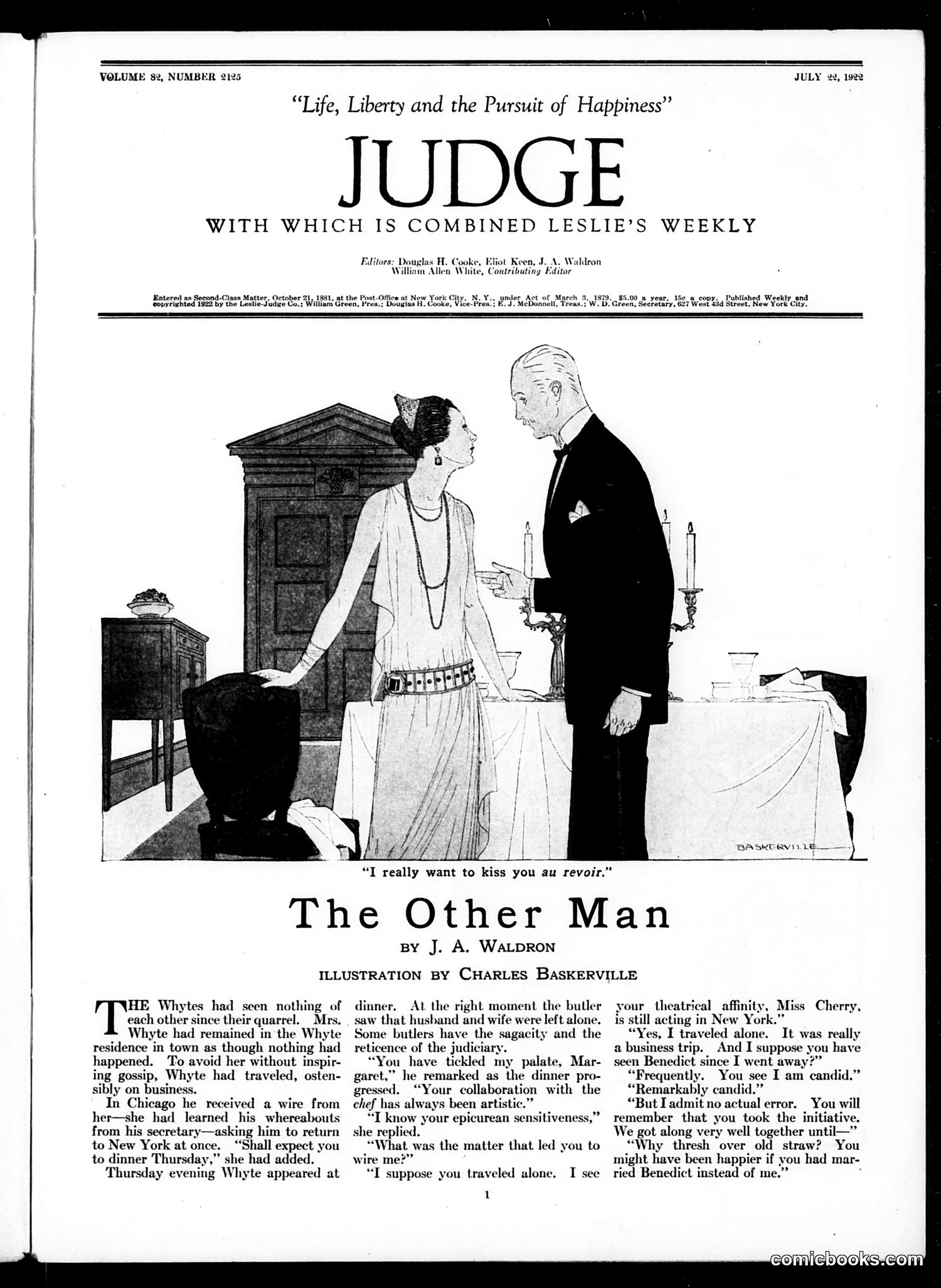
This illustration accompanies a serialized story titled "The Other Man" by J.A. Waldron, drawn by Charles Baskerville. The image depicts a domestic drama: a well-dressed man in formal evening wear confronts a woman in an elegant gown, with the caption "I really want to kiss you au revoir." The scene appears to be set in an affluent household (note the formal furniture and fireplace). The composition suggests a moment of romantic tension or infidelity—a common theme in 1920s fiction. The "other man" likely refers to a romantic rival or illicit lover, reflecting Jazz Age anxieties about marriage fidelity. The French phrase "au revoir" (goodbye) hints at a clandestine affair or farewell between lovers, typical melodramatic subject matter for Judge's serialized fiction during this period.
📄 Transcribed text from this page (OCR, searchable)
Machine-transcribed from the original scan — historical spelling and the odd misread are preserved.
VOLUME 82, NUMBER 2125 JULY 22, 1922 “Life, Liberty and the Pursuit of Happiness” JUDGE WITH WHICH IS COMBINED LESLIE’S WEEKLY Entered ax Second.C Soustighted 4855 by the Leste Jude Co any Mattes, October 21,1881. at the Host. Office at New York C ‘Douglas fi: Cooke, ot Keen, J. A. Waldron ntributing Editor Editors: Douglas H. Cooke, William Allen Whit copy... Published Weekly and West Sid Street, New York City. “I really want to kiss you au revoir.” BASKERVID LE — The Other Man BY J. A. WALDRON ILLUSTRATION BY CHARLES BASKERVILLE each other since their quarrel. Mrs. Whyte had remained in the Whyte residence in town as though nothing had happened. To avoid her without inspir- ing gossip, Whyte had traveled, osten- sibly on business. In Chicago he received a wire from her—she had learned his whereabouts from his secretary—asking him to return to New York at once. “Shall expect you to dinner Thursday,” she had added. Thursday evening Whyte appeared at Te Whytes had seen nothing of dinner. At the right moment the butler saw that husband and wife were left alone. Some butlers have the sagacity and the reticence of the judiciary. “You have tickled my palate, Mar- garet,” he remarked as the dinner pro- gressed. “Your collaboration with the chef has always been arti: “T know your epicurean s she replied. “What was the matter that led you to wire me?” “TI suppose you traveled alone. 1 sitiveness,” I see your theatrical affinity, Miss Cherry, is still acting in New York. “Yes, I traveled alone. It was really a business trip. And I suppose you have seen Benedict since I went away?” “Frequently. You see I am candid.” “Remarkably candid.” “But admit no actual error. You will remember that you took the initiative. We got along very well together until—” “Why thresh over old straw? You might have been happier if you had mar- ried Benedict instead of me.’