
Judge, 1922-07-22 · page 30 of 36
Judge — July 22, 1922 — page 30: what you’re looking at
What you’re looking at
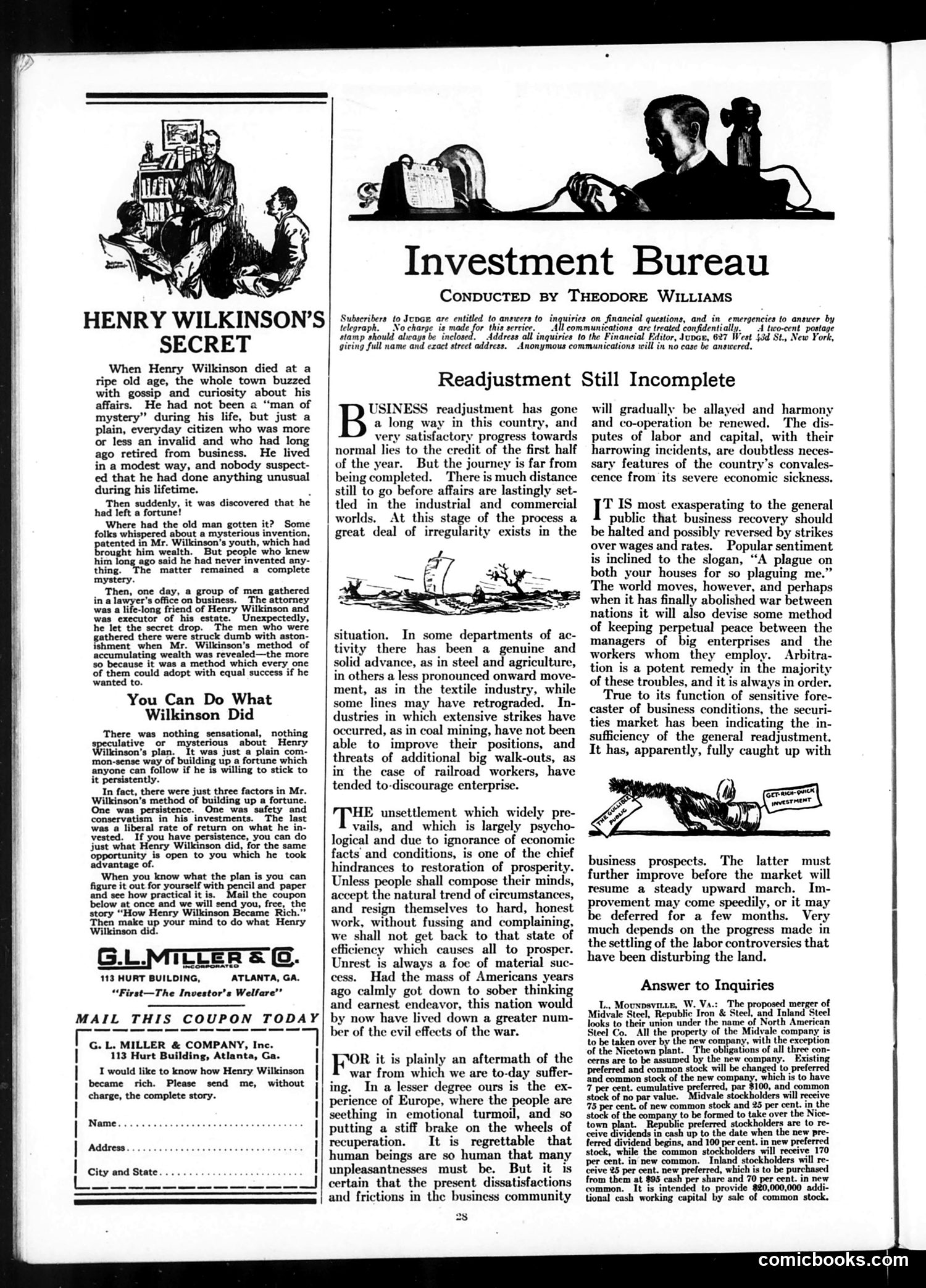
This page combines a financial advertisement with commentary on post-WWI economic recovery. **The Main Content:** The left side presents a narrative advertisement for G.L. Miller & Company's investment service. "Henry Wilkinson's Secret" is a rags-to-riches story that reveals the supposed mystery of how an ordinary man built wealth: through persistence, conservative investments, and patience. The ad uses this fictional narrative to attract readers to request the full story, positioning the investment bureau as offering legitimate wealth-building advice. **The Right Side - "Readjustment Still Incomplete":** This editorial discusses post-war economic recovery, acknowledging uneven progress across industries. It notes that strikes and labor unrest in coal mining and railroads are hindering recovery, while steel and agriculture have advanced. The piece expresses concern about ongoing "unsettle[ment]" and psychological barriers to prosperity. **Context:** This appears to be from the early 1920s, when America was transitioning from wartime to peacetime economy. The juxtaposition suggests financial optimism (the Wilkinson narrative) alongside realistic concerns about labor strife and incomplete industrial adjustment. The tone reflects moderate conservatism in financial advice.
📄 Transcribed text from this page (OCR, searchable)
Machine-transcribed from the original scan — historical spelling and the odd misread are preserved.
HENRY WILKINSON’S SECRET When Henry Wilkinson died at a ripe old age, the whole town buzzed with gossip and curiosity about his affairs. He had not been a “man of mystery” during his life, but just a plain, everyday citizen who was more or less an invalid and who had long ago retired from business. He lived in a modest way, and nobody suspect- ed that he had done anything unusual during his lifetime. : Then suddenly, it was discovered that he had left a fortune! Where had the old man gotten it? Some folks whispered about a mysterious invention, atented in Mr. Wilkinson’s youth, which had Brought him wealth. But le who knew him long ago said he had never invented any- thing. The matter remained a complete mystery. Then, one day, a group of men gathered in a lawyer's office on business. The attorney was a life-long friend of Henry Wilkinson and was executor of his estate. Unexpectedly, he let the secret drop. The men who were gathered there were struck dumb with aston- ishment when Mr. Wilkinson’s method of accumulating wealth was revealed—the more so because it was a method which every one of them could adopt with equal success if he wanted to. You Can Do What Wilkinson Did was nothing sensati itive or mysterious In fact, there were just three factors in Mr. Wilkinson’s method of building up a fortune. One was persistence. One was safety and conservatism in his investments. The last was a liberal rate of return on what he in- vested. If you have persistence, you can do just what Henry Wilkinson did, for the same opportunity is open to you which he took advantage of. When you know what the plan is you can figure it out for yourself with pencil and paper and see how practical it is. Mail the coupon below at once and we will send you, free, the story “How Henry Wilkinson Became Rich.” Then make up your mind to do what Henry Wilkinson did. G.L.MICLER Ss G. 113 HURT BUILDING, ATLANTA, GA. “First—The Investor's Welfare” MAIL THIS COUPON TODAY » L. MILLER & COMPANY, Inc. 113 Hurt Building, Atlanta, Ga. —_--_-_----—— | |. T would like to know how Henry Wilkinson | became rich. Please send me, without charge, the complete story. | City and State... a ee Investment Bureau ConpucTED BY THEODORE WILLIAMS Subscribers to Jcpae are entitled to answers to inquiries on financial questions, and in. emergencies to answer by telegraph. stamp should always be incl giving full name and ezact strect address. No charge is made for this service. _ Allcommun Address all inguirice to the Financial Editor, dooce, 627 West 43d St, New York, Anonymous communications will in no case be ansicered. fons are treated confidentially, A two-cent postage Readjustment Still Incomplete USINESS readjustment has gone B a long way in this country, and very satisfactory progress towards normal lies to the credit of the first half of the year. But the journey is far from being completed. There is much distance still to go before affairs are lastingly set- tled in the industrial and commercial worlds. At this stage of the process a great deal of irregularity exists in the situation. In some departments of ac- tivity there has been a genuine and solid advance, as in steel and agriculture, in others a less pronounced onward move- ment, as in the textile industry, while some lines may have retrograded. In- dustries in which extensive strikes have occurred, as in coal mining, have not been able to improve their positions, and threats of additional big walk-outs, as in the case of railroad workers, have tended to-discourage enterprise. HE unsettlement which widely pre- vails, and which is largely psycho- logical and due to ignorance of economic facts’ and conditions, is one of the chief hindrances to restoration of prosperity. Unless people shall compose their minds, accept the natural trend of circumstances, and resign themselves to hard, honest work, without fussing and complaining, w all not get back to that state of el ‘y which causes all to prosper. Unrest is always a foe of material suc- cess. Had the mass of Americans years ago calmly got down to sober thinking and earnest endeavor, this nation would by now have lived down a greater num- ber of the evil effects of the war. Fok it is plainly an aftermath of the war from which we are to-day suffer- ing. In a lesser degree ours is the ex- perience of Europe, where the people are seething in emotional turmoil, and so putting a stiff brake on the wheels of recuperation. It is regrettable that human beings are so human that many unpleasantnesses must be. But it is certain that the present dissatisfactions and frictions in the business community 28 will gradually be allayed and harmony and co-operation be renewed. The dis- putes of labor and capital, with their harrowing incidents, are doubtless neces- sary features of the country’s convales- cence from its severe economic sickness. T IS most exasperating to the general public that business recovery should be halted and possibly reversed by strikes over wages and rates. Popular sentiment is inclined to the slogan, “A plague on both your houses for so plaguing me.” The world moves, however, and perhaps when it has finally abolished war between nations it will also devise some method of keeping perpetual peace between the managers of big enterprises and the workers whom they employ. Arbitra- tion is a potent remedy in the majority of these troubles, and it is always in order. True to its function of sensitive fore- caster of business conditions, the securi- ties market has been indicating the in- sufficiency of the general readjustment. It has, apparently, fully caught up with business prospects. The latter must further improve before the market will resume a steady upward march. Im- provement may come speedily, or it may be deferred for a few months. Very much depends on the progress made in the settling of the labor controversies that have been disturbing the land. Answer to Inquiries L., Mounpsvitte, W. Va.: The proposed merger of Midvale Steel, Republic Iron & Steel, and Inland Steel looks to their union under the name of North American Steel Co. All the property of the Midvale company to be taken over by the new company, with the excep! of the Nicetown plant. ‘The obligations of all three cerns are to be assumed by the new company. Existiny preferred and common stock will be changed ‘o preferred and common stock of the new company, which is to have 7 per cent. cumulative preferred, par $100, and common stock of no par value. jidvale stockholders will receive 75 per cent. of new common stock and 25 per cent. in th stock of the company to be formed to take over the Nice- town plant. Republic preferred stockholders are to re- ceive dividends in cash up to the date when the new pre- ferred dividend begins, and 100 per cent. in new preferred stock, while the common stockholders will receive. 170 per cent. in new common. Inland stockholders will re- ceive 25 per cent. new preferred, which is to be purchased from them at 895 cash per share and 70 per cent. in new common. It is intended to. provide $20,000,000 addi- tional cash working capital by sale of common stock. comicbooks.com