
A complete issue · 36 pages · 1922
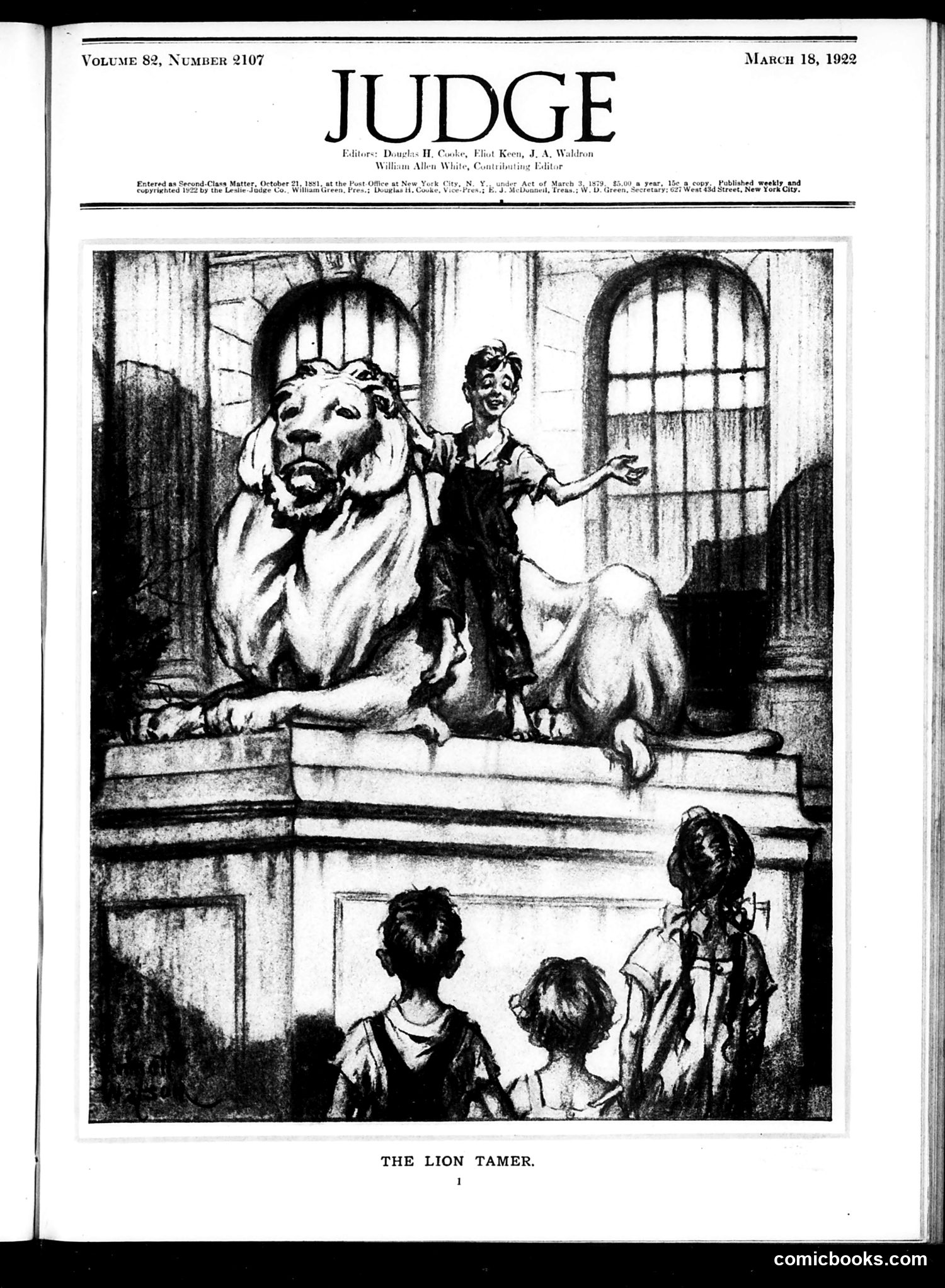
Judge — March 18, 1922
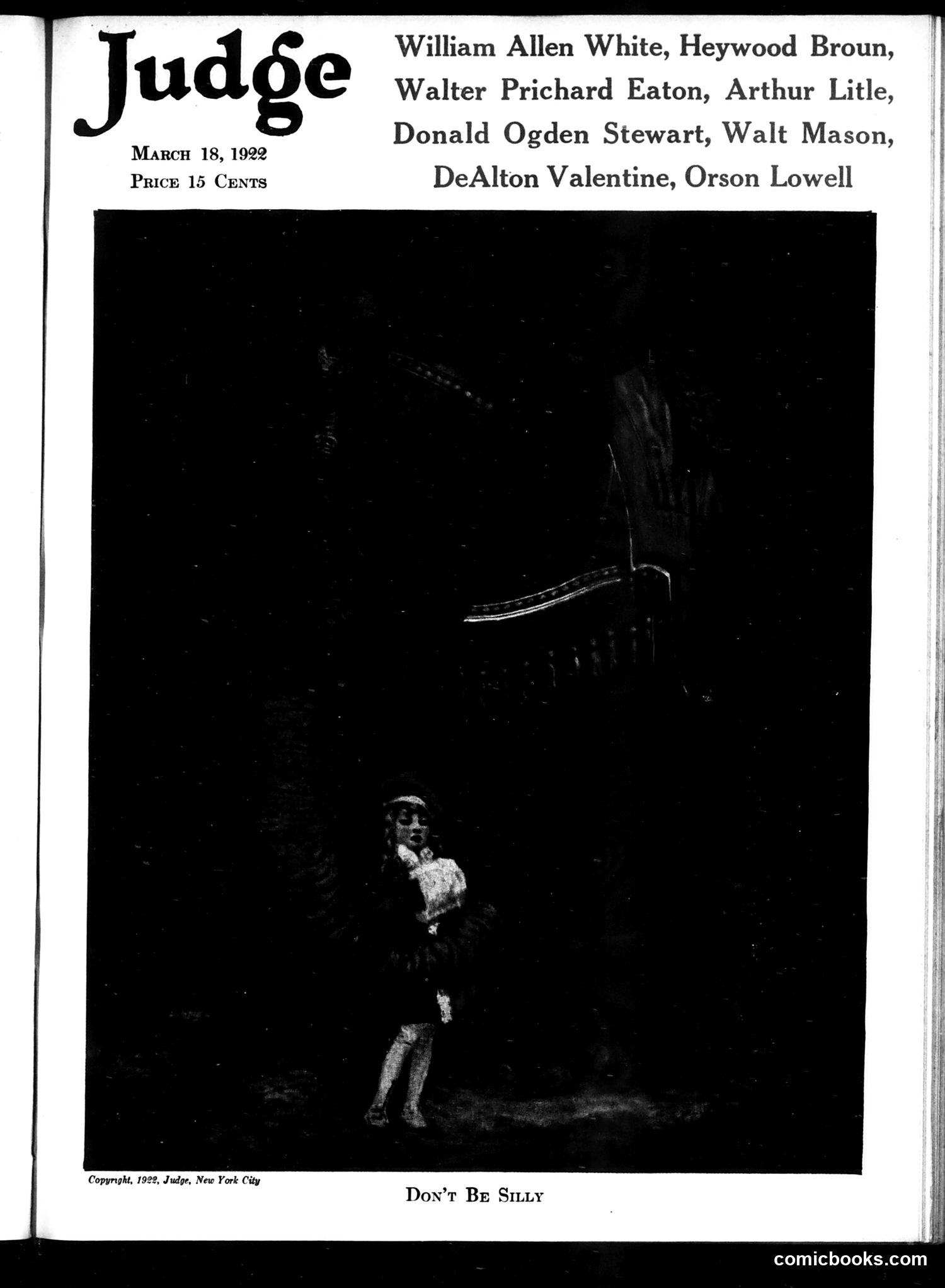
This cartoon depicts a woman standing alone in darkness, looking upward at what appears to be a large airplane overhead. The title "Don't Be Silly" suggests she's being mocked for some concern or fear. Given the 1922 date, this likely satirizes early aviation anxiety—the emerging technology of airplanes was still novel and frightening to many ordinary people. The cartoon mocks women in particular for being fearful of this modern technology, implying such worry is irrational ("silly"). The darkness and dramatic lighting emphasize the woman's apprehension. The names listed at top are likely contributing artists or writers for this issue rather than figures depicted in this specific cartoon.
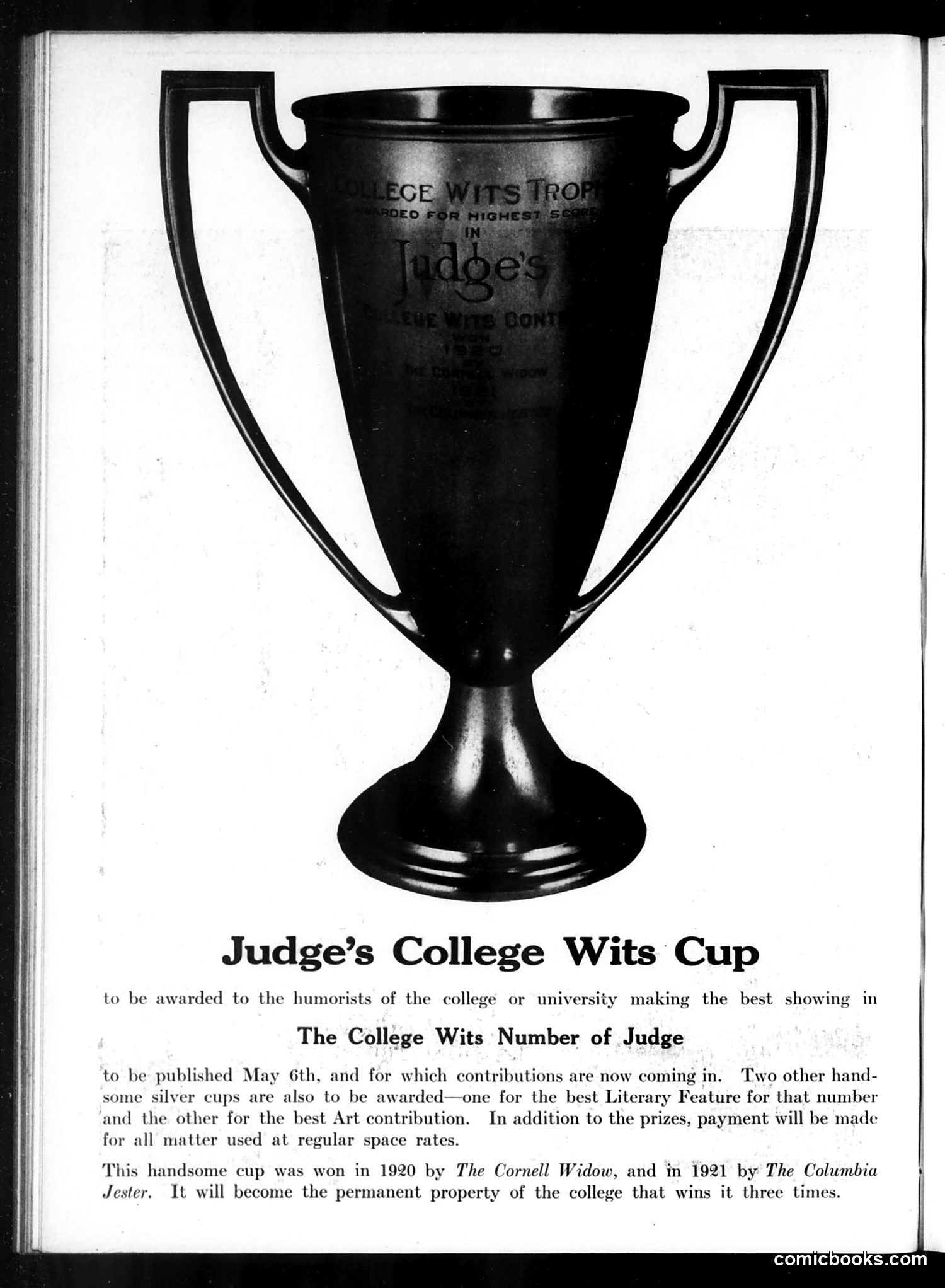
This page is primarily **informational rather than satirical**—it announces a competition, not a political cartoon. The "Judge's College Wits Cup" was a trophy awarded to college humorists producing the best content for *The College Wits Number of Judge* magazine, published May 6th. Additional silver cups were awarded for best Literary Feature and best Art contribution. The text notes the cup was previously won by *The Cornell Widow* (1920) and *The Columbia Jester* (1921). A college that won it three times would keep it permanently. This reflects Judge magazine's role as a platform for collegiate humor publications—a popular literary form in the 1920s. The competition encouraged campus-based satirical writing and art.
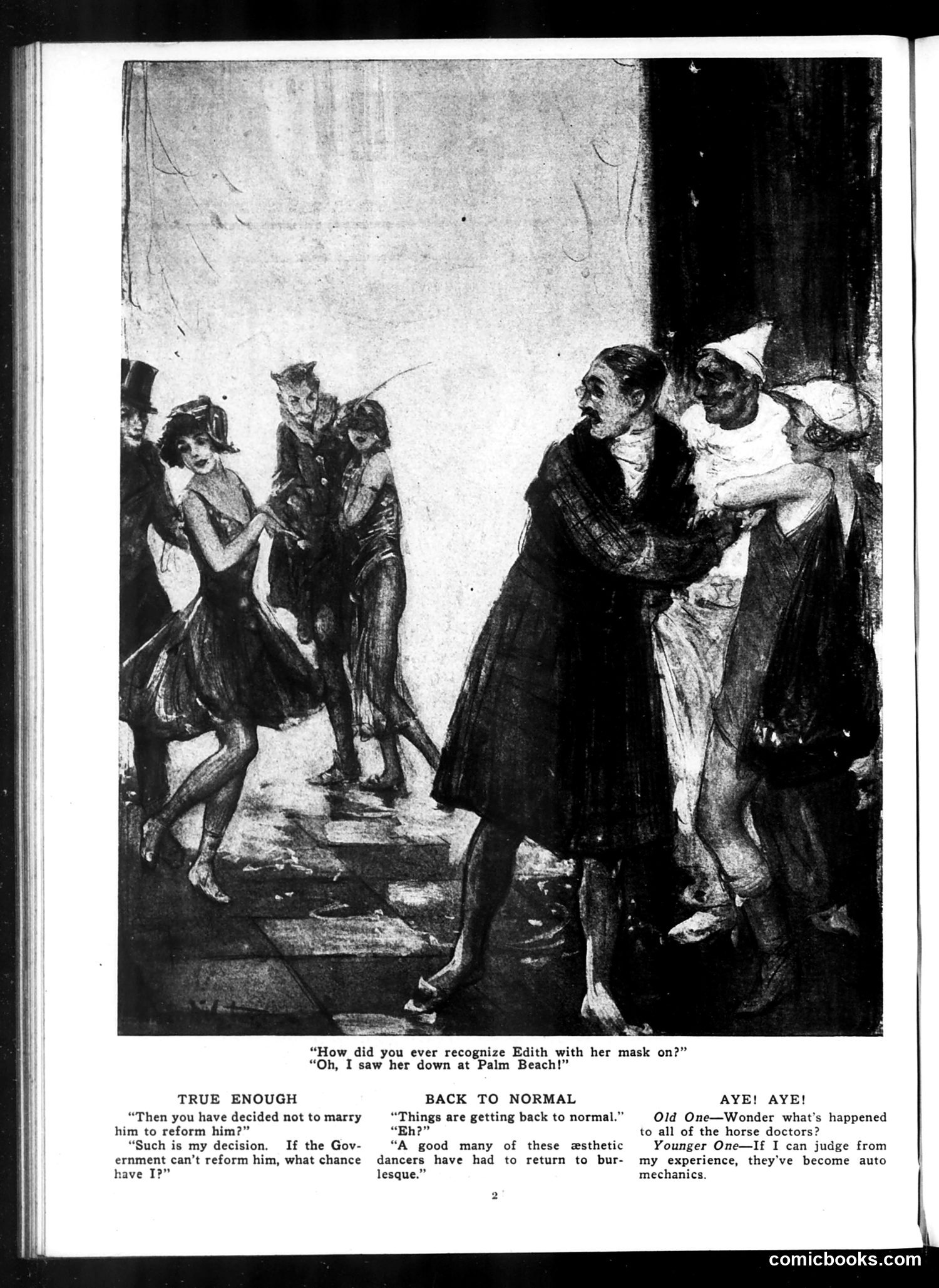
This page from *Judge* magazine contains three brief satirical dialogue exchanges commenting on post-World War I social concerns: **"TRUE ENOUGH"** mocks government attempts at criminal reform, suggesting rehabilitation is futile. **"BACK TO NORMAL"** references the post-war return to civilian life, with a joke about aesthetic dancers (likely referring to modern interpretive dancers) requiring medical attention—possibly alluding to their unconventional or physically demanding performances. **"AYE! AYE!"** appears to joke about war veterans' transition to civilian occupations, with a reference to "horse doctors" and mechanics, suggesting humorous confusion about what professions returning soldiers might pursue. The illustration shows period-dressed figures in what appears to be a street scene, though the specific narrative connection to these captions remains unclear from the image alone.
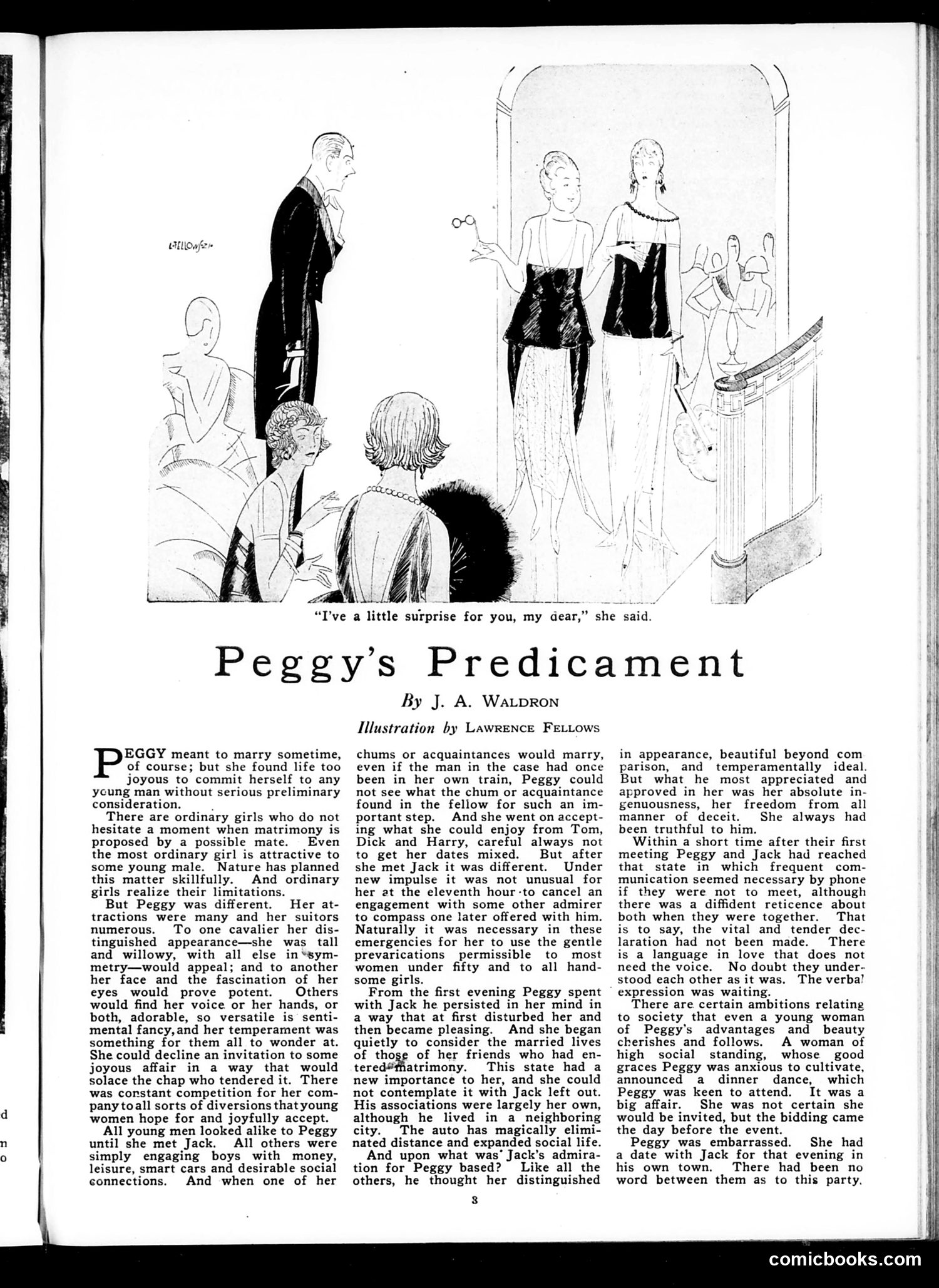
This is a short story illustration, not political satire. The narrative, by J.A. Waldron with illustrations by Lawrence Fellows, depicts a young woman named Peggy navigating romantic complications. The story concerns Peggy's marriage prospects. She attracts multiple suitors but is romantically involved with Jack. The illustration shows what appears to be a social gathering or party scene where Peggy announces she has "a little surprise" for someone—likely a dramatic revelation about her romantic situation. The piece satirizes contemporary social conventions around courtship and marriage among the upper classes, depicting the elaborate social maneuvering and occasional deception involved in romantic affairs of the era. It's domestic comedy rather than political commentary.
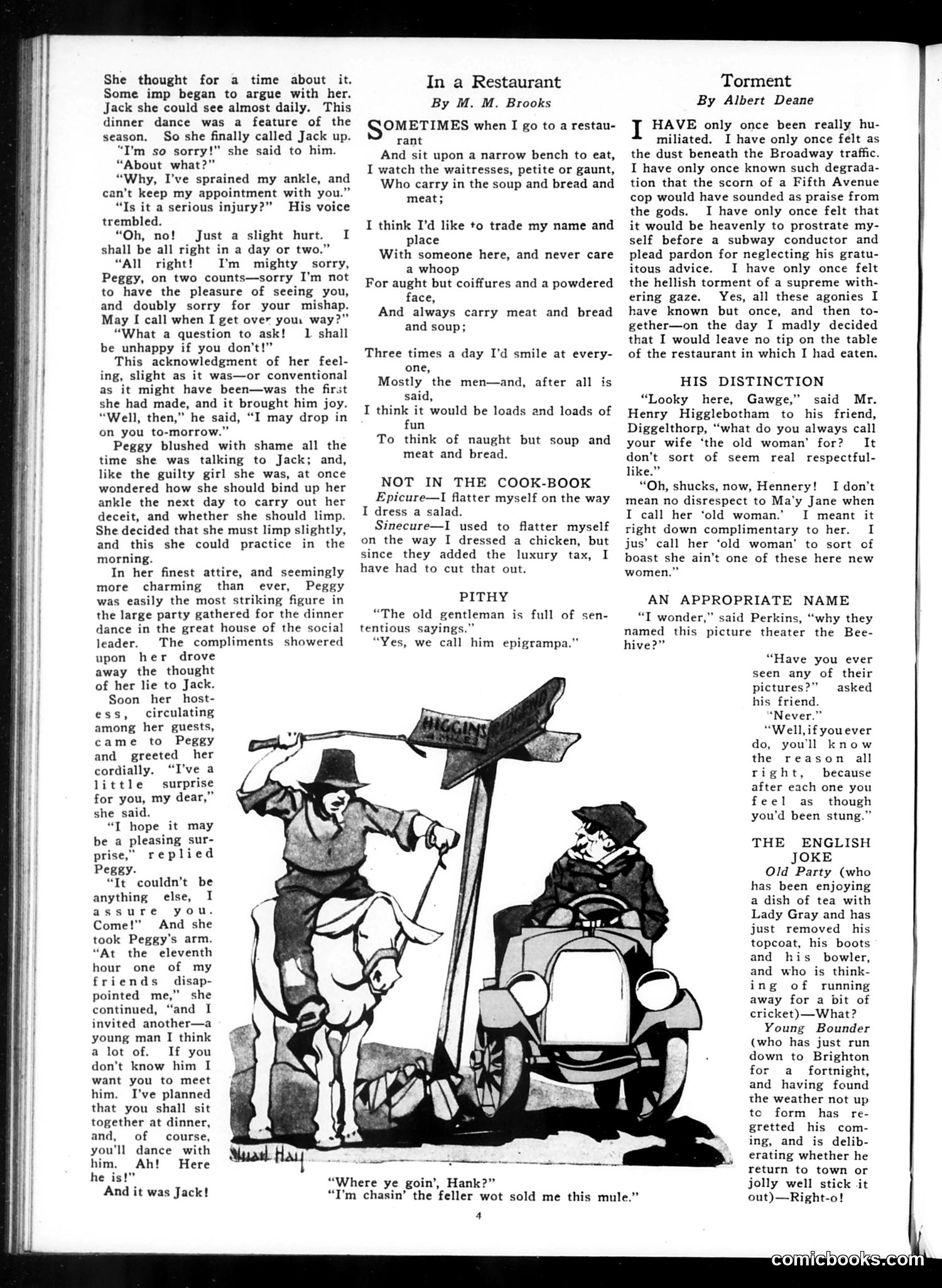
This page contains three separate humorous pieces rather than political cartoons. The main illustration by Will Hall depicts a conversation between two men—one appears to be a mule driver and the other a passenger—with the caption "Where ye goin', Hank?" / "I'm chasin' the feller wot sold me this mule." The surrounding articles ("In a Restaurant," "Torment," and others) are genteel social humor typical of Judge magazine, mocking everyday situations: restaurant etiquette, social embarrassment, and witty repartee among the upper classes. This appears to be light domestic satire rather than political commentary—reflecting early 20th-century American magazine humor focused on manners, courtship, and small social humiliations rather than current events or figures.
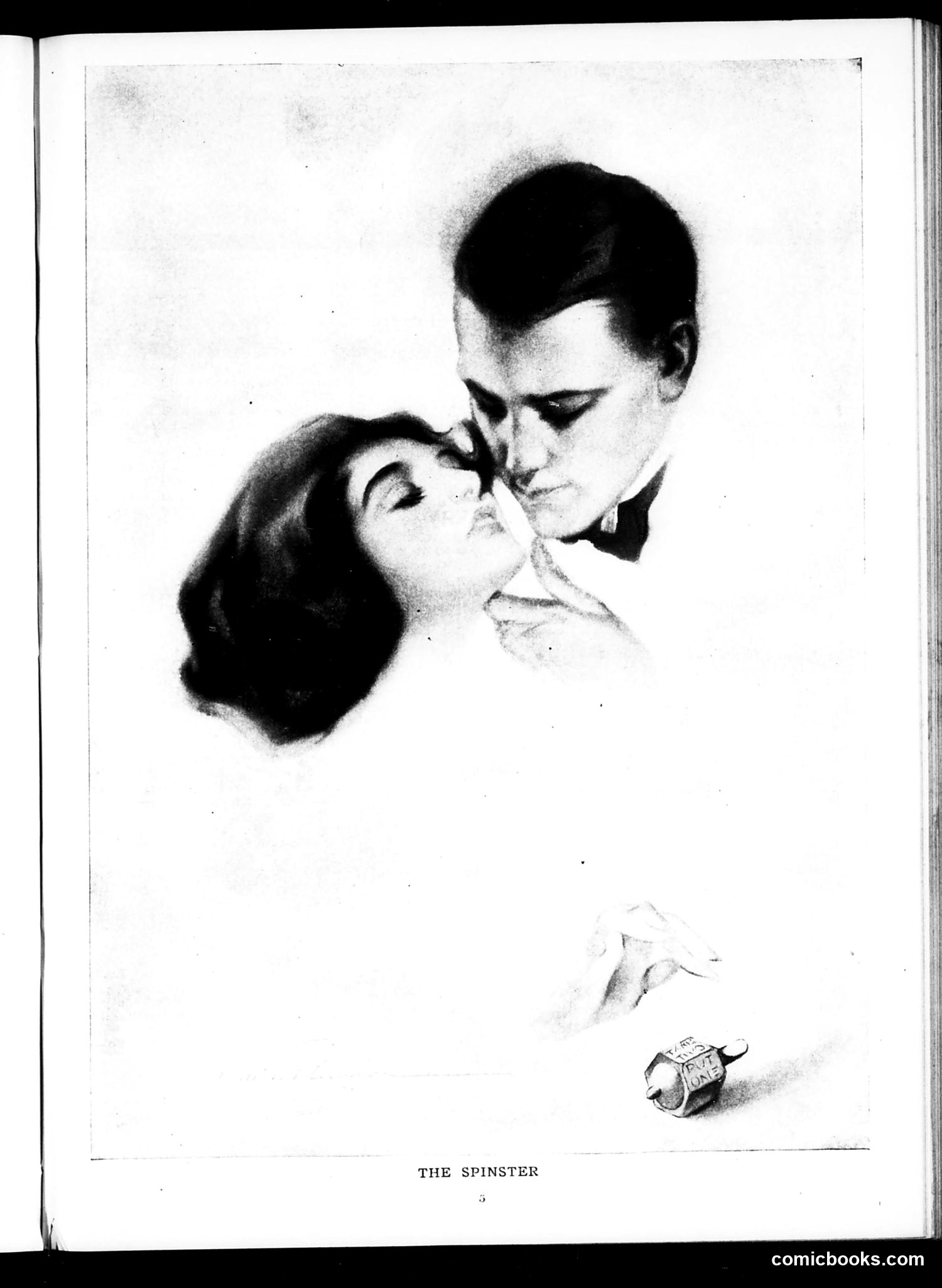
This appears to be a sentimental romantic illustration rather than political satire. It depicts a couple in an intimate moment—a man in formal wear (bow tie) gazing downward while a woman looks up at him affectionately. A ring is visible in the man's hand, suggesting a marriage proposal or engagement scene. The title "The Spinster" likely refers ironically to the woman, implying she was previously unmarried and is now being courted. The illustration celebrates romantic love and marriage, common themes in Judge magazine's lighter content. Without additional context or visible text explaining a satirical angle, this reads as straightforward romantic imagery rather than social or political commentary. The soft, sketch-like style emphasizes emotional intimacy.
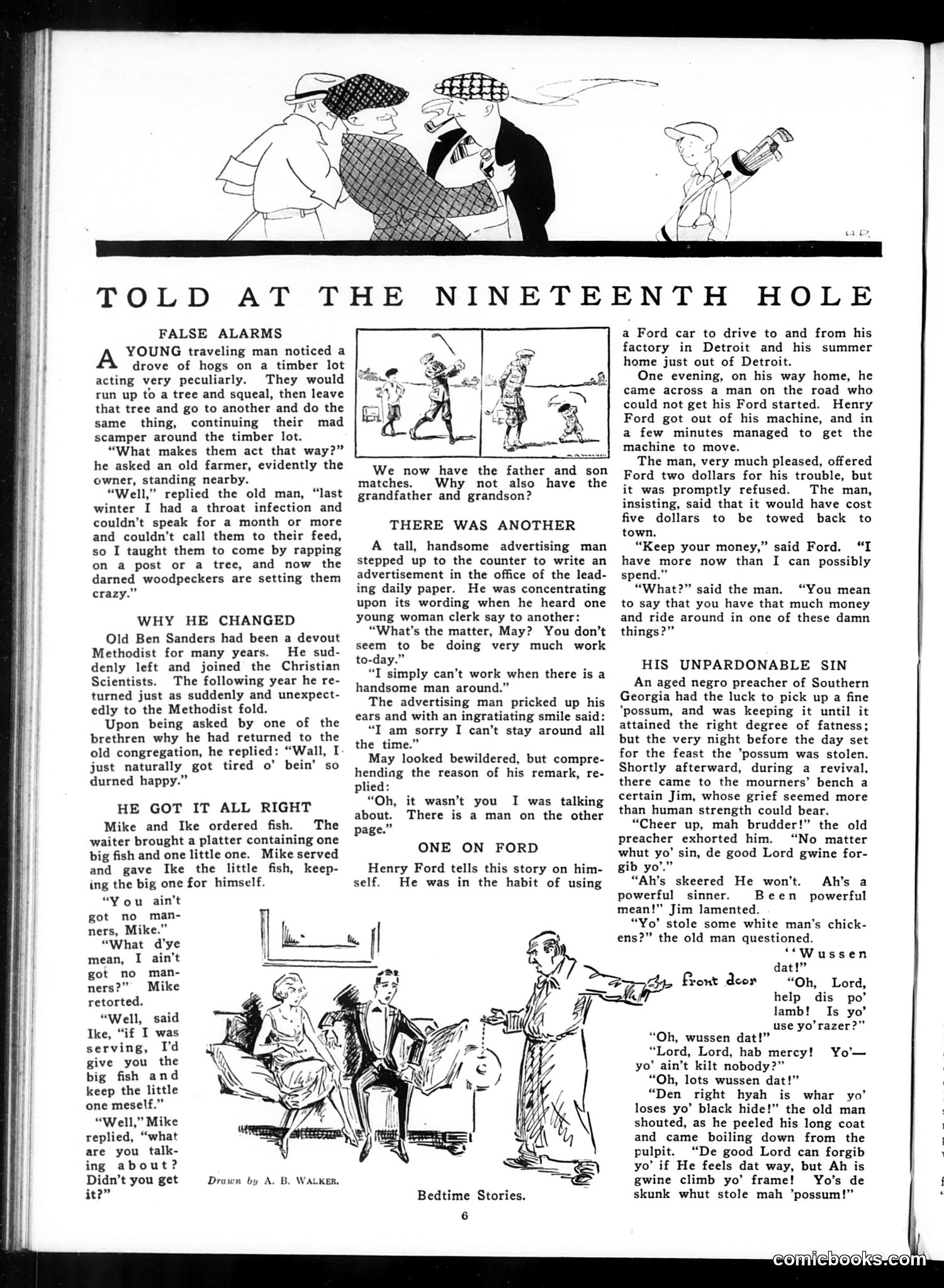
This page contains several short humorous anecdotes typical of early 20th-century American humor magazines: **"False Alarms"** satirizes rural simplicity: a farmer trained hogs to respond to tree-tapping for food, now they're confused by woodpeckers doing the same thing. **"Why He Changed"** mocks Christian Science (a contemporary religion) by suggesting its emphasis on happiness made a Methodist uncomfortable—he preferred traditional Methodism's grimmer worldview. **"He Got It All Right"** is a joke about etiquette: Mike serves himself the larger fish; when criticized for poor manners, he argues he gave Ike what he wanted, missing the point of generosity. **"One on Ford"** presents Henry Ford as arrogantly wealthy, refusing payment for fixing a stranger's car while implying he can't spend his vast fortune—a jab at industrial magnates' excessive wealth. **"His Unpardonable Sin"** uses racial dialect humor (common then, offensive now) about a Black preacher unable to forgive a congregant who stole his possum. These reflect 1920s-era sensibilities: class anxiety, religious skepticism, and casual racial stereotyping.
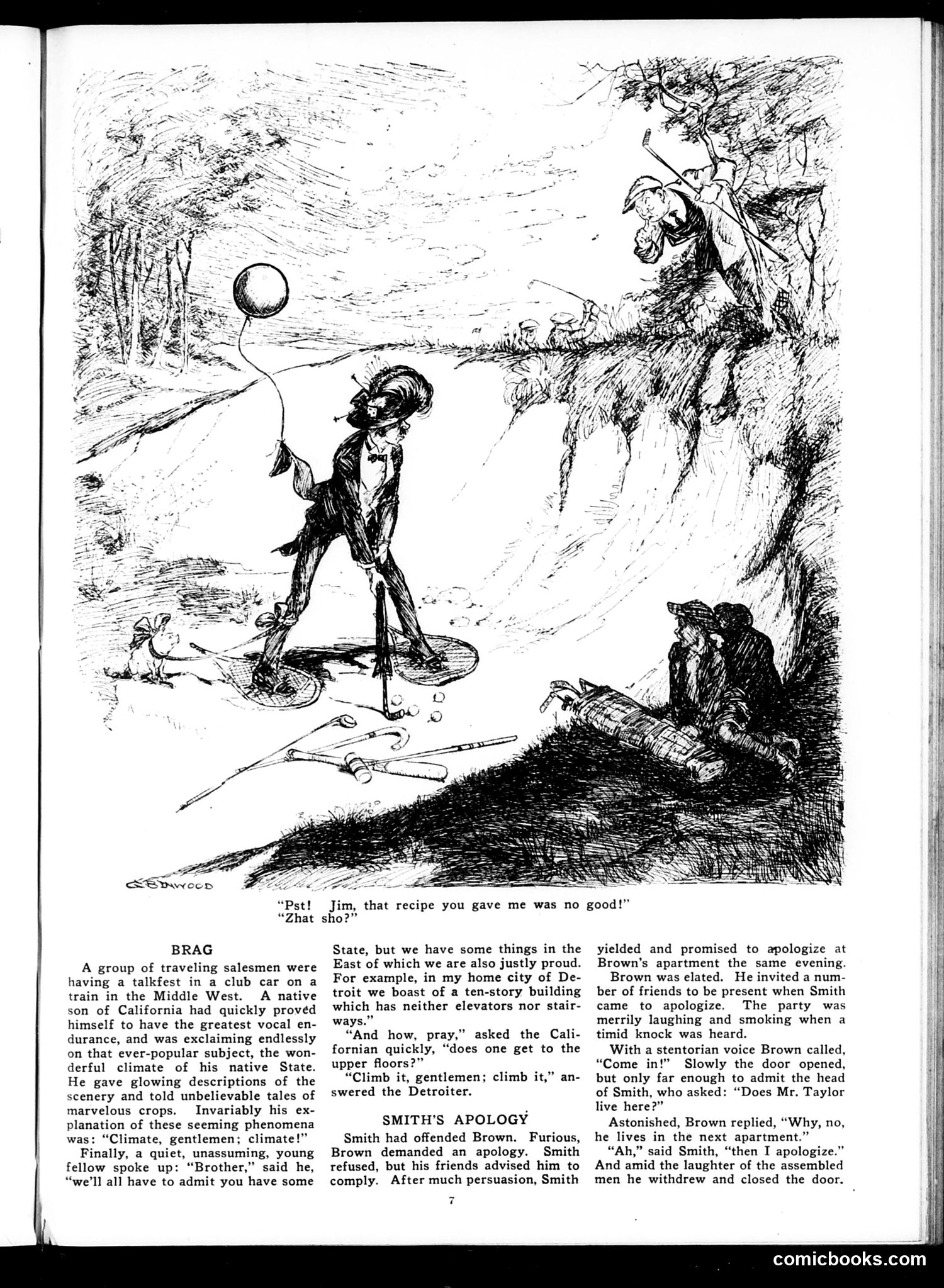
This page contains two separate humorous stories from *Judge* magazine: **"Brag"**: A California railroad passenger boasts endlessly about his state's superior climate and crops. A quiet Midwesterner (from Detroit) deflates him with a trick comeback: he claims Detroit has a ten-story building with "neither elevators nor stairways." When asked how people reach upper floors, he answers "Climb it"—exposing the Californian's bragging as equally absurd. **"Smith's Apology"**: A man forced to apologize to Brown arrives at his apartment but asks "Does Mr. Taylor live here?" When told no, Smith simply says "then I apologize" and leaves. The joke: Smith technically fulfilled his promise to apologize—just to the wrong person, at the wrong address—a technically-correct but deliberately evasive non-apology. Both stories mock self-important boasting and offer clever, mischievous comebacks that expose pretension or exploit literal language to escape obligation.
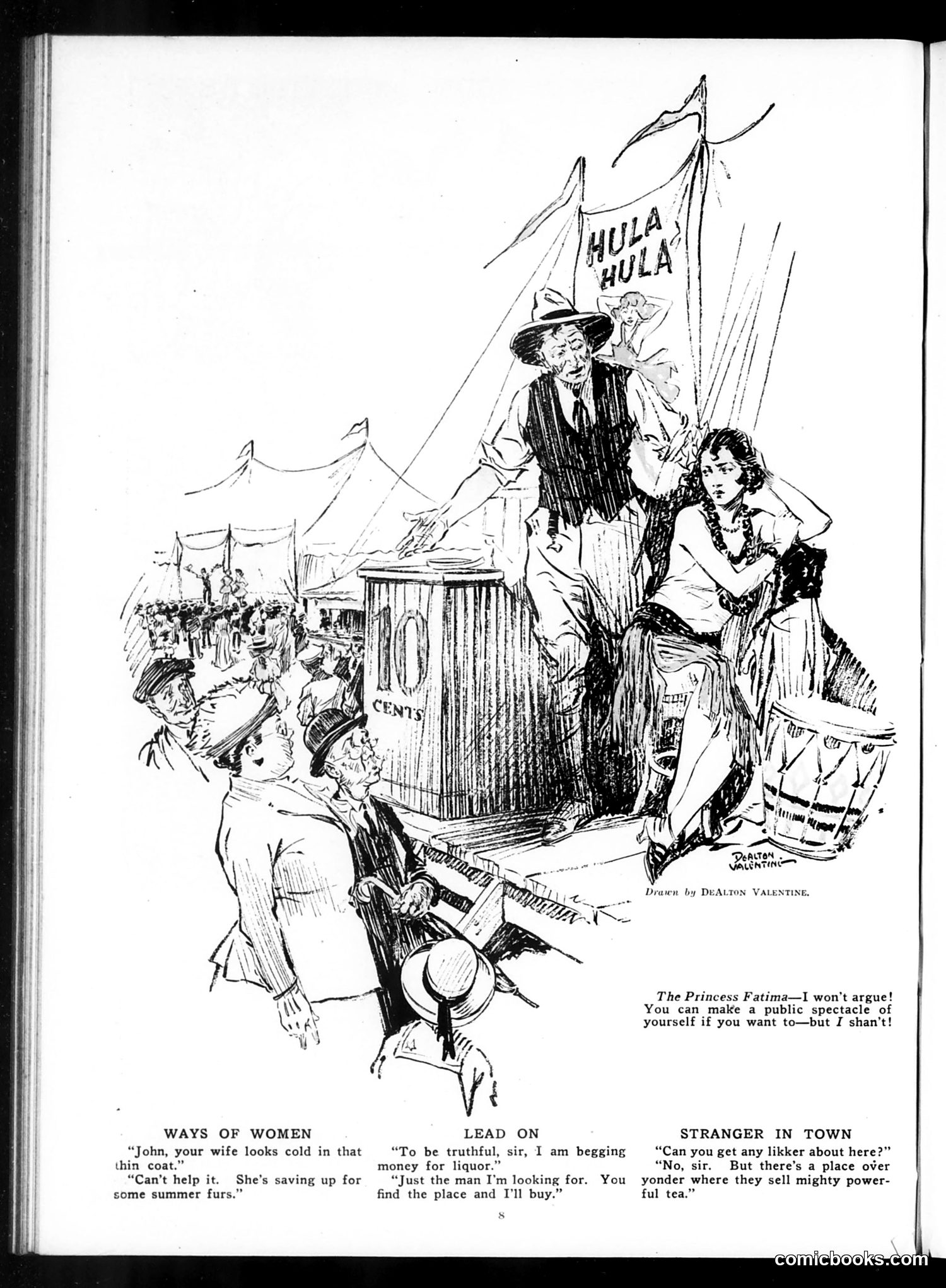
This page contains three separate jokes satirizing early 20th-century social behaviors and attitudes: **"Ways of Women"**: Mocks women's consumer priorities—a wife endures cold weather in a thin coat to save money for luxury furs, suggesting frivolous materialism. **"Lead On"**: A drunk man begging for liquor money encounters another man seeking someone honest enough to direct him to a bar. The irony: the drunk's shameless admission of his vice makes him trustworthy as a guide, rewarding dishonesty. **"Stranger in Town"**: References Prohibition-era euphemism. When asked about liquor, the local suggests "powerful tea" instead—a coded reference to illegal alcohol. The joke mocks how communities openly circumvent Prohibition laws through obvious wordplay. The cartoon features "The Princess Fatima" (likely a circus or vaudeville performer referenced in the tent imagery), appearing scandalized by public behavior—suggesting judgments about propriety. Drawn by Dealton Valentine, these vignettes reflect Judge's satirical commentary on American hypocrisy, consumerism, and Prohibition-era culture.
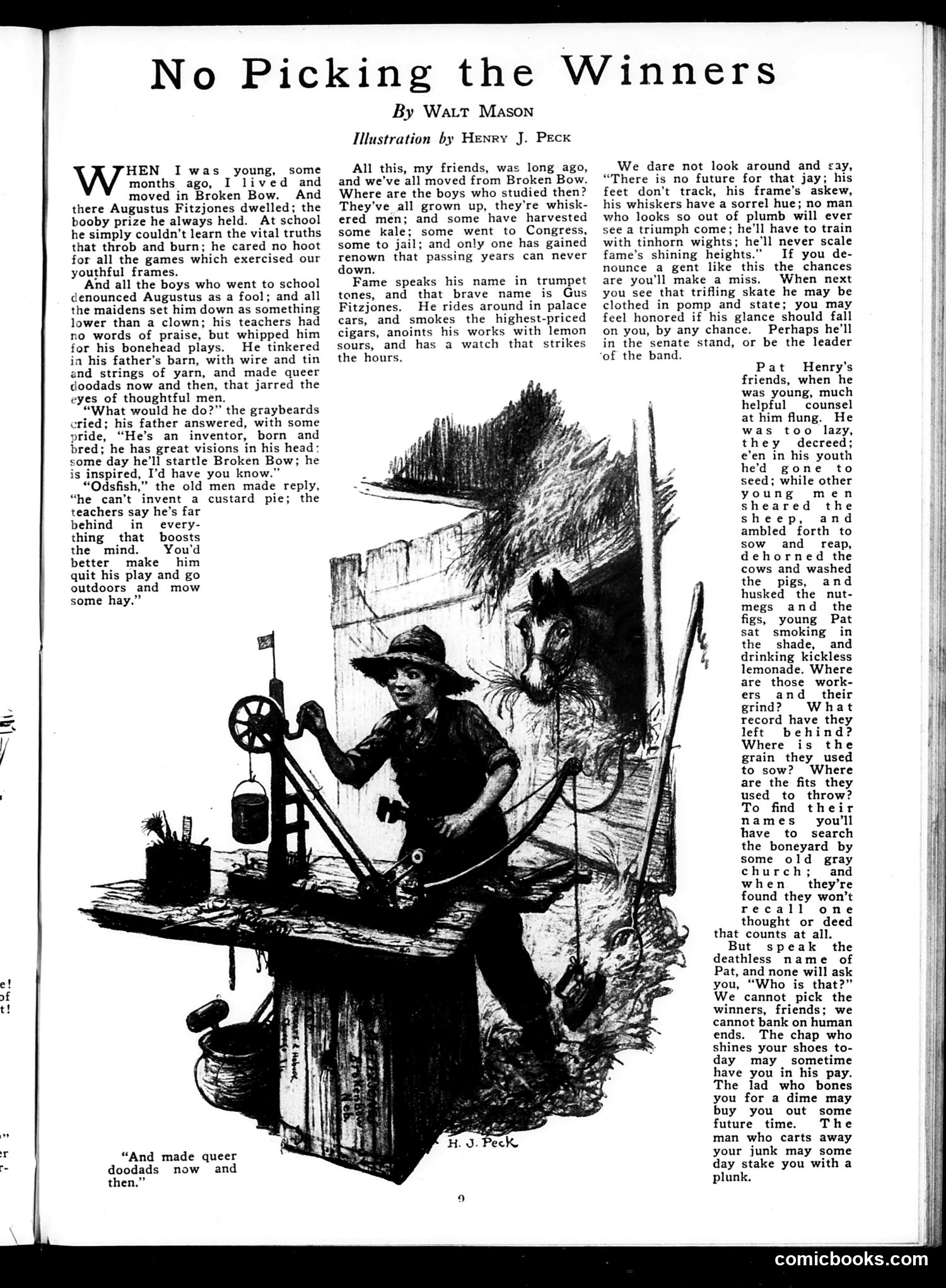
This is Walt Mason's moralizing essay illustrated by Henry J. Peck. The piece uses two cautionary tales—Augustus Fitzjones and Pat Henry—to argue against judging people's potential based on their apparent present circumstances. The cartoon depicts the "doodad" inventor at work in his barn, emphasizing his humble, tinkering origins. Mason's message is clear: Augustus was mocked as a lazy, incompetent fool by teachers and townsfolk, yet he became successful and famous. Similarly, Pat Henry, dismissed as lazy while others worked hard, apparently achieved success—while those industrious workers ended up forgotten in graveyards. The satire targets small-town certainty and snap judgments about human potential. For a modern reader, it's a turn-of-the-century pep talk: don't underestimate underdogs or assume conventional measures of merit predict success. The underlying tension—that hard work doesn't guarantee success while perceived laziness doesn't guarantee failure—challenges rural American values about industry and virtue.
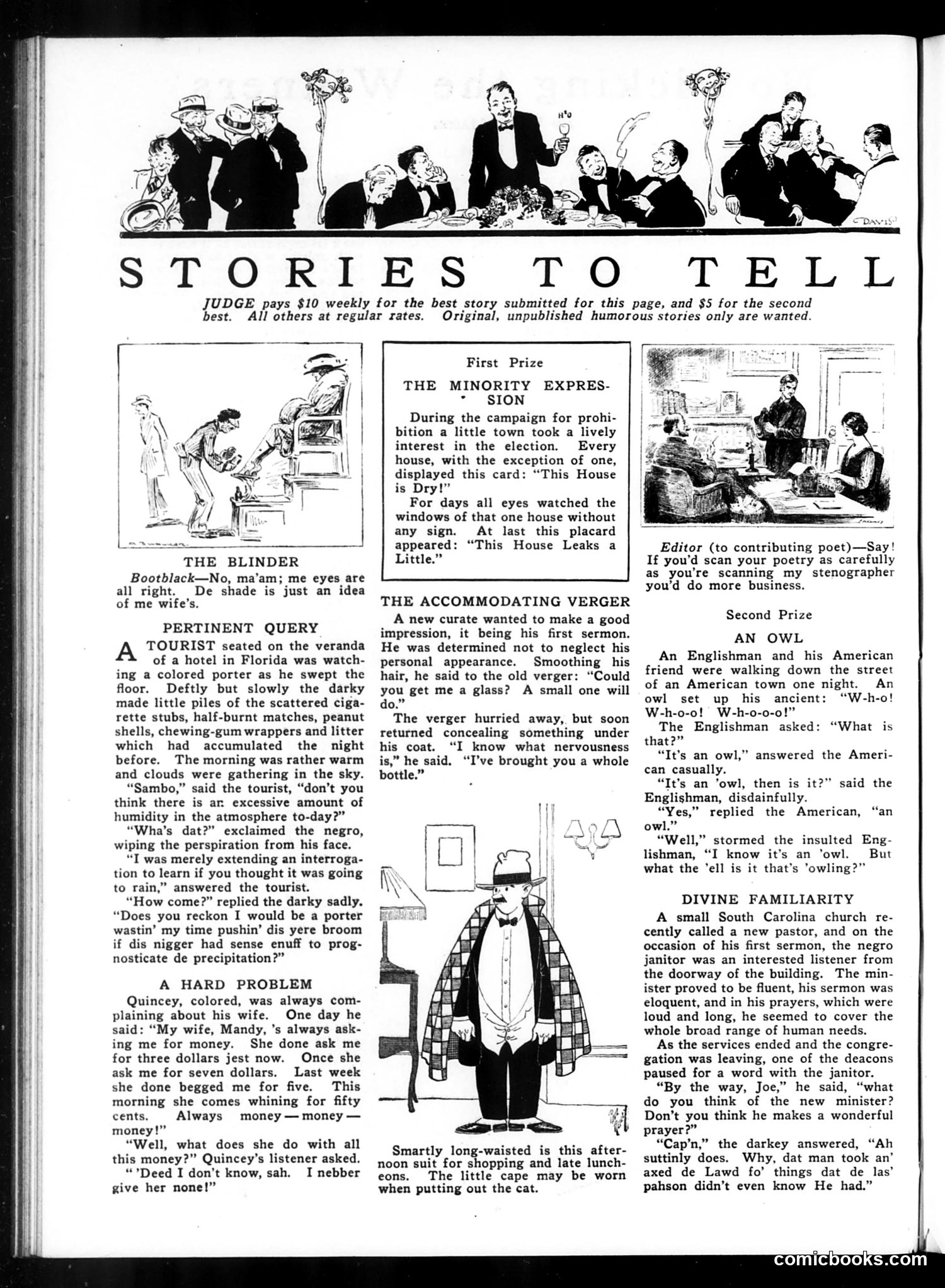
This page from *Judge* magazine presents humorous short stories submitted by readers, with prizes offered. The content reflects early-20th-century American comedy conventions, heavily reliant on racial stereotypes that would be considered offensive today. Several stories use African American characters as the basis for humor: "A Hard Problem" jokes about a Black man's confusion regarding his wife's spending; "Pertinent Query" features a porter speaking in exaggerated dialect; and "Divine Familiarity" involves a Black church janitor. These stories perpetuate era-typical caricatures of Black Americans as intellectually limited or prone to comic misunderstanding. "The Minority Expression" satirizes Prohibition-era politics through a town's temperance campaign. "An Owl" plays on British-American linguistic differences (the pronunciation of "owl" versus the letter "H"). "The Accommodating Verger" offers gentle clerical humor about nervousness and alcohol. The page reflects *Judge's* satirical approach: mixing social commentary with crude stereotyping, now historically significant primarily as evidence of period attitudes rather than humor.
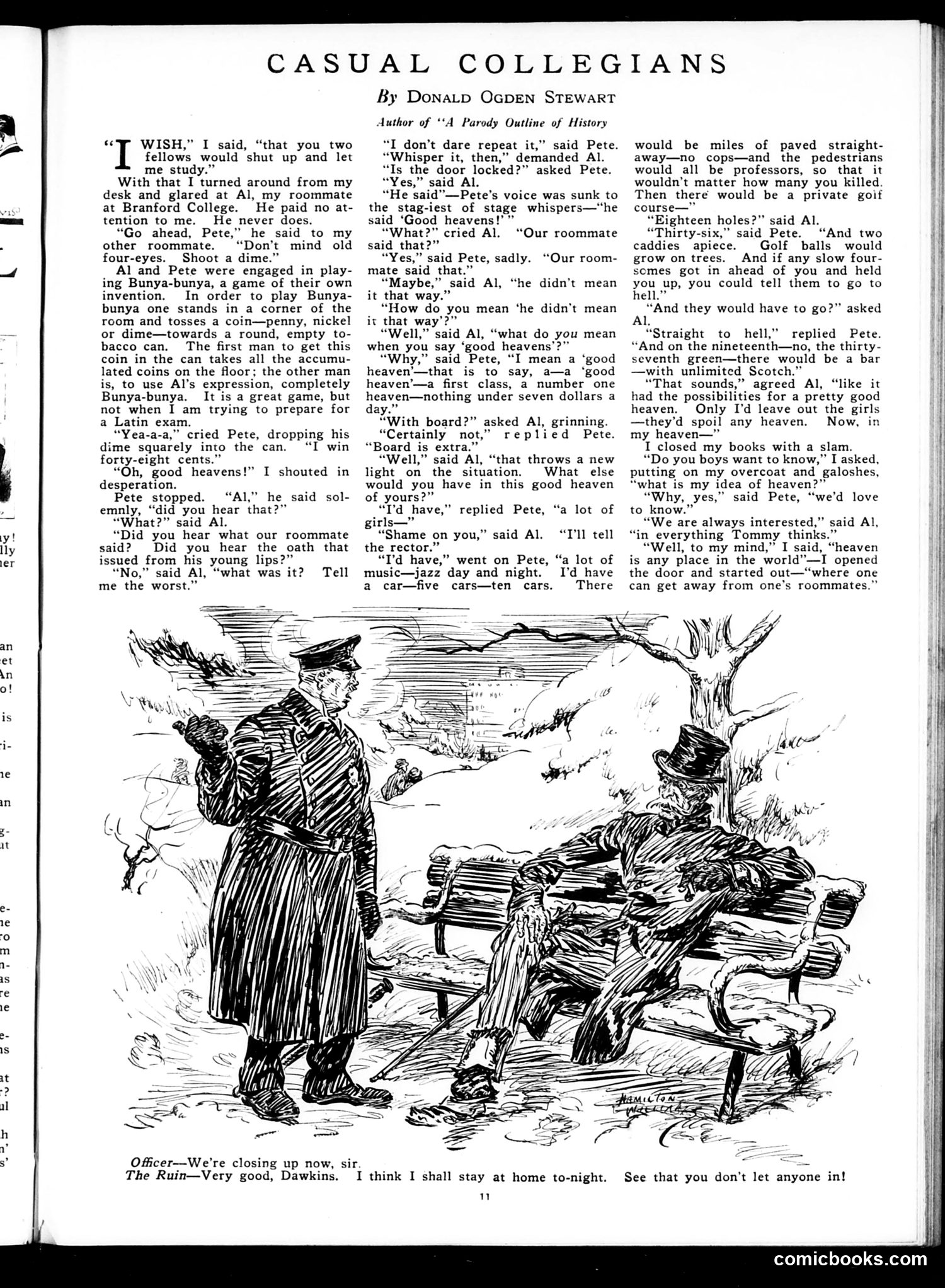
This is a humorous short story about three college roommates at Branford College debating what constitutes an ideal "heaven." Pete and Al are playing "Bunya-bunya," a coin-toss game into a tobacco can, while the narrator (Tommy/"old four-eyes") tries to study Latin. The joke escalates absurdly: Pete describes his heaven as containing unlimited cars, jazz music, a golf course with 36 holes, and—crucially—a bar with unlimited Scotch. The satire targets 1920s college excess and Prohibition-era attitudes: students fantasizing about wealth, fast cars, and alcohol despite legal restrictions. The final punchline subverts the preceding fantasy: the narrator's true heaven is simply being *away from his roommates*—a relatable counterpoint to their materialistic daydreams. The illustration shows an officer and vagrant at "The Ruin," likely reinforcing themes of social consequence and decay contrasting with collegiate indulgence.
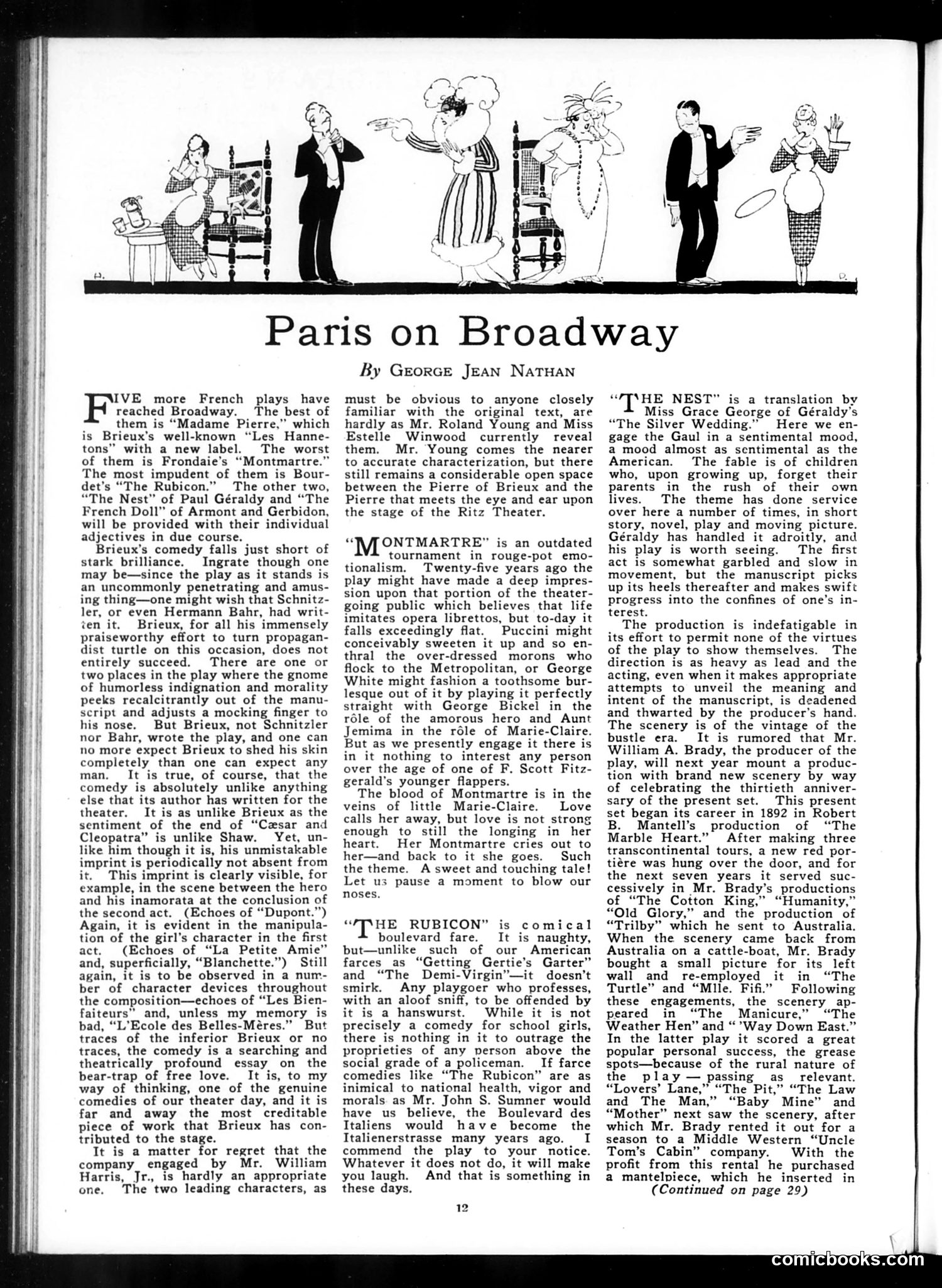
This is a theater criticism column by George Jean Nathan reviewing recent French plays on Broadway. The illustration shows stylized figures representing theatrical characters and types—likely depicting scenes or character archetypes from the plays discussed. Nathan critiques five French productions: "Madame Pierre" (praised as "uncommonly penetrating"), "Montmartre" (dismissed as outdated sentimentality), "The Rubicon" (called "impudent"), "The Nest," and "The French Doll." He praises Brieux's work despite its propagandistic elements, while harshly judging "Montmartre" as too emotionally overwrought for modern audiences—suitable only for "over-dressed morons" at the Metropolitan Opera or as burlesque material. The critique reflects Jazz Age sophistication: Nathan dismisses melodramatic romanticism as passé, referencing F. Scott Fitzgerald's "flappers" to mark generational taste shifts. The tone is characteristic of 1920s theatrical criticism—intellectually acerbic, dismissive of sentimentality, and confident in pronouncing judgments on dramatic merit.
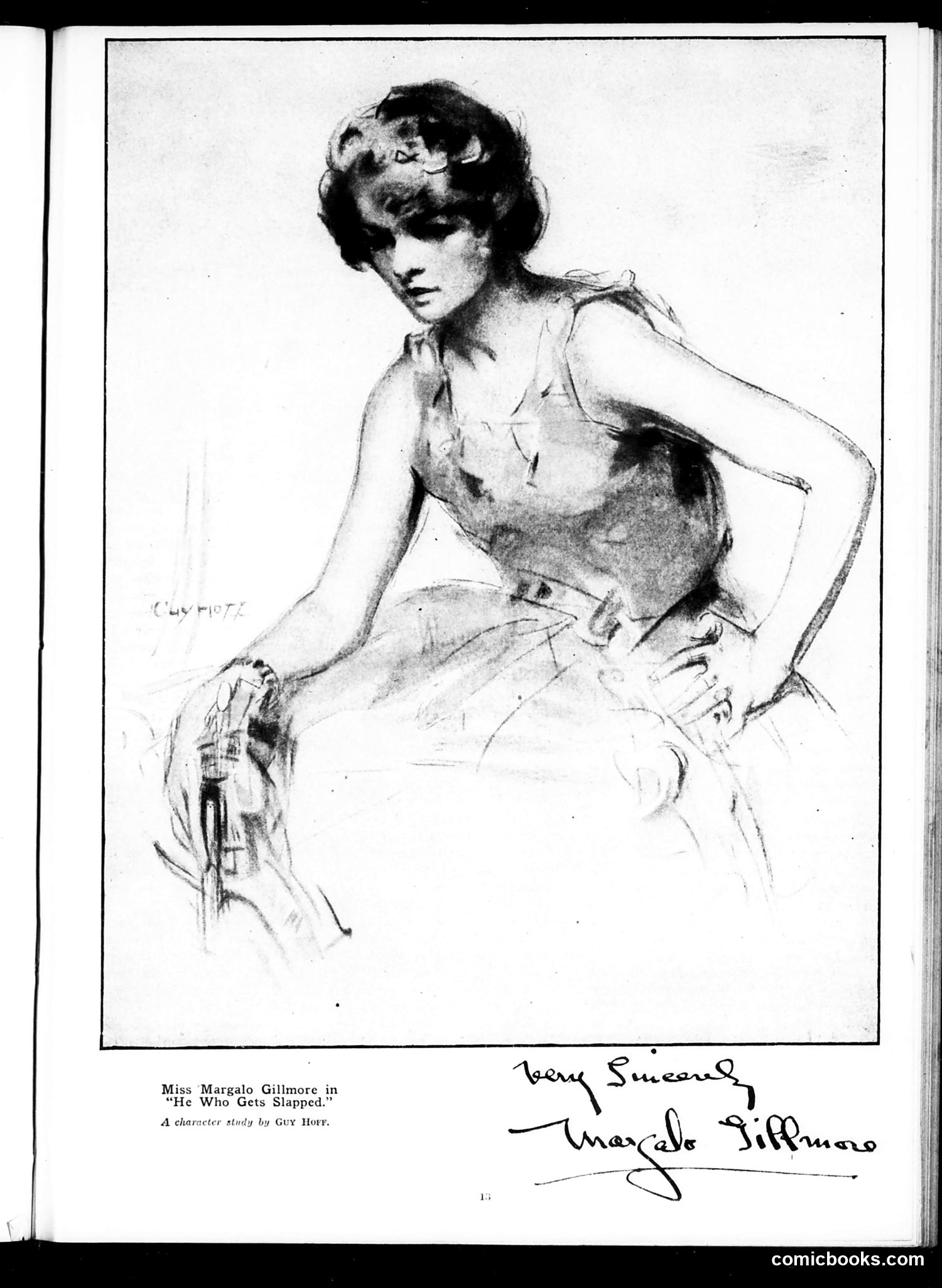
This page features a character study sketch rather than a political cartoon. It depicts **Miss Margalo Gillmore** in her role from the play **"He Who Gets Slapped,"** drawn by artist **Guy Hore**. The image is a portrait sketch in pencil/charcoal showing a seated woman in 1920s styling, with the characteristic bob hairstyle of that era. The work is signed by both the artist and the actress herself. "He Who Gets Slapped" was a 1920s theatrical production, and this appears to be a promotional or critical illustration from *Judge* magazine documenting notable stage performances of the period. It's primarily theatrical documentation rather than satire—showcasing the magazine's role in covering entertainment and celebrity culture of the Jazz Age.
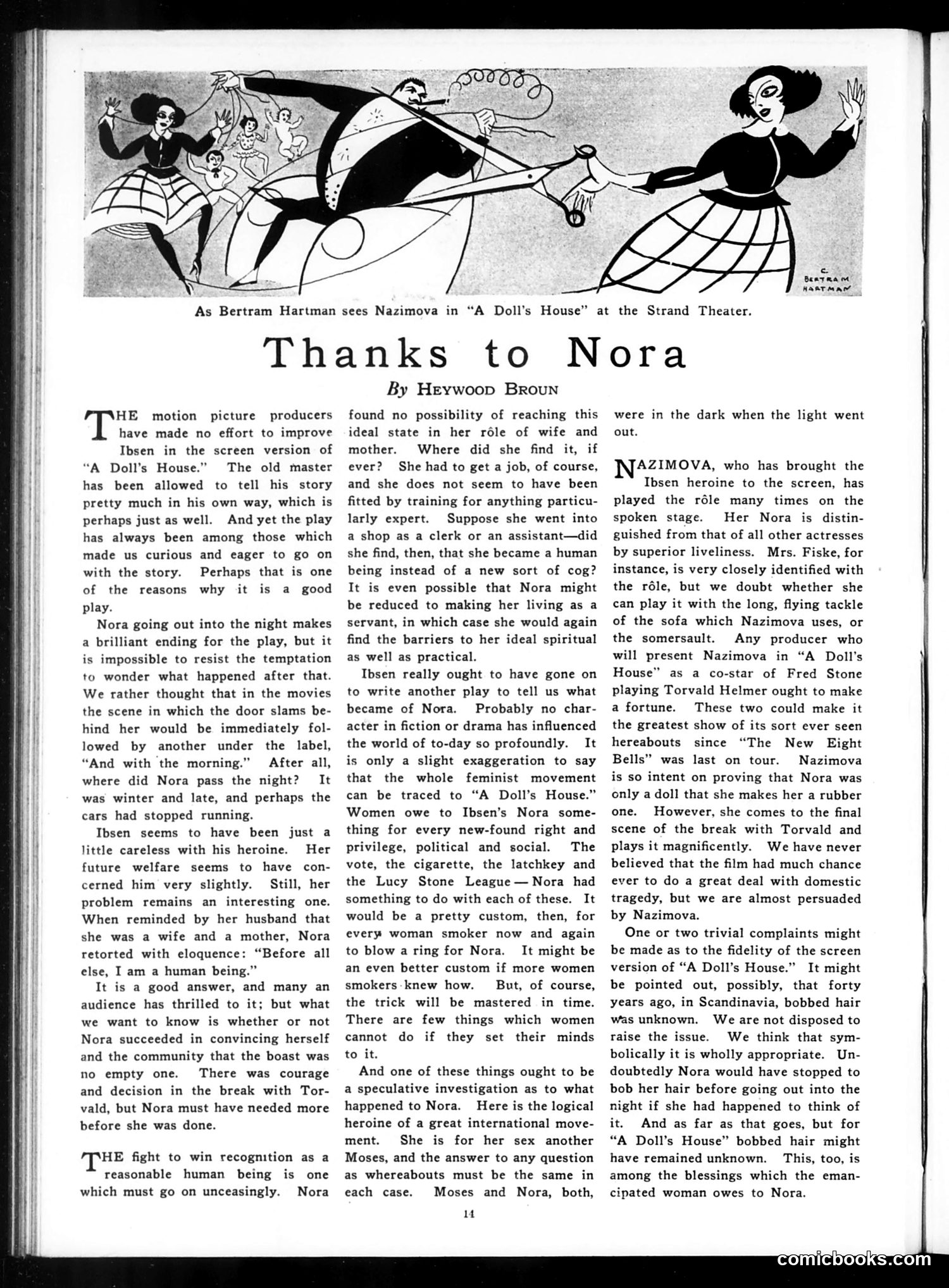
This page features a cartoon and essay about actress Alla Nazimova's film performance in Ibsen's *A Doll's House*. The cartoon depicts Nazimova as the character Nora being pulled in different directions—visualizing the play's central conflict between her roles as wife/mother versus independent human being. Heywood Broun's essay playfully critiques Ibsen for leaving Nora's fate ambiguous after her famous door-slamming exit. More significantly, it credits Nora with inspiring the entire feminist movement—the vote, smoking rights, the Lucy Stone League (a women's suffrage organization). By 1920s standards, this is remarkable: Broun argues that a fictional character fundamentally changed women's real-world rights and privileges. The essay frames Nora as "Moses" leading women to liberation, though it wryly acknowledges the practical obstacles women still faced (employment discrimination, class barriers). The piece captures a moment when modernizing gender roles were actively debated in American popular culture.
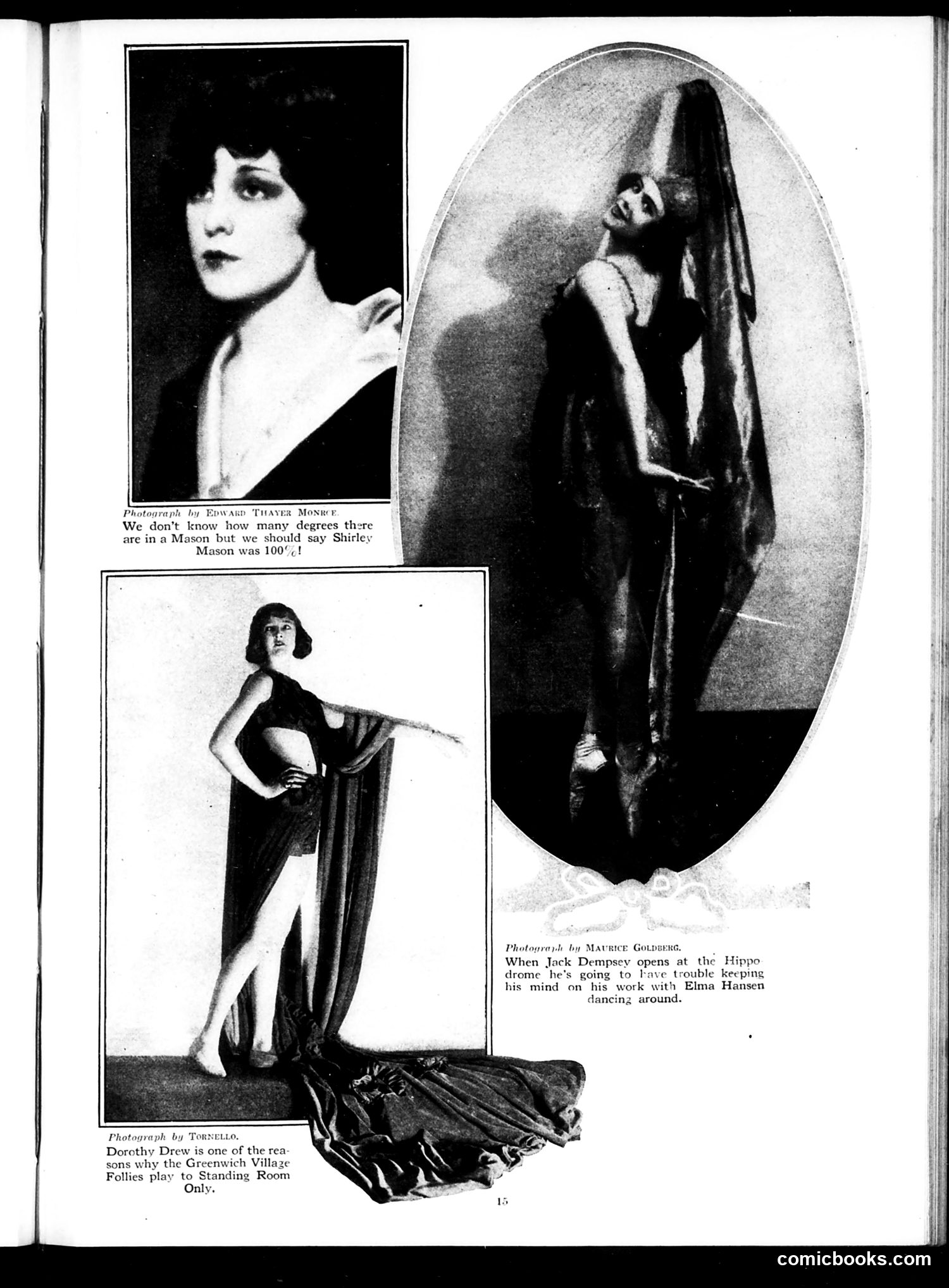
This page features three promotional photographs of female entertainers with accompanying jokes, typical of Judge's celebrity-focused content from the 1920s era. The humor relies on: 1. **Shirley Mason** (top left): A pun on "Mason" (Masonic degrees) suggesting she's "100 degrees"—slang for extremely attractive. 2. **Elma Hansen** (right): A dig at boxer Jack Dempsey, suggesting that when he performs at the Hippodrome theater, Hansen's dancing will distract him from his work—implying her beauty is irresistible. 3. **Dorothy Drew** (bottom left): States she's a reason the Greenwich Village Follies play to "Standing Room Only," crediting her as a draw. These aren't political cartoons but rather entertainment-focused jokes objectifying female performers. The page reflects 1920s attitudes toward women in theater and popular culture, using celebrity gossip and physical appearance as humor.
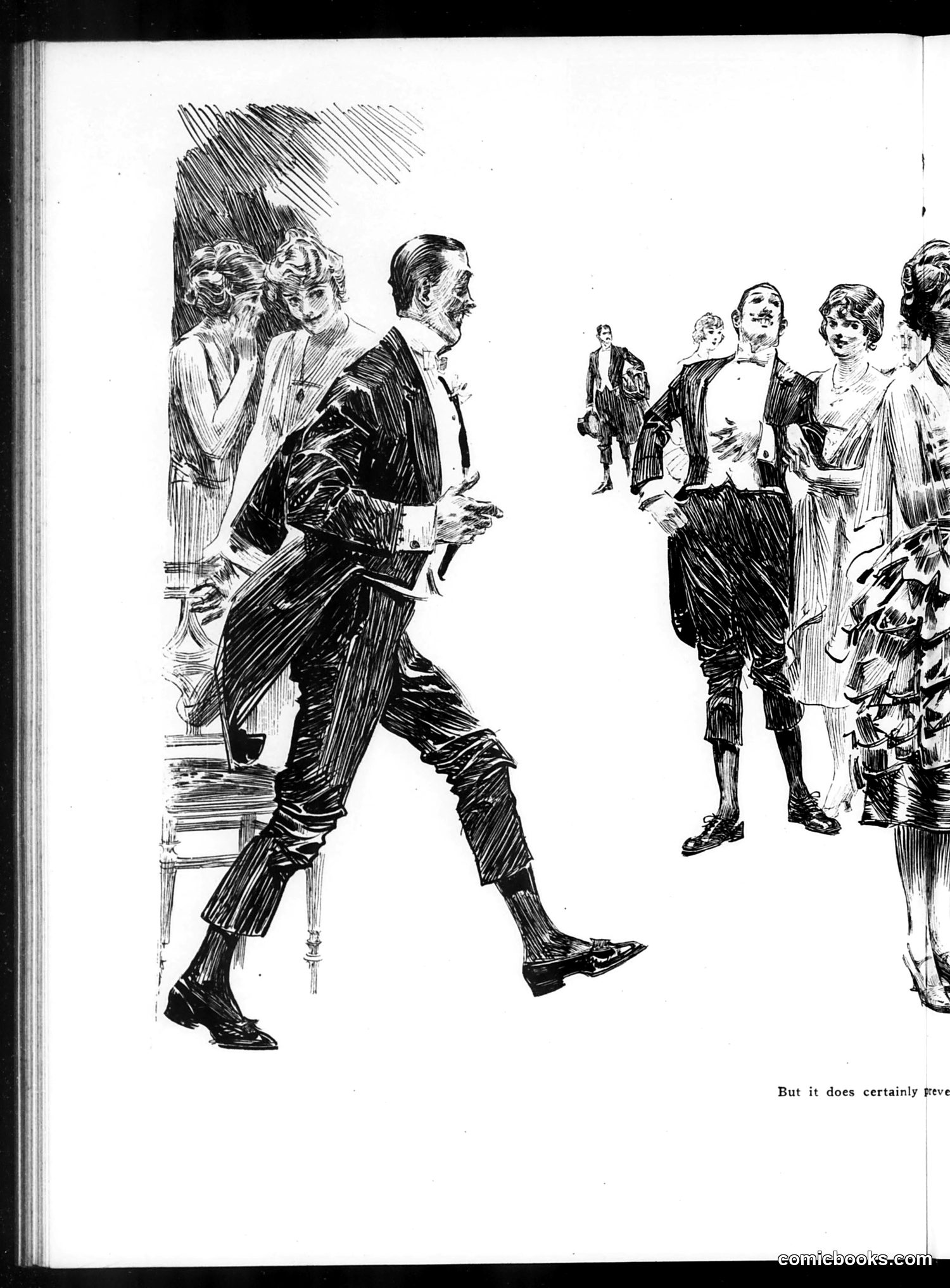
This page from *Judge* magazine shows a social scene at what appears to be a formal gathering or party. A man in a dark suit stands prominently in the center, gesturing or speaking animatedly, while women in light, flowing dresses and men in formal wear surround him on both sides. The incomplete caption ("But it does certainly preve[...]") suggests this illustrates a humorous social observation or comment about behavior at high-society events. Without the complete text, the specific satirical point is unclear. The composition suggests commentary on social dynamics—possibly about someone making a point or display at a formal occasion, or about upper-class social pretension. The artistic style is typical of early 20th-century magazine illustration.
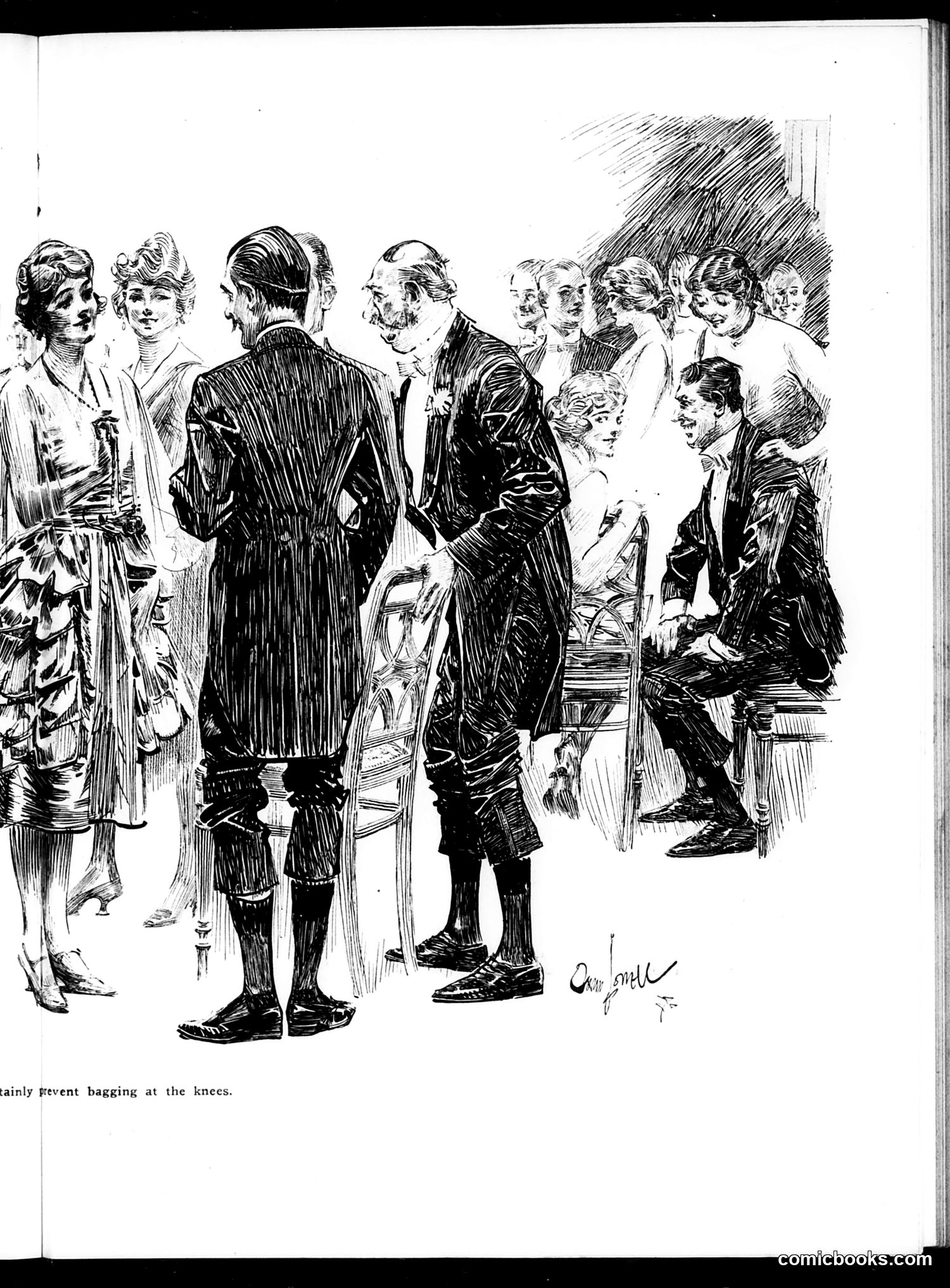
This appears to be a social satire illustration from Judge magazine depicting a formal gathering or reception. The scene shows well-dressed men in suits and women in fashionable dress engaged in conversation. The visible caption fragment—"tainly prevent bagging at the knees"—suggests the cartoon comments on fashion or clothing standards, likely mocking either: 1. Women's fashion concerns about knee-length skirts (relevant to early 20th-century hemline debates) 2. Men's tailoring and suit fit Without the complete caption or date, the precise satirical target remains unclear. The formal setting and mix of genders suggests commentary on high-society manners, fashion consciousness, or social propriety among the upper classes. The artist's signature appears in the lower right.
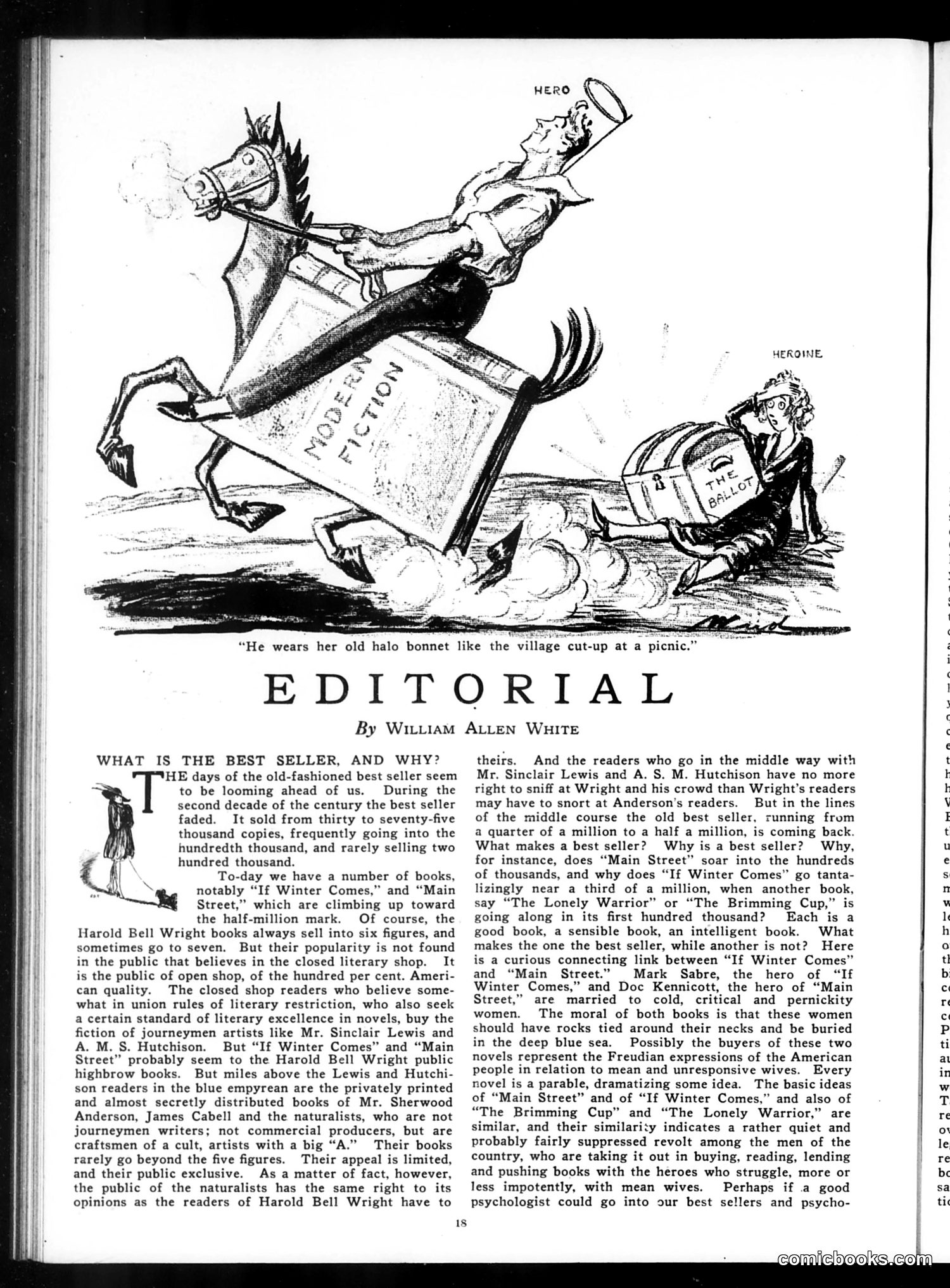
**The Cartoon:** The illustration depicts a runaway horse labeled "POPULAR FICTION" bucking a man (labeled "HERO") while a woman (labeled "HEROINE") sits nearby holding a barrel labeled "THE BALLOT." The caption jokes that she "wears her old halo bonnet like the village cut-up at a picnic." **The Satire's Context:** This appears to commentary on early 1920s literary debates. The accompanying editorial by William Allen White discusses bestsellers like *If Winter Comes* and *Main Street*—novels featuring henpecked husbands married to difficult women. White argues these books reveal suppressed male resentment toward wives, suggesting they're psychological outlets for men frustrated with "mean and unresponsive wives." The cartoon likely mocks this gendered conflict: the horse symbolizes uncontrollable popular taste, the male hero is being thrown off balance, and the woman with "the ballot" (newly granted via 19th Amendment in 1920) represents women's newfound power. The joke suggests women are now unpredictably powerful—like an unruly horse—upending traditional literary hierarchies and male authority.
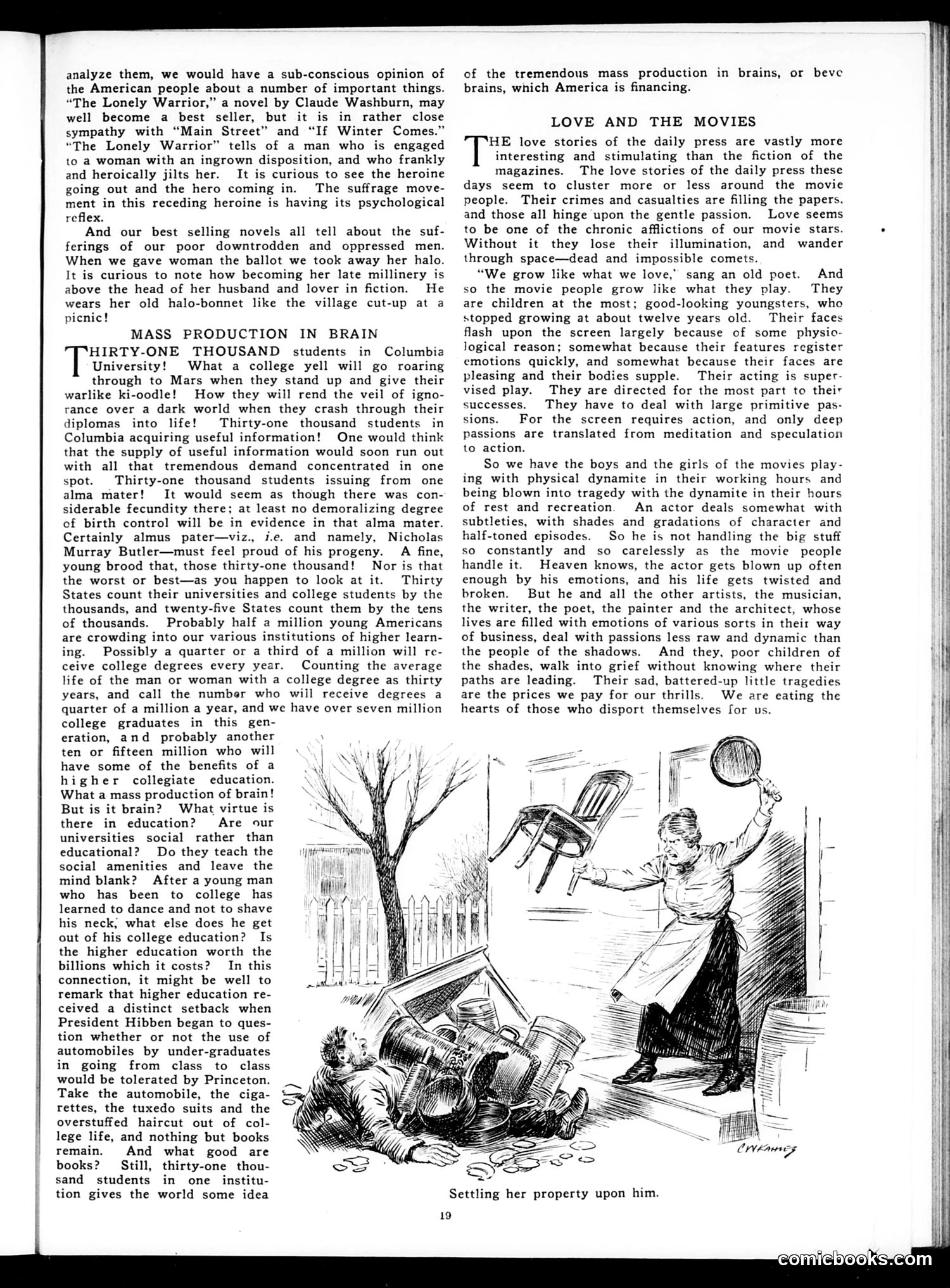
This cartoon satirizes the changing gender dynamics of the 1920s. The illustration depicts a woman literally throwing furniture and household items at a man, while he flees in alarm. The accompanying text explains the satire: with women gaining voting rights (women's suffrage), the author argues they've lost their traditional "halo" of feminine mystique. The article mocks bestselling novels depicting "poor downtrodden and oppressed men" suffering under assertive women. It notes the irony that male characters now inherit women's traditional roles and symbols (wearing "her old halo-bonnet"). The cartoon visualizes this reversal—the woman is now the aggressor, literally "settling" property on the hapless man through violent redistribution. The satire critiques both modern gender relations and the popular fiction reflecting anxieties about women's newfound independence and legal equality following suffrage.
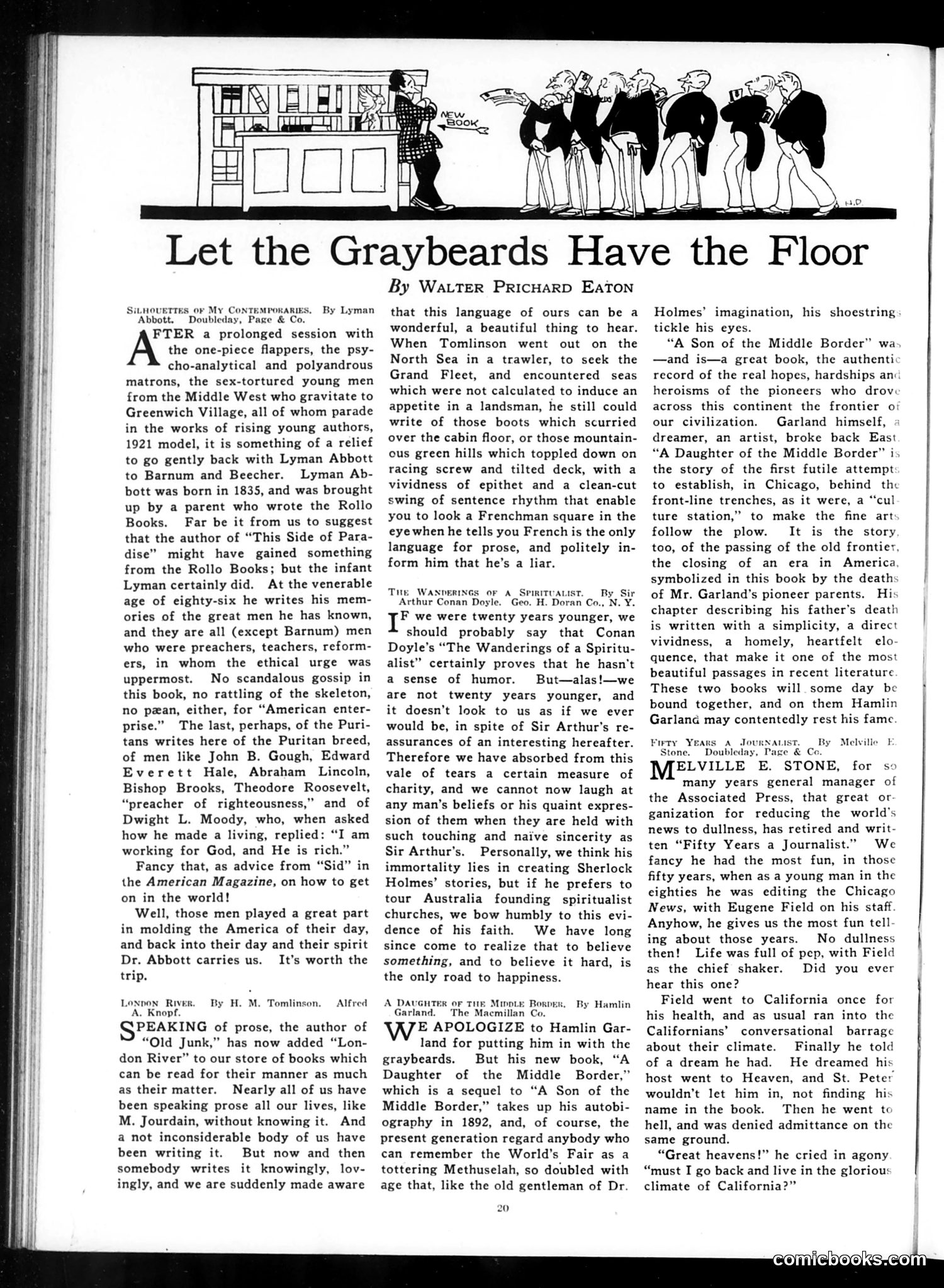
The cartoon's header silhouette depicts an older man (representing traditional, established authority) gesturing toward a group of bent-over elderly men in formal dress—the "graybeards" of the title. The article by Walter Prichard Eaton is a book review celebrating elderly, morally-grounded authors like Lyman Abbott (age 86), contrasting them favorably with the "one-piece flappers" and "sex-tortured young men from the Middle West" who populate contemporary 1921 literature. The piece nostalgically praises 19th-century preachers, reformers, and moral figures (Lincoln, Theodore Roosevelt, Dwight Moody) over modern writers. The satire's point: the article ironically surrenders literary authority to the old guard while simultaneously mocking younger modernist writers. The title suggests allowing "graybeards" (elderly traditionalists) to dominate—a gentle rebuke of both generational smugness and the author's own admission that younger writers now set the cultural agenda, whether he approves or not.
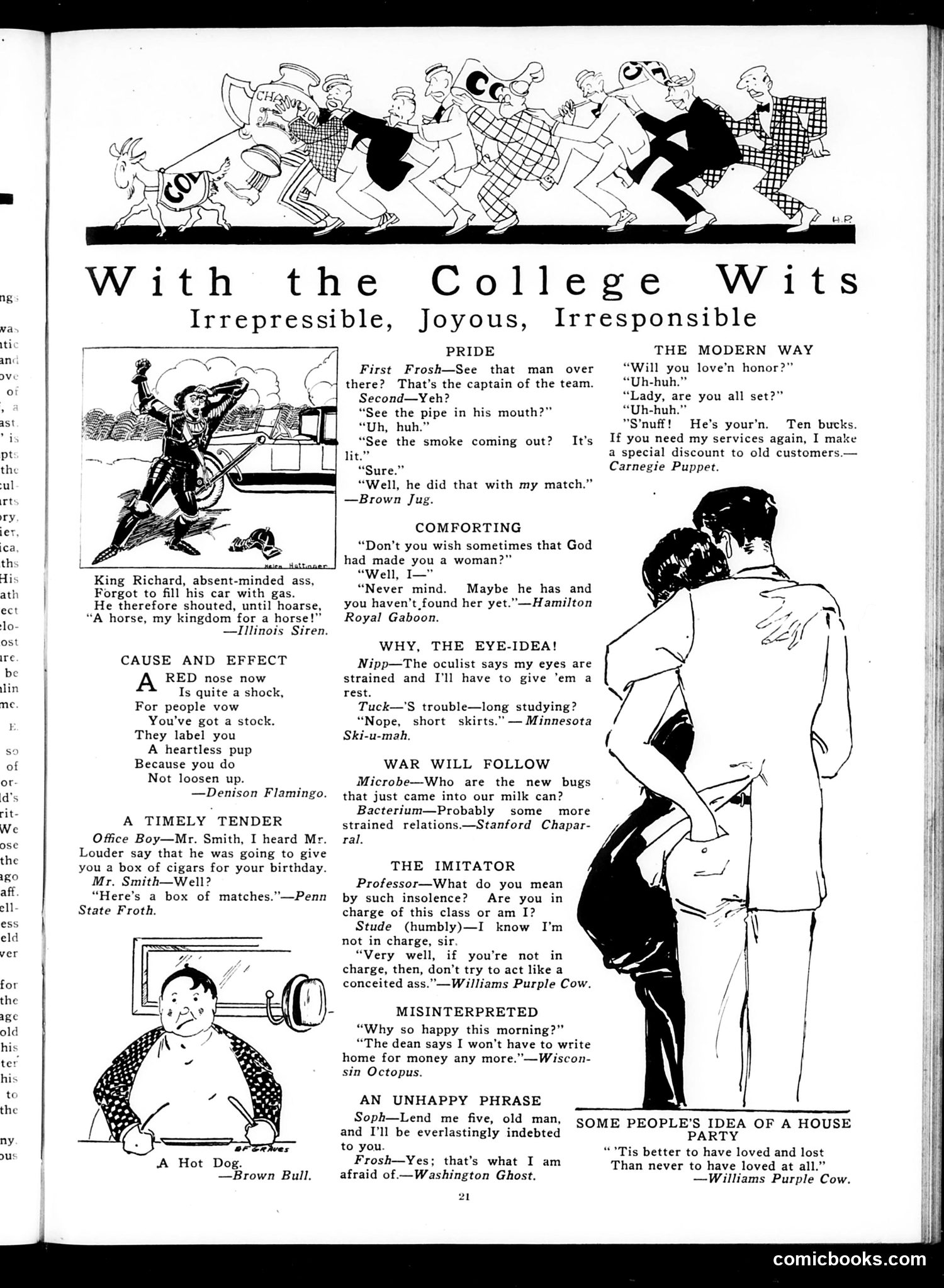
This page collects humorous jokes and cartoons from college humor magazines, typical of 1920s-era collegiate satire. The humor targets college life: absent-minded students ("King Richard" references Shakespeare while forgetting gas), office politics, dating customs, and academic hierarchies. Notable elements include: - **"The Modern Way"**: Satirizes marriage as commercialized and impersonal—a justice of the peace conducting a wedding for "ten bucks" with discount rates, mocking the erosion of romantic tradition. - **"Eye-Idea"**: References the era's anxiety about women's fashion (short skirts) as distracting, played for laughs. - **Various gags** mock student poverty, academic pretension, and dating mishaps typical of college-humor magazines published by schools like Brown, Stanford, and Wisconsin. The cartoon header shows exuberant college students in period clothing, emphasizing the "irrepressible, joyous, irresponsible" stereotype. The overall tone reflects 1920s collegiate culture before the Great Depression.
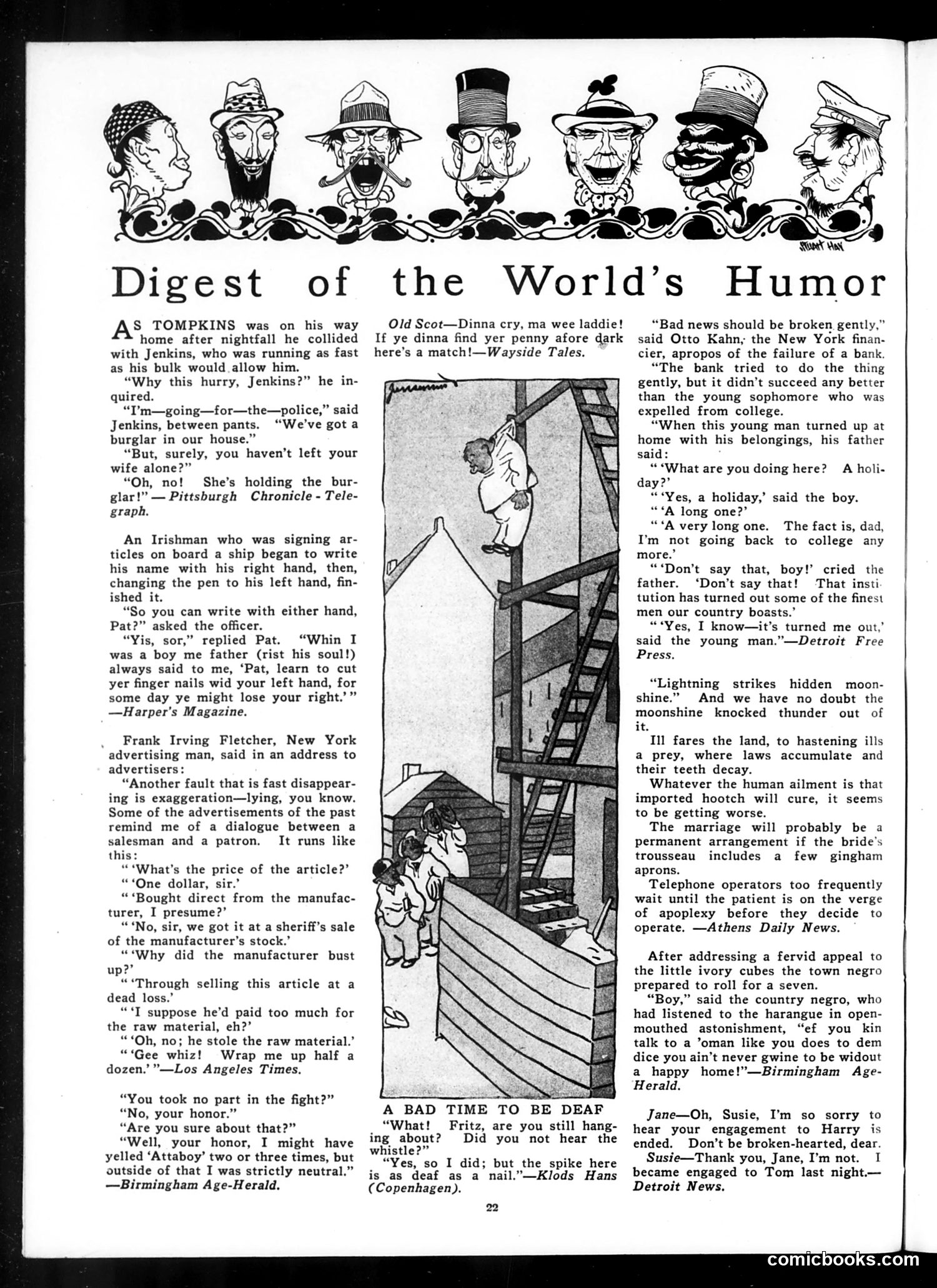
This page collects brief humorous anecdotes from various American newspapers, arranged around a central cartoon titled "A Bad Time to Be Deaf." **The Main Cartoon** shows a factory worker unable to hear a whistle (possibly a work signal) because a metal spike nearby is "as deaf as a nail"—a visual pun playing on the expression. **The Anecdotes** include: - A wife physically restraining a burglar while her husband fetches police - An Irishman writing with both hands, claiming his father taught him in case he lost his right hand - An advertising man satirizing exaggerated sales claims through absurdist dialogue - A Scottish father offering his crying son a match to find his lost penny in darkness - Various other brief jokes about deafness, bank failures, college expulsion, and moonshine **Context**: These represent turn-of-the-century American humor—lighthearted, pun-based, and published across regional newspapers. The content reflects period concerns (prohibition/moonshine, education, advertising ethics) while emphasizing wordplay over political commentary.
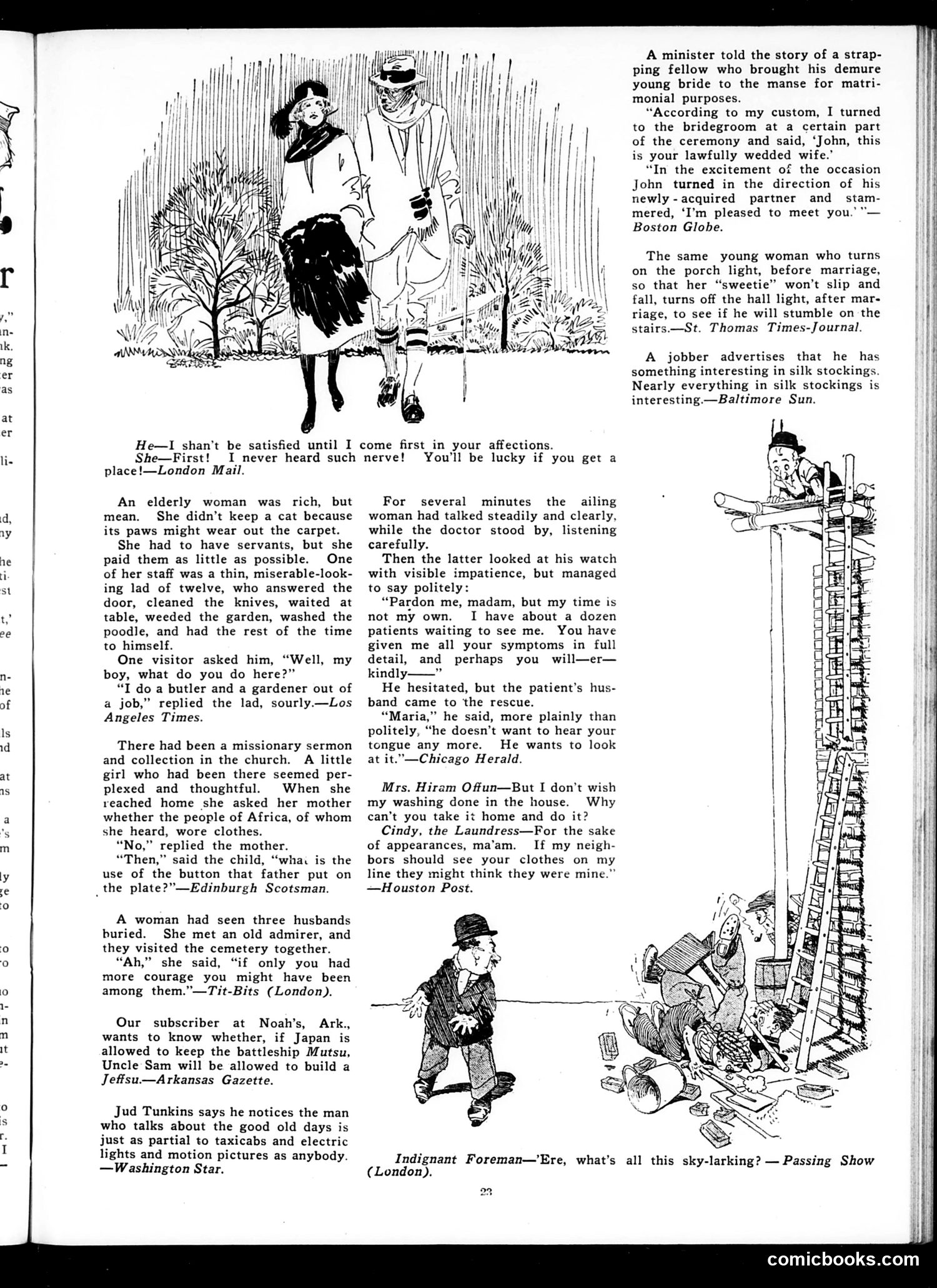
This page contains brief humorous anecdotes and jokes typical of early 20th-century American satirical magazines, alongside two cartoons. **Top Cartoon:** Shows a well-dressed couple with the caption about a man demanding first place in his girlfriend's affections—she replies he'd be lucky to place at all. This satirizes male romantic presumption. **Bottom Cartoon:** Depicts a foreman confronting a worker engaging in "sky-larking" (fooling around). This mocks workplace horseplay. The text consists of short joke columns from various newspapers addressing social observation: a wealthy woman's miserliness, gender role reversals in marriage (women turning off lights to trip husbands), impatient doctors, and laundresses protecting their reputations. One joke references Japan's battleship *Mutsu*, suggesting naval arms-race anxieties of the period. The humor targets class hypocrisy, marital discord, professional impatience, and social pretension—common Judge magazine themes satirizing middle and upper-class American life.
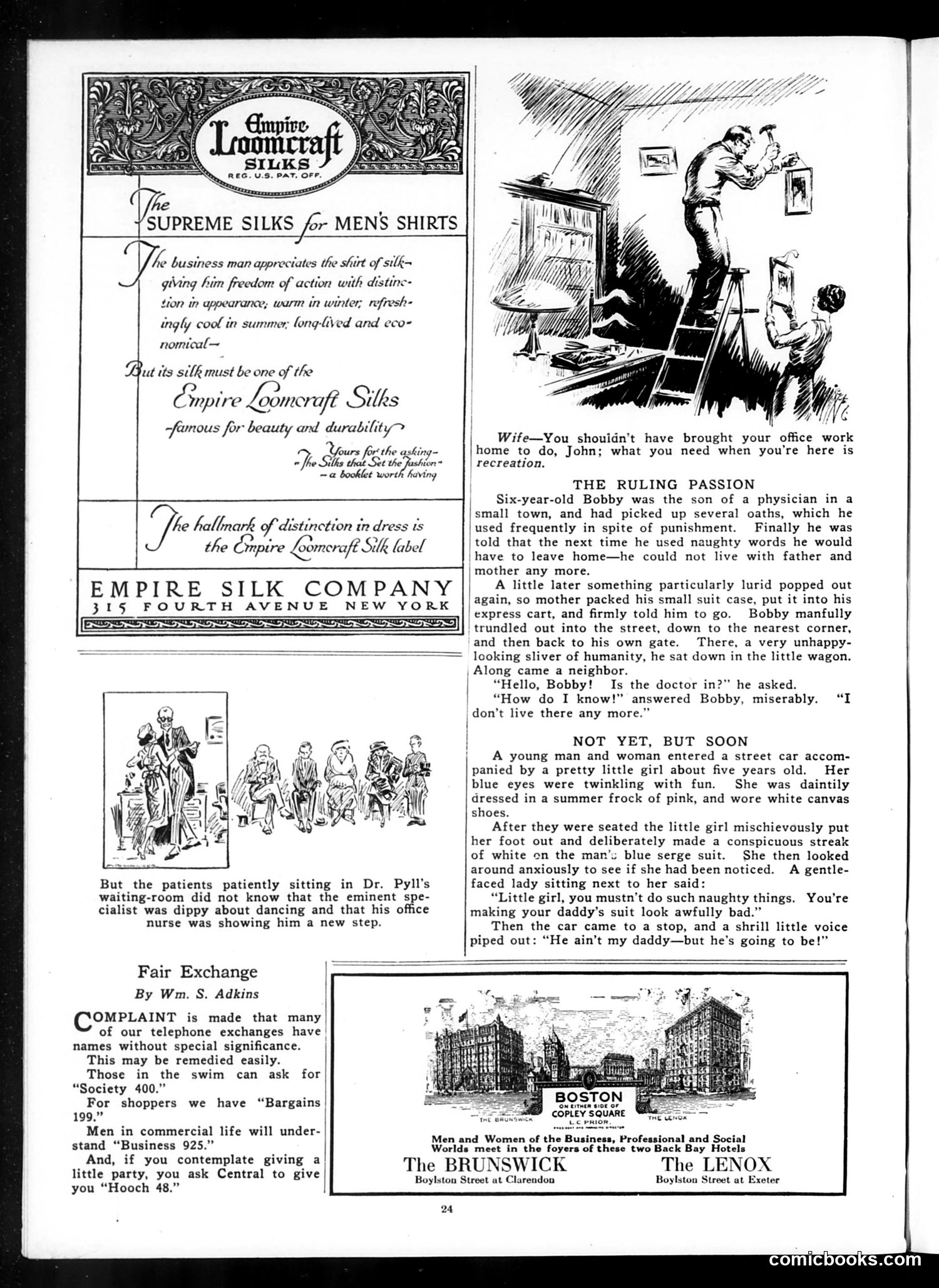
This page combines advertisements with three humorous short stories typical of Judge's satirical content. **The cartoons/stories satirize:** 1. **"The Ruling Passion"**: Mocks a physician so obsessed with dancing he demonstrates steps to his nurse during office hours, while his wife complains he brings work home instead of relaxing. The joke critiques workaholic professionals who can't separate work from leisure. 2. **Bobby's exile**: A six-year-old boy sent away for swearing returns immediately to sit outside his house, then tells a neighbor he no longer lives there—satirizing parental discipline's ineffectiveness and childhood literalism. 3. **"Not Yet, But Soon"**: A little girl deliberately dirties a stranger's suit, then tells the concerned lady onlooker the man will soon be her father—implying the couple are newly dating or the parents plan to marry. The joke relies on pre-marital relationship humor considered mildly scandalous for the era. The page also includes Empire Loomcraft silk advertisements and a piece by Wm. S. Adkins suggesting humorous telephone exchange names ("Society 400," "Business 925").
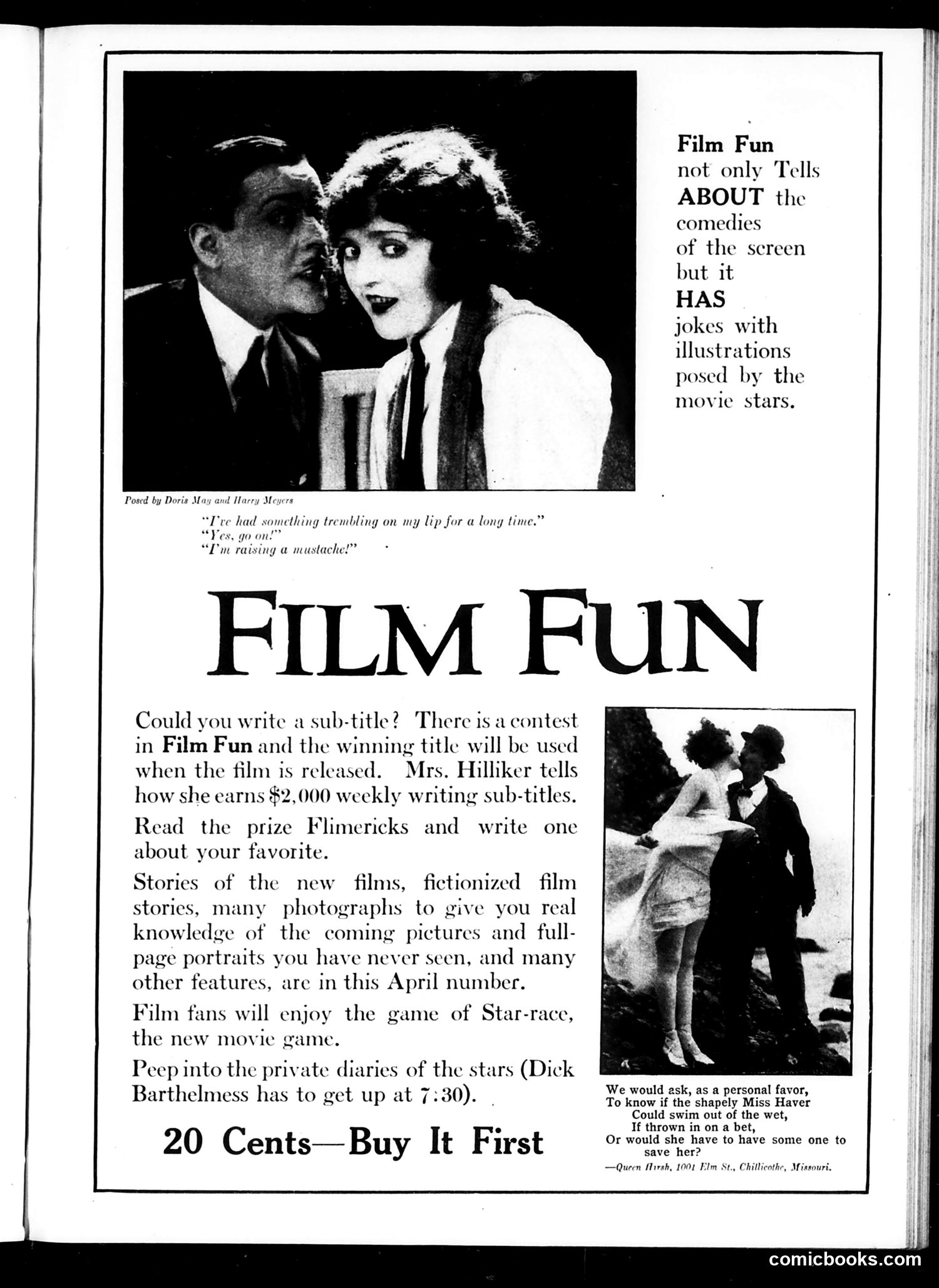
This is primarily **advertising** for *Film Fun* magazine's April issue, not political satire. The page promotes a movie-fan publication through multiple appeals: **The Images:** Two stills from silent films featuring actors posed by Doris Mud and Harry Meyers. The top photo shows a flirtatious scene with a caption-writing joke ("I'm raising a mustache"). The bottom shows an actress in a dramatic moment, accompanied by a humorous limerick contest submission about an actress named Miss Haver. **The Content:** Film Fun promises readers: - Subtitle-writing contests (Mrs. Hilliker earns $2,000 weekly doing this) - Movie gossip and celebrity "private diaries" (Dick Barthelmess's wake-up time) - A "Star-race" movie game - Behind-the-scenes photographs and stories about upcoming films **The Appeal:** This reflects 1920s fan culture—readers bought the magazine for celebrity access, trivia, and participatory contests. The limerick contest shows reader engagement was central to the magazine's appeal. The price (20 cents) and "Buy It First" slogan emphasize exclusivity.
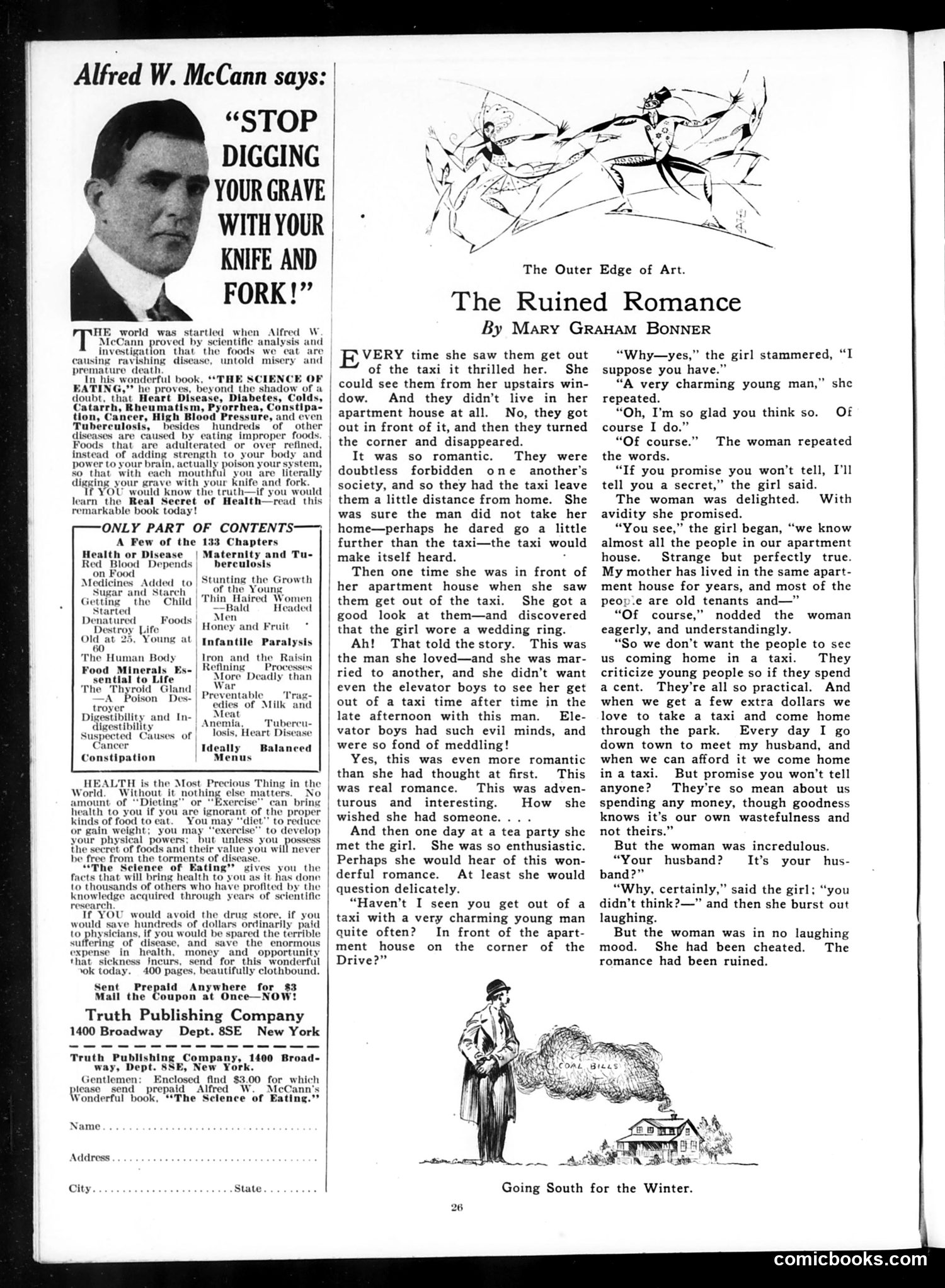
This page contains two distinct elements: a health advertisement and a short fiction story. **The Advertisement (Left):** Alfred W. McCann promotes his book "The Science of Eating," claiming improper diet causes disease and premature death. The phrase "digging your grave with your knife and fork" was McCann's actual slogan promoting nutritional reform—a common early-20th-century health-movement argument that modern processed foods were poisoning Americans. **The Story (Right):** "The Ruined Romance" by Mary Graham Bonner is a brief romantic narrative with an ironic twist. A woman romanticizes observing a couple sneaking around in taxis, imagining them as forbidden lovers. When she finally sees them clearly, she discovers the woman wears a wedding ring—meaning they're likely already married to each other, not illicitly together. The "romance" is thus "ruined" because reality deflates the woman's romantic fantasy. The story satirizes how people project romantic narratives onto strangers' lives.
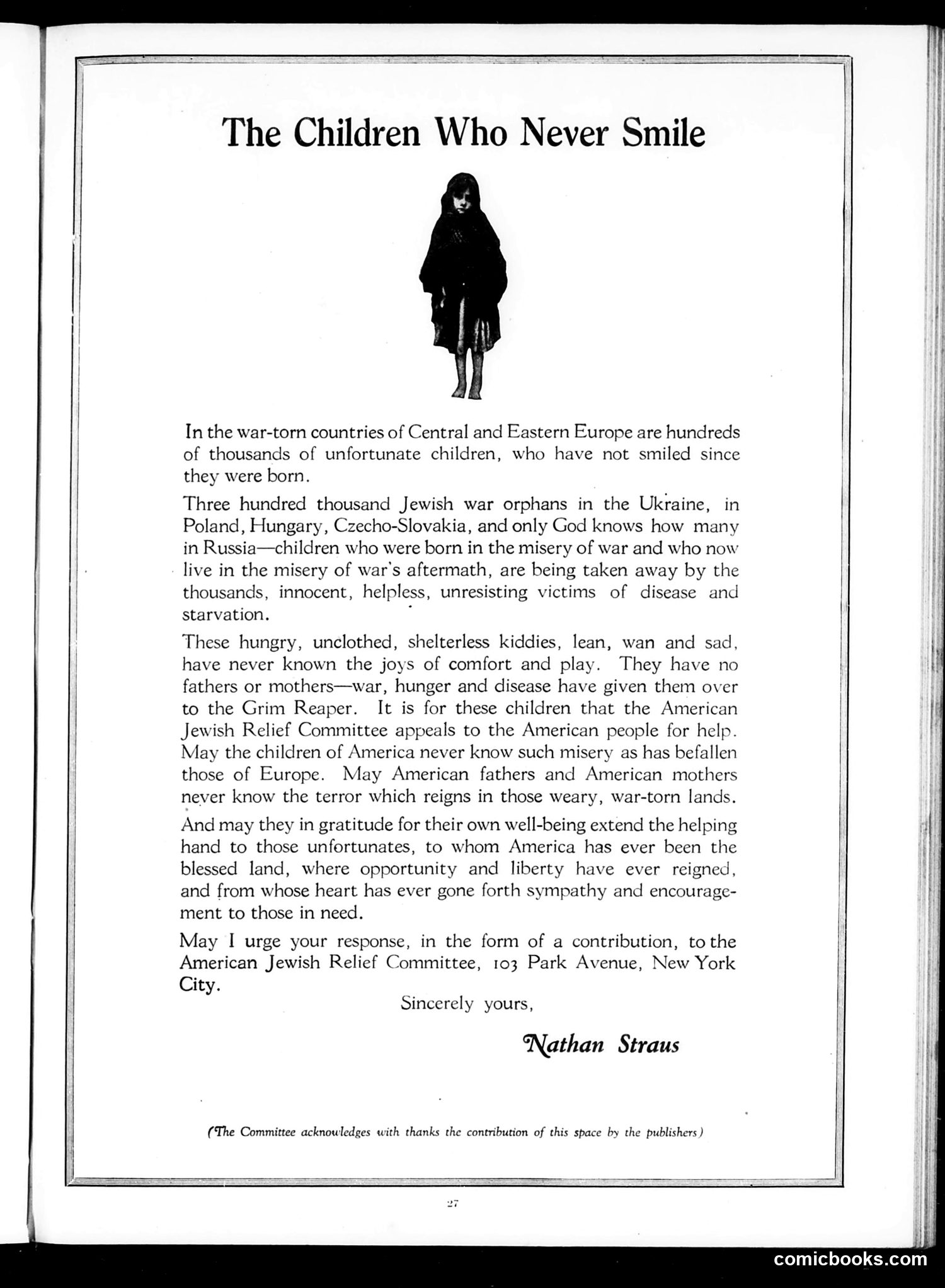
This is not satire but a humanitarian appeal by Nathan Straus for the American Jewish Relief Committee. The silhouette depicts a traumatized child orphaned by post-WWI conflict in Central and Eastern Europe. The text describes 300,000 Jewish war orphans in Ukraine, Poland, Hungary, and Czechoslovakia suffering from disease and starvation. Straus appeals to American prosperity and moral obligation, contrasting American children's comfort with European orphans who "have never smiled since they were born." This is a fundraising advertisement placed in *Judge* magazine, with the publishers donating the space. The emotional appeal relies on American exceptionalism ("blessed land") and guilt-by-contrast to motivate donations to the relief committee's New York address. It reflects post-WWI humanitarian concerns and Jewish communal welfare efforts.
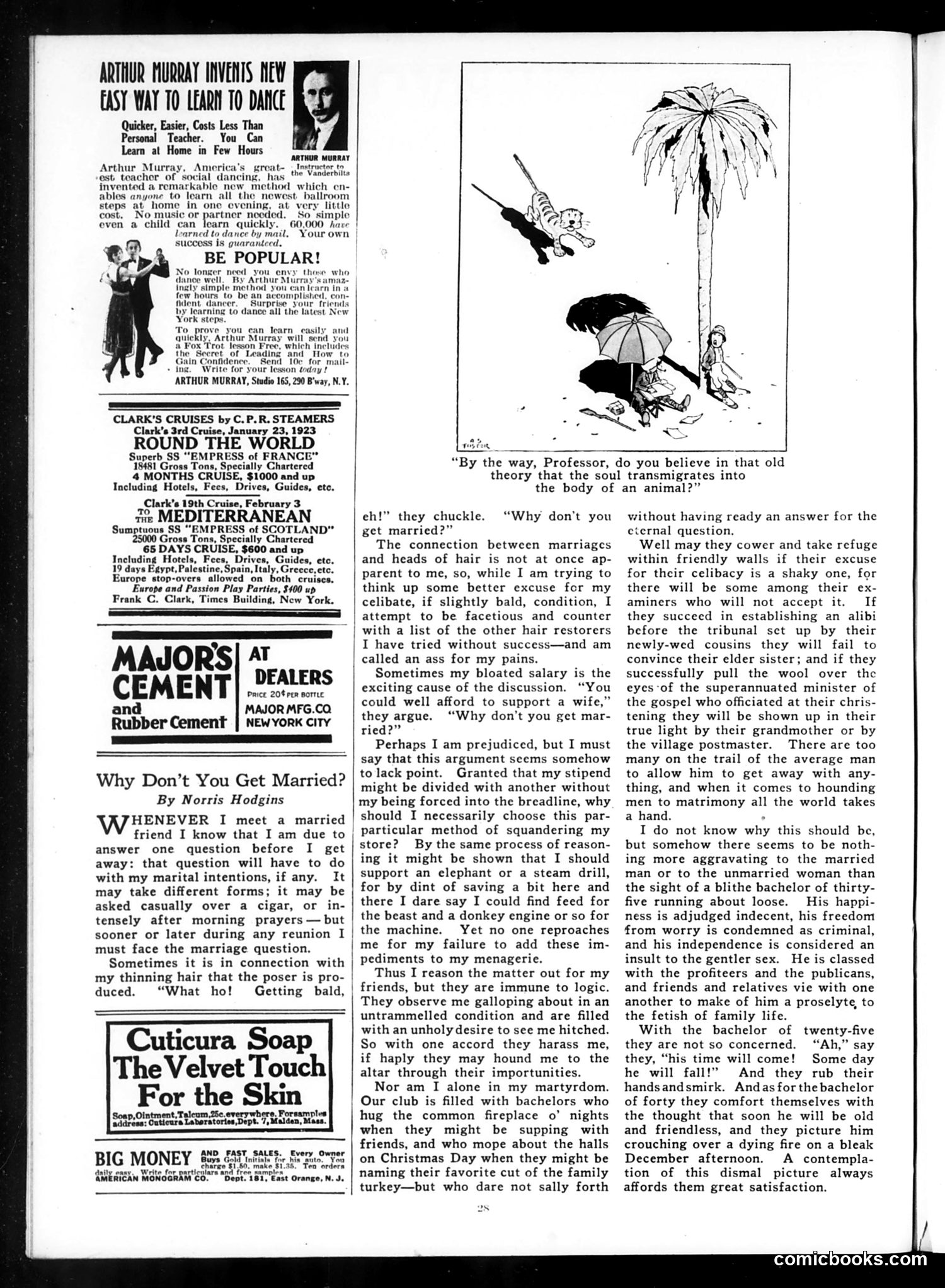
This page features a humorous essay titled "Why Don't You Get Married?" by Norris Hodgins, paired with a cartoon showing a man sheltering under an umbrella while being pelted by objects (likely representing criticism or social pressure). The accompanying illustration depicts the essay's central joke: a bachelor constantly badgered by married friends demanding to know why he remains unmarried. The cartoon shows him literally under attack—visualizing the relentless social pressure he faces. Hodgins's satire mocks both the persistence of married acquaintances and the weak excuses unmarried men offer. The essay catalogs absurd "reasons" for marriage—balding hair, salary—to demonstrate the illogic of the pressure. His counterargument compares supporting a wife to randomly supporting an elephant or steam drill, mocking the logic of those who hound him. The piece reflects early 1920s social attitudes: unmarried men were subjects of curiosity and gentle ridicule, while marriage was treated as a social obligation rather than personal choice. The satire targets both the nosiness of married people and bachelor resistance to matrimony.
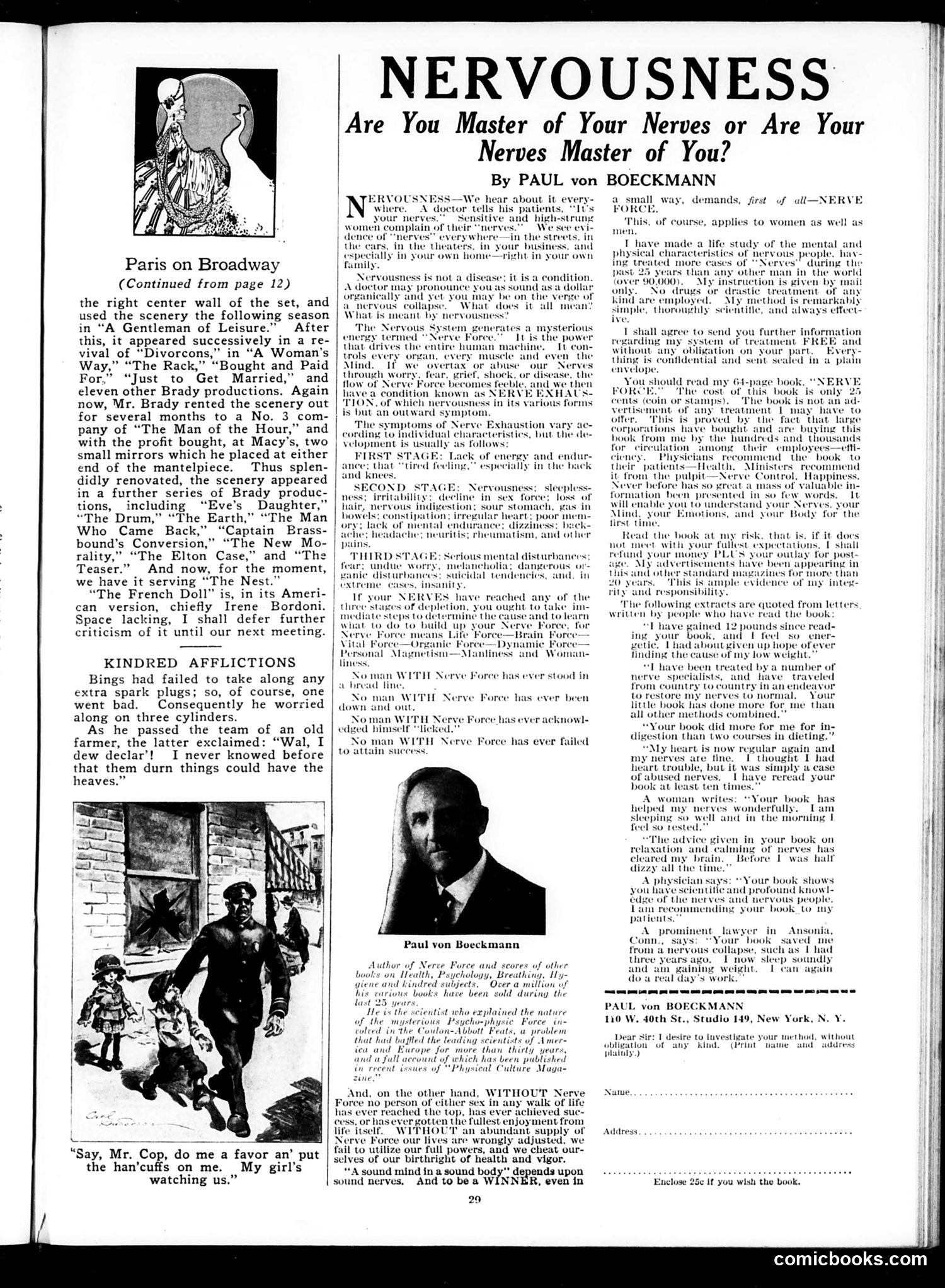
This page mixes theatrical gossip with a health advertisement, typical of Judge magazine's format. **"Paris on Broadway"** discusses theater producer William Brady's cost-cutting: he repeatedly rents and reuses the same stage scenery across multiple productions, eventually "renovating" it with two cheap mirrors from Macy's. The satire mocks corporate penny-pinching disguised as sophistication—wealthy producers maximizing profits through recycled sets while presenting new shows to audiences. **"Kindred Afflictions"** contains two brief comic anecdotes: one about a car owner worried about spark plugs, and a man asking a cop to handcuff him so his girlfriend thinks he's being arrested. These joke about the absurdity of everyday predicaments. The **Paul von Boeckmann advertisement** dominates the right page, promoting his book on "nerve force"—a pseudo-scientific wellness concept popular in early 20th-century America linking mental energy to physical health. This represents the era's faith in self-help solutions to modern anxiety and stress.
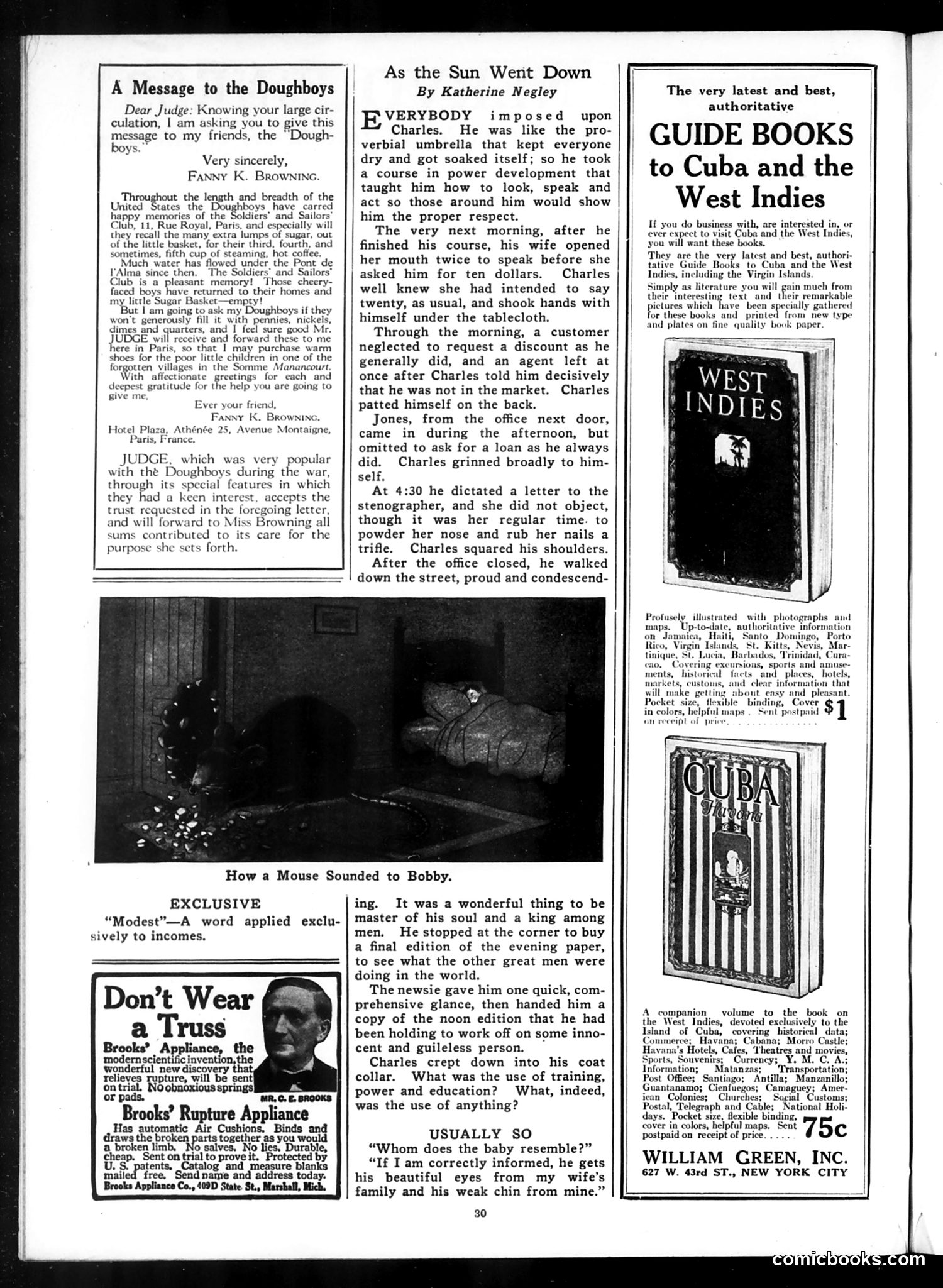
This page contains primarily **text and advertisements** rather than political cartoons. The main content includes: **"A Message to the Doughboys"** — a post-WWI appeal from Fanny K. Browning, who ran a soldiers' club in Paris during the war. She requests donations (pennies to quarters) to buy shoes for poor children in war-damaged French villages like Manancourt in the Somme region. Judge magazine pledges to forward contributions. **"As the Sun Went Down"** — a short satirical story mocking self-help culture. A man takes a "power development" course and experiences one day of people deferring to him (his wife, a customer, a borrower, his stenographer). The joke appears incomplete, but clearly satirizes the superficiality of such courses and how quickly gained confidence might deflate. The page also contains period advertisements for guide books to Cuba/West Indies and a truss appliance. **Context for moderns**: This reflects immediate post-WWI charitable appeals and the 1920s boom in self-improvement courses promising confidence and personal mastery.
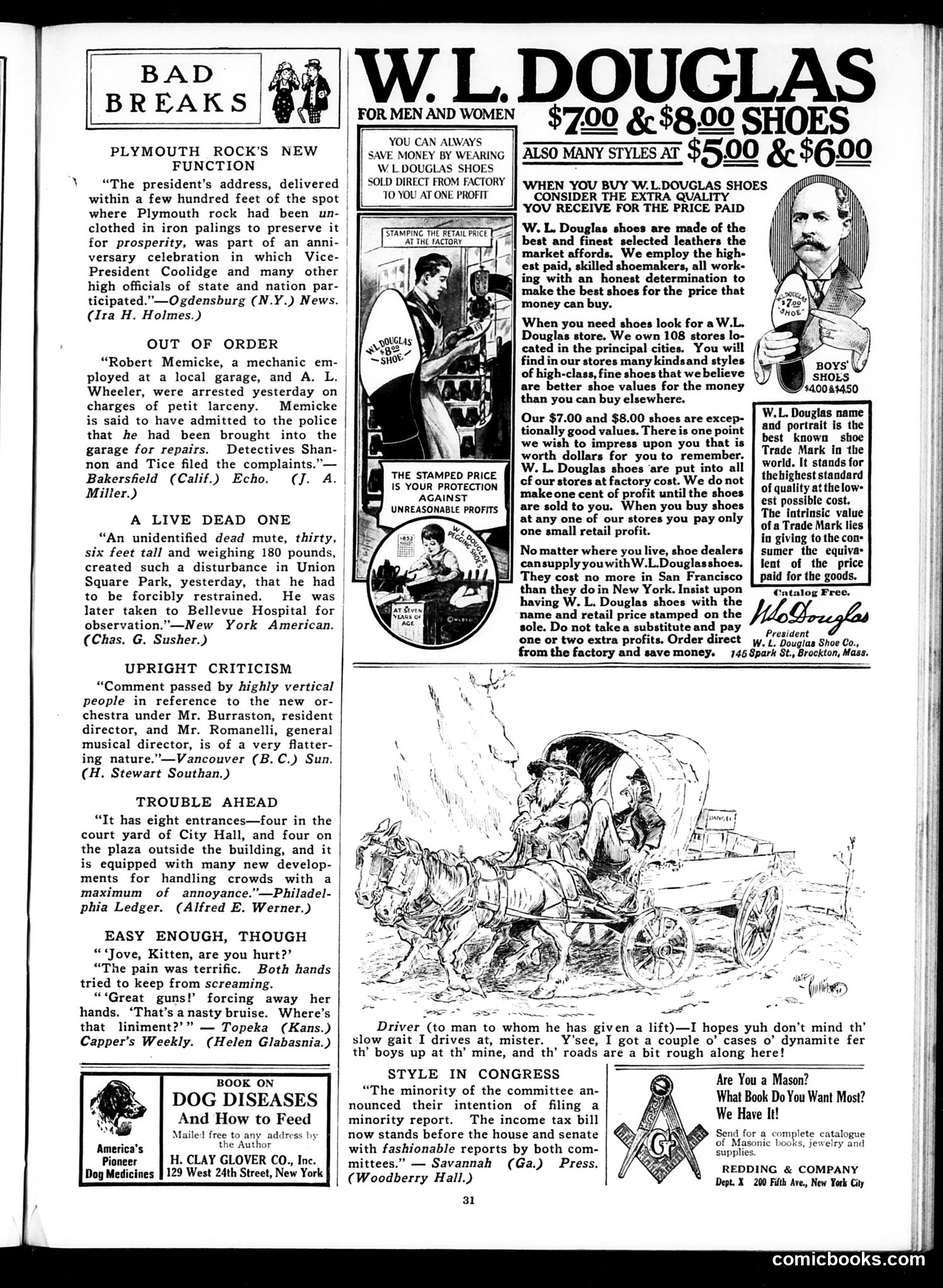
This page combines satirical "Bad Breaks" (humorous newspaper misquotes) with period advertising. **The Satire:** The "Bad Breaks" section mocks absurd newspaper headlines. Examples include: - Plymouth Rock being "unclothed" in iron palings (undressed?) at a presidential event - A mechanic arrested for petit larceny after being "brought into" a garage "for repairs" - A "dead mute" causing a disturbance—an inherent contradiction - City Hall designed with maximum "annoyance" for crowds These satirize careless newspaper writing and unintentional logical contradictions. **The Cartoon:** The central illustration shows a mule-drawn cart with a driver and passenger (loaded with dynamite for mining). The driver quips about his slow pace and rough roads—a straightforward comic commentary on frontier conditions. **The Advertising:** W.L. Douglas Shoes dominates the right side, emphasizing direct-from-factory pricing and value. This appears to be standard commercial advertising rather than satire. The page is primarily entertainment and advertising for a 1920s general-interest magazine audience.
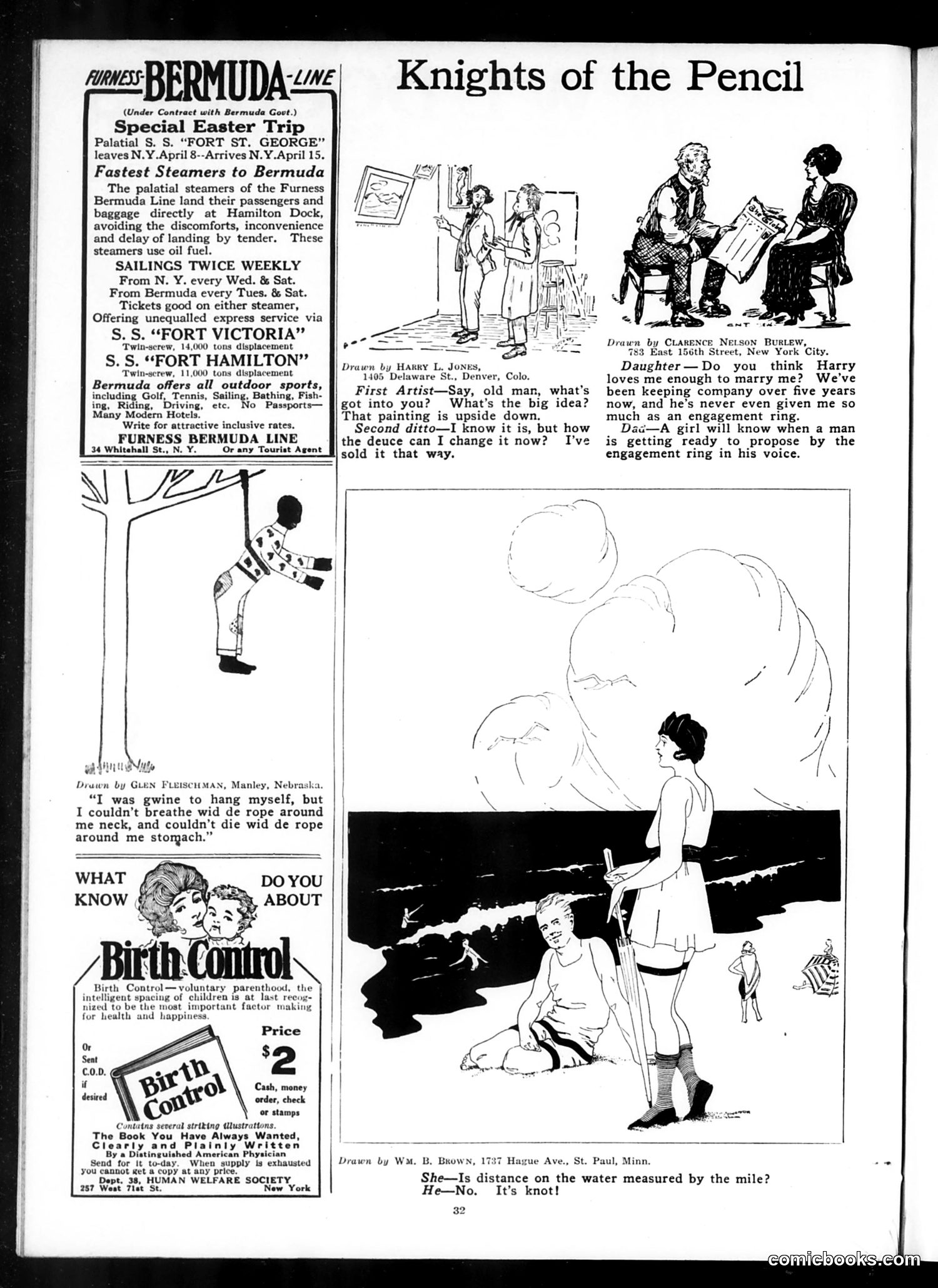
This page contains three separate cartoons under the "Knights of the Pencil" section (cartoonist humor): **First cartoon** (Harry L. Jones): Two artists discuss a painting hung upside-down. One has already sold it that way and can't change it—satirizing either artistic incompetence or the absurdity of art commerce where flawed work gets sold anyway. **Second cartoon** (Clarence Nelson Burlew): A father-daughter dialogue about marriage. The daughter worries her boyfriend won't propose after five years; the father jokes she'll recognize his readiness by "the engagement ring in his voice"—a pun playing on "ring" as both jewelry and sound. **Third cartoon** (Wm. B. Brown): A nautical pun where a woman asks if water distance uses miles; the man replies "knots" instead. This is a simple wordplay joke about maritime measurement. The page also features Furness Bermuda Line cruise advertisements and a Birth Control pamphlet advertisement, typical of 1920s Judge content mixing editorial cartoons with commercial ads.
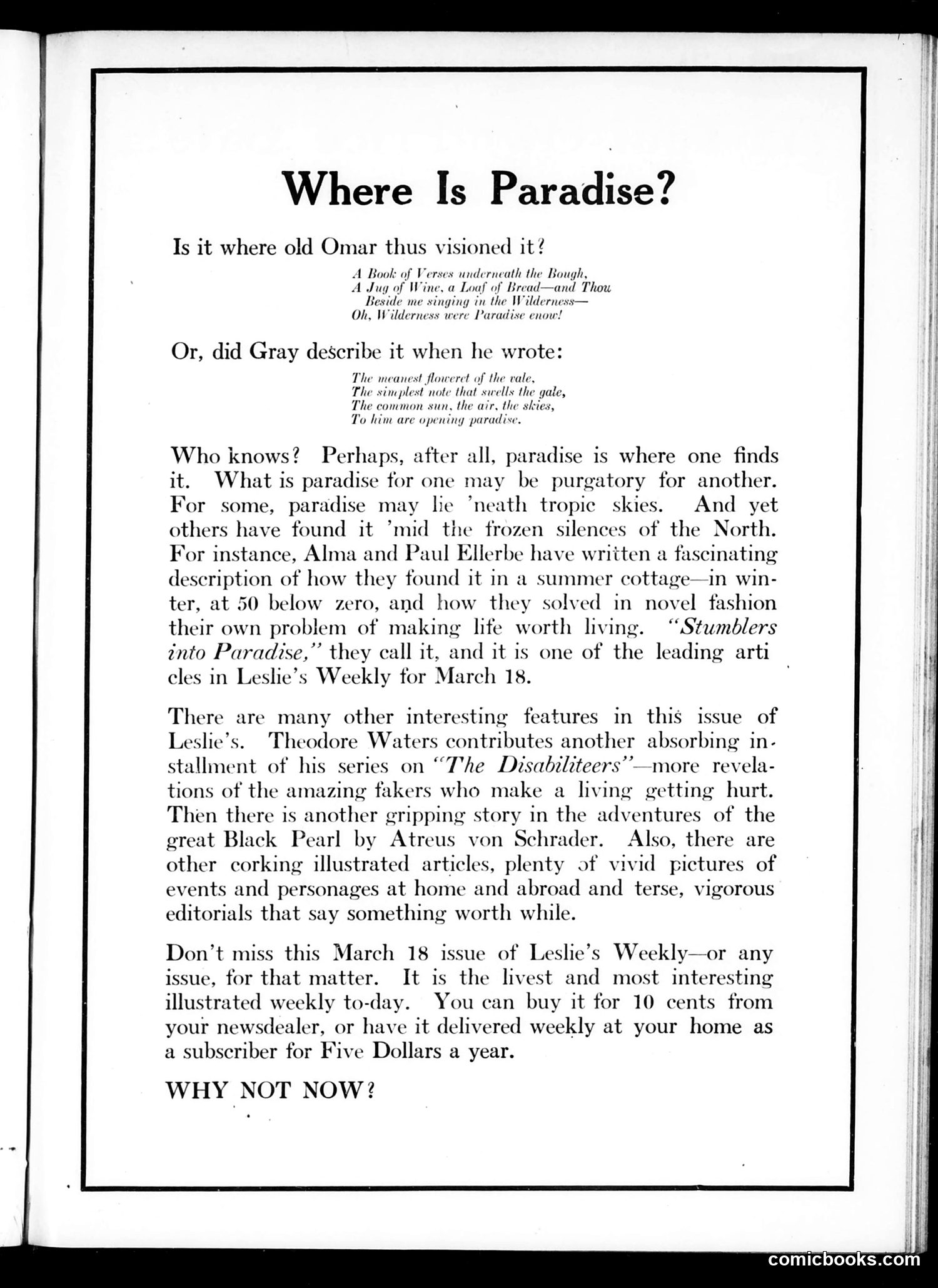
This is an advertisement for *Leslie's Weekly* magazine (March 18 issue), not a political cartoon. It uses philosophical framing to promote the publication. The ad poses the question of where paradise exists, referencing literary figures: Omar Khayyam's hedonistic vision (wine, bread, song) and Thomas Gray's Romantic celebration of nature's simple beauties. The hook is that paradise is subjective—found wherever one seeks it. The ad then advertises *Leslie's* upcoming features, including a story called "Stumblers into Paradise" about a couple (Alma and Paul Ellerbe) who found contentment in a winter cottage at 50 degrees below zero. Other promised articles include Theodore Waters' series on "The Disabliteers" (fake disability schemers) and adventure fiction. The advertisement emphasizes *Leslie's* as the most interesting illustrated weekly available, costing 10 cents per issue or $5 yearly by subscription—standard magazine promotion of the era.
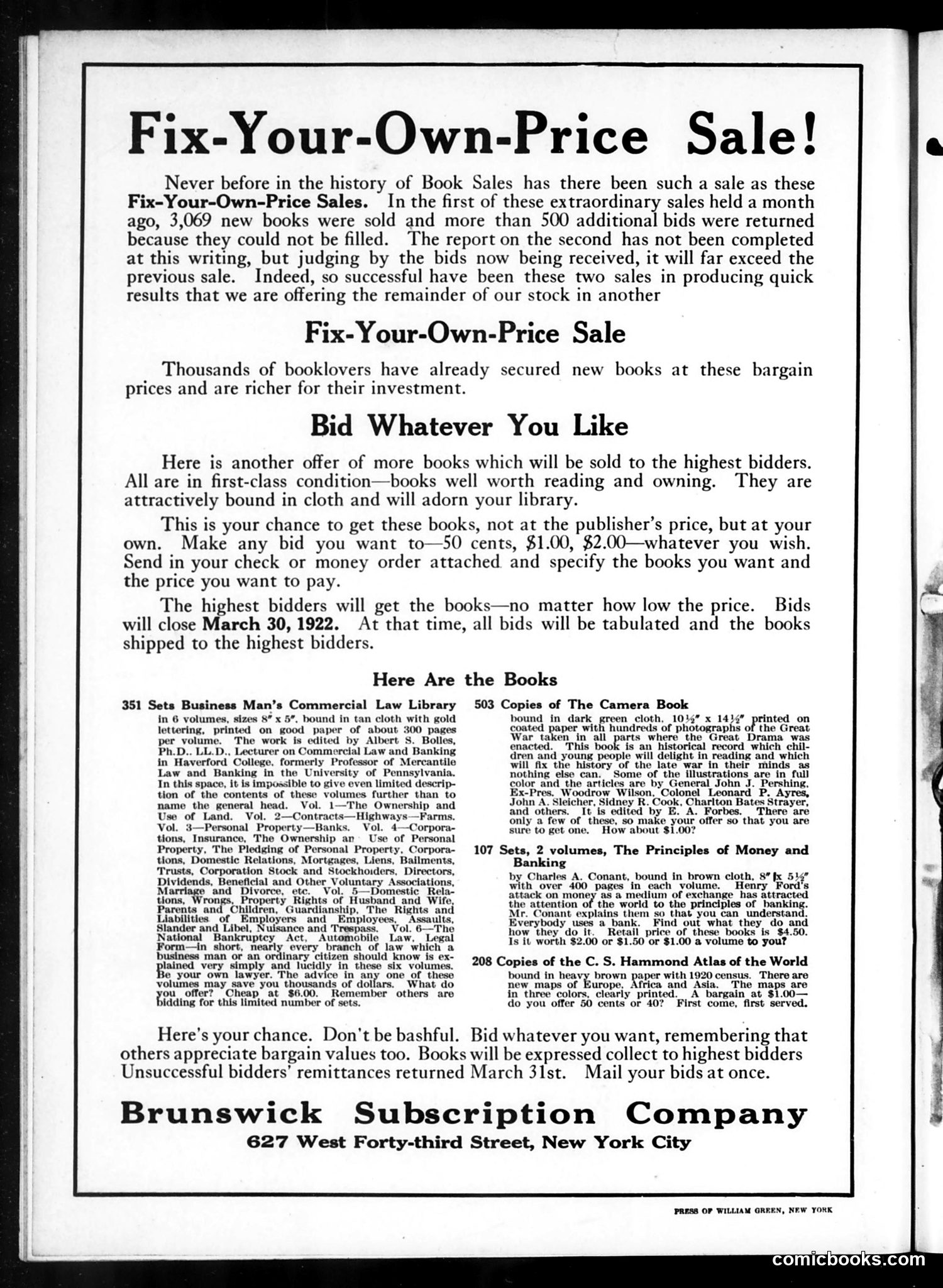
This is primarily a **book advertisement**, not a cartoon or satirical content. It's a full-page ad from the Brunswick Subscription Company announcing "Fix-Your-Own-Price Sales"—an early 1920s marketing innovation where customers could bid whatever amount they wished for books, with the highest bidders receiving their selections. The ad lists specific book collections available: a 351-set Business Man's Commercial Law Library, 503 copies of *The Camera Book* (featuring WWI photography and articles by General Pershing), and 107 sets of *The Principles of Money and Banking*. **Historical context**: Published in 1922, this reflects post-WWI consumer culture and the growing mass-market book industry. The "fix your own price" gimmick appears designed to create competitive excitement and rapid sales turnover. **No political satire is present** on this page—it's straightforward commercial advertising from the Judge magazine's back pages.