
Judge, 1922-03-18 · page 20 of 36
Judge — March 18, 1922 — page 20: what you’re looking at
What you’re looking at
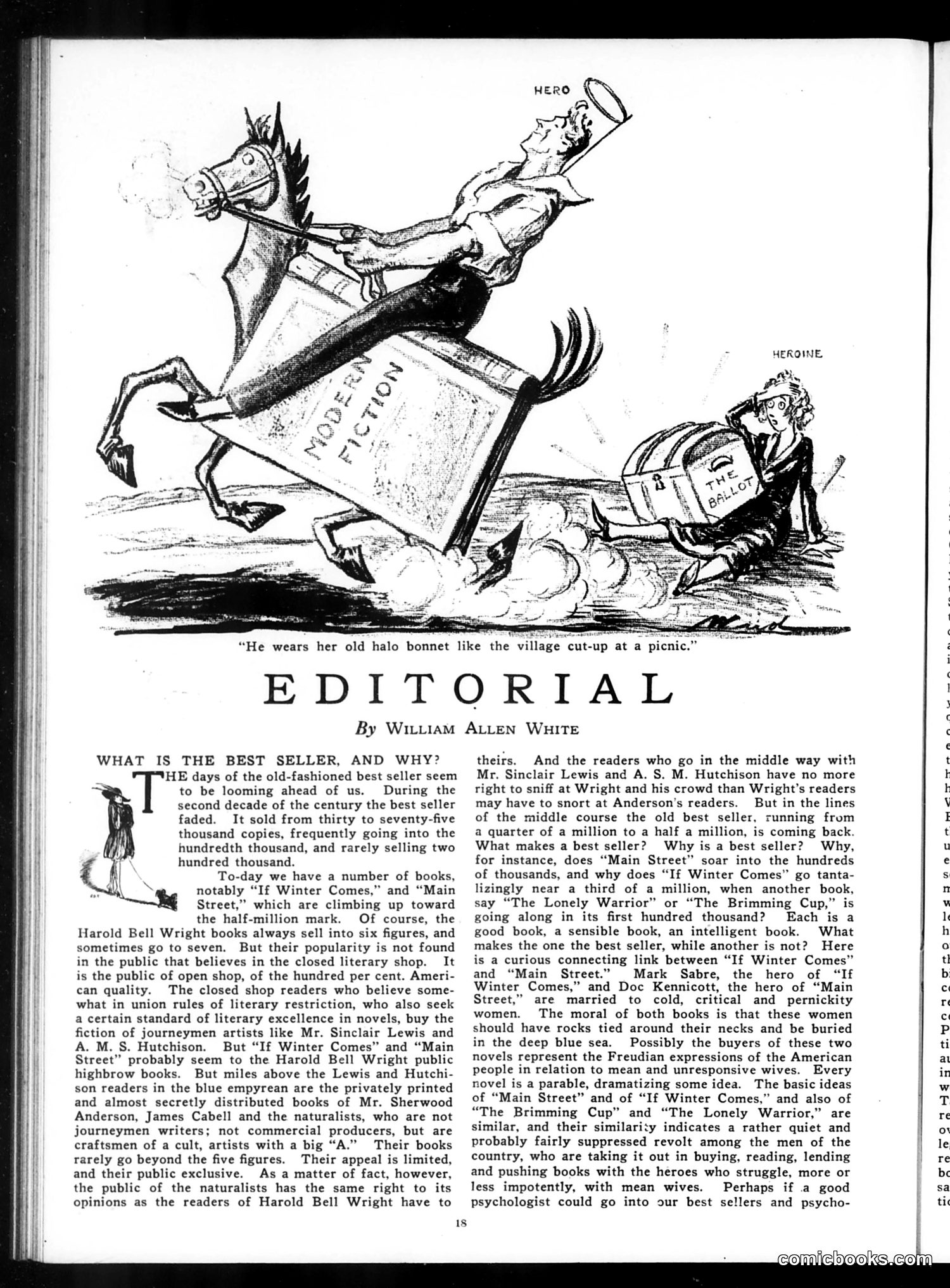
**The Cartoon:** The illustration depicts a runaway horse labeled "POPULAR FICTION" bucking a man (labeled "HERO") while a woman (labeled "HEROINE") sits nearby holding a barrel labeled "THE BALLOT." The caption jokes that she "wears her old halo bonnet like the village cut-up at a picnic." **The Satire's Context:** This appears to commentary on early 1920s literary debates. The accompanying editorial by William Allen White discusses bestsellers like *If Winter Comes* and *Main Street*—novels featuring henpecked husbands married to difficult women. White argues these books reveal suppressed male resentment toward wives, suggesting they're psychological outlets for men frustrated with "mean and unresponsive wives." The cartoon likely mocks this gendered conflict: the horse symbolizes uncontrollable popular taste, the male hero is being thrown off balance, and the woman with "the ballot" (newly granted via 19th Amendment in 1920) represents women's newfound power. The joke suggests women are now unpredictably powerful—like an unruly horse—upending traditional literary hierarchies and male authority.
📄 Transcribed text from this page (OCR, searchable)
Machine-transcribed from the original scan — historical spelling and the odd misread are preserved.
“He wears her old halo bonnet like th HEROINE fs e village cut-up at a picnic.” EDITORIAL By WituiaM ALLEN WHITE WHAT IS THE BEST SELLER, AND WHY? 'HE days of the old-fashioned best seller seem to be looming ahead of us. During the second decade of the century the best seller faded. It sold from thirty to seventy-five thousand copies, frequently going into the hundredth thousand, and rarely selling two hundred thousand. To-day we have a number of books, notably “If Winter Comes,” and “Main Street,” which are climbing up toward the half-million mark. Of course, the Harold Bell Wright books always sell into six figures, and sometimes go to seven. But their popularity is not found in the public that believes in the closed literary shop. It is the public of open shop, of the hundred per cent. Ameri- can quality. The closed shop readers who believe some- what in union rules of literary restriction, who also seek a certain standard of literary excellence in novels, buy the fiction of journeymen artists like Mr. Sinclair Lewis and A. M. S. Hutchison. But “If Winter Comes” and “Main Street” probably seem to the Harold Bell Wright public highbrow books. But miles above the Lewis and Hutchi- son readers in the blue empyrean are the privately printed and almost secretly distributed books of Mr. Sherwood Anderson, James Cabell and the naturalists, who are not journeymen writers; not commercial producers, but are craftsmen of a cult, artists with a big “A.” Their books rarely go beyond the five figures. Their appeal is limited, and their public exclusive. As a matter of fact, however, the public of the naturalists has the same right to its opinions as the readers of Harold Bell Wright have to theirs. And the readers who go in the middle way with Mr. Sinclair Lewis and A. S. M. Hutchison have no more right to sniff at Wright and his crowd than Wright's readers may have to snort at Anderson's readers. But in the lines of the middle course the old best seller, running from a quarter of a million to a half a million, is coming back. What makes a best seller? Why is a best seller? Why, for instance, does “Main Street” soar into the hundreds of thousands, and why does “If Winter Comes” go tanta- lizingly near a third of a million, when another book, say “The Lonely Warrior” or “The Brimming Cup,” is going along in its first hundred thousand? Each is a good book, a sensible book, an intelligent book. What makes the one the best seller, while another is not? Here is a curious connecting link between “If Winter Comes” and “Main Street.” Mark Sabre, the hero of “If Winter Comes,” and Doc Kennicott, the hero of “Main Street,” are married to cold, critical and pernickity women. The moral of both books is that these women should have rocks tied around their necks and be buried in the deep blue sea. Possibly the buyers of these two novels represent the Freudian expressions of the American people in relation to mean and unresponsive wives. Every novel is a parable, dramatizing some idea. The basic ideas of “Main Street” and of “If Winter Comes,” and also of “The Brimming Cup” and “The Lonely Warrior,” are similar, and their similarity indicates a rather quiet and probably fairly suppressed revolt among the men of the country, who are taking it out in buying, reading, lending and pushing books with the heroes who struggle, more or less impotently, with mean wives. Perhaps if a good psychologist could go into our best sellers and psycho- | COMMIEDOOKSECOMM Ha Se Ae wE6 HA ee 68 SX ewe Oo em 6 tw ees a RE we mR