
Judge, 1922-03-18 · page 8 of 36
Judge — March 18, 1922 — page 8: what you’re looking at
What you’re looking at
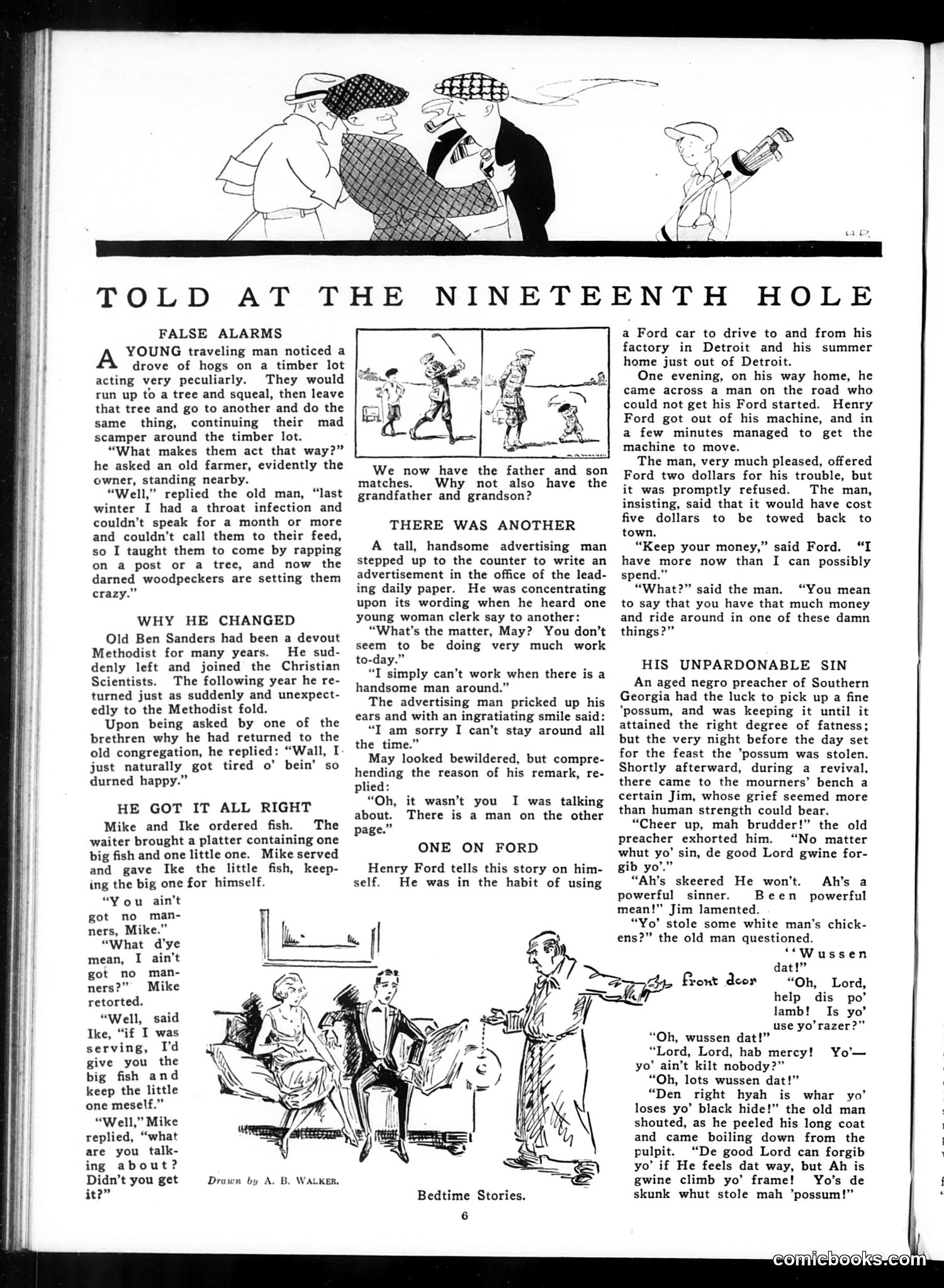
This page contains several short humorous anecdotes typical of early 20th-century American humor magazines: **"False Alarms"** satirizes rural simplicity: a farmer trained hogs to respond to tree-tapping for food, now they're confused by woodpeckers doing the same thing. **"Why He Changed"** mocks Christian Science (a contemporary religion) by suggesting its emphasis on happiness made a Methodist uncomfortable—he preferred traditional Methodism's grimmer worldview. **"He Got It All Right"** is a joke about etiquette: Mike serves himself the larger fish; when criticized for poor manners, he argues he gave Ike what he wanted, missing the point of generosity. **"One on Ford"** presents Henry Ford as arrogantly wealthy, refusing payment for fixing a stranger's car while implying he can't spend his vast fortune—a jab at industrial magnates' excessive wealth. **"His Unpardonable Sin"** uses racial dialect humor (common then, offensive now) about a Black preacher unable to forgive a congregant who stole his possum. These reflect 1920s-era sensibilities: class anxiety, religious skepticism, and casual racial stereotyping.
📄 Transcribed text from this page (OCR, searchable)
Machine-transcribed from the original scan — historical spelling and the odd misread are preserved.
FALSE ALARMS A YOUNG traveling man noticed a drove of hogs on a timber lot acting very peculiarly. They would run up to a tree and squeal, then leave that tree and go to another and do the same thing, continuing their mad scamper around the timber lot. “What makes them act that way?” he asked an old farmer, evidently the owner, standing nearby. “Well,” replied the old man, “last winter I had a throat infection and couldn’t speak for a month or more and couldn’t call them to their feed, so I taught them to come by rapping on a post or a tree, and now the darned woodpeckers are setting them crazy.” WHY HE CHANGED Old Ben Sanders had been a devout Methodist for many years. He sud- denly left and joined the Christian Scientists. The following year he re- turned just as suddenly and unexpect- edly to the Methodist fold. Upon being asked by one of the brethren why he had returned to the old congregation, he replied: “Wall, I just naturally got tired o’ bein’ so durned happy.” HE GOT IT ALL RIGHT Mike and Ike ordered fish. The waiter brought a platter containing one big fish and one little one. Mike served and gave Ike the little fish, keep- ing the big one for himself. “You ain't got no man- ners, Mike.” “What d’ye mean, I ain’t got no man- ners?” Mike retorted. “Well, said Ike, “if I was serving, I'd give you the big fish and keep the little one meself.” “Well,” Mike replied, “what are you talk- ing about? Didn’t you get it?” Drawn by A. B, WALKER, matches. Why not also have the grandfather and grandson? THERE WAS ANOTHER A tall, handsome advertising man stepped up to the counter to write an advertisement in the office of the lead- ing daily paper. He was concentrating upon its wording when he heard one young woman clerk say to another: “What's the matter, May? You don’t seem to be doing very much work to-day.” “TI simply can’t work when there is a handsome man around.” The advertising man pricked up his ears and with an ingratiating smile said: “I am sorry I can’t stay around all the time.” May looked bewildered, but compre- hending the reason of his remark, re- plied: “Oh, it wasn’t you I was talking about. There is a man on the other page.” ONE ON FORD Henry Ford tells this story on him- self. He was in the habit of using Bedtime Stories. 6 a Ford car to drive to and from his factory in Detroit and his summer home just out of Detroit. One evening, on his way home, he came across a man on the road who could not get his Ford started. Henry Ford got out of his machine, and in a few minutes managed to get the machine to move. The man, very much pleased, offered Ford two dollars for his trouble, but it was promptly refused. The man, insisting, said that it would have cost five dollars to be towed back to town. “Keep your money,” said Ford. “I have more now than I can possibly spend.” “What?” said the man. “You mean to say that you have that much money and ride around in one of these damn things?” HIS UNPARDONABLE SIN An aged negro preacher of Southern Georgia had the luck to pick up a fine ‘possum, and was keeping it until it attained the right degree of fatness; but the very night before the day set for the feast the ‘possum was stolen. Shortly afterward, during a revival, there came to the mourners’ bench a certain Jim, whose grief seemed more than human strength could bear. “Cheer up, mah brudder!” the old preacher exhorted him. “No matter whut yo’ sin, de good Lord gwine for- gib yo’.” “Ah’s skeered He won't. Ah’s a powerful sinner. Been powerful mean!” Jim lamented. “Yo’ stole some white man’s chick- ens?” the old man questioned. ““Wussen dat!” “Oh, Lord, help dis po’ lamb! Is yo’ use yo’razer?” “Oh, wussen dat!” “Lord, Lord, hab mercy! yo’ ain’t kilt nobody?” “Oh, lots wussen dat!” “Den right hyah is whar yo loses yo’ black hide!” the old man shouted, as he peeled his long coat and came boiling down from the pulpit. “De good Lord can forgib yo’ if He feels dat way, but Ah is gwine climb yo’ frame! Yo’s de skunk whut stole mah ’possum!” Yo'—