
Judge, 1922-03-18 · page 6 of 36
Judge — March 18, 1922 — page 6: what you’re looking at
What you’re looking at
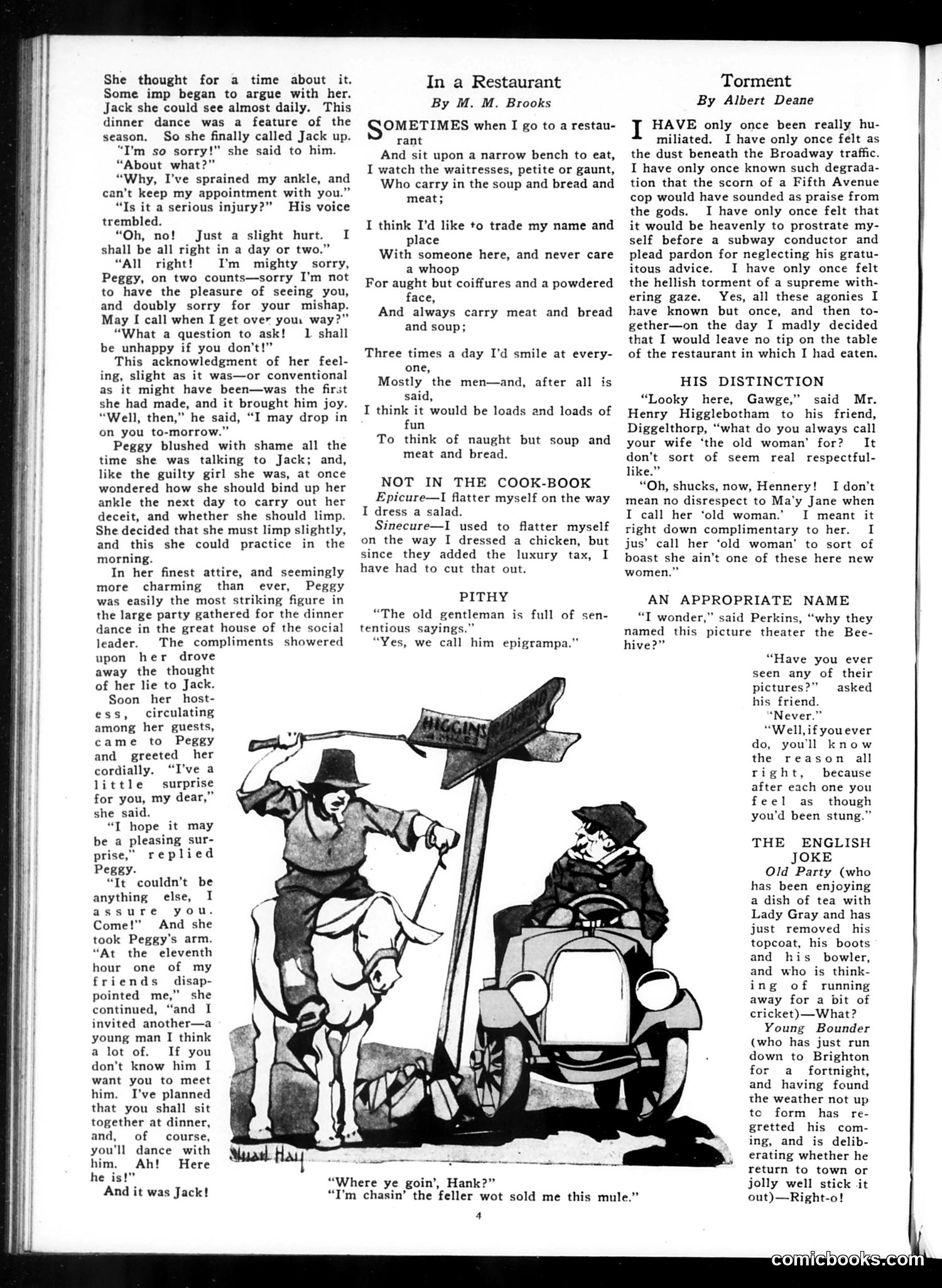
This page contains three separate humorous pieces rather than political cartoons. The main illustration by Will Hall depicts a conversation between two men—one appears to be a mule driver and the other a passenger—with the caption "Where ye goin', Hank?" / "I'm chasin' the feller wot sold me this mule." The surrounding articles ("In a Restaurant," "Torment," and others) are genteel social humor typical of Judge magazine, mocking everyday situations: restaurant etiquette, social embarrassment, and witty repartee among the upper classes. This appears to be light domestic satire rather than political commentary—reflecting early 20th-century American magazine humor focused on manners, courtship, and small social humiliations rather than current events or figures.
📄 Transcribed text from this page (OCR, searchable)
Machine-transcribed from the original scan — historical spelling and the odd misread are preserved.
She thought for a time about it. Some imp began to argue with her. Jack she could see almost daily. This dinner dance was a feature of the season. So she finally called Jack up. “I’m so sorry!” she said to him. “About what?” “Why, I’ve sprained my ankle, and can’t keep my appointment with you.” “Is it a serious injury?” His voice trembled. “Oh, no! Just a slight hurt. I shall be all right in a day or two.” “All right! I'm mighty sorry, Peggy, on two counts—sorry I’m not to have the pleasure of seeing you, and doubly sorry for your mishap. May [ call when I get over you. way?” “What a question to ask! 1 shall be unhappy if you don’t!” This acknowledgment of her feel- ing, slight as it was—or conventional as it might have been—was the first she had made, and it brought him joy. “Well, then,” he said, “I may drop in on you to-morrow.” Peggy blushed with shame all the time she was talking to Jack; and, like the guilty girl she was, at once wondered how she should bind up her ankle the next day to carry out her deceit, and whether she should limp. She decided that she must limp slightly, and this she could practice in the morning. In her finest attire, and seemingly more charming than ever, Peggy was easily the most striking figure in the large party gathered for the dinner dance in the great house of the social leader. The compliments showered upon her drove away the thought of her lie to Jack. Soon her host- ess, circulating among her guests, came to Peggy and greeted her cordially. “I’ve a little surprise for you, my dear,” she said. “IT hope it may be a pleasing sur- prise,” replied Peggy- “It couldn’t be anything else, I assure you. Come!” And she took Peggy's arm. “At the eleventh hour one of my friends disap- pointed me,” she continued, “and I invited another—a young man I think a lot of. If you don’t know him I want you to meet him. I've planned that you shall sit together at dinner, and, of course, you'll dance with him. Ah! Here he is!” And it was Jack! In a Restaurant By M. M. Brooks SOMETIMES when I go to a restau- rant And sit upon a narrow bench to eat, I watch the waitresses, petite or gaunt, Who carry in the soup and bread and meat; I think I’d like to trade my name and place With someone here, and never care a whoop For aught but coiffures and a powdered face, And always carry meat and bread and soup; Three times a day I'd smile at every- one, Mostly the men—and, after all is said, I think it would be loads and loads of fun To think of naught but soup and meat and bread. NOT IN THE COOK-BOOK Epicure—I flatter myself on the way I dress a salad. Sinecure—I used to flatter myself on the way I dressed a chicken, but since they added the luxury tax, I have had to cut that out. PITHY “The old gentleman is full of sen- tentious sayings.” “Yes, we call him epigrampa.” “Where ye goin’, Hank?” “I'm chasin’ the feller wot sold me this mule.” 4 Torment By Albert Deane I HAVE only once been really hu- miliated. I have only once felt as the dust beneath the Broadway traffic. I have only once known such degrada- tion that the scorn of a Fifth Avenue cop would have sounded as praise from the gods. I have only once felt that it would be heavenly to prostrate my- self before a subway conductor and plead pardon for neglecting his gratu- itous advice. I have only once felt the hellish torment of a supreme with- ering gaze. Yes, all these agonies I have known but once, and then to- gether—on the day I madly decided that I would leave no tip on the table of the restaurant in which I had eaten. HIS DISTINCTION “Looky here, Gawge,” said Mr. Henry Higglebotham to his friend, Diggelthorp, “what do you always call your wife ‘the old woman’ for? It don’t sort of seem real respectful- like.” “Oh, shucks, now, Hennery! I don't mean no disrespect to Ma’y Jane when I call her ‘old woman.’ I meant it right down complimentary to her. I jus’ call her ‘old woman’ to sort of boast she ain’t one of these here new women.” AN APPROPRIATE NAME “T wonder,” said Perkins, “why they named this picture theater the Bee- hive?” “Have you ever seen any of their pictures?” asked his friend. “Never.” “Well,ifyouever do, youll know the reason all right, because after each one you feel as though you'd been stung.” THE ENGLISH JOKE Old Party (who has been enjoying a dish of tea with Lady Gray and has just removed his topcoat, his boots and his bowler, and who is think- ing of running away for a bit of cricket)—What? Young Bounder (who has just run down to Brighton for a fortnight, and having found the weather not up te form has re- gretted his com- ing, and is delib- erating whether he return to town or jolly well stick it out)—Right-o!