
Judge, 1922-03-18 · page 13 of 36
Judge — March 18, 1922 — page 13: what you’re looking at
What you’re looking at
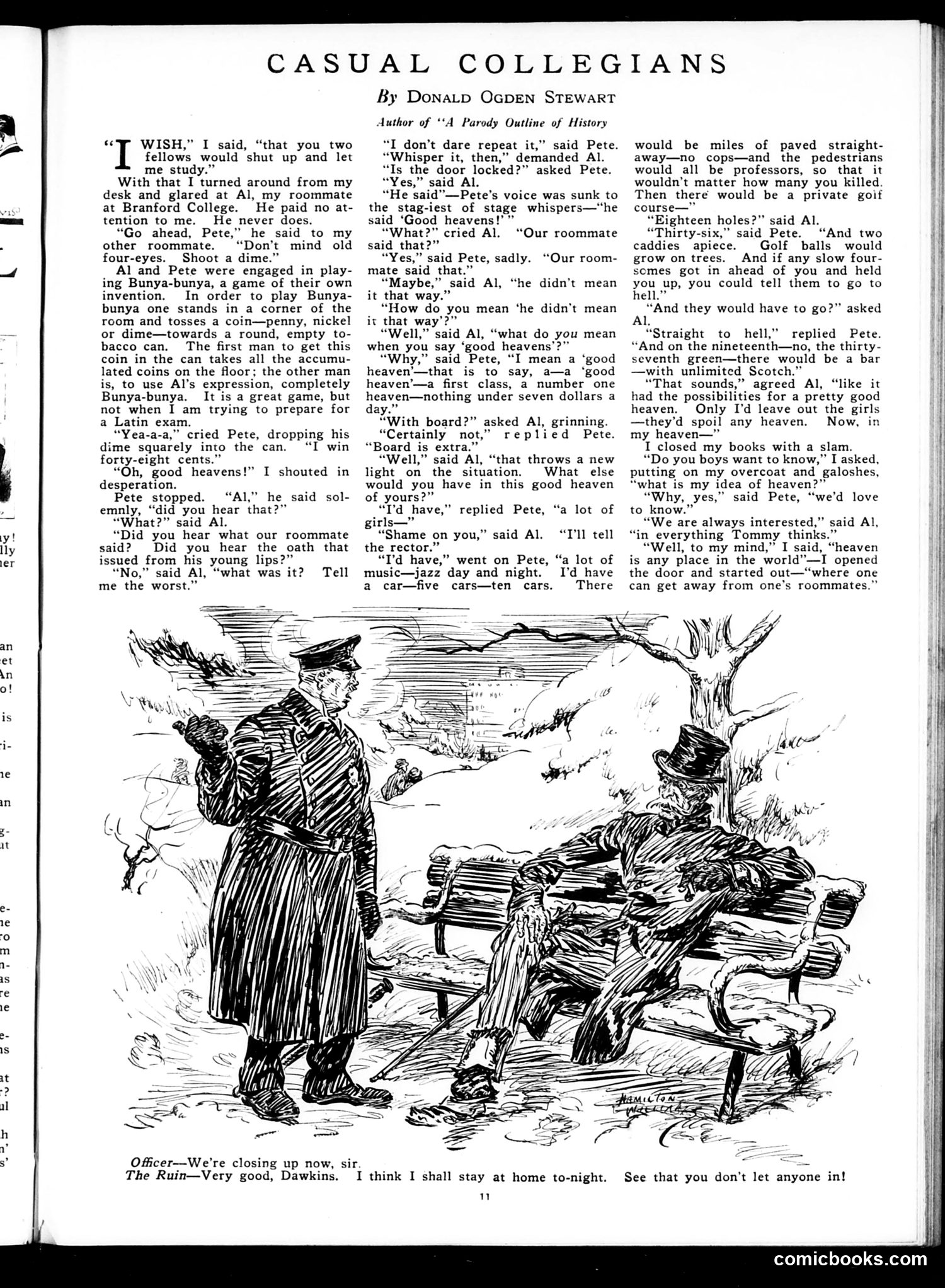
This is a humorous short story about three college roommates at Branford College debating what constitutes an ideal "heaven." Pete and Al are playing "Bunya-bunya," a coin-toss game into a tobacco can, while the narrator (Tommy/"old four-eyes") tries to study Latin. The joke escalates absurdly: Pete describes his heaven as containing unlimited cars, jazz music, a golf course with 36 holes, and—crucially—a bar with unlimited Scotch. The satire targets 1920s college excess and Prohibition-era attitudes: students fantasizing about wealth, fast cars, and alcohol despite legal restrictions. The final punchline subverts the preceding fantasy: the narrator's true heaven is simply being *away from his roommates*—a relatable counterpoint to their materialistic daydreams. The illustration shows an officer and vagrant at "The Ruin," likely reinforcing themes of social consequence and decay contrasting with collegiate indulgence.
📄 Transcribed text from this page (OCR, searchable)
Machine-transcribed from the original scan — historical spelling and the odd misread are preserved.
lly er an et in oO! CASUAL COLLEGIANS “ WISH,” I said, “that you two fellows would shut up and let me study.” With that I turned around from my desk and glared at Al, my roommate at Branford College. He paid no at- tention to me. He never does. “Go ahead, Pete,” he said to my other roommate. “Don’t mind old four-eyes. Shoot a dime.” Al and Pete were engaged in play- ing Bunya-bunya, a game of their own invention. In order to play Bunya- bunya one stands in a corner of the room and tosses a coin—penny, nickel or dime—towards a round, empty to- bacco can. The first man to get this coin in the can takes all the accumu- lated coins on the floor; the other man is, to use Al’s expression, completely Bunya-bunya. It is a great game, but not when I am trying to prepare for a Latin exam. “Yea-a-a,” cried Pete, dropping his dime squarely into the can. “I win forty-eight cents.” “Oh, good heavens!” I shouted in desperation. Pete stopped. “Al,” he said sol- emnly, “did you hear that?” “What?” said Al. “Did you hear what our roommate said? Did you hear the oath that issued from his young lips?” “No,” said Al, “what was it? Tell me the worst.” By DonaLp OGpEN STEWART Author of “A Parody Outline of History don’t dare repeat it,” said Pete. “Whisper it, then,” demanded Al. “Is the door locked?” asked Pete. “Yes,” said Al. “He said”—Pete’s voice was sunk to the stag-iest of stage whispers—‘he said ‘Good heavens!’” “What?” cried Al. “Our roommate said that?” “Yes,” said Pete, sadly. “Our room- mate said that.” “Maybe,” said Al, “he didn’t mean it that way.” “How do you mean ‘he didn’t mean it that way’?” “Well,” said Al, “what do you mean when you say ‘good heavens’?” “Why,” said Pete, “I mean a ‘good heaven’—that is to say, a—a ‘good heaven’—a first class, a number one beayen-—nothing under seven dollars a ay. “With board?” asked Al, grinning. “Certainly not,” replied Pete. “Board is extra.” “Well,” said Al, “that throws a new light on the situation. What else would you have in this good heaven of yours?” “I'd have,” replied Pete, “a lot of girls—” “Shame on you,” said Al. “I'll tell the rector.” “I'd have,” went on Pete, “a lot of music—jazz day and night. I'd have a car—five cars—ten cars. There Officer—We’'re closing up now, sir. The Ruin—Very good, Dawkins. I think I shall stay at home to-night. W would be miles of paved straight- away—no cops—and the pedestrians would all be professors, so that it wouldn’t matter how many you killed. Then there would be a private goif course—" “Eighteen holes?” said Al. “Thirty-six,” said Pete. “And two caddies apiece. Golf balls would grow ontrees. And if any slow four- somes got in ahead of you and held yeu up, you could tell them to go to ell. _ they would have to go?” asked “Straight to hell,” replied Pete. “And on the nineteenth—no, the thirty- seventh green—there would be a bar —with unlimited Scotch.” “That sounds,” agreed Al, “like it had the possibilities for a pretty good heaven. Only I'd leave out the girls —they’d spoil any heaven. Now, in my heaven—” I closed my books with a slam. “Do you boys want to know,” I asked, putting on my overcoat and galoshes, “what is my idea of heaven?” * said Pete, “we'd love “We are always interested,” said Al, “in everything Tommy thinks.” “Well, to my mind,” I said, “heaven is any place in the world”—I opened the door and started out—“where one can get away from one’s roommates.” See that you don’t let anyone in! comicbooks.com