
Judge, 1922-03-18 · page 16 of 36
Judge — March 18, 1922 — page 16: what you’re looking at
What you’re looking at
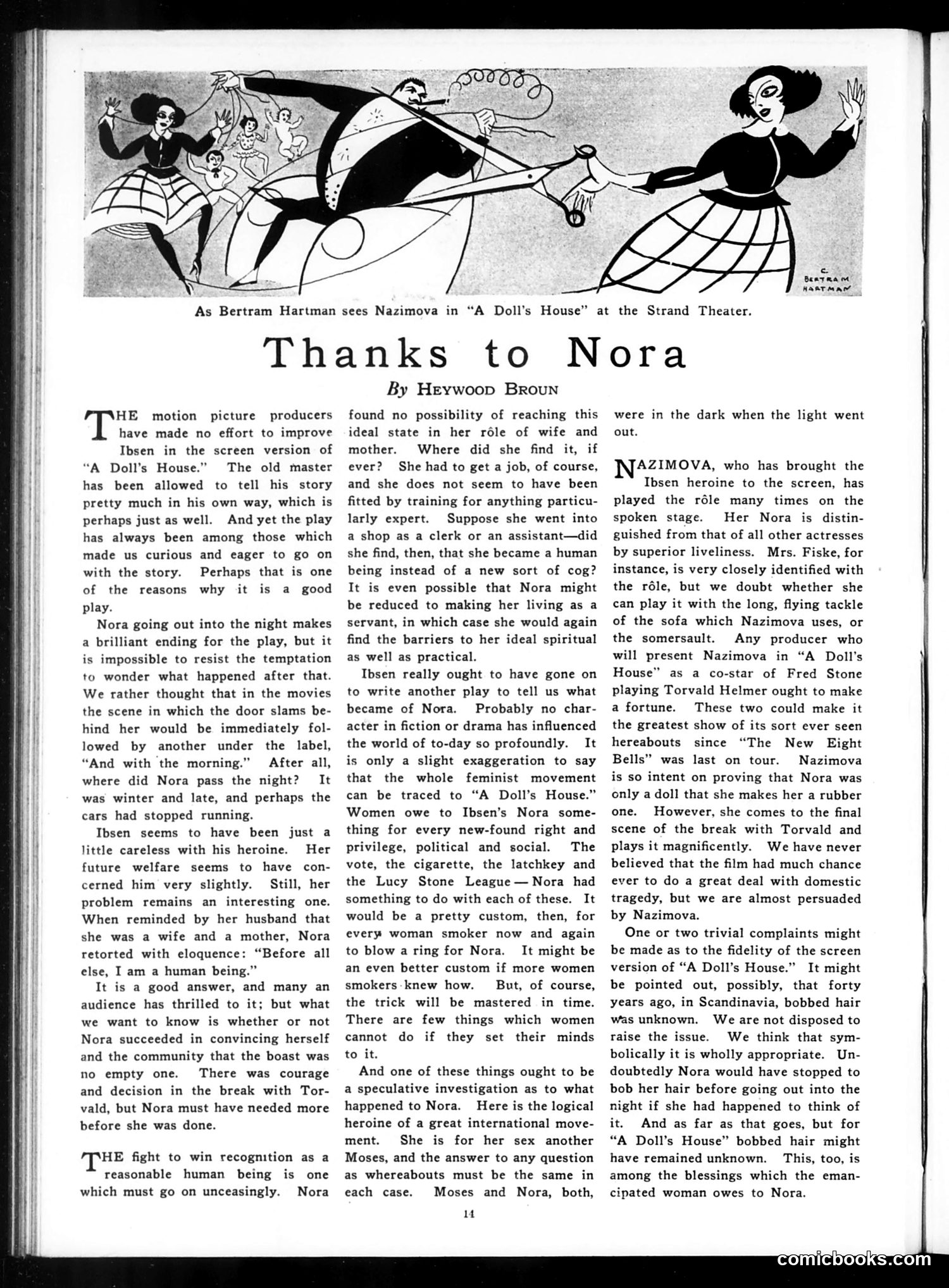
This page features a cartoon and essay about actress Alla Nazimova's film performance in Ibsen's *A Doll's House*. The cartoon depicts Nazimova as the character Nora being pulled in different directions—visualizing the play's central conflict between her roles as wife/mother versus independent human being. Heywood Broun's essay playfully critiques Ibsen for leaving Nora's fate ambiguous after her famous door-slamming exit. More significantly, it credits Nora with inspiring the entire feminist movement—the vote, smoking rights, the Lucy Stone League (a women's suffrage organization). By 1920s standards, this is remarkable: Broun argues that a fictional character fundamentally changed women's real-world rights and privileges. The essay frames Nora as "Moses" leading women to liberation, though it wryly acknowledges the practical obstacles women still faced (employment discrimination, class barriers). The piece captures a moment when modernizing gender roles were actively debated in American popular culture.
📄 Transcribed text from this page (OCR, searchable)
Machine-transcribed from the original scan — historical spelling and the odd misread are preserved.
Beata KART Mace As Bertram Hartman sees Nazimova in “A Doll’s House” at the Strand Theater. Thanks to Nora By Heywoop Broun HE motion picture producers "Pine made no effort to improve Ibsen in the screen version of “A Doll’s House.” The old master has been allowed to tell his story pretty much in his own way, which is perhaps just as well. And yet the play has always been among those which made us curious and eager to go on with the story. Perhaps that is one of the reasons why it is a good play. Nora going out into the night makes a brilliant ending for the play, but it is impossible to resist the temptation to wonder what happened after that. We rather thought that in the movies the scene in which the door slams be- hind her would be immediately fol- lowed by another under the label, “And with the morning.” After all, where did Nora pass the night? It was winter and late, and perhaps the cars had stopped running. Ibsen seems to have been just a little careless with his heroine. Her future welfare seems to have con- cerned him very slightly. Still, her problem remains an interesting one. When reminded by her husband that she was a wife and a mother, Nora retorted with eloquence: “Before all else, I am a human being.” It is a good answer, and many an audience has thrilled to it; but what we want to know is whether or not Nora succeeded in convincing herself and the community that the boast was no empty one. There was courage and decision in the break with Tor- vald, but Nora must have needed more before she was done. HE fight to win recognition as a reasonable human being is one which must go on unceasingly. Nora found no possibility of reaching this ideal state in her réle of wife and mother. Where did she find it, if ever? She had to get a job, of course, and she does not seem to have been fitted by training for anything particu- larly expert. Suppose she went into a shop as a clerk or an assistant—did she find, then, that she became a human being instead of a new sort of cog? It is even possible that Nora might be reduced to making her living as a servant, in which case she would again find the barriers to her ideal spiritual as well as practical. Ibsen really ought to have gone on to write another play to tell us what became of Nora. Probably no char- acter in fiction or drama has influenced the world of to-day so profoundly. It is only a slight exaggeration to say that the whole feminist movement can be traced to “A Doll’s House.” Women owe to Ibsen’s Nora some- thing for every new-found right and privilege, political and social. The vote, the cigarette, the latchkey and the Lucy Stone League — Nora had something to do with each of these. It would be a pretty custom, then, for every woman smoker now and again to blow a ring for Nora. It might be an even better custom if more women smokers-knew how. But, of course, the trick will be mastered in time. There are few things which women cannot do if they set their minds to it. And one of these things ought to be a speculative investigation as to what happened to Nora. Here is the logical heroine of a great international move- ment. She is for her sex another Moses, and the answer to any question as whereabouts must be the same in each case. Moses and Nora, both, u were in the dark when the light went out. N4zZIMova, who has brought the Ibsen heroine to the screen, has played the rdle many times on the spoken stage. Her Nora is distin- guished from that of all other actresses by superior liveliness. Mrs. Fiske, for instance, is very closely identified with the réle, but we doubt whether she can play it with the long, flying tackle of the sofa which Nazimova uses, or the somersault. Any producer who will present Nazimova in “A Doll's House” as a co-star of Fred Stone playing Torvald Helmer ought to make a fortune. These two could make it the greatest show of its sort ever seen hereabouts since “The New Eight Bells” was last on tour. Nazimova is so intent on proving that Nora was only a doll that she makes her a rubber However, she comes to the final scene of the break with Torvald and plays it magnificently. We have never believed that the film had much chance ever to do a great deal with domestic tragedy, but we are almost persuaded by Nazimova. One or two trivial complaints might be made as to the fidelity of the screen version of “A Doll’s House.” It might be pointed out, possibly, that forty years ago, in Scandinavia, bobbed hair was unknown. We are not disposed to raise the issue. We think that sym- bolically it is wholly appropriate. Un- doubtedly Nora would have stopped to bob her hair before going out into the night if she had happened to think of it. And as far as that goes, but for “A Doll's House” bobbed hair might have remained unknown. This, too, is among the blessings which the eman- cipated woman owes to Nora. one.