
Judge, 1922-03-18 · page 22 of 36
Judge — March 18, 1922 — page 22: what you’re looking at
What you’re looking at
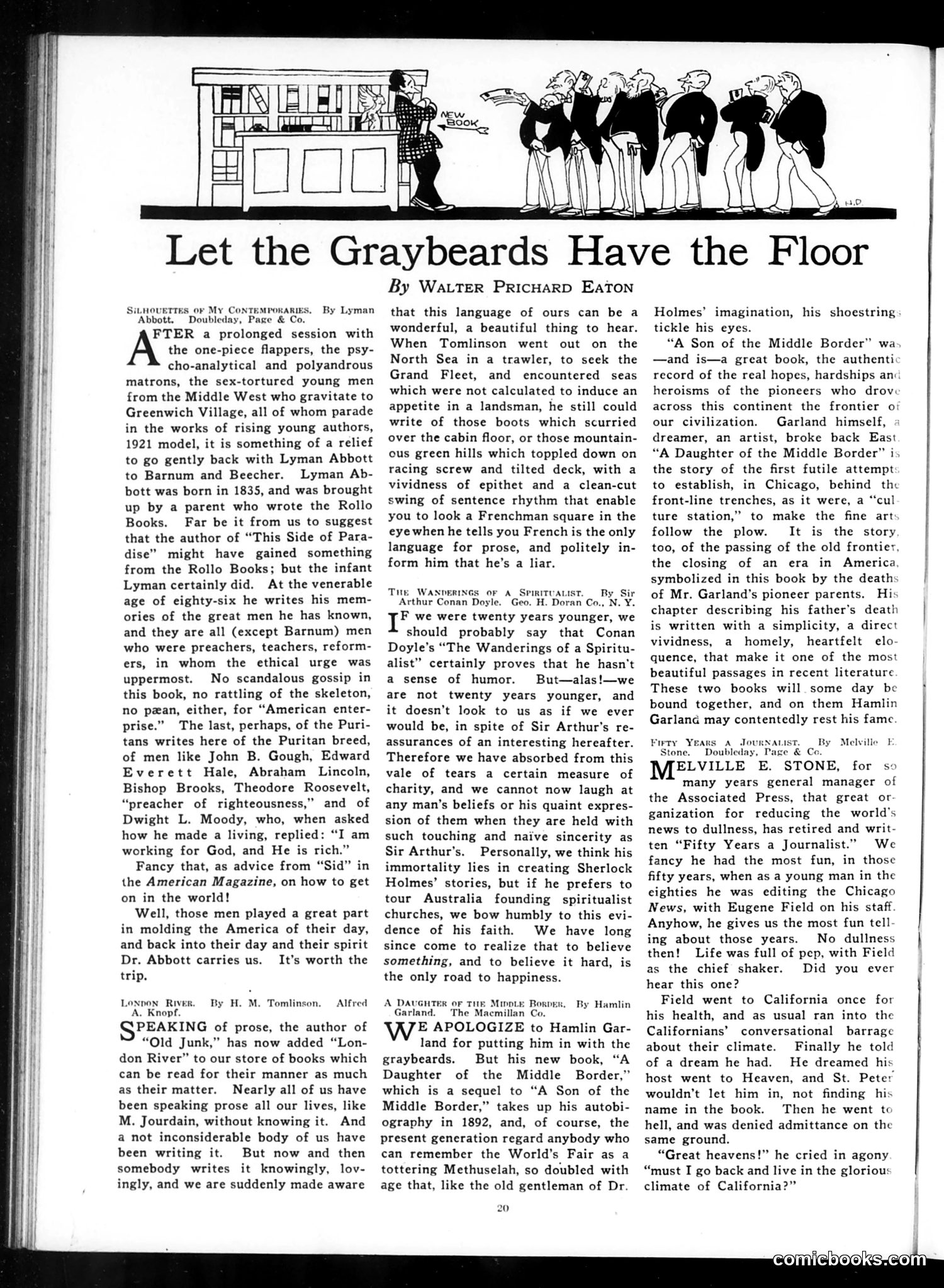
The cartoon's header silhouette depicts an older man (representing traditional, established authority) gesturing toward a group of bent-over elderly men in formal dress—the "graybeards" of the title. The article by Walter Prichard Eaton is a book review celebrating elderly, morally-grounded authors like Lyman Abbott (age 86), contrasting them favorably with the "one-piece flappers" and "sex-tortured young men from the Middle West" who populate contemporary 1921 literature. The piece nostalgically praises 19th-century preachers, reformers, and moral figures (Lincoln, Theodore Roosevelt, Dwight Moody) over modern writers. The satire's point: the article ironically surrenders literary authority to the old guard while simultaneously mocking younger modernist writers. The title suggests allowing "graybeards" (elderly traditionalists) to dominate—a gentle rebuke of both generational smugness and the author's own admission that younger writers now set the cultural agenda, whether he approves or not.
📄 Transcribed text from this page (OCR, searchable)
Machine-transcribed from the original scan — historical spelling and the odd misread are preserved.
SILHOUETTES oF My ConTEMPoraRiEs, By Lyman Abbott. Doubleday, Page & Co. FTER a prolonged session with A the one-piece flappers, the psy- cho-analytical and polyandrous matrons, the sex-tortured young men from the Middle West who gravitate to Greenwich Village, all of whom parade in the works of rising young authors, 1921 model, it is something of a relief to go gently back with Lyman Abbott to Barnum and Beecher. Lyman Ab- bott was born in 1835, and was brought up by a parent who wrote the Rollo Books. Far be it from us to suggest that the author of “This Side of Para- dise” might have gained something from the Rollo Books; but the infant Lyman certainly did. At the venerable age of eighty-six he writes his mem- ories of the great men he has known, and they are all (except Barnum) men who were preachers, teachers, reform- ers, in whom the ethical urge was uppermost. No scandalous gossip in this book, no rattling of the skeleton, no pean, either, for “American enter- prise.” The last, perhaps, of the Puri- tans writes here of the Puritan breed, of men like John B. Gough, Edward Everett Hale, Abraham Lincoln, Bishop Brooks, Theodore Roosevelt, “preacher of righteousness,” and of Dwight L. Moody, who, when asked how he made a living, replied: “I am working for God, and He is rich.” Fancy that, as advice from “Sid” in the American Magazine, on how to get on in the world! Well, those men played a great part in molding the America of their day, and back into their day and their spirit Dr. Abbott carries us. It’s worth the trip. Lonpon River. By H. M. Tomlinson. Alfred A. Knopf. PEAKING of prose, the author of “Old Junk,” has now added “Lon- don River” to our store of books which can be read for their manner as much as their matter. Nearly all of us have been speaking prose all our lives, like M. Jourdain, without knowing it. And a not inconsiderable body of us have been writing it. But now and then somebody writes it knowingly, lov- ingly, and we are suddenly made aware Let the Graybeards Have the Floor By Water PricHaRD EaToNn that this language of ours can be a wonderful, a beautiful thing to hear. When Tomlinson went out on the North Sea in a trawler, to seek the Grand Fleet, and encountered seas which were not calculated to induce an appetite in a landsman, he still could write of those boots which scurried over the cabin floor, or those mountain- ous green hills which toppled down on racing screw and tilted deck, with a vividness of epithet and a clean-cut swing of sentence rhythm that enable you to look a Frenchman square in the eye when he tells you French is the only language for prose, and politely in- form him that he’s a liar. Tie WANDERINGS oF A_SrinitvaList. By Sir Arthur Conan Doyle. Geo. H. Doran Co., N. ¥. i i we were twenty years younger, we should probably say that Conan Doyle's “The Wanderings of a Spiritu- alist” certainly proves that he hasn't a sense of humor. But—alas!—we are not twenty years younger, and it doesn’t look to us as if we ever would be, in spite of Sir Arthur's re- assurances of an interesting hereafter. Therefore we have absorbed from this vale of tears a certain measure of charity, and we cannot now laugh at any man’s beliefs or his quaint expres- sion of them when they are held with such touching and naive sincerity as Sir Arthur's. Personally, we think his immortality lies in creating Sherlock Holmes’ stories, but if he prefers to tour Australia founding spiritualist churches, we bow humbly to this evi- dence of his faith, We have long since come to realize that to believe something, and to believe it hard, is the only road to happiness. A DAUGHTER oF THE MinpLe Borper, Garland. The Macmillan Co. E APOLOGIZE to Hamlin Gar- land for putting him in with the graybeards. But his new book, “A Daughter of the Middle Border,” which is a sequel to “A Son of the Middle Border,” takes up his autobi- ography in 1892, and, of course, the present generation regard anybody who can remember the World’s Fair as a tottering Methuselah, so doubled with age that, like the old gentleman of Dr. By Hamlin 20 Holmes’ imagination, his shoestring tickle his eyes. “A Son of the Middle Border” wa —and is—a great book, the authenti record of the real hopes, hardships an: heroisms of the pioneers who drov: across this continent the frontier of our civilization. Garland himself, dreamer, an artist, broke back East “A Daughter of the Middle Border” i the story of the first futile attempt to establish, in Chicago, behind the front-line trenches, as it were, a “cul ture station,” to make the fine art follow the plow. It is the story too, of the passing of the old frontier, the closing of an era in America symbolized in this book by the death of Mr. Garland’s pioneer parents. His chapter describing his father’s death is written with a simplicity, a direct vividness, a homely, heartfelt elo- quence, that make it one of the most beautiful passages in recent literature These two books will some day be bound together, and on them Hamlin Garlanc may contentedly rest his fame Melville} Frety Years a Journauist. — By Stone. Doubleday, Page & Co. ELVILLE E. STONE, for so many years general manager of the Associated Press, that great or. ganization for reducing the world’s news to dullness, has retired and writ- ten “Fifty Years a Journalist. We fancy he had the most fun, in those fifty years, when as a young man in the eighties he was editing the Chicago News, with Eugene Field on his staff Anyhow, he gives us the most fun tell ing about those years. No dullness then! Life was full of pep, with Field as the chief shaker. Did you ever hear this one? Field went to California once for his health, and as usual ran into the Californians’ conversational barrage about their climate. Finally he told of a dream he had. He dreamed his host went to Heaven, and St. Peter wouldn’t let him in, not finding his name in the book. Then he went tc hell, and was denied admittance on the same ground. “Great heavens!” he cried in agony “must I go back and live in the glorious climate of California?”