
Judge, 1922-03-18 · page 5 of 36
Judge — March 18, 1922 — page 5: what you’re looking at
What you’re looking at
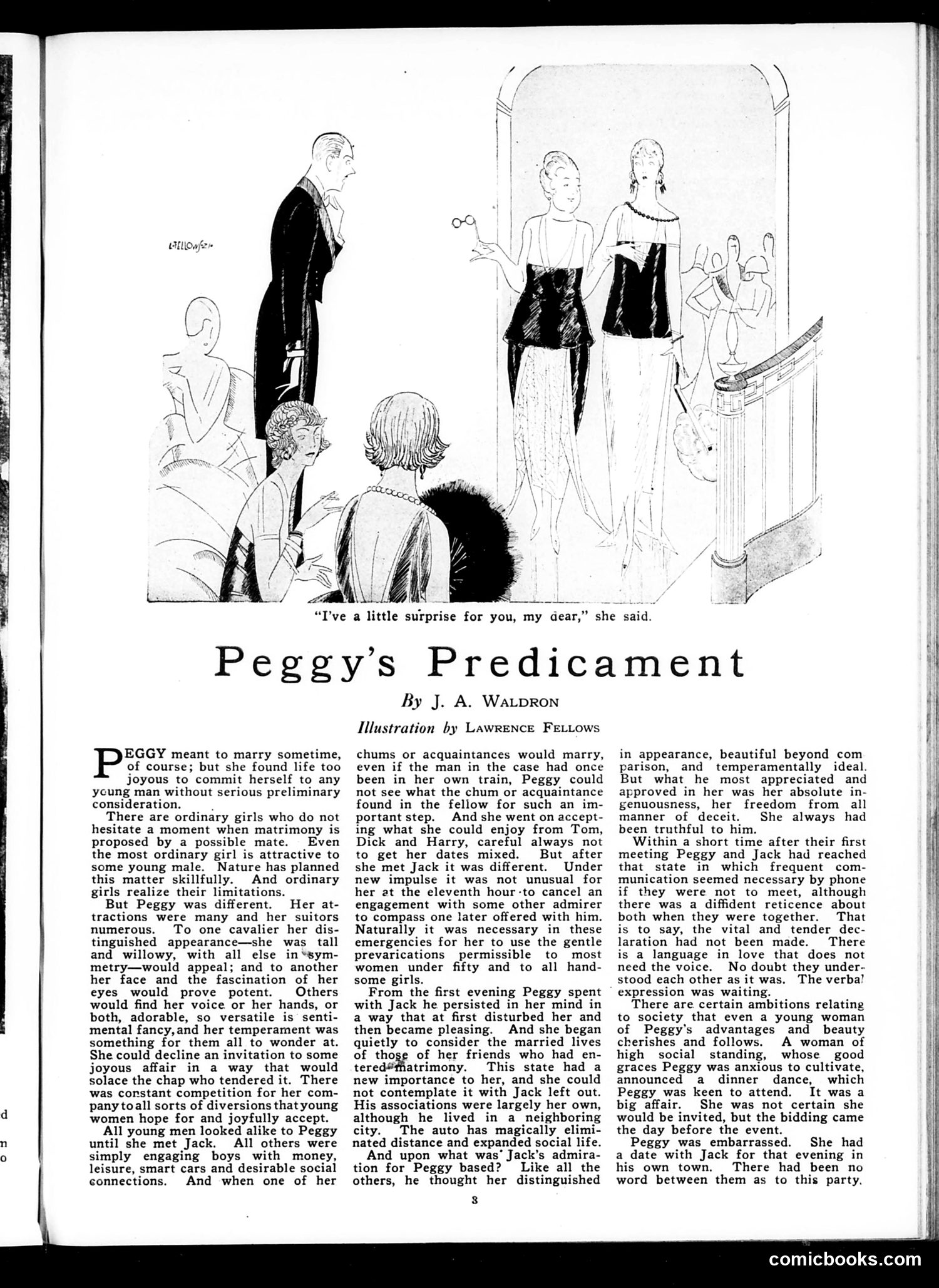
This is a short story illustration, not political satire. The narrative, by J.A. Waldron with illustrations by Lawrence Fellows, depicts a young woman named Peggy navigating romantic complications. The story concerns Peggy's marriage prospects. She attracts multiple suitors but is romantically involved with Jack. The illustration shows what appears to be a social gathering or party scene where Peggy announces she has "a little surprise" for someone—likely a dramatic revelation about her romantic situation. The piece satirizes contemporary social conventions around courtship and marriage among the upper classes, depicting the elaborate social maneuvering and occasional deception involved in romantic affairs of the era. It's domestic comedy rather than political commentary.
📄 Transcribed text from this page (OCR, searchable)
Machine-transcribed from the original scan — historical spelling and the odd misread are preserved.
Peggy’s Predicament By J. A. WaLpRon Illustration by Lawrence FELLows EGGY meant to marry sometime, of course; but she found life too joyous to commit herself to any ycung man without serious preliminary consideration. There are ordinary girls who do not hesitate a moment when matrimony is proposed by a possible mate. Even the most ordinary girl is attractive to some young male. Nature has planned this matter skillfully. And ordinary girls realize their limitations. But Peggy was different. Her at- tractions were many and her suitors numerous. To one cavalier her dis- tinguished appearance—she was tall and willowy, with all else in *sym- metry—would appeal; and to another her face and the fascination of her eyes would prove potent. Others would find her voice or her hands, or both, adorable, so versatile is senti- mental fancy,and her temperament was something for them all to wonder at. She could decline an invitation to some joyous affair in a way that would solace the chap who tendered it. There was constant competition for her com- pany toall sorts of diversions that young women hope for and joyfully accept. All young men looked alike to Peggy until she met Jack. All others were simply engaging boys with money, leisure, smart cars and desirable social connections. And when one of her chums or acquaintances would marry, even if the man in the case had once been in her own train, Peggy could not see what the chum or acquaintance found in the fellow for such an im- portant step. And she went on accept- ing what she could enjoy from Tom, Dick and Harry, careful always not to get her dates mixed. But after she met Jack it was different. Under new impulse it was not unusual for her at the eleventh hour-to cancel an engagement with some other admirer to compass one later offered with him. Naturally it was necessary in these emergencies for her to use the gentle prevarications permissible to most women under fifty and to all hand- some girls. From the first evening Peggy spent with Jack he persisted in her mind in a way that at first disturbed her and then became pleasing. And she began quietly to consider the married lives of those of her friends who had en- tered“fhatrimony. This state had a new importance to her, and she could not contemplate it with Jack left out. His associations were largely her own, although he lived in a neighboring city. The auto has magically elimi- nated distance and expanded social life. And upon what was’ Jack’s admira- tion for Peggy based? Like all the others, he thought her distinguished 3 in appearance, beautiful beyond com parison, and temperamentally ideal. But what he most appreciated and approved in her was her absolute in- genuousness, her freedom from all manner of deceit. She always had been truthful to him. Within a short time after their first meeting Peggy and Jack had reached that state in which frequent com- munication seemed necessary by phone if they were not to meet, although there was a diffident reticence about both when they were together. That is to say, the vital and tender dec- laration had not been made. There is a language in love that does not need the voice. No doubt they under- stood each other as it was. The verbal expression was waiting. There are certain ambitions relating to society that even a young woman of Peggy's advantages and beauty cherishes and follows. A woman of high social standing, whose good graces Peggy was anxious to cultivate, announced a dinner dance, which Peggy was keen to attend. It was a big affair. She was not certain she would be invited, but the bidding came the day before the event. Peggy was embarrassed. She had a date with Jack for that evening in his own town. There had been no word between them as to this party. comicbooks.com