
Judge, 1922-03-18 · page 14 of 36
Judge — March 18, 1922 — page 14: what you’re looking at
What you’re looking at
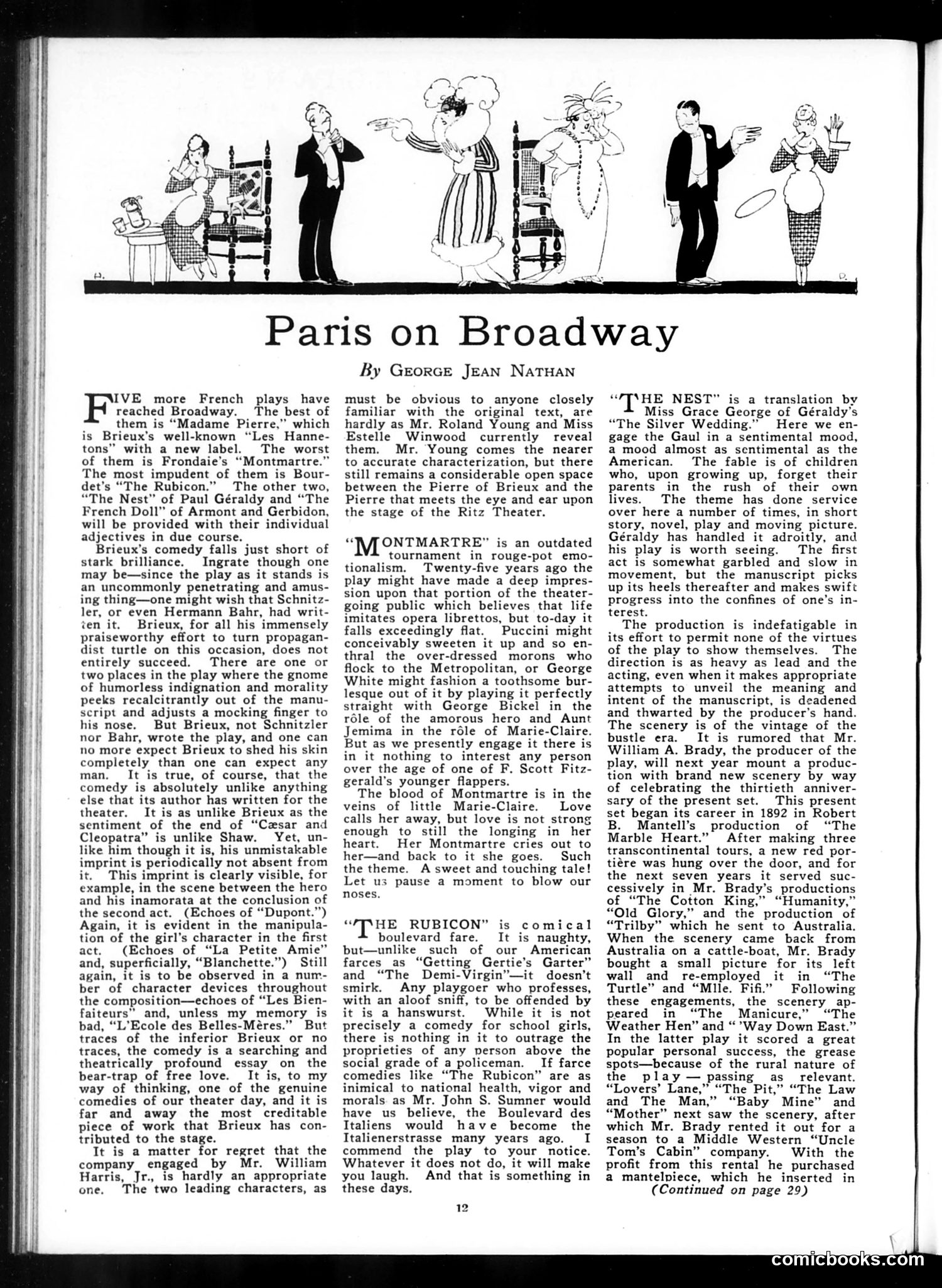
This is a theater criticism column by George Jean Nathan reviewing recent French plays on Broadway. The illustration shows stylized figures representing theatrical characters and types—likely depicting scenes or character archetypes from the plays discussed. Nathan critiques five French productions: "Madame Pierre" (praised as "uncommonly penetrating"), "Montmartre" (dismissed as outdated sentimentality), "The Rubicon" (called "impudent"), "The Nest," and "The French Doll." He praises Brieux's work despite its propagandistic elements, while harshly judging "Montmartre" as too emotionally overwrought for modern audiences—suitable only for "over-dressed morons" at the Metropolitan Opera or as burlesque material. The critique reflects Jazz Age sophistication: Nathan dismisses melodramatic romanticism as passé, referencing F. Scott Fitzgerald's "flappers" to mark generational taste shifts. The tone is characteristic of 1920s theatrical criticism—intellectually acerbic, dismissive of sentimentality, and confident in pronouncing judgments on dramatic merit.
📄 Transcribed text from this page (OCR, searchable)
Machine-transcribed from the original scan — historical spelling and the odd misread are preserved.
Paris on Broadway By Georce Jean NaTHAN IVE more French plays have reached Broadway. The best of them is “Madame Pierre,” which is Brieux’s well-known “Les Hanne- tons” with a new label. The worst of them is Frondaie’s “Montmartre.” The most impudent of them is Bour- det’s “The Rubicon.” The other two, “The Nest” of Paul Géraldy and “The French Doll” of Armont and Gerbidon, will be provided with their individual adjectives in due course. Brieux’s comedy falls just short of stark brilliance. Ingrate though one may be—since the play as it stands is an uncommonly penetrating and amus- ing thing—one might wish that Schnitz- ler, or even Hermann Bahr, had writ- ten it. Brieux, for all his immensely praiseworthy effort to turn propagan- dist turtle on this occasion, does not entirely succeed. There are one or two places in the play where the gnome of humorless indignation and morality peeks recalcitrantly out of the manu- script and adjusts a mocking finger to his nose. But Brieux, not Schnitzler nor Bahr, wrote the play, and one can no more expect Brieux to shed his skin completely than one can expect any man. _ It is true, of course, that the comedy is absolutely unlike anything else that its author has written for the theater. It is as unlike Brieux as the sentiment of the end of “Casar and Cleopatra” is unlike Shaw. Yet, un- like him though it is, his unmistakable imprint is periodically not absent from it. This imprint is clearly visible, for example, in the scene between the hero and his inamorata at the conclusion of the second act. (Echoes of “Dupont.”) Again, it is evident in the manipula- tion of the girl’s character in the first act. (Echoes of “La Petite Amie” and, superficially, “Blanchette.”) Still again, it is to be observed in a num- ber of character devices throughout the composition—echoes of “Les Bien- faiteurs” and, unless my memory is bad, “L’Ecole des Belles-Méres.” But traces of the inferior Brieux or no traces, the comedy is a searching and theatrically profound essay on the bear-trap of free love. It is, to my way of thinking, one of the genuine comedies of our theater day, and it is far and away the most creditable piece of work that Brieux has con- tributed to the stage. It is a matter for regret that the company engaged by Mr. William Harris, Jr., is hardly an appropriate one. The two leading characters, as must be obvious to anyone closely familiar with the original text, are hardly as Mr. Roland Young and Miss Estelle Winwood currently reveal them. Mr. Young comes the nearer to accurate characterization, but there still remains a considerable open space between the Pierre of Brieux and the Pierre that meets the eye and ear upon the stage of the Ritz Theater. LL ONTMARTRE"” is an outdated tournament in rouge-pot emo- tionalism. Twenty-five years ago the play might have made a deep impres- sion upon that portion of the theater- going public which believes that life imitates opera librettos, but to-day it falls exceedingly flat. Puccini might conceivably sweeten it up and so en- thral the over-dressed morons who flock to the Metropolitan, or George White might fashion a toothsome bur- lesque out of it by playing it perfectly straight with George Bickel in the réle of the amorous hero and Aunt Jemima in the role of Marie-Claire. But as we presently engage it there is in it nothing to interest any person over the age of one of F. Scott Fitz- gerald’s younger flappers. The blood of Montmartre is in the veins of little Marie-Claire. Love calls her away, but love is not strong enough to still the longing in her heart. Her Montmartre cries out to her—and back to it she goes. Such the theme. A sweet and touching tale! Let us pause a moment to blow our noses. “/D\HE RUBICON” is comical boulevard fare. It is naughty, but—unlike such of our American farces_as “Getting Gertie’s Garter” and “The Demi-Virgin’—it doesn’t smirk. Any playgoer who professes, with an aloof sniff, to be offended by it is a hanswurst. While it is not precisely a comedy for school girls, there is nothing in it to outrage the proprieties of any person above the social grade of a policeman. If farce comedies like “The Rubicon” are as inimical to national health, vigor and morals as Mr. John S. Sumner would have us believe, the Boulevard des Italiens would have become the Italienerstrasse many years ago. I commend the play to your notice. Whatever it does not do, it will make you laugh. And that is something in these days. 12 “‘TSHE NEST” is a translation by Miss Grace George of Géraldy’s “The Silver Wedding.” Here we en- gage the Gaul in a sentimental mood, a mood almost as sentimental as the American. The fable is of children who, upon growing up, forget their parents in the rush of their own lives. The theme has done service over here a number of times, in short story, novel, play and moving picture. Géraldy has handled it adroitly, and his play is worth seeing. The first act is somewhat garbled and slow in movement, but the manuscript picks up its heels thereafter and makes swift progress into the confines of one’s in- terest. The production is indefatigable in its effort to permit none of the virtues of the play to show themselves. The direction is as heavy as lead and the acting, even when it makes appropriate attempts to unveil the meaning and intent of the manuscript, is deadened and thwarted by the producer's hand. The scenery is of the vintage of the bustle era. It is rumored that Mr. William A. Brady, the producer of the play, will next year mount a produc- tion with brand new scenery by way of celebrating the thirtieth anniver- sary of the present set. This present set began its career in 1892 in Robert B. Mantell’s production of “The Marble Heart.” After making three transcontinental tours, a new red por- tiére was hung over the door, and for the next seven years it served suc- cessively in Mr. Brady’s productions of “The Cotton King,” “Humanity,” “Old Glory,” and the production of “Trilby” which he sent to Australia. When the scenery came back from Australia on a cattle-boat, Mr. Brady bought a small picture for its left wall and re-employed it in “The Turtle” and “Mlle. Fifi.” Following these engagements, the scenery ap- peared in “The Manicure,” “The Weather Hen” and “’Way Down East.” In the latter play it scored a great popular personal success, the grease spots—because of the rural nature of the play — passing as_ relevant. “Lovers’ Lane,” “The Pit,” “The Law and The Man,” “Baby Mine” and “Mother” next saw the scenery, after which Mr. Brady rented it out for a season to a Middle Western “Uncle Tom’s Cabin” company. With the profit from this rental he purchased a mantelpiece, which he inserted in (Continued on page 29)