
Judge, 1922-03-18 · page 21 of 36
Judge — March 18, 1922 — page 21: what you’re looking at
What you’re looking at
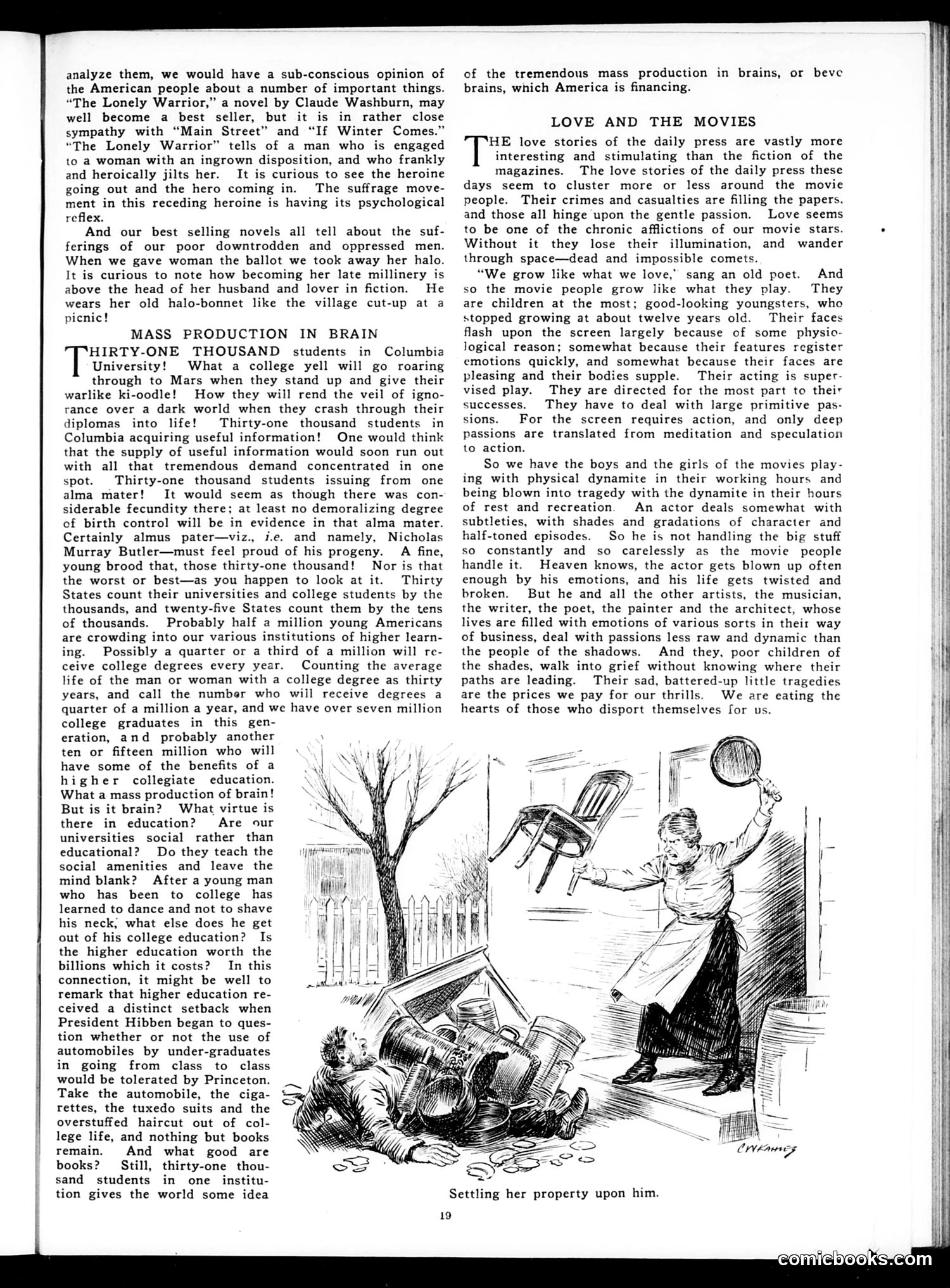
This cartoon satirizes the changing gender dynamics of the 1920s. The illustration depicts a woman literally throwing furniture and household items at a man, while he flees in alarm. The accompanying text explains the satire: with women gaining voting rights (women's suffrage), the author argues they've lost their traditional "halo" of feminine mystique. The article mocks bestselling novels depicting "poor downtrodden and oppressed men" suffering under assertive women. It notes the irony that male characters now inherit women's traditional roles and symbols (wearing "her old halo-bonnet"). The cartoon visualizes this reversal—the woman is now the aggressor, literally "settling" property on the hapless man through violent redistribution. The satire critiques both modern gender relations and the popular fiction reflecting anxieties about women's newfound independence and legal equality following suffrage.
📄 Transcribed text from this page (OCR, searchable)
Machine-transcribed from the original scan — historical spelling and the odd misread are preserved.
analyze them, we would have a sub-conscious opinion of the American people about a number of important things. “The Lonely Warrior,” a novel by Claude Washburn, may well become a best seller, but it is in rather close sympathy with “Main Street” and “If Winter Comes.” “The Lonely Warrior” tells of a man who is engaged to a woman with an ingrown disposition, and who frankly and heroically jilts her. It is curious to see the heroine going out and the hero coming in. The suffrage move- ment in this receding heroine is having its psychological reflex. And our best selling novels all tell about the suf- ferings of our poor downtrodden and oppressed men. When we gave woman the ballot we took away her halo. It is curious to note how becoming her late millinery is above the head of her husband and lover in fiction. He wears her old halo-bonnet like the village cut-up at a picnic! MASS PRODUCTION IN BRAIN HIRTY-ONE THOUSAND sstudents in Columbia University! What a college yell will go roaring through to Mars when they stand up and give their warlike ki-oodle! How they will rend the veil of igno- rance over a dark world when they crash through their diplomas into life! Thirty-one thousand students in Columbia acquiring useful information! One would think that the supply of useful information would soon run out with all that tremendous demand concentrated in one spot. Thirty-one thousand students issuing from one alma mater! It would seem as though there was con- siderable fecundity there; at least no demoralizing degree of birth control will be in evidence in that alma mater. Certainly almus pater—viz., i.e. and namely, Nicholas Murray Butler—must feel proud of his progeny. A fine, young brood that, those thirty-one thousand! Nor is that the worst or best—as you happen to look at it. Thirty States count their universities and college students by the thousands, and twenty-five States count them by the tens of thousands. Probably half a million young Americans are crowding into our various institutions of higher learn- ing. Possibly a quarter or a third of a million will re- ceive college degrees every year. Counting the average life of the man or woman with a college degree as thirty years, and call the number who will receive degrees a quarter of a million a year, and we have over seven million college graduates in this gen- eration, and probably another ten or fifteen million who will have some of the benefits of a higher collegiate education. What a mass production of brain! But is it brain? What virtue is there in education? Are our universities social rather than educational? Do they teach the social amenities and leave the mind blank? After a young man who has been to college has learned to dance and not to shave his neck, what else does he get out of his college education? Is the higher education worth the billions which it costs? In this connection, it might be well to remark that higher education re- ceived a distinct setback when President Hibben began to ques- tion whether or not the use of automobiles by under-graduates in going from class to class would be tolerated by Princeton. Take the automobile, the ciga- rettes, the tuxedo suits and the overstuffed haircut out of col- lege life, and nothing but books remain. And what good are books? Still, thirty-one thou- sand students in one institu- tion gives the world some idea of the tremendous mass production in brains, or bevc brains, which America is financing. LOVE AND THE MOVIES HE love stories of the daily press are vastly more interesting and stimulating than the fiction of the magazines. The love stories of the daily press these days seem to cluster more or less around the movie people. Their crimes and casualties are filling the papers. and those all hinge upon the gentle passion. Love seems to be one of the chronic afflictions of our movie stars. Without it they lose their illumination, and wander through space—dead and impossible comets. “We grow like what we love,” sang an old poet. And so the movie people grow like what they play. They are children at the most; good-looking youngsters, who stopped growing at about twelve years old. Their faces flash upon the screen largely because of some physio- logical reason; somewhat because their features register emotions quickly, and somewhat because their faces are pleasing and their bodies supple. Their acting is super- vised play. They are directed for the most part to their successes. They have to deal with large primitive pas- sions. For the screen requires action, and only deep passions are translated from meditation and speculation to action. So we have the boys and the girls of the movies play- ing with physical dynamite in their working hours and being blown into tragedy with the dynamite in their hours of rest and recreation. An actor deals somewhat with subtleties, with shades and gradations of character and half-toned episodes. So he is not handling the big stuff so constantly and so carelessly as the movie people handle it. Heaven knows, the actor gets blown up often enough by his emotions, and his life gets twisted and broken. But he and all the other artists, the musician, the writer, the poet, the painter and the architect, whose lives are filled with emotions of various sorts in their way of business, deal with passions less raw and dynamic than the people of the shadows. And they, poor children of the shades, walk into grief without knowing where their paths are leading. Their sad, battered-up little tragedies are the prices we pay for our thrills. We are eating the hearts of those who disport themselves for us. Settling her property upon him. 19